
Solar battery contract red flags are terms or tactics that hide costs, remove rights or rush you into signing. In NSW, the most common warning signs involve deposits, missing cooling-off details, vague rebate figures and unclear warranties.
Spotting them early protects your money. It also lets you compare quotes fairly. This guide separates what the law requires from what we simply recommend you check before you sign.
Why a Solar Battery Contract Needs a Close Read in NSW
A home battery is a major purchase. A solar battery installation contract sets your price, your rebate, your warranty and your cancellation rights. Therefore, it deserves as much attention as the equipment itself.
Government warnings support this caution. The NSW Government says energy rebate scams and misleading deals are becoming more common, especially for solar and home batteries. As a result, a careful contract review is a sensible first step.
A reputable solar battery installer should answer your contract questions clearly. Vague replies are useful information too.
Legal Requirements vs Recommended Precautions
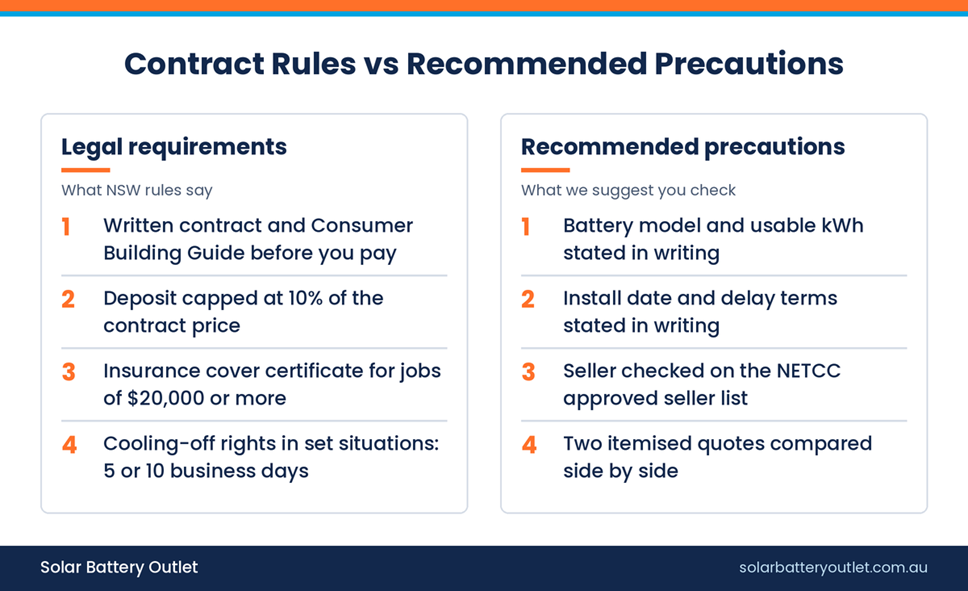
Not every good habit is a legal duty. Keeping the two apart helps you judge a contract accurately. The infographic below summarises the difference, and the sections that follow explain each point.
The NSW Government guide to solar panels sets out what your installer must give you. Before you pay or work begins, the installer must provide a written contract and the Consumer Building Guide. Recommended precautions, such as comparing itemised quotes, go further than the law requires.
However, that guidance covers solar installations. Ask your installer which rules apply to your specific job.
Seven Solar Battery Contract Red Flags to Spot Before You Sign
Each red flag below shows what the law says and what we recommend. Use them as a checklist when you read your quote.
1. Pressure to Sign or Pay on the Spot
Urgency is a classic sales tactic. The NSW Government lists pressure to sign or pay a deposit immediately as a red flag. Phrases such as “register now” or “you’ll miss out” deserve extra caution.
Rebate deadlines need particular care. The Cheaper Home Batteries Program discount reduces on a published schedule, yet the program itself continues beyond 2026. The next scheduled step-down is 1 January 2027. So if a salesperson claims the rebate ends tomorrow, ask for the source in writing.
What we recommend
Take the written quote home. Then compare it with at least one other before you decide.
2. A Deposit Above 10% or Taken Before Insurance Is in Place
What the law says
Under NSW home building law, the maximum deposit is 10% of the contract price. Where Home Building Compensation Fund cover is required, the contractor cannot ask for payment until insurance is in place.
That cover applies when labour and materials cost $20,000 or more. Moreover, a rebate cannot reduce the price on paper to avoid that threshold.
For example, on a $12,000 installation, a deposit above $1,200 breaks the cap. These figures are illustrative only.
What we recommend
Ask for a written payment schedule that shows each stage and amount. Keep every receipt.
3. Missing or Buried Cooling-Off Information
What the law says
Cooling-off rights depend on how the sale happened and the contract value. Under Australian Consumer Law, door-to-door and phone sales over $100 carry a 10 business day cooling-off period. In those cases, the business generally cannot take payment during that time. The agreement must also explain your cancellation rights.
In addition, NSW home building contracts above $20,000 must state a five business day cooling-off period.
What we recommend
Ask the seller which period applies to you. Then get it in writing, and note the date you receive your signed copy.
4. Vague Rebate Figures and Equipment Details
“Up to” rebate figures and “premium battery” labels tell you very little. Without specifics, you cannot compare quotes or confirm what you are buying.
What we recommend
NSW Fair Trading advises a written quote with separate equipment and labour costs. It should also show rebates clearly and include the full terms and conditions. We also recommend the quote names the battery brand and model and states the usable capacity in kWh. The discount is calculated on usable capacity, so that figure matters.
The discount also depends on battery size and installation date. Therefore, ask which settings your quote assumes.
5. Unclear Installer Credentials
What the law says
NSW Government guidance says a licensed builder or licensed electrical contractor must install solar systems. Battery installations must follow the AS/NZS 5139 standard. Afterwards, the electrician must give you a Certificate of Compliance for Electrical Work.
The federal discount adds another condition. A Solar Accreditation Australia (SAA) installer with battery accreditation must install the battery or supervise on site. The battery must also appear on the Clean Energy Council approved list.
What we recommend
Check the electrical licence on Verify NSW and the accreditation on the SAA website yourself. You can also check whether the seller appears on the New Energy Tech Consumer Code (NETCC) approved seller list. The Clean Energy Council administers this voluntary industry code.
6. Weak or Confusing Warranty Terms
A “10-year warranty” headline can hide important limits. Therefore, look beyond the number of years. Check the warranty term, any cycle or energy throughput limit, and any minimum capacity guaranteed. Also confirm who handles claims, and whether parts, labour and call-out fees are covered.
What the law says
Australian Consumer Law guarantees apply regardless of warranty terms. Energy products must work properly and last a reasonable time.
What we recommend
Read our guide to how solar battery warranties work before you compare offers. Then ask the seller to put the claim process in writing.
7. “No Upfront Cost” Offers Without Clear Terms
The NSW Government lists “no upfront costs” and “easy payment plans” without clear terms as red flags. A loan, lease or power purchase agreement can be legitimate. However, the total cost often differs sharply from the cash price.
Therefore, ask for the cash price and the financed price side by side. Also confirm who owns the system and who receives the rebate. Our breakdown of the hidden cost of no upfront cost solar deals in NSW shows how these structures compare.
A Five-Point Check Before You Sign a Solar Battery Agreement
Use this quick check alongside your quote. It brings the seven red flags together in one place.

If any point is unclear, pause. A short pause is usually easier than fixing a poor contract later.
What to Do If You Have Already Signed
Act quickly. First, check whether a cooling-off period still applies. Next, contact the business in writing and keep every quote, message and receipt.
If the business does not respond, contact NSW Fair Trading. In addition, consumer guarantees may entitle you to a repair, replacement or refund for faulty or misdescribed products. The remedy depends on the problem.
Solar Battery Contract Red Flags in NSW: FAQs
Under NSW home building law, a deposit cannot exceed 10% of the contract price. Where Home Building Compensation Fund cover is required, the contractor cannot ask for payment until insurance is in place. Confirm how these rules apply to your job with your installer or NSW Fair Trading.
It depends on the sale. Door-to-door and phone sales over $100 carry 10 business days under Australian Consumer Law. NSW home building contracts above $20,000 carry five business days. Ask the seller which period applies, and get it in writing.
NSW Government guidance says installers must provide a written contract before you pay or work begins. They must also give you the Consumer Building Guide. Ask your installer how this applies to your specific job.
Check the business on ABN Lookup and the electrical licence on Verify NSW. Then check the installer’s SAA accreditation. Finally, see whether the seller appears on the NETCC approved seller list.
No. The Cheaper Home Batteries Program continues beyond that date, but the discount steps down. Check the current settings with the Department of Climate Change, Energy, the Environment and Water. Then ask for the discount to appear on your quote.
Talk to Solar Battery Outlet Before You Sign
Reviewing a solar battery agreement in Liverpool, Bankstown and nearby areas? Contact Solar Battery Outlet before you sign. Our team can walk you through the quote, the rebate line and the warranty terms in plain language. That way, you can ask the right questions with confidence.
Disclaimer
This article provides general information about solar battery contracts in NSW. It does not replace individual legal, technical or purchasing advice. Laws, rebate settings and program rules change, and they may apply differently to your property and type of sale. Check current requirements with NSW Fair Trading, Building Commission NSW or a qualified legal adviser. Always seek personalised advice before making a purchasing decision.
