

Electricity bills have climbed steadily in New South Wales over the past few years, and the pressure falls hardest on households that can least afford it. If your income is low, fixed, or government-supported, going solar can feel like a luxury that other people can access—not you.
That assumption is wrong. In 2026, a set of overlapping federal and NSW programs actively reduces what low-income households pay to go solar, both upfront and on an ongoing basis. Moreover, most of these programs ask for no income test at all. You simply need to meet basic eligibility criteria and use an accredited installer.
This article walks you through every relevant program, who qualifies, how much you can realistically save, and how to stack them together for maximum benefit. Whether you are in the south-west suburbs—where homeowners are searching for solar panels in Liverpool—or anywhere else in the state, these programs apply to you.
Why Solar Is Now Genuinely Accessible for Low-Income NSW Households
Five years ago, the upfront cost of a solar system was the single biggest barrier for households on lower incomes. A decent 6.6 kW system cost $6,000 to $8,000 before any incentives. A battery added another $10,000 to $14,000.
Two things have changed significantly since then. First, the cost of solar panels and batteries has dropped sharply — a 6.6 kW panel system now typically costs between $4,000 and $6,000 installed in NSW. Second, the government incentive stack has grown considerably. Between federal rebates on both panels and batteries, ongoing bill credits, and NSW-specific programs, eligible households can now reduce their upfront solar costs by thousands of dollars.
Furthermore, the programs below do not require you to be earning very little. Several have no income test at all — they are available to any homeowner who uses an approved installer and an eligible product. Others require only a valid Pensioner Concession Card, Health Care Card, or equivalent. The key is knowing which programs exist and how to combine them.
The Six Key Programs That Lower Your Upfront Solar Costs in NSW
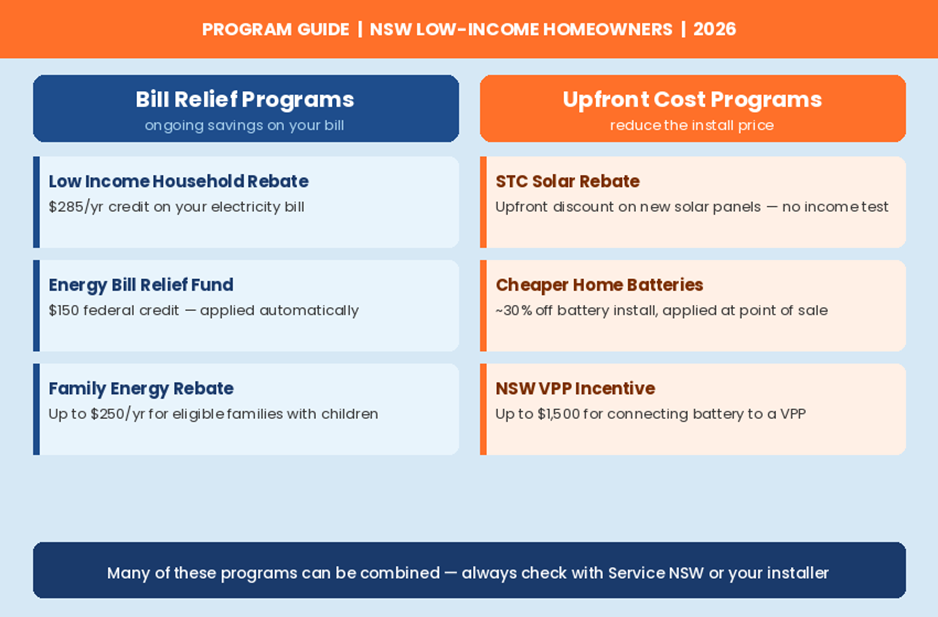
NSW households in 2026 can access two types of support: ongoing bill credits that reduce what you pay each quarter, and upfront rebates that reduce what you pay to install solar in the first place. Both matter, and they can often be combined.
1. The NSW Low Income Household Rebate — $285 Per Year
This is the core ongoing support program for eligible NSW households. If you hold a Pensioner Concession Card, Health Care Card, Low Income Health Care Card, or a DVA Gold Card, you can apply for a credit of $285 per year applied directly to your electricity bill.
The rebate is applied as a daily credit on each quarterly bill. It continues for as long as you hold the relevant concession card and remain named on the account. Retail customers apply through their electricity retailer; embedded network customers apply through Service NSW.
This is not a one-off payment — it keeps reducing your bills year after year. And importantly, you can receive this rebate at the same time as solar savings. The two do not cancel each other out.
Apply via your electricity retailer or Service NSW. For more details, visit energy.nsw.gov.au/households/grants-rebates/low-income-household-rebate
2. The Federal Energy Bill Relief Fund — $150 Total
The Australian Government is providing a direct bill credit to all residential electricity customers — no application needed and no concession card required. The credit appears automatically as two separate $75 payments on your electricity bill across the financial year.
Because it applies automatically, there is nothing to do except make sure your account details are current with your retailer. This credit does not affect any other rebate or solar incentive you may be receiving.
3. The Family Energy Rebate — Up to $250 Per Year
If you receive the Low Income Household Rebate and also receive Family Tax Benefit Part A or Part B from Centrelink, you may qualify for the Family Energy Rebate on top of it. The rebate pays up to $250 per year, or a smaller supplementary amount if you are already receiving the full Low Income Household Rebate.
The program specifically supports families with dependent children who already receive government income support. Eligible families can combine both rebates and receive the $285 household rebate along with the family supplement at the same time.
4. The STC Solar Rebate — Upfront Discount on New Panels
The federal Small-scale Technology Certificate (STC) scheme is the main mechanism by which all new solar installations in NSW receive an upfront rebate. There is no income test. Any homeowner who installs Clean Energy Council-approved panels with an accredited installer qualifies.
Your installer applies the STC rebate as an upfront discount rather than paying it as cash. This discount reduces the total system cost at purchase. The rebate value depends on your system size, location, and the current STC price. For a typical 6.6 kW system in NSW, installers usually apply a discount of $1,500 to $2,500.
Because the rebate value decreases each year until the scheme closes in 2030, acting sooner means a higher discount. However, the drop is gradual rather than sudden, so there is no panic deadline.
5. The Cheaper Home Batteries Program — ~30% Off Your Battery
Since 1 July 2025, the federal government’s Cheaper Home Batteries Program has delivered roughly a 30% upfront discount on eligible battery installations across Australia. This program also works through the STC mechanism, so the discount is applied at the point of sale. Again, there is no income test — any homeowner, any income level, qualifies.
For a standard 10 kWh battery installed between May and December 2026, the rebate is approximately $252 per usable kWh, putting the total discount at around $2,520 for a 10 kWh system. The discount reduces gradually over time as part of a step-down schedule that continues until 2030.
From 1 May 2026, the program also introduced a tiered structure for larger batteries. Systems up to 14 kWh of usable capacity receive the full per-kWh rate. Capacity between 14 kWh and 28 kWh receives 60% of that rate. Capacity above 28 kWh drops to 15%. For most residential households — particularly those focused on solar panels Sydney NSW or similar urban settings with typical evening usage — a 10–13 kWh battery hits the sweet spot for maximum rebate value.
6. The NSW VPP Incentive — Up to $1,500
The NSW Peak Demand Reduction Scheme pays a one-off incentive for households that connect their battery to an approved Virtual Power Plant (VPP). Under a VPP arrangement, your battery’s stored energy can be drawn on by the grid during periods of high demand, which helps stabilise the network.
In exchange, participating households receive a financial incentive — currently up to $1,500 depending on the VPP provider and the prevailing Price Relief Credits (PRC) rate. This stacks directly on top of the federal cheaper home batteries rebate.
Critically, this incentive is for grid-connected homes only. Off-grid households are not eligible for the VPP component, though they can still access the federal battery rebate.
Quick-Reference: Who Qualifies for Each Program
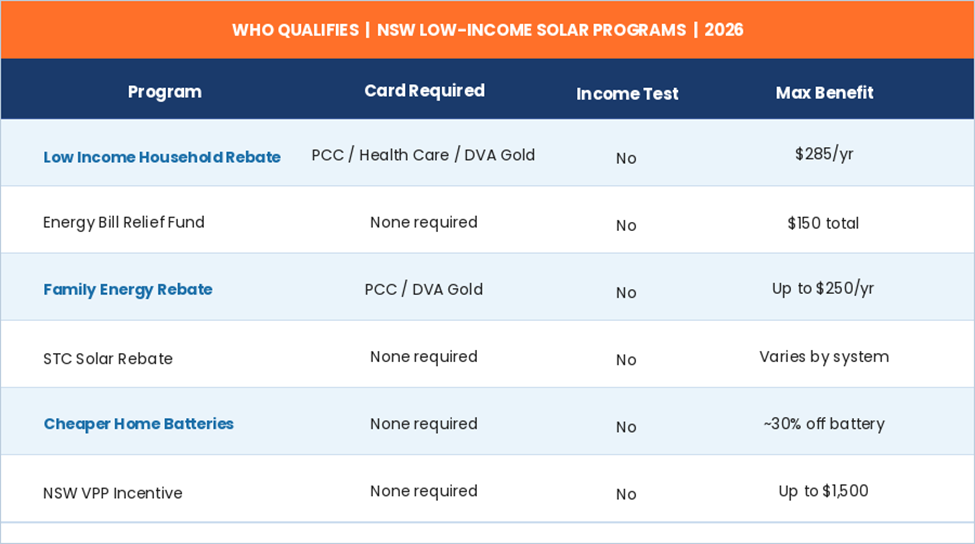
The table above confirms a key point worth repeating: the largest upfront savings — the STC solar rebate, the Cheaper Home Batteries Program, and the NSW VPP incentive — have no income test at all. This means that even if your household income is moderate, you still access these three programs in full.
For households holding a Pensioner Concession Card or Health Care Card, the Low Income Household Rebate and potentially the Family Energy Rebate add meaningful ongoing savings on top of the upfront discounts. The programs complement each other rather than compete.
How to Stack These Programs — A Real-World Example
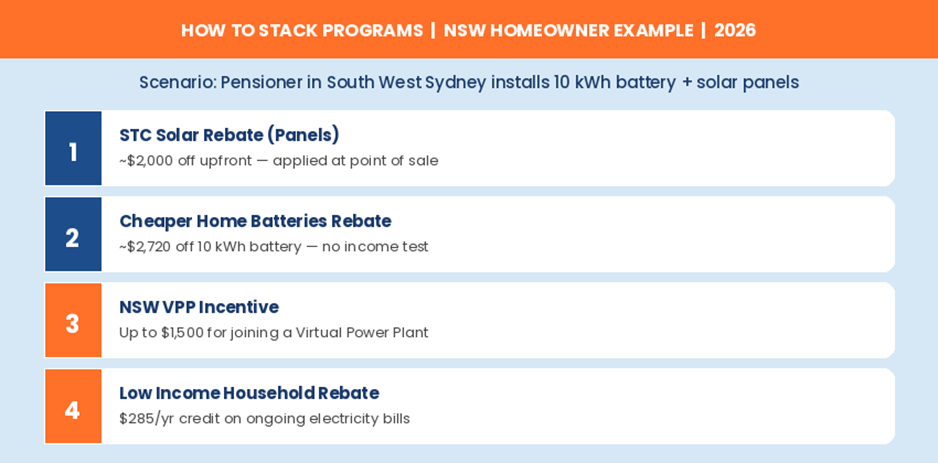
Let’s put concrete numbers to this. Consider a pensioner homeowner in South West Sydney — the sort of household that regularly asks about solar panels Bankstown or Liverpool — who wants to install a 6.6 kW solar panel system with a 10 kWh battery.
Without any incentives, this system might cost approximately $13,000 to $15,000 installed. After stacking all eligible programs, the picture changes dramatically:
- Step 1 — STC rebate on solar panels: approximately $2,000 upfront discount applied at point of sale
- Step 2 — Cheaper Home Batteries Program: approximately $2,520 off the 10 kWh battery
- Step 3 — NSW VPP incentive: up to $1,500 for connecting to an approved Virtual Power Plant
- Step 4 — Low Income Household Rebate: $285 per year ongoing credit on electricity bills
Combined, that is roughly $6,000+ in upfront savings, bringing a $14,000 system down to approximately $8,000 before any further negotiation on installer pricing. Additionally, the $285 per year ongoing credit continues reducing annual electricity costs for as long as the household holds a valid concession card.
The actual payback period then shortens considerably. After the loan or upfront payment is covered, the battery and solar system together can reduce electricity bills by $1,500 to $2,500 per year, depending on usage patterns and tariff structure.
Note: All figures are approximate and depend on system size, installer pricing, and the current STC market value. Always request itemised written quotes that show rebates as line-item deductions.
What Happened to the ‘Rebate Swap for Solar’ Program?
Several readers ask about the NSW Rebate Swap for Solar offer, which previously allowed eligible pensioners to swap their Low Income Household Rebate in exchange for a free 3 kW solar system installed on their home.
That specific program has now ended and is no longer accepting applications. However, the programs described above have largely replaced and exceeded its value. The Cheaper Home Batteries Program alone delivers more savings than the old swap offer did, and without requiring you to forfeit your ongoing rebate.
Similarly, the NSW Empowering Homes Program — which offered interest-free loans of up to $14,000 for solar-battery systems — has closed to new applications. In its place, the federal Cheaper Home Batteries Program delivers an equivalent or greater upfront benefit for most households, with no loan to repay.
Five Things to Check Before You Sign Anything
Understanding the programs is half the battle. The other half is making sure your installer applies them correctly. Here is what to look for before you commit to any installation:
- The rebate must appear on your written quote as a dollar deduction — not as a verbal promise. If an installer says ‘the rebate is included’ but cannot show you the line item, ask for a revised quote before proceeding.
- Verify your installer’s SAA accreditation number at saaustralia.com.au. Rebates are only valid for systems installed by accredited professionals using CEC-approved equipment.
- Confirm a specific installation date in writing — not just a contract signing date. For battery rebates, the rebate rate is locked in on the date of physical installation and commissioning.
- Ask whether the battery is on the CEC Approved Battery List. Only listed products qualify for the federal Cheaper Home Batteries rebate.
- If you are interested in the VPP incentive, ask your installer which VPP providers they work with and what the current incentive rate is. Rates vary between providers.
| Good to know: You are entitled to take a written quote home and compare it. Any installer who pressures you to sign on the day—or refuses to provide a take-home quote—is not acting in your interest. |
What Happens to Your Feed-In Tariff?
A feed-in tariff is the rate your electricity retailer pays you for excess solar energy your system exports back to the grid. It is separate from the rebates described above and does not affect your eligibility for any of them.
In NSW during 2025–26, electricity retailers set their own feed-in tariff rates. Most offer between 5 and 12 cents per kWh. While lower than a decade ago, these rates still provide useful bill credits. Households that export more solar energy can benefit the most. This is especially true for people away from home during the day.
If you add a battery, your solar export volume will likely decrease. More solar energy is stored for use later. This reduces the amount sent back to the grid. However, self-consumed electricity is often worth 30 cents or more per kWh. For most households, this leads to greater overall savings despite lower feed-in credits.
For more information on current NSW feed-in tariff rates, visit the NSW Government’s energy comparison website at energymadeeasy.gov.au
Frequently Asked Questions
Yes. These are separate programs administered by different levels of government. The Low Income Household Rebate applies to your ongoing electricity bill; the STC rebate reduces the upfront cost of installing solar. They do not interact with each other, and you can receive both simultaneously.
No. The federal Cheaper Home Batteries Program has no income test. It is available to any Australian household, business, or community organisation that installs an eligible battery system through an accredited installer. You do not need a concession card or a low income to qualify.
The upfront solar rebates (STC and Cheaper Home Batteries) apply to the property owner, not the tenant. If you are renting, you generally cannot access them unless your landlord agrees to install a solar system. However, the Low Income Household Rebate and Energy Bill Relief Fund credits apply to the electricity account holder, who can be a tenant. If you hold an eligible concession card and your name is on the electricity account, you can access those bill credits regardless of whether you own or rent.
The federal program is scheduled to continue until 2030, with the rebate value stepping down gradually each six months as battery prices fall and the subsidy phases out. There is no hard cutoff date, but acting earlier in the program’s life means accessing a higher per-kWh rebate.
No. Your Low Income Household Rebate is based on your concession card status and account holder details — not on whether you have solar or a battery. Installing a solar-battery system does not change your eligibility for ongoing bill rebates.
See What You Qualify For — Free, No Obligation
At Solar Battery Outlet, we install solar panels and batteries for NSW homeowners across Liverpool, Bankstown, and the surrounding South West Sydney region. Every quote we provide is written, itemised, and shows all applicable rebates as line-item deductions—so you can see exactly what you are paying and what you are saving.
We work with concession card holders regularly, and we can tell you in plain language which programs apply to your situation, what the total saving looks like, and whether a battery makes financial sense for your home before you commit to anything.
| Call us: 1800 000 777 | Or complete the 60-second eligibility form at solarbatteryoutlet.com.au |