

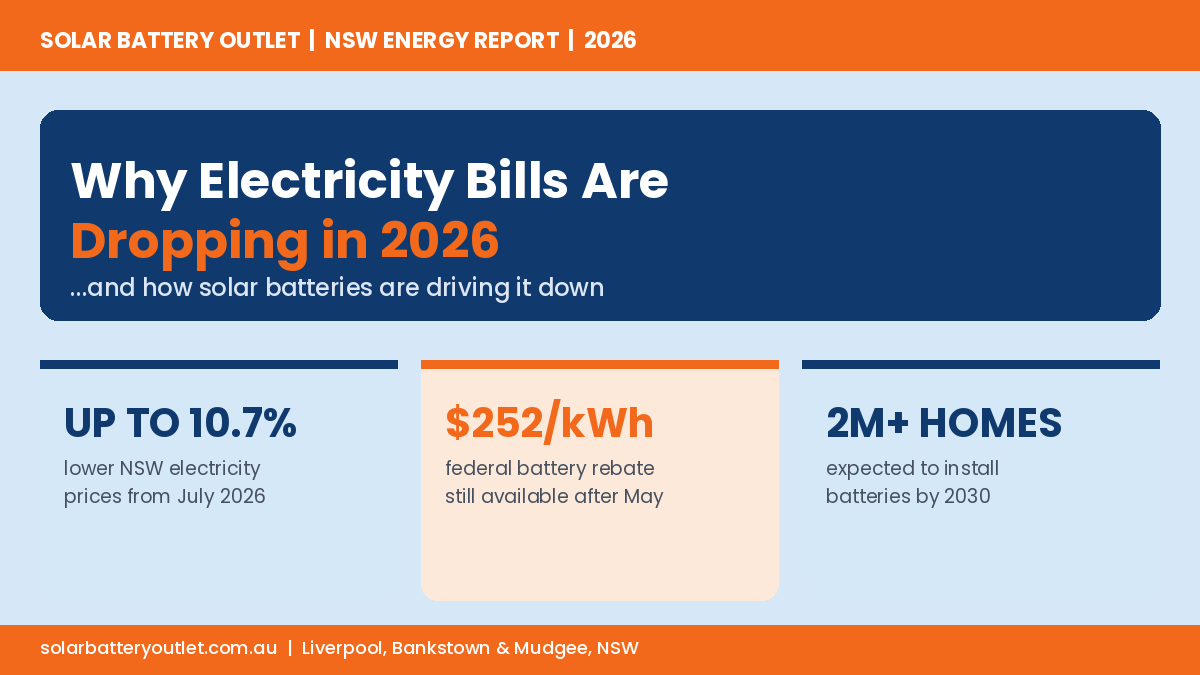
For the first time in years, NSW households are opening their electricity bills and seeing a number that has actually gone down. From 1 July 2026, the Australian Energy Regulator confirmed price cuts of up to 10.7 percent on standard offers across New South Wales, with similar falls in South East Queensland. After several years of steep increases, this is welcome news — and it is not happening by accident.
Behind this shift sits one technology more than any other: the home solar battery. As hundreds of thousands of batteries plug into the grid each year, they soak up cheap daytime solar power and release it during expensive evening peaks. This reduces strain on the network, lowers wholesale prices, and ultimately flows through to everyone’s bill—whether or not they own a battery themselves.
In this guide, we will break down exactly why electricity prices are falling in 2026, what role solar batteries play in that shift, the real numbers behind NSW pricing changes, and how homeowners considering solar batteries NSW can position themselves to benefit from both falling grid prices and remaining rebates.
The 2026 Turning Point: Electricity Prices Are Finally Falling
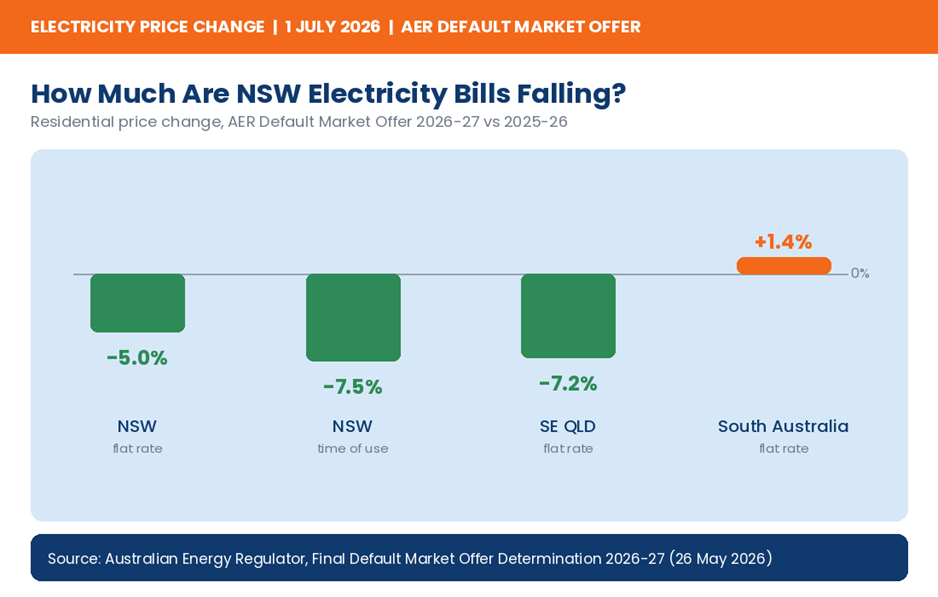
For most of the past five years, Australian households have braced for annual price increases. That trend reversed in 2026. The Australian Energy Regulator’s final Default Market Offer determination for 2026–27, released in late May 2026, confirmed that residential flat-rate prices in NSW will fall between 3.4 and 5.0 percent from 1 July, while time-of-use customers in NSW could save up to 7.5 percent. South East Queensland recorded the largest single drop at 7.2 percent, while South Australia was the only region to see a small increase of 1.4 percent.
The regulator pointed to three drivers behind the fall: lower wholesale electricity contract prices, reduced spot price volatility, and a meaningful increase in output from wind and battery generation during the evening peak. Put simply, when batteries—both household and grid-scale—release stored solar power exactly when demand spikes, expensive gas generators are needed less often, and wholesale prices come down for everyone.
How Solar Batteries Are Reshaping the Grid — And the Price You Pay
One in three Australian homes already has solar panels, but historically, only a small fraction had a battery to store that energy. That is changing fast. The federal Cheaper Home Batteries Program has already supported around 250,000 home battery installations since its launch, and the expanded budget — now $7.2 billion over four years — is expected to bring more than two million Australians into battery ownership by 2030, adding roughly 40 gigawatt hours of storage to the grid.
Why does this matter for prices? During the day, rooftop solar floods the grid with cheap power, sometimes pushing wholesale prices toward zero or even negative. In the evening, demand spikes just as solar generation drops off, traditionally forcing the grid to rely on costly gas peaking plants. Home batteries break this pattern. They store the midday surplus and discharge it during the evening peak, smoothing out the daily price curve. Industry analysts now describe this shift plainly: it is renewables, firmed by batteries, that increasingly set the price of power, not gas.
For households running a solar battery Liverpool installation or anywhere across Southwest Sydney, this means two things at once: your own bill drops because you are using stored solar instead of buying grid power at peak rates, and the broader grid becomes more stable because fewer homes are drawing power simultaneously during the 5 pm to 9 pm crunch.
What This Means for Your Household Savings
For a typical NSW household, three separate savings streams are now stacking together, and understanding each one helps you see the full financial picture rather than focusing on a single rebate figure.
1. Automatic bill reductions from 1 July 2026. Even households without a battery will see lower default electricity rates simply because the AER has reset the benchmark pricing downward.
2. The federal battery rebate. From 1 May 2026, the Cheaper Home Batteries Program discount sits at roughly $252 per usable kilowatt-hour for most standard batteries, applied as an upfront price reduction on your installation quote — no separate claim required.
3. The NSW VPP incentive. The NSW Peak Demand Reduction Scheme adds up to $1,500 on top for households that connect their battery to a virtual power Plant — a separate state-level incentive that runs independently of the federal rebate.
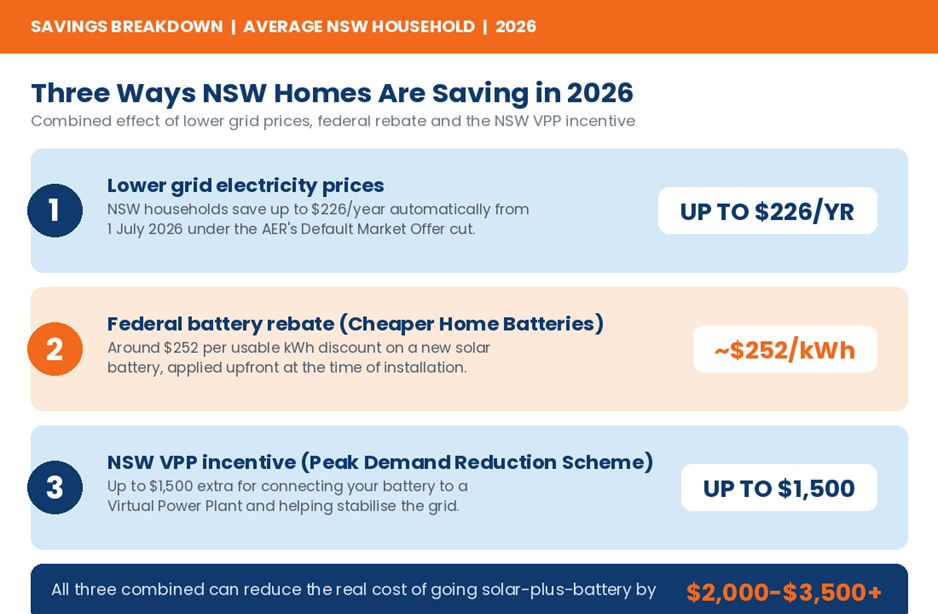
Combined, these three elements can cut the upfront cost of a solar battery system by around $2,000 to $3,500 for an average NSW household. This estimate does not include the ongoing savings from using stored solar energy instead of grid electricity at night. If you’re deciding whether to install now or wait for future rebate changes, compare these potential savings with your electricity bills before making a decision.
Real-World Example: A Liverpool Household Switching to Solar-Plus-Battery
Consider a household in Liverpool, NSW, with a 6.6kW solar system and a quarterly electricity bill of about $450. After installing a 10kWh battery, the home can reduce evening grid usage significantly. Instead of sourcing 60% to 70% of evening power from the grid, it may draw less than 15%, with the battery supplying energy for cooking, lighting, and household appliances.
Layer on the falling NSW default market. Offer rates from July 2026, and the household benefits twice over: the electricity they still buy from the grid costs less per kilowatt-hour than it did a year earlier, and they are buying far less of it overall. For households exploring options through a solar battery Liverpool installer, this combination—falling grid rates plus a battery that minimises grid reliance — is exactly the scenario the 2026 policy settings were designed to encourage.
Why This Trend Is Likely to Continue Beyond 2026
Three long-term trends suggest prices will continue to fall. First, the federal battery rebate remains available until 2030. This will support battery adoption, even as the rebate gradually decreases every six months. Second, regulators and network operators are introducing new tariffs to ease grid demand. One example is the Solar Sharer Offer, which provides three hours of free electricity during the middle of the day.
Third, battery costs continue to decline as global manufacturing expands. This improves the economics of home energy storage, even without government incentives. Together, these trends are creating a grid that relies more on distributed batteries and less on gas generation. As a result, households with battery storage are likely to see the greatest benefits.
A Simple Framework: Should You Add a Battery Now?
Rather than reacting to deadline pressure, walk through these four checks before deciding on timing.
- Check your evening usage. If most of your electricity use happens after 5 pm, a battery has the most to work with.
- Confirm your solar system’s health. A battery only stores what your panels generate, so an underperforming system should be assessed first.
- Compare written quotes. Get at least three quotes that show the federal rebate as a dollar deduction, not a verbal promise.
- Ask about VPP eligibility. Confirm your installer will register your system for the NSW VPP incentive at installation.
Frequently Asked Questions
The Australian Energy Regulator’s 2026–27 Default Market Offer reflects lower wholesale electricity costs, reduced price volatility, and higher output from wind and battery generation during peak periods. Together, these factors have lowered the benchmark used to calculate household electricity bills.
No. The Default Market Offer price reduction applies to all households, regardless of battery ownership. Battery owners can save even more by using stored energy during evening peak periods. This reduces the amount of electricity they need to buy from the grid.
Yes. The rebate is available until 2030 and currently provides around $252 per usable kilowatt-hour. The value decreases every six months, so applying sooner can secure a higher discount. However, it will continue to offer significant upfront savings beyond 2026.
Savings vary based on battery size and evening energy use. However, households that rely on stored solar power for most of their evening consumption can cut grid electricity usage by 50% to 80%. These savings come in addition to the lower electricity rates introduced in July 2026.
Ready to Lock In Today’s Falling Prices — Plus the Rebate That’s Still Available
Electricity prices are falling for everyone. However, homes with a solar battery can benefit from even greater savings. If you are in Liverpool, Bankstown, or Mudgee, our team can review your past 12 months of bills and assess your solar system. We will then provide a written quote showing the federal rebate and NSW VPP incentive in real dollar amounts.
Call us at 1800 000 777 or visit solarbatteryoutlet.com.au for a free, no-obligation eligibility check.
