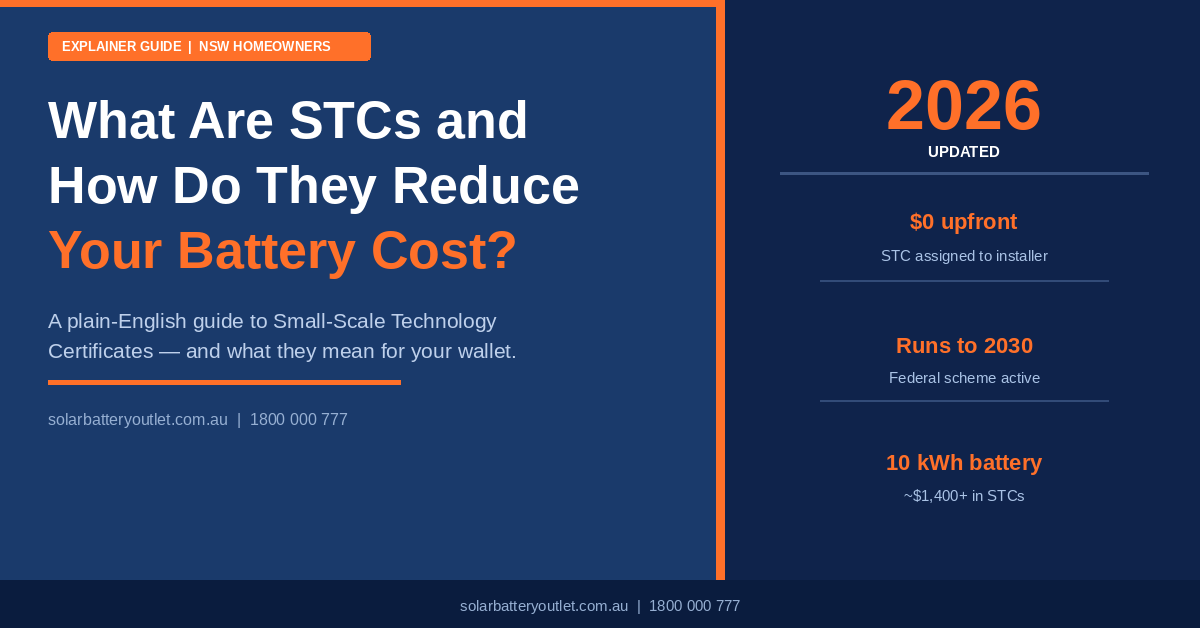
If you have received a quote for a solar battery recently, you may have noticed a line called the ‘federal rebate’ or ‘government rebate’ reducing the total price. That is not marketing spin. It is a real, government-backed mechanism called the Small-Scale Technology Certificate scheme — and in 2026, it is one of the most valuable financial tools available to NSW homeowners installing a battery.
This article explains, in plain English, exactly what STCs are, how they are calculated, what they are worth in 2026, and — most importantly — how they end up saving you money before you ever hand over a cent.
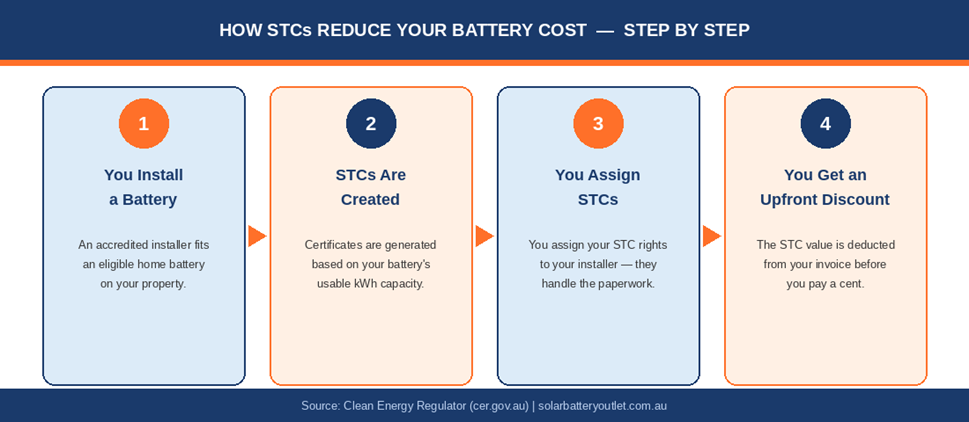
In plain English: STCs are government certificates created when you install an eligible battery. You assign them to your installer, who sells them — and that sale is deducted from your invoice as an upfront discount.
You never touch the certificates yourself. Your installer does the work. You just pay less.
What Are STCs, Really?
STC stands for Small-Scale Technology Certificate. You will also hear them called ‘the solar rebate’, ‘the federal rebate’, or simply ‘the government discount’. Technically, they are none of those things — but they function exactly like one.
STCs are part of Australia’s Renewable Energy Target, administered under the Small-scale Renewable Energy Scheme (SRES). The scheme has existed since 2011, originally to make rooftop solar more affordable. From 1 July 2025, it was expanded under the federal Cheaper Home Batteries Program to also cover eligible home battery systems.
When you install an eligible battery, your installation generates a set number of certificates. Those certificates have a dollar value. You assign your right to those certificates to your accredited installer. The installer sells them, and the proceeds are passed back to you as a deduction on your quote. The end result is a lower price on the day you pay.
How Are STCs Calculated for a Battery?
The number of STCs your installation generates depends on two things: the usable capacity of your battery in kilowatt-hours (kWh), and the STC factor that applies on the date of installation.
The STC Factor
The STC factor is a multiplier set by the government. It determines how many certificates are created per kWh of usable battery capacity. It is designed to step down over time as battery costs fall — the idea being that the rebate reflects how much financial help is needed, not a fixed handout.
From 1 July 2025 (scheme launch) to 30 April 2026: STC Factor = 8.4 per kWh
From 1 May 2026 onward: STC Factor = 6.8 per kWh (for batteries up to 14 kWh)
The factor continues declining every six months until the scheme ends in 2030.
The formula is straightforward:
Number of STCs = Usable kWh × STC Factor (rounded down to the nearest whole certificate)
The Tiered Structure for Larger Batteries
From 1 May 2026, a tiered STC factor applies for batteries above 14 kWh of usable capacity. This is how it works:
- 0 to 14 kWh (inclusive): STC Factor applied at 100%
- Every kWh above 14 kWh up to 28 kWh (inclusive): STC Factor applied at 60%
- Every kWh above 28 kWh up to 50 kWh (inclusive): STC Factor applied at 15%
- No STCs are created for any capacity above 50 kWh usable
This tiering means a 20 kWh battery does not simply get twice the STCs of a 10 kWh battery — it gets 14 kWh worth at full factor, then 6 kWh at 60% of factor. The total is still significant, but it is worth understanding the structure before assuming proportional savings.
What Is Each STC Worth?
The value of Small-scale Technology Certificates (STCs) depends on current program rules and certificate values at the time of installation. Your installer will calculate the applicable discount and include it in your written quote. The upfront discount available through the Cheaper Home Batteries Program is based on eligible battery capacity and the applicable STC rate.
The exact amount will vary between installations and should be confirmed in your quote. How Does the Discount Appear on Your Quote? When you receive a written quote from an accredited installer, any applicable incentive or certificate-based discount should be clearly identified. The quote should generally show:
- Gross cost of the battery and installation
- Applicable discounts or certificate deductions
- Net amount payable by the customer
Eligible households who connect an approved battery to an approved Virtual Power Plant (VPP) may also be able to receive a NSW Peak Demand Reduction Scheme incentive, subject to current program rules and eligibility requirements. Any available incentive amount should be confirmed in your quote.
Actual costs, incentives and savings vary depending on system size, battery capacity, installer pricing, eligibility requirements and program rules at the time of installation
How Is The Battery Discount Calculated?
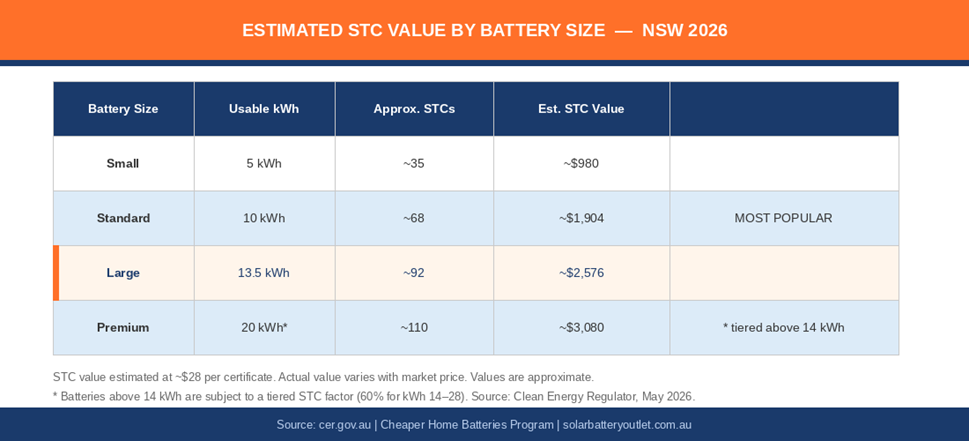
The examples above are illustrative only. The discount available through the Cheaper Home Batteries Program depends on the battery selected, the applicable certificate value and the program rules in place at the time of installation.
In general, larger eligible batteries may attract a larger upfront discount than smaller systems, although the amount available will vary between installations. Your installer will calculate the applicable discount and include it in your written quote. The discount is applied before installation, reducing the upfront cost of an eligible battery system. The exact amount available to you should be confirmed in your quote.
How Does the STC Saving Actually Show Up on Your Quote?
This is where things get practical. When you receive a written quote from an accredited installer, the STC value should appear as a separate line item — a deduction from the gross price. The quote should show you:
- Gross cost of the battery and installation
- STC deduction (shown as a dollar amount, not a vague ‘rebate’)
- Net cost — what you actually pay
| Important: If an installer mentions the rebate verbally but it does not appear as a line item on the written quote — that is a red flag. A legitimate installer will always show the STC deduction clearly in writing. You are assigning your STC rights to them. You deserve to see exactly what those rights are worth. |
The reason it works this way is that you are technically transferring your legal right to create and trade those certificates to your installer. They do the paperwork through the Clean Energy Regulator’s REC Registry. They handle the compliance requirements — including the photo documentation requirements introduced in early 2026. In return, they pass the value back to you upfront, rather than making you wait for a government reimbursement.
If you want to understand the compliance requirements your installer must meet, our guide on new government rules for solar battery installations in 2026 covers this in detail.
Does the STC Scheme Apply to All Batteries?
No. Not all batteries qualify. To generate STCs, a battery system must meet the eligibility criteria under the Cheaper Home Batteries Program. The key requirements are:
- The battery must be installed by an SAA-accredited installer
- The battery must be on the approved battery list and be VPP-capable
- The usable capacity must be between 5 and 100 kWh (STCs are only created for the first 50 kWh)
- The installation must comply with all relevant Australian Standards
- The installer must register the installation with the Clean Energy Regulator
If any of these conditions are not met — for example, if the installer is not properly accredited or the battery model is not on the approved list — no STCs are generated and no discount applies. This is another reason why installer quality matters as much as product quality.
How Does the STC Factor Change Over Time?
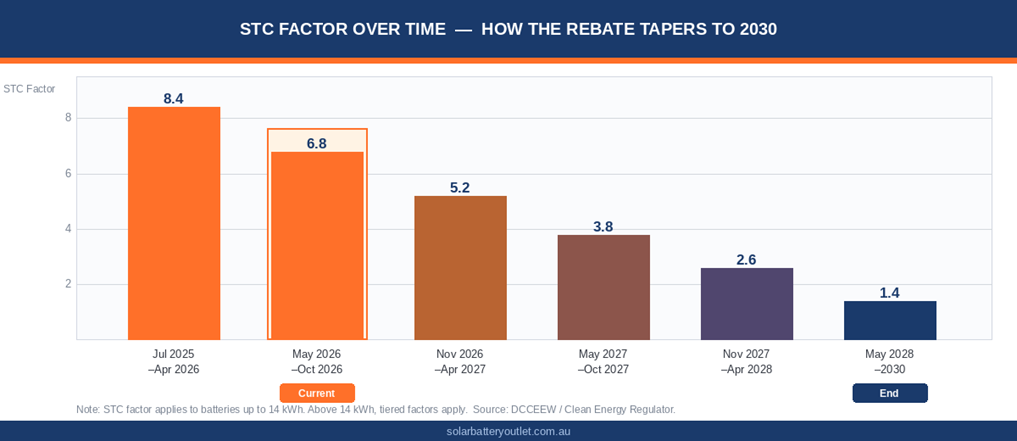
The STC factor for batteries reduces every six months under a schedule set by the government. The principle is simple: as battery costs fall over time, the government support tapers proportionally. The scheme is designed to wind down by 2030.
The factor steps down every six months, so your quote will show the amount that applies on your installation date. Each six-month period that passes reduces the certificates available — and therefore the upfront saving on your battery cost.
The scheme is not ending abruptly. It is tapering gradually. Choosing the right system matters more than rushing.
Can You Stack STCs With Other Incentives?
Yes — and this is where the full picture becomes compelling. STCs are a federal scheme. They sit alongside, not instead of, state-level incentives that NSW homeowners can also access.
- NSW Peak Demand Reduction Scheme (PDRS): Eligible households who connect an approved battery to an approved Virtual Power Plant (VPP) may receive a one-off incentive under the NSW Peak Demand Reduction Scheme. The amount depends on the battery, the VPP provider and current scheme rules, and will be confirmed in your quote.
- Virtual Power Plant (VPP) participation: Some VPP providers may offer ongoing credits or payments in accordance with their program terms and conditions. Amounts vary by provider.
- Time-of-use tariff savings: A battery may allow households to store excess solar energy generated during the day and use it during peak electricity pricing periods. Actual savings depend on electricity usage, tariff structure and battery performance.
| Example: Combining Available Battery Incentives in NSW |
| Federal battery discount: Available for eligible battery installations, subject to program rules. |
| NSW VPP incentive: May be available for eligible households connecting an approved battery to an approved Virtual Power Plant (VPP). |
| Combined upfront benefit: The total value of any available incentives depends on the battery selected, eligibility requirements and current program rules. |
| The incentives available to you will be confirmed in your written quote. |
Do You Need to Do Anything to Claim STCs?
In most cases, NO. The standard process is:
- Your installer confirms you are eligible and includes the STC deduction in the written quote.
- You sign the assignment agreement — typically a single form included with your contract.
- The installer completes the installation, takes the required compliance photos, and submits the STC application to the Clean Energy Regulator.
- The certificates are registered and sold. You have already received the value as a discount on your invoice.
You can also choose to create and trade STCs yourself through the REC Registry — but the vast majority of homeowners choose to assign them to their installer for simplicity.
For more on what the Clean Energy Regulator now requires at installation — including photo documentation — see our article on CER registration rules for NSW solar panel installers.
Frequently Asked Questions
No. STCs are a federal mechanism, separate from any state programs. In NSW, state incentives like the Peak Demand Reduction Scheme are additional to STCs, not a replacement. You can claim both if you are eligible for both.
Yes. Eligible batteries may qualify for STCs when connected to an existing solar PV system, so you do not need to install new solar panels at the same time. Eligibility requirements apply.
Yes. Adding a battery to an existing solar system qualifies for its own STC entitlement under the Cheaper Home Batteries Program. The battery STCs are calculated independently of any STCs that were claimed when you originally installed your solar panels.
Yes — indirectly. Your installation must comply with AS/NZS 5139 and related Australian Standards. Non-compliant wiring can mean the installation fails CER registration, which means no STCs. This is another reason to choose an accredited installer who knows the current standards.
The Cheaper Home Batteries Program’s STC component runs until 2030. The factor tapers every six months, Choosing the right system matters more than rushing.
| Want to Know Exactly What STCs You Qualify For? We calculate the exact STC value for your battery — and show it as a clear dollar deduction on your written quote. No hidden rebate promises. No verbal commitments. Just a transparent quote. Solar Battery Outlet — Liverpool, Bankstown & Mudgee NSW Call: 1800 000 777 | Get a free quote: survey.solarbatteryoutlet.com.au/offer All installations by SAA-accredited electricians. Rebate paperwork handled for you. |
