

Plugging your EV into a regular power point overnight feels harmless. It is slow, gentle and easy to forget about. But that slowness comes at a cost you rarely see on your bill breakdown: extra electricity lost as heat before it ever reaches your battery.
So does slow EV charging really use more electricity than fast charging? The short answer is yes, in terms of efficiency — though not by as much as you might fear, and not in a way that changes the bigger picture for most Australian EV owners. Here is what the data actually shows, and how to charge smarter at home.
AC vs DC Charging: What “Slow” and “Fast” Actually Mean
Every EV charger falls into one of two categories: AC or DC. Understanding the difference matters more than most owners realise.
AC (alternating current) charging is what you get from a standard power point, a portable EV cable, or a dedicated wall charger. Power output ranges from about 2.3 kW at a household socket up to 22 kW from a three-phase wall unit. Your car’s onboard charger converts this AC power into DC before it reaches the battery.
DC (direct current) charging is what you find at public fast-charging stations, typically 50 kW to 400 kW. These chargers convert AC to DC before it reaches the car, skipping the onboard charger almost entirely and pushing energy straight into the battery.
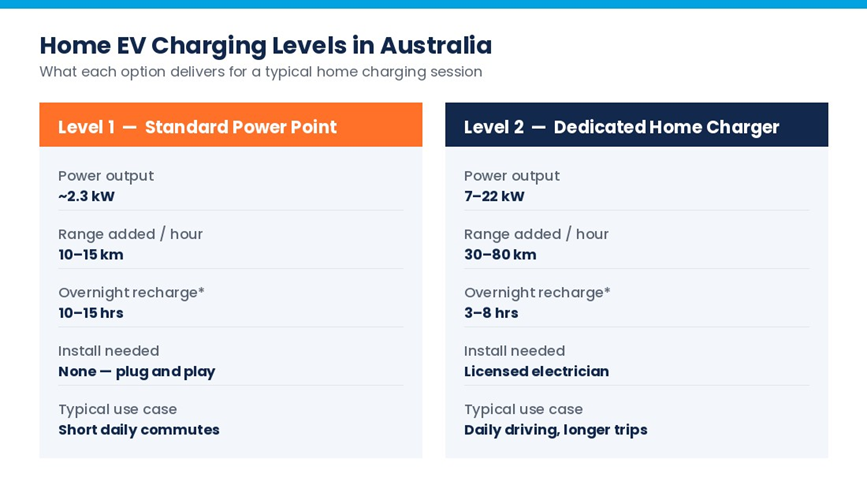
Most home charging in Australia is AC. In fact, energy.gov.au notes that a dedicated home EV charger typically charges an EV three to ten times faster than a standard power point, adding between 30 and 80 km of range per hour of charging. A standard power point, by comparison, usually adds closer to 10 to 15 km per hour.
Does Slow Charging Use More Electricity? The Surprising Answer
Here is the part most owners never see: the slower your AC charging speed, the more electricity is lost as heat inside your car’s onboard charger and cabling before it ever reaches the battery.
German motoring organisation ADAC recently tested five EV models at three charging speeds, measuring exactly how much electricity actually made it into the battery. The results were consistent across the fleet.
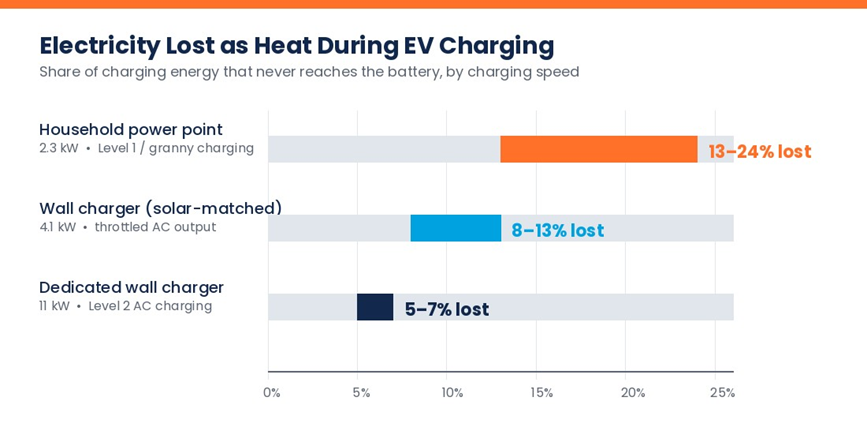
Charging from a household power point lost between 13% and 24% of the electricity drawn from the grid. A dedicated wall charger throttled down to simulate surplus solar charging lost 8% to 13%. A full-speed 11 kW wall charger lost only 5% to 7%. The trend is clear: slower AC charging wastes proportionally more electricity than faster AC charging.
Why Slower AC Charging Wastes More Energy
This seems backwards at first. Surely taking your time is gentler and more efficient? Not quite, and the reason comes down to your car’s onboard charger.
The onboard charger and its cooling systems draw a small amount of fixed power just to operate, regardless of how much energy is flowing through them. At low charging speeds, that fixed overhead makes up a larger share of the total energy used. At higher speeds, the same fixed loss is spread across far more kilowatt-hours, so it barely registers as a percentage.
Cable resistance and battery-management losses add a little more on top, but the onboard charger and vehicle electronics are the main contributors, according to the ADAC testing. A separate 2023 study of onboard chargers across 38 EV models found that reducing charging current for smart charging could increase worldwide charging energy demand by roughly 1% to 10%.
What This Actually Costs You in Australia
The efficiency loss sounds significant on paper, so let’s put it in real terms. Say your EV needs 40 kWh to top up for the week.
- Charged from a household power point (roughly 18% average loss): your home draws about 48.8 kWh from the grid to deliver that 40 kWh.
- Charged from a dedicated 11 kW home charger (roughly 6% average loss): your home draws about 42.6 kWh for the same 40 kWh.
That is a difference of around 6 kWh per charge. At a typical NSW residential rate of roughly 30 cents per kWh, slower charging costs an extra $1.80 or so per top-up — not dramatic, but it adds up to roughly $90 to $100 a year for a weekly charger.
These figures are simplified estimates for illustration, since real losses vary by vehicle, cable, and weather. The bigger cost factor is almost always the electricity price itself, not the efficiency loss. Charging from cheap overnight rates or free solar still beats a faster but pricier charging method every time.
Home Solar, Batteries and EV Charging: Where It Gets Interesting
For Australian homeowners with rooftop solar, the efficiency conversation changes shape. Charging your EV directly from solar during the day costs close to nothing, even if the onboard charger is running at a lower, solar-matched output.
A home battery adds another layer. Instead of only charging your EV while the sun is out, a battery stores surplus solar for use later — including overnight top-ups that would otherwise pull more expensive grid electricity through those same efficiency losses. Pairing a home battery with an EV charger also lets you shift charging into free or low-cost windows on time-of-use plans. Our guide to NSW Solar Sharer plans breaks down how running an EV charger during the free 11am–2pm window can meaningfully cut your annual charging cost.
If you already have solar and are considering a battery, ask your installer whether your inverter and battery can manage EV charging as part of one connected system. Several current battery models, including Tesla Powerwall 3, integrate EV charging management directly into their app.
How to Charge Your EV More Efficiently at Home
A few simple habits close most of the efficiency gap without any extra spending.
- Use a dedicated Level 2 charger for regular charging. A 7–22 kW wall charger loses less electricity as heat than a standard power point and charges far faster.
- Reserve the power point for occasional top-ups. Granny charging is fine for light use, but it is the least efficient regular option.
- Charge during daylight if you have solar. Free daytime solar energy makes the efficiency loss almost irrelevant to your bill.
- Check installation requirements early. A dedicated home charger needs a licensed electrician and may require a switchboard upgrade — see energy.nsw.gov.au for what to expect before you book.
Frequently Asked Questions
Yes, to a measurable degree. ADAC testing found that charging from a standard power point lost 13% to 24% of the electricity drawn from the grid, compared with only 5% to 7% loss from a dedicated 11 kW home charger.
Slow home charging is usually still cheaper overall than public DC fast charging, even accounting for the higher electrical losses, because off-peak and solar electricity cost far less per kWh than public charging rates.
If you drive daily, a dedicated 7–22 kW Level 2 home charger is more efficient and much faster than a power point. Energy.gov.au recommends a dedicated charger for owners who charge regularly rather than occasionally.
No. Slower AC charging generally puts less heat stress on battery cells than DC fast charging and is often the gentler choice for everyday top-ups.
Yes. Charging during daylight hours, while your panels are generating, uses solar directly. A home battery simply extends that benefit to overnight charging as well.
Disclaimer
This article explains general findings from third-party EV charging efficiency testing and publicly available Australian Government guidance on home EV charging. It is general information only and does not constitute financial, electrical or purchasing advice. Charging losses, costs and available rebates vary by vehicle, charger, electricity plan and household. Any electrical work, including installing a dedicated home EV charger, must be carried out by a licensed electrician. Always seek personalised advice before making a purchasing decision.
Thinking About Pairing Solar, a Battery and an EV Charger?
If you are charging an EV at home and want to know whether solar, a battery, or both would actually cut your charging costs, we can help you work it out properly — no pressure, no guesswork.
Solar Battery Outlet is a Liverpool-based solar and EV charger installer, part of GWM Group Pty Ltd, servicing homes across Liverpool, Bankstown and Mudgee. All installations are carried out by SAA-accredited electricians.
Call us: 1800 000 777 — or visit solarbatteryoutlet.com.au for a free, no-obligation quote on solar, batteries and EV charger installation.
