

Your new solar battery is rated at 13.5 kWh. But it never seems to deliver that much power overnight. You are not imagining it, and your battery is not faulty. The gap sits between two numbers on the spec sheet: total battery capacity and usable capacity. Manufacturers advertise the first number. Your household actually runs on the second. More than half a million home batteries are now installed across Australia. In 2026, this distinction decides whether your system covers a blackout or leaves you short. This guide breaks down what each term means. It also shows how to size a battery around the number that actually matters.
What Is Total Battery Capacity?
Total battery capacity, also called nominal or nameplate capacity, is the full amount of energy a battery can physically store. It is measured in kilowatt-hours (kWh) and printed on the spec sheet as the headline figure. Think of it as the size of the fuel tank. A “13.5 kWh battery” has a 13.5 kWh tank. However, this number does not tell you how much of that energy you can safely draw out. Every lithium battery reserves a small buffer to protect its cells and extend its lifespan. That reserved portion never reaches your switchboard. Total capacity is useful for comparing raw battery size. But it is the wrong number for planning how long a battery will power your home.
What Is Usable Capacity?
Usable capacity is the energy you can actually withdraw from the battery before it needs recharging. The Australian Government’s YourHome guide explains it clearly. Nominal capacity is the total energy a battery can hold. Usable capacity is how much of that can actually be used, once depth of discharge is factored in. This is the figure that powers your fridge, lights, and air conditioner. It is also the number your installer should use when sizing a system for your household. Two batteries can share the same headline kWh figure. Yet they can still deliver very different real-world performance, simply because their usable capacity differs.
How Depth of Discharge Connects the Two
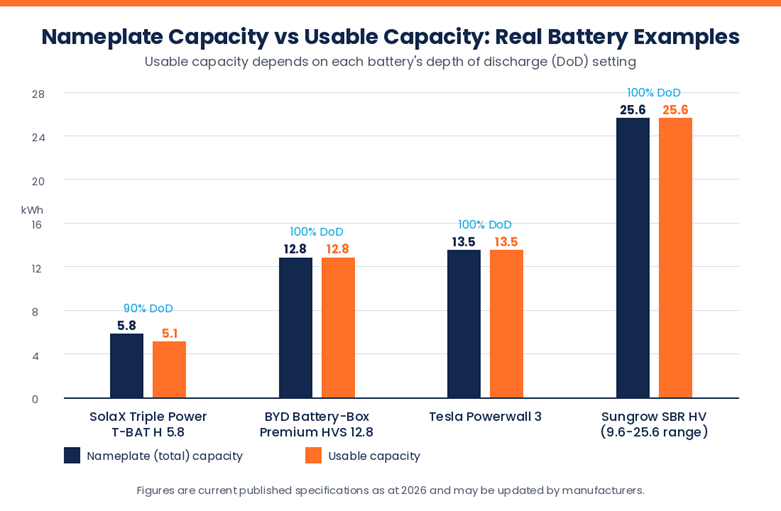
Depth of discharge (DoD) is the bridge between total and usable capacity. It is expressed as a percentage. It tells you how much of the total capacity can be regularly discharged without damaging the battery. The formula is simple: usable capacity equals total capacity multiplied by DoD. Take the SolaX Triple Power T-BAT H 5.8. It has a nominal capacity of 5.8 kWh and a warranted DoD of 90 percent. That works out to 5.1 kWh of usable capacity. Older battery chemistries and lead-acid systems often sit at 50 to 80 per cent DoD. Most modern lithium iron phosphate (LFP) home batteries now claim close to 100 percent. Even then, a small operating buffer usually remains for safety.
Real Battery Examples: Nameplate vs Usable Capacity
The chart below compares published 2026 specifications for several popular home batteries. Tesla Powerwall 3 lists a 13.5 kWh usable capacity at 100 percent DoD, so its nameplate and usable figures match. BYD’s Battery-Box Premium HVS 12.8 behaves the same way, delivering its full 12.8 kWh. Sungrow’s SBR HV range scales from 9.6 kWh to 25.6 kWh, also at 100 percent DoD. The SolaX example tells a different story. Its 5.8 kWh nameplate capacity shrinks to 5.1 kWh usable once the 90 percent DoD is applied. That 0.7 kWh gap will not appear on a quote unless you ask for it. This is exactly why comparing headline numbers alone can be misleading.
Why the Difference Matters for NSW Homeowners
This distinction carries real weight for households across Sydney, Bankstown, Liverpool, and regional NSW towns like Mudgee. A battery sized on nameplate capacity alone can fall short during a storm-related blackout. Essential circuits can lose power sooner than expected. It also affects everyday savings. A smaller usable capacity means less stored solar energy for peak evening electricity prices. Brenton Hielscher of Hielscher Electrical puts it simply. He says homeowners should not compare batteries by headline kWh alone. The real question is how much of that battery they can actually use. Clean Energy Regulator data shows the average battery installed under the federal rebate now holds about 18.3 kWh usable. More than half of these systems were fitted as retrofits to existing solar. That is the figure households are actually planning their evenings around.
How to Calculate the Usable Capacity You Actually Need
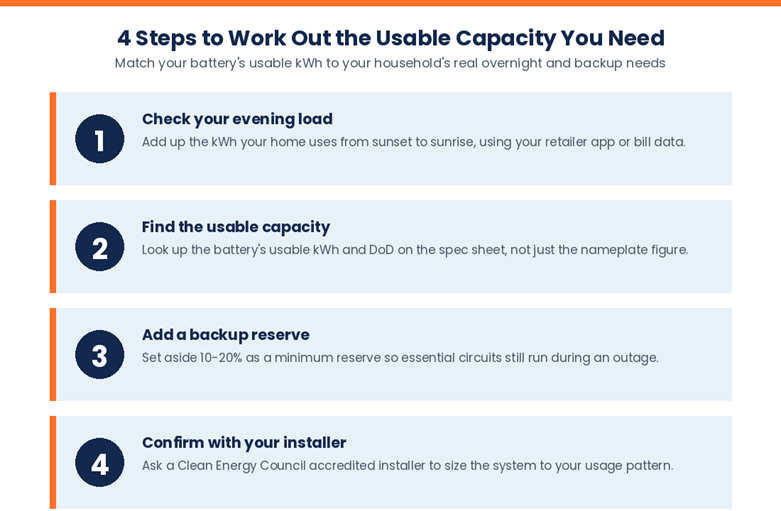
Working out the usable capacity your home needs is more reliable than chasing the biggest nameplate number. Start by reviewing your evening electricity use, from sunset through to sunrise. Then check the usable capacity and DoD on the battery’s actual spec sheet, not just its marketing name. Add a backup reserve of 10 to 20 percent. This keeps essential circuits, like your fridge and lights, running if the grid goes down. Finally, confirm the sizing with a Clean Energy Council accredited installer. As Daniel McCabe of GI Energy notes, a great installer matters just as much as a great battery. Correct sizing depends on your home, not just the brand on the box.
Common Mistakes When Comparing Battery Capacity
A few habits lead buyers astray when comparing solar batteries. The most common is comparing nameplate capacity across brands without checking each one’s DoD. Another is assuming every battery reaches 100 percent DoD just because it is lithium. Some models still sit at 90 percent or lower. Buyers also forget to account for the backup reserve set aside for outages. This further reduces day-to-day usable energy. Finally, many overlook warranty terms. BYD, for example, warrants that its batteries retain at least 60 percent of usable energy after 10 years. This means usable capacity is expected to decline gradually over the system’s life. Always ask for the usable capacity figure in writing before you sign a quote.
Frequently Asked Questions
Total battery capacity is the full energy a battery can store, shown as its nameplate kWh figure. Usable capacity is the portion of that energy you can actually draw out, once depth of discharge and any safety reserve are applied.
Some battery chemistries and models reserve a buffer to protect their cells and extend cycle life. Most modern LFP home batteries now offer close to 100 percent DoD, but older or budget models may sit at 80 to 90 percent.
It depends on your evening and overnight electricity use. Many NSW households land between 10 and 20 kWh of usable capacity, though a Clean Energy Council accredited installer can size this to your actual bills.
Not on its own. A high DoD improves usable capacity, but round-trip efficiency, warranty terms, backup features, and installation quality all affect real-world performance too.
Yes. Usable capacity typically declines gradually as a battery ages and completes more charge cycles. Manufacturer warranties usually guarantee a minimum retained capacity, often around 60 to 70 percent, after 10 years.
The federal rebate is calculated using the battery’s usable capacity in kWh, not its nameplate figure. This is another reason to confirm usable capacity before comparing quotes.
Disclaimer
This article provides general information about total and usable battery capacity for solar batteries. It is correct to the best of our knowledge as at the time of publishing. It is not personal financial, electrical, or purchasing advice. Battery specifications, depth of discharge ratings, and rebate rules can change without notice. Always confirm current specifications directly with the manufacturer or your installer before purchasing. Always seek personalised advice before making a purchasing decision, as the right battery size depends on your household’s circumstances.
