Severe storms have cut power to tens of thousands of NSW homes in recent years. When that happens, you face a practical choice. So, should you rely on a solar battery or a backup generator?
This guide compares a solar battery vs backup generator for NSW blackouts. First, we explain how each option works. Next, we cover limits, safety and cost. Finally, we give you four questions to help you choose.
| QUICK ANSWER |
| A backup-enabled solar battery supplies quiet, automatic power to your chosen circuits. A generator runs as long as you keep it fuelled, but it needs outdoor use and a licensed changeover switch. Load size sets battery runtime, while fuel supply sets generator runtime. Your outage length, essential loads and budget decide the better fit. |
Why NSW Blackouts Make Backup Power Worth Planning
Recent storms show the scale of the problem. For example, storms in January 2025 affected more than 200,000 Ausgrid customers. Likewise, Endeavour Energy reported about 78,000 affected customers, and Essential Energy reported 31,500.
Some outages then lasted for days. In fact, Ausgrid warned that repairs would continue into 20 and 21 January. Later, in November 2025, another storm left about 63,000 NSW properties without power. Most of those sat in Western Sydney.
Therefore, outage length matters as much as outage frequency. A two-hour fault and a three-day storm call for different plans. That difference drives the solar battery vs backup generator decision.
How a Solar Battery Powers Your Home During a Blackout
First, most grid-connected solar systems shut down when the grid fails. Australian standards require this, because it protects electrical workers who repair the network. As a result, rooftop panels alone cannot power your home in a blackout.
A battery changes that, but only with the right hardware. Specifically, you need a backup-capable inverter or gateway, plus wiring for backup circuits. However, not every battery includes this function, so confirm it before you buy.
When the grid drops, a backup-enabled system separates your home from the network. Then it supplies your chosen circuits from stored energy. Expect a brief interruption during switchover, which varies by product. Meanwhile, daytime sunlight can recharge the battery. Next, you decide how much to back up. Essential circuits cover items such as the fridge, lights and Wi-Fi. Whole-home backup covers more, but it drains the battery faster. Our guide to essential circuits vs whole-home backup in NSW explains this trade-off.
Safety also deserves attention. Generator exhaust contains carbon monoxide, a gas you cannot see or smell. Fire and Rescue NSW’s Roger Mentha stated, “Never use portable generators indoors, or in garages and sheds.” Instead, run the unit outside, well away from windows and vents.
Wiring needs care as well. For instance, plugging a generator into a wall socket can send power back into the grid. This backfeeding puts line workers at risk. According to Ausgrid’s portable generator guidance, a licensed electrician should install a compliant changeover switch.
Finally, consider noise. Common retail portable models run at roughly 58 to 68 decibels at seven metres. Your neighbours may hear the engine throughout a long outage.
Solar Battery vs Backup Generator: Side-by-Side Comparison
The graphic below shows the solar battery vs backup generator trade-offs that matter most during an outage.

In short, a battery favours convenience and quiet operation. In contrast, a generator favours longer runs when fuel stays available. However, neither option suits every household. Ultimately, your own loads and outage history matter most.
Where Each Option Falls Short
Solar battery limits
First, a battery stores a fixed amount of energy. Heavy loads drain it quickly, and cloudy days limit recharging. In addition, a system without a backup function will not help during a blackout. Our post on why your solar battery backup may not work when you need it most covers the common causes.
RACV spokesperson Himanshu Ahuja also cautions that “solar batteries are not an uninterruptible power supply.” Therefore, households that rely on essential medical equipment should arrange a separate plan. Speak with your medical provider and electricity distributor first.
Generator limits
On the other hand, a generator needs fuel, servicing and outdoor space. You must start it, monitor it and refuel it. Meanwhile, noise can affect your neighbours. As a result, generators suit some homes well, but they demand more attention during a long storm.
Cost and Rebates: What to Compare
First, a portable generator usually costs less upfront. However, a battery works every day, not only during blackouts. For example, it can store solar energy for use in the evening, which a generator cannot do.
In addition, the federal Cheaper Home Batteries Program reduces the upfront cost of eligible batteries. The Clean Energy Regulator lists an STC factor of 6.8 per kWh for installations from May to December 2026. That factor then steps down to 5.7 from 1 January 2027. The full factor applies to the first 14 kWh of usable capacity.
Your eligibility and final rebate depend on your system, installation date and certificate price. Therefore, ask each installer to show the rebate as a dollar amount on the written quote. Generators do not qualify for this program, so compare total costs over several years. Include fuel, servicing and electrician work in any solar battery vs backup generator comparison.
How to Choose: Four Questions to Ask First
Work through these four questions before you request quotes. Each one narrows the solar battery vs backup generator choice.
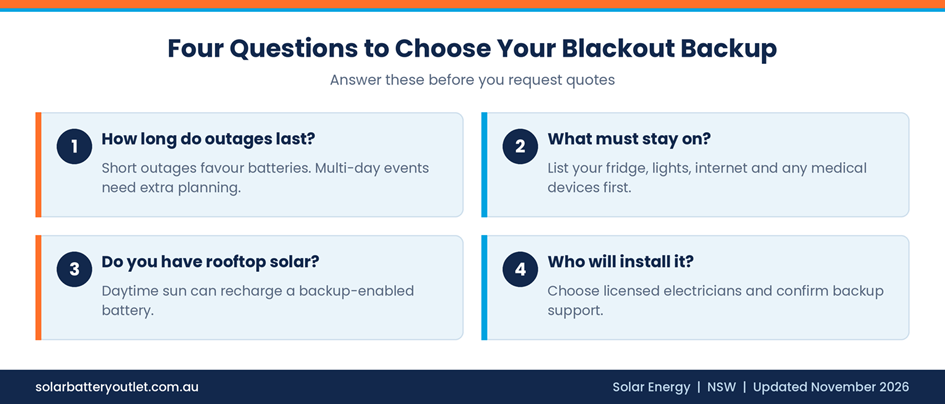
- How long do your outages last?
Short outages suit a battery. However, for multi-day events, some households add a generator as a second option, but an electrician must plan the wiring. - What must stay on?
List your fridge, lights, internet and any medical devices. Then, decide between essential circuits and whole-home backup. - Do you have rooftop solar?
Daytime sunlight can recharge a backup-enabled battery, which stretches runtime. - Who will install it?
Use licensed electricians for either option. Also, check that your battery appears on the Clean Energy Council approved list and supports backup.
Finally, compare at least three written quotes. Ask each installer to show which circuits stay live in a blackout.
Frequently Asked Questions
It depends on your outage length, loads and budget. A backup-enabled battery gives quiet, automatic power to chosen circuits. However, a generator can run longer while fuel remains available. Therefore, compare both options against your own needs.
Usually not. Grid-connected systems shut down during a blackout to protect electrical workers. However, some inverters offer a limited backup socket for a few devices. Ask your installer what your inverter supports.
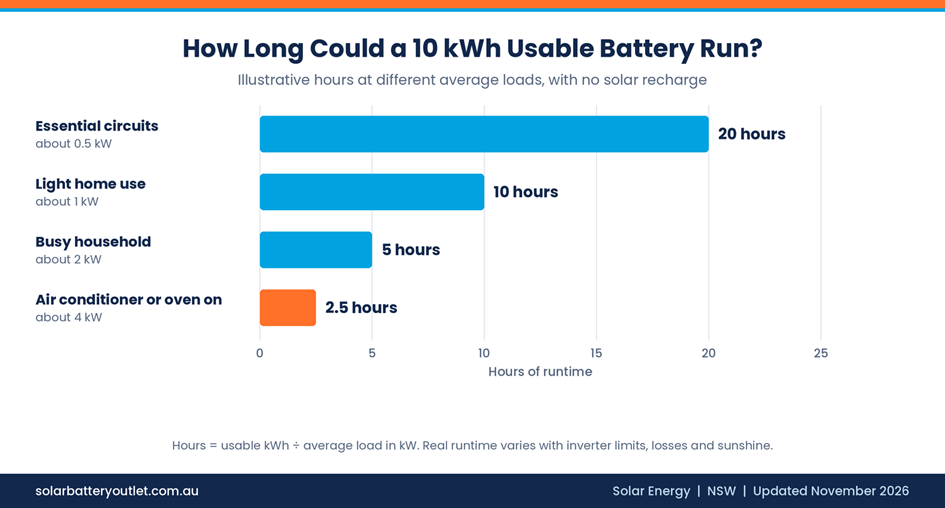
Runtime equals usable battery energy divided by your load. For example, a 10 kWh usable battery running a 0.5 kW load lasts about 20 hours. That figure ignores losses and solar recharge. In contrast, heavy loads such as air conditioning shorten that time sharply.
Not directly. First, a licensed electrician must install a compliant changeover switch. Otherwise, the generator can feed power back into the grid. Ausgrid warns that this endangers its crews.
No. Generators produce carbon monoxide, which can build up quickly in enclosed spaces. Instead, Fire and Rescue NSW advises running them outdoors, away from windows, doors and vents.
Some systems can, depending on inverter rating and battery size. However, air conditioners drain batteries quickly. As a result, most households back up essential circuits first. Ask your installer to size backup for your largest loads.
| Not Sure Whether a Battery or a Generator Fits Your Outages? Talk to Solar Battery Outlet before you decide. First, we review your bills, your solar system and your essential circuits. Then, we explain your backup options in plain terms. We offer free, no-obligation quotes for NSW homeowners across Liverpool and Bankstown. Call us: 1800 000 777 Or visit solarbatteryoutlet.com.au to request your quote. |
| Disclaimer: This article offers general information about solar battery backup and generator use during NSW blackouts. It does not replace advice from a licensed electrician, your electricity distributor or a medical professional. Runtime figures are illustrative calculations, so real results vary with your system, loads and weather. Rebate settings, including STC factors, also change over time, so confirm current details with the Clean Energy Regulator. Households that rely on medical equipment should arrange a separate backup plan. Always seek personalised advice before making a purchasing decision. |
