

Picture this. The power drops out across your street. Your neighbours reach for candles, but you paid for a solar battery. You open the app and see 70% charge. Yet your lights stay off.
This scenario plays out in homes across NSW more often than most installers admit. Owning a solar battery does not automatically mean you have backup power. The two are related, but they are not the same thing. Understanding the difference could be the reason your fridge keeps running during the next storm, or the reason it does not.
Your System Is Designed to Shut Down in a Blackout, By Law
Here is the part most homeowners never hear at the sales table. Every grid-connected solar inverter in Australia must switch off the moment the grid fails. This safety feature is called anti-islanding, and it exists so technicians repairing damaged lines are never exposed to live current flowing back from your roof. The requirement sits inside the AS/NZS 4777.2 standard that every accredited installer must follow.
The Australian Government’s energy.gov.au confirms that very few grid-connected solar-only systems provide backup power during an outage, simply because the inverter shuts down as soon as it detects one. A battery changes that equation, but only when it has been specifically configured to island itself from the grid and keep running. Buy a battery without that configuration, and you have bought expensive storage that behaves exactly like your old system once the street goes dark.
Reason 1: No Dedicated Backup Circuits Were Ever Wired In
Many installers wire a battery purely for bill savings, not blackout protection. In that setup, the battery simply charges from solar by day and discharges at night, and it does nothing extra when the grid drops.
Real backup needs a separate backup circuit board, sometimes called an essential loads panel. This board isolates your fridge, lights and internet from the rest of the house, so the battery can power them safely while everything else stays switched off. If that board was never installed, your battery cannot send power anywhere during an outage, no matter how full it is. This is one of the most common gaps between what homeowners expect and what they actually paid for.
Reason 2: The Minimum Reserve Setting Was Left Too Low
Most battery systems let you set a minimum reserve level, a slice of capacity held back purely for emergencies. Chartered electrical engineer and SolarQuotes founder Finn Peacock has flagged this reserve setting as one of the most overlooked levers in a battery system, mainly because installers rarely walk customers through it at the point of sale.
If your reserve sits at zero, your battery might discharge fully every evening to maximise your savings. Then a storm rolls through at 9pm, and there is nothing left to draw on. A sensible reserve trades a small amount of daily saving for guaranteed backup capacity. It is a setting worth asking your installer to explain, and adjust, before you sign off on the system.
Reason 3: The Installation Itself Was Not Done to Standard
Even a correctly specified system can fail if the physical installation is poor, and the compliance data backs this up. Between July 2025 and April 2026, the Clean Energy Regulator inspected more than 1,270 battery installations nationally under the federal battery rebate program.
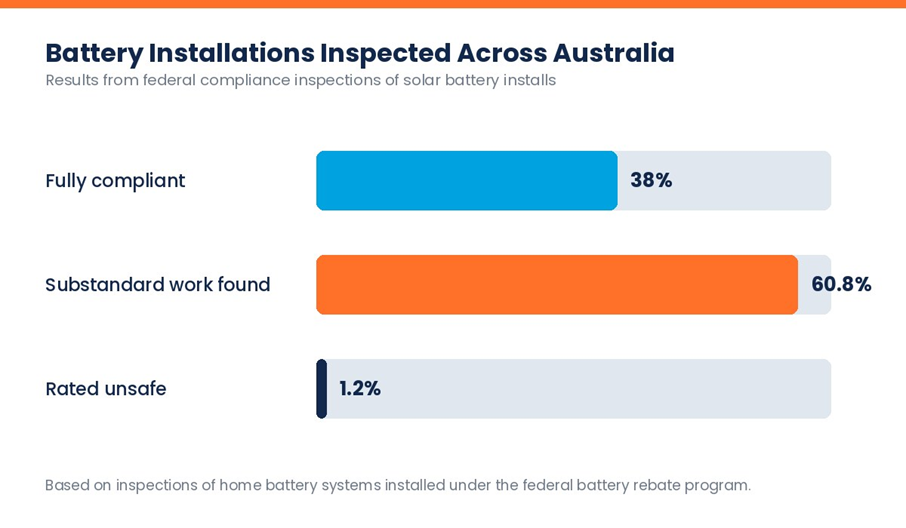
The results were sobering: 60.8% of inspected installs had substandard work, and 1.2% were rated outright unsafe. Common problems included unlabelled backup circuits and missing safety documentation, the exact details that decide whether backup power performs when it matters. NSW’s newer battery incentive settings for businesses and VPP-linked activities starting September 2026 still tie the rebate to installers holding a valid Solar Accreditation Australia (SAA) credential. That requirement exists for a reason: it is one of your main protections against exactly this kind of shortcut.
Reason 4: Nobody Ever Tested It Before the Power Actually Went Out
Backup only proves itself in a real outage, unless you test it first. On a sunny day, with the battery near full, you can flip your main switchboard isolator off and watch what happens.
If your system is islandable, your panels can keep charging the battery during an outage. This can extend your backup time. If not, you will rely on stored power until the grid returns. A short test with your installer or electrician can confirm how your backup works. It can reveal issues before a real storm or nighttime outage.
Reason 5: The Battery Was Never Sized for What You Actually Run
A battery sized for evening bill savings is not automatically sized for blackout survival. Essential circuits, such as your fridge, lights, internet and a few power points, draw relatively little. Air conditioners, ovens and electric hot water systems draw far more, and they can drain a battery within hours if they stay on backup circuits.
A properly scoped solar battery installation in Liverpool starts with understanding your backup needs. Ask your installer which appliances and circuits will run during an outage. Also, confirm how long the battery can power them under typical use.
How to Make Sure Your Backup Actually Works
Run through these four checks with your installer before you commit, and repeat them if you already own a battery.
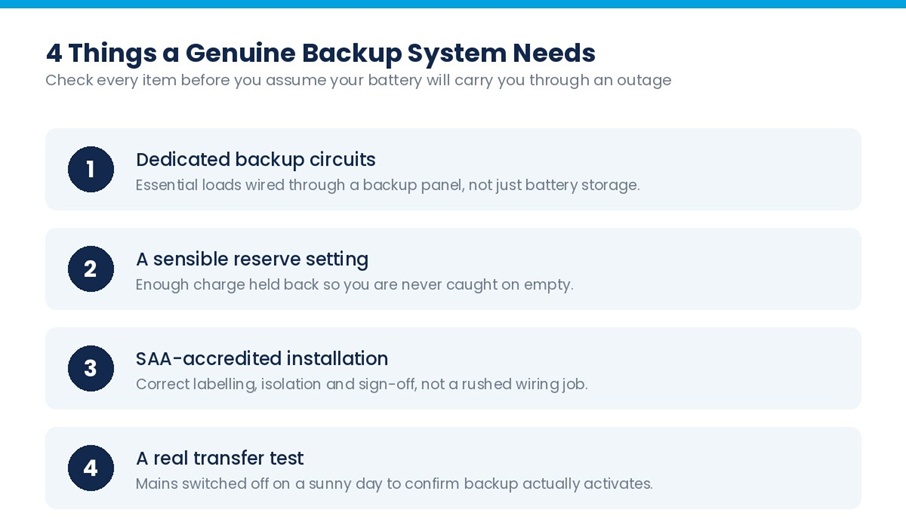
Confirm dedicated backup circuits exist and are clearly labelled. Ask what your minimum reserve is set to, and why. Check the installer’s SAA accreditation number yourself, rather than taking their word for it. Then schedule a real transfer test once the system is commissioned. None of this costs extra once it sits inside the original scope, and all of it is the difference between a battery that earns its keep and one that leaves you in the dark exactly when you needed it most.
| Not Sure Your Backup Would Actually Work? Ask Us to Check. We offer free, no-obligation system reviews for NSW homeowners across Liverpool, Bankstown and Mudgee. We will check your backup circuits, your reserve setting and your installer’s accreditation, and tell you honestly what your system will do in the next outage. Call us: 1800 000 777 Or visit solarbatteryoutlet.com.au and fill in the 60-second eligibility form. |
Frequently Asked Questions
Not unless it has been specifically configured for backup power. Grid-connected solar systems must shut down when the grid fails, under the anti-islanding rule in AS/NZS 4777.2. A battery only bypasses that shutdown if it has dedicated backup circuits and an islanding-capable inverter.
It depends on which circuits are on backup and what you are running, not battery size alone. A household running only essentials, like a fridge, lights and internet, might last many hours on a mid-size battery. Add an air conditioner or oven to backup circuits, and that runtime can drop to a couple of hours.
In most cases, yes, though it usually requires an electrician to install a backup panel and reconfigure the inverter. Ask your original installer, or another SAA-accredited electrician, for a quote before assuming backup is unavailable.
It is the percentage of battery capacity kept aside for emergencies rather than used for daily savings. A higher reserve means more guaranteed backup power but slightly less day-to-day saving. The right balance depends on how often outages happen in your area.
| About Solar Battery Outlet– We are a Liverpool-based solar battery installer, part of GWM Group Pty Ltd, servicing homes across Bankstown and Mudgee. All installations are done by SAA-accredited electricians, and we can review your existing backup setup even if we were not your original installer. |
Disclaimer
This article is general information only and does not constitute personal financial, electrical or legal advice. Backup performance depends on your specific system, installation, appliances and household usage, and results will vary between homes. Compliance figures, standards and program details referenced above are accurate as of publication and may be updated by the relevant regulators or agencies over time. Always seek personalised advice before making a purchasing decision or relying on any system for emergency backup power.
