If you installed solar panels in 2012 and received a generous 44-cent feed-in tariff for every unit of power you exported to the grid, you were in a great position. Solar felt like a money-printing machine. But the rules of the game have changed — quietly, incrementally, and significantly.
In 2026, the average NSW feed-in tariff sits between 3 and 5 cents per kWh. That is not a misprint. A decade ago you might have earned 44 cents for the same unit of electricity. Today you earn a fraction of that. If your solar strategy still revolves around exporting surplus power to the grid, you are leaving the majority of your potential savings on the table.
The good news is that a new set of strategies has emerged — ones that do not depend on grid export rates at all. This guide walks you through the most effective approaches Australian homeowners are using in 2026 to maximize solar return on investment genuinely.
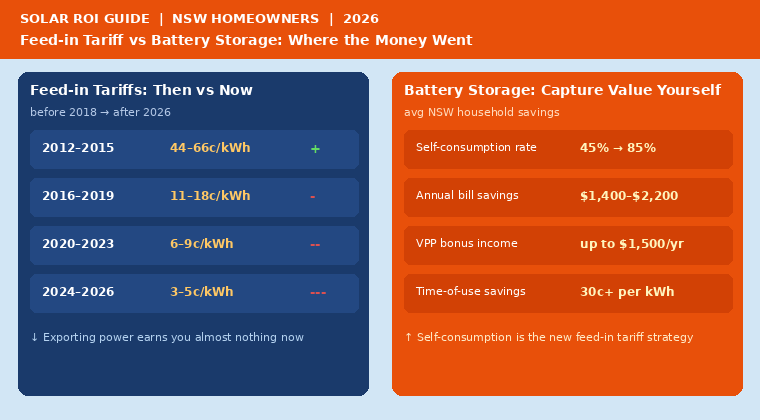
Feed-in Tariff decline vs Battery Storage savings — NSW homeowners, 2026
Why Feed-in Tariffs No Longer Drive ROI
The logic behind the old solar ROI model was simple: generate more than you use, sell the excess, and your bill drops to near zero. That worked when tariff rates were genuinely high. At 44–66 cents per exported kWh, exporting power was nearly as valuable as not consuming it at all.
But energy retailers have been steadily cutting those rates for years. The economics shifted dramatically after 2018, and by 2024 most NSW households on standard plans receive between 3 and 5 cents per kWh exported. To put that in context: the same unit of electricity costs you around 28–34 cents to buy back from the grid at peak time. Exporting it earns you 4 cents. That is a gap of 25 cents per kilowatt-hour that you are simply losing.
The key shift: Every kWh you use yourself — instead of exporting — is worth 25–30 cents in avoided cost. Every kWh you export earns just 3–5 cents. Self-consumption is now seven to ten times more valuable than grid export.
This is the fundamental reason why the strategies in this guide focus almost entirely on capturing your solar generation before it leaves your home — rather than on what you sell back.
Strategy 1: Shift Your Loads Into Solar Hours
The simplest and cheapest change you can make is to run your high-consumption appliances during the hours your panels are actually generating — typically 10 am to 3 pm in NSW.
This means:
- Running your dishwasher at midday rather than after dinner
- Setting your washing machine on a timer to start around 10 am
- Running electric hot water systems on a solar-boosted schedule
- Charging EVs during solar peak hours, when your daily schedule allows
The financial logic is straightforward. Running an appliance on your own solar avoids buying grid power, though you give up the small feed-in credit… This can save money — how much depends on your usage.
Strategy 2: Battery Storage — The Game-Changer for 2026
Load shifting alone has limits. Most households cannot rearrange their entire day around solar output. This is where battery storage becomes genuinely transformative.
A solar battery captures the excess generation you would otherwise export at 3–5 cents per kWh and stores it for use when your panels are not generating — evenings, overcast days, and peak tariff periods. Instead of selling cheap and buying expensive, you store your own solar for later.
What the numbers look like in NSW (2026): A 10 kWh battery installed alongside a solar system may increase the amount of solar energy used on-site by storing excess daytime generation for use later when solar production is lower. The extent of any increase in solar self-consumption will depend on factors including household electricity usage, solar generation, battery capacity and system configuration. Actual bill savings will vary and should be estimated using your electricity bills, tariff structure and installation quote.
If you are thinking about adding storage, it is worth understanding the current rebate structure before making a decision. Our detailed guide on whether to rush for a solar battery before the rebate changes covers the timing question in full — including what actually changes on 1 May 2026 and what stays the same until 2030.
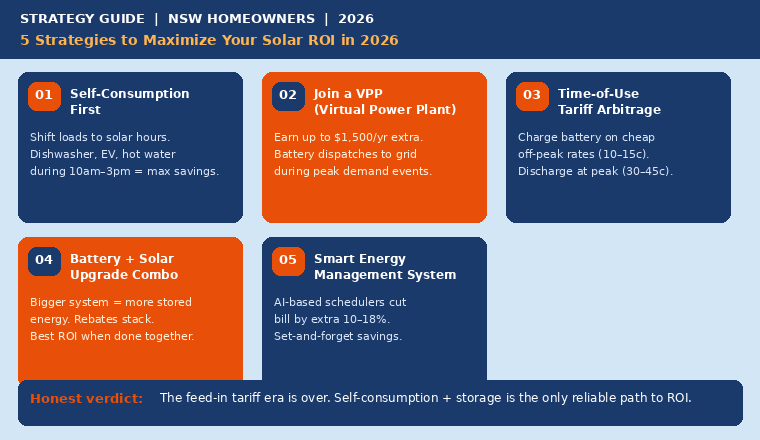
5 strategies to maximize solar ROI in 2026 — NSW households
Strategy 3: Join a Virtual Power Plant (VPP)
A Virtual Power Plant is a network of home batteries coordinated by an energy provider to act as a collective grid resource. When grid demand spikes — typically on hot summer evenings in NSW — the VPP draws small amounts of power from each enrolled battery to stabilize supply.
In exchange for participating in a Virtual Power Plant (VPP), eligible households may receive incentives or other benefits in accordance with the VPP provider’s terms and conditions. Any available incentive amount will depend on the battery, the VPP provider and current scheme rules, and should be confirmed in your quote or VPP agreement. The battery continues to meet your household’s needs in accordance with the VPP provider’s operating arrangements.
Not all battery brands and installers support VPP participation. If this strategy interests you, confirm VPP compatibility before selecting a battery model. Compatible systems include the Tesla Powerwall 3, Sungrow SBR series, and several BYD configurations, among others.
VPP eligibility note:
Eligibility for a Virtual Power Plant (VPP) depends on the battery system, inverter, VPP provider and current program requirements. Your installer or VPP provider can confirm whether your proposed system is eligible and explain any applicable participation requirements.
Strategy 4: Time-of-Use Tariff Arbitrage
If your energy plan has time-of-use (ToU) pricing — and most NSW households now have access to one — a battery can work as a tariff arbitrage tool, not just a solar storage device.
The principle is simple: charge your battery from the grid during off-peak periods (typically 10pm to 7am) at rates of 10–15 cents per kWh. Discharge it during peak periods (5pm to 10pm) when grid electricity costs 30–45 cents. The difference is your margin.
Combined with solar generation during the day, a smart battery system can cycle through three revenue events every 24 hours:
- Morning discharge: use stored solar/overnight energy during the breakfast peak
- Midday solar harvest: panels generate and fill the battery from around 9am
- Evening discharge: supply the home from battery during the 5–10pm peak tariff window
Not every household will capture all three perfectly, but even partial capture across two cycles can meaningfully improve the economics of storage.
Strategy 5: Energy Management Systems — Making It Automatic
Manual load shifting and tariff arbitrage require you to actually pay attention to when things run. Energy Management Systems (EMS) automate this entirely.
Modern EMS platforms — including those from Reposit Power, Amber Electric, and several inverter-native options from Sungrow and Fronius — use real-time weather forecasting, tariff data, and grid signals to optimize your system automatically. They decide when to charge, when to discharge, when to export, and when to import without any input from you.
Homeowners using smart EMS platforms report an additional 10–18% reduction in electricity bills compared to households with batteries but no active management software. For households already benefiting from battery storage, the additional value of increased solar generation or improved energy efficiency will depend on factors including electricity usage, tariff structure, battery performance and solar generation. Actual financial outcomes will vary between households.
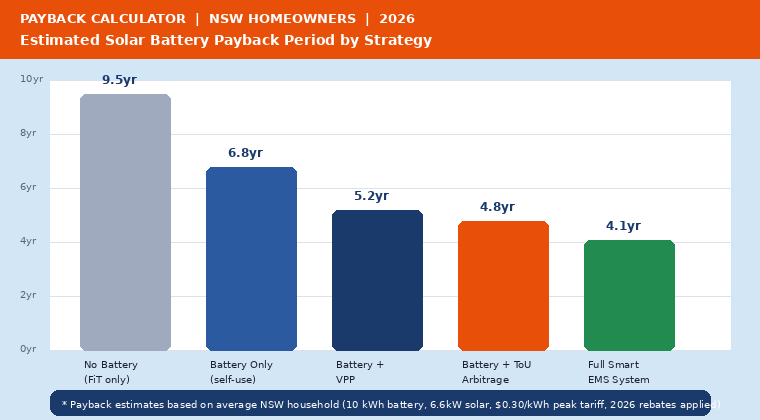
Estimated payback period by solar ROI strategy — NSW, 2026 rebates applied
What the Payback Numbers Actually Look Like
The chart above illustrates estimated payback periods for a 10 kWh battery installation in NSW under current 2026 conditions, across different strategic approaches.
The key takeaways:
- Relying on feed-in tariffs alone (no battery) has a payback period pushing 9–10 years and is lengthening as tariff rates continue to fall
- A battery used for self-consumption alone reduces payback to around 6.5–7 years
- Participation in a Virtual Power Plant (VPP) may provide additional benefits, subject to the VPP provider’s terms and conditions.
- Features such as energy management systems (EMS), tariff optimisation and VPP participation may affect household energy costs, depending on electricity usage patterns, tariff structures and system performance.
These are averages. Your actual payback depends on your tariff structure, daily consumption, solar system size, and which battery model you choose. A good installer will model this specifically for your property.
Choosing the Right Battery for These Strategies
Not all batteries support all strategies equally. Here is a quick summary of what to look for:
For VPP participation:
Ensure the battery has grid export capability enabled and is on the approved VPP provider list for your chosen program.
For ToU arbitrage:
Look for batteries with a usable capacity above 13 kWh and efficiency over 90%. Also choose a system with a smart inverter that can respond to external tariff signals.
For full EMS automation:
Inverter compatibility with third-party energy management platforms matters. Sungrow, Fronius, and Enphase all have strong EMS ecosystems.
For basic self-consumption:
Almost any quality battery will perform well. Focus on warranty terms, cycle life, and installer experience.
A Word on the 2026 Battery Rebate
The Federal Government battery rebate remains in place until 2030 — but the calculation rate adjusts every six months. For NSW homeowners, the rebate is real and meaningful. It steps down every six months, so your quote will show the current amount.
If you are weighing the timing of your installation, our guide on the rebate deadline helps you decide whether to rush or wait. It outlines five practical questions to consider before making a decision. The honest answer depends on your battery size, readiness, and overall situation. This article explains everything clearly without any sales-driven bias.
The real question for 2026: The era of passive-solar ROI via feed-in tariffs is over. The new era is active — self-consumption, storage, VPP participation, and smart energy management. Households that combine solar, battery storage, tariff optimisation and, where suitable, Virtual Power Plant participation may improve the overall economics of their energy system, although actual payback periods vary depending on installation costs, electricity usage, tariff structure and available incentives. Those who do not are watching their ROI stretch toward a decade.
Ready to Maximize Your Solar ROI?
If you have existing solar and want to know exactly how much a battery could improve your returns — or if you are starting fresh and want a system designed around the 2026 strategies in this guide — the team at Solar Battery Outlet can help.
We offer obligation-free written quotes that model your actual bill savings, VPP eligibility, and payback period based on your real usage data. No countdown timers. No pressure tactics. Just clear numbers.
Get a Free Solar Battery Assessment Today
📞 Call 1800 000 777 | Get a Free Quote | No Obligation Solar Battery Outlet — NSW’s trusted solar storage specialists. Serving homeowners across Sydney, Newcastle, Wollongong, and regional NSW.