
Something significant is happening in Australian homes right now. Walk down any street in Western Sydney, Brisbane’s outer suburbs, or Adelaide’s growth corridors, and you’ll notice it—gleaming solar panels on rooftops, flanked increasingly often by a white or grey box on the garage wall. That box is a home battery. And in 2026, more Australians are installing them than at any point in history.
The numbers are striking. In March 2026 alone, NSW recorded over 600 megawatt-hours of new battery installations — a 44% monthly increase and a new state record. Nationwide, the Clean Energy Regulator is projecting up to 520,000 home battery installations this year alone, compared to just 193,000 in all of 2025. Australia’s residential battery storage market — already worth billions — is on track to reach USD 3 billion by 2034.
The rapid adoption of solar batteries is driving Australia’s energy shift in 2026, as homeowners look for smarter ways to store excess solar power and reduce reliance on the grid. With feed-in tariffs dropping and electricity prices rising, households are prioritising energy independence and better use of their rooftop solar systems. This isn’t a blip. 2026 is a genuine structural turning point for home energy storage in Australia. Here’s exactly why — and what it means if you’re still sitting on the fence.
Reason 1: The Government Finally Made It Worth It
For years, the economics of home batteries were marginal for most Australian households. The hardware was expensive, payback periods stretched to 12–15 years, and the financial case relied on a lot of optimistic assumptions.
That changed in July 2025 when the federal government launched the Cheaper Home Batteries Program (CHBP) — making home batteries eligible for Small-scale Technology Certificates (STCs) under the Small-scale Renewable Energy Scheme for the first time. In plain English: the government is subsidising roughly 30% of the upfront cost of any eligible battery from 5 kWh to 100 kWh. On a standard 10 kWh system, that’s roughly $3,100 off the invoice before you even start talking about state-level incentives.
The results were immediate. Installations in the final quarter of 2025 alone were approximately three times higher than the total for all of 2024. The program has already supported more than 300,000 battery installations nationally since launch — and 2026 is on pace to dwarf that figure entirely.
Important for NSW homeowners: There’s also a separate NSW Peak Demand Reduction Scheme (VPP incentive) worth up to $1,500 on top of the federal rebate. Most homeowners don’t know about it until their installer tells them — or doesn’t. Read our full guide to the NSW VPP incentive here.
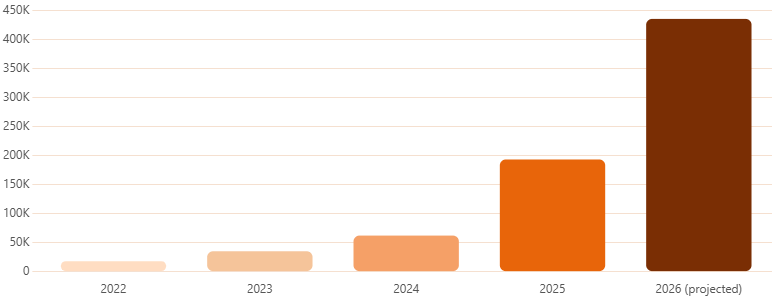
Australian residential battery installations 2022–2026 (2026 is CER midpoint projection). Sources: Clean Energy Regulator, SunWiz.
Reason 2: Feed-in Tariffs Have Changed — And That Has Increased Interest in Battery Storage
Many households that already have solar ask whether exporting electricity to the grid still provides the same value it once did. Feed-in tariffs have generally declined in recent years, while the cost of importing electricity from the grid varies depending on the retailer and tariff structure.
As a result, some households are considering solar batteries as a way to store excess solar energy generated during the day for use later when solar generation is lower.
For some households, this can increase the amount of solar energy used on-site rather than exported to the grid. A battery can store excess daytime solar generation and make that energy available during the evening, when household electricity demand is often higher.
The financial outcomes will depend on factors including electricity usage patterns, tariff structure, feed-in tariffs, battery capacity, solar generation and installation costs. Actual bill savings and payback periods vary between households and should be assessed using your electricity bills and a detailed installation quote.
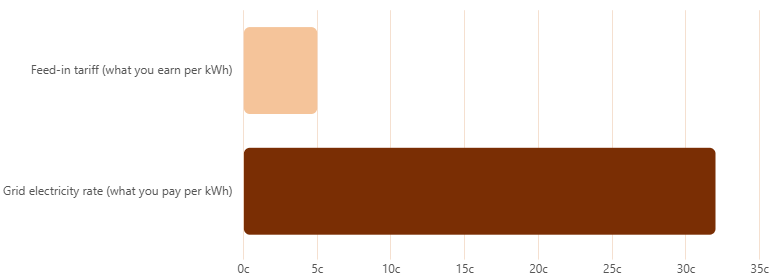
Average feed-in tariff vs. average grid electricity rate in NSW/VIC/QLD (2026). Self-consumption via battery is worth 6–10× more than exporting. Sources: VoltFlow, IMARC Group.
Reason 3: Battery Costs Have Fallen to a Tipping Point
The third major shift in 2026 is on the cost side of the ledger. Battery hardware prices have followed the same downward curve as solar panels did a decade ago — a steep, sustained decline driven by scale manufacturing, improved chemistry, and fierce competition between BYD, Tesla, Sungrow, Enphase, and a growing field of challengers.
A 10 kWh battery system that would have cost $14,000–$18,000 installed five years ago now retails for around $10,000–$12,000 before rebates. After the federal CHBP rebate, the net cost drops to roughly $7,000–$9,000 for most households. For NSW homeowners who stack the VPP incentive on top, the net cost can fall below $6,000.
At those numbers, with current electricity prices and the end of meaningful feed-in tariffs, payback periods of five to eight years are realistic for a well-matched system. For high-consumption households or those in states with stronger incentives, Payback periods vary depending on system cost, electricity usage, tariff structure, available incentives and battery performance.
Popular Battery Models and Indicative 2026 Pricing (NSW)
| Battery | Usable Capacity | Pre-Rebate (est.) | After Federal Rebate | After Federal + NSW VPP |
| BYD Battery-Box HVM 10 kWh | 10 kWh | ~$10,500 | ~$7,400 | ~$6,300 |
| Tesla Powerwall 3 | 13.5 kWh | ~$14,000 | ~$10,280 | ~$8,930 |
| Sungrow SBR 9.6 kWh | 9.6 kWh | ~$9,800 | ~$6,830 | ~$5,770 |
| Enphase IQ Battery 5P (10 kWh) | 10 kWh | ~$11,200 | ~$8,100 | ~$7,000 |
Prices are indicative estimates for installed systems including labour. Always request an itemised quote from your installer.
Government rebates and falling hardware costs have made solar batteries more affordable than ever, which is why many Australians are now pairing them with existing rooftop systems to maximise savings and improve backup reliability during outages.
Reason 4: The Grid Is Becoming Less Reliable — And Australians Know It
Beyond the financial case, there’s a growing practical motivation driving battery uptake: blackout anxiety. Australia’s electricity grid is under structural pressure. Coal plants are retiring faster than replacement capacity is being built. Extreme weather events — heatwaves, storms, cyclones — are becoming more frequent and more intense, placing higher peak demands on infrastructure that wasn’t designed for a 42-degree day.
For many Australians, the memory of being without power for hours or days is the final push they needed. A home battery with adequate backup capacity keeps the lights on, the refrigerator running, and the phone charged when the rest of the street goes dark. That resilience value is real and it’s something that doesn’t show up cleanly in payback period calculations — but it matters enormously to families with young children, medical equipment, or simply a home office they can’t afford to lose for a day.
Blackout note: If backup power is your priority, make sure your battery is configured as a “whole home backup” system. Some battery installations are grid-tied only and won’t power your home during an outage. Always confirm backup capability with your installer before signing a contract.
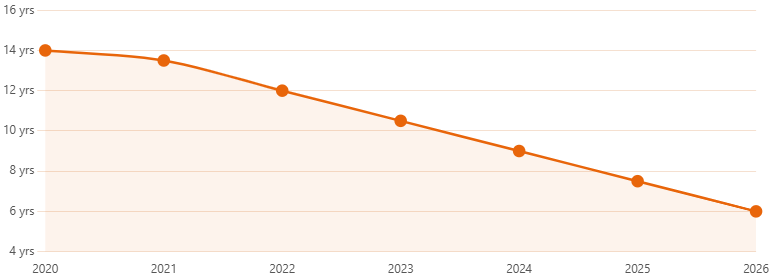
Estimated average battery payback period for a standard 10 kWh system (NSW, typical household). Reflects falling hardware costs, rising grid prices, and government rebates. Sources: Gridly, Solutions4Solar.
Reason 5: 2026 Is the Peak Incentive Window — And It’s Closing
Here’s an important consideration: the federal battery discount is scheduled to reduce over time under the program rules currently in place. The applicable discount depends on the installation date, battery size and the program settings that apply at the time of installation. The program is designed with a declining discount structure through to 2030.
As a result, the discount available for later installations may be lower than the discount available for earlier installations. The exact amount available to your installation will be shown in your quote. Battery and solar installation activity can vary over time due to a range of factors, including consumer demand, market conditions, product availability and changes to incentive programs.
Households considering a battery should review the incentives currently available and assess the suitability of the system based on their own electricity usage, tariff structure and installation requirements.
Federal Battery Rebate Step-Down Schedule (Approximate, 13.5 kWh System)
| Installation Period | Estimated Rebate Value | vs. April 2026 |
| Before 1 May 2026 | ~$4,557 | Maximum — current window |
| May – Oct 2026 | ~$3,488 | –$1,069 |
| Nov 2026 – Apr 2027 | ~$2,800 | –$1,757 |
| 2028+ | Declining further | Stepped reductions continue |
How Much Can You Actually Save?
The question every homeowner eventually asks is: what does this mean for my electricity bill? The honest answer is that it depends on your consumption patterns, your current tariff, whether you’re on time-of-use pricing, and how well your battery is sized against your usage. But some ballpark numbers help calibrate expectations.
A household with a solar system and battery may reduce the amount of electricity purchased from the grid by storing excess solar energy generated during the day for use later when solar generation is lower. Actual bill savings will depend on factors including electricity usage patterns, tariff structure, solar generation, battery capacity and system performance.
Additional benefits may be available through participation in a Virtual Power Plant (VPP), subject to the provider’s terms and conditions. Any available incentives, credits or payments will vary by provider and should be confirmed in your quote or VPP agreement. Actual savings and payback periods vary between households and should be assessed using your electricity bills, tariff structure and installation quote.
At the current rebate levels, a typical NSW household installing a 10-kWh system could recover their net investment in approx. five to seven years — and the potential savings may continue throughout the battery’s operating life, although actual outcomes will depend on electricity usage, tariff structure, battery performance, maintenance requirements and future electricity prices.
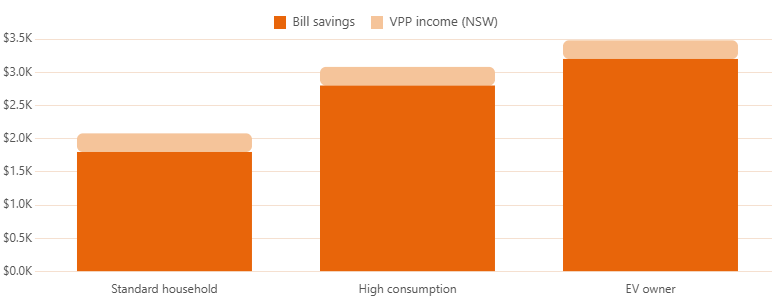
Estimated annual electricity bill savings with a 10 kWh battery system (NSW, time-of-use tariff). VPP income shown as additional layer. Sources: Gridly, Solutions4Solar, Solar Battery Outlet installs data.
What Does This All Mean for You?
If you already have solar and you’re exporting most of your generation at 4–6 cents per kWh, you’re leaving money in the grid every day. A battery doesn’t just save money — it recaptures value you’ve already generated and are currently giving away.
If you don’t have solar yet, 2026 is also an exceptional time to install solar and battery together. Combined packages often attract better pricing from installers, and the incentive structures for solar (STCs) remain strong alongside the battery rebate.
The factors influencing battery adoption include government incentives, changing feed-in tariffs, electricity prices, technology costs and household energy requirements. These factors can change over time and may affect the economics of battery storage for different households. The federal battery discount is currently scheduled to reduce over time under the program rules.
As a result, the discount available to a future installation may differ from the amount available today. Households considering a battery should assess the system based on their own electricity usage, tariff structure, installation costs and the incentives available at the time of installation. Your quote should set out the incentives and estimated financial outcomes applicable to your circumstances.
Ready to find out what you’d save?
We process both the federal Cheaper Home Batteries rebate AND the NSW VPP incentive on every installation. No chasing paperwork. Just a cleaner electricity bill.
Get a free quote — takes 60 seconds
Or call us on 1800 000 777
Frequently Asked Questions
Is 2026 really the best time to install a solar battery in Australia?
The right time to install a solar battery depends on your household’s electricity usage, tariff structure, installation costs and the incentives available at the time. The federal battery discount is currently scheduled to reduce over time under the program rules, so the amount available may differ depending on your installation date. Your installer should provide a quote showing the incentives and estimated financial outcomes applicable to your circumstances.
Do I need to already have solar panels to install a battery?
No — you can install a battery without existing solar. Some households do this to take advantage of cheaper off-peak electricity rates. However, the payback case is strongest when you pair a battery with an existing or new solar system, because the battery stores your self-generated power rather than cheap grid electricity.
What’s the difference between the federal rebate and the NSW VPP incentive?
They are completely separate programs run by different governments. The federal rebate reduces your upfront invoice by around 30% on any eligible battery. The NSW VPP incentive pays you up to $1,500 separately after installation when your battery is connected to a Virtual Power Plant network. Both can be claimed together. See our NSW VPP guide for the full detail.
How long do solar batteries last?
Most major battery brands — BYD, Tesla Powerwall, Sungrow, Enphase — come with 10-year warranties and are typically rated for 3,000 to 6,000 charge cycles. In real-world Australian conditions, batteries are lasting 12–15 years in many installations. The warranty period is the floor, not the ceiling.
What size battery do I need?
For a typical Australian home using 20–28 kWh per day, a 10–13.5 kWh battery will cover most evening and overnight usage. If you have an electric vehicle, air conditioning running heavily in summer, or a larger property, you may benefit from a larger system or stacked batteries. A good installer will analyse your actual usage data before recommending a size.
