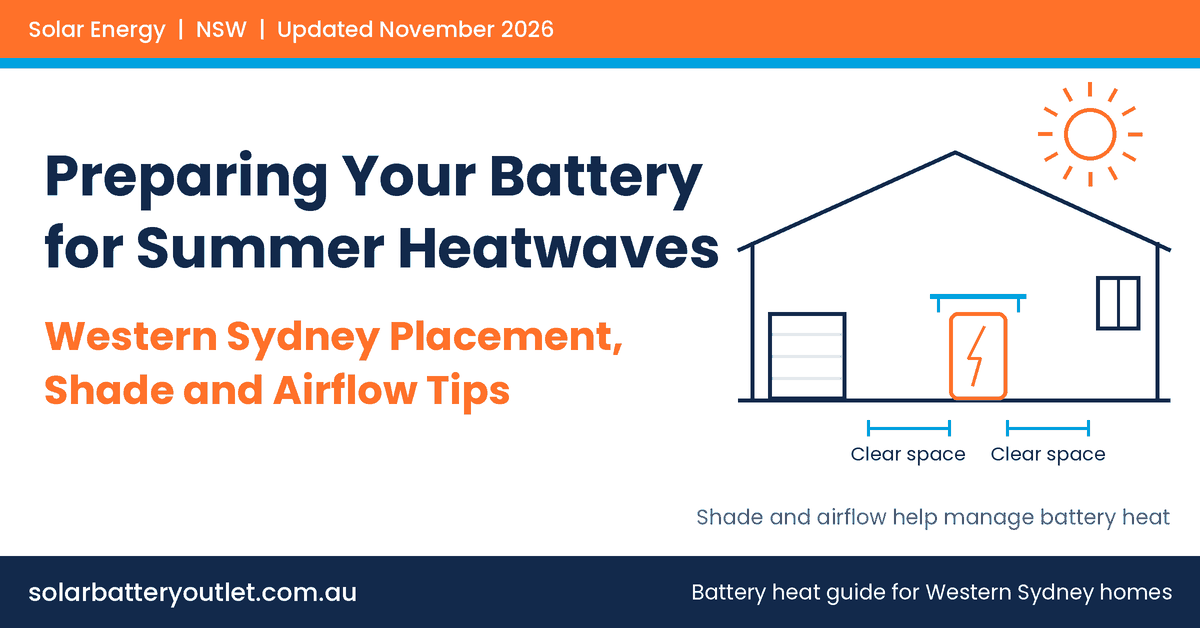
By 5 pm on a January afternoon, a Western Sydney garage can feel like an oven. Your home battery sits in that heat all summer. It protects itself by easing back, and that can change how much stored energy you can use.

This guide explains how heat affects a home battery. It also covers solar battery heatwave preparation and the questions to ask before you sign an installation contract.

Can a Solar Battery Handle a Western Sydney Heatwave?

Short answer: a compliant home battery is built for Australian conditions, but every model has its own temperature limits. When the air gets too hot, the battery or its inverter protects itself. It can slow charging, reduce output or pause until it cools.

Placement, shade and airflow decide how often that happens. So preparation starts with the site, not the settings.

Why Western Sydney Heat Puts Extra Pressure on Home Batteries

Western Sydney University researchers report that warming is felt more intensely in Sydney’s west than in the east. Summers are also lasting longer. That matters for homes in Liverpool and nearby suburbs.

What Counts as a Heatwave?

The Bureau of Meteorology describes a heatwave as three days of unusually hot maximum and minimum temperatures. Hot nights matter for batteries. Brick walls and garages release stored heat well into the evening.

Why the Evening Matters Most

Most households lean on their battery after sunset. That is also when hot walls and garages give back their heat. A battery working hard in a warm space can reach its protective limits sooner.

What Heat Does to a Home Battery

Heat has two effects. In the short term, protective limits can reduce charging and output. Over many years, sustained high temperatures can speed up battery ageing.

Check the operating temperature range on your battery’s datasheet. The manufacturer sets that range, and it differs between models.

Where to Place a Battery to Limit Heat Exposure

Location does more for battery heat than any app setting. Your installer must follow AS/NZS 5139 and the manufacturer’s instructions when choosing the spot.

Better Locations for Hot Summers

Shaded south- or east-facing walls receive the least afternoon sun. A well-ventilated garage can also work, although garages can trap heat. Ask your installer how air will move through the space.

For outdoor walls, a purpose-built cover or awning can cut direct sun. Shade typically lowers surface temperatures, so it helps even on a mild-looking day.

Locations That Run Hot

  • West-facing walls absorb afternoon sun and release heat into the evening.
  • Narrow side passages block airflow and hold warm air.
  • Spots beside brick, concrete or paving radiate stored heat back at the unit.
  • Closed cupboards and uninsulated sheds leave heat nowhere to go.
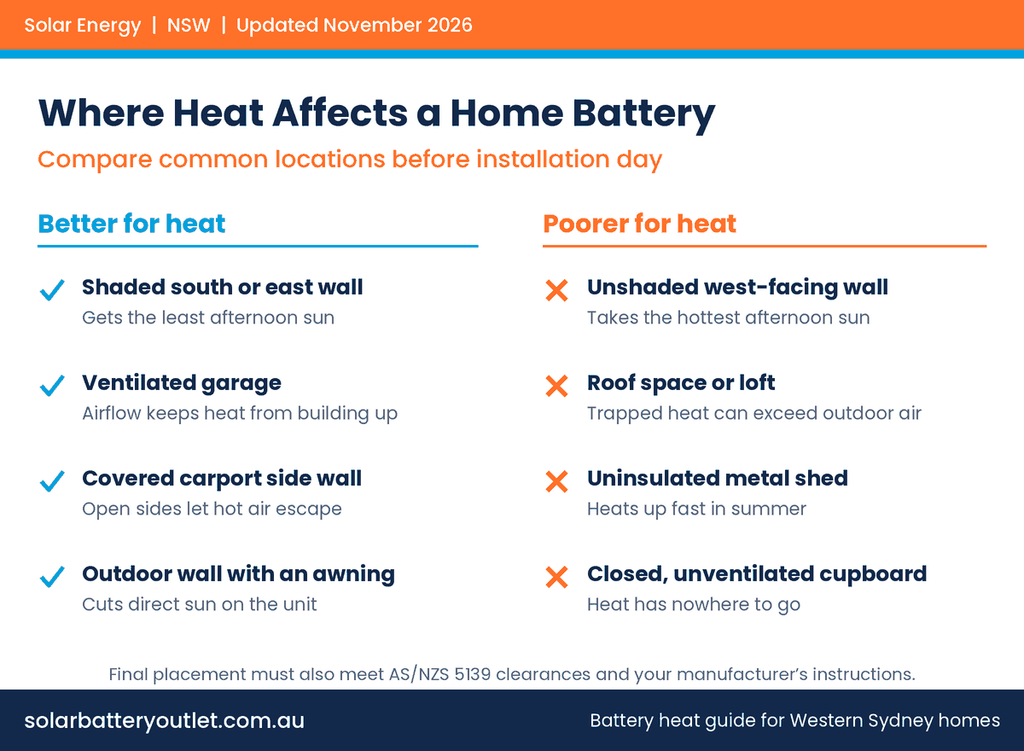
comparing better and poorer home battery locations for heat

Keep Clearances Clear

Leave the space your installer specified around the unit. Do not stack boxes on or against the battery. Keep vents free of dust, leaves and cobwebs.

Your Solar Battery Heatwave Checklist

Work through these six checks before the first heatwave arrives.
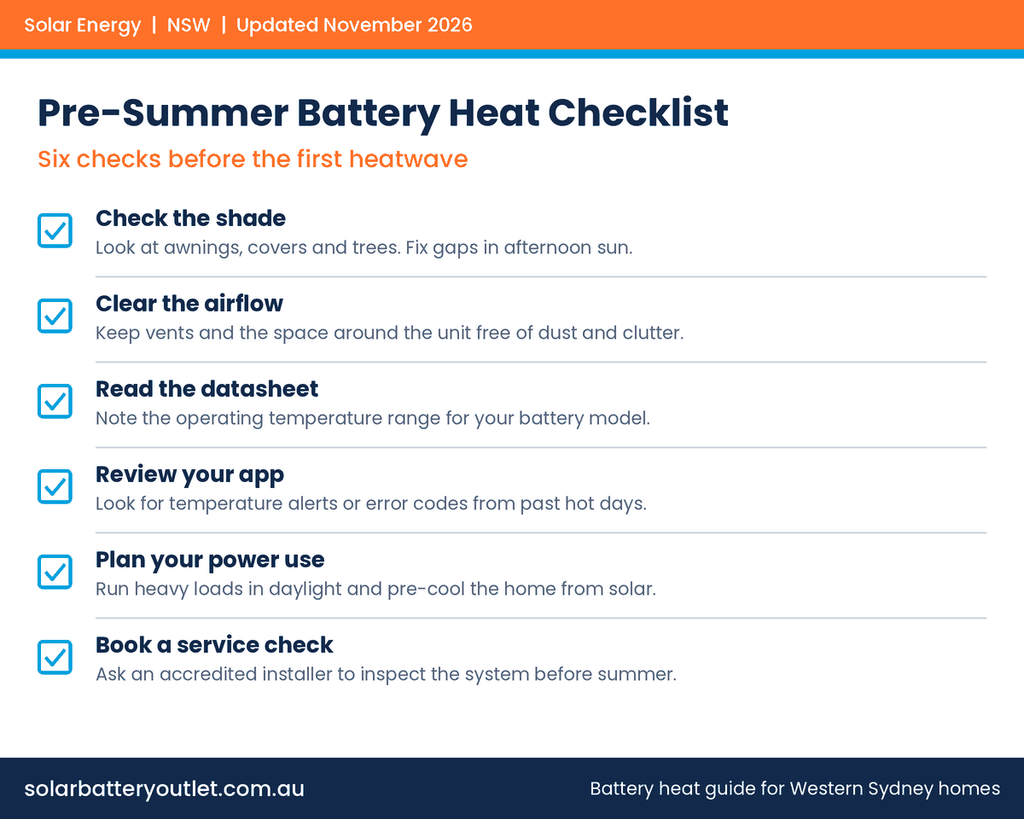
Pre-summer battery heat checklist with six steps: check the shade

How to Work Through the Six Checks

Start with shade. Walk past the battery at 3 pm and note where the sun lands. Next, look at airflow. Remove clutter, and brush leaves and dust from vents without opening the unit.

Then read the datasheet and your app history. Look for temperature alerts from last summer. Finally, plan your power use. Running heavy appliances in daylight, when solar generation is high, reduces evening demand on the battery.

A service check completes the list. Only an accredited installer should open or work on the system.

A Simple Example

Suppose your battery sits on a west-facing wall. Open the app at 6 pm on a hot day. If temperature alerts appear, ask your installer about shading or relocation before the next heatwave.

During a Heatwave

  • Check the app in the late afternoon and early evening, when heat peaks.
  • Expect some warmth. The unit should not feel hot to touch.
  • Never cover the battery or spray it with water.
  • Leave charge and discharge settings alone unless your installer advises otherwise.
  • Keep your internet connection on. Some manufacturers use monitoring data when assessing claims.

Warning Signs

Contact your installer about unusual heat, swelling, odd smells, noises or temperature alarms. If you see smoke or flames, leave the area and call 000.

Heatwaves, Outages and Backup Settings

Heatwaves can strain the electricity network, and outages sometimes follow. Not every battery system provides backup power. It depends on the equipment and how the installer wired it.

Ask whether your system supports backup. If it does, ask how the reserve setting works and how heat could affect it. Keep any changes within your installer’s guidance.

Questions to Ask Your Installer Before You Sign

Heat planning belongs at the quote stage. For solar battery installation in Liverpool, ask the installer to assess sun exposure at your property before proposing a location.

Then put these questions to every installer you compare:

  • Where will the battery go, and why? Ask for the reasoning in writing.
  • What is the battery’s operating temperature range?
  • Does the warranty set installation conditions, such as sun exposure or ventilation?
  • Does the installer hold current accreditation for batteries? You can check whether your installer is SAA-accredited before you sign.
  • Who handles warranty claims, and what does the process involve?
  • When are payments due, and which stage of the job does each payment cover?

The Clean Energy Regulator sets rules for batteries installed under the small-scale renewable energy scheme. Owners must receive written documentation about their battery and installation. Keep it with your contract.

Australian Consumer Law also provides consumer guarantees alongside any manufacturer warranty. Take your time, and do not sign under pressure.

Already Own a Battery in a Hot Spot?

Do not move or enclose the battery yourself. A homemade box can trap heat and may conflict with the manufacturer’s instructions.

Instead, ask an accredited installer to inspect the site. They can recommend shading, ventilation or relocation that meets AS/NZS 5139. Ask how any change affects your warranty, and get it in writing.

Talk to Solar Battery Outlet Before You Sign

Planning a battery for a hot Western Sydney home? Call Solar Battery Outlet on 1800 000 777 before you sign an agreement. Our Liverpool team can talk through placement, shade, airflow and contract terms with you.

A short conversation now can help you ask better questions of every installer on your shortlist.

Solar Battery Heatwave FAQs
Can a heatwave damage a solar battery?

Extreme heat can trigger protective limits that slow charging or reduce output. Over years, sustained heat can accelerate ageing. Good placement, shade and airflow reduce the risk. Check your datasheet for the temperature range.

What is the best place for a battery in a Western Sydney home?

A shaded south- or east-facing wall, or a well-ventilated garage, usually suits hot summers. Your installer must also meet AS/NZS 5139 and the manufacturer’s instructions for your site.

Is a garage safe for a home battery?

It can be, if the installation follows AS/NZS 5139 and the manufacturer’s instructions. Garages can trap heat, so ask your installer about ventilation and clearances.

Will my warranty cover heat problems?

It depends on the warranty. Some set installation conditions, such as ventilation. Read the terms before you sign, and ask for answers in writing. Consumer guarantees under Australian Consumer Law apply separately.

Should I switch my battery off during a heatwave?

Do not change settings or switch it off unless your installer or the manufacturer advises it. If the unit alarms or feels very hot, contact your installer.

Disclaimer

This article provides general information about preparing home batteries for hot weather. It does not replace individual legal, technical or purchasing advice. Battery models, site conditions and warranty terms vary. Always seek personalised advice before making a purchasing decision.
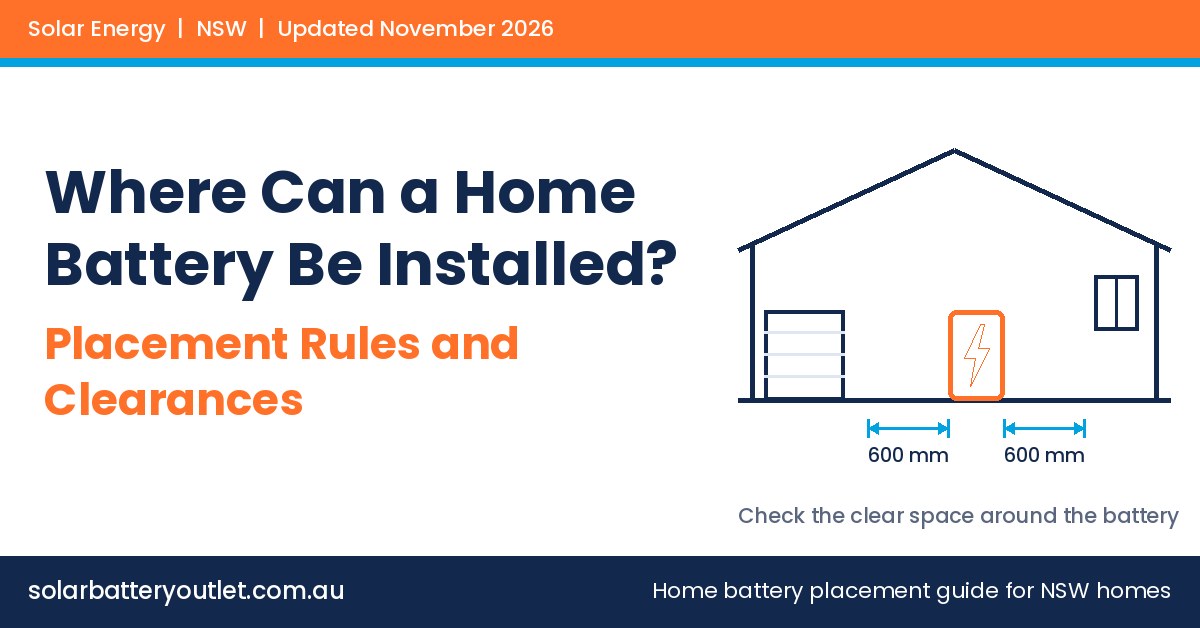
Where can a home battery be installed? Australian Standard AS/NZS 5139 answers. A battery needs a safe, accessible spot with clear space around it. For most NSW homes, that means a garage, an external wall or a laundry. However, a poor location can fail an inspection and put your household at risk. This guide explains the restricted locations, the clearances and the questions to ask before you sign.

Which Rules Decide Where a Home Battery Goes?

AS/NZS 5139:2019 sets the placement rules for home batteries in Australia. Amendment 1 arrived in December 2025. The standard works alongside AS/NZS 3000, the wiring rules, and the manufacturer’s installation manual. Therefore, your installer should apply all three to your site.

Electrical safety regulators across Australia endorse a guide to AS/NZS 5139 installation requirements. It explains how regulators read the location rules. Regulators treat a battery as a possible source of ignition. Consequently, the rules keep it away from people, escape routes and other heat sources.

Note that the guide pre-dates Amendment 1, so some details may differ today. Ask your installer which version applies to your quote.

Which Locations Are Off Limits for a Home Battery?

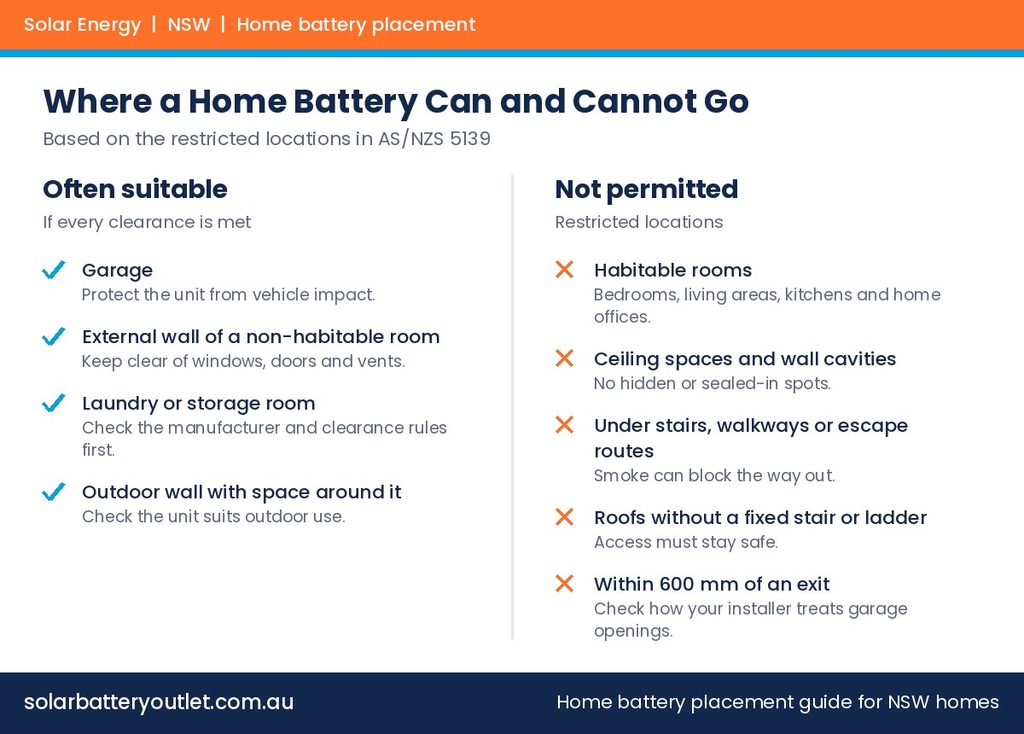
A home battery cannot go in a habitable room, a ceiling space, a wall cavity or an escape route. The details below explain why.

Habitable Rooms

Habitable rooms include bedrooms, home offices, living rooms, kitchens and dining rooms. They also cover playrooms, entertainment rooms and sunrooms. Therefore, a spare bedroom or study is never a suitable battery spot.

Ceiling Spaces, Wall Cavities and Roofs

Likewise, installers cannot place a battery in a ceiling space or set it into a wall cavity. The same rule applies to roofs without a fixed staircase or ladder. Each of these spots limits safe access.

Escape Routes and Walkways

In addition, a battery cannot sit in a passageway, walkway or escape route. It also cannot sit under stairs or entry walkways. Smoke from a burning battery could block the way out. Fire could also weaken the structure above.

Your manufacturer may prohibit other spots as well. Our guide to battery safety features explains what else to look for.

comparing often suitable home battery locations with restricted locations such as habitable rooms, ceiling spaces and escape routes

What Clearances Does a Home Battery Need?

Clearances add a second layer of rules. They keep the battery away from doors, windows and heat sources.

Exits and Doorways

A battery must sit at least 600 mm from an exit. Regulators in NSW have treated every opening people can use as an exit, including garage door openings. However, Amendment 1 now allows an exception for exits wider than 900 mm. In that case, people need at least 1 metre of clear space to pass. Because both rules exist, ask your installer which one applies to your home.

Windows and Vents

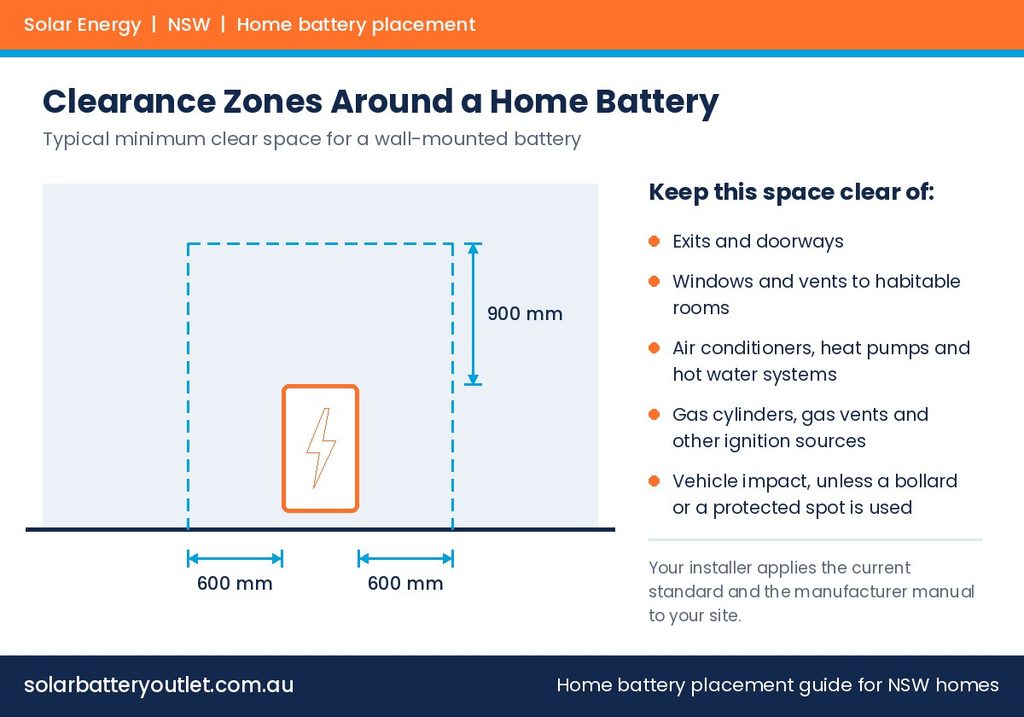
A battery cannot sit within 600 mm sideways of an opening window or vent to a habitable room. It also cannot sit within 900 mm below one. As a result, a window directly above your preferred wall spot may rule it out.

Appliances and Gas

Other electrical appliances must stay 600 mm to the side and 900 mm above the battery. Examples include air conditioners, heat pumps, hot water cylinders and stoves. Solar inverters that charge the battery are the exception. Meanwhile, gas cylinders and gas relief vents have their own exclusion zones. Gas network providers may add further limits.

Diagram of the 600 mm side and 900 mm upper clearance zones around a wall-mounted home battery, with a list of items to keep clear

Can You Install a Home Battery in a Garage?

Often, yes. A garage is not a habitable room, so it can suit a battery. However, the same clearances still apply.

Vehicles add a further risk. Regulators expect protection from impact, such as a bollard or a position a vehicle cannot reach. Furthermore, earlier NSW guidance counts a garage door opening as an exit, so measure carefully.

For example, picture a Liverpool home with a single garage. The only free wall sits close to the roller door, and a hot water unit hangs nearby. That layout may leave too little room. An external wall elsewhere may work better.

Compare quotes for solar battery installation in Liverpool carefully. Ask each installer to mark the position and clearances on a site plan.

Does the Wall Behind the Battery Matter?

Sometimes, yes. A barrier may apply when a habitable room sits on the other side of the wall. This rule covers a battery fixed to that wall or standing within 300 mm of it.

The wall must be non-combustible. Brick, masonry blocks, concrete, compressed cement sheeting and clay tiles qualify without further testing. Timber panels, plasterboard and particle board do not qualify.

The barrier must extend 600 mm beyond each side of the battery and 900 mm above it. Cement sheeting 6 mm thick counts as industry best practice, although it is not mandatory. So if your Liverpool home has brick walls, ask your installer whether the existing wall already meets this need.

Four Checks to Make Before You Sign

Use these checks to compare quotes. They also help you spot vague installation plans.

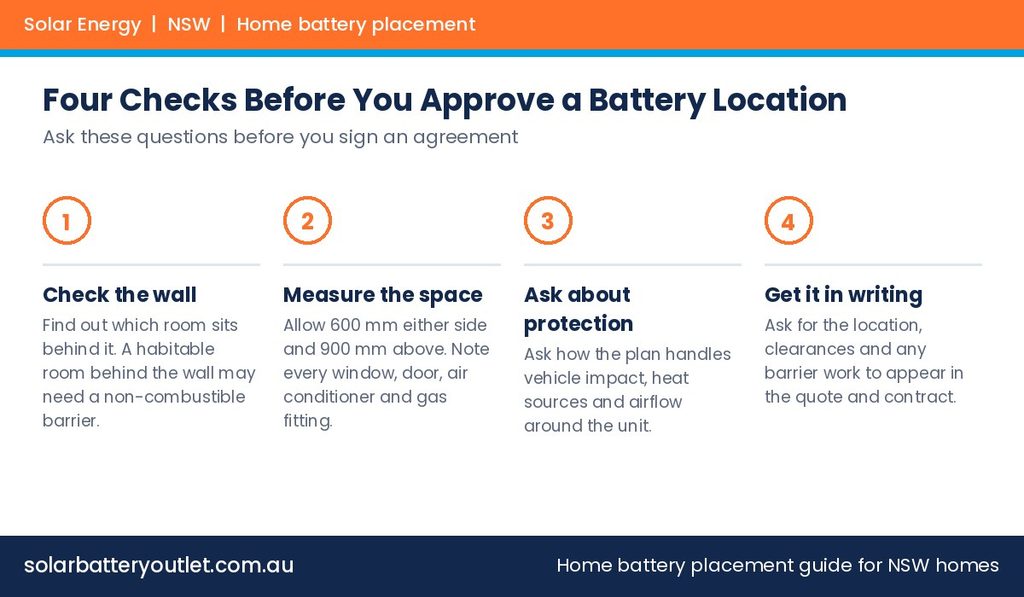
four checks before you approve a battery loocation
  1. Check the wall. Ask which room sits behind it.
  2. Measure the clear space. Note every window, door, air conditioner and gas fitting nearby.
  3. Ask about protection. Find out how the plan handles vehicle impact and heat sources.
  4. Get the plan in writing. Ask for the location, clearances and any barrier work in your quote and contract.

Also compare scope and payment terms across quotes. Australian Consumer Law consumer guarantees apply to solar products, whatever the product warranty says. Finally, check that your installer is SAA accredited before you commit.

Where Can a Home Battery Be Installed? FAQs
Can I install a home battery inside my house?

Not in a habitable room, such as a bedroom, living room, kitchen or home office. A garage, laundry or storage room may work if every clearance is met.

How far must a battery be from a window?

A battery cannot sit within 600 mm sideways of an opening window or vent to a habitable room. It also cannot sit within 900 mm below one.

Can a battery go in a garage in NSW?

Often, yes. However, it needs the usual clearances, protection from vehicle impact and distance from exits. Ask your installer how they treat the garage opening.

Does my battery need a fire barrier?

A non-combustible barrier may apply if a habitable room sits behind the wall. Brick, masonry and concrete walls already qualify.

Who decides the final battery location?

Your installer applies the standard and the manufacturer’s instructions to your site. You approve the plan. Therefore, ask for the position and clearances in writing.

Speak With Solar Battery Outlet Before You Sign

Unsure whether your garage or wall can take a battery? Call Solar Battery Outlet before you sign a solar battery agreement. Our team can talk through your site and the clearance questions to put to any installer. We help Liverpool homeowners understand the options at their own pace. You can also contact us online.

Disclaimer

This article gives general information about home battery placement in NSW. It does not replace individual legal, technical or purchasing advice. Standards and regulator guidance can change. Your site, battery model and installer’s plan decide what applies to your home. Always seek personalised advice before making a purchasing decision.