

Your solar inverter is often capable of generating far more power than your home is legally allowed to send back to the grid. Many NSW homeowners discover this the first time they check their monitoring app and notice the export numbers do not match what the panels are producing. Across New South Wales, distribution networks set a legal cap on how much solar electricity your system can export at any moment — and that cap has nothing to do with how many panels sit on your roof.
This rule matters more than ever in 2026. Australia now has 28.3 GW of rooftop solar across more than 4.3 million homes. Networks must manage how much power these systems send through ageing infrastructure.
This guide explains why export limits exist, what NSW networks allow, and how homeowners can use solar power they cannot export.
What Is a Solar Export Limit?
A solar export limit sets the maximum amount of electricity, measured in kilowatts, that your system can send back into the grid at any given moment. It differs from your system size and your inverter’s rated output. Your local distribution network service provider (DNSP) sets the export limit at your point of connection and applies it to each phase of your electrical connection.
A 10 kW solar system can generate well above its export limit at midday. However, the system may only send a fraction of that power to the grid. When production exceeds the approved limit, the inverter automatically throttles its output. It does not shut down. Your household appliances still use the power they need first. Only the surplus above your household’s usage faces the export cap. Any extra generation beyond your home’s needs and the network’s export limit is curtailed. This means you cannot turn it into savings or feed-in tariff income unless you store it first.
Why Your Network Caps How Much Solar You Can Export
Australia built its electricity networks decades before rooftop solar became common. These networks originally carried power in one direction: from power stations to homes. Today, rooftop PV provides over 14% of total electricity generation in some parts of NSW. As more homes send power back to the grid, local networks can experience voltage fluctuations and congestion.
According to the Australian Energy Regulator, only 27% of customers with rooftop solar exported energy back to the grid in 2024, and just 4% combined solar and battery to export during peak periods, reflecting how much curtailment already shapes everyday solar outcomes. Export limits protect grid stability without requiring every street’s infrastructure to undergo a complete rebuild. NSW networks set these limits based on the physical capacity of local transformers and the number of solar systems already connected nearby. This particularly affects high-solar-density suburbs and regional towns such as Mudgee, where many rural transformers were never designed to handle hundreds of homes exporting electricity simultaneously.
NSW Export Limits by Network: Ausgrid, Endeavour Energy and Essential Energy
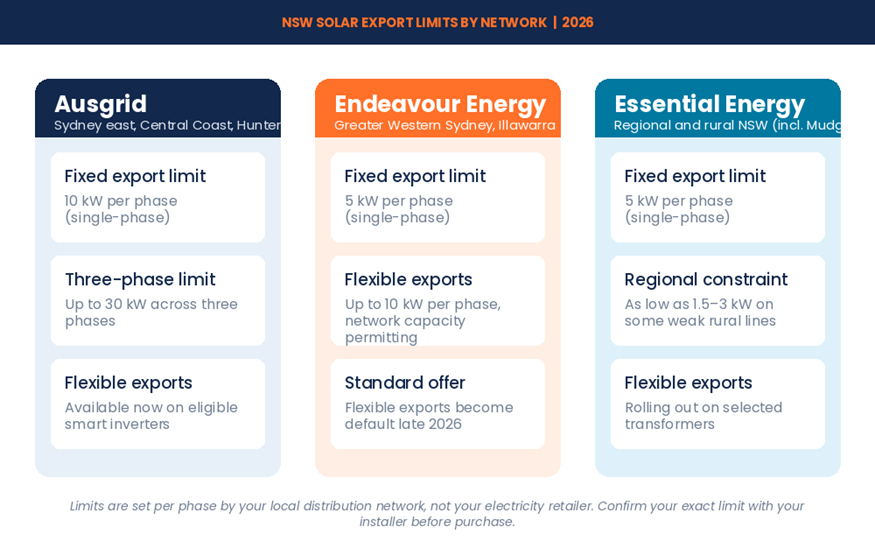
Your export limit depends entirely on which distribution network services your address, not on your electricity retailer. NSW has three networks, and each takes a slightly different approach.
Ausgrid covers Sydney’s east, the Central Coast and the Hunter. It generally allows the highest fixed limit of the three networks: 10 kW per phase for single-phase homes. Endeavour Energy covers greater western Sydney and the Illawarra. It applies a lower fixed limit of 5 kW per phase. However, flexible exports can raise this to 10 kW when the local network has spare capacity. This will become the standard connection offer for new and upgraded systems from late 2026. Essential Energy services regional NSW, including Mudgee. It also defaults to 5 kW per phase. However, some weaker rural lines can limit exports to as little as 3 kW.
If you are unsure which network covers your street, check your latest electricity bill or your distributor’s online connection portal before assuming what your system can export.
Fixed vs Flexible (Dynamic) Export Limits
A fixed export limit stays the same around the clock, regardless of how much spare capacity the local grid has at any given time. A flexible, or dynamic, export limit works differently. It relies on an internet-connected smart inverter that communicates with the network in real time using the Common Smart Inverter Profile (CSIP-AUS) protocol. When the local grid has spare capacity, your export limit rises above the standard fixed cap; when the network is under strain, it throttles back accordingly.
For homeowners planning a new system in 2026, asking an installer about flexible export connections can significantly increase the solar power they send to the grid. This helps prevent wasted energy during sunny midday periods. It also prepares the system for future virtual power plants and demand-response programs, which increasingly rely on two-way communication.
What Curtailment Really Costs You
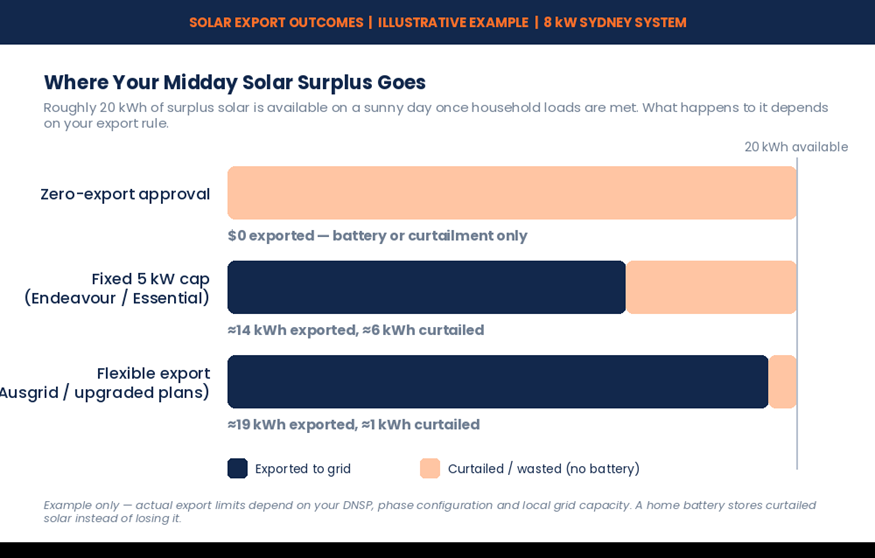
Consider a typical 8 kW solar array in Sydney sitting behind a fixed 5 kW export cap. On a sunny day, that system might export somewhere between 12 and 16 kWh, earning roughly $1 to $2 at today’s feed-in tariff rates of 2 to 10 cents per kWh. Any generation above the cap that the household is not using at the time is curtailed—it simply never gets converted into either savings or income.
Here is the part that catches most homeowners out: self-consumed solar is worth far more than exported solar. At 5 to 8 cents per kWh for exports versus 25 to 35 cents per kWh saved on grid electricity you would otherwise buy, every kilowatt-hour you use yourself is worth roughly four to eight times more than one you export. That gap makes curtailment a real financial loss, not just a technical footnote, and it is the main reason export limits matter far more to your bottom line than most sales conversations suggest.
How to Capture More Value From the Solar You Can’t Export
A home battery is the most direct way to stop curtailed solar going to waste. Instead of your inverter throttling output once you hit your export limit, a battery captures that surplus energy and releases it later, when your household needs it most — typically in the evening peak, when grid electricity can cost 30 cents or more per kWh in NSW. We covered how this shift is already playing out on the network in our article on free midday power and NSW home batteries, which looks at how batteries are reshaping demand during the exact hours export limits bite hardest.
Beyond storage, it is worth asking your installer to size your system around your own usage pattern first, rather than maximising panel count. A system matched to your daytime and evening consumption, paired with a correctly sized battery and — where available — a flexible export connection, gives you the best chance of using nearly everything your roof produces rather than losing a meaningful share to curtailment.
Actionable Framework: Check Your Export Limit Before You Buy
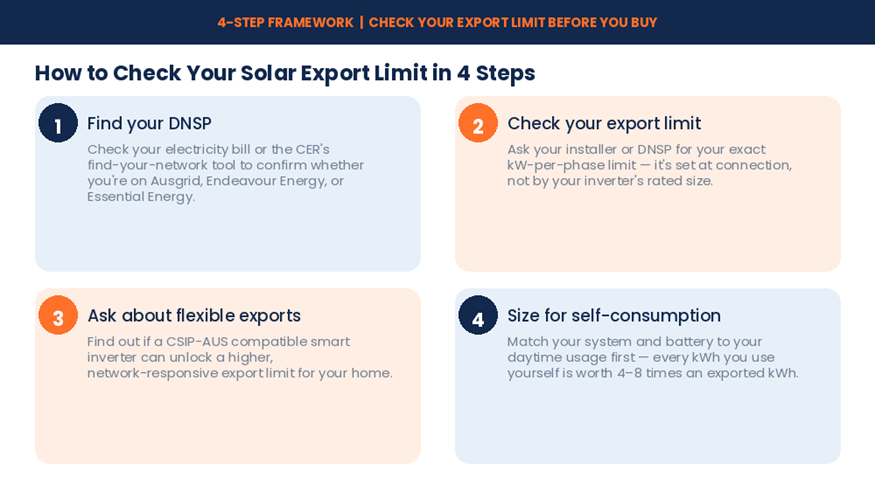
Before you commit to a system size or a battery, work through four simple checks: confirm which DNSP services your address, ask for your exact export limit in writing, find out whether a flexible export connection is available, and size your system around your own daytime and evening usage rather than panel count alone. A good installer will walk you through all four without being asked.
Frequently Asked Questions
Check your latest electricity bill, ask your installer to confirm it in writing before you sign a quote, or contact your DNSP (Ausgrid, Endeavour Energy or Essential Energy) directly through their online connection portal.
Not necessarily. Feed-in tariffs sit between roughly 2 and 10 cents per kWh in 2026, so export volume alone has a smaller impact on your bill than how much solar you use yourself. A higher export limit still helps, but pairing it with better self-consumption or storage usually delivers a bigger financial benefit.
In some cases, yes. Endeavour Energy customers, for example, can apply for special permission to connect for additional inverter capacity or a higher export limit. Approval depends on the condition of the local grid in your neighborhood, so outcomes vary from street to street.
Yes. A battery stores the solar surplus your export limit would otherwise curtail, letting you use that energy in the evening instead of losing it. This is typically the single biggest lever available to homeowners on a restrictive fixed export limit.
No. These are two different numbers. The Clean Energy Council permits a DC-to-AC oversizing ratio of up to 1.33, so a 5 kW inverter can legally support up to roughly 6.65 kW of panels — but your export limit is a separate figure set by your network, independent of your inverter or panel capacity.
A Note on Timing and Rebates
Export limits sit alongside — not instead of — the rebate decisions many NSW homeowners are weighing in 2026. If you are also comparing whether to install a battery now or later, our guide on whether to rush a solar battery before the rebate drops walks through that separate decision in detail.
Talk to a Local Installer About Your Export Limit
Every export limit is different, and the only way to know yours with certainty is to have your address checked against your DNSP’s records. Solar Battery Outlet provides free, no-obligation quotes for homeowners across Liverpool, Bankstown and Mudgee. We check your network, your export limit and your usage pattern before recommending a system size — so you are not paying for export capacity you will never actually use. Call 1800 000 777 or visit solarbatteryoutlet.com.au to get started.
Disclaimer
This article is general information only and does not constitute personal financial, technical or legal advice. Solar export limits, network rules and feed-in tariff rates vary by distribution network, address, phase configuration and inverter type, and are set and changed by your DNSP and the Australian Energy Regulator, not by Solar Battery Outlet. Figures on export volumes, curtailment and self-consumption value in this article are illustrative examples based on publicly available industry data current as of July 2026 and are not a guarantee of savings, export capacity or system performance for any individual home. Always seek personalised advice before making a purchasing decision. Solar Battery Outlet complies with Australian Consumer Law and does not use high-pressure sales tactics or misleading claims about rebates, export limits or savings.