
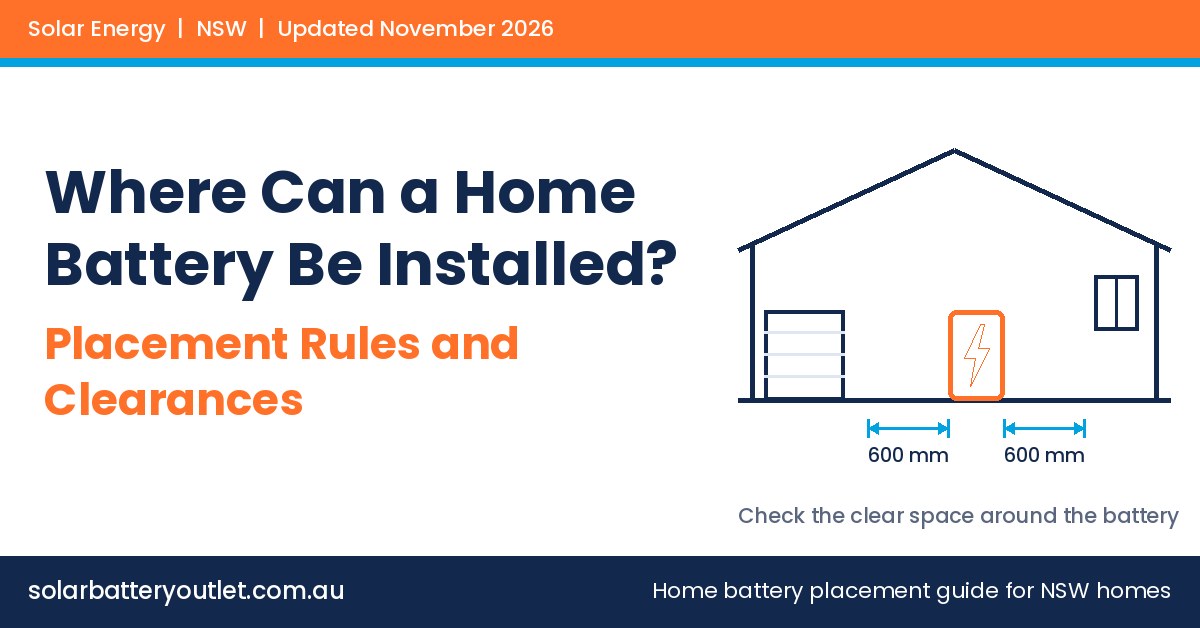
Where can a home battery be installed? Australian Standard AS/NZS 5139 answers. A battery needs a safe, accessible spot with clear space around it. For most NSW homes, that means a garage, an external wall or a laundry. However, a poor location can fail an inspection and put your household at risk. This guide explains the restricted locations, the clearances and the questions to ask before you sign.
Which Rules Decide Where a Home Battery Goes?
AS/NZS 5139:2019 sets the placement rules for home batteries in Australia. Amendment 1 arrived in December 2025. The standard works alongside AS/NZS 3000, the wiring rules, and the manufacturer’s installation manual. Therefore, your installer should apply all three to your site.
Electrical safety regulators across Australia endorse a guide to AS/NZS 5139 installation requirements. It explains how regulators read the location rules. Regulators treat a battery as a possible source of ignition. Consequently, the rules keep it away from people, escape routes and other heat sources.
Note that the guide pre-dates Amendment 1, so some details may differ today. Ask your installer which version applies to your quote.
Which Locations Are Off Limits for a Home Battery?
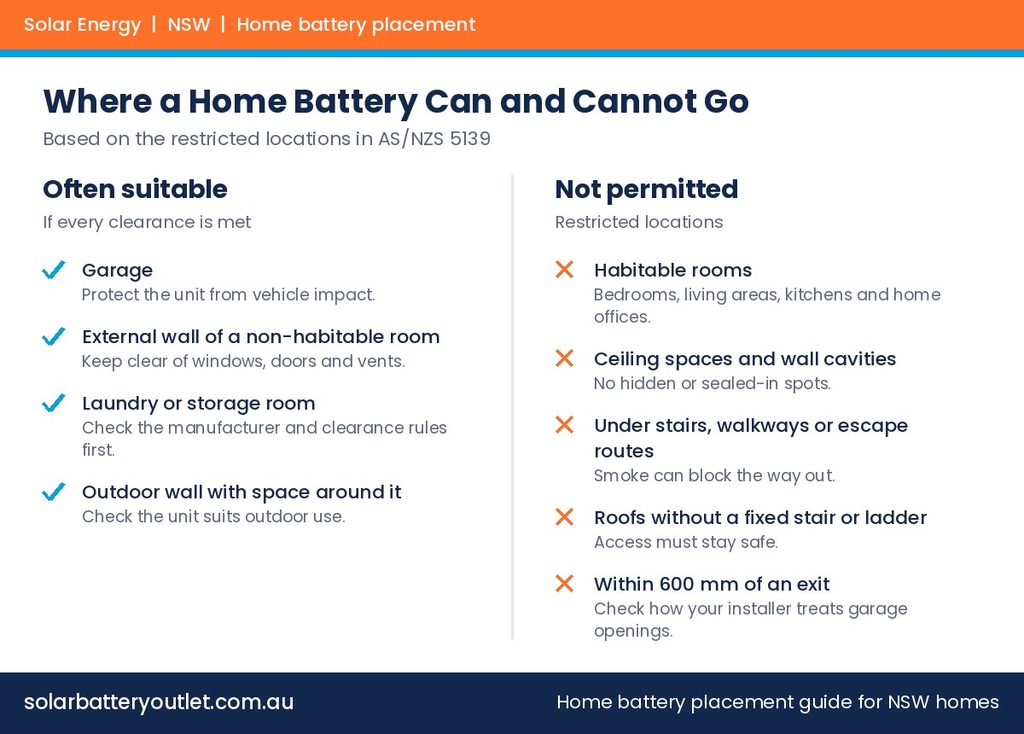
A home battery cannot go in a habitable room, a ceiling space, a wall cavity or an escape route. The details below explain why.
Habitable Rooms
Habitable rooms include bedrooms, home offices, living rooms, kitchens and dining rooms. They also cover playrooms, entertainment rooms and sunrooms. Therefore, a spare bedroom or study is never a suitable battery spot.
Ceiling Spaces, Wall Cavities and Roofs
Likewise, installers cannot place a battery in a ceiling space or set it into a wall cavity. The same rule applies to roofs without a fixed staircase or ladder. Each of these spots limits safe access.
Escape Routes and Walkways
In addition, a battery cannot sit in a passageway, walkway or escape route. It also cannot sit under stairs or entry walkways. Smoke from a burning battery could block the way out. Fire could also weaken the structure above.
Your manufacturer may prohibit other spots as well. Our guide to battery safety features explains what else to look for.
What Clearances Does a Home Battery Need?
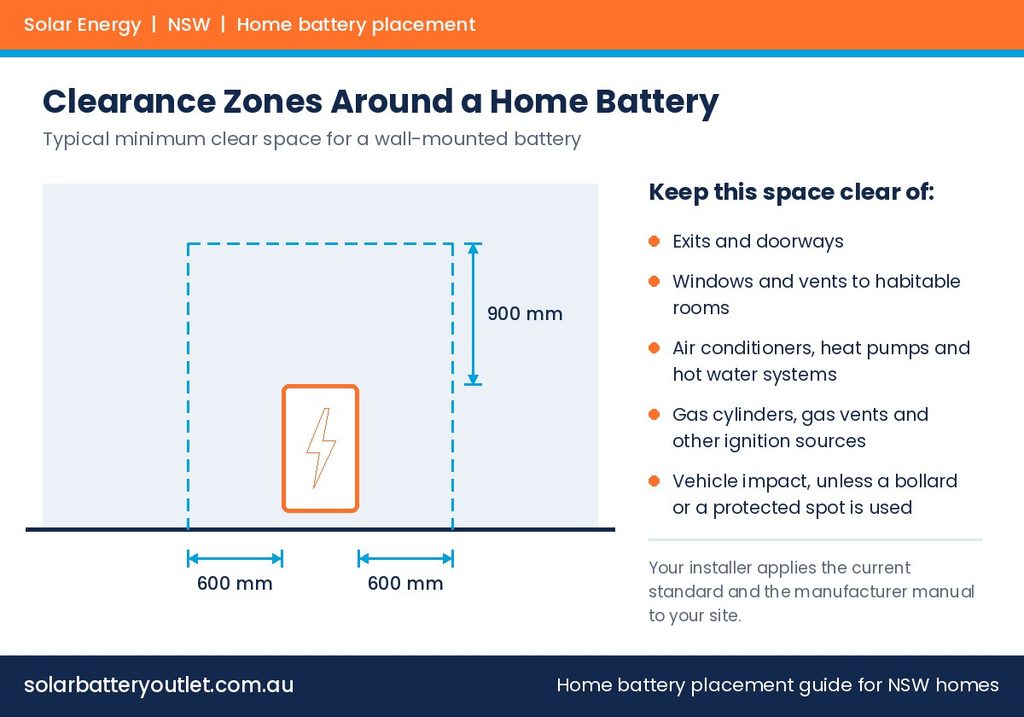
Clearances add a second layer of rules. They keep the battery away from doors, windows and heat sources.
Exits and Doorways
A battery must sit at least 600 mm from an exit. Regulators in NSW have treated every opening people can use as an exit, including garage door openings. However, Amendment 1 now allows an exception for exits wider than 900 mm. In that case, people need at least 1 metre of clear space to pass. Because both rules exist, ask your installer which one applies to your home.
Windows and Vents
A battery cannot sit within 600 mm sideways of an opening window or vent to a habitable room. It also cannot sit within 900 mm below one. As a result, a window directly above your preferred wall spot may rule it out.
Appliances and Gas
Other electrical appliances must stay 600 mm to the side and 900 mm above the battery. Examples include air conditioners, heat pumps, hot water cylinders and stoves. Solar inverters that charge the battery are the exception. Meanwhile, gas cylinders and gas relief vents have their own exclusion zones. Gas network providers may add further limits.
Can You Install a Home Battery in a Garage?
Often, yes. A garage is not a habitable room, so it can suit a battery. However, the same clearances still apply.
Vehicles add a further risk. Regulators expect protection from impact, such as a bollard or a position a vehicle cannot reach. Furthermore, earlier NSW guidance counts a garage door opening as an exit, so measure carefully.
For example, picture a Liverpool home with a single garage. The only free wall sits close to the roller door, and a hot water unit hangs nearby. That layout may leave too little room. An external wall elsewhere may work better.
Compare quotes for solar battery installation in Liverpool carefully. Ask each installer to mark the position and clearances on a site plan.
Does the Wall Behind the Battery Matter?
Sometimes, yes. A barrier may apply when a habitable room sits on the other side of the wall. This rule covers a battery fixed to that wall or standing within 300 mm of it.
The wall must be non-combustible. Brick, masonry blocks, concrete, compressed cement sheeting and clay tiles qualify without further testing. Timber panels, plasterboard and particle board do not qualify.
The barrier must extend 600 mm beyond each side of the battery and 900 mm above it. Cement sheeting 6 mm thick counts as industry best practice, although it is not mandatory. So if your Liverpool home has brick walls, ask your installer whether the existing wall already meets this need.
Four Checks to Make Before You Sign
Use these checks to compare quotes. They also help you spot vague installation plans.
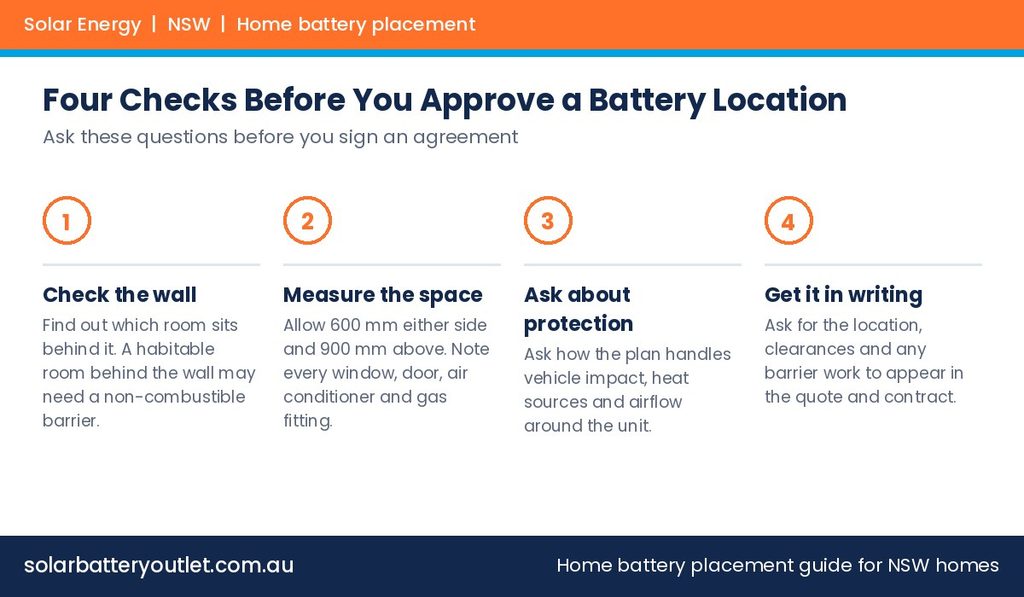
- Check the wall. Ask which room sits behind it.
- Measure the clear space. Note every window, door, air conditioner and gas fitting nearby.
- Ask about protection. Find out how the plan handles vehicle impact and heat sources.
- Get the plan in writing. Ask for the location, clearances and any barrier work in your quote and contract.
Also compare scope and payment terms across quotes. Australian Consumer Law consumer guarantees apply to solar products, whatever the product warranty says. Finally, check that your installer is SAA accredited before you commit.
Where Can a Home Battery Be Installed? FAQs
Not in a habitable room, such as a bedroom, living room, kitchen or home office. A garage, laundry or storage room may work if every clearance is met.
A battery cannot sit within 600 mm sideways of an opening window or vent to a habitable room. It also cannot sit within 900 mm below one.
Often, yes. However, it needs the usual clearances, protection from vehicle impact and distance from exits. Ask your installer how they treat the garage opening.
A non-combustible barrier may apply if a habitable room sits behind the wall. Brick, masonry and concrete walls already qualify.
Your installer applies the standard and the manufacturer’s instructions to your site. You approve the plan. Therefore, ask for the position and clearances in writing.
Speak With Solar Battery Outlet Before You Sign
Unsure whether your garage or wall can take a battery? Call Solar Battery Outlet before you sign a solar battery agreement. Our team can talk through your site and the clearance questions to put to any installer. We help Liverpool homeowners understand the options at their own pace. You can also contact us online.
Disclaimer
This article gives general information about home battery placement in NSW. It does not replace individual legal, technical or purchasing advice. Standards and regulator guidance can change. Your site, battery model and installer’s plan decide what applies to your home. Always seek personalised advice before making a purchasing decision.