NSW battery rules 2026 are shifting again, and this time businesses and apartment owners take centre stage. From 1 September 2026, the NSW Government activates three new battery incentive activities under the Peak Demand Reduction Scheme (PDRS). These changes mainly target apartment buildings and businesses. Still, every NSW homeowner should understand what is changing. This guide breaks down what happens on 1 September. It covers who qualifies and what to check before you sign a quote.
Quick answer: From 1 September 2026, NSW launches three new battery incentives. BESS3 covers apartments, BESS4 covers small and medium businesses, and BESS5 covers larger commercial sites. Homeowners with existing batteries are not directly affected. The federal Cheaper Home Batteries Program and the NSW VPP incentive (BESS2) remain the main pathways for households. Businesses can access discounts of roughly 20 to 40 per cent on eligible battery installations.
What’s Actually Changing in NSW on 1 September 2026
On 1 September 2026, the NSW Government activates three new PDRS activities: BESS3, BESS4, and BESS5. Each one targets a different type of battery buyer. BESS3 supports apartment buildings with four or more dwellings that want to share one larger battery. BESS4 covers small and medium businesses installing systems between 20 kWh and 200 kWh. BESS5 applies to larger commercial, industrial, and community batteries, up to 30 MWh.
These activities sit inside the Peak Demand Reduction Scheme, delivered under the Energy Security Safeguard. Instead of a fixed rebate, eligible projects earn Peak Reduction Certificates (PRCs). Accredited suppliers then convert these certificates into an upfront discount at the point of sale.
Minister for Climate Change and Energy Penny Sharpe said the changes will help more people cut their power bills. This applies whether they run a business or live in an apartment. According to the NSW Government, the discount typically ranges between 20 and 40 per cent of the installed cost. It scales with battery size. For example, a small grocery store could receive a discount of around $37,000. A medium-sized operation, such as a dairy farm, could see savings closer to $355,000.
What NSW Homeowners Should Know (Even Without a New Mandate)
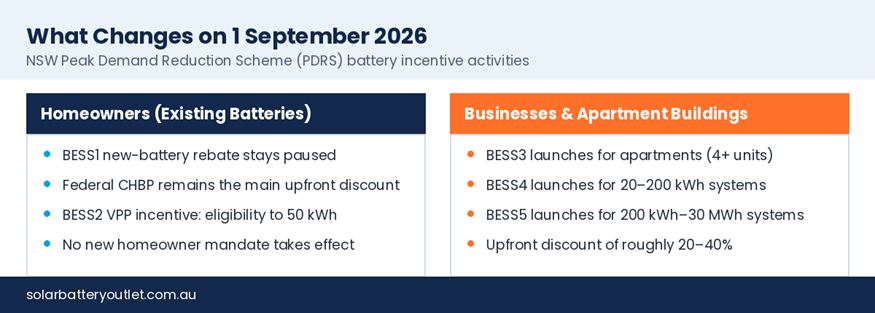
Homeowners often assume this update applies to them directly. It mostly does not, and that distinction matters. The original homeowner rebate, known as BESS1, has stayed paused since mid-2025. It was paused once the federal Cheaper Home Batteries Program (CHBP) took over that role. That program gives eligible batteries an upfront discount, based on the battery’s usable size and the current STC rate.
So what actually changed for existing homeowners? Since 1 July 2026, the NSW VPP incentive, called BESS2, now covers larger batteries. Eligibility rose to 50 kWh, up from 28 kWh previously. This suits households running bigger battery systems. The government has also flagged a further expansion. Eligible homes and small businesses that join a Virtual Power Plant could see incentives of up to $1,000.
If you already own a battery, connecting it to an accredited VPP remains the clearest path to extra savings. If you are researching solar batteries NSW options, the federal rebate does most of the heavy lifting. A state upfront discount no longer applies to new home purchases.
What NSW Businesses and Apartment Owners Should Know
Businesses and apartment owners see the real shift on 1 September. Three brand-new PDRS activities go live, opening commercial-scale battery incentives for the first time.
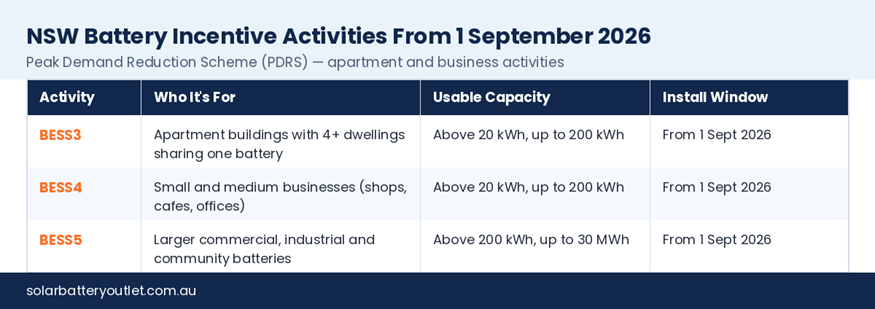
Apartment buildings with at least four dwellings can install a shared battery under BESS3. Systems must sit between 20 kWh and 200 kWh. A minimum co-payment applies per implementation, so owners corporations should budget accordingly. Small and medium businesses, such as cafes, retail stores, and offices, fall under BESS4. This activity covers the same 20 to 200 kWh range. Larger commercial, industrial, and community batteries, up to 30 MWh, sit under BESS5.
Solar is not mandatory for any of these activities. However, pairing new solar with a battery inside a short installation window can lift the certificate value. Businesses can often stack these incentives with other federal support, including discounted commercial solar programs. Because certificate values move with the market, quotes will vary between suppliers. This makes comparing offers from accredited installers even more important before you commit.
Eligibility and Compliance Checklist Before You Sign
Before signing any battery contract under these new rules, work through this checklist first.
- Installer accreditation: installers must appear on the Solar Accreditation Australia (SAA) list for BESS3 and BESS4 projects.
- Approved products: batteries must sit on the Scheme Administrator’s approved product list, or meet UL9540A testing for BESS5 projects.
- Usable capacity: the scheme calculates usable capacity as 90 per cent of nominal battery capacity, not the nameplate figure.
- Inverter sizing: your inverter’s AC output caps both eligibility and rebate value. An undersized inverter can limit your certificate return.
- Timing: installations must occur on or after 1 September 2026 to qualify for BESS3, BESS4, or BESS5.
Skipping any of these checks could cost you part, or all, of your incentive. A reputable installer will walk you through each requirement before you sign.
How to Prepare Before the 1 September Deadline
1. Confirm your category: Work out whether your property fits BESS3 (apartments), BESS4 (small-to-medium business), or BESS5 (larger commercial sites).
2. Get multiple quotes: Compare at least three proposals from accredited installers. Certificate values differ between suppliers.
3. Check the product list: Confirm your chosen battery and inverter both appear on the relevant approved list before you sign anything.
4. Time your installation: Book your install for on or after 1 September 2026. Earlier installs will not qualify for the new activities.
Why This Matters for the Broader NSW Grid
These changes fit into a bigger picture. Battery uptake across NSW keeps climbing, with roughly 10,000 new systems installed every month. More batteries connected to the grid help ease pressure during peak demand periods. This benefits everyone, not only battery owners. It helps stabilise electricity supply across the whole network.
The new business and apartment incentives extend that momentum beyond the home. As more owners corporations and small businesses adopt storage, the grid gains flexible capacity precisely when needed. Anyone comparing solar batteries NSW providers ahead of summer should factor in these rule changes. Understanding them helps you time your purchase and stack the right incentives.
For the full policy detail, see the official NSW Government announcement on the new business and apartment battery discounts.
To confirm installer credentials, check the Solar Accreditation Australia (SAA) installer list.
Frequently Asked Questions
They are three new NSW Peak Demand Reduction Scheme activities starting 1 September 2026. BESS3 covers apartment buildings, BESS4 covers small and medium businesses, and BESS5 covers larger commercial and industrial batteries.
No new mandate applies to homeowners on that date. Existing households should continue using the federal Cheaper Home Batteries Program and the NSW VPP incentive (BESS2) for savings.
The NSW Government indicates discounts of roughly 20 to 40 per cent on eligible installations, scaling with battery size. Actual savings depend on certificate prices and project design.
No. Solar is not mandatory for these activities. However, installing new solar alongside a battery within the eligible window may increase the certificate value.
Existing battery owners are not affected by the 1 September changes. Connecting an eligible existing battery to a Virtual Power Plant under BESS2 remains the main way to access further NSW incentives.
Confirm your installer appears on the Solar Accreditation Australia (SAA) list. Also confirm your battery and inverter appear on the Scheme Administrator’s approved product list before signing.
Get a Personalised Battery Assessment
Ready to make sense of the new NSW battery rules 2026 for your home, apartment block, or business? Solar Battery Outlet helps customers across Liverpool, Bankstown, and Mudgee compare tailored battery options. Our SAA-accredited installers can assess your site and explain which incentives may apply. Contact our team for a personalized assessment.
Disclaimer
This article provides general information about NSW battery incentive changes taking effect on 1 September 2026. It does not constitute financial, legal, or professional advice, and it should not replace advice from a qualified installer or adviser. Incentive amounts, eligibility criteria, and certificate values may change. Outcomes depend on individual circumstances, chosen installer, and market conditions at the time of installation. Solar Battery Outlet is not a government body. It does not administer the Peak Demand Reduction Scheme, the Cheaper Home Batteries Program, or any related incentive. Always seek personalised advice before making a purchasing decision. For the latest official details, visit the NSW Government and Clean Energy Regulator websites.