
Every sunny afternoon, NSW rooftops produce more solar power than the grid will accept. Your panels keep working. But an invisible ceiling stops the surplus from going anywhere. That ceiling is your solar export limit, and your network sets it, not you. Solar battery curtailment NSW-wide is the direct result, and it is one reason storage can now make sense. Once you understand why the grid caps your exports, storing that surplus may be worth considering for solar batteries NSW households in 2026.
What Is a Solar Export Limit, and Why Does NSW Have One?
A solar export limit is the maximum power your inverter can send to the grid at any moment. Ausgrid, Endeavour Energy and Essential Energy set these caps to protect local infrastructure. Suburban power lines were built decades before rooftop solar existed. They carried electricity one way, from substation to home. They were never designed for the reverse flow. When too many homes export at once, voltage on the line can climb too high. Networks respond by capping how much each household can push back. Your inverter still generates power. It simply throttles what leaves your property.
NSW Government energy planners acknowledge this tension directly. Their Consumer Energy Strategy notes that sunny, low-demand periods create real network risks. That is why measures like the Emergency Backstop Mechanism are rolling out across the state.
NSW Export Limits by Network: Ausgrid vs Endeavour vs Essential Energy
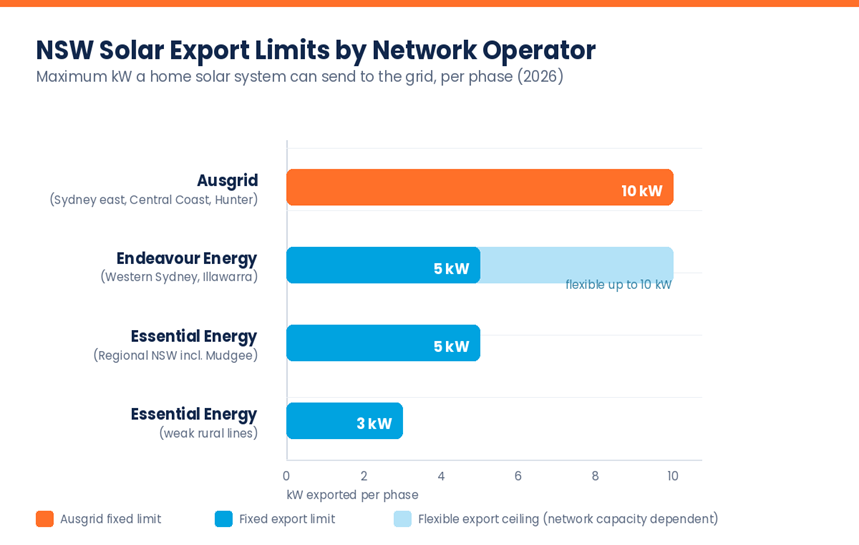
Your export limit depends on which network covers your street. Ausgrid services Sydney’s east, the Central Coast and the Hunter. It generally applies the highest fixed limit of the three, up to 10 kW per phase for single-phase homes. Endeavour Energy covers western Sydney and the Illawarra. It defaults to a lower 5 kW per phase. Flexible exports can lift this to 10 kW when the local network has spare capacity. That flexible option is set to become standard for new and upgraded systems from late 2026. Essential Energy serves regional NSW, including Mudgee. It also defaults to 5 kW per phase. Some weaker rural lines restrict exports to as little as 3 kW.
The chart below compares these limits across all three networks.
Check your latest bill, or your network’s connection portal, before assuming what your system can export.
The Real Cost of Solar Battery Curtailment in NSW
Curtailment happens when your panels generate more than your export limit allows. If your household is not using that excess, it simply disappears. The inverter throttles output smoothly. Nothing trips or shuts down. But the unused generation converts to heat, not savings.
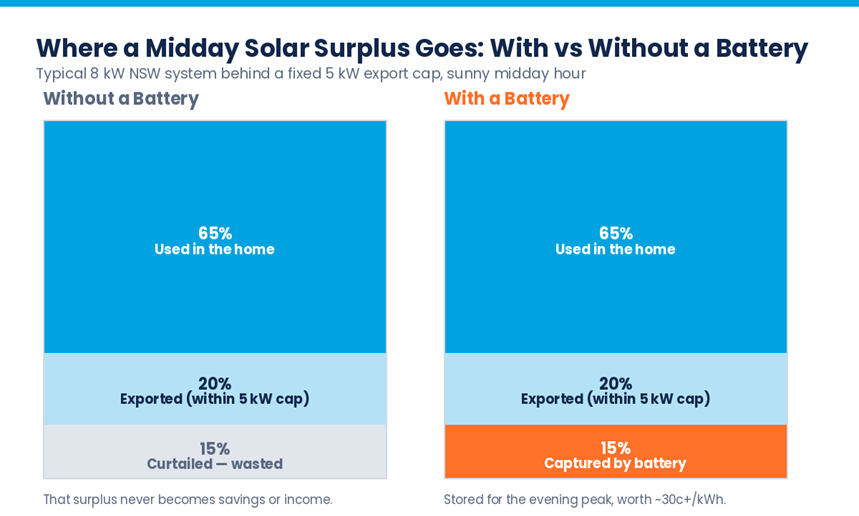
Consider a typical 8 kW system in Sydney behind a fixed 5 kW export cap. On a sunny day, it might export 12 to 16 kWh. That earns roughly one to two dollars at today’s feed-in tariff rates of 2 to 10 cents per kWh. Anything above the cap that the household is not using is curtailed. It never becomes savings or income.
This is not a rare edge case. The Australian Energy Regulator reports the average static export limit sits at just 5.7 kVA nationally. Only 27% of network customers currently use export services at all. Just 4% of customers have paired their solar with a battery. Yet batteries are the most direct way to capture what would otherwise be lost.
Why a Home Battery Turns a Limit Into an Opportunity
Here is the detail that changes the maths for solar batteries NSW owners: using your own solar is usually worth more than exporting it. NSW feed-in tariffs currently sit between roughly 4.8 and 7.3 cents per kWh. Evening grid electricity often costs 30 cents or more per kWh. A battery does not just store your surplus. It shifts that surplus from a low-value export slot into a high-value evening slot.
Ausgrid’s two-way tariff, sometimes called the “sun tax”, adds pressure on midday exports. It pays more for exports later in the day instead. Independent estimates put the average annual bill impact at around $6.60 for an unchanged 5 kW system. That is a modest number alone, but it signals where the market is heading. Our guide to solar export limits across NSW networks covers this shift in more detail. Exporting is becoming a smaller part of the value equation. Self-consumption through storage is becoming the bigger one.
Case Example: A Liverpool Household on an Endeavour Energy Connection
Picture a Liverpool family running an 8 kW solar array on an Endeavour Energy connection. Their fixed export limit sits at 5 kW. On sunny days, 2 to 3 kW of generation regularly exceeds that cap. This happens right in the middle of the day, when nobody is home to use it. Without storage, that power is wasted. With a 10 kWh battery, the same household can capture a meaningful share of that curtailed energy. It can then shift that energy to the 5pm to 9pm window. NSW electricity prices peak in that window. Endeavour Energy’s own evening export rate climbs as high as 11.71 cents per kWh in summer. Before locking in a system size, ask a licensed provider about solar batteries installation matched to your real curtailment pattern.
How Rebate Timing Affects Your Cost
The federal Cheaper Home Batteries Program currently provides roughly $250 per usable kWh of storage. This applies to the first 14 kWh, then tapers above that threshold. The rebate factor steps down every six months. The rebate steps down over time, so installing earlier usually means a larger discount. But the right battery for your home matters more than the date — don’t rush a decision. Our guide on deciding whether to rush before rebate changes walks through these numbers step by step.
A 4-Step Framework to Size a Battery Around Your Export Limit
Work through these four checks before committing to a system size.
- Step 1: Confirm your export limit. Call your DNSP, or ask your installer to confirm it in writing.
- Step 2: Compare your panel capacity to that limit. A 10 kW array behind a 5 kW cap will curtail often.
- Step 3: Estimate your midday curtailment. A good installer can model this from your roof size and usage.
- Step 4: Match your battery size to that surplus. Do not simply choose the biggest option available.
Homeowners who follow this order avoid paying for capacity they will never fill. They also avoid under-sizing a system and leaving real savings on the table.
Frequently Asked Questions
It ranges from 3 to 10 kW per phase, depending on your network. Ausgrid generally allows up to 10 kW. Endeavour Energy and Essential Energy default to 5 kW. Some rural Essential Energy lines cap at 3 kW.
Yes. Generation above your export limit that your home is not using earns nothing. On an oversized system, this can waste a noticeable share of annual generation.
In some cases, yes. Endeavour Energy allows customers to apply for special permission for extra inverter capacity or a higher limit. Approval depends on local network capacity.
Indirectly, yes. A lower export limit caps how much solar can earn a tariff at all, regardless of the rate itself. This is one reason storage often beats chasing a higher limit.
Flexible exports are already expanding across Endeavour Energy’s network. They are expected to become standard for new and upgraded systems from late 2026. Fixed limits will likely remain the default elsewhere for longer.
Get Your Export Limit Checked, Free
Not sure what your export limit is, or whether a battery makes sense for your home? Solar Battery Outlet offers free, no-obligation assessments across Liverpool, Bankstown and Mudgee. We check your network’s export limit, model your curtailment, and recommend a system sized around your real usage. Call 1800 000 777, or visit solarbatteryoutlet.com.au to book your assessment.
Disclaimer
This article is general information only. It does not constitute financial, legal or engineering advice. Export limits, feed-in tariff rates and rebate amounts referenced here are current as of publication. They vary by network operator, property and time of year, and may change without notice. Curtailment and payback figures are illustrative estimates based on a typical system. They are not a guarantee of savings for any specific property. Always confirm current export limits, tariffs and rebate eligibility with your network operator, retailer or a licensed solar provider. Always seek personalised advice before making a purchasing decision.