

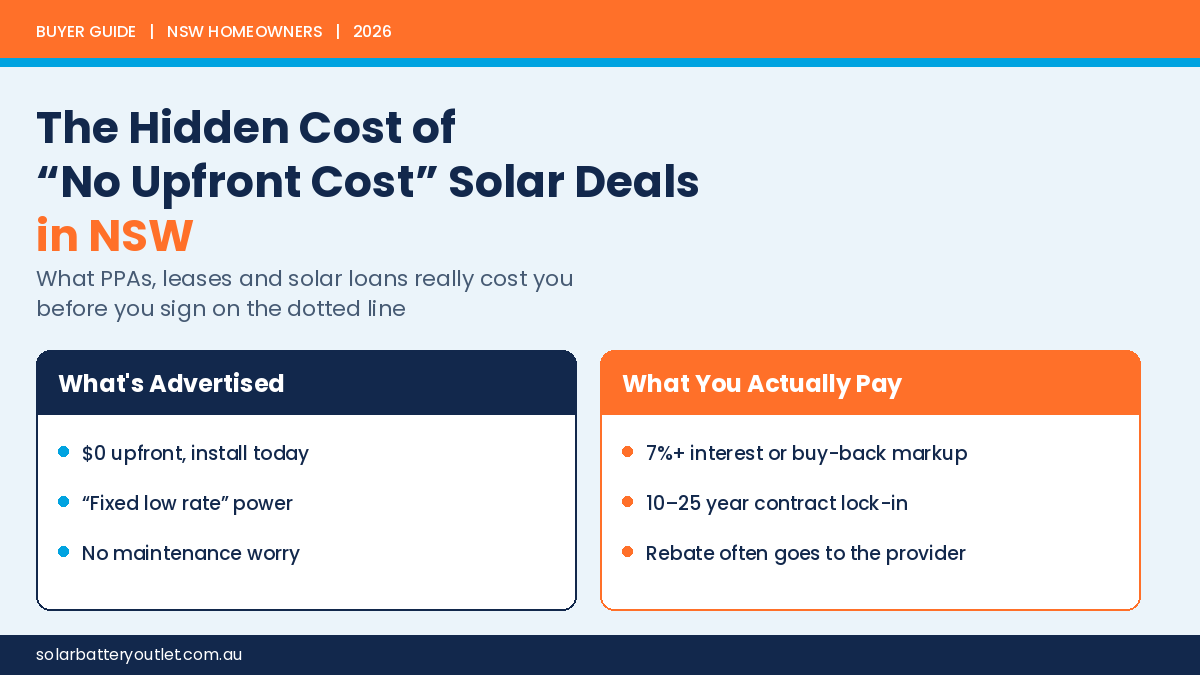
A $0-upfront solar offer is one of the easiest pitches to say yes to. No deposit, no big invoice, and a promise of cheaper power from the day the installer packs up their ladder. But “no upfront cost” doesn’t mean no cost. It usually means the cost has been moved somewhere less visible: into an interest rate, a buy-back margin, or a contract that runs for 10 to 25 years. If you’re comparing solar quotes in Liverpool, Bankstown, Mudgee or anywhere else in NSW this year, understanding where that cost actually sits is the difference between a genuinely good deal and one you’ll be paying off long after a cash-purchase system would have paid for itself.
This guide breaks down the three most common no-upfront-cost structures on the NSW market, shows a real worked example of what each one costs over 10 years, and gives you a short framework to sanity-check any quote before you sign.
What “No Upfront Cost” Solar Actually Means
Not every $0-deposit offer works the same way. In the NSW residential market, it almost always falls into one of three structures:
- Solar loan — a lender pays the installer, and you own the system immediately while repaying the loan plus interest over an agreed term, typically 5 to 10 years.
- Power Purchase Agreement (PPA) — a third party owns, installs and maintains the system on your roof, and you buy the electricity it generates at a set rate for the length of the contract, often 10 to 25 years.
- Solar lease or buy-now-pay-later (BNPL) plan — you pay a fixed periodic fee to use equipment you don’t own, with ownership only transferring (if at all) at the end of the term.
Each of these is a legitimate finance product. The issue isn’t that they exist; it’s that the marketing usually stops at “no upfront cost” and doesn’t explain which structure you’re signing, who owns the system, or what happens to the federal rebate.
Where the Hidden Cost Really Hides
Four places absorb the cost that a cash buyer simply doesn’t pay:
1. Interest and dealer fees on solar loans
A loan advertised on a low headline rate can still carry a dealer or origination fee baked into the financed price. That fee is often absorbed into the total you’re financing rather than shown as a separate line item, so the true cost only becomes visible when you compare the cash price against the financed price side by side, and check the comparison rate rather than the advertised rate alone.
2. Buy-back margins on PPAs and leases
On a PPA, the rate you pay per kWh is set by the provider, not the market. It’s typically lower than your retailer’s tariff, but because you’re locked in for the contract term, you don’t benefit from switching retailers, using government feed-in tariff changes to your advantage, or paying down the system faster.
3. Escalation clauses
Some PPAs and leases include an annual price escalator of 2–5%. It looks small in year one and compounds meaningfully by year ten, especially against a cash-purchase system whose only ongoing cost is occasional maintenance.
4. Who claims the rebate
On a cash or loan purchase, the Small-scale Technology Certificate (STC) rebate is factored into your quoted price and you’re the one who benefits. On many PPAs and leases, the installer or financier assigns the STCs to themselves as part of how they fund the “free” system — which is a normal part of the structure, but it means the rebate isn’t reducing your out-of-pocket cost the way it would on a purchase.
A Worked Example: Cash vs Loan vs PPA
Take a typical 6.6kW rooftop system, which costs around $5,800 after applying the federal STC discount—broadly in line with Solar Choice’s July 2026 Price Index, which estimates the average cost of a residential solar system in Australia at roughly $0.88–$0.95 per watt installed after the STC discount.
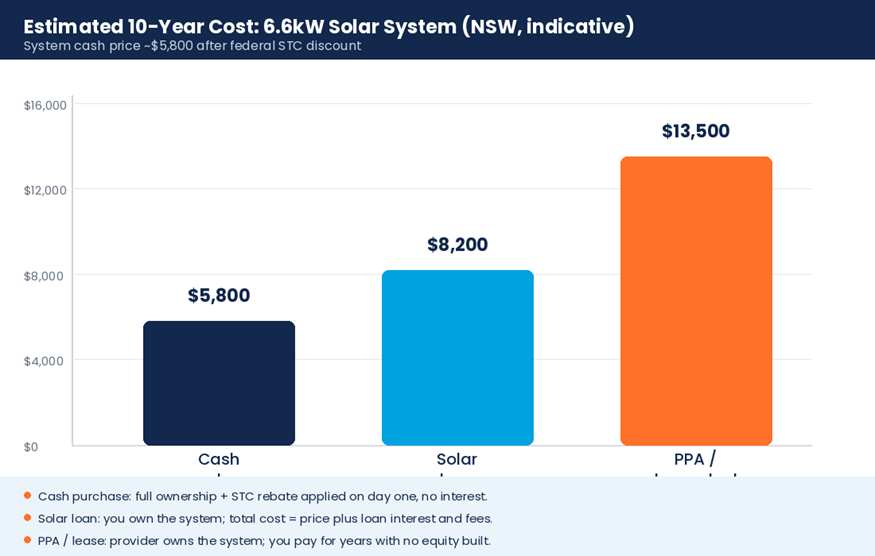
The numbers above are indicative and will vary by system size, household usage and provider. Still, the pattern holds consistently: the cash buyer pays the least in total and owns the asset outright from day one. The loan buyer pays more in total but still owns the system. The PPA or lease customer pays the most over time and, in most structures, never owns the equipment on their roof.
Red Flags to Watch For in NSW
Regulators have flagged the solar and battery finance space for closer scrutiny as more households take up subsidised systems. As
ACCC Commissioner Anna Brakey put it: “As more Australian households switch to battery and solar plans, the deals on offer must be fair, accurate and easy to understand. The ACCC will be watching carefully and actively monitoring consumer complaints.”
Unsolicited door-to-door sales are a particular concern. Consumer Action Law Centre CEO Stephanie Tonkin has raised similar issues around third-party lead generation in solar sales, noting that
Under Australian Consumer Law, sales made door-to-door or by telephone carry a mandatory 10 business day cooling-off period, and a valid contract must be signed and dated by both you and the salesperson on the front page. If a salesperson pressures you to sign today or waives the cooling-off period, that’s a clear signal to slow down.
How to Check If a “No Upfront Cost” Quote Is Actually Good Value
Before signing anything, run the quote through this five-point check:
- Ask for the cash price and the financed price side by side — the gap is your real interest and fee cost.
- Confirm who owns the system and who is claiming the STC rebate.
- Request the comparison rate or effective annual cost, not just the headline interest rate or per-kWh rate.
- Read the exit and buy-back clause — what does it cost to end the contract early or sell the property?
- Get your 10-day cooling-off right confirmed in writing before you sign.
For a closer look at how the current federal and NSW battery incentives affect timing, our earlier guide on whether it’s worth rushing before the rebate drops walks through how the Cheaper Home Batteries Program and NSW VPP incentive interact with your purchase timing.
FAQ: No Upfront Cost Solar Deals in NSW
No. A solar loan means you own the system from day one and repay a lender directly. A Power Purchase Agreement means a third party owns the system, and you buy the electricity it produces at an agreed rate for the contract term.
It depends on the structure. Loans and most BNPL plans transfer ownership to you immediately. Leases and PPAs keep ownership with the provider for the length of the agreement, sometimes with a buyout option at the end.
If the sale happened door-to-door or by phone, Australian Consumer Law gives you a 10 business day cooling-off period. Outside that window, cancellation depends entirely on your contract’s terms, so review the exit clause carefully before signing.
In most PPA and lease structures, the provider assigns the STC rebate to themselves as part of financing the “free” installation, rather than passing that value on as a lower price to you.
The Bottom Line
A no-upfront-cost deal isn’t automatically a bad one, but it’s rarely the cheapest one. If cash flow is genuinely the barrier, a straightforward solar loan with a transparent comparison rate usually costs less over time than a PPA or lease, and it leaves you owning the asset on your roof. Before you commit to any structure, get an itemised, upfront-cost quote to compare it against — that’s the only way to see what the “free” offer is actually costing you.
If you’re in Liverpool, Bankstown or Mudgee and want a transparent, upfront quote to compare against a finance offer you’ve been given, get in touch with our team—we’ll show you the real numbers before you sign anything.
Disclaimer
This article is general information only and does not constitute financial, legal or credit advice. Solar loan rates, PPA terms, and buy-back rates vary by provider and change over time, so always confirm current figures directly with your chosen installer or lender before signing a contract. Cooling-off rights and consumer protections referenced here reflect Australian Consumer Law at the time of writing and may not apply to every sale method. Always seek personalised advice before making a purchasing decision.