

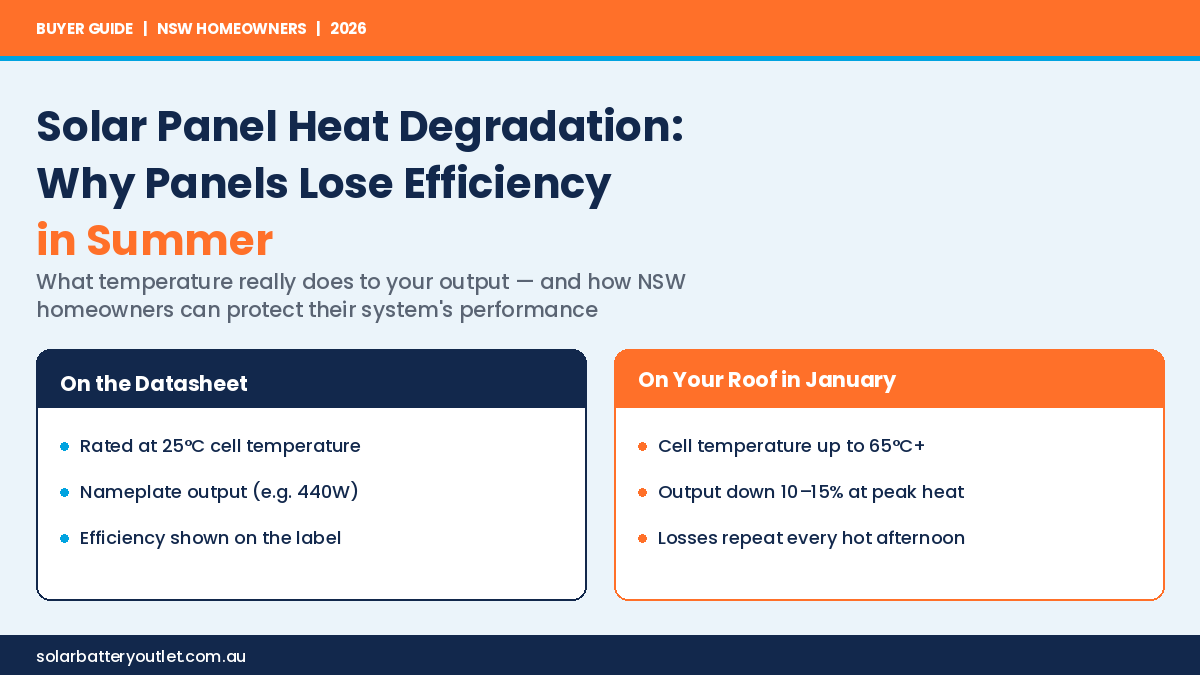
Your solar system carries a rating tested in a cool, controlled lab at 25°C. NSW summer afternoons rarely cooperate with that number. Once panel surfaces climb past it, output starts sliding — quietly, predictably, on almost every hot day from December through February.
This isn’t a fault, and it isn’t damage. It’s solar panel heat degradation, and it explains why a system can underperform on exactly the days you’d expect it to shine brightest. Understanding how heat affects panel output and what actually helps lets you get more from a system you’ve already paid for — whether your roof is in Liverpool, Bankstown, Mudgee, or anywhere else across the state.
This guide walks through the science behind heat-related losses, the real numbers involved, and a practical framework for protecting performance through an NSW summer.
What Is Solar Panel Heat Degradation?
Solar panels are rated under Standard Test Conditions: 25°C cell temperature and 1,000 W/m² of sunlight. Every wattage figure printed on a panel’s specification sheet assumes that lab-controlled temperature.
In the real world, cell temperature climbs well above the surrounding air as sunlight heats the glass, silicon, and backsheet. That heat physically changes how efficiently silicon converts light into electricity, and the effect is captured by a panel’s Pmax temperature coefficient — a figure printed on every datasheet as a negative percentage per degree Celsius.
A typical crystalline silicon panel loses roughly 0.3% to 0.5% of its rated output for every degree above 25°C. On a hot summer afternoon, when cell temperatures reach 60°C or more, that steady decline can add up to a 10–15% drop in power output compared with the rated figure on the box. It’s a normal, engineered characteristic of how silicon behaves under heat — not a sign that anything is wrong with the panel.
Why Summer Heat Hits Harder Than Most Homeowners Expect
The gap between air temperature and panel temperature is bigger than most people assume. A panel’s Nominal Operating Cell Temperature (NOCT) — the temperature it reaches under everyday conditions — typically sits 20 to 25°C above ambient air temperature once you account for mounting, airflow, and roof material.
So on a 35°C day in Western Sydney, a dark-coloured, close-mounted panel can easily reach cell temperatures of 55–60°C, and research from UNSW Sydney has recorded rooftop solar surfaces climbing as high as 70°C during peak summer periods on poorly ventilated installations. That’s a 45°C jump above the 25°C rating point — enough to meaningfully cut into a system’s expected output for hours at a time.
It’s worth noting the trade-off works in the homeowner’s favour overall: total energy output on a hot, sunny day is still typically higher than on a mild, cloudy one, because there’s simply more sunlight hitting the panel. Heat degradation reduces efficiency — it doesn’t cancel out the benefit of a longer, brighter summer day. But it does mean your system is quietly leaving output on the table during exactly the hours your air conditioner is working hardest.
How Much Efficiency Do Solar Panels Really Lose in Heat?
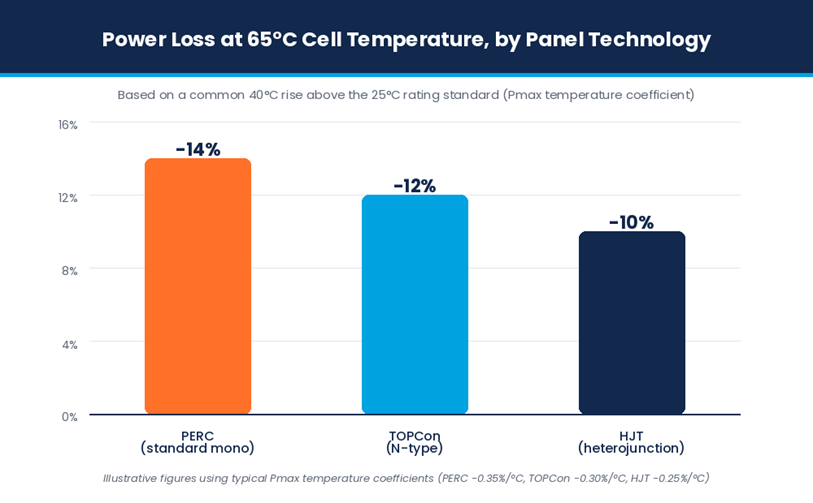
The exact loss depends on how far above 25°C the cells run and which technology sits behind the glass. Using a standard mono-PERC panel with a coefficient of around -0.35% per °C, a cell running at 65°C — a realistic peak for a dark roof on a 38–40°C Sydney day — is roughly 40°C above its rating point. That works out to a power loss of about 14% compared with the nameplate figure.
Newer N-type panels handle the same conditions better. TOPCon modules, with a typical coefficient near -0.30% per °C, lose closer to 12% under identical conditions. Heterojunction (HJT) panels, with coefficients around -0.25% per °C, come in lowest at roughly 10%. The chart below sets out how that plays out across the three technologies most commonly quoted for NSW rooftops in 2026.
Over a full summer, these percentage-point differences compound into a real gap in kilowatt-hours generated, which is why the temperature coefficient deserves as much attention as the headline efficiency percentage when comparing panels for a hot-climate install.
Not All Panels Handle Heat the Same Way
Panel technology matters here in a way that’s easy to overlook. Older P-type PERC cells contain boron-oxygen complexes that become more active at higher temperatures, adding a secondary degradation pathway on top of the standard temperature-coefficient loss. This is part of why older-generation panels can feel like they’re ageing faster on hot, north-facing roofs.
Newer N-type cells — TOPCon and HJT — don’t carry that same boron-oxygen chemistry, so they avoid this extra heat-driven pathway and tend to hold their output more consistently through summer. For homeowners in warmer parts of NSW, including inland areas like Mudgee where summer days regularly push past 35°C, a lower temperature coefficient is a genuine long-term yield advantage, not just a spec-sheet number.
None of this means older PERC panels are a poor choice — they remain a cost-effective, reliable technology across most of Australia. It simply means the temperature coefficient is worth comparing line-by-line when a quote lands on the table, the same way you’d compare efficiency percentage or warranty length.
Heat Loss vs Long-Term Degradation: Two Different Problems
It’s easy to conflate two separate effects, so it’s worth being precise. Heat-related output loss from the temperature coefficient is instant and reversible — output dips on a hot afternoon and recovers as soon as the panel cools down in the evening or on a milder day. It happens every summer, every year, for the life of the system.
Long-term degradation is a different mechanism entirely. It refers to the slow, permanent decline in a panel’s maximum output over its 25-to-30-year lifespan, caused by factors like UV exposure, micro-cracking, and light-induced degradation. Most quality panels degrade by around 0.4–0.6% per year on this measure, backed by manufacturer performance warranties.
The two interact, though. Panels that spend more hours per year at high cell temperatures — think an unventilated roof in Mudgee versus a breezy coastal install — tend to sit at the higher end of that annual degradation range. Keeping cell temperatures down doesn’t just help today’s output; it protects the panel’s long-term performance curve too.
4 Ways to Cut Heat Loss on an NSW Roof
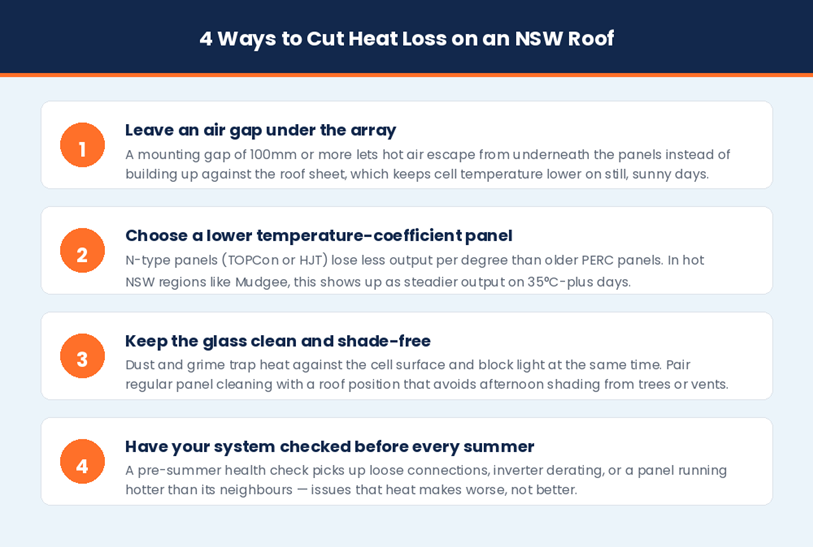
None of these fixes require replacing a working system, and most are worth raising with your installer before the next summer, not during it.
Airflow underneath the array is the single biggest lever available at install time — a mounting gap of 100mm or more lets hot air escape rather than pooling against the roof sheet. If your panels sit flush against the roof, ask a technician whether a standoff mount is feasible.
For anyone comparing panel brands as part of a new quote or an upgrade to an existing system, the temperature coefficient on the datasheet is worth weighing alongside price and warranty, particularly for larger north or west-facing arrays that see the most direct summer sun.
Clean panels also run cooler. A layer of dust or grime absorbs and traps heat against the cell surface on top of blocking light, so pairing regular cleaning with a position that avoids afternoon shade from trees or roof vents helps on both fronts. And because heat-related strain tends to surface first as loose connections or inverter derating, a pre-summer system health check is the cheapest way to catch a small issue before a 40°C week turns it into a bigger one.
Real-World Example: A 6.6kW System in Western Sydney
Take a common NSW setup — a 6.6kW system using standard PERC panels, roof-mounted with limited airflow, facing north. On a 38°C January afternoon, cell temperature on that roof commonly reaches 62–65°C. Applying a -0.35%/°C coefficient across that 37–40°C rise above the 25°C rating point works out to a power loss of roughly 13–14% during peak sun hours.
For a system rated to produce around 5.3kW at those irradiance levels, that’s a real-world output closer to 4.6kW during the hottest part of the day — a gap of roughly 700W, or enough to notice on a hot-day generation graph. Switch to a lower-coefficient TOPCon panel and the same conditions produce a loss closer to 11%, recovering a meaningful slice of that missing output across a full summer.
None of this shows up as a fault code or an error message. It simply shows up as a slightly flatter curve on your monitoring app around 1–3pm — which is exactly why understanding the temperature coefficient matters more than most homeowners realise.
What the Research Shows
UNSW Sydney’s modelling of rooftop solar and urban heat found that during peak summer periods, panel surface temperatures on poorly ventilated Sydney roofs can reach as high as 70°C — a finding that underlines just how far real rooftop conditions can drift from the 25°C rating point used on every panel’s datasheet.
“We get calls every January from homeowners convinced their system is faulty because generation dipped on the hottest day of the year. Nine times out of ten it’s simply heat doing what heat does to silicon. The fix isn’t a new system — it’s airflow, cleaning, and a pre-summer check.” — The Solar Battery Outlet installation team
For homeowners who want to verify installer credentials or read more on approved solar standards, the Clean Energy Council maintains a public list of approved solar retailers and installers, and the Bureau of Meteorology publishes long-term temperature and solar exposure data for NSW that installers use when designing for local conditions.
If your system is due for a refresh, our guide to upgrading an existing solar system covers when it makes sense to add newer, more heat-tolerant panels, and our solar panel cleaning service page explains how regular cleaning helps panels run cooler through summer.
Frequently Asked Questions
Yes. Once a panel’s cell temperature rises above the 25°C rating point, output declines steadily according to its temperature coefficient, typically -0.3% to -0.5% per °C. On a hot NSW summer afternoon, this can mean a 10–15% drop in output compared with the panel’s rated figure.
Efficiency loss begins the moment cell temperature climbs above 25°C — the Standard Test Condition benchmark. It’s a gradual, predictable decline rather than a sudden drop-off, and it becomes noticeable once cells pass around 35–40°C, which happens on most sunny NSW days.
No. Heat-related loss is temporary and reverses once the panel cools down. Long-term degradation is a separate, permanent decline in maximum output over a panel’s 25-to-30-year lifespan, usually around 0.4–0.6% per year, and is covered by the manufacturer’s performance warranty.
N-type panels — TOPCon and heterojunction (HJT) — generally have lower temperature coefficients than older PERC panels, meaning they lose less output per degree of heat. For hotter inland NSW locations, this can be a worthwhile factor to weigh alongside price when comparing quotes.
Yes. Ensuring good airflow underneath the array, keeping panels clean, avoiding unnecessary afternoon shading, and choosing a lower temperature-coefficient panel where practical can all reduce heat-related output loss on an NSW roof.
No. Temperature-related output loss is a normal, expected characteristic disclosed on every panel’s datasheet — it isn’t a defect and doesn’t affect your manufacturer or performance warranty.
Get Your System Checked Before the Next Heatwave
| Not sure how your own system is coping with the NSW heat? Solar Battery Outlet offers free, no-obligation system health checks for homeowners across Liverpool, Bankstown, and Mudgee, including a look at panel condition, airflow, and inverter performance ahead of summer. Call 1800 000 777 or visit solarbatteryoutlet.com.au to book a check — no pressure, just an honest look at how your system is performing. |
Disclaimer
This article is general information about how heat affects solar panel performance and is not a substitute for a site-specific assessment of your system. Actual output loss depends on panel technology, mounting, roof orientation, and local weather conditions, and can vary from the illustrative figures used here. Solar Battery Outlet does not guarantee specific generation outcomes for any individual property.
Always seek personalised advice before making a purchasing decision.