From 1 October 2026, Australian businesses get access to one of the biggest solar incentives in over a decade. The Federal Government has confirmed it will expand the Small-scale Renewable Energy Scheme (SRES), lifting the eligibility cap for upfront solar rebates from 100kW to 1 megawatt (MW). That is a tenfold increase, and it changes the economics of commercial solar for warehouses, farms, schools, retail centres, and manufacturing sites across the country — including right here in NSW.
In this guide, we break down exactly what the 1MW SRES expansion means, who qualifies, how much businesses could save, and how solar batteries NSW operators are already pairing with rooftop solar to get more value from the reform.
What Is the 1MW SRES Expansion, Exactly?
The SRES is the mechanism behind Australia’s upfront solar discount. Instead of businesses waiting years for a rebate, an eligible solar system generates Small-scale Technology Certificates (STCs) at the point of installation, which installers trade in for an immediate discount off the quoted price. Since 2011, this scheme has powered residential rooftop solar uptake across Australia, but the 100kW cap meant most commercial buildings quickly outgrew it.
Energy and Climate Change Minister Chris Bowen announced the change at the National Press Club on 5 August 2026, describing mid-scale commercial solar as the “missing middle” of Australia’s energy transition. From 1 October 2026, subject to the required regulations being finalised, systems up to 1MW will qualify for the same upfront STC mechanism that has driven household solar for 15 years.
- Old rule: only systems up to 100kW could claim SRES certificates.
- New rule (from 1 October 2026): systems up to 1MW (1,000kW) are eligible.
- Mechanism stays the same: no new applications process, no added red tape — it uses the existing STC market.
- Expected to remain budget-neutral for the government, since it works through the same certificate trading system.
Why the ‘Missing Middle’ Matters for NSW Businesses
Australia is a world leader in household solar, but commercial rooftops have lagged well behind. Analysis from the Institute for Energy Economics and Financial Analysis (IEEFA) shows the scale of the gap.
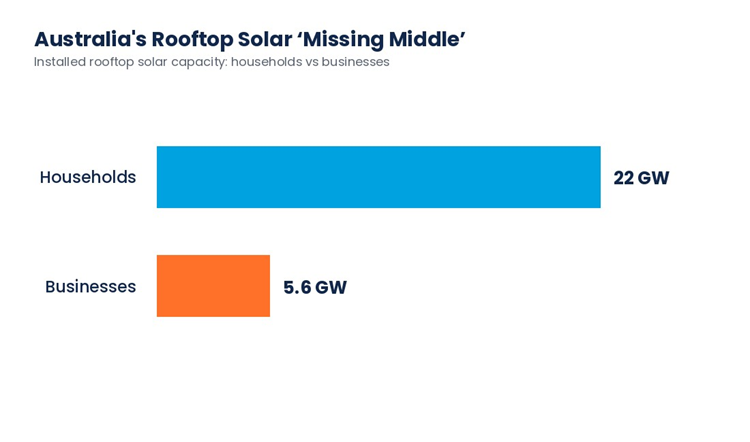
Around one in three Australian homes already has rooftop solar, but larger energy users have effectively been locked out of the same upfront incentive. For a NSW business running a warehouse, cold-storage facility, or farm shed, that gap has meant paying full price for the same technology a next-door homeowner gets discounted.
The reform specifically targets manufacturers, farmers, retailers, logistics operators, schools, hospitals, and community organisations — the segment industry has long called the “missing middle.” It sits between well-supported household solar and utility-scale renewable projects that already have their own large-scale incentive scheme.
How Much Could Businesses Actually Save?
Government estimates suggest the expanded SRES could cut the upfront cost of eligible commercial systems by roughly 20 per cent. Published examples include a discount of around $68,000 on a 250kW system and about $230,000 on an 850kW system — savings that flow straight off the invoice rather than arriving as a future tax offset.
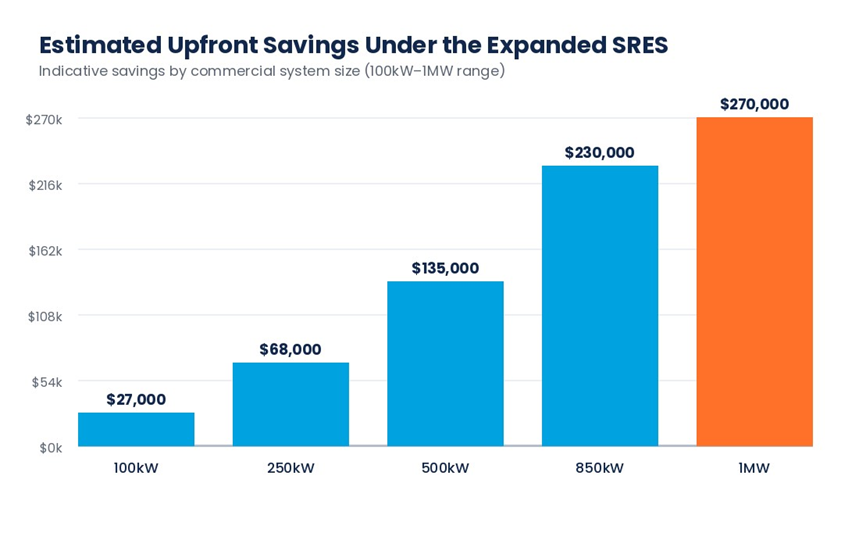
For context, a mid-sized NSW retail centre or logistics warehouse installing a 500kW system could realistically be looking at a six-figure discount before the system generates a single kilowatt-hour. That materially shortens payback periods and turns unused roof space into a genuine balance-sheet asset rather than a nice-to-have sustainability line item.
Who Is Eligible Under the New 1MW Threshold?
Eligibility sits on a sliding scale based on system size, and it’s worth checking exactly where a project falls before assuming it qualifies.
- Below 100kW: already eligible under the existing SRES rules — nothing changes here.
- 100kW to 1MW (1,000kW): newly eligible from 1 October 2026 — this is the expanded “missing middle” band.
- Above 1MW: falls outside the SRES and into the separate Large-scale Renewable Energy Target (LRET) framework.
Most medium-sized commercial buildings — think warehouses, supermarkets, agricultural sheds, schools, and shopping centres — sit comfortably within the new 100kW–1MW band. If your business has previously been quoted for solar and told it was “too big” for a meaningful rebate, this is the moment to get that quote revisited.
Pairing the Rebate with Battery Storage
A bigger solar system also raises a bigger question: what happens to the extra energy generated in the middle of the day? For many commercial sites, especially those with variable operating hours, battery storage is what turns a larger solar array into round-the-clock savings rather than exported energy sold back at low feed-in rates.
This trend is already visible among residential solar battery customers across NSW. Homes using solar with battery storage often achieve more consistent bill savings. The same principle applies to businesses. A correctly sized battery stores cheap midday solar energy. Businesses can then use that energy during expensive evening peak periods.
A 4-Step Framework for NSW Businesses
Whether you manage a warehouse in Liverpool, a retail site in Bankstown, or a farm shed near Mudgee, the same four steps apply before committing to a system.
Step 1: Confirm Your Realistic System Size
Get an energy audit or at least 12 months of billing data reviewed before assuming a number. Businesses regularly underestimate how much roof space and daytime load they actually have to work with.
Step 2: Check Where You Sit on the SRES Scale
Map your proposed system against the 100kW–1MW band. A system just above the old 100kW cap benefits enormously from this change; a system already near 1MW should get its numbers double-checked against the final legislated rules before 1 October 2026.
Step 3: Model Solar-Plus-Storage, Not Solar Alone
Ask any installer to quote both scenarios side by side. A larger system without storage can mean exporting excess power at low rates. Adding a right-sized battery may improve the payback period for some sites — ask for both options to be modelled.
Step 4: Get Written Timelines from Your Installer
With the scheme change landing on 1 October 2026, expect installer demand to rise sharply in the months beforehand. Ask for written confirmation of install timing and what happens if the schedule shifts, rather than relying on a verbal assurance.
Frequently Asked Questions
The change is expected to take effect from 1 October 2026, subject to the necessary regulations being finalised by the Federal Government.
Government estimates point to roughly a 20% reduction in upfront installation costs for eligible systems, with published examples showing about $68,000 off a 250kW system and about $230,000 off an 850kW system.
No. The residential SRES rules for solar batteries NSW households already use remain unchanged. This expansion only raises the ceiling for commercial and industrial systems, from 100kW up to 1MW.
Systems above 1MW fall outside the SRES entirely and are assessed instead under the Large-scale Renewable Energy Target (LRET) framework, which operates differently.
Not necessarily. Systems under 100kW are unaffected and can proceed now. For projects in the 100kW–1MW range, it’s worth discussing timing with your installer, since the value of waiting depends on your specific site, current quote, and how firm the final regulations turn out to be.
The Bottom Line for NSW Businesses
The 1 MW SRES expansion is Australia’s biggest commercial solar policy shift in years. It directly supports mid-sized businesses previously excluded from meaningful rebates. NSW operators in Liverpool, Bankstown, and Mudgee should assess their sites under the new 100 kW–1 MW rebate band. They should also ask their installer to compare solar-plus-battery systems with solar-only options.
Disclaimer
This article summarises publicly announced government policy on the 2026 SRES expansion. The policy was still being finalised when this article was written. Savings, eligibility, and timing are estimates based on government statements and industry reports. Final legislated rules may differ from current estimates. This article provides general information only. It is not financial, legal, or engineering advice. It does not guarantee eligibility, rebate amounts, or business savings. Always seek personalised advice before making a purchasing decision.
Ready to Find Out What Your Business Qualifies For?
Solar Battery Outlet helps businesses across Liverpool, Bankstown, and Mudgee assess their position under the new SRES scale. We also evaluate whether battery storage suits each site’s energy usage profile. Get in touch for a free eligibility check before the October 2026 changes land.
