If the power drops out tonight across Liverpool, Bankstown or Mudgee, your fridge, your WiFi and your lights will not care how big your solar system is. They will only care which circuits your battery is actually wired to protect. That single wiring decision is the real difference between essential-circuit backup and whole-home backup, and it is one that many homeowners only discover after the blackout has already started.

Choosing between the two is not just a budget question. It determines what stays on, for how long, and whether the solar batteries NSW households have already invested in can actually deliver blackout protection when the grid fails, rather than sitting there fully charged but disconnected because the backup pathway was never wired in.

How Often Do NSW Homes Actually Lose Power?

Before sizing a battery, it helps to understand what you are planning for. Reliability data from the Australian Energy Regulator provides a useful benchmark. Excluding major storm and bushfire event days, Ausgrid customers in Sydney and the Hunter experience about 75 minutes of outages each year on average.

Endeavour Energy customers across Greater Western and South Sydney experience about 90 minutes of outages annually. Essential Energy serves many regional areas, including Mudgee. These customers often face longer restoration times because of long rural feeder lines and lower customer density.

Those averages exclude the events that actually put backup power to the test. The NSW Parliament’s inquiry into the 2025 Far West power outage examined a disruption that left communities without reliable supply for around two weeks, prompting reviews by IPART and the Australian Energy Regulator into whether network obligations were met. Ausgrid’s own Guaranteed Service Level scheme sets its compensation threshold at roughly 20 cumulative hours off supply or 10 separate interruptions in a financial year, which tells you something useful: the network itself treats that level of disruption as abnormal, not routine.
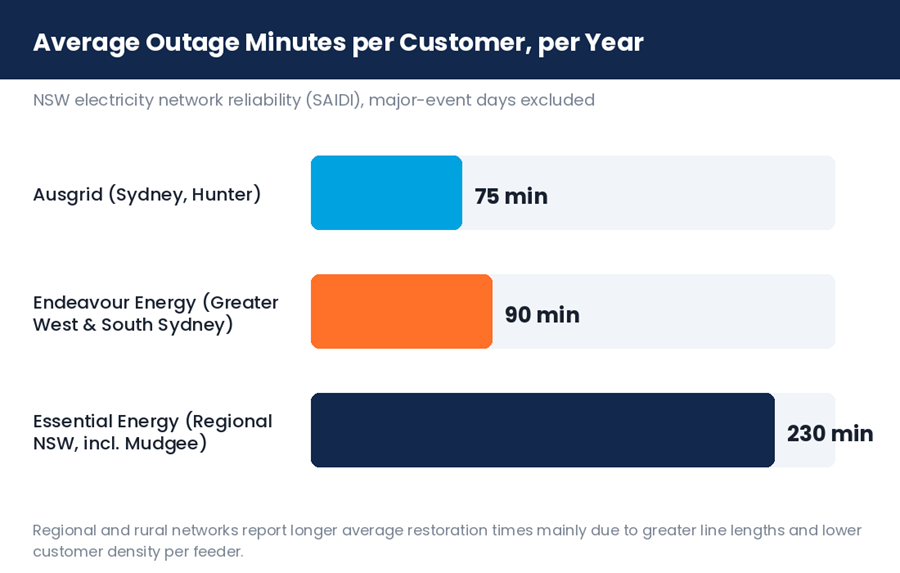
Average power outage minutes per customer per year across NSW electricity networks Ausgrid Endeavour Essential Energy

The practical takeaway is straightforward. Most NSW blackouts are short, weather-driven events measured in minutes to a few hours. Multi-day, multi-week disruptions happen, but they cluster around declared storm, flood or bushfire events, and mostly in regional and rural areas. That distinction should drive your backup decision far more than a generic size recommendation ever will.

Essential Circuits Backup — What It Covers and What It Costs

Essential-circuit backup, sometimes called partial-home backup, sends power from your battery to a dedicated sub-panel. This sub-panel is wired to a short list of critical circuits. These usually include the fridge, general lighting, the WiFi router and modem, phone chargers, and often one bedroom or living area circuit.

Everything else on your switchboard remains connected to grid power. This includes ducted air-conditioning, the oven, and the hot water system. During a power outage, these circuits simply go offline.

Because the load is small and predictable, most homes only need 5 to 15 kWh of usable battery capacity to run essential circuits for 24 to 48 hours, and installation stays relatively simple: a standard hybrid inverter and one sub-panel, rather than a full switchboard changeover. Installed cost for a genuinely backup-capable essential-circuit setup typically lands between $8,000 and $15,000 in NSW, before any rebate. If you are timing an install around the current federal battery rebate step-down, our breakdown of whether it’s worth rushing before the rebate drops walks through exactly how much a few months’ delay can cost.

“The mistake we see most often is homeowners assuming that any battery automatically backs up the whole house,” says a Solar Battery Outlet accredited electrician. “Unless the essential-circuit or whole-home pathway is specified during installation, a fully charged battery may not power your home. The switchboard must be wired correctly to transfer selected loads during an outage.”

Whole-Home Backup — What It Covers and What It Costs

Whole-home backup keeps every circuit in the house running during an outage, air-conditioning, the electric oven, hot water, and an EV charger. To do that safely, you need a multi-mode or off-grid-capable inverter and a full switchboard changeover, not just a sub-panel.

The trade-off is capacity versus runtime. Air-conditioning and electric hot water are large, spiky loads. Whole-home systems usually need 20 to 30 kWh or more of usable battery storage.

Installed costs typically range from $18,000 to $40,000 or more. The final price depends on the inverter class and the number of battery units required. Battery capacity also lasts for a much shorter time under a whole-home load. A battery that could power essential circuits for one or two days might run a full house, including air-conditioning, for only six to twelve hours.
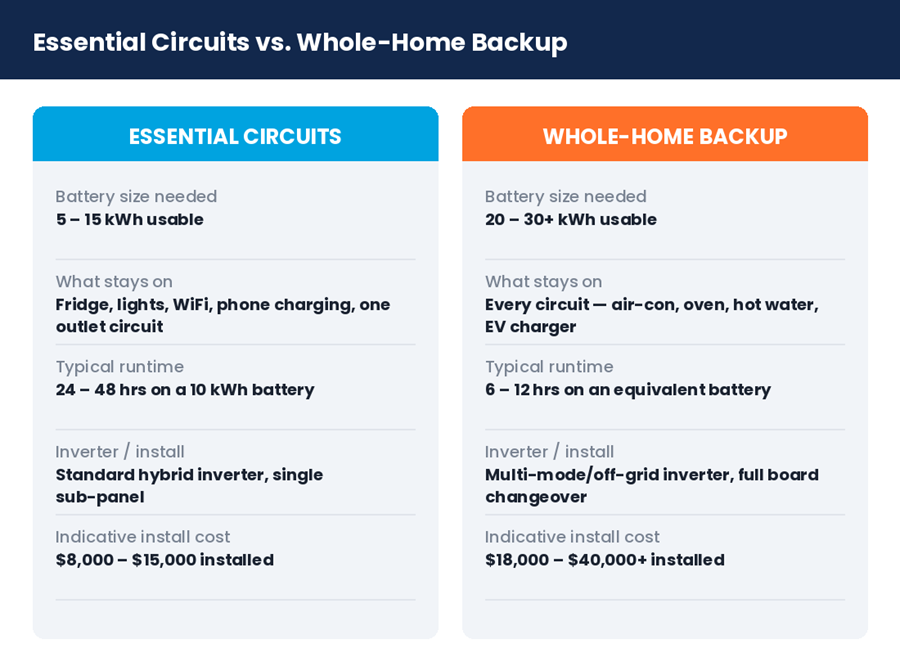
Essential circuits vs whole-home backup — battery size, runtime and cost comparison

Which One Actually Matches an NSW Blackout?

Matching the setup to the outage pattern, not the marketing brochure, is where most homeowners get this decision wrong. Given that the majority of NSW outages resolve within a few hours, essential-circuit backup is the more realistic fit for solar batteries NSW households in Ausgrid and Endeavour Energy areas, where restoration is usually fast. It protects the things that genuinely matter in a short outage: food safety, connectivity, and light.

Whole-home backup earns its higher cost in specific situations. It suits bushfire-prone or storm-exposed regional properties with less reliable power lines. It may also suit households that use medical equipment. A battery should never be your only plan for life support — register as a life support customer with your retailer and talk to your doctor about a backup plan.

Some homeowners simply value comfort during a power outage more than the higher upfront cost. Outside these situations, many homes end up paying for battery capacity they rarely use.

The 4-Step Framework to Choose Your Backup Setup

Work through these four steps with your installer before you commit to a battery size or inverter class.
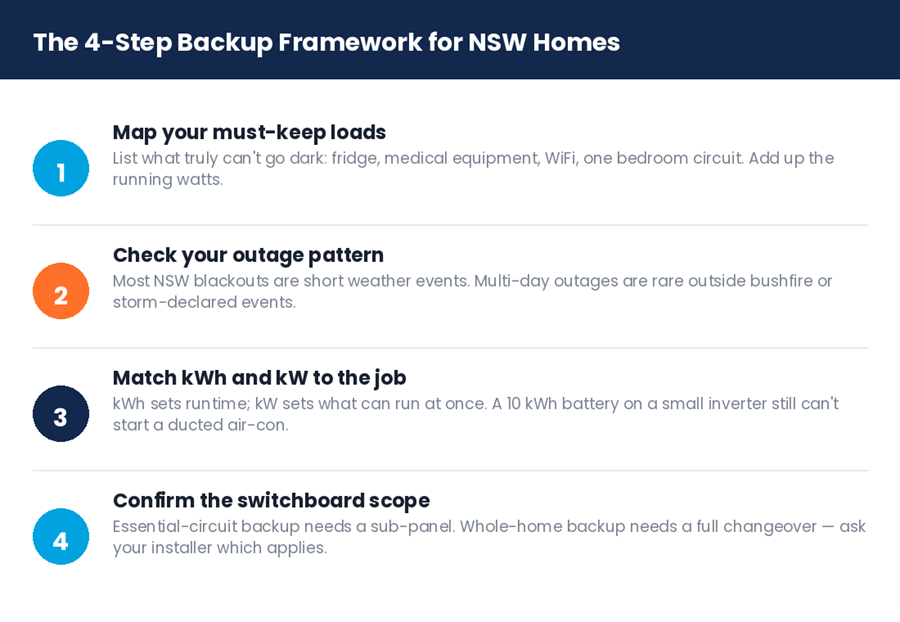
Four step framework for choosing solar battery backup setup for NSW homes

Steps-

one is mapping your must-keep loads in actual watts, not guesswork, because that number decides everything downstream.

Two means checking your own outage history and your network’s published reliability figures, rather than assuming every blackout will be a repeat of the worst storm you have heard about.

Three is matching both kWh and kW to the job: kWh determines how long the battery lasts, while kW determines what it can actually start and run at the same moment, including surge loads like a compressor kicking in.

Four is confirming the switchboard scope with your installer in writing, because essential-circuit and whole-home backup require different wiring, and retrofitting the difference later is more expensive than specifying it correctly the first time.

Example: Sizing Backup for a Bankstown Family Home

Consider a four-person household in Bankstown. The home runs a fridge, lighting, WiFi, phone charging, and a home office setup. Together, these appliances draw about 800 to 1,000 watts while running, or around 300 to 400 watts on average across the day.

At that average, a 10 kWh usable battery may provide around 24 hours of essential-circuit backup. At a steady 1,000 watts, it would last about 10 hours. That is enough to cover most outages experienced by Ausgrid customers in the area.

The same family could add a 6 kW solar array. On a sunny day during a daytime outage, the system may generate around 20 to 28 kWh of energy. That energy can recharge the battery even while it is powering essential circuits. As a result, essential-circuit backup can continue for several consecutive days. In many cases, this happens without the need for whole-home battery capacity. A formal load assessment should model this scenario before you sign anything.

Common Mistakes That Leave NSW Homes in the Dark Anyway

  • Assuming any battery equals automatic backup, without confirming the backup pathway is wired at install.
  • Sizing for kWh alone and ignoring kW, so the inverter cannot start a compressor or pump even with charge to spare.
  • Skipping a surge-load check on motors like air-conditioning compressors and pool or sump pumps, which draw two to three times their running wattage on startup.
  • Forgetting that battery-only backup, without solar recharge, is a fixed pool of energy that runs out and stays out until the grid returns.
  • Never testing the backup switchover after installation, so the first time it is needed is also the first time anyone finds out it does not work.
Frequently Asked Questions
What is the difference between essential circuits and whole-home battery backup?

Essential-circuit backup powers a short list of critical loads, such as the fridge, lighting, WiFi and phone charging, through a dedicated sub-panel, while whole-home backup powers every circuit in the house, including air-conditioning and hot water, through a full switchboard changeover and a much larger battery.

Can I add whole-home backup later if I start with essential circuits?

In many cases, you can upgrade later if the original inverter supports backup power and future expansion. However, you should plan the switchboard rewiring and any additional battery units with your installer in advance. Retrofitting a full changeover later usually costs more than specifying it during the initial installation.

Do I need a new switchboard for battery backup in NSW?

Not always. Essential-circuit backup usually needs a backup sub-panel, and whole-home backup usually needs a full switchboard changeover. Some older switchboards also need an upgrade first. Your installer will check this on site and show any switchboard work on your quote.

Is whole-home backup worth it for bushfire-prone or regional NSW areas?

Whole-home backup can be worthwhile because regional networks such as Essential Energy often take longer to restore power than metropolitan networks. Households in fire-prone or storm-exposed areas may face extended outages. Homes that rely on medical equipment requiring guaranteed climate control also benefit the most. These situations provide the clearest justification for the higher cost of whole-home backup.

Disclaimer
This article is general information only and does not constitute a formal load assessment, electrical design, or financial advice. Battery sizes, runtimes and costs quoted are indicative ranges drawn from current published Australian industry data and typical NSW installations; your actual backup capacity, runtime and installed cost will depend on your home’s wiring, switchboard, usage patterns and the inverter and battery model chosen, and should be confirmed by a licensed, SAA-accredited installer before you commit to a system. NSW network outage figures are representative averages and vary by location and year. Always seek personalised advice before making a purchasing decision.
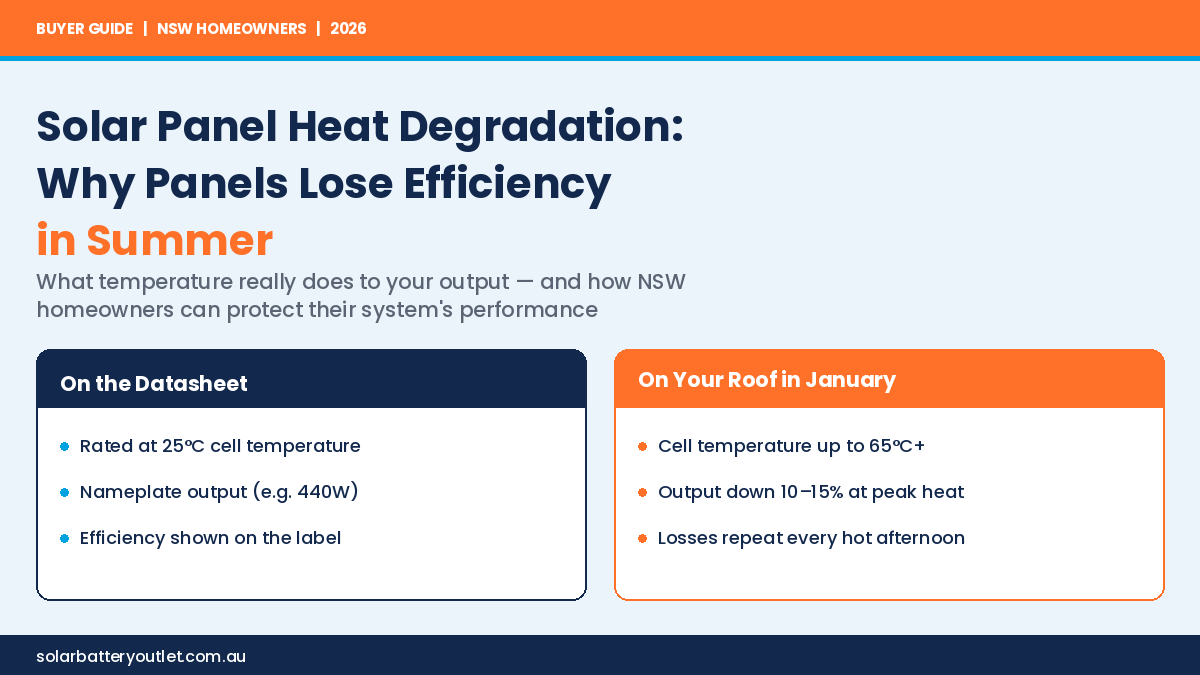
Your solar system carries a rating tested in a cool, controlled lab at 25°C. NSW summer afternoons rarely cooperate with that number. Once panel surfaces climb past it, output starts sliding — quietly, predictably, on almost every hot day from December through February.

This isn’t a fault, and it isn’t damage. It’s solar panel heat degradation, and it explains why a system can underperform on exactly the days you’d expect it to shine brightest. Understanding how heat affects panel output and what actually helps lets you get more from a system you’ve already paid for — whether your roof is in Liverpool, Bankstown, Mudgee, or anywhere else across the state.

This guide walks through the science behind heat-related losses, the real numbers involved, and a practical framework for protecting performance through an NSW summer.

What Is Solar Panel Heat Degradation?

Solar panels are rated under Standard Test Conditions: 25°C cell temperature and 1,000 W/m² of sunlight. Every wattage figure printed on a panel’s specification sheet assumes that lab-controlled temperature.

In the real world, cell temperature climbs well above the surrounding air as sunlight heats the glass, silicon, and backsheet. That heat physically changes how efficiently silicon converts light into electricity, and the effect is captured by a panel’s Pmax temperature coefficient — a figure printed on every datasheet as a negative percentage per degree Celsius.

A typical crystalline silicon panel loses roughly 0.3% to 0.5% of its rated output for every degree above 25°C. On a hot summer afternoon, when cell temperatures reach 60°C or more, that steady decline can add up to a 10–15% drop in power output compared with the rated figure on the box. It’s a normal, engineered characteristic of how silicon behaves under heat — not a sign that anything is wrong with the panel.

Why Summer Heat Hits Harder Than Most Homeowners Expect

The gap between air temperature and panel temperature is bigger than most people assume. A panel’s Nominal Operating Cell Temperature (NOCT) — the temperature it reaches under everyday conditions — typically sits 20 to 25°C above ambient air temperature once you account for mounting, airflow, and roof material.

So on a 35°C day in Western Sydney, a dark-coloured, close-mounted panel can easily reach cell temperatures of 55–60°C, and research from UNSW Sydney has recorded rooftop solar surfaces climbing as high as 70°C during peak summer periods on poorly ventilated installations. That’s a 45°C jump above the 25°C rating point — enough to meaningfully cut into a system’s expected output for hours at a time.

It’s worth noting the trade-off works in the homeowner’s favour overall: total energy output on a hot, sunny day is still typically higher than on a mild, cloudy one, because there’s simply more sunlight hitting the panel. Heat degradation reduces efficiency — it doesn’t cancel out the benefit of a longer, brighter summer day. But it does mean your system is quietly leaving output on the table during exactly the hours your air conditioner is working hardest.

How Much Efficiency Do Solar Panels Really Lose in Heat?

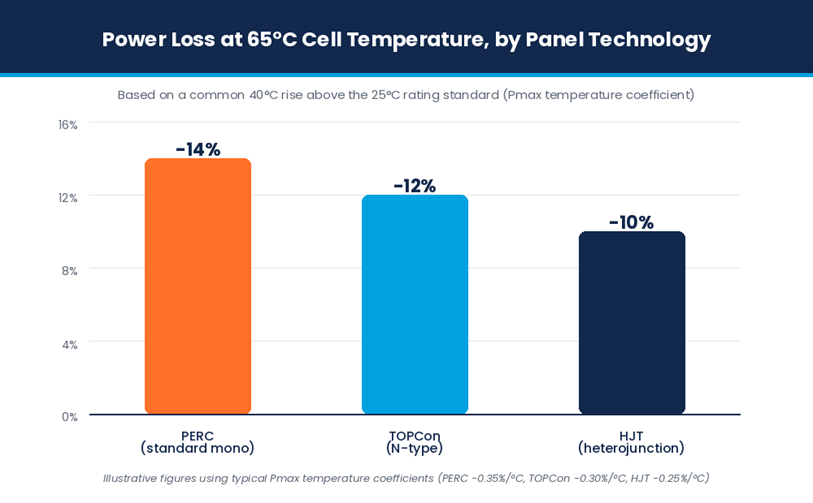
Estimated power loss at 65°C cell temperature, by common panel technology used in Australian installs

The exact loss depends on how far above 25°C the cells run and which technology sits behind the glass. Using a standard mono-PERC panel with a coefficient of around -0.35% per °C, a cell running at 65°C — a realistic peak for a dark roof on a 38–40°C Sydney day — is roughly 40°C above its rating point. That works out to a power loss of about 14% compared with the nameplate figure.

Newer N-type panels handle the same conditions better. TOPCon modules, with a typical coefficient near -0.30% per °C, lose closer to 12% under identical conditions. Heterojunction (HJT) panels, with coefficients around -0.25% per °C, come in lowest at roughly 10%. The chart below sets out how that plays out across the three technologies most commonly quoted for NSW rooftops in 2026.

Over a full summer, these percentage-point differences compound into a real gap in kilowatt-hours generated, which is why the temperature coefficient deserves as much attention as the headline efficiency percentage when comparing panels for a hot-climate install.

Not All Panels Handle Heat the Same Way

Panel technology matters here in a way that’s easy to overlook. Older P-type PERC cells contain boron-oxygen complexes that become more active at higher temperatures, adding a secondary degradation pathway on top of the standard temperature-coefficient loss. This is part of why older-generation panels can feel like they’re ageing faster on hot, north-facing roofs.

Newer N-type cells — TOPCon and HJT — don’t carry that same boron-oxygen chemistry, so they avoid this extra heat-driven pathway and tend to hold their output more consistently through summer. For homeowners in warmer parts of NSW, including inland areas like Mudgee where summer days regularly push past 35°C, a lower temperature coefficient is a genuine long-term yield advantage, not just a spec-sheet number.

None of this means older PERC panels are a poor choice — they remain a cost-effective, reliable technology across most of Australia. It simply means the temperature coefficient is worth comparing line-by-line when a quote lands on the table, the same way you’d compare efficiency percentage or warranty length.

Heat Loss vs Long-Term Degradation: Two Different Problems

It’s easy to conflate two separate effects, so it’s worth being precise. Heat-related output loss from the temperature coefficient is instant and reversible — output dips on a hot afternoon and recovers as soon as the panel cools down in the evening or on a milder day. It happens every summer, every year, for the life of the system.

Long-term degradation is a different mechanism entirely. It refers to the slow, permanent decline in a panel’s maximum output over its 25-to-30-year lifespan, caused by factors like UV exposure, micro-cracking, and light-induced degradation. Most quality panels degrade by around 0.4–0.6% per year on this measure, backed by manufacturer performance warranties.

The two interact, though. Panels that spend more hours per year at high cell temperatures — think an unventilated roof in Mudgee versus a breezy coastal install — tend to sit at the higher end of that annual degradation range. Keeping cell temperatures down doesn’t just help today’s output; it protects the panel’s long-term performance curve too.

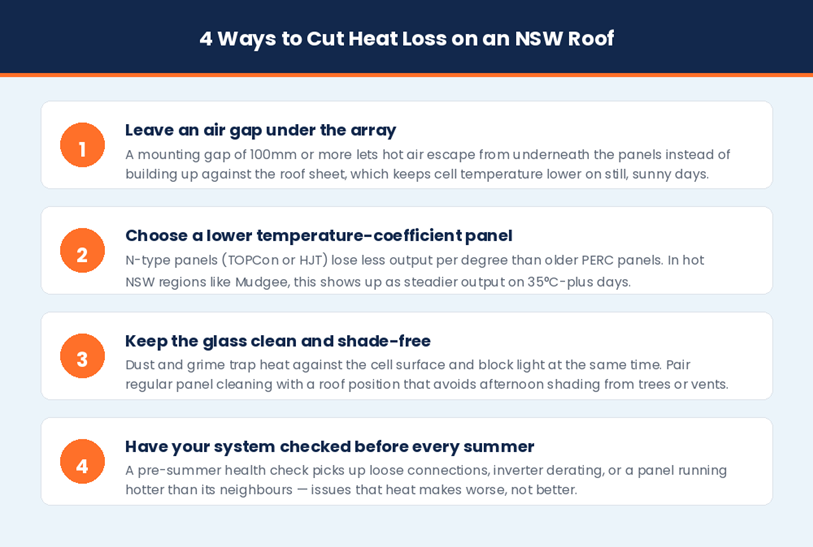
4 Ways to Cut Heat Loss on an NSW Roof

A practical framework for reducing heat-related output loss on residential NSW installs.

None of these fixes require replacing a working system, and most are worth raising with your installer before the next summer, not during it.

Airflow underneath the array is the single biggest lever available at install time — a mounting gap of 100mm or more lets hot air escape rather than pooling against the roof sheet. If your panels sit flush against the roof, ask a technician whether a standoff mount is feasible.

For anyone comparing panel brands as part of a new quote or an upgrade to an existing system, the temperature coefficient on the datasheet is worth weighing alongside price and warranty, particularly for larger north or west-facing arrays that see the most direct summer sun.

Clean panels also run cooler. A layer of dust or grime absorbs and traps heat against the cell surface on top of blocking light, so pairing regular cleaning with a position that avoids afternoon shade from trees or roof vents helps on both fronts. And because heat-related strain tends to surface first as loose connections or inverter derating, a pre-summer system health check is the cheapest way to catch a small issue before a 40°C week turns it into a bigger one.

Real-World Example: A 6.6kW System in Western Sydney

Take a common NSW setup — a 6.6kW system using standard PERC panels, roof-mounted with limited airflow, facing north. On a 38°C January afternoon, cell temperature on that roof commonly reaches 62–65°C. Applying a -0.35%/°C coefficient across that 37–40°C rise above the 25°C rating point works out to a power loss of roughly 13–14% during peak sun hours.

For a system rated to produce around 5.3kW at those irradiance levels, that’s a real-world output closer to 4.6kW during the hottest part of the day — a gap of roughly 700W, or enough to notice on a hot-day generation graph. Switch to a lower-coefficient TOPCon panel and the same conditions produce a loss closer to 11%, recovering a meaningful slice of that missing output across a full summer.

None of this shows up as a fault code or an error message. It simply shows up as a slightly flatter curve on your monitoring app around 1–3pm — which is exactly why understanding the temperature coefficient matters more than most homeowners realise.

For homeowners who want to verify installer credentials, Solar Accreditation Australia (SAA) keeps a public list of accredited installers, and the Clean Energy Council keeps a list of approved products. The Bureau of Meteorology publishes… long-term temperature and solar exposure data for NSW that installers use when designing for local conditions.

If your system is due for a refresh, our guide to upgrading an existing solar system covers when it makes sense to add newer, more heat-tolerant panels, and our solar panel cleaning service page explains how regular cleaning helps panels run cooler through summer.

Frequently Asked Questions
Do solar panels really lose efficiency in hot weather?

Yes. Once a panel’s cell temperature rises above the 25°C rating point, output declines steadily according to its temperature coefficient, typically -0.3% to -0.5% per °C. On a hot NSW summer afternoon, this can mean a 10–15% drop in output compared with the panel’s rated figure.

At what temperature do solar panels start losing power?

Efficiency loss begins the moment cell temperature climbs above 25°C — the Standard Test Condition benchmark. It’s a gradual, predictable decline rather than a sudden drop-off, and it becomes noticeable once cells pass around 35–40°C, which happens on most sunny NSW days.

Is heat-related efficiency loss the same as panel degradation?

No. Heat-related loss is temporary and reverses once the panel cools down. Long-term degradation is a separate, permanent decline in maximum output over a panel’s 25-to-30-year lifespan, usually around 0.4–0.6% per year, and is covered by the manufacturer’s performance warranty.

Which solar panels perform best in NSW summer heat?

N-type panels — TOPCon and heterojunction (HJT) — generally have lower temperature coefficients than older PERC panels, meaning they lose less output per degree of heat. For hotter inland NSW locations, this can be a worthwhile factor to weigh alongside price when comparing quotes.

Can I reduce how much heat affects my solar panels?

Yes. Ensuring good airflow underneath the array, keeping panels clean, avoiding unnecessary afternoon shading, and choosing a lower temperature-coefficient panel where practical can all reduce heat-related output loss on an NSW roof.

Does solar panel heat degradation void my warranty?

No. Temperature-related output loss is a normal, expected characteristic disclosed on every panel’s datasheet — it isn’t a defect and doesn’t affect your manufacturer or performance warranty.

Get Your System Checked Before the Next Heatwave
Disclaimer

This article is general information about how heat affects solar panel performance and is not a substitute for a site-specific assessment of your system. Actual output loss depends on panel technology, mounting, roof orientation, and local weather conditions, and can vary from the illustrative figures used here. Solar Battery Outlet does not guarantee specific generation outcomes for any individual property.

Always seek personalised advice before making a purchasing decision.
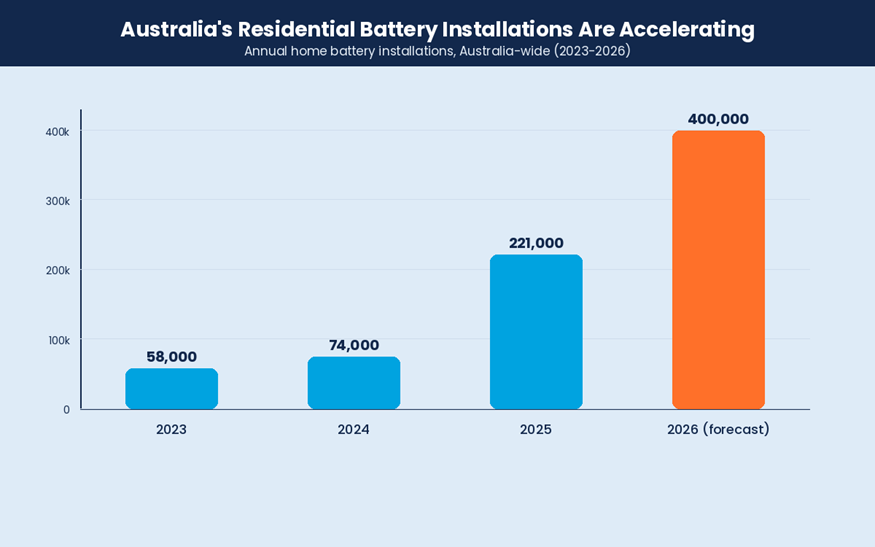
Home battery sales in Australia are no longer a niche trend — they are a mainstream shift in how solar households manage power. In 2025, Australians installed a record 221,000 residential battery systems, almost three times the volume installed in 2024, and industry analyst SunWiz expects the 2026 calendar year to add roughly 400,000 more. For NSW homeowners who already have rooftop solar, or are weighing it up, this surge changes the maths, the market, and the timing of a smart decision. Here is what is actually driving the boom, what it means for your household, and how to use the momentum to your advantage.

Australia's residential battery installations rising from 58,000 in 2023 to a forecast 400,000 in 2026

The scale of the shift is hard to overstate. Australians spent close to $8.69 billion on home batteries in just the first five months of 2026, according to a Reuters calculation built on SunWiz installation data. Between January and May 2026 alone, households installed 7.7 gigawatt-hours of battery storage — more than the previous six years combined. By mid-2026, more than 466,000 residential battery systems had been connected under the federal Cheaper Home Batteries Program since it launched in July 2025, delivering over 12 gigawatt-hours of new storage capacity nationwide.

NSW is playing a leading role in that growth. Government data to March 2026 shows four of the twelve highest-uptake postcode regions in the country sit in outer and western Sydney, accounting for 6,590 installations between them. Today, roughly one in twenty Australian homes has a battery, up from a small fraction just two years ago, and the trajectory keeps climbing. This is not a short-lived spike. It reflects a structural change in how solar households value the power they generate.

Why More NSW Homeowners Are Looking at Batteries

Three forces are converging at once, and together they explain why so many solar owners are moving from “maybe one day” to “book a quote.”

1. Feed-in tariffs have kept shrinking

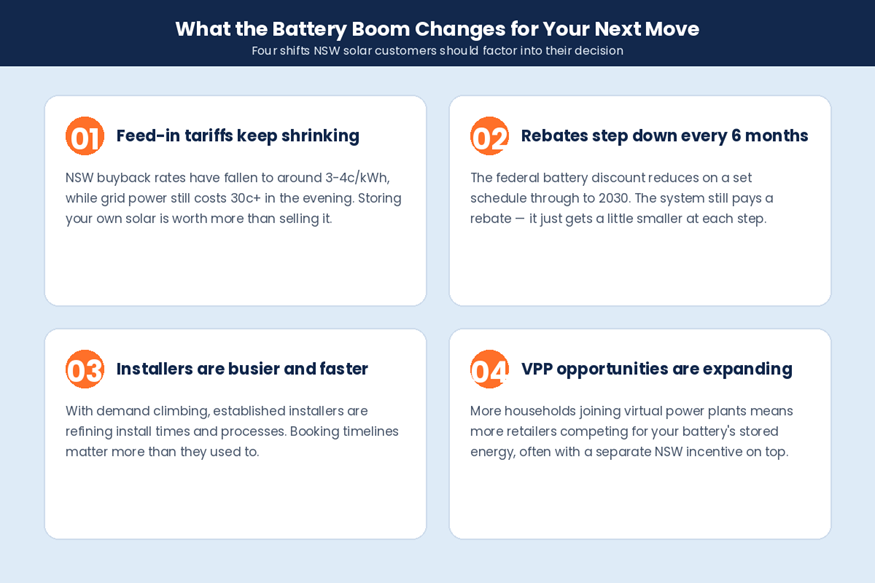
From 1 July 2026, NSW solar buyback rates dropped again, to as low as 3c/kWh on many plans, while the same household still pays roughly 30 to 40c/kWh to buy power back after dark. That gap is the entire financial case for storage: a solar-only home effectively gives away its cheap daytime power and buys it back at ten times the price a few hours later.

2. Electricity bills remain historically elevated

The average NSW household is paying close to $1,450 a year on a market offer, and while the 2026-27 Default Market Offer trimmed flat rates by roughly 3.4 to 5.0 percent, that follows a much larger increase the year before. A battery reduces exposure to further rises because it lets you use your own stored solar instead of buying from the grid at peak.

3. The federal rebate steps down on a schedule

Since 1 May 2026 the Cheaper Home Batteries Program has used a tiered structure. The upfront discount depends on the battery’s usable size and the current STC rate, and the rate reduces every six months through to 2030. Waiting does not remove the rebate; it just shrinks it a little further each cycle, which is exactly why installation volumes keep climbing rather than tapering off.

What the Surge Means If You Already Have Solar

If your panels have been running solar-only for a few years, you are part of the group installers now describe as their fastest-growing customer base. Industry reporting shows a majority of battery installations are retrofits onto existing rooftop solar rather than new combined systems, which means you do not need to replace your panels to benefit. Most modern inverters and panel setups are compatible with a retrofitted battery.

The surge also strengthens your negotiating position. More installers are competing for retrofit customers, more battery brands are available at competitive pricing, and virtual power plants (VPPs) are actively recruiting existing solar households to join, often stacking a separate NSW incentive on top of the federal rebate. That combination, a mature retrofit market plus rising VPP demand, means existing solar owners are, in many cases, well placed to get a fast, well-priced install.

What the Surge Means If You’re Still Deciding

four ways rising battery sales change the decision for NSW solar customers

If you have not installed solar and a battery yet, the calculation has shifted from “is this worth it” to “what size and when.” Feed-in tariffs will likely keep falling rather than recovering, which increases the value of storing your own power over time. The rebate step-down is scheduled and predictable, so you can plan around it rather than react to it. Reputable installers are refining their processes to handle higher demand, so booking early in a rebate cycle tends to mean a shorter wait for your installation date. And VPP participation can add extra credits or payments for some households, as more retailers compete for access to household batteries during peak demand periods. Amounts vary by plan.

None of this means every household should rush. It means the case for comparing a proper, itemised quote has become stronger, because the gap between a well-sized system and an oversized or poorly matched one is now worth more than it used to be.

Three Steps Before You Get a Quote

1. Pull your last 12 months of electricity bills and check how much power you use after sunset. This is what actually determines whether a battery pays for itself.

2. Confirm your existing solar system’s age and output before adding storage, since a battery cannot fix an underperforming or degraded solar array.

3. Compare at least three written quotes that show the federal rebate as a dollar figure, not a verbal promise, and ask each installer how the NSW VPP incentive applies to your postcode.

Working through these three steps before you sign anything protects you from both extremes: rushing into an oversized system, and delaying so long that a rebate step-down costs you more than waiting was worth.

You can see how this plays out in practice in our related breakdown of why home battery uptake in Australia is surging, and if your panels have been running solar-only for a while, our guide on adding a battery to an existing rooftop solar system walks through the retrofit process step by step.

Frequently Asked Questions

Is now a good time to buy a solar battery in NSW?

For many households, yes. Feed-in tariffs are low, bills remain elevated, and the federal rebate is still active. But “good time” depends on your usage pattern and your solar system’s condition, so compare written quotes before committing to a size or brand.

Why are so many more Australians installing batteries in 2026?

A combination of the federal Cheaper Home Batteries Program discount, falling feed-in tariffs, and elevated retail electricity prices has made storing solar power more valuable than exporting it. SunWiz data shows installations roughly tripled between 2024 and 2025.

Do I need new solar panels to add a battery?

Usually not. Most battery installations recorded in the last two years have been retrofits onto existing rooftop solar systems. A qualified installer can confirm your inverter and panels are compatible before quoting.

Will the battery rebate run out if I wait?

The Cheaper Home Batteries Program is currently scheduled to run until 2030, with the discount reducing every six months. Government programs can change, so check the official program page for the latest rules.

How do I know if a battery will actually save me money?

It depends on how much electricity you use in the evening after your solar stops generating. A reputable installer should review your last 12 months of bills before recommending a battery size.

Disclaimer

This article is general information about home battery trends in NSW and is not personal financial, legal, or energy advice. Rebate rates, feed-in tariffs, and electricity prices referenced here were accurate at the time of publication and are subject to change by the relevant government body or your retailer. Every home’s usage pattern, solar system, and eligibility differ, so actual savings and payback periods will vary. Always seek personalised advice before making a purchasing decision.

If you installed solar panels five, eight, or even ten years ago, you are sitting on an asset that is quietly becoming more valuable — and less rewarded by the grid. Feed-in tariffs have fallen every year since 2020, while evening electricity prices keep climbing. As a result, hundreds of thousands of Australian households are taking the same next step: adding a battery to the solar system they already own, rather than exporting cheap power and buying it back expensive.

This shift is not a niche trend. It is now the dominant pattern in the Australian solar market, and understanding why can help you decide whether the same move makes sense for your home.

The Retrofit Boom, By the Numbers

Australia has more rooftop solar than almost anywhere on earth. The Clean Energy Regulator puts the national total at roughly 4.3 to 4.5 million homes and small businesses with solar panels installed — around 40 per cent of all households. Yet until recently, only about one in eight of those systems included a battery.

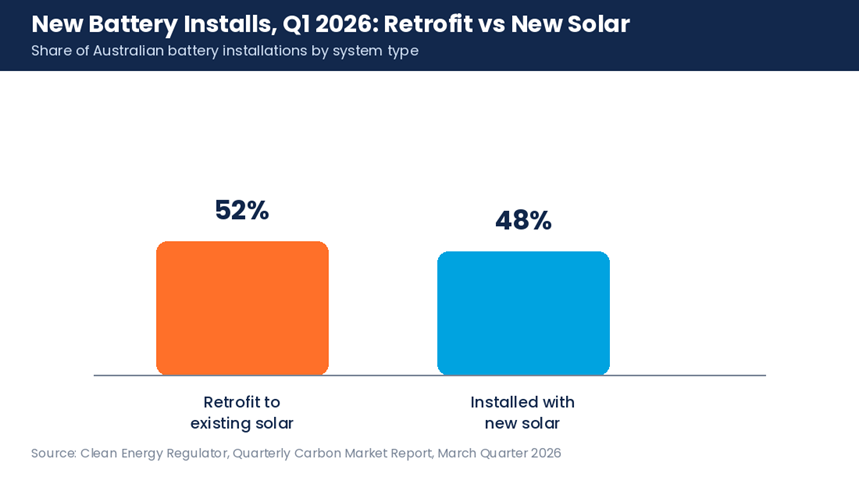
That gap is closing fast. Clean Energy Regulator data for the March quarter of 2026 shows that 52 per cent of all new battery installations were retrofits, added to solar systems already sitting on the roof, with no change to the panels themselves. The remaining 48 per cent went in alongside brand-new solar. Industry analyst SunWiz reports that stand-alone, battery-free solar installations have become rare, making up just 7 per cent of the market today. Almost every household getting solar now gets a battery with it, and just as many are going back to add one to a system they already have.

Roughly 3.7 million Australian homes currently have solar and no battery. That is the retrofit opportunity driving this trend, and it is one every solar owner should understand.

52% of new battery installs in Q1 2026 were retrofits to existing solar, versus 48% installed alongside new solar

Why Now? Three Forces Are Lining Up at Once

Three separate trends are converging, and together they explain the timing.

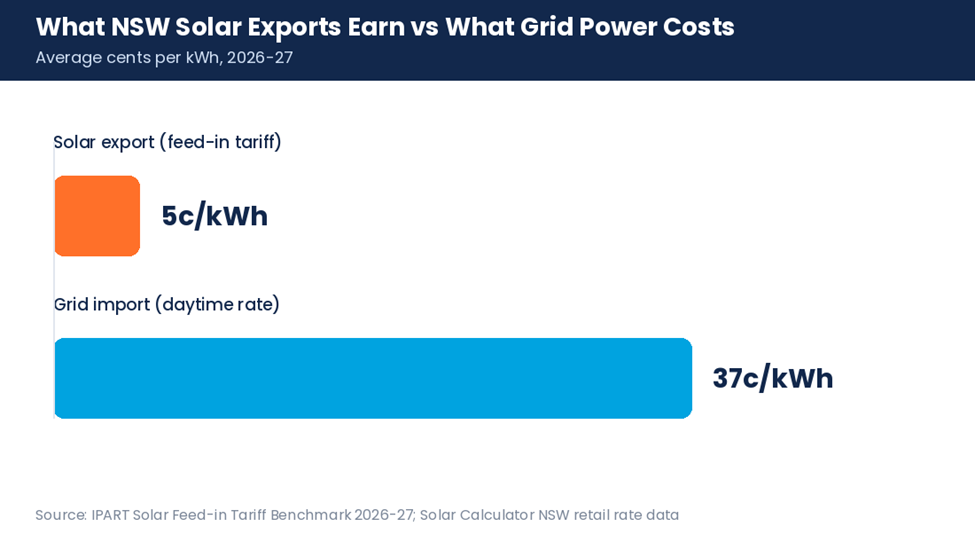
Feed-in tariffs keep shrinking. IPART’s benchmark for NSW solar exports has fallen from 4.8–7.3 cents per kWh in 2025–26 to just 3.4–6.5 cents per kWh for 2026–27. Compare that with the average NSW retail electricity price of around 36–37 cents per kWh, and the maths becomes clear: every kilowatt-hour you use yourself is worth roughly five to ten times more than the same kilowatt-hour exported to the grid.

The federal rebate made batteries dramatically cheaper. Since the Cheaper Home Batteries Program (CHBP) began on 1 July 2025, it has funded an upfront discount on eligible battery systems through Small-scale Technology Certificates (STCs). It started at around 30 per cent and has reduced since 1 May 2026.The scheme has already supported more than 350,000 household installations, and its budget has grown from $2.3 billion to an estimated $7.2 billion, targeting two million battery installations and 40 gigawatt-hours of storage by 2030.

Grid electricity prices are not falling. Even as wholesale daytime prices drop — part of why feed-in tariffs are shrinking — evening peak import rates in NSW remain high, commonly 30 to 40 cents per kWh, and higher again in some network areas during the 4 pm to 9 pm window.

Bar chart comparing the NSW solar feed-in tariff (about 5 cents per kWh) with the grid import rate (about 37 cents per kWh)

Put those three trends together, and a battery is worth a serious look for many solar systems that are earning less and less for the power they send away.

What Adding a Battery Actually Involves

Retrofitting a battery is more straightforward than most homeowners expect, and in most cases your existing panels do not need to change at all.

A qualified installer will assess your existing inverter, switchboard, and meter setup, then usually recommend one of two approaches. An AC-coupled battery connects independently to your switchboard and works alongside your existing solar inverter — the most common retrofit option, since it does not disturb your current solar setup. A hybrid inverter replacement swaps your existing inverter for one built to manage solar and battery together, which can suit older or underperforming systems.

Either way, a straightforward retrofit for a well-maintained system typically takes a single day, and your solar continues generating throughout. The Clean Energy Regulator requires all rebate-eligible installations to be completed by a Solar Accreditation Australia (SAA) accredited installer using an approved product, so it is worth confirming accreditation before booking.

A Practical Example: What Retrofitting Can Look Like

Consider a typical Liverpool household — this example is illustrative, not an individual case study — with a 6.6 kW solar system installed around 2018 and average evening electricity use of roughly 12 kWh per day. Under the current NSW feed-in tariff, that household might earn only 40–60 cents a day exporting that surplus. Storing it in a 10 kWh battery and using it after sunset instead of buying grid power at 36 cents per kWh could be worth around $3 a day on sunny days (after the lost feed-in credit), and less in winter — a meaningfully different outcome from the same solar panels, simply because the power is used rather than exported.

This is the calculation worth running with your real bills before committing, and it is exactly the kind of assessment a good installer should walk through with you at no cost.

Is Your Home a Good Candidate for a Retrofit?

Not every solar system benefits equally from adding storage. Use this quick framework to check your own situation before requesting quotes.

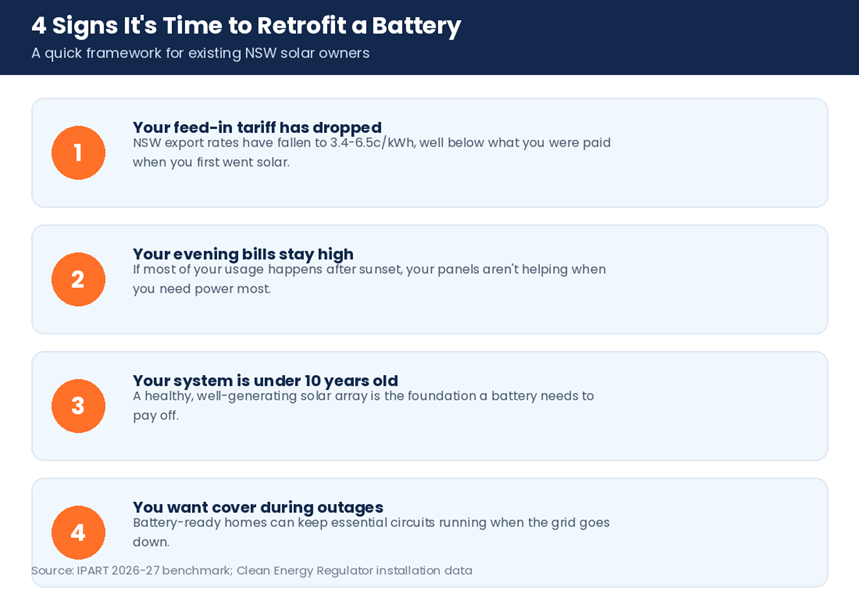
Four signs it may be time to retrofit a battery onto your existing solar system

If most of these apply to your household, a retrofit is likely to pay off. If your solar system is older, underperforming, or you are mostly home during the day already using your solar directly, it is worth getting a system health check first — see our guide on upgrading an existing solar system for what that involves.

Rebate Timing Still Matters

The federal rebate is not disappearing — it runs until 2030 — but it does keep shrinking. From 1 May 2026, the STC factor used to calculate the discount dropped from 8.4 to 6.8, and a new tiered structure now reduces support for batteries above 14 kWh. For a standard 10 kWh battery, that works out to roughly $530 less rebate than installing before the change. For larger batteries above 14 kWh, the difference can run to $1,000–$1,800 or more, since the tiering applies on top of the factor drop.

The rebate is recalculated every six months, each January and July, so it will continue to taper gradually. None of this means you need to rush, but if you have already compared quotes and are ready to proceed, timing can shift the numbers meaningfully, particularly for larger systems.

Choosing an Installer for Your Retrofit

The quality of your installer affects your outcome more than the timing of your rebate. Ask for the rebate to appear as a dollar figure on a written quote, confirm the installer’s SAA accreditation number, and check that your battery model is on the approved product list before signing anything. We cover the full checklist of what separates a reliable installer from a risky one in our guide on solar battery rebate timing

Can any solar system have a battery added later?

Most systems can be retrofitted, though older inverters, undersized switchboards, or systems near end of warranty may need extra work first. A qualified installer can confirm compatibility during a free assessment.

Does adding a battery affect my existing solar warranty?

A properly installed retrofit should not affect your panel warranty. It is worth confirming your inverter warranty terms if you are adding an AC-coupled battery rather than replacing the inverter.

Is it cheaper to retrofit a battery or buy solar and battery together?

Retrofitting is often more cost-effective if your existing solar system is still performing well, since you are only paying for the battery and its installation, not new panels.

How long does a battery take to pay for itself?

Payback depends on your electricity usage pattern and battery size, but typical NSW households see payback in the range of six to eight years under current tariffs and rebates, with the battery continuing to save money well beyond that.

Will my feed-in tariff keep falling?

It is likely to keep trending downward as more rooftop solar comes online and daytime wholesale prices soften. This is one of the main reasons more solar owners are shifting toward self-consumption rather than relying on exports.

Not Sure If a Retrofit Is Right for You?

We provide free, no-obligation assessments for solar homeowners across Liverpool, Bankstown, and Mudgee. We will check your existing system, review your bills, and give you an honest answer about whether adding a battery makes financial sense for your household, before you spend a cent. Call 1800 000 777 or visit solarbatteryoutlet.com.au to book your assessment.

Disclaimer: This article is general information only and does not constitute financial, technical, or legal advice. Feed-in tariffs, rebate values, and electricity prices vary by retailer, network area, and household usage, and figures in this article are indicative estimates based on published sources current as of publication. Actual savings and payback periods will differ depending on your specific solar system, electricity plan, and consumption pattern. Rebate eligibility depends on your installer’s accreditation and product approval status at the time of installation. Always seek personalised advice before making a purchasing decision.