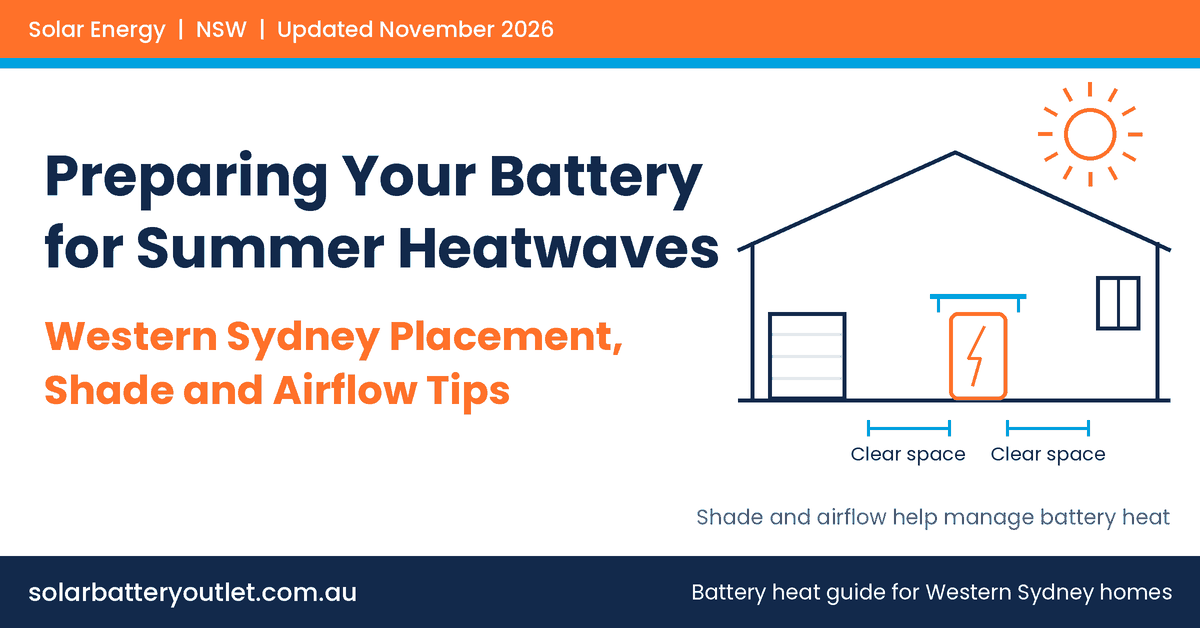
By 5 pm on a January afternoon, a Western Sydney garage can feel like an oven. Your home battery sits in that heat all summer. It protects itself by easing back, and that can change how much stored energy you can use.

This guide explains how heat affects a home battery. It also covers solar battery heatwave preparation and the questions to ask before you sign an installation contract.

Can a Solar Battery Handle a Western Sydney Heatwave?

Short answer: a compliant home battery is built for Australian conditions, but every model has its own temperature limits. When the air gets too hot, the battery or its inverter protects itself. It can slow charging, reduce output or pause until it cools.

Placement, shade and airflow decide how often that happens. So preparation starts with the site, not the settings.

Why Western Sydney Heat Puts Extra Pressure on Home Batteries

Western Sydney University researchers report that warming is felt more intensely in Sydney’s west than in the east. Summers are also lasting longer. That matters for homes in Liverpool and nearby suburbs.

What Counts as a Heatwave?

The Bureau of Meteorology describes a heatwave as three days of unusually hot maximum and minimum temperatures. Hot nights matter for batteries. Brick walls and garages release stored heat well into the evening.

Why the Evening Matters Most

Most households lean on their battery after sunset. That is also when hot walls and garages give back their heat. A battery working hard in a warm space can reach its protective limits sooner.

What Heat Does to a Home Battery

Heat has two effects. In the short term, protective limits can reduce charging and output. Over many years, sustained high temperatures can speed up battery ageing.

Check the operating temperature range on your battery’s datasheet. The manufacturer sets that range, and it differs between models.

Where to Place a Battery to Limit Heat Exposure

Location does more for battery heat than any app setting. Your installer must follow AS/NZS 5139 and the manufacturer’s instructions when choosing the spot.

Better Locations for Hot Summers

Shaded south- or east-facing walls receive the least afternoon sun. A well-ventilated garage can also work, although garages can trap heat. Ask your installer how air will move through the space.

For outdoor walls, a purpose-built cover or awning can cut direct sun. Shade typically lowers surface temperatures, so it helps even on a mild-looking day.

Locations That Run Hot

  • West-facing walls absorb afternoon sun and release heat into the evening.
  • Narrow side passages block airflow and hold warm air.
  • Spots beside brick, concrete or paving radiate stored heat back at the unit.
  • Closed cupboards and uninsulated sheds leave heat nowhere to go.
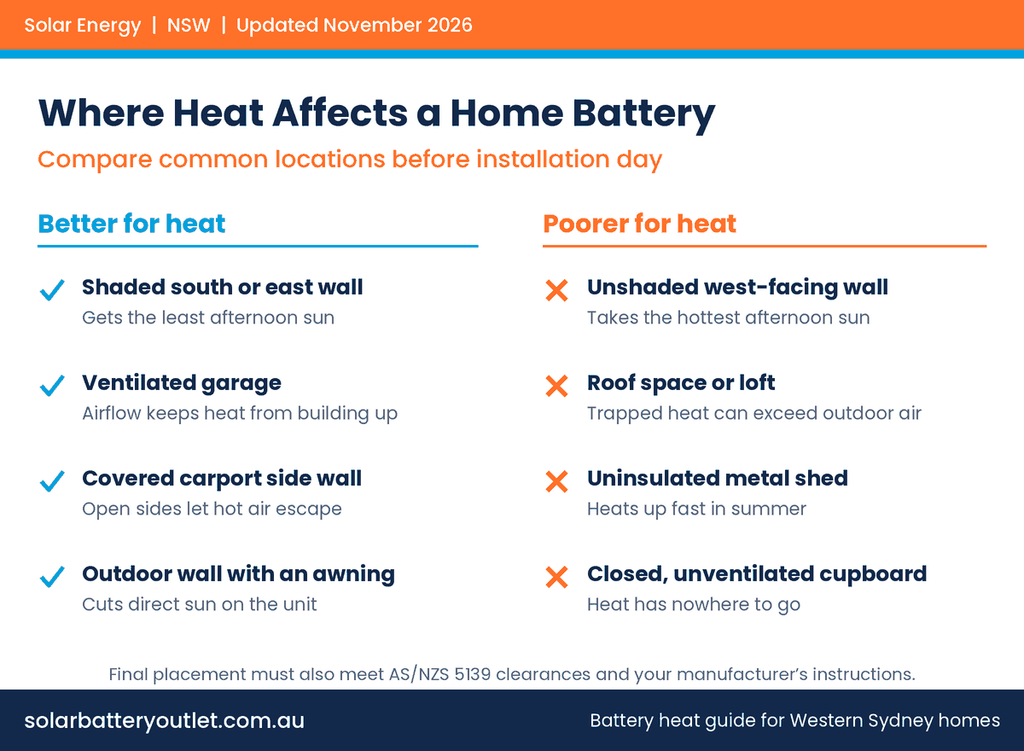
comparing better and poorer home battery locations for heat

Keep Clearances Clear

Leave the space your installer specified around the unit. Do not stack boxes on or against the battery. Keep vents free of dust, leaves and cobwebs.

Your Solar Battery Heatwave Checklist

Work through these six checks before the first heatwave arrives.
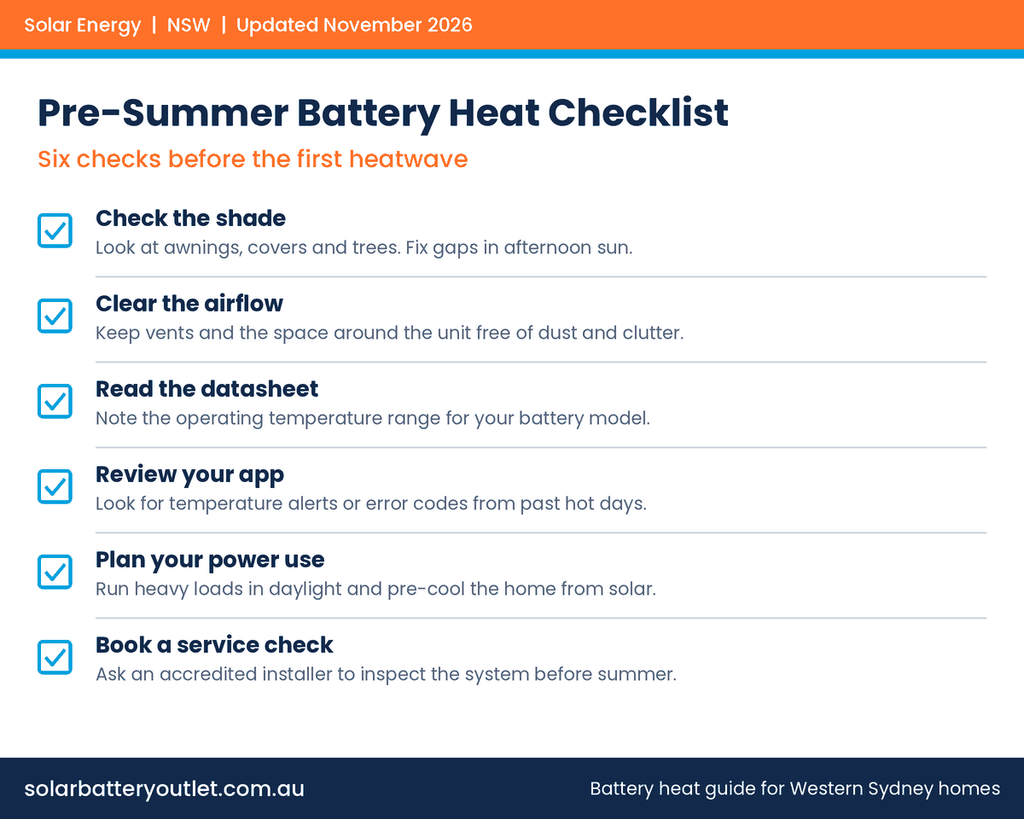
Pre-summer battery heat checklist with six steps: check the shade

How to Work Through the Six Checks

Start with shade. Walk past the battery at 3 pm and note where the sun lands. Next, look at airflow. Remove clutter, and brush leaves and dust from vents without opening the unit.

Then read the datasheet and your app history. Look for temperature alerts from last summer. Finally, plan your power use. Running heavy appliances in daylight, when solar generation is high, reduces evening demand on the battery.

A service check completes the list. Only an accredited installer should open or work on the system.

A Simple Example

Suppose your battery sits on a west-facing wall. Open the app at 6 pm on a hot day. If temperature alerts appear, ask your installer about shading or relocation before the next heatwave.

During a Heatwave

  • Check the app in the late afternoon and early evening, when heat peaks.
  • Expect some warmth. The unit should not feel hot to touch.
  • Never cover the battery or spray it with water.
  • Leave charge and discharge settings alone unless your installer advises otherwise.
  • Keep your internet connection on. Some manufacturers use monitoring data when assessing claims.

Warning Signs

Contact your installer about unusual heat, swelling, odd smells, noises or temperature alarms. If you see smoke or flames, leave the area and call 000.

Heatwaves, Outages and Backup Settings

Heatwaves can strain the electricity network, and outages sometimes follow. Not every battery system provides backup power. It depends on the equipment and how the installer wired it.

Ask whether your system supports backup. If it does, ask how the reserve setting works and how heat could affect it. Keep any changes within your installer’s guidance.

Questions to Ask Your Installer Before You Sign

Heat planning belongs at the quote stage. For solar battery installation in Liverpool, ask the installer to assess sun exposure at your property before proposing a location.

Then put these questions to every installer you compare:

  • Where will the battery go, and why? Ask for the reasoning in writing.
  • What is the battery’s operating temperature range?
  • Does the warranty set installation conditions, such as sun exposure or ventilation?
  • Does the installer hold current accreditation for batteries? You can check whether your installer is SAA-accredited before you sign.
  • Who handles warranty claims, and what does the process involve?
  • When are payments due, and which stage of the job does each payment cover?

The Clean Energy Regulator sets rules for batteries installed under the small-scale renewable energy scheme. Owners must receive written documentation about their battery and installation. Keep it with your contract.

Australian Consumer Law also provides consumer guarantees alongside any manufacturer warranty. Take your time, and do not sign under pressure.

Already Own a Battery in a Hot Spot?

Do not move or enclose the battery yourself. A homemade box can trap heat and may conflict with the manufacturer’s instructions.

Instead, ask an accredited installer to inspect the site. They can recommend shading, ventilation or relocation that meets AS/NZS 5139. Ask how any change affects your warranty, and get it in writing.

Talk to Solar Battery Outlet Before You Sign

Planning a battery for a hot Western Sydney home? Call Solar Battery Outlet on 1800 000 777 before you sign an agreement. Our Liverpool team can talk through placement, shade, airflow and contract terms with you.

A short conversation now can help you ask better questions of every installer on your shortlist.

Solar Battery Heatwave FAQs
Can a heatwave damage a solar battery?

Extreme heat can trigger protective limits that slow charging or reduce output. Over years, sustained heat can accelerate ageing. Good placement, shade and airflow reduce the risk. Check your datasheet for the temperature range.

What is the best place for a battery in a Western Sydney home?

A shaded south- or east-facing wall, or a well-ventilated garage, usually suits hot summers. Your installer must also meet AS/NZS 5139 and the manufacturer’s instructions for your site.

Is a garage safe for a home battery?

It can be, if the installation follows AS/NZS 5139 and the manufacturer’s instructions. Garages can trap heat, so ask your installer about ventilation and clearances.

Will my warranty cover heat problems?

It depends on the warranty. Some set installation conditions, such as ventilation. Read the terms before you sign, and ask for answers in writing. Consumer guarantees under Australian Consumer Law apply separately.

Should I switch my battery off during a heatwave?

Do not change settings or switch it off unless your installer or the manufacturer advises it. If the unit alarms or feels very hot, contact your installer.

Disclaimer

This article provides general information about preparing home batteries for hot weather. It does not replace individual legal, technical or purchasing advice. Battery models, site conditions and warranty terms vary. Always seek personalised advice before making a purchasing decision.
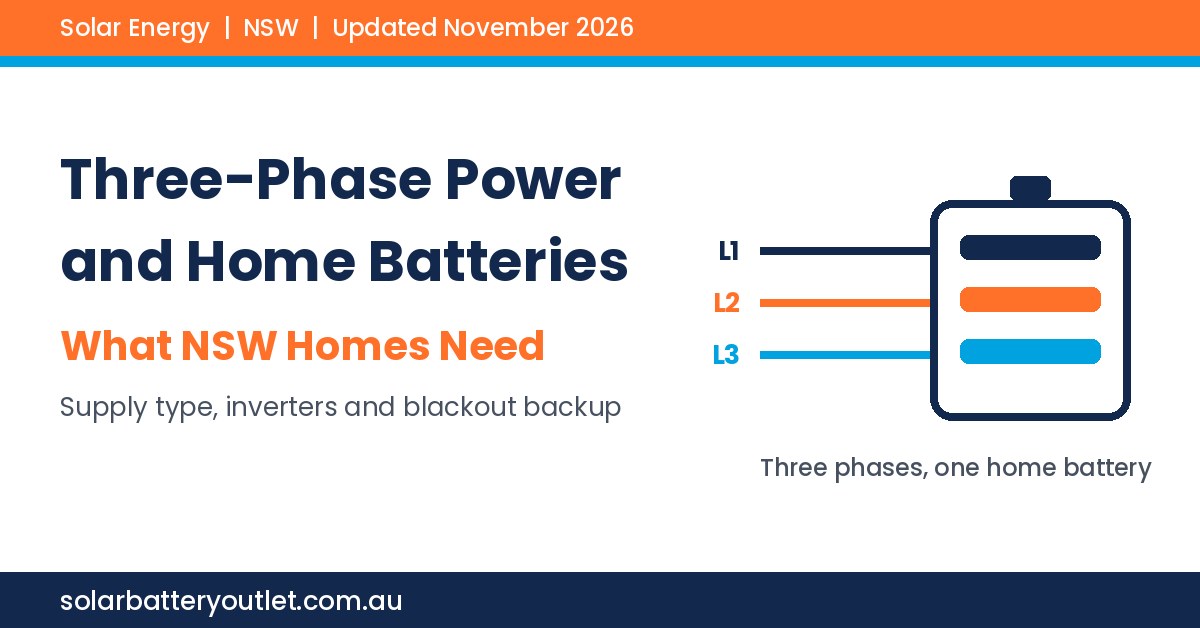
Most Australian homes run on single-phase power. Three-phase homes face more choices. Your supply type shapes the inverter you choose. It also affects which circuits stay on in a blackout. Finally, it influences the limits your network applies. Therefore, NSW homeowners should confirm their phase before they compare any three-phase home battery or single-phase quote.

What Is Three-Phase Power?

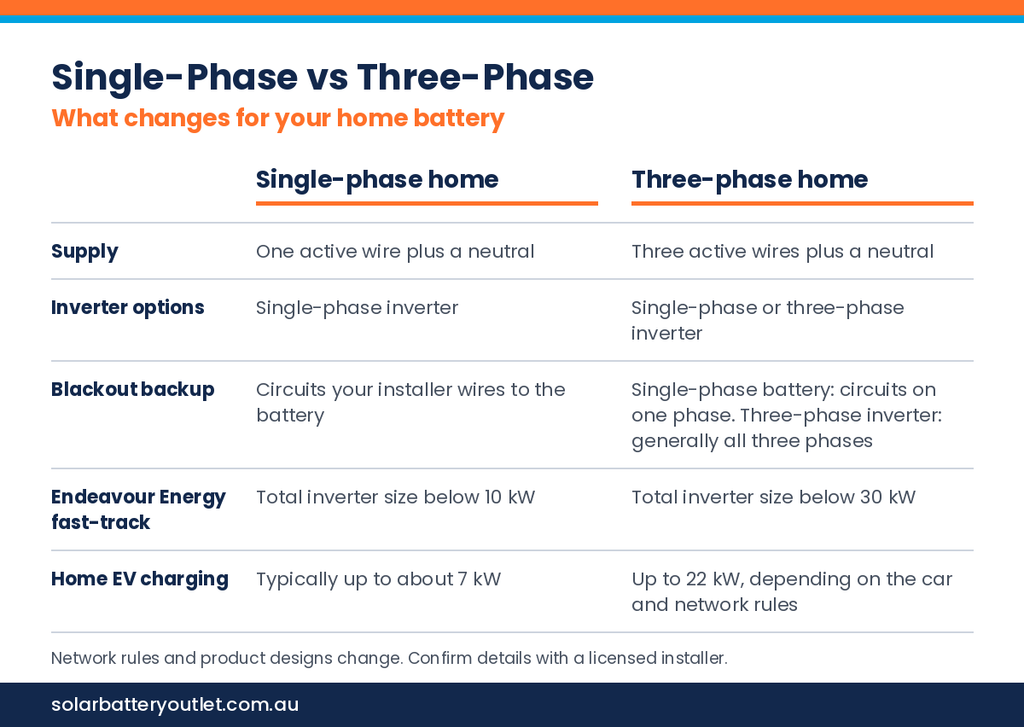
Three-phase power delivers electricity through three active wires plus a neutral. Single-phase power uses one active wire plus a neutral. With three phases, a home splits its electrical load across three wires. As a result, more total power can flow without overloading any one wire.

Newer builds and upgraded homes more often have three-phase supply. Heavier loads, such as ducted air conditioning or workshop equipment, make it more useful.

How to Check Which Supply You Have

Start at your meter box. One main switch or one fuse usually means single-phase. Three main switches or three fuses side by side usually means three-phase. Some three-phase meters also show a marking such as “3P 4W”. However, a licensed electrician should confirm your supply before anyone designs your system.

What Makes a Three-Phase Home Battery Different?

With many modular systems, the inverter decides whether the setup is single-phase or three-phase. The battery modules can stay the same. A single-phase inverter feeds one phase. A three-phase inverter spreads its output across all three.

Options for a Single-Phase Home

A single-phase home can only take a single-phase inverter. Therefore, your decisions focus on battery size, inverter rating and backup needs.

Options for a Three-Phase Home

A three-phase home can use either inverter type. Option one is a single-phase battery connected to one phase. Option two is a three-phase hybrid or battery inverter. Each option suits different priorities. For instance, a single-phase battery can be simpler to install. A three-phase inverter can spread solar output and backup across all three phases.

single-phase vs three-phase battery comparison

How Phase Affects Export Limits

Distributors set export limits per phase. Therefore, a three-phase connection generally allows more total export than a single-phase one. However, export limits only cap what you send to the grid. They do not cap what your system generates for your own use. A battery can store that surplus for later.

What Happens to Backup During a Blackout

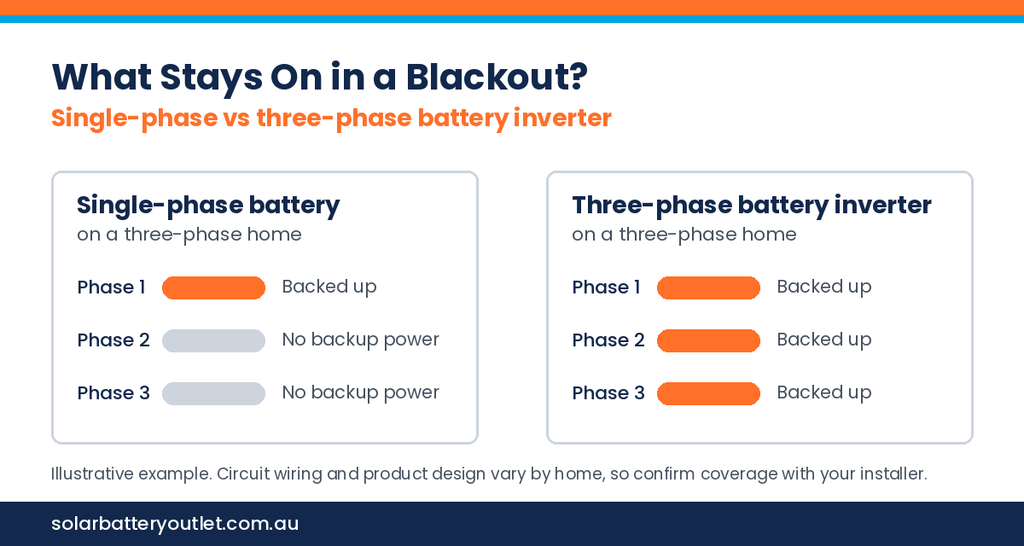
Backup is where phase matters most. A single-phase battery on a three-phase home backs up only the circuits on its own phase. The other two phases lose power during an outage. For backup across all three phases, you generally need a three-phase battery inverter.

Product design and switchboard wiring still decide the final result. Therefore, list the appliances that must keep running before you sign. If you are weighing essential circuits against whole-home backup, start with that list.

Infographic showing a single-phase battery backing up one phase of a three-phase home, while a three-phase battery inverter backs up all three phases

What Endeavour Energy Requires in Liverpool

Liverpool sits within the Endeavour Energy network area. For solar battery installation in Liverpool, your installer must follow Endeavour Energy’s connection process for solar and battery systems. That process covers adding or increasing a solar system or solar battery.

Endeavour Energy describes a fast-track online application for sites that are already connected. It applies when your total inverter size is below 10 kW on single-phase or below 30 kW on three-phase. Small systems can often receive instant permission to connect. The inverter must meet AS 4777. Installers must also enter the system in the AEMO DER register.

In eligible areas, flexible exports allow up to 10 kW of exports about 95 per cent of the time.

Network rules change, and individual sites differ. Therefore, put your questions to your installer before you sign.

What to Ask About Network Approval

  • Which limits apply to my site?
  • Does my battery inverter count toward the total inverter size?
  • Who lodges the application and registers the system?
  • What happens if the network asks for changes?

Should You Upgrade From Single-Phase to Three-Phase?

Many NSW households do not need an upgrade. A well-designed single-phase system can serve many homes. However, some situations deserve a closer look.

Signs an Upgrade May Deserve Consideration

  • You own equipment that needs three-phase supply.
  • You want faster home EV charging. Single-phase chargers typically deliver about 7 kW. Three-phase chargers can reach 22 kW, depending on the car and network rules.
  • You want battery backup across all three phases.
  • You expect to add an EV, heat pump or other large electric loads soon.

What an Upgrade Involves

Endeavour Energy lists changing from single-phase to three-phase under its connection of load service. You need an electricity retailer and a Level 2 Accredited Service Provider. Costs vary with your wiring, switchboard and street connection. Therefore, request a written quote before you decide.

Two Liverpool Examples

These examples are illustrative only. Your own home may differ.

A Single-Phase Family Home

Consider a Liverpool family in a single-phase home. They want evening power and backup for the fridge, lights and router. Their installer proposes a single-phase battery with essential-circuit backup. That design matches their supply. They still ask for the usable capacity, the backed-up circuits and the network application plan in writing.

A Three-Phase Home With Heavy Loads

Now consider a three-phase home with ducted air conditioning and a pool pump. The owners want most circuits to stay on during an outage. A single-phase battery would cover only one phase. Therefore, they request quotes with a three-phase inverter. They also check whether each design can run the large loads they care about.

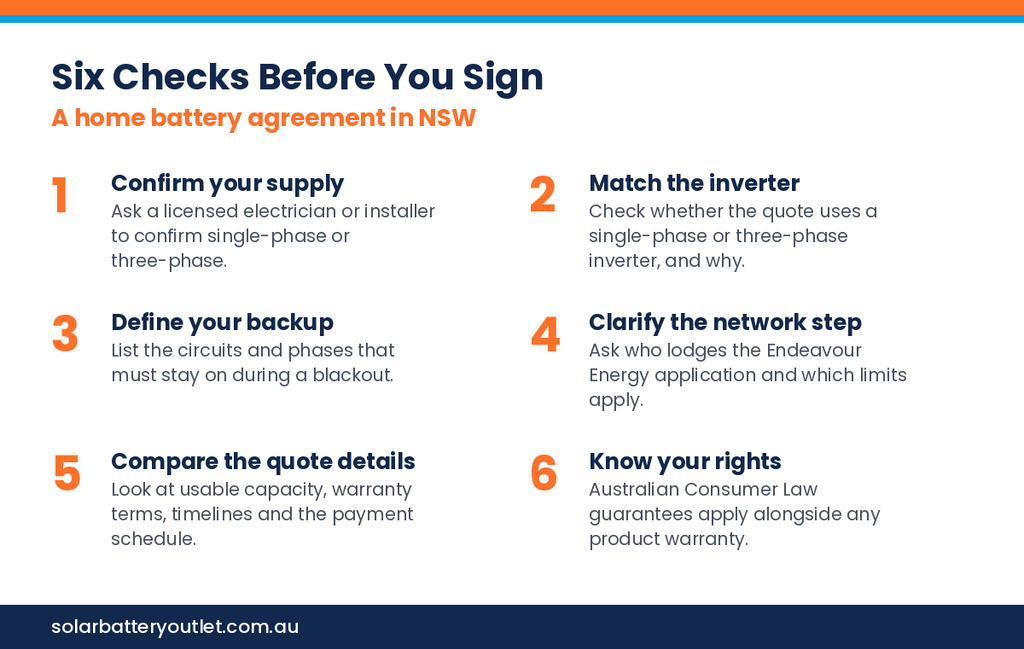
Six Checks Before You Sign a Battery Agreement

Use these checks to compare NSW quotes on equal terms. You can also check an installer’s accreditation before you proceed.

Six Checks Before You Sign a Battery Agreement

Contracts, Warranties and Payment Terms

Consumer Guarantees

The Australian Consumer Law gives you consumer guarantees. Goods must be of acceptable quality and fit for their disclosed purpose. Providers must deliver services with due care and skill, and within a reasonable time. These guarantees apply regardless of any product warranty.

Quote Details to Request in Writing

Ask for key terms in writing. These include the battery model, usable capacity, inverter type and backup coverage. They also include the installation timeline, warranty terms and payment schedule. Compare these terms across quotes, not only the headline price. Read the cancellation and deposit terms before you sign. Also ask who you should contact if a problem appears after installation.

Rebates and Usable Capacity

The federal Cheaper Home Batteries Program bases its discount on a battery’s usable capacity. The program’s settings change over time. Therefore, ask your installer to show the discount on your quote and explain how they calculated it.

Do I need three-phase power to install a home battery?

No. Single-phase homes use single-phase inverters. Three-phase homes can use either type. Your choice depends on backup needs, system size and network limits. Ask an installer to assess your switchboard and loads.

Can I connect a single-phase battery to a three-phase home?

Yes. A three-phase home can take a single-phase inverter. However, during a blackout, that battery backs up only the circuits on its own phase. Discuss backup coverage with your installer before you buy.

How do I know if my Liverpool home has three-phase power?

Check your meter box. Three main switches, or three fuses, suggest three-phase. One suggests single-phase. A licensed electrician should confirm the result.

Does Endeavour Energy need to know about my battery?

Endeavour Energy’s connection process covers adding a solar battery. Small systems can use a fast-track online application. Ask your installer who lodges the application and registers the system.

Is a three-phase upgrade worth it for a battery?

It depends. Many homes work well on single-phase. An upgrade may suit homes with heavy loads, fast EV charging plans or a need for three-phase backup. Get a written quote and a licensed electrician’s assessment first.

Planning a battery for a single-phase or three-phase home? Call the Solar Battery Outlet team before you sign an agreement. We can talk through your supply type, backup priorities and network requirements. That conversation helps you compare quotes with clearer questions. Call us to discuss your home.

Disclaimer

This article gives general information about three-phase supply and home batteries in NSW. It does not replace individual legal, technical or purchasing advice. Network rules, rebate settings and product specifications change over time. Always seek personalised advice before making a purchasing decision.
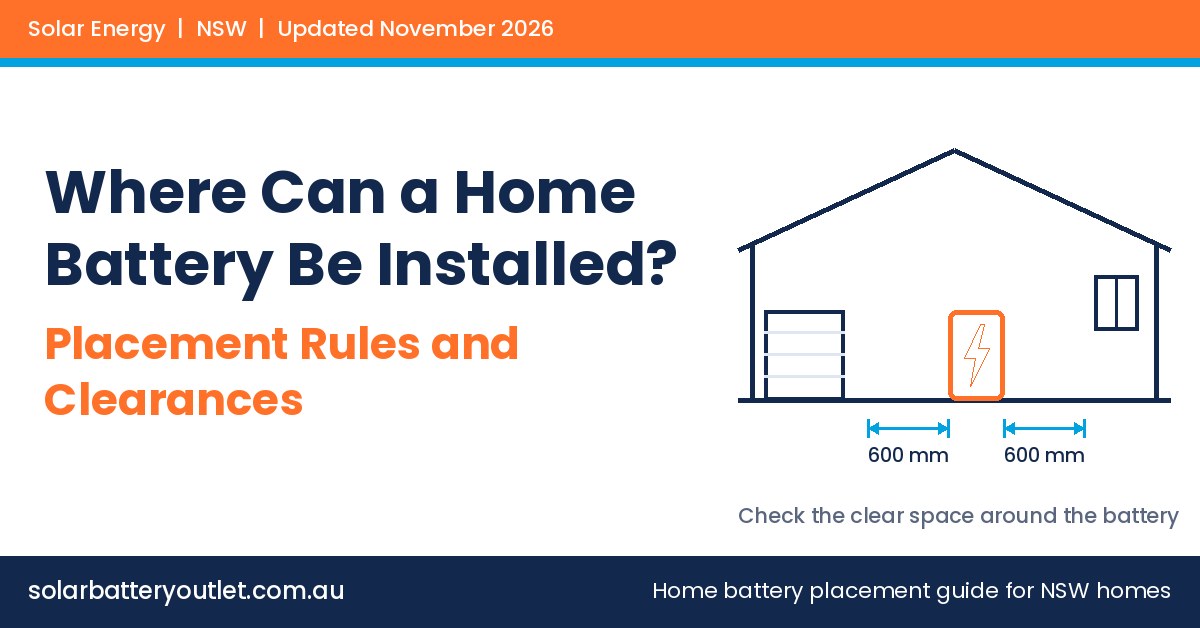
Where can a home battery be installed? Australian Standard AS/NZS 5139 answers. A battery needs a safe, accessible spot with clear space around it. For most NSW homes, that means a garage, an external wall or a laundry. However, a poor location can fail an inspection and put your household at risk. This guide explains the restricted locations, the clearances and the questions to ask before you sign.

Which Rules Decide Where a Home Battery Goes?

AS/NZS 5139:2019 sets the placement rules for home batteries in Australia. Amendment 1 arrived in December 2025. The standard works alongside AS/NZS 3000, the wiring rules, and the manufacturer’s installation manual. Therefore, your installer should apply all three to your site.

Electrical safety regulators across Australia endorse a guide to AS/NZS 5139 installation requirements. It explains how regulators read the location rules. Regulators treat a battery as a possible source of ignition. Consequently, the rules keep it away from people, escape routes and other heat sources.

Note that the guide pre-dates Amendment 1, so some details may differ today. Ask your installer which version applies to your quote.

Which Locations Are Off Limits for a Home Battery?

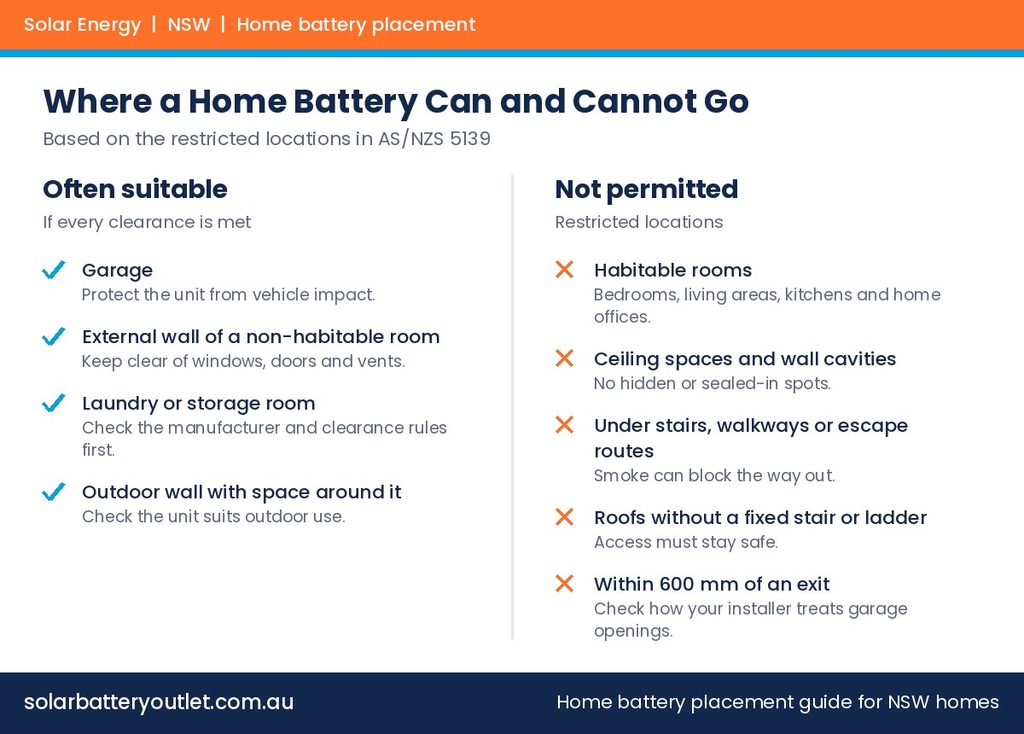
A home battery cannot go in a habitable room, a ceiling space, a wall cavity or an escape route. The details below explain why.

Habitable Rooms

Habitable rooms include bedrooms, home offices, living rooms, kitchens and dining rooms. They also cover playrooms, entertainment rooms and sunrooms. Therefore, a spare bedroom or study is never a suitable battery spot.

Ceiling Spaces, Wall Cavities and Roofs

Likewise, installers cannot place a battery in a ceiling space or set it into a wall cavity. The same rule applies to roofs without a fixed staircase or ladder. Each of these spots limits safe access.

Escape Routes and Walkways

In addition, a battery cannot sit in a passageway, walkway or escape route. It also cannot sit under stairs or entry walkways. Smoke from a burning battery could block the way out. Fire could also weaken the structure above.

Your manufacturer may prohibit other spots as well. Our guide to battery safety features explains what else to look for.

comparing often suitable home battery locations with restricted locations such as habitable rooms, ceiling spaces and escape routes

What Clearances Does a Home Battery Need?

Clearances add a second layer of rules. They keep the battery away from doors, windows and heat sources.

Exits and Doorways

A battery must sit at least 600 mm from an exit. Regulators in NSW have treated every opening people can use as an exit, including garage door openings. However, Amendment 1 now allows an exception for exits wider than 900 mm. In that case, people need at least 1 metre of clear space to pass. Because both rules exist, ask your installer which one applies to your home.

Windows and Vents

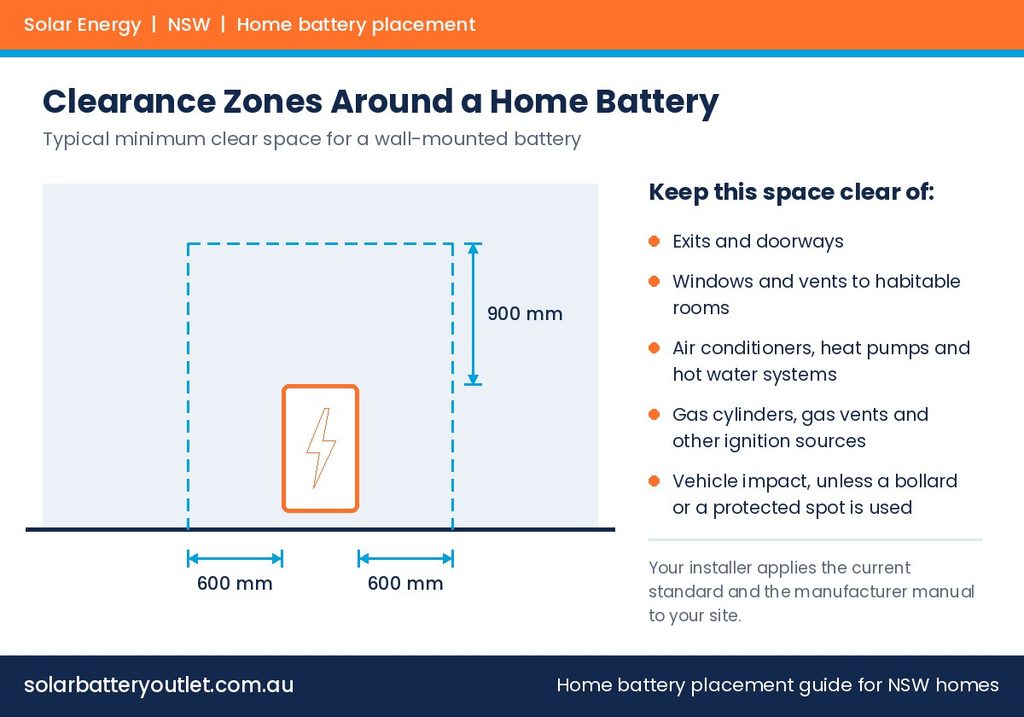
A battery cannot sit within 600 mm sideways of an opening window or vent to a habitable room. It also cannot sit within 900 mm below one. As a result, a window directly above your preferred wall spot may rule it out.

Appliances and Gas

Other electrical appliances must stay 600 mm to the side and 900 mm above the battery. Examples include air conditioners, heat pumps, hot water cylinders and stoves. Solar inverters that charge the battery are the exception. Meanwhile, gas cylinders and gas relief vents have their own exclusion zones. Gas network providers may add further limits.

Diagram of the 600 mm side and 900 mm upper clearance zones around a wall-mounted home battery, with a list of items to keep clear

Can You Install a Home Battery in a Garage?

Often, yes. A garage is not a habitable room, so it can suit a battery. However, the same clearances still apply.

Vehicles add a further risk. Regulators expect protection from impact, such as a bollard or a position a vehicle cannot reach. Furthermore, earlier NSW guidance counts a garage door opening as an exit, so measure carefully.

For example, picture a Liverpool home with a single garage. The only free wall sits close to the roller door, and a hot water unit hangs nearby. That layout may leave too little room. An external wall elsewhere may work better.

Compare quotes for solar battery installation in Liverpool carefully. Ask each installer to mark the position and clearances on a site plan.

Does the Wall Behind the Battery Matter?

Sometimes, yes. A barrier may apply when a habitable room sits on the other side of the wall. This rule covers a battery fixed to that wall or standing within 300 mm of it.

The wall must be non-combustible. Brick, masonry blocks, concrete, compressed cement sheeting and clay tiles qualify without further testing. Timber panels, plasterboard and particle board do not qualify.

The barrier must extend 600 mm beyond each side of the battery and 900 mm above it. Cement sheeting 6 mm thick counts as industry best practice, although it is not mandatory. So if your Liverpool home has brick walls, ask your installer whether the existing wall already meets this need.

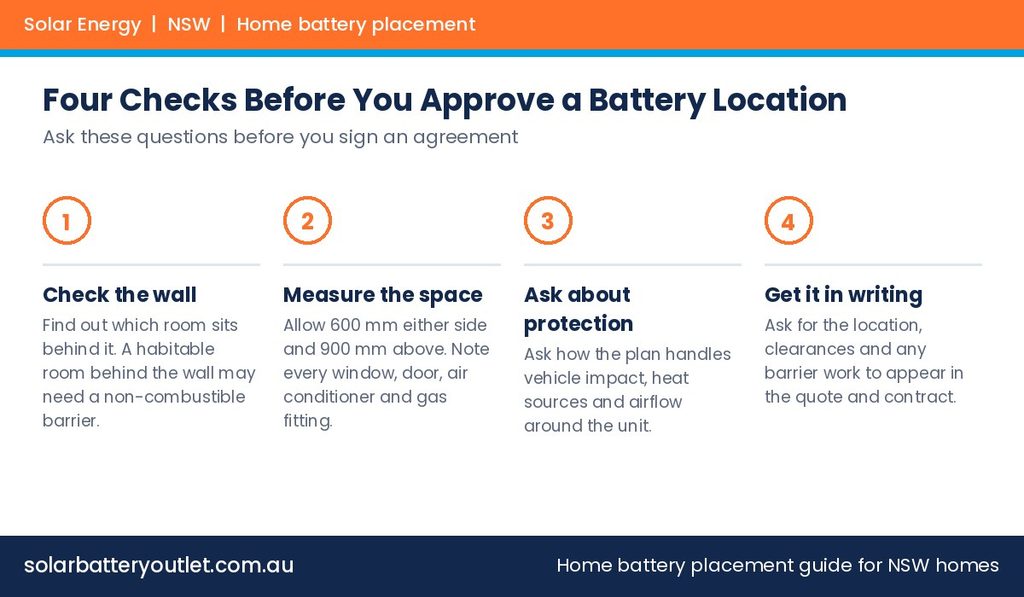
Four Checks to Make Before You Sign

Use these checks to compare quotes. They also help you spot vague installation plans.

four checks before you approve a battery loocation
  1. Check the wall. Ask which room sits behind it.
  2. Measure the clear space. Note every window, door, air conditioner and gas fitting nearby.
  3. Ask about protection. Find out how the plan handles vehicle impact and heat sources.
  4. Get the plan in writing. Ask for the location, clearances and any barrier work in your quote and contract.

Also compare scope and payment terms across quotes. Australian Consumer Law consumer guarantees apply to solar products, whatever the product warranty says. Finally, check that your installer is SAA accredited before you commit.

Where Can a Home Battery Be Installed? FAQs
Can I install a home battery inside my house?

Not in a habitable room, such as a bedroom, living room, kitchen or home office. A garage, laundry or storage room may work if every clearance is met.

How far must a battery be from a window?

A battery cannot sit within 600 mm sideways of an opening window or vent to a habitable room. It also cannot sit within 900 mm below one.

Can a battery go in a garage in NSW?

Often, yes. However, it needs the usual clearances, protection from vehicle impact and distance from exits. Ask your installer how they treat the garage opening.

Does my battery need a fire barrier?

A non-combustible barrier may apply if a habitable room sits behind the wall. Brick, masonry and concrete walls already qualify.

Who decides the final battery location?

Your installer applies the standard and the manufacturer’s instructions to your site. You approve the plan. Therefore, ask for the position and clearances in writing.

Speak With Solar Battery Outlet Before You Sign

Unsure whether your garage or wall can take a battery? Call Solar Battery Outlet before you sign a solar battery agreement. Our team can talk through your site and the clearance questions to put to any installer. We help Liverpool homeowners understand the options at their own pace. You can also contact us online.

Disclaimer

This article gives general information about home battery placement in NSW. It does not replace individual legal, technical or purchasing advice. Standards and regulator guidance can change. Your site, battery model and installer’s plan decide what applies to your home. Always seek personalised advice before making a purchasing decision.
A solar and battery setup should fit your household, not a brochure. Two homes on the same street can need very different systems. One family cooks, cools and charges an EV after dark. The other works away all day and uses little power at night.

This guide walks NSW homeowners through the design process in four steps. You will learn how to read your usage, size your panels and choose a battery. You will also see which details shape your contract.

What Is the Right Solar and Battery Setup for Your Home?

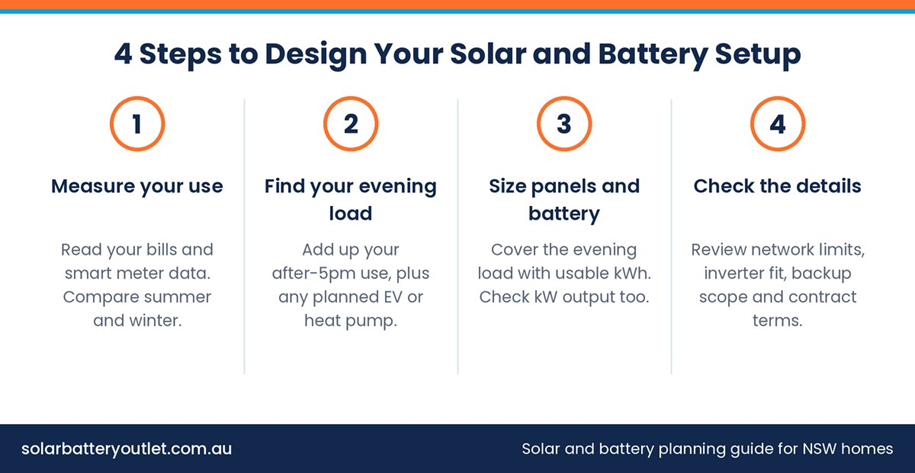
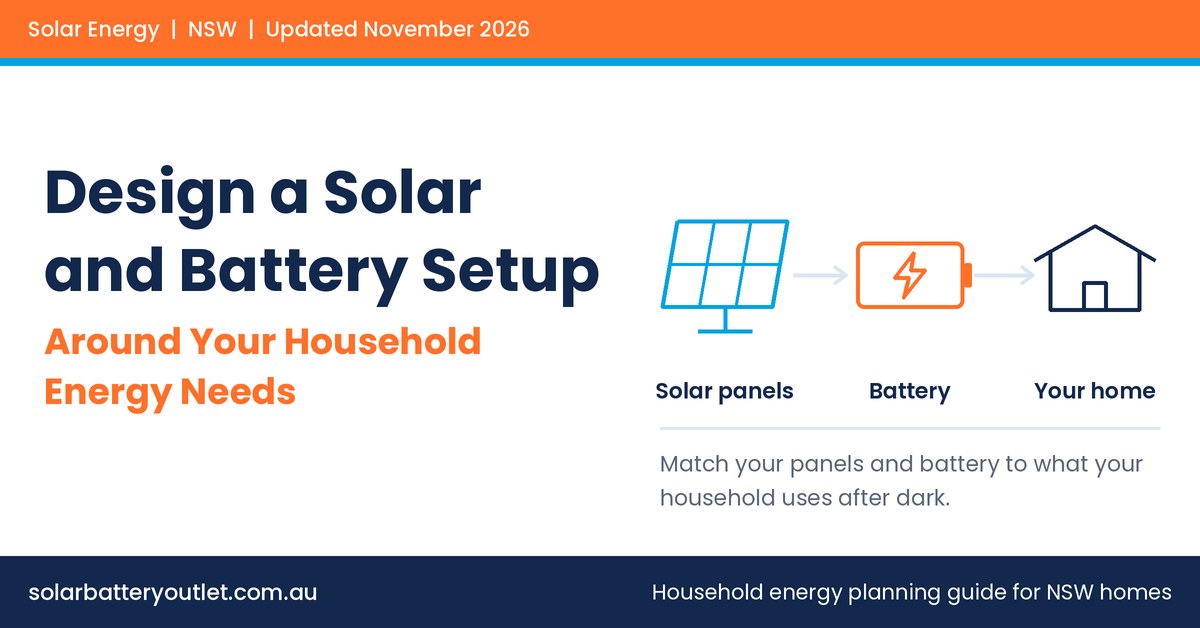
The right solar and battery setup matches your daytime generation to your evening demand. First, find your daily kWh use and your after-sunset load. Next, size the battery to cover that evening load. Then size the panels to fill it. Finally, check network limits, backup goals and contract terms before you sign.

4 steps to design your solar and batter setup

Step 1: Measure What Your Household Actually Uses

Your electricity bill is the natural starting point. It shows your average daily use in kilowatt-hours (kWh). Compare a summer bill with a winter bill, because cooling and heating can change your usage a lot. Smart meter data goes further. Most retailers show half-hourly use in an online portal or app.

Find Your Evening and Overnight Load

A battery supplies power when your panels cannot. For that reason, your evening use matters more than your daily total. The NSW Government battery guide says homes with higher late-afternoon and evening use benefit the most from a battery. Homes that already use most of their solar output during the day see smaller gains.

Look at your usage after about 5pm. Then add up the big loads, such as air conditioning, cooking, hot water, the dishwasher and lighting. That total gives you a realistic evening figure.

Allow for Changes in the Next Few Years

Think about planned upgrades before you finalise the design. An electric vehicle, a heat pump hot water system or a new reverse-cycle air conditioner will lift your demand. Likewise, a household member who starts working from home will shift usage into the daytime. Tell your installer about these plans early, so the design leaves room to grow.

Step 2: Size Your Solar Panels for Daytime Use and Battery Charging

Your panels must do two jobs. They power your home during the day. They also charge the battery with the surplus. As a result, a household adding a battery often needs more solar capacity than a household without one.

Roof space, orientation and shading set the practical limit. North-facing roof sections usually produce the most in NSW. However, east and west sections can suit households that use more power in the morning or afternoon.

Your installer should model the expected output for your specific roof. Treat any estimate as a projection, not a promise, because weather and shading vary.

Step 3: Size the Battery to Your Evening Demand

Start with the evening load you want to cover. Then add a small buffer for cloudy days and extra guests. That figure points to the usable capacity you should discuss with your installer.

Understand Usable Versus Nominal Capacity

Nominal capacity is the total energy a battery can hold. Usable capacity is the portion you can actually draw on. For example, a battery listed at 10kWh may offer about 9kWh of usable storage. Therefore, compare quotes on usable capacity, not on the headline figure.

Check Power Output as Well as Storage

Capacity (kWh) tells you how long a battery can supply power. Power output (kW) tells you how much it can supply at once. A high-capacity battery with low output may struggle if your oven, air conditioner and EV charger run together. Ask your installer to match the output to your peak loads.

Worked Example: A Liverpool Family of Four

This example is illustrative only and is not a quote. Imagine a family that uses about 20kWh a day. Around 9kWh of that use happens after 5pm. A battery with roughly 10kWh of usable capacity would cover most of that evening load. Meanwhile, a 14kWh battery would add headroom for an EV top-up or a hot night. In practice, an installer would check your actual meter data first.

How Does Battery Size Affect the Federal Rebate?

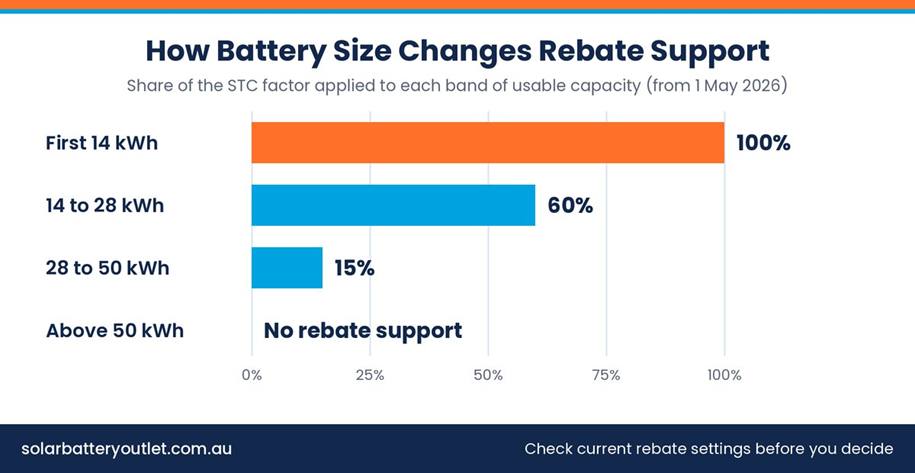
The federal Cheaper Home Batteries Program delivers its discount through small-scale technology certificates (STCs). The number of certificates depends on your battery’s usable capacity. Since 1 May 2026, the program tapers support by size. The first 14kWh receives the full STC factor. Capacity from 14kWh to 28kWh receives 60 per cent. Capacity from 28kWh to 50kWh receives 15 per cent.

How battery size changes rebate support

Therefore, each extra kilowatt-hour above 14kWh earns less support than the first 14kWh. A bigger battery is not automatically better value. In addition, the STC factor steps down every six months, so your installation date matters. The battery and installer must also meet program requirements. Rules and eligibility can change, so ask your installer to show the current calculation in writing.

What Should Liverpool Homeowners Check Before Finalising a Design?

If you are comparing solar batteries in Liverpool, start with your own load profile before you compare brands. Then work through the local checks below.

Network Export Limits

Liverpool sits within the Endeavour Energy network. Endeavour has applied a fixed export limit of 5kW for single-phase connections. It also offers a Flexible Exports option for eligible customers. A battery can store solar energy that would otherwise exceed your limit. Confirm your current connection terms with Endeavour Energy or your installer before you lock in the system size.

Inverter, Switchboard and Meter Checks

Your existing inverter may not suit a new battery. Some homes need a replacement inverter or a switchboard upgrade. The NSW Government guidance flags both points, along with metering.

Questions to Ask Your Installer

  • Is my current inverter compatible with this battery?
  • Does my switchboard need an upgrade?
  • Does the quote include any inverter or switchboard work?

Decide Your Backup Needs Early

Backup design changes the hardware, the wiring and the price. Some households only need essential circuits, such as the fridge, lights and internet. Others want whole-home backup. Our guide to essential circuits versus whole-home backup in NSW explains the difference. Decide before you request quotes, because backup affects battery size and output.

Review Contracts, Warranties and Payment Terms Before You Sign

A good design still needs a clear contract. Australian Consumer Law applies to solar and battery sales in NSW. It includes consumer guarantees, such as acceptable quality for goods and due care and skill for services. Your contract and warranty documents then add the specific terms.

The checks below are recommended precautions, not legal requirements. Ask for these details in writing:

  • Panel capacity, inverter model and battery model
  • Battery usable capacity and power output
  • The scope of any backup power
  • Warranty documents for each major component and the installation work
  • The payment schedule and installation timeline
  • Your installer’s licence and accreditation details

You can also verify credentials yourself. Our guide explains how to check whether a solar battery installer is SAA accredited.

Frequently Asked Questions
How big should my solar battery be?

Size it to your evening and overnight use, measured in usable kWh. Compare your after-5pm load against the battery options. Your installer should check this against your actual meter data rather than rely on a general rule.

Should I install solar panels and a battery at the same time?

Installing both together lets your installer design the panels, inverter, and battery as one system. That can simplify compatibility checks. Households with existing solar can still add a battery, although the existing inverter may need review.

What is the difference between kW and kWh on a battery quote?

kWh measures stored energy, which sets how long the battery lasts. kW measures power output, which sets how many appliances it can run at once. Check both figures on every quote.

Does a bigger battery always mean a bigger rebate?

No. The federal rebate uses a tiered structure from 1 May 2026. Capacity above 14kWh receives a reduced share of the STC factor. Support also applies only to the first 50kWh of usable capacity. Confirm current settings with your installer.

What should a solar and battery quote include?

A clear quote lists the panel capacity, inverter model, battery model, usable capacity and backup scope. It also states payment terms, warranty documents and installation timing. Ask for any missing item before you sign.

Talk to Solar Battery Outlet Before You Sign

Designing a system around your household takes more than a calculator. Before you sign a solar battery agreement, call Solar Battery Outlet. Our team can talk through your bills, evening usage and backup goals. We support homeowners in Liverpool, Bankstown and Mudgee. We will explain your options in plain language and answer questions about any quote you already hold.

Disclaimer

This article provides general information about designing a solar and battery setup in NSW. It does not replace individual legal, technical or purchasing advice. Rebates, network rules and product specifications can change. Always seek personalised advice before making a purchasing decision. A licensed installer should assess your site, usage data and contract terms.
Commercial solar battery storage lets a business use more of the power its own panels produce. A battery energy storage system (BESS) captures surplus solar power. It then releases that power later, when the site still needs electricity. For a Liverpool warehouse, café or workshop, that can change when the site buys grid power. This guide explains how the technology works, which support schemes exist, and what to check before you sign.

What Is a Battery Energy Storage System (BESS)?

A BESS is a set of batteries, controls and power electronics that stores electricity for later use. A commercial system usually includes four parts:

  • Battery modules. These are commonly lithium iron phosphate (LFP) cells.
  • A battery management system. It monitors temperature, voltage and safety limits.
  • An inverter or power conversion system. It converts power between DC and AC.
  • Monitoring software. It tracks charging, discharging and site demand.

These parts work alongside the solar array and the site’s switchboard. They do not replace the grid connection. Most commercial sites stay connected to the grid and use the battery to manage when they draw power.

How Does a BESS Work With Commercial Solar Panels?

The system follows a simple daily cycle. However, the exact behaviour depends on your inverter settings, tariff and load profile.

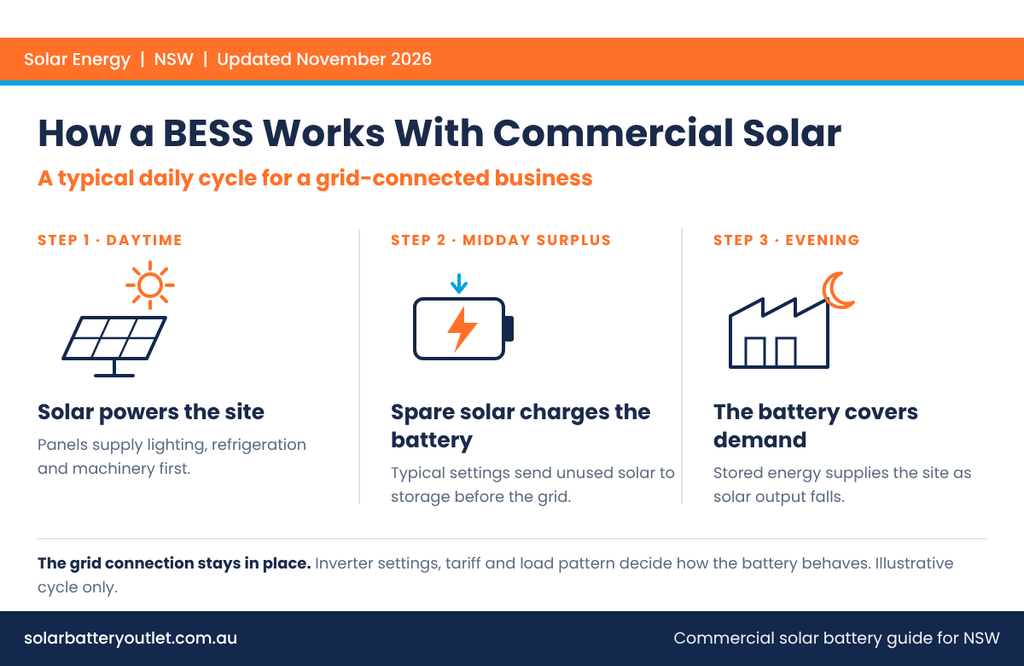
Step 1: Solar Powers the Site First

During the day, panels feed the business directly. Lights, refrigeration, machinery and air-conditioning use solar power before they use grid power.

Step 2: Surplus Solar Charges the Battery

When panels produce more than the site uses, the extra power charges the battery. Without a battery, that surplus typically exports to the grid. Export payments are usually lower than the price of imported electricity.

Step 3: The Battery Supplies Power Later

When solar output falls, the battery discharges to cover site demand. Many businesses programme it to discharge during peak-price or peak-demand periods. As a result, the site imports less grid power at those times.

BESS works with Commercial Solar

AC-Coupled vs DC-Coupled Systems

Installers connect batteries to solar in two main ways. An AC-coupled system adds a battery with its own inverter, which suits many retrofits. A DC-coupled system links the battery and panels through a hybrid inverter, which often suits new builds. The right choice depends on your existing inverter, switchboard and supply type. Ask the installer to explain their reasoning.

Why Do Australian Businesses Add Batteries to Commercial Solar?

Businesses usually pursue one of three goals:

  • Use more of their own solar. Stored surplus replaces some imported power later in the day.
  • Manage peak demand. Some commercial tariffs charge for the highest demand in a billing period. A battery may reduce those peaks, depending on your tariff and load pattern.
  • Add backup capability. Standard grid-connected solar shuts down during an outage. Only a system designed for backup keeps selected circuits running.

Savings vary widely. They depend on your tariff, usage pattern, solar size and battery size. Therefore, treat any savings figure with caution unless it uses your own usage data.

What Support Is Available for Commercial Batteries in NSW?

Support changes often. The details below reflect government information available in November 2026.

NSW Business Battery Discount

The NSW Government announced an upfront discount for business batteries starting on 1 September 2026. It covers batteries from 20 kWh to 30,000 kWh. Accredited suppliers apply the discount to the installation price, and larger batteries attract bigger discounts. The government cites discounts of around 20 to 40 per cent, depending on system size. Ask your installer for the exact figure in writing.

Federal Cheaper Home Batteries Program

The Clean Energy Regulator says the program covers batteries installed at a home or business. Key rules include the following.

Battery and Solar Requirements

  • Nominal battery capacity must sit between 5 kWh and 100 kWh.
  • Small-scale technology certificates (STCs) apply to the first 50 kWh of usable capacity.
  • The battery must connect to a new or existing solar PV system up to 1 MW.

Installer and Product Requirements

  • A Solar Accreditation Australia (SAA) installer with a battery endorsement must install it.
  • The battery must appear on the Clean Energy Council approved battery list.
  • The installation must meet AS/NZS 5139:2019 and be capable of joining a virtual power plant (VPP) when grid-connected.

Batteries above 100 kWh fall outside the federal limit, so the NSW discount may be the relevant scheme. Each scheme has its own rules. Therefore, ask your installer which one applies and whether you can combine them.

Safety and Grid Connection Checks for Liverpool Businesses

A commercial battery is an electrical installation, so safety and network rules apply. Check these points with your installer:

  • Standards. Ask how the design meets AS/NZS 5139:2019, the standard for battery installations.
  • Accreditation. Ask for the installer’s electrical licence and accreditation details. SAA offers an online status checker.
  • Network approval. Your network operator may need to approve grid-connected solar and batteries. Endeavour Energy, for instance, runs an online application for adding solar or batteries. Ask your installer to check which operator serves your address and to handle the application.
  • Site suitability. Ask where the battery will sit and how the installer will manage ventilation and clearances. Also ask which fire-safety requirements apply to your premises.

Australian Consumer Law and Your Commercial Battery Contract

A battery agreement sets your price, equipment, warranty and payment terms. Therefore, read it closely before you sign.

Small businesses may gain extra protection under unfair contract terms rules. The ACCC says these rules apply to standard form contracts with small businesses. It describes a small business as one with fewer than 100 employees or less than $10 million in annual turnover. Larger businesses should seek their own legal advice.

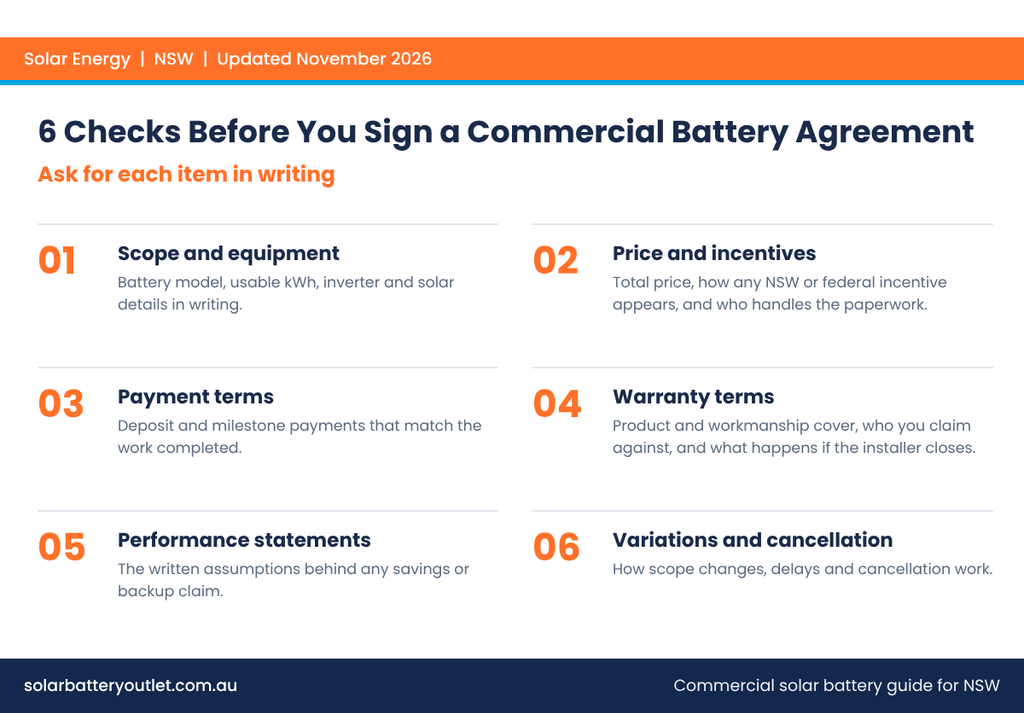
Check these six points before you sign:

  1. Scope and equipment. Get the battery model, usable capacity (kWh), inverter and solar details in writing.
  2. Price and incentives. Check the total price, how any NSW or federal incentive appears, and who handles the paperwork.
  3. Payment terms. Compare the deposit and any milestone payments against the work completed.
  4. Warranty terms. Separate the product warranty from the workmanship warranty. Ask who you claim against, and what happens if the installer closes.
  5. Performance statements. Ask for the written assumptions behind any savings or backup claim.
  6. Variations and cancellation. Check how scope changes, delays and cancellation work.
6 checks before signing a commercial battery agreement

For more on spotting common contract warning signs, read our NSW guide. It focuses on home batteries, yet many of its principles carry over to business quotes.

Practical Example: Planning a Battery for a Liverpool Warehouse

Consider a hypothetical warehouse in Moorebank. It already has rooftop solar and runs lighting, refrigeration and forklift chargers through the day. The owner now wants a battery quote. A sensible process looks like this:

  1. Collect 12 months of electricity bills and smart meter interval data.
  2. Check the current tariff, including any demand charges.
  3. Ask the installer to model battery size against solar output and your load pattern.
  4. Compare quotes using the same usable kWh, inverter and warranty terms.
  5. Ask which NSW or federal incentive applies and how it appears on the invoice.

This example is illustrative only. It does not predict savings for any site.

Commercial Solar Battery Storage FAQs
Can I add a battery to an existing commercial solar system?

Often, yes. An installer must first check your inverter, switchboard capacity and supply type. Some sites add an AC-coupled battery, while others replace the inverter with a hybrid unit. The installer should explain which option suits your system and why.

How big should a commercial battery be?

Size depends on your load pattern, tariff and solar output. Start with 12 months of interval data. A larger battery is not always better value, because unused capacity adds cost without adding benefit.

Do NSW businesses get a rebate or discount for batteries?

Eligible businesses can access the NSW upfront discount for batteries from 20 kWh to 30,000 kWh. The federal program may also apply to batteries between 5 kWh and 100 kWh nominal capacity. Each scheme has its own rules, so check eligibility before you sign.

Will a commercial battery power my business in a blackout?

Only if the installer designs it for backup. Many grid-connected systems shut down during an outage. If backup matters, specify which circuits stay on and which loads they must run.

What should a commercial battery contract include?

It should list the equipment, usable capacity, total price, payment schedule and warranty terms. It should also explain incentive handling, variations and cancellation in writing.

Talk to the Solar Battery Outlet Before You Sign

Comparing commercial battery quotes takes time, and the details matter. Before you sign a solar battery agreement, call Solar Battery Outlet on 1800 000 777. Our team can explain how a battery would work with your solar system. We can also review your quote and point out unclear terms.

Disclaimer

This article provides general information about commercial solar battery storage in Australia. It does not replace individual legal, technical or purchasing advice. Scheme rules, incentive values and standards change, so check current details with the relevant government body. Always seek personalised advice before making a purchasing decision.
Home battery brands often dominate the buying conversation. However, a long-term purchase also depends on the team behind the installation. Many buyers compare specifications first and support second. That order can cause problems later.

This guide covers the questions worth asking about home battery brands, installers, warranties and paperwork. It focuses on NSW households, including those in Liverpool. It draws on Australian regulators and industry bodies.

The Short Answer: What to Confirm Before You Sign

Confirm four things in writing before you sign a solar battery agreement.

  • The exact battery and inverter models appear on the Clean Energy Council (CEC) approved list.
  • A Solar Accreditation Australia (SAA) accredited installer with a battery endorsement will install or supervise the work.
  • The warranty terms are clear, including who handles claims in Australia.
  • You know who to call for support after installation.

The sections below explain each point and the questions that help you check it.

Why Brand and Installer Support Matter Together

Two households can buy the same battery and have different experiences. Installation quality and aftercare often explain the gap.

The Clean Energy Regulator’s solar battery guidance notes that prices, warranties and system quality can vary. It recommends getting multiple quotes and comparing the systems on offer.

Support also affects eligibility for small-scale technology certificates (STCs). The battery must stay at the property for the warranty period or until the end of 2030, whichever is later. Therefore, a warranty that works in practice matters from day one.

Home battery brands can also differ in how they deliver service. Ask whether support comes from the manufacturer, a distributor or the installer.

Questions to Ask About Home Battery Brands

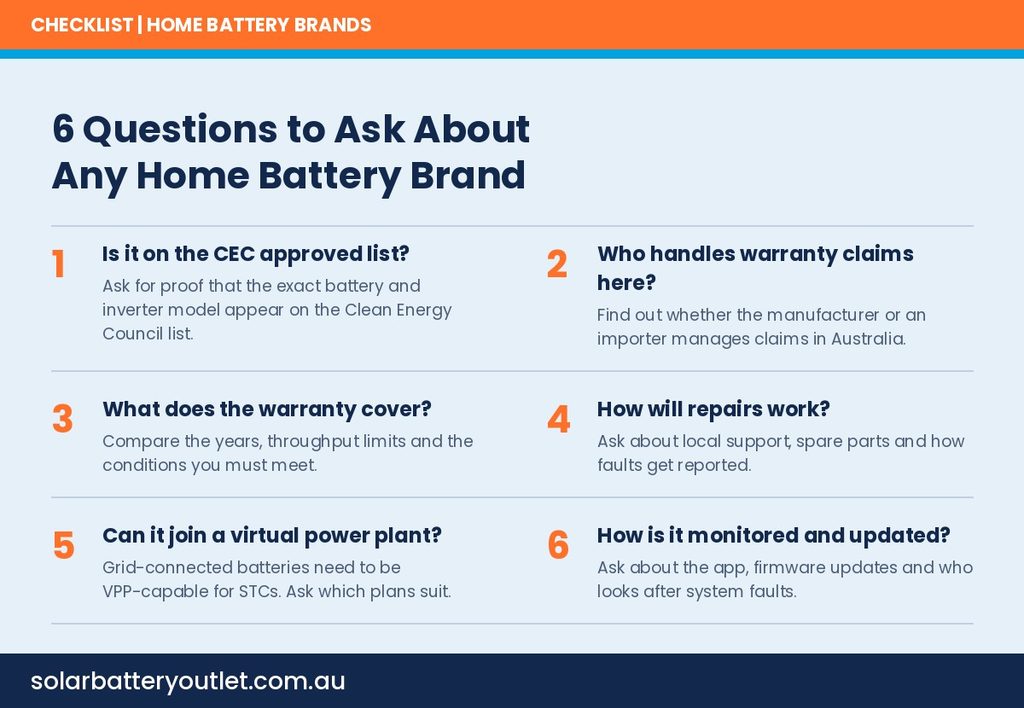
Use these six questions to compare home battery brands on facts rather than marketing.

Questions to Ask About Home Battery Brands

Is the exact model on the CEC approved list?

The Cheaper Home Batteries Program requires eligible batteries to appear on the CEC approved battery list. The inverter connected to the battery must also be capable of joining a virtual power plant. Ask your seller for written evidence of the exact model numbers. A brand name alone does not confirm eligibility.

Who handles warranty claims in Australia?

A warranty is only as useful as the business behind it. Ask whether the manufacturer has an Australian presence. Then ask who you should contact first if a fault appears. Where a manufacturer has no Australian base, an importer may carry the manufacturer’s obligations under Australian Consumer Law.

What does the warranty actually cover?

Read the full warranty document, not only the sales summary. Check the warranty length and any throughput or cycle limits. Look for conditions that could affect a claim, such as registration or maintenance requirements. Also ask who covers labour and removal costs. For more detail, see our guide to how solar battery warranties work.

How will repairs work?

Ask where repairs happen and who arranges them. Australian Consumer Law includes guarantees about acceptable quality. It also covers repair facilities and spare parts for a reasonable time. Even so, ask the seller to explain the practical process in writing.

Can the battery join a virtual power plant?

Grid-connected batteries must be technically capable of joining a virtual power plant (VPP) to qualify for STCs. Joining a VPP is a separate decision. The Clean Energy Regulator suggests discussing it with your energy provider. Ask which retailer plans suit the model you are considering.

How will the system be monitored and updated?

Batteries may need firmware updates, system health checks and safety testing over time. Ask how the monitoring app works. Then ask who handles updates and faults. Clear answers now prevent confusion later.

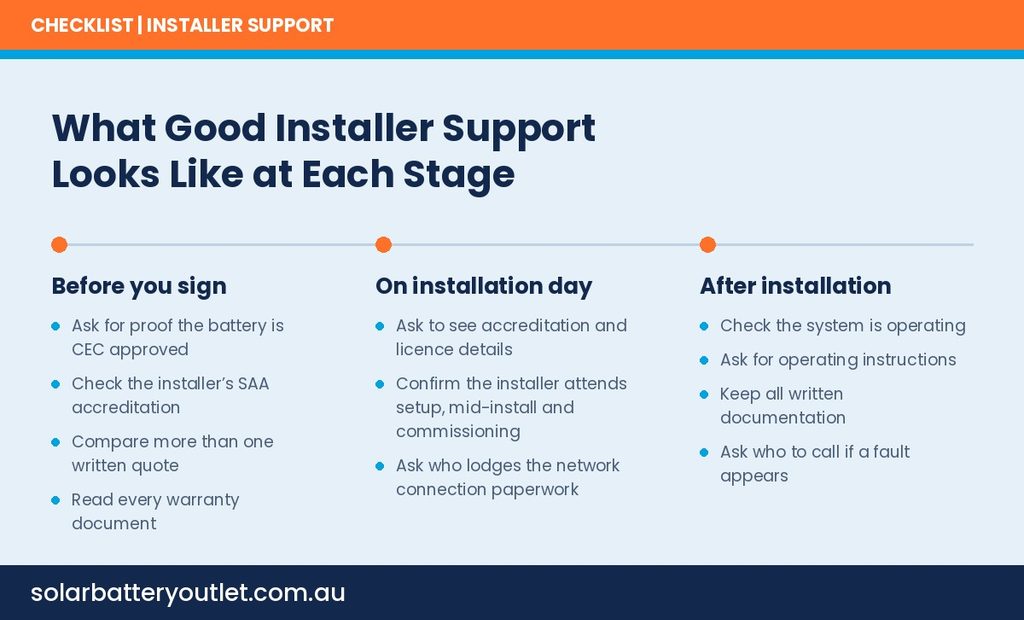
Questions to Ask About Installer Support

Brand quality counts for little if the installation falls short. Installer support covers the whole journey, from design to aftercare.

Is the installer accredited for batteries?

Under the program, an SAA accredited installer with a battery endorsement must install or supervise the work. In Endeavour Energy’s network, designers and installers of solar and battery systems also need SAA accreditation. Ask to see accreditation and licence details on installation day. You can also learn how to check whether your installer is SAA accredited.

Who will be on site, and when?

If the installer will not be on site throughout, confirm they attend job setup, mid-installation and commissioning. Ask for this to be recorded in writing. In addition, confirm who completes each stage of the job.

Who manages the network connection?

Local knowledge helps when you install solar batteries in Liverpool, where Endeavour Energy operates the electricity network. Endeavour Energy says your installer manages the connection process with it. It also suggests asking whether the installer has worked in its network before. Finally, ask who lodges any application and who updates you on progress.

installer support checklist by stage

What support continues after installation?

Ask what you receive when the job finishes. The Clean Energy Regulator says owners must receive written documentation about the battery and the installation. It also recommends an annual safety check by a licensed electrician accredited by SAA. Ask your installer for a suggested maintenance schedule and a clear contact point for faults.

Contracts, Warranties and Consumer Guarantees

Your written agreement should turn verbal promises into clear terms. Review it carefully before you sign.

What a clear written quote includes

Compare quotes line by line. A clear quote usually lists the following:

  • The battery make and model, plus the inverter make and model.
  • Nominal and usable battery capacity in kilowatt-hours.
  • Installer details, including accreditation and licence information.
  • The total price and how any STC discount appears.
  • The payment schedule, including deposit and due dates.
  • The expected installation timeline.
  • Warranty documents and the contact for claims.
  • Any extra work, such as switchboard changes.

Payment terms

Payment terms deserve extra attention. Compare deposit amounts across quotes. Ask when each payment falls due, and request the schedule in writing.

How consumer guarantees fit alongside warranties

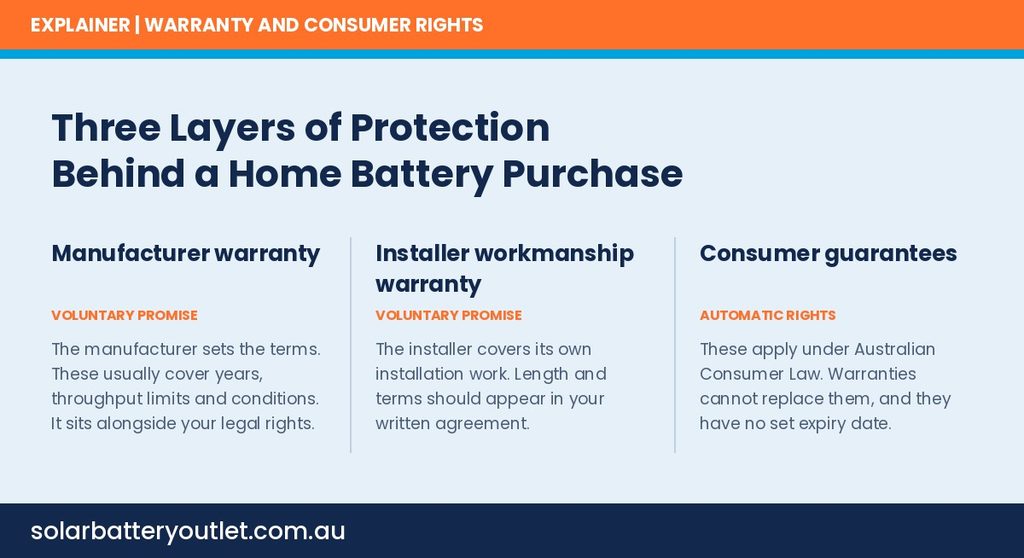
A manufacturer’s or installer’s warranty is a voluntary promise. Consumer guarantees under Australian Consumer Law work differently. The Australian Competition and Consumer Commission (ACCC) states that warranties cannot replace, change or take away these rights. It also says consumer guarantee rights may still apply after a warranty expires.

solar battery warranty consumer guarantees layers

Therefore, treat warranty terms as extra cover, not the only cover. If a problem arises, contact your seller first. Their details appear on your invoice or contract. State fair trading bodies, including NSW Fair Trading, also handle consumer complaints.

A Practical Example for Liverpool Households

Consider a household in Liverpool comparing three quotes. This example is illustrative only.

Two quotes name only a brand and a capacity. The third lists exact battery and inverter models, installer accreditation details, warranty documents and a payment schedule. The household checks the model numbers against the CEC approved list. It then checks the installer’s status on the SAA website. Finally, it asks each business who handles faults after installation.

As a result, the household compares quotes on verified facts rather than brand reputation alone.

Frequently Asked Questions
Which home battery brands qualify for the Cheaper Home Batteries Program?

No brand qualifies automatically. The specific battery model must appear on the CEC approved battery list. It must also meet the program’s other requirements, including installation by an SAA accredited installer with a battery endorsement.

How do I check whether a home battery is CEC approved?

Ask your seller for the exact battery and inverter model numbers. Then search for them on the Clean Energy Council approved battery list. The Clean Energy Regulator also advises asking your retailer for evidence of approval.

Does a manufacturer warranty replace my consumer guarantees?

No. The ACCC states that warranties cannot replace, change or take away consumer guarantees. Those rights may continue after a warranty expires.

What should an installer give me after installation?

You should receive written documentation about the battery and the installation. Ask for operating instructions and a clear contact point for faults. Also ask about a recommended maintenance schedule.

Who do I contact if I have a problem with my installation?

Contact your seller first. Their details appear on your invoice or contract. If the issue continues, the Clean Energy Regulator publishes complaints information for rooftop solar and batteries. NSW Fair Trading can also help with consumer complaints.

Talk to Solar Battery Outlet Before You Sign

Comparing home battery brands and installer promises takes time. Contracts can feel dense, especially when several quotes arrive at once.

The Solar Battery Outlet team can talk through your quote with you before you sign a solar battery agreement. We support Liverpool households with questions about battery models, installer support and warranty paperwork. Call our team today. We will explain your options, and the decision stays with you.

Disclaimer

This article provides general information about home battery brands, installer support and purchasing questions. It does not replace individual legal, technical or purchasing advice. Program rules, product listings, and warranty terms can change and vary between suppliers. Always seek personalised advice before making a purchasing decision.
The Sigenergy vs Sungrow question comes up often for NSW households in 2026. Both brands use lithium iron phosphate (LFP) cells. Both advertise 10-year manufacturer warranties. However, the two systems work differently, and that difference often matters more than any headline specification.

Quick answer: neither brand suits every home. Sigenergy’s SigenStor combines the inverter, battery, and an optional EV charging module on one platform. Sungrow’s SBR pairs 3.2 kWh battery modules with a Sungrow hybrid inverter. Your existing solar system, electrical phase, backup needs, and budget will decide which one fits.

Sigenergy vs Sungrow at a Glance

This guide compares both systems for Liverpool homes. It covers design, capacity, warranty, safety history, backup power and NSW incentives. You can then ask your installer sharper questions before you sign.

The infographic below summarises the main differences. However, specifications vary by model and phase. Confirm every figure against your written quote and the manufacturer’s datasheet.

Comparing Sigenergy SigenStor and Sungrow SBR on system design

How the Two Systems Are Built

Sigenergy SigenStor: One Platform

The SigenStor uses a single energy controller. That controller contains the hybrid inverter and the energy management system. Stackable battery modules then connect to it. Each module offers roughly 5.2 to 8.8 kWh of usable capacity. One controller accepts up to six modules, or five if you add the EV module.

Sigenergy also offers an optional DC EV charging module. Therefore, households planning an electric vehicle can build that option into the same system. For a retrofit, ask your installer how the SigenStor will connect to your existing solar panels and inverter.

Sungrow SBR: Modules Plus a Sungrow Inverter

The Sungrow SBR is a high-voltage LFP battery built from 3.2 kWh modules. A standard stack holds three to eight modules, giving 9.6 to 25.6 kWh. It connects to a Sungrow hybrid inverter, such as an SH-RS model.

As a result, homes with a compatible Sungrow inverter can add the battery without replacing that inverter. Homes with another inverter brand may need a swap. Ask your installer to list that cost as a separate line on the quote.

Capacity and Sizing for Liverpool Homes

Size your battery around your evening electricity use, not around the largest unit available. Liverpool’s hot summers can lift evening air-conditioning use, so check that load first. Your recent bills and smart meter data will show your real pattern.

Sungrow’s 3.2 kWh modules allow small capacity steps. Sigenergy’s larger modules give fewer steps but a higher maximum per controller. Neither approach is better by itself. The right size depends on your usage and budget.

How Rebate Tiers Affect Size

The federal Cheaper Home Batteries Program has used tiers since 1 May 2026. The first 14 kWh of usable capacity receives 100% of the certificate factor. The next 14 kWh receives 60%. Capacity from 28 to 50 kWh receives 15%.

Bar graphic of Cheaper Home Batteries Program rebate tiers

As a result, each extra kWh above 14 kWh earns a smaller rebate share. The rebate value also steps down on a published schedule. Therefore, check the current rate on the Australian Government’s program page before you sign.

The program requires a battery on the Clean Energy Council-approved battery list. On-grid batteries must also be VPP-capable, although you do not have to join a VPP. Confirm the exact model on that list.

Warranty Terms: Read the Fine Print

Ten Years Is Not the Whole Story

Both brands advertise 10-year manufacturer warranties. However, each warranty also sets performance limits. Sigenergy’s terms promise either 70% capacity retention or a minimum energy throughput, whichever comes first. Sungrow’s terms also link cover to throughput limits. Published figures for Sungrow vary between sources and document versions.

Therefore, ask for the current warranty document for the exact model on your quote. Check who handles a claim: the installer, the retailer or the manufacturer’s Australian service partner. Our guide to solar battery warranties explained covers years, cycles and throughput in more detail.

Australian Consumer Law Sits Alongside the Warranty

A manufacturer warranty is an extra promise. It does not replace your consumer guarantees under the Australian Consumer Law. Those guarantees include acceptable quality and a product that matches its description. The ACCC says warranties cannot remove those basic rights, and the rights can outlast a warranty period.

In practice, keep your contract, invoice and compliance paperwork together. If a problem arises, those documents help you explain what you bought.

Safety and Recall History

What the 2025 Sigenergy Recall Covered

In November 2025, the ACCC published a voluntary recall. It covers Sigenergy’s single-phase SigenStor 8, 10 and 12 kW energy controllers. The affected units use a quick-connect AC plug. The ACCC notice says those plugs may overheat and pose a fire risk. Owners receive a free replacement controller with an updated plug, arranged through their retailer or Sigenergy’s Australian service partner.

What Sigenergy and the Regulator Said

Sigenergy said the issue stems from incorrect installation practices rather than a product defect. The Clean Energy Regulator said the recall affected about 100 inverters. It also said the recall showed existing oversight systems identify and manage safety issues quickly.

Check Any Brand Before You Buy

Recalls can affect any battery or inverter brand. Search the Product Safety Australia recall database for your exact model. Then ask your installer who completes the AC connections and how they follow the manufacturer’s installation instructions.

Backup Power During NSW Outages

Both systems can support backup power, but output depends on configuration. Your electrical phase matters. A single-phase home and a three-phase home will see different options. The paired inverter model also changes the figure.

Backup also needs the right circuits and settings. Ask which circuits stay live during an outage and for how long. Then request the backup output in writing for the exact battery and inverter pairing.

NSW Incentives and VPP Compatibility

NSW also offers a separate VPP incentive. NSW Climate and Energy Action describes an upfront payment. You receive it when you connect an eligible battery to a VPP provider. The amount depends on the capacity you make available, up to 28 kWh. It also varies by provider and contract.

However, VPP providers choose which battery models they support. Your electricity retailer must also offer VPP access. Therefore, check both before you buy. Liverpool homes typically connect through Endeavour Energy’s network, so ask your installer about its connection requirements.

Which Battery Suits Which Liverpool Household?

Sigenergy May Suit You If

  • You are installing new solar and a battery together.
  • You want one integrated platform instead of matching separate parts.
  • You plan to add an electric vehicle and want an integrated charging option.
  • You expect to expand your capacity later.

Sungrow May Suit You If

  • You already run a compatible Sungrow hybrid inverter.
  • You prefer smaller 3.2 kWh capacity steps.

Consider two Liverpool examples. One family owns a Sungrow hybrid inverter and has no EV plans. The SBR path may keep their project simpler. Another family is installing new solar and expects to buy an EV next year. The SigenStor’s integrated design may suit them better. These examples are illustrative, not recommendations.

Four-step checklist for choosing between Sigenergy and Sungrow

Questions to Ask Before You Sign a Contract

These steps are precautions we recommend, not legal requirements. They help you compare quotes fairly.

1.  Ask for an itemised written quote. It should name the battery model, usable kWh, inverter model and backup circuits.

2.  Confirm the payment schedule and deposit terms in writing before you sign.

3.  Request the warranty documents and the claims process for each component.

4.  Check the installer’s accreditation. Our guide explains how to check if a solar battery installer is SAA accredited.

5.  Ask who arranges grid connection approval and VPP onboarding, and what each step costs.

Also remember that, under the NSW Peak Demand Reduction Scheme, salespeople cannot knock on your door uninvited. Treat any unsolicited approach with caution.

Frequently Asked Questions

Is Sigenergy or Sungrow better for NSW homes?

Neither brand wins for every home. Sigenergy suits households that want an integrated system with an optional EV charging module. Sungrow suits homes that already run a compatible Sungrow inverter or want small capacity steps. Your inverter, phase, backup needs, and written quote should decide.

Can I add a Sungrow SBR to my existing solar system?

Only if your inverter is a compatible Sungrow hybrid model. The SBR connects to a Sungrow hybrid inverter. With another inverter brand, your installer may recommend an inverter swap or a different battery. Ask for any swap cost as a separate quote line.

Do both batteries qualify for the Cheaper Home Batteries Program?

Eligibility depends on the exact model. The battery must appear on the Clean Energy Council approved list. On-grid systems must also be VPP-capable. Confirm each point on your quote before you sign.

Does the Sigenergy recall affect every SigenStor?

No. The ACCC recall covers single-phase 8, 10 and 12 kW SigenStor energy controllers with quick-connect AC plugs. Ask your installer to confirm your model and connector status. Check Product Safety Australia for current details.

What should I ask before signing a solar battery contract?

Ask for an itemised quote, warranty documents, payment terms and installer accreditation details. Also ask who handles claims and grid connection approval. Compare at least two written quotes. Take time to review each one.

Get Guidance Before You Sign

Comparing Sigenergy and Sungrow takes more than a spec sheet. Your inverter, phase, usage, and contract terms all shape the right choice. Solar Battery Outlet can walk you through both systems and explain your quote line by line.

If you are comparing solar batteries in Liverpool, call Solar Battery Outlet before you sign a battery agreement. Our team will review your solar setup, answer your warranty, backup and installation questions, and explain your options.

Disclaimer: This article provides general information about Sigenergy and Sungrow home batteries for NSW households. It does not replace legal, technical or purchasing advice. Specifications, warranties, rebates and incentive rules change over time, so verify current details with manufacturers, government sources and your installer. Always seek personalised advice before making a purchasing decision.
Solar battery contract red flags are terms or tactics that hide costs, remove rights or rush you into signing. In NSW, the most common warning signs involve deposits, missing cooling-off details, vague rebate figures and unclear warranties.

Spotting them early protects your money. It also lets you compare quotes fairly. This guide separates what the law requires from what we simply recommend you check before you sign.

Why a Solar Battery Contract Needs a Close Read in NSW

A home battery is a major purchase. A solar battery installation contract sets your price, your rebate, your warranty and your cancellation rights. Therefore, it deserves as much attention as the equipment itself.

Government warnings support this caution. The NSW Government says energy rebate scams and misleading deals are becoming more common, especially for solar and home batteries. As a result, a careful contract review is a sensible first step.

A reputable solar battery installer should answer your contract questions clearly. Vague replies are useful information too.

Legal Requirements vs Recommended Precautions

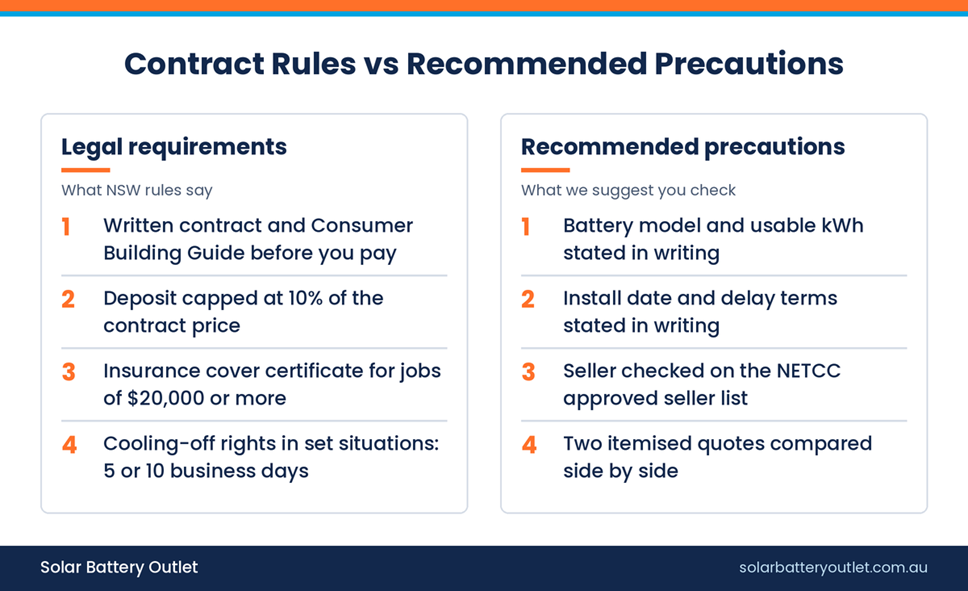
Not every good habit is a legal duty. Keeping the two apart helps you judge a contract accurately. The infographic below summarises the difference, and the sections that follow explain each point.

The NSW Government guide to solar panels sets out what your installer must give you. Before you pay or work begins, the installer must provide a written contract and the Consumer Building Guide. Recommended precautions, such as comparing itemised quotes, go further than the law requires.

However, that guidance covers solar installations. Ask your installer which rules apply to your specific job.

nsw contract rules vs recommended precautions

Seven Solar Battery Contract Red Flags to Spot Before You Sign

Each red flag below shows what the law says and what we recommend. Use them as a checklist when you read your quote.

1. Pressure to Sign or Pay on the Spot

Urgency is a classic sales tactic. The NSW Government lists pressure to sign or pay a deposit immediately as a red flag. Phrases such as “register now” or “you’ll miss out” deserve extra caution.

Rebate deadlines need particular care. The Cheaper Home Batteries Program discount reduces on a published schedule, yet the program itself continues beyond 2026. The next scheduled step-down is 1 January 2027. So if a salesperson claims the rebate ends tomorrow, ask for the source in writing.

What we recommend

Take the written quote home. Then compare it with at least one other before you decide.

2. A Deposit Above 10% or Taken Before Insurance Is in Place

What the law says

Under NSW home building law, the maximum deposit is 10% of the contract price. Where Home Building Compensation Fund cover is required, the contractor cannot ask for payment until insurance is in place.

That cover applies when labour and materials cost $20,000 or more. Moreover, a rebate cannot reduce the price on paper to avoid that threshold.

For example, on a $12,000 installation, a deposit above $1,200 breaks the cap. These figures are illustrative only.

What we recommend

Ask for a written payment schedule that shows each stage and amount. Keep every receipt.

3. Missing or Buried Cooling-Off Information

What the law says

Cooling-off rights depend on how the sale happened and the contract value. Under Australian Consumer Law, door-to-door and phone sales over $100 carry a 10 business day cooling-off period. In those cases, the business generally cannot take payment during that time. The agreement must also explain your cancellation rights.

In addition, NSW home building contracts above $20,000 must state a five business day cooling-off period.

What we recommend

Ask the seller which period applies to you. Then get it in writing, and note the date you receive your signed copy.

4. Vague Rebate Figures and Equipment Details

“Up to” rebate figures and “premium battery” labels tell you very little. Without specifics, you cannot compare quotes or confirm what you are buying.

What we recommend

NSW Fair Trading advises a written quote with separate equipment and labour costs. It should also show rebates clearly and include the full terms and conditions. We also recommend the quote names the battery brand and model and states the usable capacity in kWh. The discount is calculated on usable capacity, so that figure matters.

The discount also depends on battery size and installation date. Therefore, ask which settings your quote assumes.

5. Unclear Installer Credentials

What the law says

NSW Government guidance says a licensed builder or licensed electrical contractor must install solar systems. Battery installations must follow the AS/NZS 5139 standard. Afterwards, the electrician must give you a Certificate of Compliance for Electrical Work.

The federal discount adds another condition. A Solar Accreditation Australia (SAA) installer with battery accreditation must install the battery or supervise on site. The battery must also appear on the Clean Energy Council approved list.

What we recommend

Check the electrical licence on Verify NSW and the accreditation on the SAA website yourself. You can also check whether the seller appears on the New Energy Tech Consumer Code (NETCC) approved seller list. The Clean Energy Council administers this voluntary industry code.

6. Weak or Confusing Warranty Terms

A “10-year warranty” headline can hide important limits. Therefore, look beyond the number of years. Check the warranty term, any cycle or energy throughput limit, and any minimum capacity guaranteed. Also confirm who handles claims, and whether parts, labour and call-out fees are covered.

What the law says

Australian Consumer Law guarantees apply regardless of warranty terms. Energy products must work properly and last a reasonable time.

What we recommend

Read our guide to how solar battery warranties work before you compare offers. Then ask the seller to put the claim process in writing.

7. “No Upfront Cost” Offers Without Clear Terms

The NSW Government lists “no upfront costs” and “easy payment plans” without clear terms as red flags. A loan, lease or power purchase agreement can be legitimate. However, the total cost often differs sharply from the cash price.

Therefore, ask for the cash price and the financed price side by side. Also confirm who owns the system and who receives the rebate. Our breakdown of the hidden cost of no upfront cost solar deals in NSW shows how these structures compare.

A Five-Point Check Before You Sign a Solar Battery Agreement

Use this quick check alongside your quote. It brings the seven red flags together in one place.

5 points to check before you sign

If any point is unclear, pause. A short pause is usually easier than fixing a poor contract later.

What to Do If You Have Already Signed

Act quickly. First, check whether a cooling-off period still applies. Next, contact the business in writing and keep every quote, message and receipt.

If the business does not respond, contact NSW Fair Trading. In addition, consumer guarantees may entitle you to a repair, replacement or refund for faulty or misdescribed products. The remedy depends on the problem.

Solar Battery Contract Red Flags in NSW: FAQs

What is the maximum deposit on a solar battery in NSW?

Under NSW home building law, a deposit cannot exceed 10% of the contract price. Where Home Building Compensation Fund cover is required, the contractor cannot ask for payment until insurance is in place. Confirm how these rules apply to your job with your installer or NSW Fair Trading.

Do I get a cooling-off period on a solar battery contract in NSW?

It depends on the sale. Door-to-door and phone sales over $100 carry 10 business days under Australian Consumer Law. NSW home building contracts above $20,000 carry five business days. Ask the seller which period applies, and get it in writing.

Is a written contract required for a solar battery installation?

NSW Government guidance says installers must provide a written contract before you pay or work begins. They must also give you the Consumer Building Guide. Ask your installer how this applies to your specific job.

How do I check that a solar battery installer is legitimate?

Check the business on ABN Lookup and the electrical licence on Verify NSW. Then check the installer’s SAA accreditation. Finally, see whether the seller appears on the NETCC approved seller list.

Does the battery rebate end on 1 January 2027?

No. The Cheaper Home Batteries Program continues beyond that date, but the discount steps down. Check the current settings with the Department of Climate Change, Energy, the Environment and Water. Then ask for the discount to appear on your quote.

Talk to Solar Battery Outlet Before You Sign

Reviewing a solar battery agreement in Liverpool, Bankstown and nearby areas? Contact Solar Battery Outlet before you sign. Our team can walk you through the quote, the rebate line and the warranty terms in plain language. That way, you can ask the right questions with confidence.

Disclaimer

This article provides general information about solar battery contracts in NSW. It does not replace individual legal, technical or purchasing advice. Laws, rebate settings and program rules change, and they may apply differently to your property and type of sale. Check current requirements with NSW Fair Trading, Building Commission NSW or a qualified legal adviser. Always seek personalised advice before making a purchasing decision.
Severe storms have cut power to tens of thousands of NSW homes in recent years. When that happens, you face a practical choice. So, should you rely on a solar battery or a backup generator?

This guide compares a solar battery vs backup generator for NSW blackouts. First, we explain how each option works. Next, we cover limits, safety and cost. Finally, we give you four questions to help you choose.

QUICK ANSWER
A backup-enabled solar battery supplies quiet, automatic power to your chosen circuits.
A generator runs as long as you keep it fuelled, but it needs outdoor use and a licensed changeover switch.
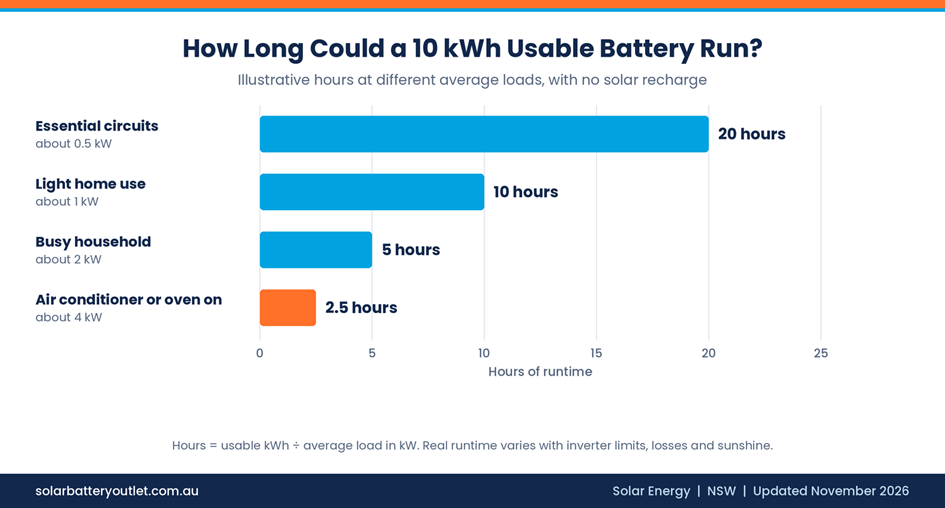
Load size sets battery runtime, while fuel supply sets generator runtime.
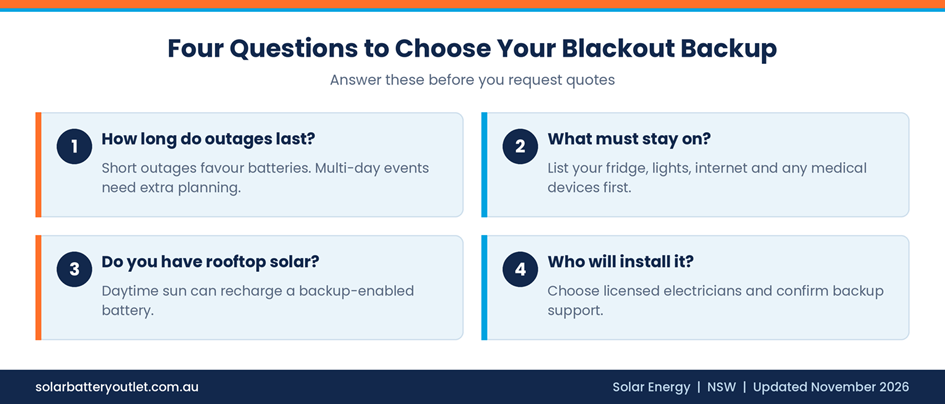
Your outage length, essential loads and budget decide the better fit.

Why NSW Blackouts Make Backup Power Worth Planning

Recent storms show the scale of the problem. For example, storms in January 2025 affected more than 200,000 Ausgrid customers. Likewise, Endeavour Energy reported about 78,000 affected customers, and Essential Energy reported 31,500.

Some outages then lasted for days. In fact, Ausgrid warned that repairs would continue into 20 and 21 January. Later, in November 2025, another storm left about 63,000 NSW properties without power. Most of those sat in Western Sydney.

Therefore, outage length matters as much as outage frequency. A two-hour fault and a three-day storm call for different plans. That difference drives the solar battery vs backup generator decision.

How a Solar Battery Powers Your Home During a Blackout

First, most grid-connected solar systems shut down when the grid fails. Australian standards require this, because it protects electrical workers who repair the network. As a result, rooftop panels alone cannot power your home in a blackout.

A battery changes that, but only with the right hardware. Specifically, you need a backup-capable inverter or gateway, plus wiring for backup circuits. However, not every battery includes this function, so confirm it before you buy.

When the grid drops, a backup-enabled system separates your home from the network. Then it supplies your chosen circuits from stored energy. Expect a brief interruption during switchover, which varies by product. Meanwhile, daytime sunlight can recharge the battery. Next, you decide how much to back up. Essential circuits cover items such as the fridge, lights and Wi-Fi. Whole-home backup covers more, but it drains the battery faster. Our guide to essential circuits vs whole-home backup in NSW explains this trade-off.

how long a 10 kWh usable solar battery could run at different household loads during an NSW blackout

Safety also deserves attention. Generator exhaust contains carbon monoxide, a gas you cannot see or smell. Fire and Rescue NSW’s Roger Mentha stated, “Never use portable generators indoors, or in garages and sheds.” Instead, run the unit outside, well away from windows and vents.

Wiring needs care as well. For instance, plugging a generator into a wall socket can send power back into the grid. This backfeeding puts line workers at risk. According to Ausgrid’s portable generator guidance, a licensed electrician should install a compliant changeover switch.

Finally, consider noise. Common retail portable models run at roughly 58 to 68 decibels at seven metres. Your neighbours may hear the engine throughout a long outage.

Solar Battery vs Backup Generator: Side-by-Side Comparison

The graphic below shows the solar battery vs backup generator trade-offs that matter most during an outage.

Solar battery vs backup generator

In short, a battery favours convenience and quiet operation. In contrast, a generator favours longer runs when fuel stays available. However, neither option suits every household. Ultimately, your own loads and outage history matter most.

Where Each Option Falls Short

Solar battery limits

First, a battery stores a fixed amount of energy. Heavy loads drain it quickly, and cloudy days limit recharging. In addition, a system without a backup function will not help during a blackout. Our post on why your solar battery backup may not work when you need it most covers the common causes.

RACV spokesperson Himanshu Ahuja also cautions that “solar batteries are not an uninterruptible power supply.” Therefore, households that rely on essential medical equipment should arrange a separate plan. Speak with your medical provider and electricity distributor first.

Generator limits

On the other hand, a generator needs fuel, servicing and outdoor space. You must start it, monitor it and refuel it. Meanwhile, noise can affect your neighbours. As a result, generators suit some homes well, but they demand more attention during a long storm.

Cost and Rebates: What to Compare

First, a portable generator usually costs less upfront. However, a battery works every day, not only during blackouts. For example, it can store solar energy for use in the evening, which a generator cannot do.

In addition, the federal Cheaper Home Batteries Program reduces the upfront cost of eligible batteries. The Clean Energy Regulator lists an STC factor of 6.8 per kWh for installations from May to December 2026. That factor then steps down to 5.7 from 1 January 2027. The full factor applies to the first 14 kWh of usable capacity.

Your eligibility and final rebate depend on your system, installation date and certificate price. Therefore, ask each installer to show the rebate as a dollar amount on the written quote. Generators do not qualify for this program, so compare total costs over several years. Include fuel, servicing and electrician work in any solar battery vs backup generator comparison.

How to Choose: Four Questions to Ask First

Work through these four questions before you request quotes. Each one narrows the solar battery vs backup generator choice.

four questions before you request quotes
  1. How long do your outages last?
    Short outages suit a battery. However, for multi-day events, some households add a generator as a second option, but an electrician must plan the wiring.
  2. What must stay on?
    List your fridge, lights, internet and any medical devices. Then, decide between essential circuits and whole-home backup.
  3. Do you have rooftop solar?
    Daytime sunlight can recharge a backup-enabled battery, which stretches runtime.
  4. Who will install it?
    Use licensed electricians for either option. Also, check that your battery appears on the Clean Energy Council approved list and supports backup.

Finally, compare at least three written quotes. Ask each installer to show which circuits stay live in a blackout.

Frequently Asked Questions

Is a solar battery better than a generator in a blackout?

It depends on your outage length, loads and budget. A backup-enabled battery gives quiet, automatic power to chosen circuits. However, a generator can run longer while fuel remains available. Therefore, compare both options against your own needs.

Will my solar panels work in a blackout without a battery?

Usually not. Grid-connected systems shut down during a blackout to protect electrical workers. However, some inverters offer a limited backup socket for a few devices. Ask your installer what your inverter supports.

How long will a solar battery last in a blackout?

Runtime equals usable battery energy divided by your load. For example, a 10 kWh usable battery running a 0.5 kW load lasts about 20 hours. That figure ignores losses and solar recharge. In contrast, heavy loads such as air conditioning shorten that time sharply.

Can I plug a generator into my home’s wiring?

Not directly. First, a licensed electrician must install a compliant changeover switch. Otherwise, the generator can feed power back into the grid. Ausgrid warns that this endangers its crews.

Is it safe to run a generator in a garage?

No. Generators produce carbon monoxide, which can build up quickly in enclosed spaces. Instead, Fire and Rescue NSW advises running them outdoors, away from windows, doors and vents.

Can a solar battery run an air conditioner during a blackout?

Some systems can, depending on inverter rating and battery size. However, air conditioners drain batteries quickly. As a result, most households back up essential circuits first. Ask your installer to size backup for your largest loads.

Disclaimer: This article offers general information about solar battery backup and generator use during NSW blackouts. It does not replace advice from a licensed electrician, your electricity distributor or a medical professional. Runtime figures are illustrative calculations, so real results vary with your system, loads and weather. Rebate settings, including STC factors, also change over time, so confirm current details with the Clean Energy Regulator. Households that rely on medical equipment should arrange a separate backup plan. Always seek personalised advice before making a purchasing decision.