
If you have recently had a solar battery installed—or you are considering one—you may have heard that the government now requires your installer to photograph the job before they can claim your rebate. It sounds unusual. And some homeowners are wondering what exactly is being photographed, why, and whether it affects them.
Here is the plain-language explanation, sourced directly from the Clean Energy Regulator (CER).
| The Short Version From 1 March 2026, every accredited solar battery installer in Australia must take clear, geotagged and timestamped photos of critical safety labelling for every installation. These photos are submitted to the CER with the STC (rebate) claim paperwork. If the photos are missing or show noncompliant labeling, the rebate claim is rejected. This is not a new policy invented by installers. It is a legislative requirement under the Renewable Energy (Electricity) Regulations 2001, section 20ACA(12)(h)(iii). |
Why Did the CER Introduce This Rule?
The answer is straightforward: audits revealed that installers most commonly failed Australian standards because they used non-compliant labelling on solar battery installations.
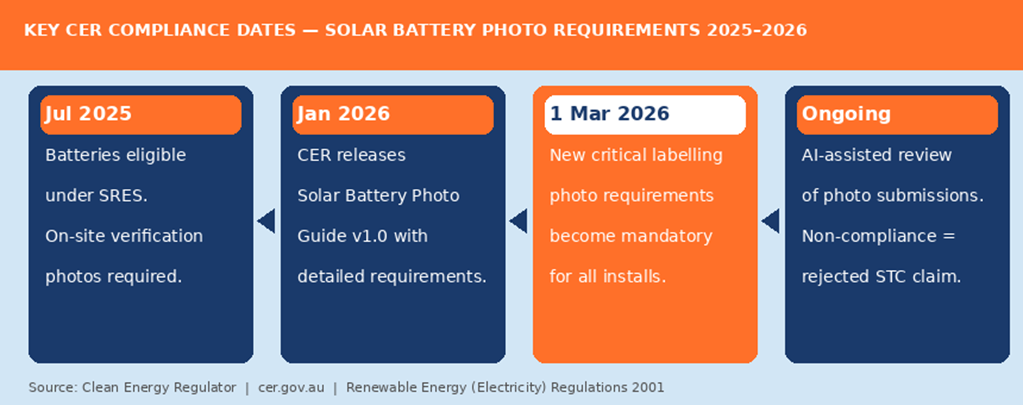
Australia has seen an extraordinary surge in battery installations since the Cheaper Home Batteries Program launched in July 2025. By early March 2026, more than 254,800 households, small businesses, and community organisations had installed a battery under the program—delivering a combined 6.3 GWh of storage capacity nationally. That is more than the 12 biggest in-service utility-scale batteries in the National Electricity Market combined.
With that kind of volume, compliance problems multiply fast. The CER’s own inspection data showed that missing, misplaced, or incorrect safety labels were appearing regularly across installations. These are not cosmetic issues—correct labeling is essential for the following:
- Emergency responders (firefighters, paramedics) who need to know a lithium battery is present before cutting power or entering a roof space
- Future electricians or tradespeople working on the property, who need shutdown procedure labels and hazard warnings clearly displayed
- Homeowners themselves, who have a right to a safely installed system that meets Australian standards
What Exactly Gets Photographed?
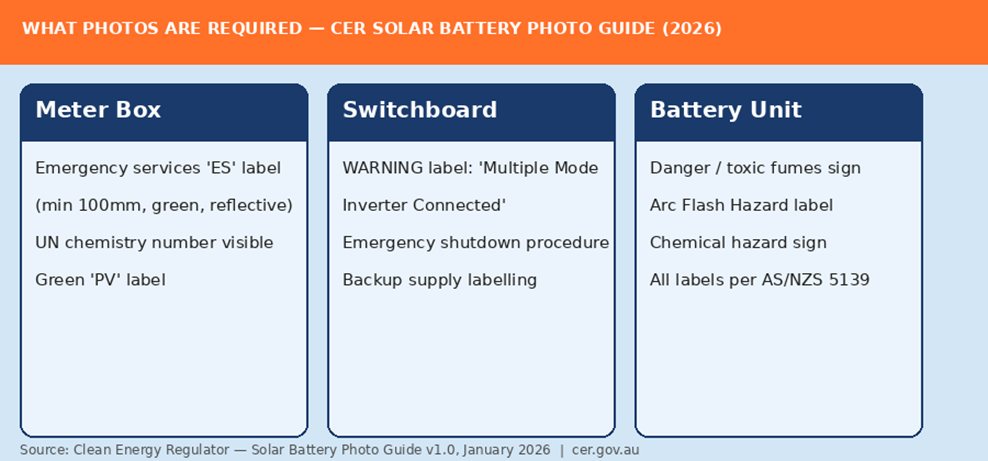
The CER’s Solar Battery Photo Guide (Version 1.0, January 2026) requires installers to take three categories of photos for every installation. These requirements add to the on-site verification photos introduced in July 2025.
1. The Meter Box (External)
Installers must photograph the emergency services label on the outside of or visible near the meter box. This circular green reflective label, at least 100 mm in diameter, displays the letters ‘ES’ and includes the UN number for the battery type—for example, UN3480 for lithium-ion batteries (which includes LiFePO₄). A green ‘PV’ label must also be visible where applicable.
2. The Switchboard (Internal)
Installers must take a photo of the labels inside the switchboard or meter box cover. CER inspection data showed installers most commonly failed compliance in this area. The photo must capture the WARNING label stating ‘MULTIPLE MODE INVERTER CONNECTED’ and ‘NEUTRAL AND EARTH CIRCUITS MAY BE LIVE UNDER NORMAL AND FAULT CONDITIONS,’ along with the emergency shutdown procedure and, for backup systems, the labeling of backed-up circuits.
3. The Battery Unit Itself
Photos must show the front and sides of the battery unit, including all hazard warning signs placed in compliant positions. These include danger signs for toxic fumes, risk of battery explosion, arc flash hazard, and chemical exposure—all as required by Australian Standard AS/NZS 5139 (Safety of battery systems).
How Does the CER Review These Photos?
This is where it gets interesting. The CER has invested in artificial intelligence to assess photo submissions at scale. According to the regulator’s own statement:
| “We use sophisticated artificial intelligence as part of our comprehensive assessment process to ensure that all claims meet the new photo requirements.” — Clean Energy Regulator, March 2026 |
In practice, automated systems review photo submissions. The system flags claims when installers submit missing, misplaced, or unreadable labels. Installers must then return to the site, fix the issue, and resubmit the claim.
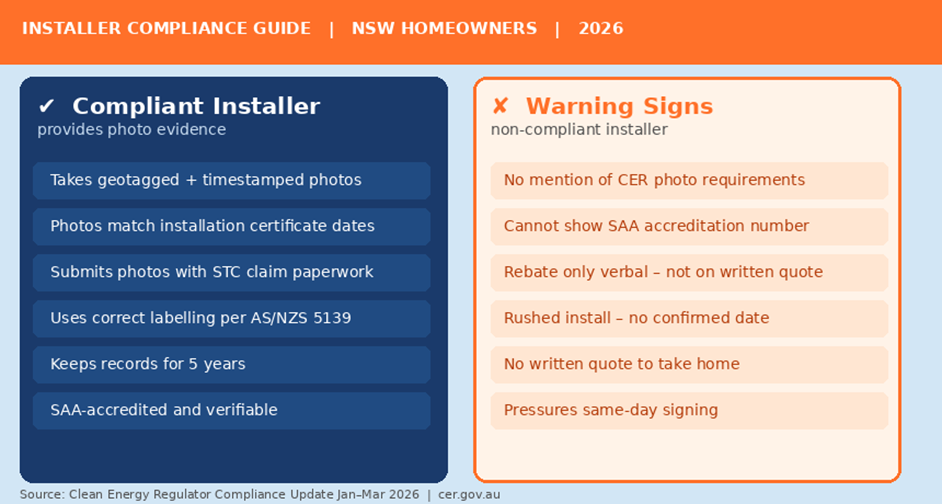
Installers must submit photos in their original file format, not inside a PDF. The CER requires original metadata, including geotags and timestamps, to match installation records. Installers must also keep all submitted photos on file for five years. The CER can audit those photos at any time, even after approving the claim.
What Does This Mean for You as a Homeowner?
The short answer: if your installer is doing their job properly, you will not notice this at all. It is an administrative and safety compliance process that happens between the installer and the regulator.
But there are three things worth knowing:
Your Rebate Depends on Compliance
When an accredited installer completes your solar battery installation and claims small-scale technology certificates (STCs) on your behalf, that claim — and the upfront discount you receive — depends on the paperwork being in order. Installers photograph the labelling to protect you and anyone who enters your home during an emergency or electrical work. In serious cases, the CER can reject the claim entirely. Installers cannot pass the rebate on to you until they fix the issue.
This is not a theoretical risk. The CER has already begun suspending installers for repeated non-compliance and has explicitly warned that it will not hesitate to remove installers from the scheme.
It Is a Signal of a Good Installer
An installer who knows the photo requirements well is more likely to understand the labelling standards too to install the correct labelling in the first place. Non-compliant labelling and non-compliant photo submissions tend to go together—because both stem from the same underlying problem: an installer who cuts corners.
Asking your installer directly—’Do you submit geotagged photos of critical labelling as required by the CER?’—is a useful question to ask.
Your Home Is Safer for It
The photographed labelling protects you and anyone who enters your home during an emergency or electrical work. A correctly labelled solar battery installation tells a first responder that there is a lithium battery on site, what chemistry it uses, and how to safely shut the system down. That information can be the difference between a manageable incident and a serious one.
Compliant vs Non-Compliant: What to Look For
Whether you are booking a new installation or thinking about your existing system, this guide shows what separates an installer who will keep your rebate safe from one who will not.
A Note About Misleading Advertising
The CER also used this compliance update to address misleading rebate advertising. The regulator warned agencies to monitor poor consumer practices around rebate deadlines. It specifically highlighted misleading quoting and aggressive sales tactics. State and territory fair trading agencies were notified about these concerns.
If you have seen advertising that makes the photo requirement sound alarming or uses it to pressure you into signing quickly, be cautious. The photo requirements apply to the installer, not the homeowner. They do not affect the value of your rebate or change your eligibility for any NSW state incentive. A compliant installer can still complete the installation within the normal timeline.
Frequently Asked Questions
No. The new critical labeling photo requirements apply to all solar batteries installed from 1 March 2026 onwards. Installations completed before that date are subject to the on-site verification photo requirements that applied since July 2025, but not the new labeling-specific photos.
Not directly. Your STC rebate value depends on the battery size, STC price, and STC factor at installation time. The photo compliance process does not directly affect the rebate value. However, non-compliant photo submissions can delay or reject the STC claim. That delay can postpone the rebate being processed and passed on to you.
You can verify any installer’s accreditation number directly at saaustralia.com.au. Ask your installer to provide their SAA accreditation number before signing any contract. A legitimate, accredited installer will provide this without hesitation.
You can request copies from your installer, and many will provide them as part of their installation documentation. You are not required to receive them, but there is no reason a compliant installer would refuse the request.
If you have concerns about the labeling on an existing installation, contact your original installer. If the installation was completed under the SRES, the installer has ongoing obligations regarding compliance. You can also contact Solar Accreditation Australia or your state or territory electrical safety regulator for guidance.
| Ready to Install a Solar Battery the Right Way? Solar Battery Outlet is a Liverpool-based solar battery installer, part of GWM Group Pty Ltd, servicing homes across NSW, including Bankstown and Mudgee. SAA-accredited electricians complete all our installations, and all rebate paperwork—including the new CER photo requirements—is handled for you. We do not use door knockers. We do not pressure for same-day signing. We give you a written quote that shows the rebate as a dollar deduction, with a confirmed installation date. If you want a free, no-obligation quote for your NSW home: 📞 Call us: 1800 000 777 🌐 Visit: solarbatteryoutlet.com.au — fill in the 60-second eligibility form. We will look at your bills, check your solar setup, and tell you honestly whether a battery makes financial sense for your home. |
Data Sources & References
All factual claims in this article are drawn from official Australian Government sources and other Non-Government Sources:
- Clean Energy Regulator — Solar Battery Photo Guide v1.0, January 2026 (cer.gov.au/document/solar-battery-photo-guide)
- Clean Energy Regulator — Solar battery installers and designers (cer.gov.au)
- Clean Energy Regulator — Compliance Update January to March 2026 (cer.gov.au)
- Clean Energy Regulator — Media Release: Safety the Priority as Solar Battery Installations Surge, February 2026 (cer.gov.au)
- Clean Energy Regulator — News: New Solar Battery Photo Requirements Now in Place, March 2026 (cer.gov.au)
- Renewable Energy (Electricity) Regulations 2001, Section 20ACA(12)(h)(iii) (legislation.gov.au)
- pv Magazine Australia — Australian Regulator Ramps Up Battery Inspections, March 2026 (pv-magazine.com)
- Australian Standard AS/NZS 5139 — Safety of Battery Systems for Use with Power Conversion Equipment
- Solar Accreditation Australia—saaustralia.com.au
Solar Battery Outlet is a Liverpool-based solar battery installer, part of GWM Group Pty Ltd, servicing NSW homes. SAA-accredited electricians perform all installations. This article is published for informational purposes and reflects current CER requirements as at May 2026.
