
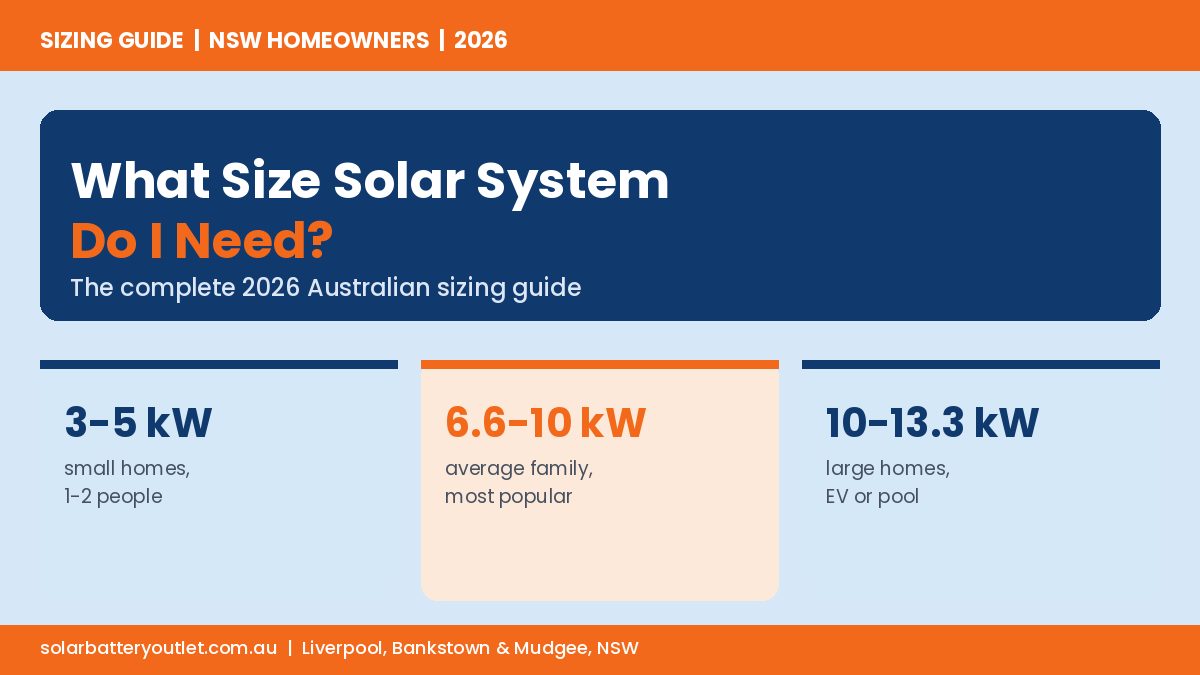
Choosing the right solar system size is one of the biggest decisions a homeowner makes. Go too small, and you will still rely heavily on the grid. Go too big, and you pay for capacity you never use. So, what size actually fits your home?
In 2026, the answer depends on three things: how much electricity you use each day, how much sun your roof receives, and what you plan to add in the next few years. An electric vehicle, a heat pump, or a battery can change the right size dramatically.
This guide walks through the exact formula installers use, a quick sizing table for common household types, real Sydney output data, and the questions to ask before you commit. Whether you are buying your first system or planning to upgrade solar system capacity to support a future battery, the same fundamentals apply.
Start With Your Electricity Bill, Not Your Roof
The most reliable starting point is your actual electricity usage, not roof size or budget. Your bill shows total kilowatt-hours (kWh) used over the billing period. Divide that figure by the number of days to get your daily average.
Most Australian households use between 12 and 30 kWh per day. Smaller, energy-efficient homes sit at the lower end. Larger households, or homes with a pool, electric hot water, or an EV, sit much higher. If possible, use a full 12-month average rather than a single quarter, because summer and winter usage can differ by 30 percent or more.
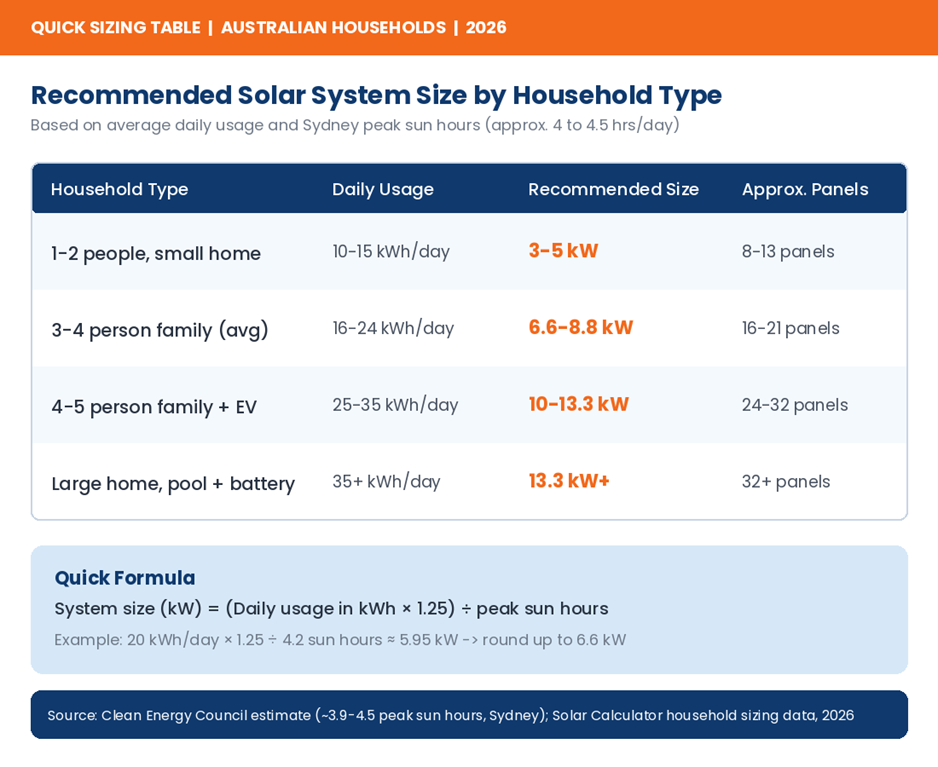
Once you have your daily average, the sizing formula is straightforward. Multiply your daily usage by 1.25 to account for system losses. Then divide by your area’s peak sun hours. The result is your minimum recommended system size in kilowatts.
Quick Sizing Table for Common Australian Households
Every home is different, but these ranges give a solid starting point. They reflect typical Sydney conditions, where peak sun hours average around 3.9 to 4.5 hours per day, slightly lower than Brisbane or Perth.
Why 6.6kW Remains the Most Popular Choice in 2026
A 6.6kW system has been Australia’s most common residential install for several years, and 2026 is no exception. It suits most three to four-person households, fits comfortably on a standard roof, and strikes a good balance between cost and output.
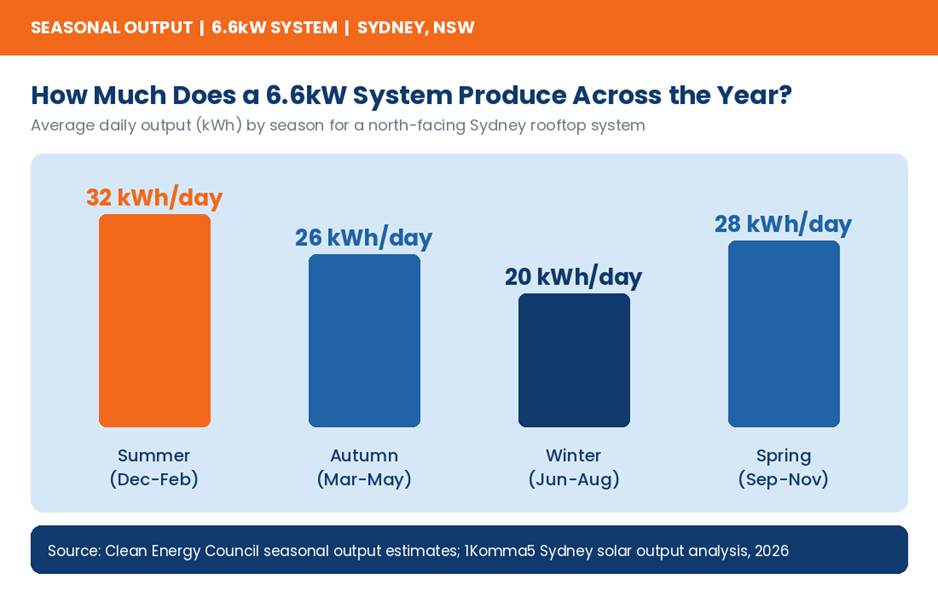
In Sydney, a north-facing 6.6kW system produces roughly 24 to 28 kWh per day on average (add source). Output is higher on long summer days and lower in winter.
When Bigger Makes Sense: EVs, Heat Pumps and Batteries
A common mistake is sizing for today’s usage only. Many households add an electric vehicle, heat pump hot water, or a battery within a few years of installing solar, and then wish their system were larger.
An EV typically adds 8 to 10 kWh per day for an average commute, pushing many households from the 6.6kW range into 8.8kW or 10kW territory. Heat pump hot water adds a smaller but steady load, often 2 to 4 kWh per day.
If you are planning to add a battery later, oversizing your solar array slightly now gives the battery more surplus midday energy to store. Households exploring solar battery Liverpool options, for example, may find that a larger solar array gives a 10kWh battery more surplus to store, which can improve the value of the battery, simply because there is more excess solar to redirect into storage rather than exporting it for a low feed-in tariff.
Roof Space, Orientation and the 13.3kW Ceiling
Each modern panel needs around 1.7 square metres of roof space. A 6.6kW system needs roughly 16 to 17 panels, while a 10kW system needs around 24 panels. Most homes have enough roof area, but orientation matters more than total space.
North-facing panels produce the most energy in Australia. East and west-facing arrays produce 15 to 20 percent less, but splitting panels across both sides of a dual-pitch roof can smooth your generation curve across the day, which is useful if you use more power in the morning and evening.
If your household needs more than 6.6kW, the next decision is whether to upgrade to three-phase power, which opens access to larger single inverters above 10kW, your local network (Ausgrid, Endeavour or Essential) sets limits on how much inverter capacity and export a single-phase home can have, so your installer will check this. An SAA-accredited installer should also confirm your switchboard capacity before recommending a larger system.
A Simple Framework for Choosing Your System Size
Use these four steps before requesting quotes. Each step takes only a few minutes and helps you compare installer recommendations with confidence.
- Calculate your baseline. Use your 12-month average daily usage, not a single bill.
- Apply the formula. Multiply by 1.25, then divide by your area’s peak sun hours.
- Add future loads. Factor in an EV, heat pump, or battery you may add within five years.
- Round to a standard size. Most installers offer set sizes like 5kW, 6.6kW, 8.8kW, 10kW, or 13.3kW.
Frequently Asked Questions
Yes, for most three- to four-person households using 16 to 24 kWh per day, a 6.6kW system comfortably covers daytime usage and offers reasonable winter output. Households planning a battery or EV often choose 8.8kW or 10kW instead.
With standard 400W to 440W panels, a 10kW system typically needs around 23 to 25 panels, requiring approximately 39 to 43 square metres of roof space, depending on the exact panel wattage chosen.
Yes, and it is often recommended. A larger solar array generates more midday surplus, which a future battery can store and use overnight, improving the overall value of both the solar and battery investment.
Yes. East or west-facing roofs produce 15 to 20 percent less than north-facing roofs. If your roof is not north-facing, you may need to size up slightly to reach the same daily output as the sizing table suggests.
Not Sure What Size Is Right for Your Home?
Every roof, household, and energy bill is different. Our team can review your last 12 months of usage, check your roof’s orientation and shading, and recommend a system size that fits your home today and your plans for the next five years — whether that means your first solar install or a plan to upgrade solar system capacity for a future battery.
Call us on 1800 000 777 or visit solarbatteryoutlet.com.au for a free, no-obligation sizing assessment.
Disclaimer: The figures, savings estimates, system sizes, battery capacities, payback periods, and rebate amounts mentioned in this article are provided as illustrative examples only and are not a guarantee of future performance or savings. Actual outcomes vary depending on your location, electricity usage, tariff, solar generation, battery configuration, eligibility for government incentives, and other household-specific factors. Please seek personalised advice before making a purchasing decision.
