
If you’ve ever heard someone say solar batteries are useless in winter, this article is for you. It’s one of the most common misconceptions in Australian solar circles—and it’s costing homeowners real money.
The short answer is: yes, a solar battery still helps in winter. But the ‘how much’ depends on your home, your usage, and how well you configure your system. This guide gives you the full picture—including real data, illustrative savings examples, a 5-step optimisation framework, and honest caveats.
What Actually Happens to Solar in the Australian Winter?
First, let’s separate myth from fact. Solar panels in Australia do not stop working in winter. They produce less energy — but not by as much as many people assume.
According to BrightFuture Energy’s seasonal performance data, a 6.6kW rooftop system in Sydney can generate around 26 kWh on a sunny summer day, while mid-winter days typically yield 16–20 kWh—roughly 60–70% of summer output. That’s still a meaningful amount of energy.
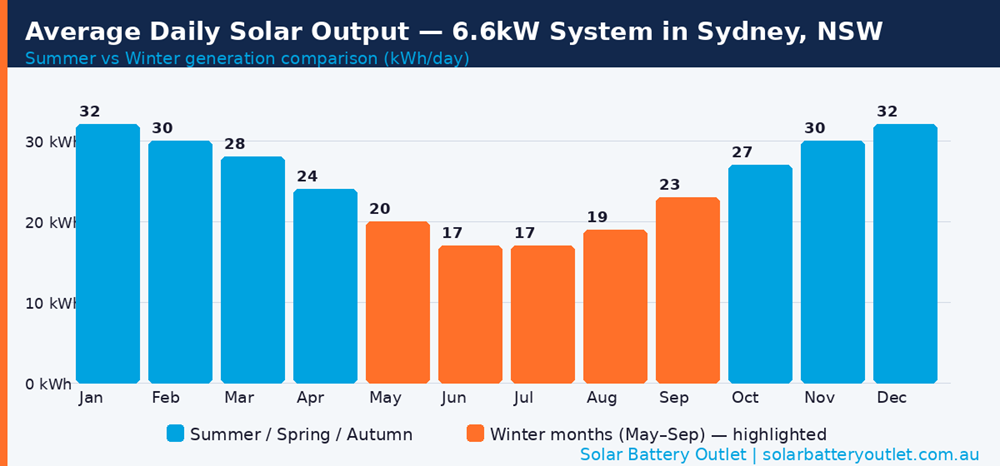
The dip happens for three main reasons. First, days are shorter — the solar production window in NSW narrows from roughly 10 am–4 pm in summer to 11 am–2 pm in June. Second, the sun sits lower in the sky, reducing the angle of incidence on your panels. Third, cloud cover increases, though overcast days in NSW still allow panels to generate at 10–40% capacity.
Here’s the key insight most people miss: cool temperatures actually improve panel efficiency. Solar panels lose roughly 0.3–0.5% efficiency per degree above 25°C. So while your system generates fewer kWh in winter due to fewer daylight hours, each kWh it does generate is produced at slightly better conversion efficiency than on a scorching 38°C summer afternoon.
The Real Question: What Does a Battery Actually Do in Winter?
A solar battery doesn’t generate electricity — it stores it. This distinction is critical when thinking about winter performance. Your panels still collect energy during the day (just a bit less of it). Your battery stores that energy and releases it in the evening, when the sun has gone down and your heating, lighting, and appliances kick in.
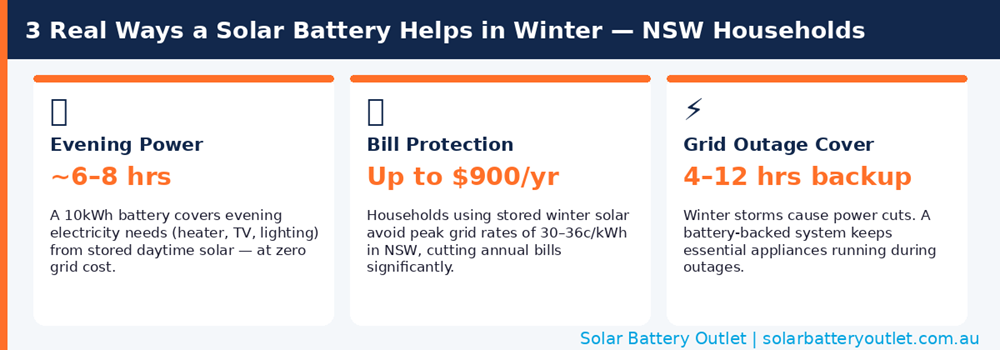
In winter, this storage function becomes more valuable, not less. Here’s why: Australian winters bring higher evening electricity demand (heating, longer nights, cooking earlier) paired with higher peak electricity prices. In NSW, peak grid rates run at 30–36 cents per kWh during evening shoulder and peak periods.
Example: A Sydney Family in Bankstown
Take a family of four in Bankstown (this is an illustrative example, not a real customer). They use around 22 kWh per day in winter — more than the summer average of 18 kWh due to electric heating. Their 10kWh battery (a BYD HVS or Tesla Powerwall 3) charges to around 7–8 kWh on a typical winter day, covering their 5 pm–10 pm peak usage almost entirely. Instead of paying 33c/kWh from the grid, they use stored solar. The only thing they give up is the small feed-in credit they would have earned by exporting it..
Over a winter quarter (90 days), that’s roughly 630–720 kWh of avoided grid electricity — worth $208–$238 in bill savings from winter alone. Scale that across the full year with summer performance included, and the total saving potential reaches $900–$1,100 per year for a well-sized battery setup. These are illustrative estimates — actual outcomes depend on your tariff, usage pattern, and system configuration.
Where Batteries Shine in Winter — and Where They Fall Short
Battery Adds the Most Winter Value
- Evening heating loads: If you run reverse-cycle air conditioning or an electric heat pump for heating, the battery covers this load without touching grid electricity.
- Grid outage protection: Winter storms in NSW, particularly in areas like Liverpool, Bankstown, and Mudgee, cause power cuts. If your system is set up for backup, a battery can keep some essentials running during an outage. How long depends on battery size, charge level and what you run. Not every battery setup provides backup, ask us which setups can.
- Time-of-Use tariff arbitrage: Households on TOU tariffs can benefit. The battery charges from solar (or cheaper off-peak power) and discharges during the 5–9 pm peak. The saving per kWh is the peak rate minus what that kWh cost you to charge, less some charging losses.
- Virtual Power Plant (VPP) earnings: Under the NSW Peak Demand Reduction Scheme, households who connect an eligible battery to an approved Virtual Power Plant (VPP) may receive a one-off upfront incentive. The incentive amount varies depending on battery capacity and other factors. Some VPP providers may also offer additional ongoing credits or payments, which vary by provider, which happen more frequently in winter cold snaps.
Winter Does Limit Battery Performance
- Smaller charge window: With only 3–4 peak solar hours in June–July (vs 6–7 in summer), a large 20kWh+ battery may not reach full charge on overcast winter days.
- Sequential cloudy days: Extended cloudy periods (3+ days) can exhaust battery reserves and force a switch to grid power — though this is uncommon in most of NSW.
- Oversized batteries in small homes: A 13.5kWh battery in a home that only uses 14kWh per day will cycle less efficiently in winter when charge input drops.
| Pro Tip from Solar Battery Outlet: In winter, we recommend setting your battery’s target charge window to 10 am–2 pm — the narrower NSW solar peak. |
Solar Battery ROI in Winter: The Numbers NSW Homeowners Need
One of the most common questions from NSW homeowners is: does the ROI calculation change in winter? The answer is: not significantly — and here’s why.
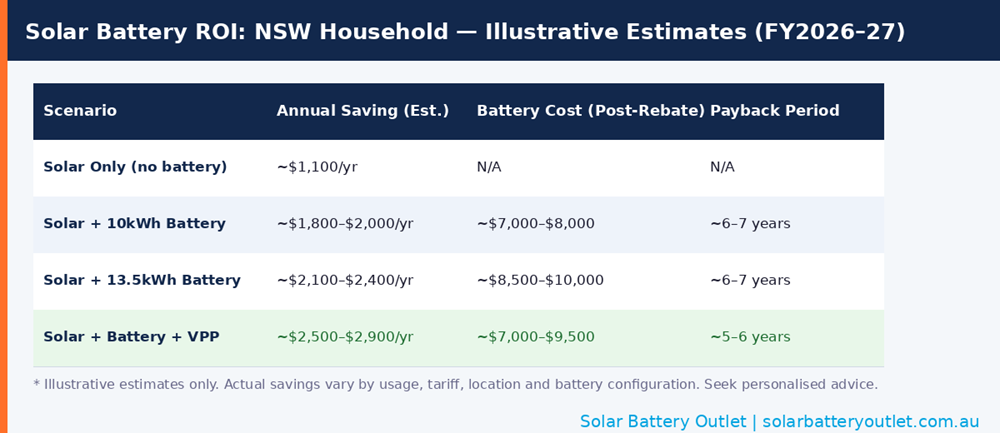
Your battery’s ROI is calculated over its full 10–15 year lifespan. Winter months contribute proportionally less solar income but proportionally more grid bill savings (because evening usage and peak prices are higher). These effects partially cancel each other out. The overall annual saving figure remains robust even with winter’s reduced generation.
Popular batteries such as the Tesla Powerwall 3, BYD HVS and Sungrow SBH work well in NSW winter conditions. Some energy is always lost when charging and discharging — check the round-trip efficiency on each product’s datasheet. LFP batteries generally handle mild cool weather well, but charging can slow near freezing.
The Cheaper Home Batteries Program (launched July 2025) gives an upfront discount on eligible batteries. For a 10kWh usable battery it is currently about $2,500, based on the STC rate on the day. This significantly improves winter-adjusted payback periods across all NSW regions.
The 5-Step Winter Battery Optimisation Framework
If you already have a solar battery installed — or you’re about to have one installed by the best solar battery installer in your area — use this framework to maximise your winter output.
Step 1 — Set your charge window: Check your battery app settings so the battery charges from your midday solar surplus. Ask your installer what settings suit your system.
Step 2 — Adjust your reserve percentage: In summer, a 10–15% battery reserve is standard. In winter, you may want to lift this to 20–30% so you keep some stored power for early mornings — and, if your system is set up for backup, for outages. This setting takes 60 seconds to change.
Step 3 — Switch to a Time-of-Use tariff: If you’re on a flat-rate tariff, compare it with a Time-of-Use plan on Energy Made Easy. TOU can save money if your battery covers the evening peak, but it can cost more if you use a lot of peak power. Your battery discharging during the 5–9 pm peak is usually your biggest saving lever.
Step 4 — Join a NSW Virtual Power Plant: Under the NSW Peak Demand Reduction Scheme, households who connect an eligible battery to an approved Virtual Power Plant (VPP) may receive a one-off upfront incentive. The incentive amount varies depending on battery capacity and other factors. Some VPP providers may also offer additional ongoing credits or payments, which vary by provider and sharing stored energy during demand events. Winter cold snaps are prime VPP activation windows. You stay in control — the VPP takes a small, brief amount of stored energy during events.
Step 5 — Book a pre-winter panel inspection: A dirty or partially shaded panel can reduce your winter output by 5–10% — amplifying the seasonal dip. Book a solar panel cleaning and health check before May each year. This is especially important in areas like Bankstown and Mudgee, where dust and bird activity are common.
Who Benefits Most From a Battery in Winter? A Quick Diagnostic
Not every NSW household gets the same winter value from a battery. Use these four profile questions to gauge your likely benefit:
- Evening-heavy household: If 60%+ of your electricity use happens after 4 pm, you will see strong winter battery savings regardless of generation dip. Shift workers, families with kids, and work-from-home households that heat and cook in the evening all fall into this category.
- Electric heating users: If you rely on reverse-cycle air conditioning or a heat pump for winter heating, your 5–9 pm load is substantial. A 10kWh+ battery can cover a good part of this load on sunny winter days.
- Homes with existing solar (5kW+): Larger solar systems generate more in winter, giving the battery more to work with. If you have a 6.6kW+ system, a battery is a natural complement even through June–August.
- Homes on poor feed-in tariffs: Many NSW solar households receive feed-in tariffs of only a few cents per kWh for exported electricity. IPART’s 2026-27 benchmark range is 3.4 to 6.5 c/kWh, although actual retailer rates vary. Exporting surplus winter solar earns almost nothing. Using stored solar in the evening is worth several times more per kWh than exporting it.
The National Picture: Why Australians Are Installing Batteries Year-Round
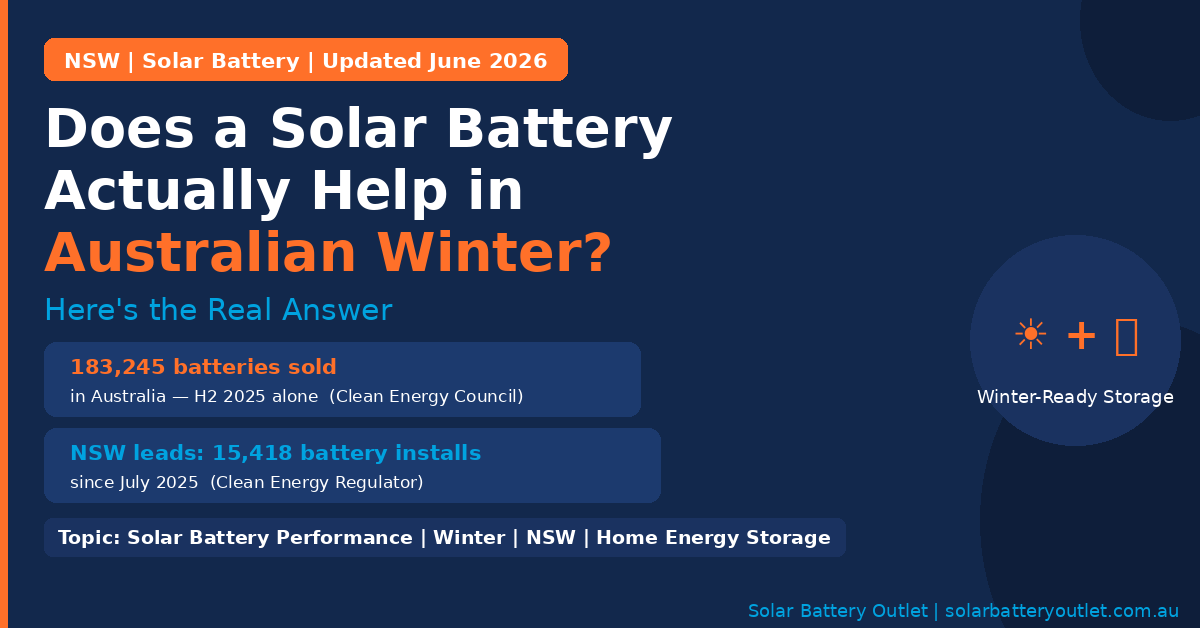
The scale of Australia’s battery adoption in 2025–26 makes clear that winter concerns aren’t stopping the market. The Clean Energy Council reported a record 183,245 batteries sold in Australia in H2 2025 alone, more than the previous four years combined. NSW recorded 15,418 battery installations by the end of August 2025, according to data released by the Clean Energy Regulator. Australians continued installing batteries through winter because of their year-round value.
Average battery size in NSW reached 19.6 kWh. The Clean Energy Council also notes that participation in a Virtual Power Plant (VPP) may provide additional benefits, with ACCC analysis showing VPP customers achieved average quarterly bill savings around $106 higher than comparable customers. Actual benefits vary by provider and household.
| Not Sure If a Battery Is Worth It This Winter? Let’s Run the Numbers. Solar Battery Outlet provides free, no-obligation assessments for NSW homeowners in Liverpool, Bankstown, Mudgee, and surrounding areas. We look at your actual bills, your solar system’s winter performance data, and your evening usage profile — then give you an honest answer on whether a battery makes financial sense for your home, winter included. Call us: 1800 000 777 | Get a Free Quote at solarbatteryoutlet.com.au |
Frequently Asked Questions
Yes — it charges, just at a reduced rate. Overcast days in NSW still allow solar panels to generate at 10–40% of peak capacity, depending on cloud density. On a typical cloudy winter day in Sydney, a 6.6kW system might generate 6–10 kWh rather than 17–20 kWh. A 10kWh battery would reach 60–100% charge on most winter days in NSW. Extended overcast periods of 3+ consecutive days are uncommon across most of the state.
This depends on your battery capacity and your heater’s power draw. A reverse-cycle air conditioner in heating mode typically draws 1–3 kW. A 10kWh battery at 90% usable capacity can run a 2kW heater for approximately 4.5 hours — covering the 5 pm–9 pm evening peak. For larger homes using higher-output heating, a 13.5kWh+ battery provides more comfortable headroom.
Installing before winter is generally a sound strategy — you’ll capture the June–August storage savings from the moment installation is complete. The Cheaper Home Batteries Program federal rebate applies regardless of installation season. Speak to a qualified installer who will review your system’s performance data to confirm sizing. Homeowners in the Solar Battery Bankstown area and surrounding suburbs can contact Solar Battery Outlet for a no-obligation winter assessment.
Modern lithium iron phosphate (LFP) batteries — including the popular solar batteries BYD HVS, Sungrow SBH, and Tesla Powerwall 3 work well in NSW winter conditions (typically 5–18°C in NSW). Unlike some older lithium-ion chemistries, LFP batteries do not significantly degrade in cold weather. The main winter variable is solar generation input, not battery chemistry performance.
