

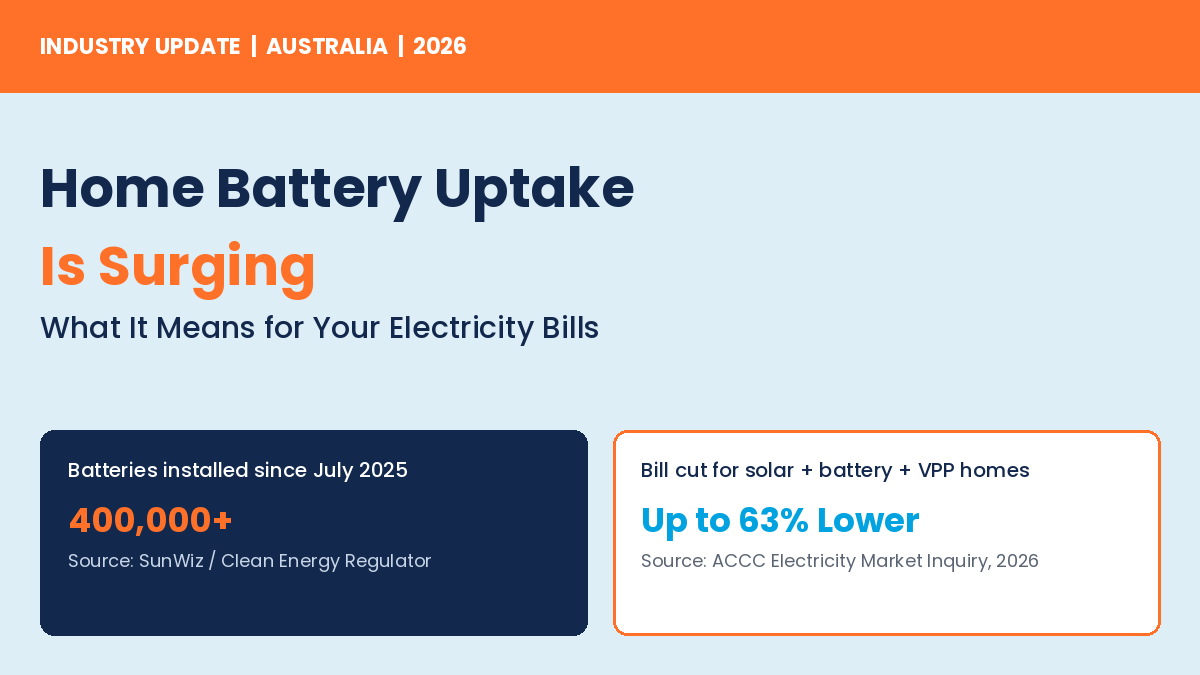
Home battery uptake in Australia is no longer a niche trend among early adopters. It has turned into a mainstream shift in how households manage power. In just under a year, hundreds of thousands of homes have added battery storage to their existing solar systems, largely thanks to the federal Cheaper Home Batteries Program. For homeowners across NSW, this surge raises a practical question: what does it actually mean for your electricity bill?
This article breaks down the latest uptake data, unpacks what is driving it, and offers a simple framework to help you decide whether now is the right time to invest in solar batteries for your own home.
Australia’s Home Battery Boom, By the Numbers
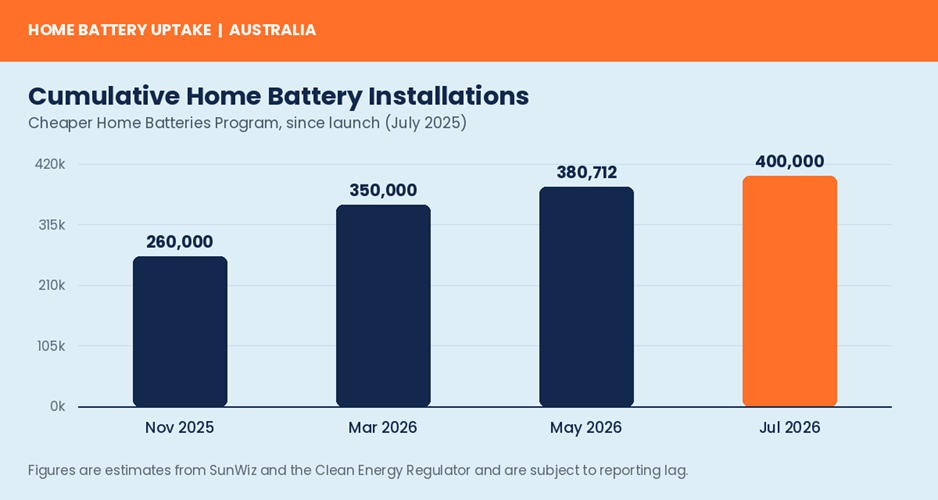
Since the Cheaper Home Batteries Program launched in July 2025, uptake has moved from steady to remarkable. More than 260,000 households, businesses, and organisations installed a battery within the program’s first ten months, and daily installation rates climbed from a few hundred to well over a thousand. By May 2026, the total reached 380,712 systems, representing 10.7 GWh of storage capacity, according to Minister for Climate Change and Energy Chris Bowen. Analyst SunWiz now projects the country will pass 400,000 installations before the end of 2026, with total capacity climbing toward 11.2 GWh.
To put that growth in perspective, look at the chart below. Installations moved from roughly 260,000 in late 2025 to more than 380,000 just six months later, a pace that has genuinely surprised policymakers. Uptake has already outpaced the government’s own electric vehicle tax discount, and demand shows no sign of slowing, even as the rebate steps down twice a year through to 2030.
Why Everyone Is Suddenly Talking About Home Batteries
Three forces are driving this surge together, and each one is worth understanding on its own.
First, the economics changed. The Cheaper Home Batteries Program discounts around 30 percent off the upfront cost of eligible battery systems between 5kWh and 100kWh, through small-scale technology certificates. That single change turned batteries from a luxury upgrade into a realistic purchase for far more households.
Second, electricity prices kept climbing. Time-of-use tariffs now charge many NSW households 40 to 55 cents per kWh during the 3pm to 9pm peak window, exactly when families get home, cook dinner, and run the air conditioning. A battery lets you store cheap daytime solar and use it instead of buying expensive peak-rate power later.
Third, feed-in tariffs kept falling. Exporting solar power back to the grid in NSW now earns most households only 3 to 10 cents per kWh, well below what that same power is worth if you store it and use it yourself. That widening gap is pushing more solar owners toward storage rather than simply exporting their surplus.
Together, these shifts explain why uptake has moved from early-adopter territory into the mainstream, and why it is translating into measurable bill savings for the households that made the switch.
What Rising Battery Uptake Means for Your Electricity Bill
This is the part that matters most to homeowners. According to the Australian Competition and Consumer Commission’s latest Electricity Market Inquiry report, households with solar and battery systems paid electricity bills between roughly $329 and $909 lower over a year compared with customers relying on grid electricity alone, a saving of 20 to 52 percent. Homes that went a step further and joined a virtual power plant did even better, saving between $762 and $1,093 a year, or 57 to 63 percent, with roughly 24 percent of solar-and-battery customers now taking part in a VPP.
The chart below shows how these three scenarios stack up against each other.
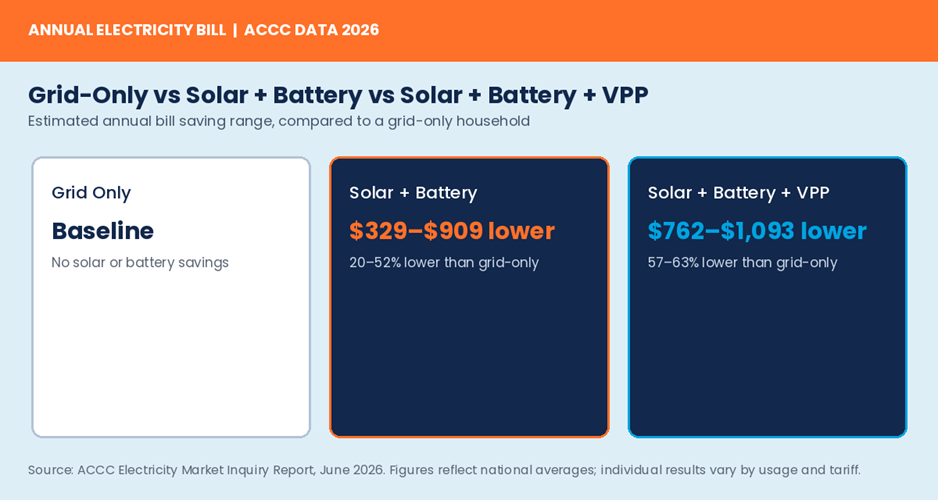
Consider a hypothetical example. A family in Western Sydney on a standard time-of-use tariff, paying around $2,000 a year for grid electricity, could realistically bring that down toward the $1,100 to $1,670 range once solar and a battery are added, based on the ACCC’s published figures. Joining a VPP on top of that could push savings further still. Actual results always depend on your usage pattern, tariff, and battery size, but the direction is now well established.
The NSW Angle: Higher Prices, Bigger Savings
NSW households have a particular stake in this trend. The state has some of the highest electricity prices in the country, and NSW Government figures show around 13,000 new batteries are now being installed across the state every month, on top of the more than half of NSW houses that already have solar. That combination of high prices and fast uptake means NSW is where the bill-saving case for storage is strongest.
The NSW Government has backed this shift with its own incentives. The Peak Demand Reduction Scheme supports Virtual Power Plant participation, and the newer Home Energy Saver program adds an interest-free loan of up to $15,000, alongside discounts of up to $4,000 for eligible households upgrading their home energy setup. If you are weighing up whether to move quickly, our guide on whether to rush a solar battery before the rebate drops walks through the exact questions to ask before booking an installer.
A 4-Step Framework: Should You Add a Battery Now?
With uptake this high, it helps to have a clear, unemotional way to decide whether a battery makes sense for your home right now, rather than reacting to marketing pressure.
- Step 1 — Check your evening usage. Pull up your last 12 months of bills and see how much power you use after 3pm. Batteries deliver the most value to households that use most of their electricity in the evening, after solar stops generating.
- Step 2 — Confirm your solar is performing well. A battery only stores what your panels generate. If your system is more than 10 years old or under-performing, get a health check before adding storage.
- Step 3 — Size for your actual usage, not the biggest option available. The rebate is now tiered, so a right-sized 10 to 13kWh system paired with existing solar typically sits in the value sweet spot for most homes.
- Step 4 — Compare at least three written quotes and check installer accreditation. Confirm the rebate appears as a dollar figure on the quote itself, and verify the installer’s SAA accreditation before signing anything.
What This Means for Liverpool, Bankstown, and Mudgee Homeowners
If you live across Liverpool, Bankstown, or Mudgee, this national surge is playing out locally too. Solar Battery Outlet has watched local demand for solar batteries climb alongside the national numbers, with more households asking about right-sized systems, VPP participation, and how to stack the federal rebate with NSW incentives. Homeowners exploring solar battery Liverpool options are increasingly asking the same question this article set out to answer: not whether to get a battery, but how to size and time it correctly for their home. Our recent postcode guide on rebates across Liverpool, Bankstown, and Mudgee breaks down what is available suburb by suburb.
Frequently Asked Questions
More than 400,000 home battery systems have been installed across Australia since the Cheaper Home Batteries Program launched in July 2025, representing well over 11 GWh of storage capacity, according to SunWiz and Clean Energy Regulator data current as of mid-2026.
The ACCC’s Electricity Market Inquiry found households with solar and battery systems saved between $329 and $909 a year (20 to 52 percent) compared with grid-only customers, rising to $762 to $1,093 (57 to 63 percent) for households also participating in a virtual power plant.
Yes. NSW electricity prices remain among the highest in Australia, and the federal rebate, while tapering gradually every six months through 2030, still covers around 30 percent of the upfront cost for eligible systems, alongside state incentives like the Peak Demand Reduction Scheme.
Most NSW homes fall into the 10 to 13kWh sweet spot, since the rebate structure applies the strongest support up to 14kWh of usable capacity, with reduced support above that threshold.
No, but it helps. Even standalone solar-and-battery homes save materially on bills, while VPP participation adds further savings by earning payments for sharing stored power with the grid during peak demand periods.
Wondering What Your Own Bill Could Look Like?
Solar Battery Outlet offers free, no-obligation quotes for homeowners across Liverpool, Bankstown, and Mudgee. We will check your solar performance, review your usage, and tell you honestly whether a battery, and which size, makes sense for your home. Call 1800 000 777 or visit solarbatteryoutlet.com.au to get started.
Disclaimer
This article is general information only and does not constitute financial, legal, or personalised energy advice. Statistics on installation numbers, capacity, and bill savings are sourced from government and industry reports current as of July 2026 and reflect national or state averages; individual results depend on your electricity usage, tariff, solar system size, and battery specifications, and are not guaranteed. Rebate amounts and eligibility rules referenced in this article are subject to change under the Cheaper Home Batteries Program and NSW Government schemes, so always confirm current rates with the relevant government agency before purchasing. Always seek personalised advice before making a purchasing decision.
