
If the power drops out tonight across Liverpool, Bankstown or Mudgee, your fridge, your WiFi and your lights will not care how big your solar system is. They will only care which circuits your battery is actually wired to protect. That single wiring decision is the real difference between essential-circuit backup and whole-home backup, and it is one that many homeowners only discover after the blackout has already started.
Choosing between the two is not just a budget question. It determines what stays on, for how long, and whether the solar batteries NSW households have already invested in can actually deliver blackout protection when the grid fails, rather than sitting there fully charged but disconnected because the backup pathway was never wired in.
How Often Do NSW Homes Actually Lose Power?
Before sizing a battery, it helps to understand what you are planning for. Reliability data from the Australian Energy Regulator provides a useful benchmark. Excluding major storm and bushfire event days, Ausgrid customers in Sydney and the Hunter experience about 75 minutes of outages each year on average.
Endeavour Energy customers across Greater Western and South Sydney experience about 90 minutes of outages annually. Essential Energy serves many regional areas, including Mudgee. These customers often face longer restoration times because of long rural feeder lines and lower customer density.
Those averages exclude the events that actually put backup power to the test. The NSW Parliament’s inquiry into the 2025 Far West power outage examined a disruption that left communities without reliable supply for around two weeks, prompting reviews by IPART and the Australian Energy Regulator into whether network obligations were met. Ausgrid’s own Guaranteed Service Level scheme sets its compensation threshold at roughly 20 cumulative hours off supply or 10 separate interruptions in a financial year, which tells you something useful: the network itself treats that level of disruption as abnormal, not routine.
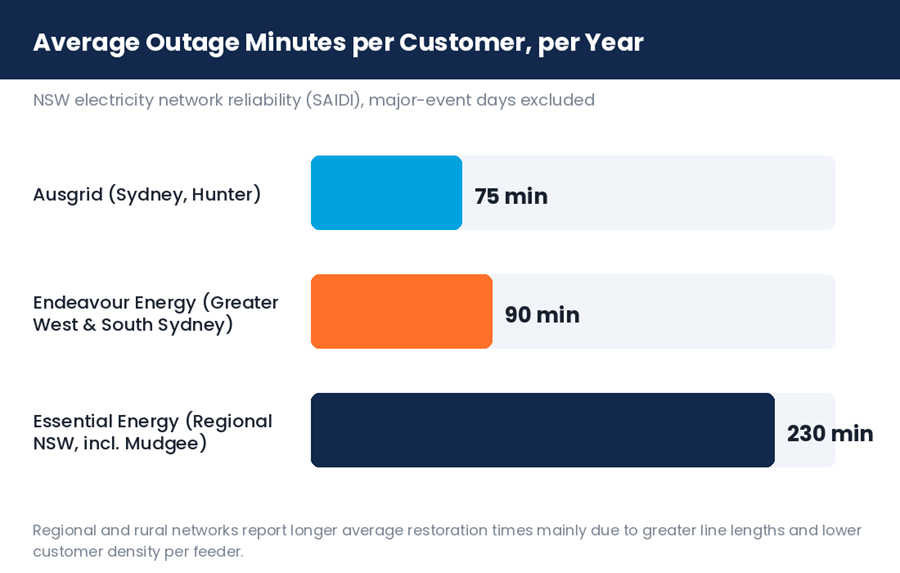
The practical takeaway is straightforward. Most NSW blackouts are short, weather-driven events measured in minutes to a few hours. Multi-day, multi-week disruptions happen, but they cluster around declared storm, flood or bushfire events, and mostly in regional and rural areas. That distinction should drive your backup decision far more than a generic size recommendation ever will.
Essential Circuits Backup — What It Covers and What It Costs
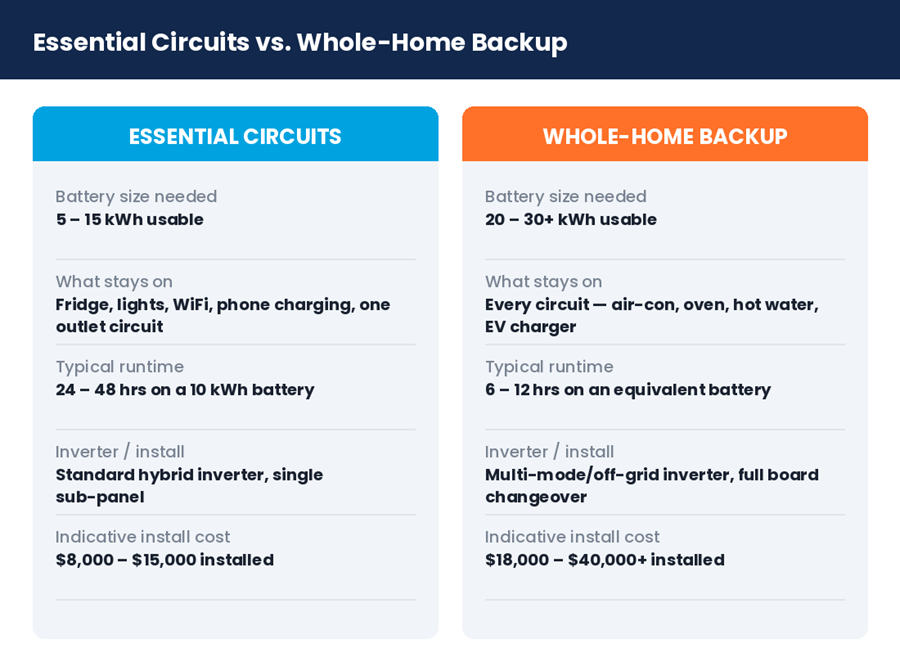
Essential-circuit backup, sometimes called partial-home backup, sends power from your battery to a dedicated sub-panel. This sub-panel is wired to a short list of critical circuits. These usually include the fridge, general lighting, the WiFi router and modem, phone chargers, and often one bedroom or living area circuit.
Everything else on your switchboard remains connected to grid power. This includes ducted air-conditioning, the oven, and the hot water system. During a power outage, these circuits simply go offline.
Because the load is small and predictable, most homes only need 5 to 15 kWh of usable battery capacity to run essential circuits for 24 to 48 hours, and installation stays relatively simple: a standard hybrid inverter and one sub-panel, rather than a full switchboard changeover. Installed cost for a genuinely backup-capable essential-circuit setup typically lands between $8,000 and $15,000 in NSW, before any rebate. If you are timing an install around the current federal battery rebate step-down, our breakdown of whether it’s worth rushing before the rebate drops walks through exactly how much a few months’ delay can cost.
“The mistake we see most often is homeowners assuming that any battery automatically backs up the whole house,” says a Solar Battery Outlet accredited electrician. “Unless the essential-circuit or whole-home pathway is specified during installation, a fully charged battery may not power your home. The switchboard must be wired correctly to transfer selected loads during an outage.”
Whole-Home Backup — What It Covers and What It Costs
Whole-home backup keeps every circuit in the house running during an outage, air-conditioning, the electric oven, hot water, and an EV charger. To do that safely, you need a multi-mode or off-grid-capable inverter and a full switchboard changeover, not just a sub-panel.
The trade-off is capacity versus runtime. Air-conditioning and electric hot water are large, spiky loads. Whole-home systems usually need 20 to 30 kWh or more of usable battery storage.
Installed costs typically range from $18,000 to $40,000 or more. The final price depends on the inverter class and the number of battery units required. Battery capacity also lasts for a much shorter time under a whole-home load. A battery that could power essential circuits for one or two days might run a full house, including air-conditioning, for only six to twelve hours.
Which One Actually Matches an NSW Blackout?
Matching the setup to the outage pattern, not the marketing brochure, is where most homeowners get this decision wrong. Given that the majority of NSW outages resolve within a few hours, essential-circuit backup is the more realistic fit for solar batteries NSW households in Ausgrid and Endeavour Energy areas, where restoration is usually fast. It protects the things that genuinely matter in a short outage: food safety, connectivity, and light.
Whole-home backup earns its higher cost in specific situations. It suits bushfire-prone or storm-exposed regional properties with less reliable power lines. It may also suit households that use medical equipment. A battery should never be your only plan for life support — register as a life support customer with your retailer and talk to your doctor about a backup plan.
Some homeowners simply value comfort during a power outage more than the higher upfront cost. Outside these situations, many homes end up paying for battery capacity they rarely use.
The 4-Step Framework to Choose Your Backup Setup
Work through these four steps with your installer before you commit to a battery size or inverter class.
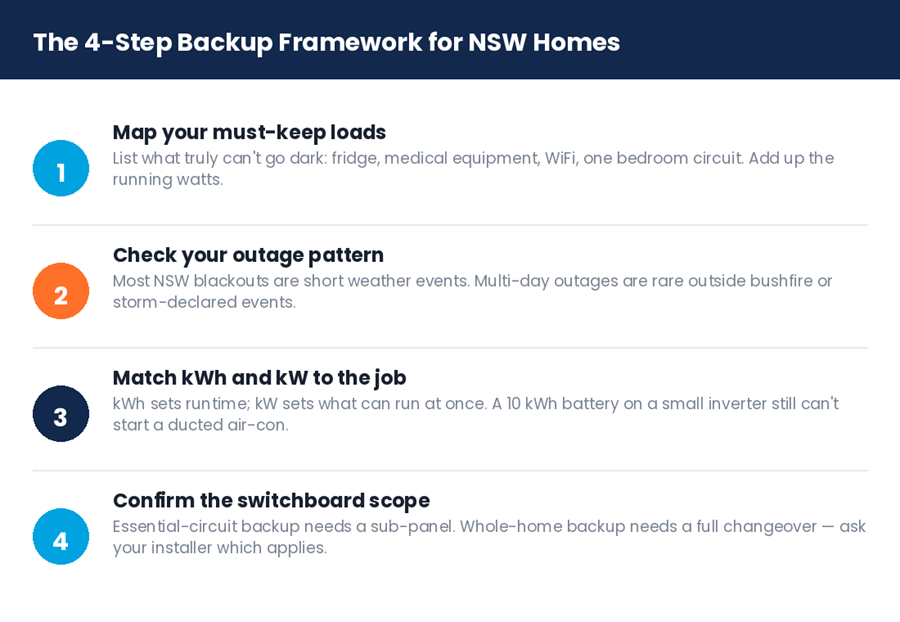
Steps-
one is mapping your must-keep loads in actual watts, not guesswork, because that number decides everything downstream.
Two means checking your own outage history and your network’s published reliability figures, rather than assuming every blackout will be a repeat of the worst storm you have heard about.
Three is matching both kWh and kW to the job: kWh determines how long the battery lasts, while kW determines what it can actually start and run at the same moment, including surge loads like a compressor kicking in.
Four is confirming the switchboard scope with your installer in writing, because essential-circuit and whole-home backup require different wiring, and retrofitting the difference later is more expensive than specifying it correctly the first time.
Example: Sizing Backup for a Bankstown Family Home
Consider a four-person household in Bankstown. The home runs a fridge, lighting, WiFi, phone charging, and a home office setup. Together, these appliances draw about 800 to 1,000 watts while running, or around 300 to 400 watts on average across the day.
At that average, a 10 kWh usable battery may provide around 24 hours of essential-circuit backup. At a steady 1,000 watts, it would last about 10 hours. That is enough to cover most outages experienced by Ausgrid customers in the area.
The same family could add a 6 kW solar array. On a sunny day during a daytime outage, the system may generate around 20 to 28 kWh of energy. That energy can recharge the battery even while it is powering essential circuits. As a result, essential-circuit backup can continue for several consecutive days. In many cases, this happens without the need for whole-home battery capacity. A formal load assessment should model this scenario before you sign anything.
Common Mistakes That Leave NSW Homes in the Dark Anyway
- Assuming any battery equals automatic backup, without confirming the backup pathway is wired at install.
- Sizing for kWh alone and ignoring kW, so the inverter cannot start a compressor or pump even with charge to spare.
- Skipping a surge-load check on motors like air-conditioning compressors and pool or sump pumps, which draw two to three times their running wattage on startup.
- Forgetting that battery-only backup, without solar recharge, is a fixed pool of energy that runs out and stays out until the grid returns.
- Never testing the backup switchover after installation, so the first time it is needed is also the first time anyone finds out it does not work.
Not sure whether your setup needs essential circuits or whole-home backup? Talk to us first.
We assess essential-circuit and whole-home backup for NSW homeowners across Liverpool, Bankstown and Mudgee, based on your actual usage, your network’s outage history, and your switchboard, not a generic size chart. Call 1800 000 777 or visit solarbatteryoutlet.com.au for a free, no-obligation assessment.
Frequently Asked Questions
Essential-circuit backup powers a short list of critical loads, such as the fridge, lighting, WiFi and phone charging, through a dedicated sub-panel, while whole-home backup powers every circuit in the house, including air-conditioning and hot water, through a full switchboard changeover and a much larger battery.
In many cases, you can upgrade later if the original inverter supports backup power and future expansion. However, you should plan the switchboard rewiring and any additional battery units with your installer in advance. Retrofitting a full changeover later usually costs more than specifying it during the initial installation.
Not always. Essential-circuit backup usually needs a backup sub-panel, and whole-home backup usually needs a full switchboard changeover. Some older switchboards also need an upgrade first. Your installer will check this on site and show any switchboard work on your quote.
Whole-home backup can be worthwhile because regional networks such as Essential Energy often take longer to restore power than metropolitan networks. Households in fire-prone or storm-exposed areas may face extended outages. Homes that rely on medical equipment requiring guaranteed climate control also benefit the most. These situations provide the clearest justification for the higher cost of whole-home backup.
Disclaimer
This article is general information only and does not constitute a formal load assessment, electrical design, or financial advice. Battery sizes, runtimes and costs quoted are indicative ranges drawn from current published Australian industry data and typical NSW installations; your actual backup capacity, runtime and installed cost will depend on your home’s wiring, switchboard, usage patterns and the inverter and battery model chosen, and should be confirmed by a licensed, SAA-accredited installer before you commit to a system. NSW network outage figures are representative averages and vary by location and year. Always seek personalised advice before making a purchasing decision.
