
Summer heat pushes Australian air conditioners into overdrive. Homeowners with solar batteries want a straight answer. How long will stored power actually keep the air conditioner running? It depends on two things: your battery’s usable capacity, and your air conditioner’s real power draw. Not its marketing number. This guide breaks down the maths. It shares real Australian runtime estimates and a simple sizing framework for your own cooling needs.
What Determines How Long a Solar Battery Can Run an Air Conditioner
Two numbers decide runtime. Your battery’s usable capacity in kWh, and your air conditioner’s input power in kW. Divide the first by the second, and you get hours of runtime. It sounds simple, but most homeowners get the inputs wrong. They quote cooling capacity, say 5kW, instead of electrical input power. Input power sits far lower, thanks to the refrigeration cycle. They also quote nameplate battery capacity, not what it actually delivers after losses. Get both numbers right, and this formula becomes a genuinely useful planning tool. Real-world weather, thermostat settings and insulation will still shift the result slightly. Treat every figure here as an estimate, not a guarantee.
Air Conditioner Power Draw: What the Numbers Actually Look Like
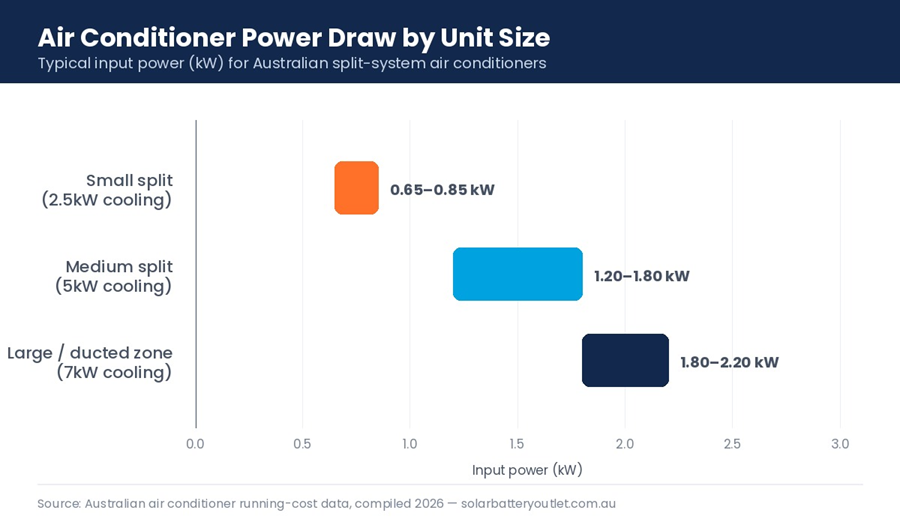
Split-system air conditioners draw far less power than their cooling rating suggests. A small 2.5kW bedroom unit typically pulls around 0.65 to 0.85kW of input power. A mid-size 5kW living-area system draws roughly 1.2 to 1.8kW. Larger 7kW units, or a single zone of a ducted system, sit around 1.8 to 2.2kW. Inverter-style compressors throttle back once a room reaches its target temperature. These figures usually represent the higher end during start-up. They settle lower once the room cools down. Older, non-inverter units tend to sit toward the top of this range throughout. Before calculating runtime, check your unit’s actual input power. Look at the compliance plate, not the cooling capacity in its model name.
From Nameplate to Usable: Why Your Battery Doesn’t Deliver Its Full kWh
Some brands quote total capacity and others quote usable capacity, so always check which one your quote shows. Depth-of-discharge limits typically cap usable energy around 90 to 95% of nameplate capacity. Round-trip efficiency then trims another 5 to 15% of that figure. Energy converts from DC to AC and back through the inverter, and some is lost as heat. Together, these losses mean a 13.5kWh battery often delivers closer to 11 to 12kWh in practice. The Australian Government’s energy.gov.au notes that matching power output to appliance draw matters as much as stored capacity. Ask your installer for usable capacity, not just the nameplate figure, before comparing quotes.
Solar Battery Runtime for Air Conditioners: Real-World Scenarios
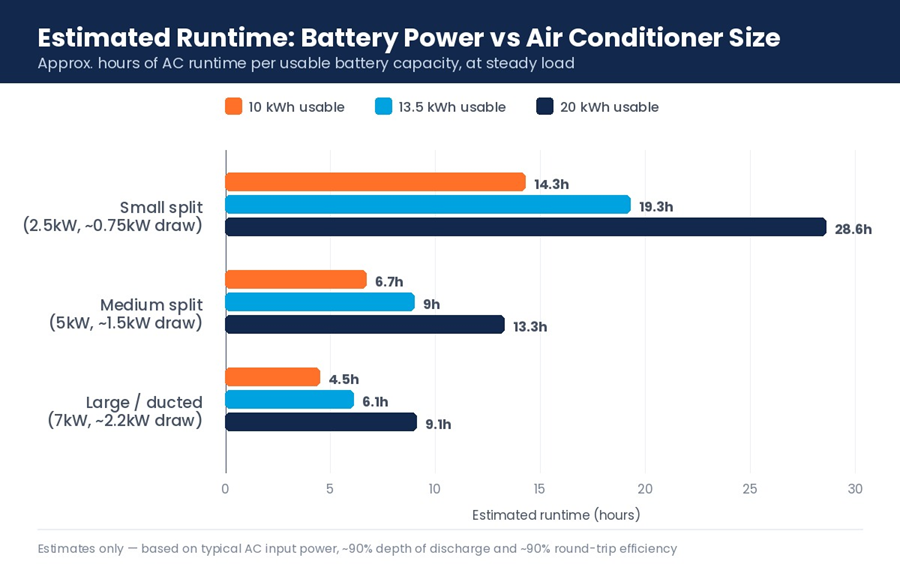
Using the formula above, here’s what runtime looks like in practice. These are common Australian battery and air conditioner combinations. A 10kWh usable battery can run a small bedroom split system for roughly 14 hours. The same battery covers a medium living-area unit for about 7 hours. A large ducted zone runs for around 4.5 hours on that same battery. Step up to a 20kWh usable battery, and these figures roughly double. That’s close to 28 hours for the small unit, and 13 hours for the medium system. The large zone stretches to around 9 hours. These numbers assume the air conditioner runs continuously at its average draw. They also assume no other household loads compete for the same battery. In practice, a fridge, lights and standby appliances draw on that capacity too. Treat these figures as a ceiling, not a guarantee, for your own system.
A 4-Step Framework to Size a Battery for Your Air Conditioner
Work through these four steps before requesting a quote.
- Check your air conditioner’s input power. Look at the compliance plate, not the box.
- Decide your target runtime. Overnight cooling usually means 6 to 10 hours. (In a blackout, air conditioners are often not on backup circuits — ask your installer.)
- Multiply power draw by target hours to get your required usable kWh.
- Add 20 to 30% headroom for other essential loads and normal battery ageing.
A household running a 5kW split system for eight hours overnight needs roughly 12kWh of input energy. Add headroom, and a 15 to 16kWh usable battery becomes a realistic target. This is exactly the conversation a good, accredited installer will walk you through first. Skipping this step is the most common reason homeowners end up with an undersized battery.
Tips to Extend Air Conditioner Runtime on Battery Power
Small habits stretch every stored kWh further. Set the thermostat to 24 to 25°C. Each degree lower can add 5 to 10% to power draw. Close doors to unused rooms so the unit cools less air. Clean filters monthly, because a blocked filter forces the compressor to work harder. Use timer or sleep modes overnight, rather than running at full power until morning. The ACT Government’s Climate Choices program notes that a well-sized battery can run a split-system unit for around five hours on stored power alone. Combine these habits with correct sizing. A well-specified system may cover an evening of cooling with little or no grid power, depending on your usage and the weather.
FAQs
Most 10kWh usable batteries run a small split system for around 14 hours. A medium system runs for about 7 hours, and a large or ducted zone for 4 to 5 hours. This assumes no other loads draw from the battery at the same time.
For eight hours of overnight cooling with a 5kW split system, aim for roughly 15 to 16kWh usable. Allow extra headroom for other household loads.
No. Nameplate capacity is reduced by depth-of-discharge limits and round-trip efficiency losses. Usable energy typically sits 10 to 25% below the number on the spec sheet.
It depends on system size. A single ducted zone draws roughly 1.8 to 2.2kW. A 20kWh usable battery can generally cover one zone for around 9 hours. Whole-home ducted systems need considerably more capacity.
Yes. Air conditioning is typically the largest continuous load in an Australian home. Its power draw can exceed lighting, fridges and electronics combined, so it depletes a battery noticeably faster.
Ready to Cool Your Home on Solar Power?
Want to know exactly how long a solar battery could run your air conditioner? Solar Battery Outlet’s SAA-accredited installers serve Liverpool, Bankstown and Mudgee. We size every battery around your home’s real cooling load, not a generic average. Contact us today for a free, obligation-free assessment.
Note: Power-draw and runtime figures are rounded, typical-use estimates compiled from the sources above. They are provided for general guidance and are not a performance guarantee for any specific product.This article is general information only. Always seek personalised advice before making a purchasing decision.
