
It is 9pm and the sun set hours ago. Your solar panels sit idle on the roof, generating nothing. Yet the lights are still on, the fridge is humming, and the television is running. So where is that power actually coming from?
For homes with a solar battery, the answer is simple. It is stored daytime solar, released overnight. But most homeowners want a more specific answer: exactly how long does that stored power last?
The honest answer depends on three things. These are your battery’s usable capacity, your household’s overnight usage, and your system’s efficiency. This guide breaks down real numbers for Australian homes. That way, you know what to expect before you buy.
The Short Answer
If your home draws about 1kW on average overnight, a 10kWh battery (about 9.5kWh usable) lasts roughly 9 to 10 hours. A 13.5kWh system, such as a Tesla Powerwall 3, may last around 12 to 13 hours, and a 20kWh battery can often cover the whole night. Your own usage decides the real number.
However, runtime always comes down to your household’s actual overnight load. A family running ducted air conditioning overnight will drain a battery faster than one using just a fridge and lighting. Battery size sets the ceiling. Your usage pattern decides how close you get to it.
What Actually Determines Overnight Runtime
Four factors shape how long a solar battery lasts once the sun goes down. Together, they matter more than the number printed on the box.
Usable capacity comes first. Most batteries reserve a small buffer to protect battery health. So usable capacity sits slightly below the advertised total. A “10kWh” battery typically delivers around 9 to 9.5kWh of real, usable storage.
Household load comes next, and it matters most. A home drawing 400 watts overnight lasts far longer than one drawing 1,200 watts. This holds true regardless of battery size.
Inverter efficiency also plays a role. Converting stored DC power into usable AC power loses a small percentage of energy. That loss is typically 3 to 5 percent along the way.
Finally, circuit configuration changes everything. A battery wired to essential circuits only lasts much longer than one covering the whole house. Essential circuits usually mean the fridge, lights, Wi-Fi, and some power points.
How Much Power Does an Australian Home Use Overnight?
According to Australian Government energy guidance and Australian Energy Regulator benchmark data, the average Australian household uses between 15 and 20kWh of electricity per day. A meaningful share of that happens after sunset. That is when everyone gets home and the kitchen, lounge, and bathroom all switch on together.
Overnight usage generally breaks down across steady loads, rather than one big draw. The fridge and freezer run continuously, day and night. This makes them one of the largest single overnight consumers. Heating or cooling, electric hot water, lighting, and standby devices make up most of the rest.
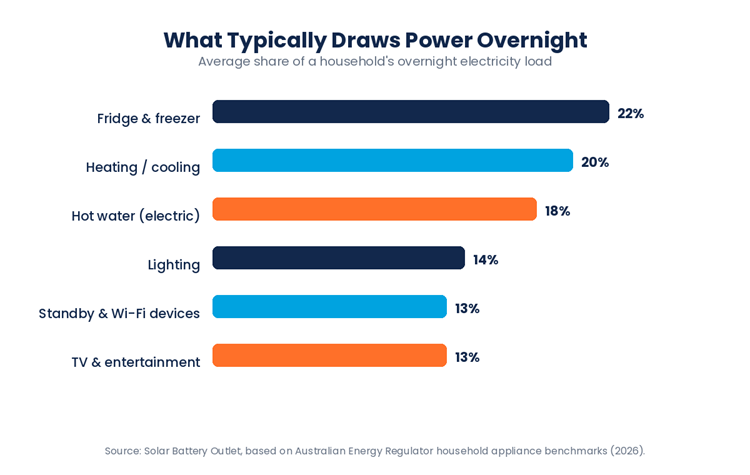
This pattern matters for one key reason. Battery sizing is not just about your daily total. It is about how much of that total shifts into the hours your battery needs to cover.
Battery Size vs Overnight Runtime
Consider an average NSW household with an essential load of around 1kW (about 1kWh every hour) overnight. Here is roughly how long common battery sizes last once the sun goes down.
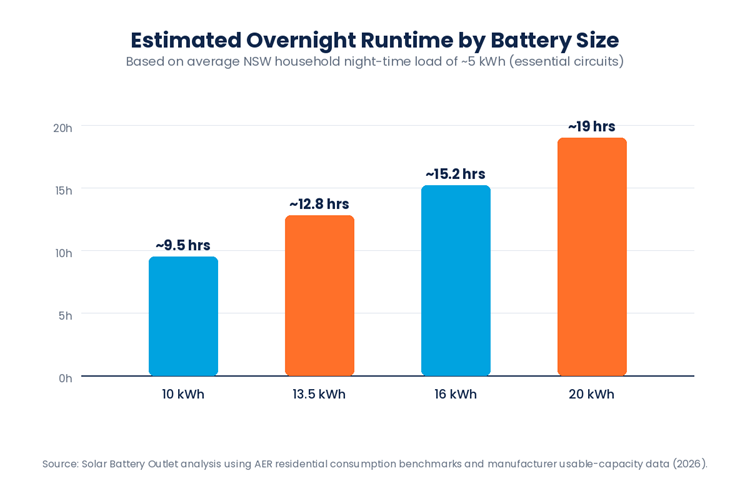
A 10kWh battery covers close to 9.5 hours of essential-circuit use. That is enough for most households to reach early morning. Step up to 13.5kWh and you gain roughly three more hours of buffer. This extra buffer helps on cloudy days, when a battery starts the evening only partially charged. A 20kWh system is increasingly common in whole-home backup setups. It can realistically cover 19 hours of essential use. That is close to a full night, even allowing for reduced solar next morning.
These figures assume essential-circuit loads, not whole-home usage. A whole-home setup running air conditioning or an electric oven overnight will see shorter runtimes than the numbers above.
A Real-World Example: A Family in Liverpool
Consider a four-person household in Liverpool running a 13.5kWh battery. Their solar system is a standard 6.6kW rooftop array. On a sunny day, their panels can charge the battery fully before anyone gets home.
By 6pm, the family starts cooking dinner and running the dishwasher. Lights and the television switch on soon after. Overnight, the fridge, security lighting, and standby devices draw power steadily until sunrise. In this example, the battery could last the entire night. On cloudy or winter days it may not fully charge, so it may run out sooner.
This is a common outcome for solar batteries Liverpool electricians install in evening-heavy homes. Anyone researching solar batteries Liverpool wide tends to ask this exact question before buying. Results vary by home. Still, this example shows how a correctly sized battery can realistically get a family through the night.
What the Experts Say
Battery performance overnight is not just about hardware. It also depends on the broader energy system, and on household behaviour, evolving around it.
Dr Julio Braslavsky is a Senior Principal Research Scientist at CSIRO. He has highlighted how Australian homes create large swings in grid demand each evening. As the sun sets, solar households shift from exporting power to drawing on it. This is exactly the gap a correctly sized battery is designed to fill.
Hayden Barry is Managing Director at energy retailer Nectr. He notes that battery households increasingly track their generation and storage in real time. Many shift appliance use into sunnier hours. That way, they can lean on stored solar during the evening peak, instead of buying it back from the grid.
Together, these observations point to one conclusion. Overnight runtime improves when households actively manage usage, not just when they buy a bigger battery.
Tips to Extend Your Solar Battery’s Overnight Runtime
A few practical habits can stretch overnight performance without spending another dollar.
- Run high-draw appliances during the day. Dishwashers, washing machines, and pool pumps use far less stored battery power when they run on live solar instead.
- Check your battery’s charge before evening. On overcast days, your battery may start the night only partially charged. It is worth checking your monitoring app first.
- Separate essential and non-essential circuits. Ask your installer about wiring configuration if outage backup matters to you. Essential-only setups run significantly longer than whole-home setups.
- Keep firmware and settings updated. Battery management software improves regularly. Small efficiency gains add up across hundreds of overnight cycles.
Frequently Asked Questions
A 10kWh battery typically delivers around 9 to 9.5 hours of usable overnight power. This applies to an average household running essential circuits, based on standard usable-capacity benchmarks.
It depends on battery size and household load. A 20kWh battery can often cover a full night of essential and moderate whole-home use. Smaller batteries usually cover essential circuits only.
Fridges, heating or cooling, and electric hot water typically use the largest share of overnight electricity. This is based on Australian Energy Regulator appliance benchmark data.
No. Runtime depends on usable capacity, household load, inverter efficiency, and whether the battery covers essential circuits or the whole home.
For many households, a small buffer above calculated need helps on cloudy days. An accredited installer can assess your bills and recommend the right size for your home.
Curious how long a battery would actually run your home overnight? Solar Battery Outlet offers free, no-obligation assessments across Liverpool, Bankstown, and Mudgee. Our SAA-accredited electricians check your bills, your roof and your evening usage first. Then we recommend a size that fits — not the biggest system on the shelf. Call 1800 000 777 or visit solarbatteryoutlet.com.au to get started.
Disclaimer
This article provides general information about solar battery runtime. It is not personalised financial, electrical, or investment advice. Battery performance depends on household usage, system configuration, weather, and installation quality. Actual results will vary from home to home. Figures here are estimates, based on public data and standard industry assumptions. They should not be relied upon as guaranteed outcomes. Always seek personalised advice before making a purchasing decision.
