If you have been comparing solar quotes recently, you may have noticed that some installers clearly explain government rebates while others provide little detail. The reason often comes down to whether the installer is registered and approved under the Clean Energy Regulator (CER) requirements.

New rules introduced across 2025 and 2026 have tightened the requirements around who can legally install a solar system and claim the rebate on your behalf. For NSW homeowners — whether you are in Liverpool, Bankstown, or anywhere else in the state — this directly affects whether you receive your full entitlement, whether your installation is safe, and whether it will pass inspection.

This guide outlines the CER registration rules, explains why regulators introduced them, and shows you what to check before signing a contract with a solar installer.

What Is the CER and Why Does It Set the Rules?

The Clean Energy Regulator is the Australian Government body responsible for administering the Small-scale Renewable Energy Scheme (SRES) — the program that funds the rebate that reduces the upfront cost of solar panels and batteries for homes across Australia.

When a solar installer completes a job, they do not just put panels on your roof and leave. To trigger your rebate, they must create Small-scale Technology Certificates (STCs) in the government’s REC Registry. Those certificates are only valid — and your rebate is only real — if the installer meets a specific set of CER registration requirements at the time of installation.

The CER does not just set these rules once and walk away. It actively monitors compliance, suspends installers who breach the rules, and publishes regular compliance updates. As of the most recent update covering January to March 2026, the CER permanently suspended one registered person (Phenix Trading Pty Ltd) following regulatory action in NSW and Victoria — a reminder that enforcement is real and ongoing.

SAA accredited vs unaccredited solar installer NSW comparison

The Core Rule: Only SAA Accredited Installers Can Legally Claim Your Rebate

The single most important requirement is this: your solar system must be designed and installed by a Solar Accreditation Australia (SAA) accredited installer. This is not optional or a formality — it is a hard legal requirement under the Renewable Energy (Electricity) Regulations.

Solar Accreditation Australia (SAA) took over the accreditation role from the Clean Energy Council in 2024. As of 2024, only SAA accredited designers and installers can interact with the CER’s Small-scale Renewable Energy Scheme. Any installer claiming to offer you a rebate without holding a current SAA accreditation number is not legally able to do so.

To hold SAA accreditation, an installer must:

  • Hold an unrestricted electrician’s licence in the relevant state or territory
  • Complete an approved solar training course for their accreditation category
  • Complete a minimum of 100 continuing professional development (CPD) points every 12 months
  • Carry current public liability insurance
  • Comply with SAA guidelines, Australian Standards, and all relevant regulations

SAA requires accredited installers to maintain their skills through annual CPD training and may suspend or de-accredit those who fail to comply with Australian standards.

The 5 CER Registration Rules That Apply to Your Installation in 2026

Beyond SAA accreditation, the CER now requires installers and solar businesses to follow specific rules for registering, documenting, and reporting solar installations. Here is what every NSW homeowner should understand.

5 CER registration rules your solar panel installer in NSW

Rule 1 — SAA Accreditation Is Mandatory, Not Optional

As covered above, this requirement forms the foundation of STC eligibility. Every system claiming STCs must have an SAA-accredited installer complete the installation. The installer must be physically present on site, as phone-based supervision or remote oversight does not meet the requirement. SAA requires accredited installers to supervise installations on site and follow its installation rules.

Rule 2 — All System Components Must Be on the CEC Approved List

Your solar panels and inverters must appear on the Clean Energy Council’s approved products list. This list is maintained and updated by the CEC. Installing panels or inverters that are not on this list means your system is not eligible for STCs — regardless of who installs it. A legitimate installer will only quote products that are currently on the approved list and will confirm this if you ask. If you are looking at a home solar panel system Liverpool quote or anywhere else in NSW, this is one of the first things to verify.

Rule 3 — Geotagged, Time-Stamped Photo Evidence Is Now Required

From 1 March 2026, the CER introduced a new mandatory photo requirement for all solar and battery installations. Every installation must be accompanied by geotagged, time-stamped photographic evidence confirming that the system complies with Australian Standard labelling requirements.

Authorities introduced this requirement specifically to address the issue of non-compliant battery labelling identified across numerous installations. An accredited installer will build this documentation into their standard process. If an installer seems unaware of this requirement or dismisses it, that is a significant warning sign.

Rule 4 — VPP-Capable Inverter Required for Battery Installations

For any installation that includes a solar battery, the inverter must be technically capable of participating in a Virtual Power Plant (VPP) and must communicate using appropriate protocols (the CSIP-AUS standard). You do not have to actually join a VPP — but the system must have the technical capability. This requirement affects which inverters are eligible, and an accredited installer will be across it when specifying your system.

Rule 5 — The NSW CER Installer Portal (From Mid-2026)

The NSW Government is launching a new centralised CER Installer Portal that will replace manual entry into AEMO’s DER Register. From mid-2026, all solar and battery installers in NSW must use this portal to register every new installation. The portal covers all three NSW distribution networks — Ausgrid, Endeavour Energy, and Essential Energy — and automatically confirms that each system meets national technical standards.

As a homeowner, you do not interact with the portal yourself — your installer does. However, a legitimate accredited installer will be fully aware of this requirement. An installer who seems unfamiliar with the CER portal should prompt caution when you are getting quotes for solar panels Bankstown, Liverpool, or any other part of NSW.

How to Verify Your Installer Before You Sign Anything

Knowing the rules is useful. Knowing how to check that your installer actually follows them is what protects you. Here is a practical guide to verifying any installer before you commit.

solar panel installer credentials NSW green and red flags

Step 1: Ask for the SAA Accreditation Number

Every SAA accredited installer has a publicly listed accreditation number. Ask for it — and then check it yourself at saaustralia.com.au. This takes under two minutes and tells you whether the accreditation is current, what category it covers (grid-connected PV, battery, standalone), and whether it is in good standing.

Step 2: Confirm Products Are on the CEC List

Ask the installer which solar panels and inverters they included in the quote, then verify those products in the Clean Energy Council’s approved products database. If you find that the products are not on the approved list, you could lose access to government rebates before the installation even begins.

Step 3: Ask How They Handle the CER Photo Requirements

A compliant installer will know exactly what you mean when you ask about the March 2026 photo requirements. They should be able to explain that they take geotagged, time-stamped photos at each installation phase as a standard part of their compliance process. Vagueness here is a red flag.

Step 4: Get Everything in Writing Before You Sign

The rebate should appear as a dollar figure on your written quote — not mentioned verbally and applied later. A legitimate installer will provide a written quote you can take home, compare, and consider. If anyone pressures you to sign on the day without providing a written quote, walk away. This applies whether you are looking at a home solar panel system in Liverpool, Bankstown, or anywhere else in NSW.

Why These Rules Exist — And Why They Protect You

It is worth being direct about something: these CER registration rules are not bureaucratic red tape. They exist because there has been a documented pattern of non-compliant installations in the Australian solar market — installers cutting corners on labelling, incorrect system sizing, products that do not meet Australian standards, and in some cases, outright fraud in the STC system.

When you choose a properly registered installer, you are not just protecting the rebate. You are protecting the investment itself — the panels on your roof, the system’s performance over its 25-year design life, and the safety of your home.

If you are planning a full solar panels installation in NSW and want to understand the complete picture — from system sizing to battery storage options — the same rules apply. Every component of a compliant installation, from panels to batteries, must be covered by an accredited installer.

Frequently Asked Questions

How Can I Check Whether My Solar Installer Holds SAA Accreditation?

Go to saaustralia.com.au and use the accreditation search. Enter the installer’s name or accreditation number. The result will show you the current accreditation status, the type of accreditation held (e.g. Grid-Connected PV, Battery), and whether it is currently active. Always verify this before signing any quote, whether you are getting a home solar panel system or solar panel installation services in Bankstown.

Can an unaccredited installer do the work if an accredited person signs off on it?

The CER and SAA are explicit: the accredited person must be present on site for the installation. Supervision must be on site and in accordance with SAA rules. Remote sign-off or paper-based oversight does not satisfy the requirement. If an installer’s arrangement does not meet this standard, any STCs created may be invalid.

Does the accreditation requirement apply to solar panel-only systems, or just batteries?

Both. SAA accreditation is required for both solar PV installations and battery installations under the SRES. The category of accreditation differs (Grid-Connected PV vs Battery), but the core requirement — that only accredited installers can legally create STCs — applies to all system types claiming government rebates.

What if my installer says they will handle the accreditation paperwork themselves?

The installer handling the rebate paperwork (STC assignment) is standard practice and expected. What you want to verify is that they hold the accreditation themselves — not that someone else on the paperwork does. Ask for their SAA number and verify it directly. The paperwork process is separate from the accreditation requirement.

Will the CER registration rules change again after mid-2026?

The CER regularly updates its compliance requirements as part of its annual enforcement priorities. The core requirement for SAA accreditation is unlikely to change. However, documentation requirements, photo evidence standards, and portal registration processes are updated periodically. A reputable installer stays current with these updates as part of their ongoing CPD requirements.

DATA SOURCES & REFERENCES

Small-scale renewable energy systems: https://cer.gov.au/schemes/renewable-energy-target/small-scale-renewable-energy-scheme/small-scale-renewable-energy-systems

Solar battery installers and designers: https://cer.gov.au/schemes/renewable-energy-target/renewable-energy-target-participants-and-industry/solar-battery-installers-and-designers

Clean Energy Regulator—Compliance update January to March 2026: https://cer.gov.au/about-us/our-compliance-approach/compliance-and-enforcement-priorities/compliance-and-enforcement-priorities-2025-26/compliance-update-january-to-march-2026

Clean Energy Council — Approved Products List: https://www.cleanenergycouncil.org.au/industry-advocacy/renewable-energy-systems/approved-products

If you are planning to install a solar battery in NSW in 2026, the rules have changed — and not in a small way. Three separate regulatory updates have landed this year, covering how batteries are photographed at installation, how inverters must communicate with the grid, and how your installer registers the job.

None of these changes end the rebate or make batteries less worthwhile. However, they do change what you should be asking your installer before you sign anything. Therefore, this guide covers every new requirement in plain language and tells you what to do — and what to watch out for — when comparing quotes.

What Has Changed in 2026: The Three Key Updates

Solar Battery Installations 2026

1. Mandatory Photo Documentation — From 1 March 2026

The Clean Energy Regulator (CER) introduced a mandatory photo requirement for every solar battery installation in Australia from 1 March 2026. This is now legislated under the Renewable Energy (Electricity) Regulations 2001 and applies to all accredited installers.

Every installer must now take geotagged and timestamped photos of critical labelling at the time of installation. These photos are submitted as part of the compliance paperwork, and the CER uses AI to check every submission. If the photos are missing or incorrect, your rebate claim will be delayed or rejected.

What this means for you: Ask your installer upfront to confirm they will handle the photo documentation correctly. A compliant installer will do this automatically. One who is unaware of the requirement is a red flag.

2. NSW Emergency Backstop Mechanism — From Mid-2026

From mid-2026, the NSW Government is implementing the Emergency Backstop Mechanism (EBM) — a technical requirement designed to protect the electricity grid during rare emergency conditions known as Minimum System Load events. These occur on mild, sunny days when rooftop solar exports can exceed the grid’s capacity to absorb them.

Under the new rules, all new and upgraded rooftop solar systems under 200 kW must be backstop-enabled. In practice, this means your system’s inverter must comply with a new Australian technical standard called Common Smart Inverter Profile Australia (CSIP-AUS). A compliant inverter can receive instructions from your distribution network to temporarily reduce exports during a grid emergency.

What this means for you: This mechanism is a last-resort safeguard and will be a rare event. It will not affect your daily solar savings under normal conditions. If you are installing after mid-2026, ask your installer to confirm your inverter is CSIP-AUS compliant. Modern inverters already meet this standard. If you are not upgrading an existing system, these requirements do not apply to you.

3. NSW CER Installer Portal — From Mid-2026

Alongside the Emergency Backstop Mechanism, the NSW Government is launching a new CER Installer Portal — a centralised registration system that replaces manual entry into AEMO’s DER Register.

From mid-2026, all solar and battery installers in NSW must use this portal to register every new installation. It creates a single registration process across all three NSW distribution networks (Ausgrid, Endeavour Energy, and Essential Energy) and automatically confirms each system meets national technical standards.

What this means for you: You do not interact with the portal directly — your installer handles it. However, a legitimate accredited installer will be aware of this requirement. An installer who seems unaware of the CER portal or CSIP-AUS standard should prompt caution.

Safety Rules That Have Not Changed — But Still Matter

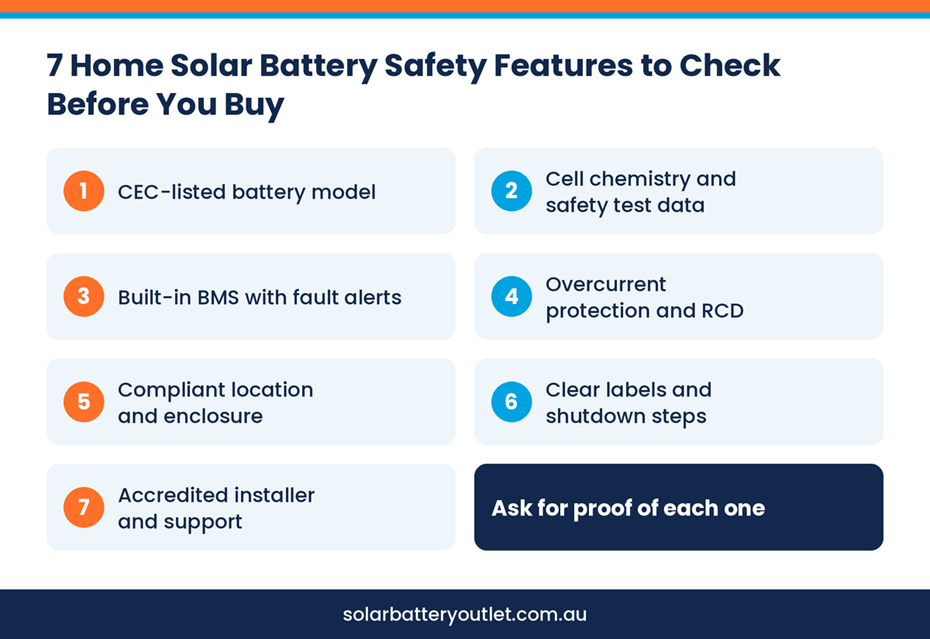
While the three updates above are new for 2026, the core safety rules for how and where a battery can be physically installed have been in place since AS/NZS 5139:2019. These rules are non-negotiable, and every reputable installer will already follow them.

battery placement rules

Clearance Requirements

Your battery must maintain specific distances from potential hazards. Most NSW gas networks require at least 1,000 mm clearance from any gas meter vent or pressure relief device. The battery must also be kept at least 600 mm from any window or ventilation opening into a habitable room.

Fire Barrier Requirements

If a battery is mounted on or within 300 mm of a wall backing onto a habitable room, a non-combustible fire barrier is required under AS/NZS 5139. Therefore, your installer should assess this automatically before recommending an installation location.

No Escape Route Obstruction

Under AS/NZS 5139 and NSW Fair Trading rules, installers cannot place a battery in an escape route or evacuation path. In practical terms, they should not install a battery where it could block a garage door or doorway used for emergencies.

The Stricter Rule Always Applies

When the manufacturer’s installation manual requires greater clearances than the Australian Standard, the manufacturer’s requirements apply. A compliant installer will check both and apply whichever is more demanding.

New Photo Requirements: What Your Installer Must Document

CER Photo Requirements

The CER’s mandatory photo requirements from 1 March 2026 cover four categories of documentation that your installer must submit for every job:

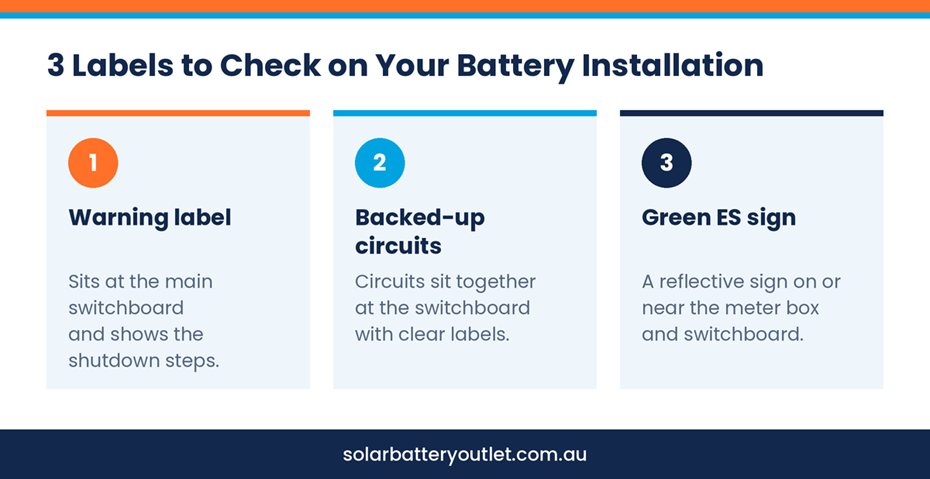
  • A clear, geotagged photo of the battery unit label showing the model and serial number
  • A photo of the green circular “ES” reflective label near the meter box — providing critical information for emergency services
  • Evidence of the accredited installer’s presence on site during the main installation stages
  • All photos must include GPS location data and a timestamp—the CER uses AI to verify every submission automatically

If labeling does not meet the required standard, the claim fails, and the installer must return to the site to rectify it before the STC rebate can be processed. That’s why choosing an experienced, CER-compliant installer matters more than ever—a poorly documented job can delay your rebate by weeks.

Your NSW Homeowner Compliance Checklist

Before you book any solar battery installation in NSW, work through this checklist. A legitimate, compliant installer will be able to answer yes to all of these without hesitation.

NSW Homeowner Compliance Checklist

Questions to Ask Before Signing

  • Is your company SAA-accredited? Can you provide your accreditation number to verify at saaustralia.com.au?
  • Will the inverter be CSIP-AUS compliant — is it on the Clean Energy Council’s approved list for the NSW Backstop Mechanism?
  • Is the battery CEC-approved and listed on the AS/NZS 5139:2019 product register?
  • Will you handle the geotagged photo documentation required by the CER from 1 March 2026?
  • Can you provide a written quote showing the rebate as a dollar deduction — not just a verbal promise?
  • What is the confirmed installation date — not just the contract signing date?
Do I need to do anything about the emergency backstop mechanism if I already have solar?

No. If you are not installing new equipment or upgrading your existing system, the Backstop Mechanism requirements do not apply. Existing systems continue to operate under their current arrangements.

How do I know if my installer is SAA-accredited?

Ask them for their accreditation number and check it yourself at saaustralia.com.au. Any installer who is reluctant to provide this number is not compliant. Do not proceed — your rebate will not be valid.

My installer said the rebate is reflected in the price — is that enough?

No. The rebate must appear as an itemised dollar deduction on your written quote. A verbal promise does not protect you if the rebate is processed incorrectly. Insist on seeing it in writing before you sign.

What batteries qualify for the federal rebate in 2026?

To qualify, your battery must meet AS/NZS 5139:2019 and appear on the CEC-approved list. Your installer must install the battery alongside solar panels. Well-known compliant brands include Tesla Powerwall, BYD, Sungrow, Enphase, and Growatt — but you should always verify that the specific model appears on the CEC approved list.

Is the NSW VPP incentive still available?

Yes. The NSW Peak Demand Reduction Scheme — up to $1,500 for connecting to a Virtual Power Plant — is a separate state incentive and is not affected by the 2026 regulatory changes. Ask your installer whether your chosen battery is VPP-compatible.

Ready to Get Compliant Quotes for Your NSW Home?

Solar Battery Outlet installs CEC-approved solar batteries for homes across Liverpool, Bankstown, and Mudgee. Every installation is completed by SAA-accredited electricians, with full CER photo documentation and rebate paperwork handled for you.

If you have questions about the new 2026 rules — or want to know whether your home qualifies for the federal rebate and the NSW VPP incentive — we are happy to talk through it without any sales pressure

DATA SOURCES

1. Clean Energy Regulator — Solar Battery Photo Guide: cer.gov.au/document/solar-battery-photo-guide

2. Clean Energy Regulator — Solar Batteries eligibility rules: cer.gov.au

3. NSW Climate & Energy Action — Emergency Backstop Mechanism: energy.nsw.gov.au

4. NSW Climate & Energy Action — CER Installer Portal: energy.nsw.gov.au

5. Ausgrid — Information for Solar Installers / Emergency Backstop: ausgrid.com.au

6. Endeavour Energy — NSW Emergency Backstop Mechanism: endeavourenergy.com.au

7. AS/NZS 5139:2019 — Battery Energy Storage System installation safety standard

8. AS/NZS 4777.2:2020 — Grid connection of energy systems via inverters

9. ERAC — Battery Energy Storage System installation clarifications: erac.gov.au

If you have recently had a solar battery installed—or you are considering one—you may have heard that the government now requires your installer to photograph the job before they can claim your rebate. It sounds unusual. And some homeowners are wondering what exactly is being photographed, why, and whether it affects them.

Here is the plain-language explanation, sourced directly from the Clean Energy Regulator (CER).

The answer is straightforward: audits revealed that installers most commonly failed Australian standards because they used non-compliant labelling on solar battery installations.

Australia has seen an extraordinary surge in battery installations since the Cheaper Home Batteries Program launched in July 2025. By early March 2026, more than 254,800 households, small businesses, and community organisations had installed a battery under the program—delivering a combined 6.3 GWh of storage capacity nationally. That is more than the 12 biggest in-service utility-scale batteries in the National Electricity Market combined.

With that kind of volume, compliance problems multiply fast. The CER’s own inspection data showed that missing, misplaced, or incorrect safety labels were appearing regularly across installations. These are not cosmetic issues—correct labeling is essential for the following:

  • Emergency responders (firefighters, paramedics) who need to know a lithium battery is present before cutting power or entering a roof space
  • Future electricians or tradespeople working on the property, who need shutdown procedure labels and hazard warnings clearly displayed
  • Homeowners themselves, who have a right to a safely installed system that meets Australian standards
CER solar battery photo requirements key compliance dates 2025 to 2026

What Exactly Gets Photographed?

The CER’s Solar Battery Photo Guide (Version 1.0, January 2026) requires installers to take three categories of photos for every installation. These requirements add to the on-site verification photos introduced in July 2025.

What photos are required for solar battery installation CER 2026

1. The Meter Box (External)

Installers must photograph the emergency services label on the outside of or visible near the meter box. This circular green reflective label, at least 100 mm in diameter, displays the letters ‘ES’ and includes the UN number for the battery chemistry—for example, UN3480 for lithium iron phosphate (LiFePO₄). A green ‘PV’ label must also be visible where applicable.

2. The Switchboard (Internal)

Installers must take a photo of the labels inside the switchboard or meter box cover. CER inspection data showed installers most commonly failed compliance in this area. The photo must capture the WARNING label stating ‘MULTIPLE MODE INVERTER CONNECTED’ and ‘NEUTRAL AND EARTH CIRCUITS MAY BE LIVE UNDER NORMAL AND FAULT CONDITIONS,’ along with the emergency shutdown procedure and, for backup systems, the labeling of backed-up circuits.

3. The Battery Unit Itself

Photos must show the front and sides of the battery unit, including all hazard warning signs placed in compliant positions. These include danger signs for toxic fumes, risk of battery explosion, arc flash hazard, and chemical exposure—all as required by Australian Standard AS/NZS 5139 (Safety of battery systems).

How Does the CER Review These Photos?

This is where it gets interesting. The CER has invested in artificial intelligence to assess photo submissions at scale. According to the regulator’s own statement:

In practice, automated systems review photo submissions. The system flags claims when installers submit missing, misplaced, or unreadable labels. Installers must then return to the site, fix the issue, and resubmit the claim.

Installers must submit photos in their original file format, not inside a PDF. The CER requires original metadata, including geotags and timestamps, to match installation records. Installers must also keep all submitted photos on file for five years. The CER can audit those photos at any time, even after approving the claim.

The short answer: if your installer is doing their job properly, you will not notice this at all. It is an administrative and safety compliance process that happens between the installer and the regulator.

But there are three things worth knowing:

When an accredited installer completes your solar battery installation and claims small-scale technology certificates (STCs) on your behalf, that claim — and the upfront discount you receive — depends on the paperwork being in order. Installers photograph the labelling to protect you and anyone who enters your home during an emergency or electrical work. In serious cases, the CER can reject the claim entirely. Installers cannot pass the rebate on to you until they fix the issue.

This is not a theoretical risk. The CER has already begun suspending installers for repeated non-compliance and has explicitly warned that it will not hesitate to remove installers from the scheme.

An installer who understands and complies with the photo requirements is, by definition, one who understands Australian standards well enough to install the correct labelling in the first place. Non-compliant labelling and non-compliant photo submissions tend to go together—because both stem from the same underlying problem: an installer who cuts corners.

Asking your installer directly—’Do you submit geotagged photos of critical labelling as required by the CER?’—is one of the most reliable signals you can get about their professionalism.

The photographed labelling protects you and anyone who enters your home during an emergency or electrical work. A correctly labelled solar battery installation tells a first responder that there is a lithium battery on site, what chemistry it uses, and how to safely shut the system down. That information can be the difference between a manageable incident and a serious one.

Compliant vs Non-Compliant: What to Look For

Whether you are booking a new installation or thinking about your existing system, this guide shows what separates an installer who will keep your rebate safe from one who will not.

Compliant vs non-compliant solar battery installer checklist NSW 2026

A Note About Misleading Advertising

The CER also used this compliance update to address misleading rebate advertising. The regulator warned agencies to monitor poor consumer practices around rebate deadlines. It specifically highlighted misleading quoting and aggressive sales tactics. State and territory fair trading agencies were notified about these concerns.

If you have seen advertising that makes the photo requirement sound alarming or uses it to pressure you into signing quickly, be cautious. The photo requirements apply to the installer, not the homeowner. They do not affect the value of your rebate or change your eligibility for any NSW state incentive. A compliant installer can still complete the installation within the normal timeline.

Does the photo requirement apply to batteries already installed before 1 March 2026?

No. The new critical labeling photo requirements apply to all solar batteries installed from 1 March 2026 onwards. Installations completed before that date are subject to the on-site verification photo requirements that applied since July 2025, but not the new labeling-specific photos.

Does this affect my STC rebate value?

Not directly. Your STC rebate value depends on the battery size, STC price, and STC factor at installation time. The photo compliance process does not directly affect the rebate value. However, non-compliant photo submissions can delay or reject the STC claim. That delay can postpone the rebate being processed and passed on to you.

How do I know if my installer is SAA-accredited?

You can verify any installer’s accreditation number directly at saaustralia.com.au. Ask your installer to provide their SAA accreditation number before signing any contract. A legitimate, accredited installer will provide this without hesitation.

Can I see the photos my installer submits?

You can request copies from your installer, and many will provide them as part of their installation documentation. You are not required to receive them, but there is no reason a compliant installer would refuse the request.

What if my existing battery does not have the correct labels?

If you have concerns about the labeling on an existing installation, contact your original installer. If the installation was completed under the SRES, the installer has ongoing obligations regarding compliance. You can also contact Solar Accreditation Australia or your state or territory electrical safety regulator for guidance.

Data Sources & References

All factual claims in this article are drawn from official Australian Government sources:

  • Clean Energy Regulator — Solar Battery Photo Guide v1.0, January 2026 (cer.gov.au/document/solar-battery-photo-guide)
  • Clean Energy Regulator — Solar battery installers and designers (cer.gov.au)
  • Clean Energy Regulator — Compliance Update January to March 2026 (cer.gov.au)
  • Clean Energy Regulator — Media Release: Safety the Priority as Solar Battery Installations Surge, February 2026 (cer.gov.au)
  • Clean Energy Regulator — News: New Solar Battery Photo Requirements Now in Place, March 2026 (cer.gov.au)
  • Renewable Energy (Electricity) Regulations 2001, Section 20ACA(12)(h)(iii) (legislation.gov.au)
  • pv Magazine Australia — Australian Regulator Ramps Up Battery Inspections, March 2026 (pv-magazine.com)
  • Australian Standard AS/NZS 5139 — Safety of Battery Systems for Use with Power Conversion Equipment
  • Solar Accreditation Australia—saaustralia.com.au

Solar Battery Outlet is a Liverpool-based solar battery installer, part of GWM Group Pty Ltd, servicing NSW homes. SAA-accredited electricians perform all installations. This article is published for informational purposes and reflects current CER requirements as at May 2026.

If you have been searching for a solar battery in NSW and wondering whether your shortlisted model actually qualifies for the federal rebate — you are not alone. The government’s Cheaper Home Batteries Program has attracted enormous interest since launching in July 2025, but the eligibility rules are specific, and not every battery on the market makes the cut.

This guide gives you a straight answer. It explains which batteries qualify, outlines the technical requirements, lists the approved brands, and shows how the 2026 tiered rebate structure affects your savings.

The 5 Rules That Determine Whether a Battery Qualifies

To be eligible for the federal rebate under the Cheaper Home Batteries Program, your battery and installation must meet five specific criteria. Miss any one of them and the rebate does not apply.

4 core requirements to quality for the federal battery rebate

1. The Battery Must Be on the CEC Approved Product List

The Clean Energy Council (CEC) maintains a list of approved battery products. If your battery is not on this list, it is simply not eligible — regardless of brand name, price, or capacity. The list is updated regularly and contains hundreds of models from dozens of manufacturers.

The major brands available in NSW — Tesla, BYD, Sungrow, Enphase, Growatt, AlphaESS, GoodWe, Sonnen, and SolarEdge — all have qualifying models on the list. But here is the important nuance: not every model from every brand is automatically listed. Some older variants, grey imports, or uncertified sub-models of otherwise approved brands may not qualify.

2. The Installer Must Hold Current SAA Accreditation

Since 2024, the accreditation body for solar installers in Australia changed from the Clean Energy Council to Solar Accreditation Australia (SAA). Your installer must hold a current, active SAA accreditation — not a historic CEC accreditation that predates the changeover.

You can verify an installer’s accreditation status directly at saaustralia.com.au. This check takes less than a minute and protects you from using an unqualified installer who cannot legally apply the rebate.

3. The Battery Must Be VPP-Capable

VPP stands for Virtual Power Plant. The federal government’s program requires that all eligible batteries are technically capable of participating in a VPP—meaning the battery’s hardware and firmware must support remote dispatch by a VPP operator.

You do not have to actually enrol in a VPP to claim the rebate. But the battery must be capable of it. This requirement rules out some older models and certain cheaper imported batteries that lack the communications hardware needed for VPP operation.

Every major brand installed by qualified NSW installers—Tesla Powerwall, BYD, Sungrow, Enphase, and Growatt—meets this requirement. Cheaper or unlisted brands may not.

4. The Battery Must Be Paired with a Solar PV System

This rule strictly requires you to connect your battery to a solar panel system to qualify for the federal rebate. You must either install the battery alongside a new solar system or retrofit it to an existing solar system already operating at the property.

However, off-grid properties are eligible for the federal rebate as long as the battery and solar pairing requirement is met. At the same time, off-grid systems cannot access the NSW VPP incentive, which requires grid connection by definition.

5. The Battery Must Have Between 5 kWh and 100 kWh Usable Capacity

The program covers batteries with a usable capacity of 5 kWh to 100 kWh. Batteries below 5 kWh do not qualify. Batteries above 100 kWh are eligible for installation under the program but receive no additional STC discount on capacity above 50 kWh.

For most NSW homeowners, the relevant range is 10–20 kWh. The tiered rebate structure introduced in May 2026 means the best rebate-per-dollar outcome sits in the 10–14 kWh range.

Which Battery Brands Are Approved in NSW?

Qualified NSW installers commonly install the following CEC-approved, VPP-capable battery brands. All of these qualify for the federal Cheaper Home Batteries Program and the NSW Peak Demand Reduction Scheme (VPP incentive).

Top Qualifying Batteries

Key Approved Brands — NSW 2026

Tesla Powerwall 3 (13.5 kWh) — The most popular choice in NSW. Fully CEC-listed, VPP-capable, and eligible for both the federal rebate and the NSW PDRS incentive. Estimated rebate: approximately $4,500 at the post-May 2026 STC rate.

BYD Battery-Box Premium HVS (5–22 kWh, modular) — A modular system allowing homeowners to start smaller and expand later. All HVS variants currently listed are CEC-approved. Estimated rebate: $1,700–$5,800 depending on configured capacity.

Sungrow SBR Series (9.6–25.6 kWh) — Often cited as the best value option in NSW for mid-range capacity. CEC-listed, fully VPP-capable, and widely available through SAA-accredited installers. Estimated rebate: $3,200–$5,800.

Enphase IQ Battery 5P (5 kWh, stackable) — An AC-coupled system that stacks in 5 kWh increments. Excellent for homes with older DC-coupled solar systems. Fully CEC-listed and VPP-capable. Estimated rebate: approximately $1,700 per unit.

Growatt ARK Series (5.12–30.72 kWh) — A competitively priced option with growing installer support across NSW. CEC-listed variants available. Estimated rebate: $1,700–$6,000 depending on configuration.

Other brands with CEC-approved models available in NSW include AlphaESS, GoodWe Lynx Home, Sonnen, SolarEdge Energy Bank, and Fronius. Your installer can confirm which specific variants are currently listed and available.

From 1 May 2026, the Cheaper Home Batteries Program introduced a tiered rebate structure. The STC rate from May to December 2026 is $272 per usable kWh of battery capacity — but this full rate only applies to the first 14 kWh.

Rebate Tiers

The Three Tiers Explained

  • Tier 1 (0–14 kWh): 100% of the STC rate — $272 per kWh. A 14 kWh battery earns approximately $3,808 in rebate.
  • Tier 2 (14–28 kWh): 60% of the STC rate — approximately $163 per kWh. An additional 14 kWh in this band earns approximately $2,282.
  • Tier 3 (28–50 kWh): 15% of the STC rate — approximately $41 per kWh. Minimal return for oversized systems.

For a standard 10–13.5 kWh battery (the most common size in NSW homes), the full Tier 1 rate applies, giving you the maximum rebate per kilowatt-hour of capacity installed.

In addition to the federal rebate, NSW homeowners can also access the NSW Peak Demand Reduction Scheme (PDRS) — a VPP incentive worth up to $1,500 for connecting your battery to a registered Virtual Power Plant. These two rebates can be stacked for maximum savings.

Common Reasons a Battery Claim Is Rejected

The most common reasons homeowners find their rebate was not applied correctly or was rejected:

Battery Qualify for the 2026 NSW Federal Rebate
  • The battery brand or specific model was not on the CEC approved list at the time of installation.
  • The installer’s SAA accreditation had lapsed or they were never accredited — meaning the rebate cannot be claimed.
  • The battery was installed as a standalone system with no solar panels connected.
  • The property had previously claimed a battery STC rebate — one claim per address applies.
  • The battery’s capacity was below 5 kWh usable, making it ineligible under the program rules.
  • The installer quoted a “rebate” verbally but it was never applied as an STC deduction on the written invoice.

The simplest protection against all of these: check that your written quote clearly shows the rebate as a dollar deduction line item — not just a single “after-rebate price.” If it is not visible on paper, ask why before signing.

What About the NSW VPP Incentive — How Does It Stack?

The NSW Peak Demand Reduction Scheme (PDRS) is a separate state incentive that runs alongside the federal Cheaper Home Batteries Program. Furthermore, it rewards homeowners for connecting a new battery to a registered Virtual Power Plant operator, which allows the grid to draw on stored energy during peak periods.

The NSW VPP incentive is worth up to $1,500, paid through Peak Reduction Certificates (PRCs). Additionally, it is available to all NSW homeowners installing an eligible battery and can be combined with the federal rebate regardless of your installation timing — before or after 1 May 2026.

To access it, your installer registers your battery with a VPP operator and the local network operator (Ausgrid, for most of Sydney and NSW). You sign a VPP agreement, which covers the terms under which your battery can be remotely dispatched. Your installer handles all of this as part of the installation process.

Frequently Asked Questions

Can I claim the rebate if I already have solar but no battery?

Yes. Adding a battery to an existing solar system is one of the most common claim types. The federal rebate applies as long as your new battery meets the eligibility requirements and an SAA-accredited installer installs it. The installer will retrofit the battery to your existing system and connect it accordingly.

Does the rebate apply if I am renting the property?

The federal Cheaper Home Batteries Program does not have an income test or homeowner restriction. Landlords, owner-occupiers, small businesses, and community organisations can all qualify. For renters looking to install a battery, the decision rests with the property owner — but the rebate would be available to them if they choose to proceed.

What happens if I want to install two batteries?

One rebate claim applies per property address. If you install a second battery at the same address, it is not eligible for a fresh STC rebate. However, if you install a modular system like BYD or Enphase that supports expansion, the installer can configure the initial setup to maximise your eligible capacity within the rebate tiers.

How do I verify that my installer is SAA-accredited?

Visit saaustralia.com.au and search the installer’s name or accreditation number. Verification takes less than 60 seconds and protects you from working with an uncertified installer. Any legitimate installer will give you their SAA number without hesitation.

Is there a deadline to claim the rebate?

The program runs until 2030. There is no single cut-off date, but the rebate value decreases over time. The STC factor reduces every six months, meaning the discount is slightly smaller in each subsequent period. The highest rebate available within the post-May 2026 period applies from May through December 2026.

Check If Your Battery Qualifies — Free Quote for NSW Homeowners

At Solar Battery Outlet, we install CEC-approved batteries across Liverpool, Bankstown, and Mudgee. SAA-accredited electricians complete all installations, and we handle all rebate paperwork on your behalf.

If you are unsure whether your shortlisted battery qualifies or want a written quote that clearly shows the rebate deduction, get in touch. We will look at your existing solar system, your electricity usage, and your budget—and give you an honest answer on whether a battery makes financial sense before you commit to anything.

Data Sources & References

The information in this article is drawn from the following sources:

  • Australian Government Clean Energy Regulator (CER) — Cheaper Home Batteries Program guidelines and STC rate tables
  • Clean Energy Council (CEC) — Approved battery product list (accessed May 2026)
  • Solar Accreditation Australia (SAA) — Installer accreditation database: saaustralia.com.au
  • NSW Department of Climate Change, Energy, the Environment and Water — Peak Demand Reduction Scheme (PDRS) guidelines
  • Tesla Australia — Powerwall 3 Cheaper Home Batteries Program eligibility page (tesla.com/en_au/support/energy/powerwall)
  • Solar Choice — Federal Solar Battery Rebate 2026 guide (solarchoice.net.au)
  • Solar Scorecard — Battery Rebates Australia 2026 (solarscorecard.com.au)
  • PSC Energy — Ultimate Guide to Australia Solar and Battery Rebates 2026 (pscenergy.com.au)
  • Solar Battery Outlet — Federal Battery Rebate NSW 2026 guide (solarbatteryoutlet.com.au)

Rebate estimates in this article are based on the post-May 2026 STC rate of $272 per usable kWh. Actual rebate amounts vary based on battery capacity, STC market price at time of installation, and installer calculations. Always confirm figures with your SAA-accredited installer before signing a contract.

If you have been waiting for a sign that NSW is heading into an energy crunch, this is it. The New South Wales government has just contracted 532MW of new firming capacity, securing 2,128MWh of battery energy storage to prevent a forecast electricity shortfall in the summer of 2027 and 2028. The projects are required to be operational by November 2027.

That is a significant move. It tells you that the people running the state grid are genuinely worried about what happens when Eraring — Australia’s largest coal-fired power station — closes in August 2027, taking 2.8GW of baseload generation offline with it.

What it does not tell you is that any of this grid infrastructure will protect your home if there is a local fault, a heat event, or an outage on your street. For that, you need your own battery.

NSW Grid Battery Rollout

What Just Happened: The NSW 7th Firming Tender Explained

In October 2025, the NSW government opened its seventh infrastructure firming tender, inviting bids from battery storage projects, gas generators, demand response programs, and aggregated portfolios. The target was an indicative 500MW of firming capacity.

The result, announced in May 2026, exceeded that target. Two successful projects — one battery energy storage system (BESS) and one virtual power plant (VPP) — were awarded Long-Term Energy Service Agreements (LTESAs) of up to 15 years. Combined, they deliver 2,128MWh of storage capacity, with a focus on the Sydney-Newcastle-Wollongong corridor.

Why that region? It is home to the highest electricity demand concentration, the most critical transmission infrastructure, and the industrial load growth driven by electrification. It is also where supply pressure will be felt hardest when Eraring shuts.

Nevenka Codevelle, CEO of Australian Sustainability Limited (ASL), confirmed that the tender attracted strong competition and that both selected projects demonstrated value for NSW electricity customers. Under the contract terms, these projects must dispatch electricity during Lack of Reserve (LOR) events — the exact moments when the grid is most at risk of failing to meet demand.

The reason all of this is happening urgently is Eraring. Origin Energy coal-fired power station at Lake Macquarie produces 2.8GW — more electricity than most Australian states use at peak. It is scheduled to close in August 2027.

Origin is transforming the Eraring site into a large-scale battery storage facility, ultimately planned at 700MW and 3,160MWh. The first stage — 460MW and 1,770MWh — is already operating, with Wartsila as the primary technology provider.

But replacing 2.8GW of always-available coal generation with storage and renewables is a complex challenge. Battery storage charges from intermittent solar and wind; it cannot simply run around the clock the way a coal station can. The grid needs multiple layers of firming to stay reliable.

The NSW government is moving to add those layers. Two additional NSW Roadmap tenders were announced for May 2026, targeting 2.5GW of generation projects and 12GWh of long-duration storage.

The Australian Energy Market Commission (AEMC) specifically warned last year that the Sydney-Newcastle-Wollongong region faced forecast supply shortfalls in summer 2027-28. The government is racing to close that gap before Eraring goes dark.

What This Means for NSW Homeowners

The Grid Battery and You Home Battery

Here is the thing about grid-scale battery storage: it keeps the market running. It prevents widespread blackouts across regions. It is essential infrastructure — the same way a hospital generator is essential.

But it does not guarantee that your home stays powered.

A grid battery in the Sydney-Newcastle-Wollongong region reduces the probability of a regional supply event. It does not prevent the transformer on your street from overloading during a heat wave. It does not protect you when a bushfire or storm takes out local lines.Your home battery does. When the grid goes down, a solar battery system with backup functionality switches your home to island mode. You do not notice the outage. Your family does not notice it. The grid can do whatever it needs to do, and your home keeps running.

The Summer 2026-27 Reality Check The Eraring closure is August 2027. The new grid batteries are operational from November 2027 at the earliest. That means summer 2026-27 and summer 2027-28 are both periods of elevated grid stress — and neither is fully covered by the new infrastructure yet. This is not a time to assume the grid has it handled.

The Financial Case for Acting Before Summer

Beyond energy security, the financial case for home battery storage in NSW remains strong — and right now, there are multiple incentives stacking up that may not all be available together for long.

1. Federal Battery Rebate: The federal STC rebate continues to 2030, but the multiplier decreases every six months. The last adjustment reduced savings by 30 or more on a standard 10kWh battery. Larger systems above 14kWh face steeper reductions. Installing now captures the current rate before the next reduction.

2. NSW VPP Incentive: NSW homeowners who connect to a registered Virtual Power Plant can access up to ,500 under the Peak Demand Reduction Scheme. This is separate from the federal rebate and is stackable on top of it.

3. Energy Bill Savings: With time-of-use tariffs common across NSW, storing cheap daytime solar and using it during the evening peak (30 cents or more per kWh) generates meaningful annual savings. Most households see payback periods of six to seven years.

NSW homeowners are installing solar batteries

The grid battery news will generate renewed interest in home storage — and with that comes opportunistic sellers. Know what separates a genuine installer from a pressure-driven one.

  • Federal rebate appears as a dollar deduction on your written quote
  • They show SAA accreditation number — verify at saaustralia.com.au
  • Confirmed installation date, not just a contract date
  • They review your electricity bills before recommending a size
  • They explain the NSW VPP incentive clearly
  • Happy for you to take the quote home and compare
  • Pressure to sign on the same day
  • Cannot produce an SAA accreditation number
  • Rebate mentioned verbally but not on the written quote
  • No confirmed installation date — just a contract signing date
  • Recommends the largest possible system without reviewing your bills
  • Door knockers who will not leave a written quote

What Battery Brands Should NSW Homeowners Consider?

Tesla Powerwall 3: 10kWh usable, 11.5kW continuous output — best for larger homes with high evening load or EV charging. Includes integrated inverter.

BYD Battery-Box Premium HVS/HVM: Modular design 5.1kWh to 22.1kWh — flexible for small and large homes, ideal for families wanting to expand over time.

Sungrow SBR: Cost-competitive modular option 9.6kWh to 25.6kWh, strong NSW installer network, reliable in hot climates.

Enphase IQ Battery 5P: AC-coupled, works well with existing Enphase microinverter solar systems.

Does the 2,128MWh grid battery protect my home during a blackout?

No. Grid batteries reduce risk of large-scale regional events. They do not protect individual homes from local faults. A home battery with backup capability does.

Is the federal battery rebate still available?

Yes — it runs until 2030. The multiplier factor reduces every six months, so installing sooner captures a higher rebate.

Can I claim both the federal rebate and the NSW VPP incentive?

Yes. The NSW Peak Demand Reduction Scheme (up to ,500) is separate from the federal rebate and can be claimed on top of it.

When will the new grid batteries be operational?

Both projects from the 7th tender are contracted to reach commercial operations by end of November 2027 — after the Eraring closure in August 2027.

What is a VPP, and how does it benefit me?

A VPP aggregates home batteries into a network responding to grid demand. In NSW, joining makes you eligible for up to ,500 in incentives — while still giving your home full backup power.

DATA SOURCES

1. Energy-Storage.News — NSW firming tender secures 2,128MWh, George Heynes, 15 May 2026. https://www.energy-storage.news/australia-nsw-firming-tender-secures-2128mwh-of-energy-storage-to-address-summer-shortfall/

2. Energy-Storage.News — Australia 1,770MWh Eraring Battery 1 commences commercial operations, 2026.

3. Energy-Storage.News — Origin selects Wartsila for expansion of Eraring BESS.

4. Australian Energy Market Commission (AEMC) — Battery storage growth and reliability gap forecasts, 2025.

5. NSW Peak Demand Reduction Scheme — NSW Government Energy Policy, May 2026. https://www.energy.nsw.gov.au/nsw-plans-and-progress/regulatory-plans-and-frameworks/changes-rules-and-frameworks/peak-demand-reduction-scheme

6. Clean Energy Regulator — STC deeming period and multiplier schedule, 2026.

If you have ever noticed your electricity bill barely budges during a 38-degree January day, even with solar panels on your roof, there is a straightforward explanation: heat hurts solar panel output. In Liverpool and across South West Sydney, summer temperatures regularly push past 35°C, and roof surface temperatures can reach 50°C or higher. That matters a great deal when you are comparing panels.

The solar industry has a term for this: the temperature coefficient. It is the single most important specification for anyone buying solar panels in hot Australian climates, and it is the one number most salespeople skip over. This guide explains what it means, which panel types handle heat best, and what Liverpool homeowners specifically need to know before signing any contract.

Why Heat Is the Enemy of Solar Output

Solar panels are rated at standard test conditions (STC): 25°C cell temperature and 1,000 W/m² irradiance. That is a laboratory measurement. Real-world Australian conditions are quite dstandard test conditionsifferent — rooftop temperatures in Liverpool regularly reach 45°C to 55°C during summer, and that gap between 25°C and 45°C is where your output quietly disappears.

Every degree above 25°C causes a panel to lose a percentage of its rated output. That percentage is the temperature coefficient, expressed as %/°C. A panel rated at -0.45%/°C loses 0.45% of its capacity for every degree above 25°C. At a cell temperature of 45°C — a very ordinary Liverpool summer afternoon — that panel is already running at roughly 9% below its rated output before clouds, shading, or soiling even enter the picture. For a 6.6kW system, 9% represents around 594 watts of continuous lost capacity. Over a full Australian summer, that adds up to hundreds of kilowatt hours of lost generation — and lost savings on your electricity bill.

How different panel technologies compare on heat performance at typical Liverpool summer rooftop temperatures

What Temperature Coefficient Should You Look For?

The industry benchmark has shifted significantly in the past few years. Standard polycrystalline panels, which dominated Australian rooftops through the 2010s, typically carry a coefficient of -0.45%/°C or worse. Monocrystalline PERC panels — the most common choice today — come in around -0.37%/°C. The newer generation technologies, TOPCon and HJT (Heterojunction), are achieving -0.29% to -0.32%/°C.

That difference may look small on paper. It is not small on your roof in February.

Quick Rule: What to Look For on the Spec Sheet

For hot Australian climates, aim for a temperature coefficient of -0.35%/°C or better. TOPCon and HJT panels (-0.29% to -0.32%/°C) are the benchmark for heat performance in 2026. Avoid any panel with a coefficient worse than -0.40%/°C if you are in Western Sydney.

Here is how the numbers translate into actual Liverpool conditions. On a day where your roof cell temperature reaches 45°C, a 6.6kW system with TOPCon panels (-0.29%/°C) produces approximately 9,400 kWh annually. The same system with standard polycrystalline panels (-0.45%/°C) produces around 8,200 kWh — a difference of 1,200 kWh per year. At a typical NSW grid offset rate of around $0.30/kWh, that is approximately $360 in additional value per year simply from choosing the right panel technology.

Over a 25-year system life, that gap compounds significantly.

Annual Energy Output by Solar Panel  Type

Solar Panel Types That Work Best in Australian Heat

Not all solar panel technologies handle heat the same way. Here is what you need to know about each category available to Liverpool homeowners in 2026.

Monocrystalline PERC — The Proven Standard

Mono PERC remains the dominant technology on Australian rooftops and for good reason. It offers a solid balance of efficiency (19–21%), heat performance (-0.37%/°C), and cost. For Liverpool homeowners with a standard north-facing roof and adequate space, a quality Mono PERC system from a tier-one brand is a reliable, well-supported choice. Brands like REC, Jinko Solar (Tiger Pro range), Longi, and Canadian Solar all manufacture reputable Mono PERC panels with strong Australian market presence and local warranty support.

TOPCon — The Heat Champion

Tunnel Oxide Passivated Contact (TOPCon) technology has become the premium choice for hot-climate performance. With coefficients around -0.29% to -0.32%/°C and efficiencies reaching 22–24%, these panels are purpose-built for the conditions Liverpool homeowners deal with every summer. They maintain output better when the roof heats up, degrade less over time, and carry superior low-light performance as well. If your roof is on the smaller side or you want to maximise output from limited space, TOPCon panels are worth the premium — typically 10–15% more upfront over Mono PERC.

Key brands in Australia: Jinko Neo (N-Type TOPCon), Longi Hi-MO 6, REC Alpha Pure-R, and Trina Solar Vertex N.

HJT (Heterojunction) — Premium Hot-Weather Performance

Heterojunction panels combine a crystalline silicon wafer with thin-film amorphous silicon layers, producing some of the lowest temperature coefficients available — around -0.26% to -0.30%/°C. HJT panels also carry the lowest degradation rates in the industry, typically 0.25% per year versus 0.45–0.55% for standard mono panels. They are more expensive than TOPCon, but for Liverpool homeowners who plan to pair their system with a battery and want maximum long-term output, HJT deserves serious consideration.

Bifacial Panels — Worth It on Certain Roofs

Bifacial panels generate power from both sides — the front captures direct sunlight while the rear harvests reflected light. In Liverpool, bifacial panels perform best on Colorbond steel rooftops in lighter colours (white, cream, pale grey), where reflectivity is high. On dark tile roofs, the rear-side gain is minimal and the bifacial premium is harder to justify. Temperature coefficients for bifacial monocrystalline panels are similar to standard mono (-0.30%/°C), so the heat advantage comes from the rear-generation bonus rather than from intrinsic temperature resistance.

What Liverpool Homeowners Specifically Need to Know

Liverpool sits in the Western Sydney Basin — one of the hottest urban environments in Australia. Unlike coastal Sydney suburbs that benefit from sea breezes, Liverpool regularly records temperatures 5–8°C above those at Observatory Hill in the CBD. This is not a hypothetical concern: in January 2025, Penrith (just 25 km north of Liverpool) recorded 47.3°C. Your roof was hotter.

Four practical considerations matter specifically for Liverpool and South West Sydney installations.

Concrete tile roofs — by far the most common in Liverpool’s residential suburbs — absorb more heat than Colorbond steel. A dark concrete tile can reach 70°C+ on a hot day. That heat conducts to the underside of panels and drives cell temperatures well above ambient air temperature. This makes the temperature coefficient argument even stronger for Liverpool than for a coastal suburb. If you have dark roof tiles, prioritise panels with the lowest temperature coefficient you can justify within your budget.

Standard pitched racking leaves a 30–50mm gap between the panel and the roof surface. That gap allows some airflow but not much. Higher-profile racking with a 100mm+ gap significantly reduces cell operating temperatures and can recover 2–5% of output on hot days. Not all installers offer this — ask specifically. The performance gain on a Liverpool summer is measurable.

Your inverter should never be installed in direct sunlight, in a non-ventilated roof space, or on a west-facing wall that receives afternoon sun. In Liverpool’s heat, inverter operating temperature directly affects conversion efficiency and longevity. A shaded, ventilated garage wall or south-facing external wall will extend your inverter’s life and maintain its output quality throughout summer.

Liverpool households that work from home, have retirees, or run air conditioning heavily during the day should size their system to meet that daytime peak demand directly — not just to export. A larger system (8.8kW–13.3kW) using high-efficiency panels covers air conditioning load directly from solar, avoiding expensive grid draw during peak periods. Pair that with a battery for evening usage, and you have a genuinely high-performing energy setup for the Liverpool climate.

How to Read a Solar Quote in Liverpool — What to Actually Check

Most solar quotes you receive will include a specification sheet for the panel being proposed. Here is what to check before you sign anything.

  • Temperature coefficient — listed as Pmax temp coefficient on the spec sheet. Look for -0.37%/°C or better. If it is not on the quote, ask for it.
  • Product warranty — 25 years minimum for any tier-one brand in 2026. Less than this is a red flag.
  • Linear performance warranty — should guarantee at least 80–82% output at year 25. Avoid any panel that only guarantees 75–78%.
  • Panel efficiency — listed as conversion or module efficiency. Above 20% is good; above 22% is premium for 2026.
  • CEC approval — panels must appear on the Clean Energy Council approved products list for rebate eligibility.
  • Installer CEC accreditation — your installer must be CEC-accredited. Verify this yourself at cleanenergycouncil.org.au.
  • Written installation date — not just a contract signing date. Rebates are triggered by the installation date, not when you sign.
What separates a good solar installer from a poor one — Liverpool homeowner checklist

Should You Pair Solar Panels with a Battery in Liverpool?

Liverpool’s electricity usage patterns make battery storage a strong complement to solar for many households. The typical Liverpool household uses significant power in the evenings — air conditioning after sunset, cooking, TV, devices charging — and this is exactly the window that solar panels cannot cover without storage.

The economics work well. Grid electricity in NSW currently sits around 28–32 cents per kWh on most residential tariffs. A solar battery storing 10–15 kWh of the day’s solar output and discharging it from 5pm to 11pm can offset a substantial portion of that evening consumption. Pair that with a quality TOPCon or HJT system that generates more through Liverpool’s hot summer days, and you compound the benefit across the whole year.

The federal Cheaper Home Batteries Program provides an upfront rebate on eligible battery installations, reducing the cost barrier significantly for Liverpool homeowners installing solar and battery together. The NSW Peak Demand Reduction Scheme adds a further incentive — up to $1,500 — for connecting to a Virtual Power Plant (VPP). Both can be claimed together.

Frequently Asked Questions

Does shade matter as much as heat for Liverpool panels?

Both matter, but they work differently. Shade causes immediate, severe output drops — even partial shading of one panel can affect the whole string in older string-inverter systems. Heat causes a steady, predictable reduction across the entire array. Modern micro-inverters and DC optimisers mitigate the shading problem panel by panel. The temperature coefficient issue affects every panel regardless of inverter type, which is why choosing the right panel technology is important for every Liverpool installation.

Are Chinese-brand panels acceptable for Australian heat conditions?

Yes, provided you choose from tier-one manufacturers. Longi, Jinko Solar, Trina Solar, and Canadian Solar all manufacture panels with genuinely strong temperature performance and carry full Australian warranty support infrastructure. The country of manufacture matters far less than the quality tier, temperature coefficient specification, and the integrity of the local warranty support. All of the brands above have Australian operations and CEC-listed products.

How long do solar panels last in Australia’s UV environment?

Quality tier-one panels in Australian conditions typically maintain above 80% of their rated output at year 25. UV degradation is factored into linear performance warranties. Panels with lower degradation rates — notably HJT panels at around 0.25% per year — retain more output across the system life. In Liverpool specifically, choosing a panel with a strong linear performance warranty matters more than upfront efficiency rating alone.

Can I add more panels to an existing solar system?

Yes, in most cases, but there are important compatibility considerations. Your existing inverter must have capacity headroom for additional panels, and any added panels should match or exceed the temperature coefficient of your existing ones to avoid a mixed-performance array. Solar Battery Outlet offers solar system assessments and can advise on whether your existing setup supports an upgrade.

Is it better to install now or wait for cheaper panels?

Panel prices have fallen substantially over the past decade and the rate of further decline has slowed considerably. Waiting for further price drops means years of forgone savings on your electricity bills. The better question is: have you compared at least three written quotes from reputable installers, chosen the right technology for your roof and usage, and confirmed the installation date in writing? Any reputable installer will tell you the same thing — when you are genuinely ready, there is no good reason to delay.

Date Source
#SourceArticle / Page TitleWebsiteData Used From This Source
1Clean Energy Regulator (CER)Battery rebates are changing 1 May 2026cer.gov.auTier structure, STC factor 8.4→6.8, $7.2B budget, 2030 end date
2CHOICE AustraliaSolar home battery rebate: The big changes coming 1 Maychoice.com.auConsumer impact breakdown, homeowner guidance
3Energy MattersHow Much Will Batteries Cost When the Federal Battery Rebate Reduces?energymatters.com.auDollar-figure modelling for common battery sizes pre & post May
4Battery IQ AustraliaFederal Battery Rebate 2026 — Complete Guidebatteryiq.com.auDetailed STC factor & tier calculation methodology
5Solar ChoiceChanges To Cheaper Home Batteries Program — Coming 1 May 2026solarchoice.net.auInstaller-side tier analysis, 14 kWh threshold discussion
6Solar MarketFederal Solar Battery Rebate Changes – May 2026 Updatesolarmarket.com.auSTC reduction schedule, six-monthly step-down timeline to 2030
7Solar Score CardBattery Rebates Australia 2026: Complete Federal + State Stack Guidesolarscorecard.com.auFederal + NSW VPP stacking, PDRS scheme details
8Why SolarBattery Rebate Changes May 2026: New Tiered STC Structure Explainedwhysolar.com.auTier 1/2/3 percentage factors, per-kWh calculation method
9Solar Battery GroupTime is Ticking on Bigger Rebates for Batteries Over 14 kWhsolarbatterygroup.com.au14 kWh threshold impact, 20–40 kWh rebate reduction analysis
10Opera Solar (NSW)New Solar Battery Rebate 2026: The May 1st Drop & NSW Guideoperasolar.com.auNSW-specific figures, VPP $1,500 incentive, Zone 3 calculations

Disclaimer: This article does not constitute financial advice. Rebate formula: kWh capacity x applicable STCs/kWh x STC price ($38 used). NSW Zone 3 applies to Liverpool, Bankstown, Mudgee and surrounding regions. Verify current STC price and approved battery list at cer.gov.au before making purchase decisions.

If you run a small business, manage a commercial property, or operate from a home office, you have probably wondered whether a solar battery can reduce your tax bill. The short answer—backed by ATO guidance and confirmed by the 2026-27 Federal Budget — is yes. A solar battery can be tax-deductible for Australian small businesses, and the rules in 2026 are more favourable than they have ever been.

This guide cuts through the noise. No jargon, no sales pitch. Just a clear walkthrough of how the deduction works, who qualifies, what you can claim, and what mistakes to avoid.

What Does Tax Deductible Actually Mean Here?

When we say a solar battery is “tax deductible” for a business, we mean you can reduce the taxable income your business reports to the ATO by the cost of the battery — either in full (if the asset qualifies for the Instant Asset Write-Off) or gradually over time (through depreciation).

This is not the same as a rebate. The federal battery rebate (under the Cheaper Home Batteries Program) reduces your upfront purchase price. A tax deduction reduces the income you pay tax on. They are separate benefits, and eligible businesses can access both.

Example: How the two incentives stack up for a small business

How the two incentives stack up for a small business

The Instant Asset Write-Off: Your Main Vehicle in 2025-26

The Instant Asset Write-Off (IAWO) is the primary mechanism most small businesses will use to claim a solar battery deduction. It allows you to claim the full cost of the asset in the year it is installed and ready for use — rather than depreciating it over 20 years.

Who qualifies for solar battery tax deduction Australia 2026

Who is eligible?

To use the instant asset write-off for a solar battery in 2025-26, your business must:

  • Have an aggregated annual turnover of less than $10 million
  • Have the battery installed and ready for use between 1 July 2025 and 30 June 2026 (for FY2025-26 claims)
  • Use the battery wholly or primarily for business purposes
  • Claim the GST-exclusive cost (if your business is GST registered)

What is the threshold?

For FY2025-26, the threshold is $20,000 per asset (excluding GST). If your solar battery costs less than $20,000 after the federal rebate, you can write it off immediately. The threshold applies per asset — you can write off multiple assets in the same financial year, each under $20,000.

What If the Battery Costs More Than $20,000?

Larger commercial battery systems — particularly those paired with rooftop solar installation for warehouses, offices, or multi-unit residential properties — may exceed the $20,000 threshold. In that case, the asset goes into the small business general depreciation pool.

YearDepreciation RateOn a $28,000 BatteryCumulative Claimed
Year 115%$4,200$4,200
Year 230%$7,140$11,340
Year 330%$5,004$16,344
Year 430%$3,503$19,847
Year 530%$2,452$22,299

Note: The 15% first-year rate and 30% subsequent-year rate apply under the simplified small business depreciation pool. The ATO has assigned solar systems an effective life of 20 years, but the simplified pool rules allow faster write-down. Always verify with your registered tax agent.

Three Business Types That Can Claim—and How

1. Sole Traders and Small Business Owners

If you run a registered business — a cafe, trade business, retail shop, professional practice, or any other commercial enterprise — and you install a solar battery at your business premises, the ATO treats the battery as a depreciating business asset. You can claim the full cost under the Instant Asset Write-Off (if under $20,000 after rebate) in the year of installation.

If your business uses solar battery installation at premises that are also partly residential (e.g. a live-in shopfront), you need to apportion your claim to reflect only the business-use percentage.

2. Landlords and Commercial Property Owners

Landlords who install a solar battery on their own commercial or residential rental property can claim the cost as a depreciating asset — but only if the landlord purchases and installs the system, not the tenant. The ATO makes this distinction clearly.

For residential rental properties, the deduction is available only for the portion of the property used for income-producing purposes. A purely personal residence does not qualify. A property rented at arm’s length to tenants does qualify.

3. Home-Business Owners and Sole Traders Working Remotely

If you run your business from a dedicated area of your home—a home office, a workshop, a studio—you may be able to claim the business-use portion of your solar battery system. The ATO confirmed in guidance to industry media that a solar system can be claimed under the $20,000 Instant Asset Write-Off when it is bought and used by an eligible small business to generate electricity for business use.

The key requirement: you must make a genuine and defensible apportionment. If 40% of your home’s electricity is used for business, you may be able to claim 40% of the battery cost. Document this carefully — the ATO expects a reasonable basis for the split.

Solar battery tax savings chart Australian small business

Can You Claim Both the Rebate and the Tax Deduction?

Yes. The federal battery rebate (delivered through the STC scheme under the Cheaper Home Batteries Program) and the Instant Asset Write-Off tax deduction are entirely separate incentives. You can access both, and doing so is the correct and legal approach.

Here is how they interact: the rebate reduces the upfront cost at the point of sale. Your tax deduction is then based on the net cost you actually paid (i.e. after the rebate is applied). You do not claim a deduction on the full retail price — only on what your business actually spent out of pocket.

For businesses looking at the best solar batteries Australia has to offer—BYD, Tesla Powerwall 3, Sungrow, or Enphase—the combination of a rebate and a write-off makes the effective cost significantly lower than the sticker price suggests.

Key ATO Rules You Need to Know

The ATO is specific about what is required to make a valid claim. Getting this wrong means lost deductions or, worse, a disallowance and penalties. Here are the rules that matter most:

Rules that protect your claim ✔  Asset installed & ready for use in same FY
✔  Separate invoice for battery (not bundled)
✔  GST-exclusive amount claimed if GST registered
✔  Written record of business-use percentage
✔  Installer confirms battery operates independently
✔  Keep records for at least 5 years
 Mistakes that void your deduction
✔  Claiming in year deposit paid, not year installed
✔  Bundled solar + battery on one invoice
✔  Claiming 100% when property has personal use
✔  No documentation for business-use apportionment
✔  Claiming on full retail price including rebate
✔  Claiming on a purely personal residential property
ATO documentation checklist solar battery tax claim

What About the NSW VPP Incentive?

If your commercial property or home business is in NSW, you may also be eligible for the Peak Demand Reduction Scheme (PDRS)—commonly called the VPP incentive — worth up to $1,500 for connecting your battery to a Virtual Power Plant program. This is a state-level incentive administered separately from the federal rebate and is not affected by tax treatment.

The NSW VPP incentive is available to eligible premises regardless of whether the battery owner is a homeowner, landlord, or business operator. It continues to 2030. It does not affect your tax claim — it simply adds another layer of upfront saving.

The Verdict: Is It Worth It for Your Business in 2026?

Let’s be direct. If you are a small business owner, landlord, or home-business operator with taxable income, a solar battery in 2026 offers a combination of financial benefits that is unusually strong:

  • The federal battery rebate reduces your upfront cost by $1,000 to $1,800+ depending on battery size
  • The Instant Asset Write-Off — now permanent — lets you claim up to $20,000 immediately against your taxable income
  • The ongoing electricity savings from the battery reduce your operating costs for 10 to 15 years
  • If in NSW, the VPP incentive adds up to another $1,500 on top

The businesses that benefit most are those with:

  • A clear, documentable business use for the electricity stored in the battery
  • A registered ABN and annual turnover under $10 million
  • An accountant or registered tax agent who can structure the claim correctly
  • A net battery cost (after rebate) under $20,000 — putting them squarely in Instant Asset Write-Off territory

The businesses that should take more care are those with mixed-use properties where personal and business electricity are difficult to separate, or those with purely residential properties. In those cases, the claim is still possible, but it requires careful apportionment and solid documentation.

Important: This article is general information only and does not constitute tax advice. Tax rules can change, and your circumstances are unique. Always consult a registered tax agent or accountant before making a deduction claim. The ATO website (ato.gov.au) has the latest Instant Asset Write-Off guidance.
Frequently Asked Questions
Can I claim a solar battery and solar panels separately under the write-off?

Yes — if they are invoiced separately and each costs less than $20,000 (excluding GST), you can claim both individually. The $20,000 threshold is per asset, not per project. Ask your installer to issue separate invoices for the solar system and the battery if you want to maximise this.

Does the solar battery have to be used exclusively for business?

No. You claim only the business-use portion. If your battery powers a mix of personal and business consumption, apportion the claim accordingly. Document the basis of your apportionment — the ATO expects a reasonable, defensible methodology.

What if I finance the battery through a chattel mortgage or commercial loan?

You can still claim the Instant Asset Write-Off even if you finance the purchase — you do not need to pay cash upfront. Under a chattel mortgage, the asset is legally treated as yours from day one, so you can claim the full deduction in the year of installation, then repay the finance over time. Discuss this structure with your accountant and your lender.

Can I claim the deduction if the battery is installed during June but I haven’t received the invoice yet?

The deduction applies in the financial year the asset is installed and ready for use — not the year the invoice is issued or paid. If the battery is commissioned in June 2026, it counts as FY2025-26 regardless of invoice timing. Keep the installation certificate as documentation.

Does the permanent instant asset write-off mean I can wait until next year?

For tax purposes, the permanent extension means there is no urgency created by a sunset clause. However, the federal battery rebate does continue to reduce in value every six months (the STC rate adjusts). If reducing upfront cost is your priority, acting sooner rather than later on the rebate side still makes sense.

Data Sources and References

The information in this article is drawn from the following sources:

  • Australian Tax Office (ATO) — Instant Asset Write-Off guidance: ato.gov.au/businesses/depreciating-assets
  • Australian Government business.gov.au — 2026-27 Federal Budget small business summary: business.gov.au/news/budget-2026-27
  • SmartCompany — ‘$20,000 instant asset write-off to become permanent’, published May 2026
  • SolarQuotes Australia — ‘Federal Budget 2026: What It Means For Home Electrification’, published May 2026
  • Choice Energy Australia — ‘Solar Panels Tax Deduction for Businesses’ (AU-specific ATO interpretation): choiceenergy.com.au
  • AusPac Solar — ‘How to Maximise Tax Deductions on Your Business Solar System’: auspacsolar.com.au
  • Why Solar Australia — ‘Instant Asset Write-Off for Solar: Can Your Business Claim It in 2026?’: whysolar.com.au
  • Energy Matters Australia — ‘Can I Claim a Home Solar System on Tax?’: energymatters.com.au
  • Journey Finance Australia — ‘The $20,000 Write-Off Deadline Is 30 June 2026’: journeyfinance.com.au
  • NSW Government — Peak Demand Reduction Scheme (VPP incentive): energysaver.nsw.gov.au

Note: All figures in this article are estimates for general illustration only. Tax outcomes depend on individual business circumstances, applicable tax rates, business-use percentages, and asset costs. Always consult a registered Australian tax agent before making a deduction claim.

If you have been shopping for a solar battery since the 1 May 2026 rebate changes came into effect, you have probably noticed the rebate figures on your quotes look different. That is not a mistake, and it is not the installer padding their margin. The federal Cheaper Home Batteries Program restructured how it calculates upfront discounts from 1 May — and for the first time, the rebate is not the same for every battery size. It now depends on how large your system is.

This article breaks down exactly what changed, what the new slab structure looks like in plain terms, and — most usefully — what that means in dollars for every common battery size installed in NSW right now. 

If you are buying a standard 10 kWh or 13.5 kWh battery, the rebate is still very meaningful — roughly $2,520 to $3,402 upfront. The tiered structure does not cut your savings at all for batteries 14 kWh or under. If you are considering larger batteries for solar, such as 20 kWh, 27 kWh, or above, the new structure does reduce the per-kWh rebate on the extra capacity, and that is where the real numbers start to diverge.

First: What Actually Changed on 1 May 2026?

The federal battery rebate — delivered through the Small-scale Renewable Energy Scheme (SRES) as Small-scale Technology Certificates (STCs) — has been running since 1 July 2025 under the Cheaper Home Batteries Program. It is the same mechanism used for rooftop solar for over 15 years: STCs are created at installation, sold to liable entities (large electricity retailers), and passed back to you as an upfront discount off the cost of the battery. You do not apply, there is no waiting for a cheque, and there is no income test.

From 1 May 2026, two significant changes took effect simultaneously:

  • Change 1: The STC factor dropped from 8.4 to 6.8 — a reduction of about 19%. This applies to every eligible battery, regardless of size.
  • Change 2: The government introduced a new tiered (tapered) structure, so the STC factor no longer applies equally across the full capacity of larger batteries. Instead, different battery capacity bands now receive different percentages of the 6.8 factor.

Energy Minister Chris Bowen announced both changes in December 2025, and the Clean Energy Regulator confirmed them in March 2026. The stated purpose is to keep the program’s $7.2 billion budget sustainable through to its 2030 end date, while aligning rebate levels with the continued fall in battery hardware costs.

Here is the tiered structure as confirmed by the Clean Energy Regulator. This is the structure that applies from 1 May 2026:

New Tiered STC Structure

Using the new STC factor of 6.8 and an average STC market price of approximately $37 to $40 (after typical admin fees), here is what the rebate looks like across the batteries most commonly installed in NSW homes:

Real Dollar Rebate by Battery Size

Note on figures: Estimates use STC price of $38. Your actual quote may vary depending on your installer’s STC handling fee, your location zone, and the exact usable capacity of your chosen battery model. Always ask your installer to show the rebate as a line-item deduction on your written quote.

The STC Schedule: How the Rebate Continues to Fall

This is the part most people miss when they assume the 1 May change is a one-off event. It is not. From May 2026, the STC factor now reduces every six months rather than every twelve months as it previously did. That is twice the rate of reduction previously planned.

STC Factor Schedule to 2030

What this means practically is that every six months you delay an installation, the available rebate shrinks a little more. However, the gap is not enormous for a standard 10 to 14 kWh battery in any single period — usually around $300 to $500. Over time, though, those differences begin to compound. As a result, a homeowner who installs in late 2027 instead of mid-2026 could receive over $2,000 less in total rebate value for a standard battery, and significantly less for larger systems.

The rebate is not ending — it is shrinking, slowly but twice as fast as before. The program continues to 2030 with government backing and a $7.2 billion budget. The principle is simple: the earlier you install, the higher your STC factor, and the bigger your upfront saving. This is not a sales pressure tactic — it is the program’s designed-in incentive to act sooner rather than later.

How the NSW VPP Incentive Still Stacks on Top

One aspect of the rebate picture that often gets lost in the noise about May changes is the NSW Peak Demand Reduction Scheme (PDRS) — commonly called the NSW VPP incentive. This is a completely separate, state-level incentive worth up to $1,500 for connecting your battery to a Virtual Power Plant.

The key facts NSW homeowners need to know:

  • The NSW VPP incentive is not affected by the 1 May 2026 federal STC changes at all. It runs under a different program entirely.
  • You can claim both the federal STC rebate and the NSW PDRS incentive on the same installation — they stack together.
  • To qualify for the NSW incentive, your battery must be VPP-capable (able to participate in demand response), though actual participation is voluntary.
  • Most modern batteries — Tesla Powerwall 3, BYD HVM, Sungrow SBR, Growatt, Sigenergy — are VPP-capable. Ask your installer to confirm.

Adding the $1,500 NSW incentive to the federal rebate means a 10 kWh battery installation in NSW could see total upfront savings of around $4,020 post-May. Even after the rebate reduction, many homeowners are still investing in what they consider the best solar battery NSW solutions to reduce long-term electricity costs and improve energy independence.

Does a Battery Still Make Financial Sense Post-May?

The honest answer for most NSW homeowners is yes. The rebate reduction changes the numbers, but does not change the fundamental financial case for battery storage.

A solar battery delivers its main financial return not through the rebate itself, but through the savings it generates every single day. It stores cheap solar energy and releases it during peak evening hours when grid electricity in NSW costs 30 to 35 cents per kWh. The STC changes do not affect those savings at all. A household can still save $1,400 per year on electricity bills regardless of when the rebate rate was set.

The rebate change affects your upfront cost and, therefore, your payback period. Here is how that looks for a standard 10 kWh battery in NSW:

Assumed gross install cost of $10,500 for a 10 kWh system. Annual bill saving of ~$1,150/year (based on typical 30c/kWh evening usage in NSW). Figures are indicative — get a written quote for your specific home and usage profile.

The clear takeaway: the payback period is lengthening as the rebate reduces. But it remains well within the typical 10-year battery warranty period even at 2027 rates. The battery still makes financial sense for most NSW homeowners — the urgency is relative, not absolute, unless you are planning a system above 14 kWh where the tiered cut is sharper.

Popular NSW Battery Models and Their New Rebate

Here is a quick guide to the most popular battery models installed across Liverpool, Bankstown, and Mudgee, and what the new tiered structure means for each:

Sizing tip: If you are considering a battery slightly above 14 kWh, ask your installer whether a 14 kWh system can still meet your energy needs. Once you move above the Tier 1 threshold, the cost of additional capacity rises more sharply because the rebate only covers 60% of that extra capacity. However, you should not reduce your battery size purely to qualify for the threshold — instead, use it as an opportunity to discuss the most cost-effective option with your installer.

What to Check Before Signing Any Quote

Whether you book now or wait a few more months, the requirements for a quality installation experience remain the same. Before signing any agreement, every NSW homeowner should verify the following:

  • The rebate is shown as a dollar deduction on your written quote — not mentioned verbally and absent from the paperwork.
  • Your installer is accredited with Solar Accreditation Australia (SAA). Verify their SAA number yourself at saaustralia.com.au — it takes 30 seconds.
  • Make sure your chosen battery model appears on the Clean Energy Council (CEC) approved product list. If the CEC does not list the battery, installers cannot create STCs, which means the rebate will not apply.
  • The quote should clearly specify the actual installation date, not just the contract signing date. Your installation date determines and locks in your STC factor—not the date you sign the agreement
  • The installer asked about your electricity bills and solar setup before recommending a battery size. Good installer size for your home.
  • You are not being pressured to sign on the day. Reputable installers provide a written quote to take home and compare.
Important note on the CEC-approved product list: The Clean Energy Council periodically removes older or non-compliant battery models. Always confirm the specific model and firmware version of your battery is currently listed. Some older Powerwall 2 units and certain grey-import models have been removed. Solar Battery Outlet installs only currently CEC-listed batteries.

Frequently Asked Questions

Is the battery rebate still worth claiming after May 2026?

Yes, for most homeowners. A 10 to 14 kWh system still attracts $2,500 to $3,500 in upfront savings in NSW when you combine the federal STC discount and the state VPP incentive. The financial case depends on your electricity usage pattern, not just the rebate level — a good installer will model this for your specific home.

Should I deliberately size my battery to exactly 14 kWh to maximise the rebate?

It is worth discussing with your installer. If your energy usage can genuinely be met by 14 kWh, choosing a battery system at the Tier 1 ceiling allows you to maximise the rebate for every dollar spent on battery capacity. However, do not shrink a system purely to chase the threshold — the long-term bill savings from appropriate additional storage often outweigh the marginal rebate difference depending on your tariff and usage.

Can I still claim the NSW VPP incentive after May 2026?

Yes. The NSW Peak Demand Reduction Scheme is a separate state program and is completely unaffected by the federal STC changes. You can stack both incentives on the same installation, provided your battery is VPP-capable — which most current-generation residential batteries are.

The rebate runs to 2030 — why not just wait?

Because the STC factor reduces every six months from May 2026 onwards. Every period you delay, the available upfront discount shrinks a little further. The battery’s annual bill saving does not increase to compensate. The rebate is a one-time upfront benefit — the earlier you access it, the lower your net cost and the shorter your payback period.

Does Solar Battery Outlet handle all the rebate paperwork?

Yes. Solar Battery Outlet manages the full STC creation and lodgement process on your behalf through the Clean Energy Regulator’s REC Registry. You do not apply for anything separately. The rebate appears as a line-item deduction on your invoice — the post-rebate price is simply what you pay.

The tiered structure makes accurate quoting more important than ever — the rebate you receive depends on your exact battery size, your location zone, and the current STC market price. We calculate your specific rebate upfront, show it clearly as a line item on your written quote, and size the battery for your home, not for maximum paperwork.

Solar Battery Outlet serves homeowners across Liverpool, Bankstown, Mudgee, and surrounding NSW regions. All installations are carried out by SAA-accredited electricians. We handle every step from quote to grid connection to rebate lodgement.

Or visit solarbatteryoutlet.com.au — fill in the 60-second eligibility form.
https://survey.solarbatteryoutlet.com.au/offer

Data Sources & References

As of May 2026, we verified all dollar figures, STC factors, and tier structures in this article using the following primary and secondary sources:

#SourceArticle / PageDomain
1Clean Energy Regulator (CER)Battery rebates are changing 1 May 2026cer.gov.au
2CHOICE AustraliaSolar home battery rebate: The big changes coming 1 Maychoice.com.au
3Energy MattersHow Much Will Batteries Cost When the Federal Battery Rebate Reduces From 1 May 2026?energymatters.com.au
4Battery IQ AustraliaFederal Battery Rebate 2026 — Complete Guidebatteryiq.com.au
5Solar ChoiceChanges To Cheaper Home Batteries Program | Coming 1 May 2026solarchoice.net.au
6Solar MarketFederal Solar Battery Rebate Changes — May 2026 Updatesolarmarket.com.au
7Solar Score CardBattery Rebates Australia 2026: The Complete Federal + State Stack Guidesolarscorecard.com.au
8Why SolarBattery Rebate Changes May 2026: New Tiered STC Structure Explainedwhysolar.com.au
9Solar Battery GroupTime is Ticking on Bigger Rebates for Batteries Over 14 kWhsolarbatterygroup.com.au
10Opera Solar (NSW)New Solar Battery Rebate 2026: The May 1st Drop & NSW Guideoperasolar.com.au

Note on figures: All rebate estimates use an STC price of $37 to $38 per certificate, reflecting typical market prices net of standard admin fees. The Clean Energy Regulator publishes current STC spot prices at cer.gov.au. Actual installer quotes may vary. This article does not constitute financial advice.

If you have been following Australia’s home energy space in 2026, you have probably heard two things: the federal battery rebate changed on 1 May, and installation numbers have been breaking records. Both are true — and they are connected. This article pulls together what actually happened, what the numbers mean, and what they tell NSW homeowners right now.

At the centre of it all is the Australian Government’s $1 billion Household Energy Upgrades Fund (HEUF), which crossed a major milestone in the quarter to December 2025: more than 10,000 energy upgrades financed across over 4,100 Australian homes. But that milestone, significant as it is, has now been overtaken by an even bigger story in 2026 — the Cheaper Home Batteries Program (CHBP) surge that saw daily battery installations jump from 200 to over 1,500 per day.

Here is the full picture, with verified data from the Australian Government and the Clean Energy Regulator.

HEUF Key Program Statistics — as at December 2025

HEUF Key Program Statistics — as at December 2025 (Source: energy.gov.au)

What Is the Household Energy Upgrades Fund?

The HEUF is a $1 billion federal initiative delivered through the Clean Energy Finance Corporation (CEFC). It does not hand you cash directly — instead, it works with banks and lenders to offer discounted finance products so that upgrading your home becomes more affordable upfront. Think of it as the government subsidising your interest rate, not writing you a cheque.

Running since May 2024, the HEUF targets existing homes — many built before modern energy efficiency standards. The aim is to bring down the practical barrier of upfront cost so more households can access solar, batteries, insulation, and other upgrades that lower bills and reduce emissions.

The 10,000 Milestone — What the December 2025 Numbers Say

The HEUF reached 10,000 financed upgrades across more than 4,100 homes in the quarter to December 2025. Here is what the data behind that number reveals:

Loans Nearly Doubled in One Quarter

In the last quarter of 2025 alone, HEUF loan volumes almost doubled. This was not a gradual climb — it was a sharp acceleration driven directly by the July 2025 launch of the CHBP. When the battery rebate arrived, homeowners started bundling finance and rebate together, and uptake tripled across batteries, inverters and solar PV under the HEUF in the six months that followed.

Queensland and NSW Are Leading

Around 2,600 households in Queensland and NSW combined have accessed HEUF discounted finance — making these two states the most active in the country. If you are an NSW homeowner, you are in the heart of where this is happening.

$800 Million in Total Investment Committed

The CEFC has committed over $400 million through seven participating lenders. Those lenders have matched it with a further $400 million in private capital, bringing total committed investment to over $800 million. With more lender deals expected in 2026 and beyond, competition for your finance business is likely to increase — which is good for borrowers.

Batteries, Inverters and Solar Are the Top Choices

The most popular HEUF upgrades by a clear margin have been batteries, inverters and solar PV systems. This is consistent with broader market trends — solar and storage offer the most direct, measurable reduction in electricity bills, and they pair naturally with the CHBP rebate.

Eligible Upgrade Categories Under the HEUF

The 2026 Story: Australia’s Battery Boom in Numbers

The HEUF milestone is impressive. But to understand where Australia’s home energy market stands in May 2026, you need the full CHBP picture alongside it. The numbers are genuinely remarkable.

CHBP 2026 Installation Surge

350,000+ Batteries Installed in 10 Months

From July 2025 to May 2026, more than 350,000 home battery installations were completed under the CHBP. That is not a typo. To put it in context: in the entire year before the CHBP launched, Australia averaged around 200 battery installations per day. After the program started, that figure jumped to over 1,500 per day — a 7.5x increase.

184,672 Batteries in Just the Second Half of 2025

Federal Minister for Climate Change and Energy Chris Bowen confirmed that from 1 July to 31 December 2025, Australians installed 184,672 home batteries, adding 4.27 gigawatt-hours of storage capacity. The average battery size also doubled compared to 2024 — from 10–12 kWh to around 23 kWh — as households took advantage of the rebate structure to install larger systems.

From 1 in 40 to 1 in 24 Households

Before the CHBP launched, only 1 in 40 Australian households had a home battery. By May 2026, that figure had shifted to 1 in 24 — a 67% increase in household adoption in under a year. This is the fastest shift in home battery penetration Australia has ever recorded.

Record Solar Month: 341 MW in March 2026

Australia’s rooftop solar market hit an all-time record in March 2026, with 341 MW of small-scale solar capacity installed in a single month — a 19% jump from February. Industry analyst firm SunWiz noted the market was already 16% ahead of the same point in 2025, with battery demand pulling larger solar systems along with it. As of early 2026, Australia’s total rooftop solar capacity stands at 28.3 GW across approximately 4.3 million installations — making Australia the world leader in per capita rooftop solar.

★  2026 Data Snapshot — Verified Sources

How HEUF and CHBP Work Together

With both programs now running at scale, the most financially savvy move for an NSW homeowner is to use them in combination. Here is how they fit together:

HEUF vs. CHBP- Comparison

The HEUF provides the discounted loan to spread the cost over time. The CHBP reduces the purchase price of the battery upfront — around 30% off, delivered through your installer. On top of both, the NSW Peak Demand Reduction Scheme (PDRS) VPP incentive adds up to $1,500 for battery owners who connect to a Virtual Power Plant.

The three stacked together — HEUF finance + CHBP rebate + NSW VPP — represent the most comprehensive government support package for home batteries that has ever existed in NSW. The fact that CHBP uptake through HEUF tripled in the six months after July 2025 shows that homeowners have already figured this out.

What the Budget Expansion Means for You

On 13 December 2025, the Australian Government announced the CHBP budget would be expanded from the original estimate of $2.3 billion to $7.2 billion over four years. This is important for a few reasons:

  • The program is not going anywhere. It runs through to 2030 with massively increased funding.
  • More than 2 million Australians are expected to install a battery by 2030 — adding around 40 GWh of grid storage.
  • The expansion was triggered by uptake far exceeding forecasts, confirming the market is real and the demand is genuine.
  • New requirements from May 2026 mean all new CHBP battery installations must be VPP-capable — meaning the hardware is already set up to participate in grid programs like the NSW PDRS.

The Australian Energy Market Commission analysis found that increased home battery uptake could deliver a 3% reduction in energy bills annually across the entire energy system by smoothing out peak demand. In other words, your battery does not just save you money — it helps reduce costs for everyone connected to the grid.

HEUF Investment & Uptake Growth Timeline (May 2024 – December 2025)

What This Means for NSW Homeowners Right Now

Pulling the HEUF milestone and the 2026 CHBP data together, here is the practical picture for an NSW homeowner considering solar or batteries today:

The market has validated the technology

350,000+ installations in 10 months is not a niche movement. Batteries are now mainstream in Australian homes — 1 in 24 households have one. The installers, the products, and the programs are all mature. The early-adopter risk is gone.

Government support is substantial and funded to 2030

The CHBP has $7.2 billion behind it. The HEUF has $800 million in committed capital from seven lenders. The NSW VPP incentive is active. This is not a rebate program that might disappear — it is a funded, multi-year policy commitment with an accelerating trajectory.

The rebate declines over time — but not off a cliff

The most common misconception right now is that the rebate ‘ended’ on 1 May 2026. It did not. What changed is that the STC factor now steps down every six months rather than annually, and larger batteries above 14 kWh attract a tapered rate. The program continues to deliver around 30% off battery costs across a range of sizes. Every six months you delay, the rebate is slightly smaller — but it does not disappear overnight.

The combination of programs is where the real value lies

Treasury analysis found that full electrification — solar PV, battery, and EV — can save a typical Australian household around $4,300 per year. Even just adding a battery to an existing solar system can deliver meaningful bill reductions, particularly for households with high evening electricity usage. The HEUF + CHBP + NSW VPP combination makes this more accessible than it has ever been.

How to Access These Programs — Step by Step

  • Decide on your upgrade: for most NSW homeowners, this is solar + battery, or battery-only if you already have solar panels.
  • Get written quotes from at least three SAA-accredited installers — compare size, brand, installation date, and what rebates are shown on the quote.
  • Speak to a participating HEUF lender about discounted finance options: Brighte, Plenti, Plico, Commonwealth Bank, Westpac, ING, or Bank Australia.
  • Confirm the CHBP rebate appears as a dollar deduction on your written quote — not just mentioned verbally.
  • Ask your installer about the NSW VPP incentive and whether your battery will be enrolled in a Virtual Power Plant.
  • Confirm an actual installation date in writing — your rebate is determined by installation date, not contract signing date.

Frequently Asked Questions

Is the HEUF still open in 2026?

Yes. The HEUF is active with seven participating lenders and more expected to be announced in 2026. It is open to homeowners with or without a mortgage, rental property owners, and strata properties. High-value properties are excluded — speak to your lender for eligibility details.

Did the battery rebate end on 1 May 2026?

No. The CHBP continues until 2030 with a significantly expanded $7.2 billion budget. What changed on 1 May 2026 is the calculation method: the STC factor now steps down every six months instead of annually, and batteries above 14 kWh attract a tiered rate. The government states the around 30% discount is maintained across a range of battery sizes under the new structure.

How many batteries have been installed under the CHBP so far?

More than 350,000 installations were completed in the ten months from July 2025 to May 2026, according to PV Magazine Australia and CER public data. In the second half of 2025 alone, 184,672 batteries were installed, adding 4.27 GWh of storage capacity to the grid.

Can I still use HEUF finance and the CHBP rebate together?

Yes — and it is the recommended approach. The HEUF reduces your interest rate on the finance. The CHBP reduces the upfront purchase price. They are complementary programs. On top of both, the NSW PDRS VPP incentive adds up to $1,500. Your installer and lender can help you access all three.

What is the average battery size being installed in 2026?

The average has grown significantly. Before the CHBP launched, the average battery usable capacity was 10–12 kWh. In the second half of 2025, it jumped to around 23 kWh as households took advantage of the rebate structure to install larger systems. From May 2026, the tiered structure is designed to encourage right-sizing rather than over-sizing.

Data Sources

All data in this article is sourced from official Australian Government publications and verified industry sources:

1. energy.gov.au/news/household-energy-upgrades-fund-reaches-10000-installations

2. dcceew.gov.au/energy/programs/cheaper-home-batteries

3. pv-magazine-australia.com — 350,000 installations in 10 months under CHBP (May 2026)

4. minister.dcceew.gov.au — Joint media release: 10,000 home energy upgrades (April 2026)

5. cer.gov.au/batteries — Clean Energy Regulator CHBP postcode data to 31 March 2026

6. dailyenergynews.com.au — Record 341 MW solar month, March 2026

7. solarchoice.net.au — CHBP 1 May 2026 changes explained

8. solarquotes.com.au — Battery installation data H2 2025

About Solar Battery Outlet

When homeowners think about solar battery safety, they usually think about fire risk from the battery itself — a legitimate concern and one that good brands like BYD and Sungrow take seriously. But there is a second risk that almost nobody talks about: the wiring behind the wall.

Across New South Wales, a significant number of solar battery installations are wired incorrectly. Not badly — incorrectly. There is a specific Australian Standard that governs how batteries must be wired into your home, and many homeowners have no idea it exists, let alone whether their own installer followed it.

This article explains what the standard is, what it requires, and the three questions you should ask any installer before you sign anything.

Battery Safety Guide

The Standard You Have Never Heard Of: AS/NZS 3000:2018

Australian electrical installations — including solar battery storage systems — are governed by AS/NZS 3000:2018, commonly known as the Wiring Rules. Every licensed electrician in NSW is legally required to follow it. The problem is not that the standard does not exist. The problem is that nobody tells homeowners about it, which means nobody thinks to check.

In 2019, the standard was updated with a companion document specifically for battery energy storage systems: AS/NZS 5139:2019. Together, these two documents set out exactly how a battery must be wired — from the cable sizing, to the isolator placement, to the earthing arrangement — to be considered safe and compliant.

Why Most Homeowners Miss It

The solar and battery industry in NSW has grown rapidly. With that growth has come pressure on installers to move quickly, keep costs low, and compete on price. In that environment, some corners get cut — and wiring compliance is one of the first places shortcuts appear.

Here is what non-compliant wiring typically looks like in practice:

  • The installation connects the battery to an existing circuit that already serves other loads, instead of using a dedicated run
  • The cable used is undersized for the continuous discharge current of the battery — creating heat at the cable over time
  • The DC isolator is missing, poorly placed, or not rated for the battery’s voltage and current
  • No Certificate of Compliance is issued after the install — meaning there is no official record that the work meets the standard

None of these shortcuts are visible once the wall is closed. You would not know. Your installer might not even acknowledge the issue. But your insurer might — particularly if something goes wrong.

The Insurance Problem Nobody Warns You About

Home insurance policies in Australia typically contain a clause that voids coverage for damage caused by non-compliant electrical work. If your battery is wired incorrectly and causes a fire or electrical fault, your insurer can — and in some cases will — refuse to pay.

This is not about fearmongering. The vast majority of battery installations are done correctly. But a ‘mostly fine’ installation rate is not the same as a ‘yours is definitely fine’ guarantee. Given that a compliant install and a non-compliant install often look identical from the outside, the only way to know is to ask the right questions before you sign.

Compliance Checklist

The Three Questions to Ask Any Installer

You do not need to become an electrician to protect yourself. These three questions will quickly tell you whether an installer knows their obligations — and whether they are willing to meet them.

Question 1: Which wiring standard governs battery installations in NSW?

The correct answer is AS/NZS 3000:2018 (the Wiring Rules) and AS/NZS 5139:2019 (the battery-specific standard). An installer who cannot name either document — or who looks uncertain — is a red flag. This is not obscure knowledge. It is the legal foundation of their work.

Every licensed installer in NSW should hold current accreditation. You can verify your installer’s accreditation here before you agree to anything — it takes less than a minute and gives you immediate peace of mind.

Question 2: Will you provide a Certificate of Compliance after installation?

This certificate, sometimes called a Certificate of Compliance for Electrical Work (CCEW), is issued by a licensed electrician to confirm that the installation meets the required standard. It is not optional. If an installer says they do not usually provide one, or that you can request it separately, be cautious. It should be offered as standard.

Question 3: Will the battery have its own dedicated circuit?

A compliant battery installation requires a dedicated circuit — not a circuit shared with other appliances or with your existing solar setup. If the answer is vague or the installer suggests they will reuse existing wiring, that is a flag worth exploring further before proceeding.

Solar Installer Guide

A Note on NSW VPP Incentives and Compliance

If you plan to participate in a Virtual Power Plant (VPP) to access the NSW VPP battery incentive — which can add up to $1,500 on top of the federal rebate — you must ensure your battery installation passes a network assessment before enrollment.

That assessment includes a review of how the system is wired. If your installation doesn’t meet AS/NZS 3000 or 5139 standards, it won’t pass the network check. A simple wiring shortcut could end up costing you the entire incentive If you want to understand more about how the VPP incentive works in NSW, this guide to the NSW VPP battery incentive explains the full requirements and eligibility process.

What a Compliant Installation Includes

To be clear about what you should expect from a professional battery installation in NSW. Here is what the standards require:

  • A dedicated battery circuit, separate from all other household wiring
  • AC and DC cables sized correctly for the battery’s continuous discharge current
  • A DC isolator installed between the battery and inverter, rated for the system voltage
  • Correct earthing and bonding in line with AS/NZS 3000:2018
  • Battery location meeting the clearance and ventilation requirements of AS/NZS 5139:2019
  • A Certificate of Compliance issued by the licensed electrician who performed the work

None of this is expensive or time-consuming when done from the start. The problem only arises when an installer tries to save time by skipping steps — and the homeowner does not know what to ask.

The Honest Bottom Line

Solar batteries are safe when installed correctly. The Australian standards exist precisely because someone — or many someones — worked out what ‘correctly’ looks like in detail. They are not bureaucratic box-ticking. They are the engineering consensus on what a battery installation needs to look like to be reliably safe over its working life.

The single most effective thing you can do as a homeowner is ask the three questions above before you sign. A good installer will answer them clearly and confidently. A poor installer will not.

Ask anyway. The answer will tell you everything you need to know.