Two major electricity changes took effect for NSW households on 1 July 2026. First, the Australian Energy Regulator (AER) finalised its Default Market Offer (DMO) 8 determination. This reduced residential standing-offer electricity prices across all three NSW distribution zones.

Second, every retailer in the DMO area must now offer the Solar Sharer Offer (SSO). This new opt-in plan gives households with smart meters three hours of free electricity every day from 11 am to 2 pm, with a daily limit of 24 kWh.

If you have solar panels, a home battery, or both, these changes could work together to significantly reduce your annual electricity bill. In addition, the federal Cheaper Home Batteries Program remains available through 2030, and its rebate continues to provide substantial savings after May 2026.

This article explains what these changes mean for NSW households. It also provides a practical framework to help you maximise savings during the 2026–27 financial year.

What Is the Solar Sharer Offer (SSO)?

The Solar Sharer Offer is a regulated, opt-in electricity plan introduced as part of the DMO 8 framework. Its core mechanic is straightforward: eligible households receive a three-hour window of free electricity — 11 am to 2 pm daily in NSW — capped at 24 kWh per day. That cap is well above the midday consumption of most households; the CSIRO estimates average five-person household daily use at around 20 kWh, meaning the cap is unlikely to be an issue for most families.

Importantly, you do not need rooftop solar to access the SSO. Renters are eligible, provided they have a smart meter installed. If you do not currently have a smart meter, contact your retailer—for most NSW households, smart meter installation is available at no upfront cost.

The SSO is designed to solve a structural challenge in the National Electricity Market. Australia now has more than 4.2 million rooftop solar systems, generating over 25 GW of daytime capacity. As a result, wholesale electricity prices often fall to zero or even become negative during the middle of the day. Instead of letting this excess solar energy go to waste, the SSO passes the cost savings directly to households that can shift their electricity use into the free energy window.

Solar Sharer Offer vs Standard TOU plan comparison

What Is the DMO 8 and How Much Can NSW Households Save?

The Default Market Offer (DMO) is the regulated benchmark price set by the AER each year. It acts as a safety net for the roughly 8% of NSW households — approximately 463,000 customers nationally — who remain on standing-offer electricity plans. It also functions as a comparison reference price that helps all electricity customers evaluate market offers.

The AER’s Final DMO 8 Determination, released 26 May 2026, confirmed residential price reductions across all three NSW distribution zones from 1 July 2026. The reductions were driven by lower wholesale electricity costs, reduced environmental scheme costs, and declining retail operating expenses.

NSW DMO 8 electricity price reduction by zone 2026-27

NSW DMO 8 Residential Savings at a Glance

For the Ausgrid zone (Sydney Metro): flat-rate customers save -3.4% (up to $89/yr); TOU customers save -3.7% (up to $97/yr).

Endeavour Energy zone (Greater Western Sydney/Blue Mountains): flat-rate customers save -3.4% (up to $79/yr); TOU customers save -4.5% (up to $105/yr).

Essential Energy zone (Regional NSW): the largest savings—flat-rate customers save -5.0% (up to $137/yr); TOU customers save -7.7% (up to $211/yr). This zone benefits most from the correction of elevated wholesale costs that disproportionately affected regional NSW in 2022–24.

These savings apply to standing-offer customers. If you are on a competitive market offer—and you should be—you may already be paying up to 20% below the DMO. The DMO’s value is as a benchmark for comparing plans on the Australian Government’s free comparison tool, Energy Made Easy.

The Federal Cheaper Home Batteries Program—Still Active in FY2026–27

The Cheaper Home Batteries Program is a $7.2 billion federal initiative. It provides an upfront discount of approximately 30% on eligible home battery systems ranging from 5–100 kWh. The program is delivered through the Small-Scale Renewable Energy Scheme (SRES). The discount is applied at the point of sale, so there is no separate application process. There is also no means test, making the program available to all eligible households and businesses.

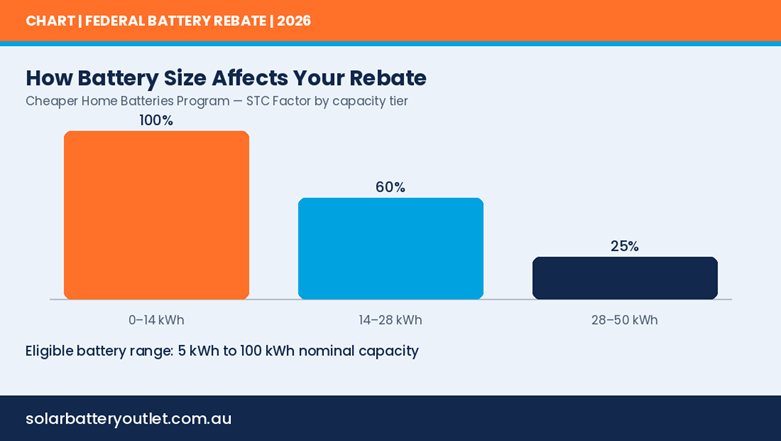
What changed on 1 May 2026: The STC factor dropped from 8.4 to 6.8 per kWh of usable capacity, and a new tiered structure was introduced for larger batteries. Specifically:

  • Tier 1 (0–14 kWh): Full STC rate — approximately $252–$272 per usable kWh in NSW (Zone 3)
  • Tier 2 (14–28 kWh): 60% of the full rate applies
  • Tier 3 (28–50 kWh): Only 15% of the full rate applies

For a standard 10 kWh battery, the current rebate is approximately $2,720 (post-May 2026, at ~$272/kWh). The rebate will step down again on 1 January 2027, so FY2026–27 represents the highest available value under the current schedule. The program runs through 2030.

NSW Rebate Stacking — How to Maximise Your Battery Savings

NSW households can combine several incentives to maximise their savings. By stacking these incentives correctly, you can make one of the smartest financial decisions when investing in home battery storage.

Available NSW Incentive Stack

  • Federal Cheaper Home Batteries Program: ~$2,720 for a 10 kWh system (post-May 2026), applied as a point-of-sale discount by your accredited installer
  • NSW VPP Incentive (PDRS): Up to $1,500 for households who connect their battery to an approved Virtual Power Plant (VPP). Stackable with the federal rebate
  • NSW Home Energy Saver — Interest-Free Loan: Up to $15,000 for eligible households (income under $210,000/yr, repaid over 10 years). A targeted discount of up to $4,000 is available for lower-income households or concession-card holders

An eligible NSW household can access more than $5,720 in combined support by installing a 10 kWh battery, before factoring in any electricity bill savings. Eligibility conditions apply. Speak to an accredited installer or visit energy.gov.au for more details.

Which Strategy Suits Your Household? A Practical FY2026–27 Framework

Not every NSW household benefits from every option. The right strategy depends on your usage pattern, whether you have solar, and what tariff you are currently on. Here is a straightforward framework to guide your decision.

NSW energy plan decision framework Solar Sharer solar battery 2026

Strategy 1 — Solar Sharer Offer Only

Best for renters, apartment residents, or any household without solar panels who can shift appliance use to the 11 am–2 pm window. Running your dishwasher, washing machine, pool pump, or EV charger during the free window is where the savings are. On the Essential Energy TOU tariff, this strategy alone could save up to $211 per year.

Strategy 2 — Existing Solar + Battery

Best for households with an existing solar system that generates strong daytime output. A home battery stores surplus solar generated during the free window and discharges it during the 5–9 pm evening peak—when grid electricity typically costs 36 cents or more per kWh. Consequently, well-sized households can reduce grid dependency by 60–80%.

Strategy 3 — Solar + Battery + SSO (The Optimal Stack)

The most powerful combination for eligible households. During the 11 am–2 pm free window, the battery charges from the grid at zero cost. Any surplus solar is exported to the grid at feed-in tariff rates (currently 4–10 c/kWh across NSW retailers). In the evening, the battery discharges — avoiding peak rates. Joining a VPP adds a potential $1,500 incentive and ongoing grid participation revenue. This strategy delivers the maximum possible reduction in annual electricity bills.

A Real-World NSW Example — The Kumar Family in Parramatta

Consider a four-person household in Parramatta (Endeavour Energy zone) on a TOU standing offer, using 15 kWh per day with most usage in the evenings. Prior to FY2026–27, their annual electricity bill was approximately $2,328 (DMO 7 TOU reference price).

Under DMO 8, their standing-offer TOU price drops by -4.5%, saving approximately $105 per year automatically—without changing a thing.

By switching to the Solar Sharer Offer and shifting their dishwasher, washing machine, and air-conditioner pre-cool to the 11 am–2 pm window (about 3 kWh per day), they capture an additional estimated saving of $130–$180 per year.

They add a 10 kWh solar battery using the federal rebate (~$2,720 discount), reducing their out-of-pocket cost to approximately $5,000–$6,000 after the rebate. Their evening grid draw drops from roughly 9 kWh to 1–2 kWh per night. Annual electricity bill savings from the battery alone are estimated at $800–$1,200, suggesting a payback period of approximately 5–7 years under current tariffs.

This is a simplified illustrative example. Actual outcomes depend on household usage, system size, tariff structure, solar exposure, and other factors. See our contact page to get personalised advice for your home.

The Smart Meter Requirement — What NSW Households Need to Know

Access to the Solar Sharer Offer requires a smart meter. Smart meters record electricity usage at 30-minute intervals and transmit data to your retailer, enabling time-of-use billing. Without a smart meter, TOU plans — including the SSO — are not accessible.

The good news: for most NSW households, smart meter installation is available free of charge through your electricity retailer or distributor. Contact your retailer and ask specifically about smart meter installation ahead of the 1 July 2026 SSO launch. If you are with a retailer offering 10 or fewer customers, they may not be required to offer the SSO, but most major retailers are participating.

Frequently Asked Questions

Do I need rooftop solar to access the Solar Sharer Offer in NSW?

No. The Solar Sharer Offer is available to all NSW households in DMO-regulated zones with a smart meter, regardless of whether you have solar panels. Renters are also eligible.

Is the Solar Sharer Offer free electricity, or are there strings attached?

The SSO provides free electricity between 11 am and 2 pm, up to 24 kWh per day. However, the overall plan cost is calibrated to equal the DMO TOU reference price — meaning rates outside the free window are approximately 1–4 cents per kWh higher than a standard TOU plan. Households that can shift usage to the free window benefit; those who cannot may find a standard market offer more cost-effective.

Can I still claim the federal battery rebate in FY2026–27?

Yes. The Cheaper Home Batteries Program runs through 2030. Post-May 2026, the rebate is approximately $252–$272 per usable kWh for systems under 14 kWh (Zone 3 NSW). The next step-down is 1 January 2027, so the current half-year window offers the highest available rebate in FY2026–27.

Can I stack the federal battery rebate with NSW state incentives?

Yes. The federal Cheaper Home Batteries Program is stackable with the NSW VPP Incentive (up to $1,500) and the NSW Home Energy Saver interest-free loan (up to $15,000 for eligible households). Eligibility conditions apply.

What happens if I use more than 24 kWh during the Solar Sharer free window?

Usage above the 24 kWh daily cap during the free window is charged at the applicable ‘reasonable use rate’, as set out in your Energy Price Fact Sheet. For most households, 24 kWh far exceeds midday consumption, so hitting the cap is unlikely.

How do I compare Solar Sharer plans across retailers?

Use the Australian Government’s free, independent comparison tool at energymadeeasy.gov.au. From July 2026, retailers must list their Solar Sharer Offer plans on the site. Compare the off-peak rates, daily supply charges, and any feed-in tariffs included with the SSO.

Your FY2026–27 Energy Action Plan — 5 Steps
  • Step 1 — Check your smart meter status. Contact your retailer to confirm you have a smart meter, or arrange installation (free for most NSW households).
  • Step 2 — Map your usage pattern. Review your electricity bills from the last three months. If you can shift more than 20–30% of your electricity use to the 11 am–2 pm window, you will likely benefit from the Solar Sharer Offer.
  • Step 3 — Compare plans on Energy Made Easy. Use energymadeeasy.gov.au to compare your current plan against available Solar Sharer offers in your zone.
  • Step 4 — Get at least 3 battery quotes. If you are considering a battery, compare a minimum of three written quotes from accredited installers. Ask each installer to confirm the federal rebate amount, any VPP incentive, and your eligibility for the NSW Home Energy Saver loan.
  • Step 5 — Act before 1 January 2027. The federal battery rebate steps down again on 1 January 2027. If you are ready to proceed, the current second half of FY2026–27 offers the best available rebate under the post-May 2026 schedule.
Ready to Maximise Your NSW Energy Savings in FY2026–27?

Whether you want to understand how the Solar Sharer Offer works for your home, explore the federal battery rebate, or stack NSW incentives for maximum savings — our team is here to help.

Get a Free Quote from Solar Battery Outlet → or call us on 1800 000 777—serving NSW households across Sydney, Parramatta, Newcastle, Wollongong, and regional NSW.

Disclaimer: The figures, savings estimates, rebate amounts, and tariff reductions in this article are illustrative examples only and are not a guarantee of future savings or outcomes. Actual results vary depending on your location, usage pattern, tariff, solar system, battery size, and eligibility for government incentives. Information is accurate at the date of publication and is subject to change. Please seek personalised advice before switching plans or making a purchasing decision.

Short answer: yes. NSW homeowners can access both the federal Cheaper Home Batteries Program and at least one NSW-specific incentive—and in many cases, two. What surprises most people is that these incentives stack. You do not have to choose between them.

However, the two programs work differently, come from different government departments, and have separate eligibility conditions. If you simply ask your installer about ‘the rebate,’ you may only hear about the federal one. This guide explains both, shows you how to stack them, and gives you the numbers you need to make an informed decision.

What Is the Federal Cheaper Home Batteries Program (CHBP)?

The federal Cheaper Home Batteries Program launched on 1 July 2025. It applies nationwide and is delivered through the existing Small-Scale Renewable Energy Scheme (SRES)—the same mechanism that has been funding rooftop solar rebates in Australia for over a decade.

Rather than paying you cash, the program creates Small-scale Technology Certificates (STCs) based on your battery’s usable capacity. Your accredited installer claims these certificates on your behalf and deducts the value from your upfront quote. No paperwork. No waiting. The rebate is already factored into the price you see.

From 1 May 2026, the rebate uses a tiered structure:

  • First 14 kWh of usable capacity: full STC factor at $272 per kWh (May to December 2026)
  • 14 kWh to 28 kWh: STC factor reduced to 60% of the rate
  • 28 kWh to 50 kWh: STC factor reduced to 15% of the rate

For a standard 10 kWh home battery, the rebate works out to approximately $2,720 under the May–December 2026 rate. For a 13.5 kWh system like the Tesla Powerwall 3, the illustrative saving is around $3,674. These figures are based on the STC factor and market price — your installer will confirm the exact amount at the time of installation.

Importantly, the rebate steps down every six months. After 1 January 2027, the rate decreases again. Installing sooner locks in a higher rebate, though the program itself runs until the end of 2030.

Does NSW Have Its Own Battery Rebate on Top of the Federal One?

Yes — but the structure changed significantly in 2025 and 2026. The previous standalone NSW battery rebate (which operated independently of the federal scheme) wound back to avoid overlap once the Cheaper Home Batteries Program launched. What replaced it is actually more valuable for most households, provided you claim both parts.

In 2026, NSW homeowners have access to three state-level incentives that stack on top of the federal rebate:

The NSW Peak Demand Reduction Scheme pays you for connecting your battery to a Virtual Power Plant (VPP). Your battery stays in your home. A VPP is simply a software connection that allows an approved operator to draw a small amount of stored energy during peak demand periods — typically hot summer afternoons when the grid is under pressure.

In return, you receive Peak Reduction Certificates (PRCs). These translate into a cash payment — typically between $400 and $1,500 depending on your battery size. The value is paid upfront through your installer or VPP operator when you connect.

  • Available to all NSW homeowners installing a CEC-approved, VPP-capable battery
  • Stackable directly on top of the federal CHBP rebate
  • Does not require you to stay with a VPP contract — you can leave after the incentive is paid
  • Managed by the NSW Government through IPART and the Electricity Infrastructure Roadmap

On 17 June 2026, the NSW Government launched the $557 million Home Energy Saver program. This is a significant new addition to the incentive stack for NSW residents.

The Home Energy Saver Loan offers an interest-free loan of up to $15,000 for eligible NSW homeowners to install batteries, solar, heat pumps, EV chargers, and other approved energy upgrades. The loan is repaid over 10 years and is available to households with a combined income under $210,000 per year.

  • 0% interest — no fees on the loan itself
  • Up to $15,000 for eligible energy upgrades including solar batteries
  • Income threshold: household income under $210,000 per year
  • Repaid over 10 years — monthly repayments of approximately $125 for a $15,000 loan
  • Can be used to cover the balance after the federal rebate is applied

Alongside the loan, the Home Energy Saver program includes a targeted grant of up to $4,000 for households with an income under $80,000 per year, or those holding a valid concession card. This grant does not need to be repaid and stacks on top of both the federal rebate and the interest-free loan.

For eligible low-income households in areas like Liverpool and Western Sydney, the combined value of the federal rebate, the VPP incentive, and this grant can bring a standard 10 kWh battery installation within reach of $0 upfront.

Federal vs NSW incentive comparison—both programs are designed to stack.

How the NSW + Federal Stack Works in Practice

Here is how the three layers combine for a typical NSW homeowner installing a 10 kWh battery in the second half of 2026. These numbers are illustrative—your actual savings depend on your STC zone, battery size, install date, and eligibility.

Estimated incentive stack for a 10 kWh battery in NSW (2026).

As the chart shows, the federal CHBP alone provides an estimated ~$2,720 in savings for a 10 kWh battery. Stack the NSW VPP incentive on top and the combined savings reach up to $4,220. For households eligible for the targeted grant, savings climb further still.

The key point is that these incentives come from different funding pools. Claiming the federal rebate does not exclude you from the NSW incentives. Your accredited installer handles the CHBP at the point of sale. The VPP incentive is arranged through your VPP operator (which your installer can recommend). The Home Energy Saver Loan is applied for separately through the NSW Government portal.

Who Is Eligible for the NSW Battery Incentives in 2026?

Eligibility for the federal CHBP is straightforward: install a CEC-approved battery (5 kWh to 100 kWh) through an SAA-accredited installer. There is no income test and no application form.

The NSW incentives have additional conditions:

IncentiveEligibilityMax Value
Federal CHBPAll Australians, no income test, 5–100 kWh battery~$2,720 (10 kWh, May–Dec 2026)
NSW VPP / PDRSNSW homeowners with VPP-capable battery, Ausgrid or Endeavour areaUp to $1,500
Home Energy Saver LoanNSW residents, income <$210,000/yrUp to $15,000 (0% interest)
Targeted GrantNSW residents, income <$80,000/yr or concession cardUp to $4,000

Solar Battery Liverpool and Western Sydney: What Local Homeowners Need to Know

For homeowners in Liverpool, Bankstown, Mudgee, and the broader Western Sydney region, the incentive stack is particularly relevant. This area has some of the highest rooftop solar penetration in Australia — and battery attachment rates are rising rapidly as households look to capture more of the energy they already generate.

Liverpool and Bankstown fall within the Ausgrid network area, which means VPP connections qualify for the NSW PDRS incentive. Mudgee falls within the Essential Energy network. VPP eligibility is subject to network operator conditions—your installer can confirm whether your specific address qualifies.

If you are researching solar battery Liverpool options, the key questions to ask any installer are (1) which batteries on their quote are CEC-approved and VPP-capable, (2) which VPP operators they work with, and (3) whether they can register the PDRS incentive on your behalf. A quality installer handles all three as a standard part of the installation process.

The federal rebate applies regardless of your location in NSW. The tiered structure that came into effect on 1 May 2026 means the best rebate-per-dollar value sits in the 10 to 14 kWh range — which also happens to suit most three- and four-bedroom homes in Western Sydney.

Ready to See What Your Stack Looks Like?

Every home is different. The right battery size, the right VPP operator, and the right combination of incentives depend on your electricity usage, your solar system, and your income. The numbers in this article are illustrative — but they give you a realistic picture of what is possible.

Solar Battery Outlet serves NSW homeowners across Liverpool, Bankstown, Mudgee, and the surrounding region. Our team works with CEC-approved batteries and SAA-accredited installers, and we handle the federal rebate, VPP connection, and NSW incentive paperwork as part of every installation.

Get a written quote that shows all applicable incentives—contact Solar Battery Outlet today and we will walk you through the full incentive stack for your home.

Frequently Asked Questions

Can I claim the NSW battery rebate if I already have solar panels?

Yes. The federal CHBP applies to battery-only installations — you do not need to install new solar panels. The NSW VPP incentive also applies to standalone battery installations. If your existing solar system is less than 10 years old and generating well, adding a battery is straightforward.

Is the NSW battery rebate the same as the federal one?

No. They are separate programs. The federal Cheaper Home Batteries Program provides an upfront point-of-sale discount through the STC mechanism. The NSW incentives (VPP incentive and Home Energy Saver Loan) are state-funded and have different eligibility rules. You can claim all of them at the same time.

Does the federal battery rebate apply in NSW?

Yes. The Cheaper Home Batteries Program applies in every Australian postcode including all of NSW. There is no location restriction. The rate varies slightly by STC zone — NSW is in Zone 3, which gives a slightly lower per-kWh rate than Queensland but is otherwise the same program.

What is the best home battery in Australia for the NSW rebate?

Any CEC-approved battery qualifies for the federal rebate. Popular options in NSW include the Tesla Powerwall 3 (13.5 kWh), Sungrow SBR series, BYD Battery-Box, and GoodWe Lynx Home. For the NSW VPP incentive, the battery also needs to be VPP-capable — most modern units are. Your installer can confirm eligibility for your specific model.

Does the federal battery rebate step down in NSW?

Yes. The STC factor steps down every six months under the revised program rules that took effect on 1 May 2026. The next reduction is 1 January 2027. Installing sooner locks in the current (higher) rate, though the program continues until the end of 2030.

Disclaimer—Please note all figures, rebate amounts, savings estimates, and eligibility details in this article are illustrative only and are not a guarantee of outcomes. Actual results vary based on your location, battery size, usage, tariff, and eligibility. Incentive rates change every six months. Please seek personalised advice before making a purchasing decision.
Choosing the right solar system size is one of the biggest decisions a homeowner makes. Go too small, and you will still rely heavily on the grid. Go too big, and you pay for capacity you never use. So, what size actually fits your home?

In 2026, the answer depends on three things: how much electricity you use each day, how much sun your roof receives, and what you plan to add in the next few years. An electric vehicle, a heat pump, or a battery can change the right size dramatically.

This guide walks through the exact formula installers use, a quick sizing table for common household types, real Sydney output data, and the questions to ask before you commit. Whether you are buying your first system or planning to upgrade solar system capacity to support a future battery, the same fundamentals apply.

Start With Your Electricity Bill, Not Your Roof

The most reliable starting point is your actual electricity usage, not roof size or budget. Your bill shows total kilowatt-hours (kWh) used over the billing period. Divide that figure by the number of days to get your daily average.

Most Australian households use between 12 and 30 kWh per day. Smaller, energy-efficient homes sit at the lower end. Larger households, or homes with a pool, electric hot water, or an EV, sit much higher. If possible, use a full 12-month average rather than a single quarter, because summer and winter usage can differ by 30 percent or more.

Once you have your daily average, the sizing formula is straightforward. Multiply your daily usage by 1.25 to account for system losses. Then divide by your area’s peak sun hours. The result is your minimum recommended system size in kilowatts.

Quick Sizing Table for Common Australian Households

Every home is different, but these ranges give a solid starting point. They reflect typical Sydney conditions, where peak sun hours average around 3.9 to 4.5 hours per day, slightly lower than Brisbane or Perth.

Recommended solar system size by household type, 2026

Why 6.6kW Remains the Most Popular Choice in 2026

A 6.6kW system has been Australia’s most common residential install for several years, and 2026 is no exception. It suits most three to four-person households, fits comfortably on a standard roof, and strikes a good balance between cost and output.

In Sydney, a north-facing 6.6kW system produces roughly 26 to 32 kWh per day on average, though output swings noticeably with the seasons. Summer days can push generation toward 32 to 36 kWh, while shorter winter days bring it down closer to 20 kWh.

Seasonal output of a 6.6kW system, Sydney NSW

When Bigger Makes Sense: EVs, Heat Pumps and Batteries

A common mistake is sizing for today’s usage only. Many households add an electric vehicle, heat pump hot water, or a battery within a few years of installing solar, and then wish their system were larger.

An EV typically adds 8 to 10 kWh per day for an average commute, pushing many households from the 6.6kW range into 8.8kW or 10kW territory. Heat pump hot water adds a smaller but steady load, often 2 to 4 kWh per day.

If you are planning to add a battery later, oversizing your solar array slightly now gives the battery more surplus midday energy to store. Households exploring solar battery Liverpool options, for example, often find that pairing a 10kW solar array with a 10kWh battery captures far more value than a smaller array paired with the same battery, simply because there is more excess solar to redirect into storage rather than exporting it for a low feed-in tariff.

Roof Space, Orientation and the 13.3kW Ceiling

Each modern panel needs around 1.7 square metres of roof space. A 6.6kW system needs roughly 16 to 17 panels, while a 10kW system needs around 24 panels. Most homes have enough roof area, but orientation matters more than total space.

North-facing panels produce the most energy in Australia. East and west-facing arrays produce 15 to 20 percent less, but splitting panels across both sides of a dual-pitch roof can smooth your generation curve across the day, which is useful if you use more power in the morning and evening.

If your household needs more than 6.6kW, the next decision is whether to upgrade to three-phase power, which opens access to larger single inverters above 10kW, or install two separate inverter systems to reach similar capacity without rewiring your switchboard. According to the Clean Energy Council, a CEC-accredited installer should always confirm your switchboard capacity before recommending a system above 10kW.

A Simple Framework for Choosing Your System Size

Use these four steps before requesting quotes. Each step takes only a few minutes and helps you compare installer recommendations with confidence.

  1. Calculate your baseline. Use your 12-month average daily usage, not a single bill.
  2. Apply the formula. Multiply by 1.25, then divide by your area’s peak sun hours.
  3. Add future loads. Factor in an EV, heat pump, or battery you may add within five years.
  4. Round to a standard size. Most installers offer set sizes like 5kW, 6.6kW, 8.8kW, 10kW, or 13.3kW.

Frequently Asked Questions

Is 6.6kW enough for an average Australian home?

Yes, for most three- to four-person households using 16 to 24 kWh per day, a 6.6kW system comfortably covers daytime usage and offers reasonable winter output. Households planning a battery or EV often choose 8.8kW or 10kW instead.

How many solar panels do I need for a 10kW system?

With standard 400W to 440W panels, a 10kW system typically needs around 23 to 25 panels, requiring approximately 39 to 43 square metres of roof space, depending on the exact panel wattage chosen.

Can I oversize my solar system if I plan to add a battery later?

Yes, and it is often recommended. A larger solar array generates more midday surplus, which a future battery can store and use overnight, improving the overall value of both the solar and battery investment.

Does roof orientation change what size system I need?

Yes. East or west-facing roofs produce 15 to 20 percent less than north-facing roofs. If your roof is not north-facing, you may need to size up slightly to reach the same daily output as the sizing table suggests.

Disclaimer: The figures, savings estimates, system sizes, battery capacities, payback periods, and rebate amounts mentioned in this article are provided as illustrative examples only and are not a guarantee of future performance or savings. Actual outcomes vary depending on your location, electricity usage, tariff, solar generation, battery configuration, eligibility for government incentives, and other household-specific factors. Please seek personalised advice before making a purchasing decision.
A practical, numbers-first guide for NSW homeowners weighing up a home battery in 2026

Every NSW homeowner researching solar batteries eventually runs into the same headline: “save up to $1,100 a year.” It sounds promising, but it also raises an obvious question — is that figure realistic for your home or just a marketing average? In 2026, with electricity prices climbing and battery rebates shifting, that question matters more than ever.

This guide breaks down exactly where the $1,100 figure comes from, how it changes depending on your battery size, household usage, and tariff plan, and what the real 10-year savings picture looks like once rebates, bill savings, and avoided peak charges are combined. We’ll also walk through a worked example using actual NSW electricity rates so you can sense-check the numbers against your own bill.

If you’re comparing options for solar batteries NSW wide, or specifically researching a solar battery Liverpool installers can supply and fit, the framework below applies regardless of postcode—only the inputs (your usage, your tariff, your roof) change.

Where Does the “$1,100 a Year” Figure Actually Come From?

The $1,100 number isn’t pulled from thin air, but it also isn’t a guarantee. It typically represents the combined effect of three separate savings streams working together over a full year:

  • Avoided peak import charges—using stored solar instead of grid power during the 3pm–9pm peak window, when NSW time-of-use rates often sit between 40 and 55 cents per kWh.
  • Higher solar self-consumption — instead of exporting excess solar for a low feed-in tariff, the battery stores it for later use, effectively converting a 5–8 cent export credit into a 30+ cent saving.
  • Reduced reliance on the grid during outages or price spikes — particularly relevant as wholesale prices become more volatile.

Independently, the New South Wales government’s home battery rebate explainer for the Cheaper Home Batteries Program confirms that NSW households can stack the federal rebate with the state’s VPP incentive, which is the second half of the savings equation alongside ongoing bill reductions.

For a household with average NSW consumption (around 14–16 kWh per day) and a 10kWh battery, the combined annual bill savings typically land between $950 and $1,200, depending on tariff structure and how much solar is already being self-consumed before the battery is installed.

Breakdown of where annual battery savings and year-one incentives come from for a typical 10kWh NSW system

The 2026 Rebate Landscape: Why Timing Still Matters

From 1 May 2026, the federal Cheaper Home Batteries Program moved to a tiered structure. Batteries up to 14kWh continue to receive the full STC rate, currently around $252 to $272 per usable kWh, while capacity between 14kWh and 28kWh receives roughly 60% of that rate, and capacity beyond that drops further still. For most NSW homes, a battery in the 10–14kWh range remains the sweet spot for rebate value.

On top of the federal rebate, NSW homeowners can apply for the Peak Demand Reduction Scheme (PDRS) VPP incentive, worth up to $1,500 when a battery is connected to an approved virtual power plant. Combined, a 10kWh battery installed in 2026 can attract a federal rebate of roughly $2,520, plus the VPP incentive, for a total reduction in upfront cost approaching $4,000.

None of this changes the underlying running-cost savings discussed in this article — those depend on your usage and tariff, not the rebate. But the rebate does affect how quickly your system pays for itself, which is why timing your install before further STC step-downs (the next is scheduled for January 2027) can meaningfully shorten your payback period.

A Worked Example: 10kWh Battery, Average NSW Household

Let’s use a realistic household profile. According to NSW energy data, the average household electricity bill currently sits around $1,800 to $1,900 per year, with a typical usage rate of roughly 30 to 34 cents per kWh and many homes now on time-of-use tariffs where peak rates climb above 40 cents.

Consider a household with 6.6kW of rooftop solar and a 10kWh battery added in 2026. Before the battery, this home self-consumes roughly 35% of its solar generation and exports the rest at a low feed-in tariff. After the battery is installed, self-consumption typically rises to 70–80%, because the battery soaks up midday solar surplus and discharges it during the evening peak instead of drawing from the grid.

Running the numbers across a full year produces three savings categories that, added together, comfortably reach the $1,100 mark in homes with above-average evening usage, and sit closer to $850–950 for smaller households. The breakdown image above shows the typical split: roughly $620 from avoided peak imports, $310 from improved solar self-consumption, and $95 from reduced reliance on the daily supply charge during outages or low-generation days.

It’s worth being transparent here: these figures will not be identical for every home. A single-person household using 7–8 kWh per day will see proportionally smaller savings, while a larger family running air conditioning, an EV charger, and a pool pump during peak hours could exceed $1,300 annually.

The 10-Year Picture: When Does a Battery Actually Pay for Itself?

Annual savings are useful, but the real question most homeowners want answered is payback time. Using the $1,025/year average from our worked example, and assuming a net system cost (after rebates) of roughly $5,000 to $7,000 for a 10kWh battery added to existing solar, payback typically falls between 5 and 7 years. Most home batteries carry a 10-year warranty, meaning the system continues delivering savings well past the point it has paid for itself.

The chart below shows cumulative bill savings over a 10-year period at the $1,025/year rate, excluding the one-off rebate already banked in year one. By year 10, cumulative bill savings alone exceed $10,000 — and that’s before accounting for the likelihood that electricity prices, and therefore savings, will continue rising over that period.

Cumulative bill savings over 10 years for a 10kWh battery paired with rooftop solar in NSW

A Simple Framework to Estimate Your Own Savings

Rather than relying on a generic average, you can estimate your own potential savings in four steps. This framework mirrors the approach used by energy analysts when calculating real bill impact rather than theoretical kWh totals.

  1. Find your actual evening usage. Pull a recent bill and identify how much electricity you use between 3pm and 9pm — this is the window a battery primarily offsets.
  2. Check your time-of-use rate for that window. Multiply your average evening kWh usage by your peak rate (often 40–55c/kWh) to estimate your current peak spend.
  3. Estimate your battery’s usable discharge. A 10kWh battery typically delivers 8–9kWh of usable evening discharge per day after accounting for depth-of-discharge limits and standby losses.
  4. Multiply and annualise. Multiply your usable discharge by your peak rate, then by 365 days, to estimate annual peak-avoidance savings. Add your expected solar self-consumption uplift (usually $250–$400/year) for a total estimate.

This four-step approach consistently produces estimates within 10–15% of actual post-installation savings reported by NSW households, making it a far more reliable starting point than a flat headline figure.

Common Mistakes That Inflate or Deflate Battery Savings Estimates

  • Ignoring tariff structure. A flat-rate tariff produces very different savings to a time-of-use tariff, sometimes by a factor of two.
  • Assuming 100% battery efficiency. Real-world round-trip efficiency for most lithium batteries sits between 85% and 95%, which should be factored into any estimate.
  • Overlooking export tariff changes. Some NSW retailers now apply negative feed-in tariffs during solar-flush periods, which increases the relative value of storing solar rather than exporting it.
  • Comparing battery size to roof size, not usage. A larger battery only delivers proportionally larger savings if your evening usage is high enough to draw down that extra capacity each day.

Getting these details right is where working with an experienced, CEC-accredited installer makes a measurable difference — not just in installation quality, but in correctly sizing the system to your actual usage pattern rather than a generic recommendation.

Frequently Asked Questions
Is the $1,100 a year savings figure realistic for most NSW homes?

It’s realistic for households with above-average evening electricity use and a 10kWh or larger battery on a time-of-use tariff. Smaller households or those on flat tariffs may see figures closer to $700–$950 per year, while larger households with high peak-period consumption can exceed $1,100.

How is battery savings different from solar savings?

Solar savings come from generating your own electricity during the day. Battery savings come from storing that solar for use later, particularly during the evening peak when grid electricity is most expensive. The two work together, but a battery specifically targets the gap between cheap daytime solar and expensive evening grid power.

Does the rebate change reduce my ongoing savings?

No. The May 2026 changes to the Cheaper Home Batteries Program affect the upfront rebate amount, particularly for batteries over 14kWh, but they don’t change how much you save on your electricity bill each year. Ongoing savings depend entirely on your usage and tariff, not the rebate structure.

How long does a home battery take to pay for itself?

Based on current rebate levels and average NSW usage, most 10kWh batteries reach payback within 5 to 7 years, with a typical 10-year warranty meaning several years of savings continue after the system has paid for itself.

Do I need a specific tariff plan to benefit from a battery?

A time-of-use tariff generally maximises battery savings because it creates a larger gap between cheap off-peak rates and expensive peak rates. However, batteries still provide savings on flat tariffs through improved solar self-consumption, just at a slightly lower rate.

Get Your Personalised Savings Estimate

The numbers in this guide are based on average NSW usage patterns, but your actual savings depend on your roof, your bill, and how your household uses electricity. At Solar Battery Outlet, we use your real usage data to model expected savings before you commit to a system size — so you know what to expect, not just a headline figure.

Whether you’re comparing solar batteries NSW-wide or you’re specifically after a solar battery Liverpool homeowners can have installed quickly, our team can walk you through current rebate eligibility, VPP options, and a savings estimate based on your own electricity bill—not an industry average.

Data used in this from these links:

cheaper-home-batteries

eligibility-information

average-electricity-bill-nsw

For the first time in years, NSW households are opening their electricity bills and seeing a number that has actually gone down. From 1 July 2026, the Australian Energy Regulator confirmed price cuts of up to 10.7 percent on standard offers across New South Wales, with similar falls in South East Queensland. After several years of steep increases, this is welcome news — and it is not happening by accident.

Behind this shift sits one technology more than any other: the home solar battery. As hundreds of thousands of batteries plug into the grid each year, they soak up cheap daytime solar power and release it during expensive evening peaks. This reduces strain on the network, lowers wholesale prices, and ultimately flows through to everyone’s bill—whether or not they own a battery themselves.

In this guide, we will break down exactly why electricity prices are falling in 2026, what role solar batteries play in that shift, the real numbers behind NSW pricing changes, and how homeowners considering solar batteries NSW can position themselves to benefit from both falling grid prices and remaining rebates.

The 2026 Turning Point: Electricity Prices Are Finally Falling

For most of the past five years, Australian households have braced for annual price increases. That trend reversed in 2026. The Australian Energy Regulator’s final Default Market Offer determination for 2026–27, released in late May 2026, confirmed that residential flat-rate prices in NSW will fall between 3.4 and 5.0 percent from 1 July, while time-of-use customers in NSW could save up to 7.5 percent. South East Queensland recorded the largest single drop at 7.2 percent, while South Australia was the only region to see a small increase of 1.4 percent.

The regulator pointed to three drivers behind the fall: lower wholesale electricity contract prices, reduced spot price volatility, and a meaningful increase in output from wind and battery generation during the evening peak. Put simply, when batteries—both household and grid-scale—release stored solar power exactly when demand spikes, expensive gas generators are needed less often, and wholesale prices come down for everyone.

NSW and SE QLD residential price changes, AER DMO 2026-27

How Solar Batteries Are Reshaping the Grid — And the Price You Pay

One in three Australian homes already has solar panels, but historically, only a small fraction had a battery to store that energy. That is changing fast. The federal Cheaper Home Batteries Program has already supported around 250,000 home battery installations since its launch, and the expanded budget — now $7.2 billion over four years — is expected to bring more than two million Australians into battery ownership by 2030, adding roughly 40 gigawatt hours of storage to the grid.

Why does this matter for prices? During the day, rooftop solar floods the grid with cheap power, sometimes pushing wholesale prices toward zero or even negative. In the evening, demand spikes just as solar generation drops off, traditionally forcing the grid to rely on costly gas peaking plants. Home batteries break this pattern. They store the midday surplus and discharge it during the evening peak, smoothing out the daily price curve. Industry analysts now describe this shift plainly: it is renewables, firmed by batteries, that increasingly set the price of power, not gas.

For households running a solar battery Liverpool installation or anywhere across Southwest Sydney, this means two things at once: your own bill drops because you are using stored solar instead of buying grid power at peak rates, and the broader grid becomes more stable because fewer homes are drawing power simultaneously during the 5 pm to 9 pm crunch.

What This Means for Your Household Savings

For a typical NSW household, three separate savings streams are now stacking together, and understanding each one helps you see the full financial picture rather than focusing on a single rebate figure.

1. Automatic bill reductions from 1 July 2026. Even households without a battery will see lower default electricity rates simply because the AER has reset the benchmark pricing downward.

2. The federal battery rebate. From 1 May 2026, the Cheaper Home Batteries Program discount sits at roughly $252 per usable kilowatt-hour for most standard batteries, applied as an upfront price reduction on your installation quote — no separate claim required.

3. The NSW VPP incentive. The NSW Peak Demand Reduction Scheme adds up to $1,500 on top for households that connect their battery to a virtual power Plant — a separate state-level incentive that runs independently of the federal rebate.

Three stacking savings sources for NSW solar battery households in 2026

Combined, these three elements can cut the upfront cost of a solar battery system by around $2,000 to $3,500 for an average NSW household. This estimate does not include the ongoing savings from using stored solar energy instead of grid electricity at night. If you’re deciding whether to install now or wait for future rebate changes, compare these potential savings with your electricity bills before making a decision.

Real-World Example: A Liverpool Household Switching to Solar-Plus-Battery

Consider a household in Liverpool, NSW, with a 6.6kW solar system and a quarterly electricity bill of about $450. After installing a 10kWh battery, the home can reduce evening grid usage significantly. Instead of sourcing 60% to 70% of evening power from the grid, it may draw less than 15%, with the battery supplying energy for cooking, lighting, and household appliances.

Layer on the falling NSW default market. Offer rates from July 2026, and the household benefits twice over: the electricity they still buy from the grid costs less per kilowatt-hour than it did a year earlier, and they are buying far less of it overall. For households exploring options through a solar battery Liverpool installer, this combination—falling grid rates plus a battery that minimises grid reliance — is exactly the scenario the 2026 policy settings were designed to encourage.

Why This Trend Is Likely to Continue Beyond 2026

Three long-term trends suggest prices will continue to fall. First, the federal battery rebate remains available until 2030. This will support battery adoption, even as the rebate gradually decreases every six months. Second, regulators and network operators are introducing new tariffs to ease grid demand. One example is the Solar Sharer Offer, which provides three hours of free electricity during the middle of the day.

Third, battery costs continue to decline as global manufacturing expands. This improves the economics of home energy storage, even without government incentives. Together, these trends are creating a grid that relies more on distributed batteries and less on gas generation. As a result, households with battery storage are likely to see the greatest benefits.

A Simple Framework: Should You Add a Battery Now?

Rather than reacting to deadline pressure, walk through these four checks before deciding on timing.

  1. Check your evening usage. If most of your electricity use happens after 5 pm, a battery has the most to work with.
  2. Confirm your solar system’s health. A battery only stores what your panels generate, so an underperforming system should be assessed first.
  3. Compare written quotes. Get at least three quotes that show the federal rebate as a dollar deduction, not a verbal promise.
  4. Ask about VPP eligibility. Confirm your installer will register your system for the NSW VPP incentive at installation.
Why are NSW electricity prices falling in 2026 after years of increases?

The Australian Energy Regulator’s 2026–27 Default Market Offer reflects lower wholesale electricity costs, reduced price volatility, and higher output from wind and battery generation during peak periods. Together, these factors have lowered the benchmark used to calculate household electricity bills.

Do I need a solar battery to benefit from the lower electricity prices?

No. The Default Market Offer price reduction applies to all households, regardless of battery ownership. Battery owners can save even more by using stored energy during evening peak periods. This reduces the amount of electricity they need to buy from the grid.

Is the federal battery rebate still worth claiming after May 2026?

Yes. The rebate is available until 2030 and currently provides around $252 per usable kilowatt-hour. The value decreases every six months, so applying sooner can secure a higher discount. However, it will continue to offer significant upfront savings beyond 2026.

How much can a home battery realistically save on an NSW electricity bill?

Savings vary based on battery size and evening energy use. However, households that rely on stored solar power for most of their evening consumption can cut grid electricity usage by 50% to 80%. These savings come in addition to the lower electricity rates introduced in July 2026.

Sources & Data References

If you are a NSW homeowner with solar panels, you have almost certainly asked this question: Should you install a battery now, or wait another year for prices to fall? It sounds like a simple cost-benefit decision. In reality, the answer involves several moving parts—hardware trends, government rebates, import costs, and your household’s own usage pattern.

This article cuts through the noise. It draws on data from CSIRO’s GenCost report. It also uses BloombergNEF’s 2025 Energy Storage Outlook and the Australian Government’s updated Cheaper Home Batteries Program. Together, these sources show where battery prices are heading. They also explain what that means for your timing decision.
Home battery storage costs 2026 Australia – decision guide for NSW homeowners

What Has Happened to Battery Prices So Far?

The short version is that prices have fallen dramatically over the past five years. According to BloombergNEF, lithium battery costs declined by more than 40% between 2020 and 2025 globally. In Australia specifically, CSIRO’s GenCost 2025–26 draft report confirmed residential battery storage costs dropped 11 to 16% in 2024–25 alone. Furthermore, an even steeper 40% drop was recorded from 2023 to 2024.

To put that into dollar terms: the average installed cost of a 10 kWh residential battery in Australia currently sits at around $8,650 after the federal rebate, compared to well over $12,000 just three years ago. For homeowners researching the best home batteries Australia has to offer, this downward trend is genuinely significant.

Solar battery price per kWh Australia 2021 to 2026 trend chart

So Will Costs Drop Further in 2026?

Yes — but the picture is more nuanced than a simple ‘wait and save more’ conclusion.

On the hardware side, the outlook is positive. BloombergNEF expects lithium battery pack prices to fall by 8–12% through late 2026. Expanding manufacturing capacity is a key reason. Increased use of lithium iron phosphate (LFP) batteries is also helping. Supply chains have become more stable since 2024. CSIRO projects battery storage costs of $484 per kWh by 2030. That is down from $525 per kWh in 2025.

However, two factors are pushing back against those hardware savings for Australian buyers in 2026.

Factor 1: The Chinese Export VAT Change

In April 2026, China reduced its VAT rebate on battery exports from 9% to 6%. That 3-percentage-point cut increases the cost of imported battery components by roughly 3%, and industry analysts expect it to flow through to Australian installed prices within one to two months. The same rebate is scheduled for complete removal in January 2027, which could add a further 6% at the import stage.

For small- to mid-size batteries (5–10 kWh), the projected decline in hardware costs should offset this. For larger systems above 14 kWh, the combination of tiered rebates and higher import costs means the net price direction is less favorable than the headline hardware trend suggests.

Factor 2: The Rebate Steps Down — And Keeps Stepping

This is the factor most homeowners underestimate. The federal Cheaper Home Batteries Program is not ending — it runs to 2030, with the total program funding expanded to an estimated $7.2 billion. However, from 1 May 2026, the rebate structure changed in two important ways.

First, the STC factor dropped from 8.4 to 6.8. For a standard 10 kWh battery, that translates to approximately $530 less rebate. For batteries above 14 kWh, the new tiered structure means the reduction is considerably larger — between $1,000 and $1,800 or more, depending on size.

Second, and this is the part fewer people are talking about: from May 2026 onward, rebate values step down every six months rather than annually. That means the rebate is structurally programmed to shrink twice per year from this point forward.

The practical takeaway is clear: even if hardware costs fall 8% in the next 12 months, a homeowner who waits may find that the rebate reduction over the same period cancels out — or exceeds — those hardware savings.

Should I buy a home battery now or wait – decision guide 2026

The Numbers: What a NSW Homeowner Can Expect to Pay in 2026

Below is a realistic snapshot of what NSW homeowners are paying for installed battery systems in June 2026, post-rebate. These figures are drawn from current market data and exclude switchboard upgrades or additional backup wiring.

The Decision Framework: Should You Buy Now or Wait?

Rather than giving a one-size-fits-all answer, the most useful thing this article can do is give you a structured way to assess your own situation. Work through the following checkpoints honestly.

Decision guide for NSW homeowners considering home battery storage in 2026

Act Before the Next Rebate Step-Down If:

  • You have already obtained three or more written quotes and are ready to proceed.
  • Your planned battery is 10 kWh or larger, where the tiered rebate reduction has the most financial impact.
  • Your household uses the majority of its power in the evenings, after solar generation stops.
  • Your existing solar system is under ten years old and generating reliably.
  • You plan to enrol in a Virtual Power Plant (VPP) — NSW VPP incentives can add up to $1,500 on top of the standard rebate.

Take Your Time If:

  • You are still researching brands, sizes, or installers and have not yet compared quotes.
  • Your battery plan is under 5 kWh, where the hardware cost decline is likely to outpace the rebate reduction over the short term.
  • Your solar system is more than ten years old and may need servicing or replacement before adding storage makes sense.
  • Your daytime electricity usage is high — meaning you may already be consuming much of your solar output directly.

One important point worth emphasising: installers in NSW report that booking calendars filled rapidly ahead of the May 2026 rebate change. If you are considering a mid-2026 installation, getting onto a waiting list sooner rather than later is practical advice regardless of your timing decision.
What about solar battery NSW Markets?

For homeowners in south-western Sydney and areas like Liverpool, Bankstown, and Campbelltown, the same national pricing dynamics apply. However, there are a few local factors worth noting.

First, installation costs in Greater Sydney tend to be slightly higher than in regional NSW due to labour rates and parking/access considerations. This makes the upfront rebate value proportionally more significant for metro homeowners, since you are starting from a higher baseline cost.

Second, feed-in tariffs in the Ausgrid and Endeavour Energy network areas are now as low as 4–6 cents per kWh for excess solar exports. That gap between what you earn from exporting (4–6c) and what you pay to buy power back at night (30–35c) is exactly the economic case for solar battery Liverpool homeowners—and it is growing rather than shrinking.

If you are on a time-of-use tariff in NSW, a well-sized home battery storage system can shift almost all of your expensive peak consumption to free solar energy, making the payback calculation considerably more favorable than the headline figures suggest.

A Real-World Example: The Mathers Family, Penrith

To make the numbers concrete, consider a typical four-person household in western Sydney. They have a 6.6 kW solar system installed in 2021, pay approximately $2,400 per year in electricity bills despite having solar, and use most of their power between 5 pm and 10 pm.

Battery installed (10 kWh, mid-2026): The upfront cost is approximately $8,500 after rebate. Annual bill savings estimated at $1,100–$1,400 based on current Ausgrid tariff rates. Payback period: approximately 6–7 years. VPP enrolment could reduce payback to 5 years.

If they wait until 2027, Hardware cost savings of roughly $400–$600. Rebate reduction of approximately $400 (next step-down). Chinese VAT removal adds ~$300 to import costs. Net position: roughly similar or slightly worse out-of-pocket, plus 12 more months of high evening bills ($1,200+ missed savings).

The maths does not always favor waiting—especially once you factor in the electricity savings you forgo during the waiting period.

What the Experts Are Saying About Prices to 2030

CSIRO’s GenCost 2025–26 draft report is the most authoritative domestic source on battery cost trajectories. Its findings confirm that battery technologies continue to show significant double-digit cost reductions, while noting that large-scale solar has seen its first price rise in three years.

For residential storage specifically, CSIRO projects two-hour battery storage capital costs will reach $484 per kWh by 2030 under a current-policies scenario—down from $525 per kWh in 2025. In a faster-decarbonisation scenario, costs could fall to $358 per kWh by 2050.

BloombergNEF’s 2025 Energy Storage Outlook adds global context: average battery pack prices are expected to approach $80 per kWh at the pack level by 2026, roughly half of what they were in 2023. That said, pack-level costs do not translate directly to Australian installed residential prices, which include inverter hardware, installation labour, certifications, and grid connection charges.

What to Do Next

You have done the reading. Now it is time to do the numbers for your specific home.

Will home battery storage costs continue to fall through 2026?

Yes, but modestly. Hardware costs are projected to decline 8–12% year-on-year. However, the rebate step-downs and Chinese VAT changes partially offset those savings for Australian buyers. Small batteries (5–10 kWh) remain the sweet spot where hardware declines outpace rebate reductions.

How much does a 10 kWh battery cost in NSW right now?

As of June 2026, the average installed cost for a 10 kWh residential battery in NSW sits between $8,000 and $10,000 after the federal rebate. The exact figure depends on brand, installer, and whether any additional work (switchboard upgrade, backup wiring) is needed.

Is the federal battery rebate ending soon?

No. The Cheaper Home Batteries Program runs until 2030, backed by $7.2 billion in expanded funding. However, the rebate amount steps down every six months from May 2026. It does not end — but it does keep getting smaller, which means earlier installations attract a larger discount.

What are the best home batteries Australia currently recommends?

The most commonly recommended brands by NSW installers in 2026 are the Tesla Powerwall 3, Sungrow SBR, BYD Battery-Box, and Alpha ESS Smile-5. Each suits different budgets and system sizes. The best choice depends on your inverter compatibility, backup requirements, and long-term warranty support.

Does a battery make sense if I already use most of my solar during the day?

In that case, the financial return is lower than for households that shift a significant load to the evening. However, a battery can still provide value through VPP enrollment, blackout protection, and bill stability as grid electricity prices continue to rise. The honest answer: get a quote and review your usage profile with a qualified installer before deciding.

What is a virtual power plant, and how does it affect payback?

A Virtual Power Plant (VPP) connects your battery to a network of other home batteries, allowing the operator to dispatch small amounts of energy during grid demand peaks. In return, you receive bill credits or annual payments typically ranging from $200 to $600. In NSW, the government also offers a separate VPP incentive of up to $1,500 on eligible systems, which can reduce your payback period by 12–18 months.

Electricity bills have climbed steadily in New South Wales over the past few years, and the pressure falls hardest on households that can least afford it. If your income is low, fixed, or government-supported, going solar can feel like a luxury that other people can access—not you.

That assumption is wrong. In 2026, a set of overlapping federal and NSW programs actively reduces what low-income households pay to go solar, both upfront and on an ongoing basis. Moreover, most of these programs ask for no income test at all. You simply need to meet basic eligibility criteria and use an accredited installer.

This article walks you through every relevant program, who qualifies, how much you can realistically save, and how to stack them together for maximum benefit. Whether you are in the south-west suburbs—where homeowners are searching for solar panels in Liverpool—or anywhere else in the state, these programs apply to you.

Why Solar Is Now Genuinely Accessible for Low-Income NSW Households

Five years ago, the upfront cost of a solar system was the single biggest barrier for households on lower incomes. A decent 6.6 kW system cost $6,000 to $8,000 before any incentives. A battery added another $10,000 to $14,000.

Two things have changed significantly since then. First, the cost of solar panels and batteries has dropped sharply — a 6.6 kW panel system now typically costs between $4,000 and $6,000 installed in NSW. Second, the government incentive stack has grown considerably. Between federal rebates on both panels and batteries, ongoing bill credits, and NSW-specific programs, eligible households can now reduce their upfront solar costs by thousands of dollars.

Furthermore, the programs below do not require you to be earning very little. Several have no income test at all — they are available to any homeowner who uses an approved installer and an eligible product. Others require only a valid Pensioner Concession Card, Health Care Card, or equivalent. The key is knowing which programs exist and how to combine them.

The Six Key Programs That Lower Your Upfront Solar Costs in NSW

NSW solar program comparison — Bill Relief Programs vs Upfront Cost Programs for low-income homeowners in 2026

NSW households in 2026 can access two types of support: ongoing bill credits that reduce what you pay each quarter, and upfront rebates that reduce what you pay to install solar in the first place. Both matter, and they can often be combined.

1. The NSW Low Income Household Rebate — $285 Per Year

This is the core ongoing support program for eligible NSW households. If you hold a Pensioner Concession Card, Health Care Card, Low Income Health Care Card, or a DVA Gold Card, you can apply for a credit of $285 per year applied directly to your electricity bill.

The rebate is applied as a daily credit on each quarterly bill. It continues for as long as you hold the relevant concession card and remain named on the account. Retail customers apply through their electricity retailer; embedded network customers apply through Service NSW.

This is not a one-off payment — it keeps reducing your bills year after year. And importantly, you can receive this rebate at the same time as solar savings. The two do not cancel each other out.

Apply via your electricity retailer or Service NSW. For more details, visit energy.nsw.gov.au/households/grants-rebates/low-income-household-rebate

2. The Federal Energy Bill Relief Fund — $150 Total

The Australian Government is providing a direct bill credit to all residential electricity customers — no application needed and no concession card required. The credit appears automatically as two separate $75 payments on your electricity bill across the financial year.

Because it applies automatically, there is nothing to do except make sure your account details are current with your retailer. This credit does not affect any other rebate or solar incentive you may be receiving.

3. The Family Energy Rebate — Up to $250 Per Year

If you receive the Low Income Household Rebate and also receive Family Tax Benefit Part A or Part B from Centrelink, you may qualify for the Family Energy Rebate on top of it. The rebate pays up to $250 per year, or a smaller supplementary amount if you are already receiving the full Low Income Household Rebate.

The program specifically supports families with dependent children who already receive government income support. Eligible families can combine both rebates and receive the $285 household rebate along with the family supplement at the same time.

4. The STC Solar Rebate — Upfront Discount on New Panels

The federal Small-scale Technology Certificate (STC) scheme is the main mechanism by which all new solar installations in NSW receive an upfront rebate. There is no income test. Any homeowner who installs Clean Energy Council-approved panels with an accredited installer qualifies.

Your installer applies the STC rebate as an upfront discount rather than paying it as cash. This discount reduces the total system cost at purchase. The rebate value depends on your system size, location, and the current STC price. For a typical 6.6 kW system in NSW, installers usually apply a discount of $1,500 to $2,500.

Because the rebate value decreases each year until the scheme closes in 2030, acting sooner means a higher discount. However, the drop is gradual rather than sudden, so there is no panic deadline.

5. The Cheaper Home Batteries Program — ~30% Off Your Battery

Since 1 July 2025, the federal government’s Cheaper Home Batteries Program has delivered roughly a 30% upfront discount on eligible battery installations across Australia. This program also works through the STC mechanism, so the discount is applied at the point of sale. Again, there is no income test — any homeowner, any income level, qualifies.

For a standard 10 kWh battery installed between May and December 2026, the rebate is approximately $252 per usable kWh, putting the total discount at around $2,520 for a 10 kWh system. The discount reduces gradually over time as part of a step-down schedule that continues until 2030.

From 1 May 2026, the program also introduced a tiered structure for larger batteries. Systems up to 14 kWh of usable capacity receive the full per-kWh rate. Capacity between 14 kWh and 28 kWh receives 60% of that rate. Capacity above 28 kWh drops to 15%. For most residential households — particularly those focused on solar panels Sydney NSW or similar urban settings with typical evening usage — a 10–13 kWh battery hits the sweet spot for maximum rebate value.

6. The NSW VPP Incentive — Up to $1,500

The NSW Peak Demand Reduction Scheme pays a one-off incentive for households that connect their battery to an approved Virtual Power Plant (VPP). Under a VPP arrangement, your battery’s stored energy can be drawn on by the grid during periods of high demand, which helps stabilise the network.

In exchange, participating households receive a financial incentive — currently up to $1,500 depending on the VPP provider and the prevailing Price Relief Credits (PRC) rate. This stacks directly on top of the federal cheaper home batteries rebate.

Critically, this incentive is for grid-connected homes only. Off-grid households are not eligible for the VPP component, though they can still access the federal battery rebate.

Quick-Reference: Who Qualifies for Each Program

Quick-reference eligibility table for NSW low-income solar programs in 2026

The table above confirms a key point worth repeating: the largest upfront savings — the STC solar rebate, the Cheaper Home Batteries Program, and the NSW VPP incentive — have no income test at all. This means that even if your household income is moderate, you still access these three programs in full.

For households holding a Pensioner Concession Card or Health Care Card, the Low Income Household Rebate and potentially the Family Energy Rebate add meaningful ongoing savings on top of the upfront discounts. The programs complement each other rather than compete.

How to Stack These Programs — A Real-World Example

Step-by-step stacking guide for NSW solar programs — pensioner example in South West Sydney, 2026

Let’s put concrete numbers to this. Consider a pensioner homeowner in South West Sydney — the sort of household that regularly asks about solar panels Bankstown or Liverpool — who wants to install a 6.6 kW solar panel system with a 10 kWh battery.

Without any incentives, this system might cost approximately $13,000 to $15,000 installed. After stacking all eligible programs, the picture changes dramatically:

  • Step 1 — STC rebate on solar panels: approximately $2,000 upfront discount applied at point of sale
  • Step 2 — Cheaper Home Batteries Program: approximately $2,520 off the 10 kWh battery
  • Step 3 — NSW VPP incentive: up to $1,500 for connecting to an approved Virtual Power Plant
  • Step 4 — Low Income Household Rebate: $285 per year ongoing credit on electricity bills

Combined, that is roughly $6,000+ in upfront savings, bringing a $14,000 system down to approximately $8,000 before any further negotiation on installer pricing. Additionally, the $285 per year ongoing credit continues reducing annual electricity costs for as long as the household holds a valid concession card.

The actual payback period then shortens considerably. After the loan or upfront payment is covered, the battery and solar system together can reduce electricity bills by $1,500 to $2,500 per year, depending on usage patterns and tariff structure.

Note: All figures are approximate and depend on system size, installer pricing, and the current STC market value. Always request itemised written quotes that show rebates as line-item deductions.

What Happened to the ‘Rebate Swap for Solar’ Program?

Several readers ask about the NSW Rebate Swap for Solar offer, which previously allowed eligible pensioners to swap their Low Income Household Rebate in exchange for a free 3 kW solar system installed on their home.

That specific program has now ended and is no longer accepting applications. However, the programs described above have largely replaced and exceeded its value. The Cheaper Home Batteries Program alone delivers more savings than the old swap offer did, and without requiring you to forfeit your ongoing rebate.

Similarly, the NSW Empowering Homes Program — which offered interest-free loans of up to $14,000 for solar-battery systems — has closed to new applications. In its place, the federal Cheaper Home Batteries Program delivers an equivalent or greater upfront benefit for most households, with no loan to repay.

Five Things to Check Before You Sign Anything

Understanding the programs is half the battle. The other half is making sure your installer applies them correctly. Here is what to look for before you commit to any installation:

  • The rebate must appear on your written quote as a dollar deduction — not as a verbal promise. If an installer says ‘the rebate is included’ but cannot show you the line item, ask for a revised quote before proceeding.
  • Verify your installer’s SAA accreditation number at saaustralia.com.au. Rebates are only valid for systems installed by accredited professionals using CEC-approved equipment.
  • Confirm a specific installation date in writing — not just a contract signing date. For battery rebates, the rebate rate is locked in on the date of physical installation and commissioning.
  • Ask whether the battery is on the CEC Approved Battery List. Only listed products qualify for the federal Cheaper Home Batteries rebate.
  • If you are interested in the VPP incentive, ask your installer which VPP providers they work with and what the current incentive rate is. Rates vary between providers.

What Happens to Your Feed-In Tariff?

A feed-in tariff is the rate your electricity retailer pays you for excess solar energy your system exports back to the grid. It is separate from the rebates described above and does not affect your eligibility for any of them.

In NSW during 2025–26, electricity retailers set their own feed-in tariff rates. Most offer between 5 and 12 cents per kWh. While lower than a decade ago, these rates still provide useful bill credits. Households that export more solar energy can benefit the most. This is especially true for people away from home during the day.

If you add a battery, your solar export volume will likely decrease. More solar energy is stored for use later. This reduces the amount sent back to the grid. However, self-consumed electricity is often worth 30 cents or more per kWh. For most households, this leads to greater overall savings despite lower feed-in credits.

For more information on current NSW feed-in tariff rates, visit the NSW Government’s energy comparison website at energymadeeasy.gov.au

Frequently Asked Questions

Can I receive the Low Income Household Rebate and the STC solar rebate at the same time?

Yes. These are separate programs administered by different levels of government. The Low Income Household Rebate applies to your ongoing electricity bill; the STC rebate reduces the upfront cost of installing solar. They do not interact with each other, and you can receive both simultaneously.

Is there an income limit for the Cheaper Home Batteries Program?

No. The federal Cheaper Home Batteries Program has no income test. It is available to any Australian household, business, or community organisation that installs an eligible battery system through an accredited installer. You do not need a concession card or a low income to qualify.

What if I am renting? Can I still access these programs?

The upfront solar rebates (STC and Cheaper Home Batteries) apply to the property owner, not the tenant. If you are renting, you generally cannot access them unless your landlord agrees to install a solar system. However, the Low Income Household Rebate and Energy Bill Relief Fund credits apply to the electricity account holder, who can be a tenant. If you hold an eligible concession card and your name is on the electricity account, you can access those bill credits regardless of whether you own or rent.

How long does the cheaper home batteries program run?

The federal program is scheduled to continue until 2030, with the rebate value stepping down gradually each six months as battery prices fall and the subsidy phases out. There is no hard cutoff date, but acting earlier in the program’s life means accessing a higher per-kWh rebate.

Does adding a battery affect my low-income household rebate?

No. Your Low Income Household Rebate is based on your concession card status and account holder details — not on whether you have solar or a battery. Installing a solar-battery system does not change your eligibility for ongoing bill rebates.

See What You Qualify For — Free, No Obligation

At Solar Battery Outlet, we install solar panels and batteries for NSW homeowners across Liverpool, Bankstown, and the surrounding South West Sydney region. Every quote we provide is written, itemised, and shows all applicable rebates as line-item deductions—so you can see exactly what you are paying and what you are saving.

We work with concession card holders regularly, and we can tell you in plain language which programs apply to your situation, what the total saving looks like, and whether a battery makes financial sense for your home before you commit to anything.

If you are shopping for a solar battery in NSW, the most common question is also the most important one: what size do you actually need? Buying too small means your battery fills up early and you still pay peak rates for evening electricity. Buying too large means you spend thousands more upfront — and a portion of that battery capacity sits idle every day.

This guide breaks down the three most common residential battery sizes — 10 kWh, 13 kWh, and 20 kWh — and shows you exactly which one suits which household. We cover real costs, rebate entitlements, annual savings, and payback periods for NSW homeowners in 2026.

First, understand what battery capacity actually means.

Battery capacity is measured in kilowatt-hours (kWh). One kWh is roughly what a typical split-system air conditioner uses in 30 minutes, or what a fridge uses in about 7 hours. Therefore, a 10 kWh battery holds ten times that amount of stored energy.

However, the number on the box is not always the number you can use. Most batteries have a usable capacity of 90–100% of their rated storage — this is called the depth of discharge (DoD). For example, a BYD Battery-Box 10 kWh has 100% usable capacity, while some older models only allowed 80%.

When comparing quotes, always ask about usable capacity — not just the headline figure.

How Much Power Does a NSW Home Use Each Evening?

To size a battery correctly, you need to know how much electricity your household draws after sunset — typically from around 4 pm to 10 pm. This is the window when electricity costs the most in NSW, particularly if you are on a time-of-use tariff.

Here is how NSW households break down by daily evening usage:

  • 1–2 person household: 7–12 kWh per day total, with roughly 5–8 kWh used after 4 pm
  • 3–4 person household: 15–22 kWh per day total, with 8–14 kWh used after 4 pm
  • 4–6 person household with EV or pool: 25 kWh+ per day, with 14–20 kWh after 4 pm

The goal is to match your battery’s usable capacity to your evening demand. A battery that runs out by 8 pm is undersized. A battery that still has 60% charge remaining at midnight is oversized for your situation.

Battery Size Comparison: 10 kWh vs 13 kWh vs 20 kWh

Solar battery size comparison table NSW

The table above summarises the key numbers. However, the figures are estimates based on typical NSW installations — your actual quote will depend on your solar system, switchboard condition, and installer. Always get three written quotes before committing.

For detailed information on government rules affecting your installation, the new 2026 installation requirements for NSW homeowners cover what has changed and what your installer must comply with.

The 10 kWh Battery: Who Is It Best For?

A 10 kWh battery is the entry-level option for most NSW homeowners — and for the right household, it is also the most cost-effective. At a net cost of roughly $6,500–$7,500 after the 2026 federal rebate, it delivers a solid payback without the larger upfront investment.

This size suits you well if:

  • Your household has 1–2 people, or 3 people who are home and using power during the day
  • Your total daily electricity use is under 15 kWh
  • You already have a 5–6.6 kW solar system
  • Your main goal is to reduce your evening electricity bill, not full energy independence
  • You are on a standard tariff rather than a time-of-use plan with high peak rates

The 10 kWh category includes popular models such as the BYD Battery-Box 10 kWh and various Sungrow and Growatt options. These batteries are widely available, well-supported, and CEC-approved — which matters if you want to access the federal rebate and the NSW VPP incentive.

One important consideration: if you plan to add an electric vehicle within the next few years, a 10 kWh battery will likely feel undersized. Charging an EV overnight typically adds 8–15 kWh of demand on its own.

The 13 kWh Battery: The NSW Sweet Spot

For most NSW families, the 13–13.5 kWh range is the practical sweet spot. This is the size tier where the federal rebate provides the most benefit relative to capacity, where annual savings are substantial, and where the payback period remains manageable.

The Tesla Powerwall 3 (13.5 kWh) sits squarely in this category and remains the most popular single-unit residential battery in NSW. The BYD Battery-Box 13.8 kWh is a strong alternative, offering a slightly larger capacity at a competitive price point.

This size suits you well if:

  • Your household has 3–4 people with typical appliance use
  • Your daily electricity consumption is between 15–25 kWh
  • You have a 6.6–10 kW solar system
  • You run the dishwasher, washing machine, and AC during peak evening hours
  • You want a comfortable energy buffer without a premium price

At a net cost of approximately $7,500–$9,500 after rebates, the 13 kWh option offers annual savings of $1,100–$1,600 for a typical NSW family — giving a payback period of around 6–8 years. That is a strong result by any measure.

It is also worth noting that the 13 kWh size tier falls within the most favourable portion of the federal Cheaper Home Batteries Program rebate structure. For specifics on which batteries qualify for the 2026 federal rebate in NSW, including eligible brands and models, check the full eligibility list.

Matching Battery Size to Your Household: A Quick Reference

Decision guide — which solar battery size suits your NSW household, 10kWh, 13kWh or 20kWh

The decision guide above makes the size decision straightforward. Furthermore, keep in mind that the right battery size is not just about your current usage — it is about where your household is heading over the next 3–5 years.

If you are planning to switch to an electric vehicle, install an induction cooktop, or add more occupants to the house, factor that future demand into your decision now. Upgrading a battery system later involves additional labour and potential equipment costs.

The 20 kWh Battery: When Bigger Makes Sense

A 20 kWh battery is not for everyone — and that is by design. However, for a specific type of NSW homeowner, it is genuinely the right call rather than an oversized purchase.

This size suits you well if:

  • Your household has 4–6 people with high appliance usage
  • You own or plan to own an electric vehicle
  • You have a pool, home office, or other high-draw equipment
  • Blackout protection and energy independence are a priority
  • You have a 10–13 kW solar system that generates surplus power daily

The 20 kWh tier typically requires either two battery units stacked together (for example, two BYD 10 kWh batteries) or a single large-format unit designed for residential or light commercial use. Installation costs are proportionally higher, and the switchboard may need upgrading depending on your home’s existing electrical capacity.

Moreover, from 1 May 2026, the federal rebate structure introduced tiered support — which means larger batteries above 14 kWh attract a smaller proportional subsidy than before. Consequently, the relative financial case for a 20 kWh battery is slightly less favourable than it was pre-May. That said, if your household genuinely needs the capacity, the payback still stacks up.

Solar battery payback period by size NSW 2026 — 10kWh, 13kWh, 20kWh estimated years to payback

As the chart shows, all three sizes deliver a reasonable payback period in NSW — typically 6 to 9 years. The exact figure depends on your electricity tariff, your evening usage pattern, and whether you participate in the NSW Virtual Power Plant (VPP) incentive through the Peak Demand Reduction Scheme.

Importantly, VPP participation adds $300–$1,000+ in annual earnings on top of your bill savings. For solar batteries NSW-wide, that additional income can shave 1–2 years off the payback period. Ask your installer whether the battery they are recommending is VPP-compatible.

What Affects Your Battery’s Actual Performance in NSW?

Choosing the right size is only part of the equation. Even with the perfect capacity, your battery will underperform if the following factors are not in order.

Your solar system’s output

A battery only charges from excess solar production. If your panels are aged, shaded, or undersized, they will not generate enough surplus to fill the battery each day. Before adding storage, ask your installer to assess your current solar system’s performance. The

Before adding storage, ask your installer to assess your current solar system. The CER registration rules for NSW solar panel installers explain the credentials your installer must hold for the installation to qualify for rebates.

Your tariff type

On a flat tariff, a battery saves you the difference between what you would have paid for grid electricity and what it cost to generate solar. On a time-of-use tariff — which many NSW households are now on — the savings are larger, because you avoid paying 45–55 cents per kWh during peak evening hours. The higher your peak rate, the faster your battery pays back.

Installation quality

A properly installed battery on a compatible solar system outperforms a poorly installed one regardless of size. Wiring standards matter — the battery wiring standard in Australia sets out what a compliant installation must include. Make sure your installer follows AS/NZS 3000 and the relevant clean energy installer requirements.

Rebates Available in NSW in 2026: What You Can Stack

NSW homeowners in 2026 can access two separate incentives — and they stack together, which makes a significant difference to the net cost.

  • Federal Cheaper Home Batteries Program (CHBP): Approximately $302–$372 per kWh of usable capacity, applied as an upfront discount at the point of installation. For a 10 kWh battery, this is roughly $3,100–$3,700. For a 13 kWh battery, roughly $4,200–$4,800.
  • NSW Peak Demand Reduction Scheme (PDRS) VPP Incentive: Up to $1,500 when you connect your battery to an approved Virtual Power Plant. The exact amount depends on your battery size. You must use an Accredited Certificate Provider.

Combined, these two incentives can reduce your net cost by $4,000–$5,500 on a typical 10–13 kWh system. That is a meaningful contribution to payback, and it is available right now regardless of when you install — as long as you use a CEC-accredited installer and an eligible battery.

Quick Checklist: Before You Choose a Battery Size

Before you sign anything, work through these five checks. They take 10 minutes and will save you from buying the wrong size.

  • Check your last 12 months of electricity bills. Look at your total daily usage and identify how much you draw after 4 pm. Your retailer’s app or your smart meter data will show this.
  • Find out what solar system you have. Note the total panel capacity (kW) and the inverter size. A 5 kW inverter may not support a 20 kWh battery without an upgrade.
  • Ask whether your switchboard needs upgrading. Some older NSW homes need a switchboard upgrade before a battery can be safely added. This adds $500–$1,500 to the project cost and should appear on your written quote.
  • Confirm the battery is CEC-approved and VPP-capable. Both are required to access the federal rebate and the NSW PDRS incentive, respectively.
  • Get three written quotes. Size recommendations vary between installers. If one quote recommends a 10 kWh system and another recommends 20 kWh for the same home, ask both to justify the recommendation with your actual usage data.

Frequently Asked Questions

Is a 10 kWh battery enough to run a typical NSW home overnight?

It depends on your evening usage. A 10 kWh battery is sufficient for a 1–2 person household or a family that uses most of its power during the day. For a 3–4 person family running AC, the dishwasher, and the TV from 4 pm onwards, 10 kWh will often run out before midnight. In that case, 13 kWh is a safer choice.

Does the federal rebate cover the full cost difference between a 10 kWh and 13 kWh battery?

Not entirely. The rebate is calculated per kWh of usable capacity — so a 13 kWh battery attracts a larger absolute rebate than a 10 kWh battery. However, the total installed cost of the 13 kWh system is also higher. The net cost difference between the two is typically $1,000–$2,500 after rebates.

Can I install two 10 kWh batteries instead of one 20 kWh unit?

Yes. Many NSW homeowners choose to install one 10 kWh or 13 kWh battery initially, then add a second unit later as demand grows. However, adding a second battery in a future installation involves additional labour costs compared to installing both at once. If you know your usage is high, installing the full capacity upfront is usually the better financial decision.

How does my solar panel size affect which battery I should choose?

Your solar panels charge your battery. A 5 kW solar system in NSW typically generates 18–22 kWh on a good day. After powering daytime loads, it might produce 8–12 kWh of surplus available to charge a battery. Therefore, installing a 20 kWh battery on a 5 kW solar system means the battery will rarely be fully charged, which reduces your annual savings and stretches the payback period.

Do all battery sizes qualify for the NSW VPP incentive?

The PDRS VPP incentive applies to batteries connected to an approved Virtual Power Plant provider. The incentive value scales with battery size, with larger systems receiving up to $1,500. However, the battery must be VPP-capable (able to discharge to the grid on demand) — not all models support this. Ask your installer specifically about VPP compatibility before purchasing.

If you have received a quote for a solar battery recently, you may have noticed a line called the ‘federal rebate’ or ‘government rebate’ reducing the total price. That is not marketing spin. It is a real, government-backed mechanism called the Small-Scale Technology Certificate scheme — and in 2026, it is one of the most valuable financial tools available to NSW homeowners installing a battery.

This article explains, in plain English, exactly what STCs are, how they are calculated, what they are worth in 2026, and — most importantly — how they end up saving you money before you ever hand over a cent.

In plain English: STCs are government certificates created when you install an eligible battery. You assign them to your installer, who sells them — and that sale is deducted from your invoice as an upfront discount.

You never touch the certificates yourself. Your installer does the work. You just pay less.

What Are STCs, Really?

STC stands for Small-Scale Technology Certificate. You will also hear them called ‘the solar rebate’, ‘the federal rebate’, or simply ‘the government discount’. Technically, they are none of those things — but they function exactly like one.

STCs are part of Australia’s Renewable Energy Target, administered under the Small-scale Renewable Energy Scheme (SRES). The scheme has existed since 2011, originally to make rooftop solar more affordable. From 1 July 2025, it was expanded under the federal Cheaper Home Batteries Program to also cover eligible home battery systems.

When you install an eligible battery, your installation generates a set number of certificates. Those certificates have a dollar value. You assign your right to those certificates to your accredited installer. The installer sells them, and the proceeds are passed back to you as a deduction on your quote. The end result is a lower price on the day you pay.

How Are STCs Calculated for a Battery?

How STCs reduce your solar battery cost

The number of STCs your installation generates depends on two things: the usable capacity of your battery in kilowatt-hours (kWh), and the STC factor that applies on the date of installation.

The STC Factor

The STC factor is a multiplier set by the government. It determines how many certificates are created per kWh of usable battery capacity. It is designed to step down over time as battery costs fall — the idea being that the rebate reflects how much financial help is needed, not a fixed handout.

The formula is straightforward:

Number of STCs = Usable kWh × STC Factor (rounded down to the nearest whole certificate)

From 1 May 2026, a tiered STC factor applies for batteries above 14 kWh of usable capacity. This is how it works:

This tiering means a 20 kWh battery does not simply get twice the STCs of a 10 kWh battery — it gets 14 kWh worth at full factor, then 6 kWh at 60% of factor. The total is still significant, but it is worth understanding the structure before assuming proportional savings.

What Is Each STC Worth?

The value of each individual STC fluctuates with the open market. The government purchases STCs from the STC Clearing House at a fixed administrative price, which provides a floor. In practice, STCs for batteries have traded close to the clearing house price.

As of mid-2026, each STC is worth approximately $28 to $30. Your installer will give you the exact amount when they prepare your written quote, as they deal with the certificates directly on your behalf.

How Much Will STCs Actually Save You?

Estimated STC value by battery size NSW 2026- Comparison

To put the numbers in perspective, a standard 10 kWh home battery installed in NSW after May 2026 generates approximately 68 STCs (10 × 6.8 = 68). At roughly $28 each, that is around $1,904 in certificate value — deducted from your invoice before you pay.

For a larger 13.5 kWh system, the saving rises to around $2,576 at the same rate. These are not small numbers. They represent a meaningful reduction off the total installed cost of a battery that might otherwise sit at $10,000 to $14,000 before any incentives.

How Does the STC Saving Actually Show Up on Your Quote?

This is where things get practical. When you receive a written quote from an accredited installer, the STC value should appear as a separate line item — a deduction from the gross price. The quote should show you:

  • Gross cost of the battery and installation
  • STC deduction (shown as a dollar amount, not a vague ‘rebate’)
  • Net cost — what you actually pay

The reason it works this way is that you are technically transferring your legal right to create and trade those certificates to your installer. They do the paperwork through the Clean Energy Regulator’s REC Registry. They handle the compliance requirements — including the photo documentation requirements introduced in early 2026. In return, they pass the value back to you upfront, rather than making you wait for a government reimbursement.

If you want to understand the compliance requirements your installer must meet, our guide on new government rules for solar battery installations in 2026 covers this in detail.

Does the STC Scheme Apply to All Batteries?

No. Not all batteries qualify. To generate STCs, a battery system must meet the eligibility criteria under the Cheaper Home Batteries Program. The key requirements are:

  • The battery must be installed and commissioned by an accredited installer
  • The battery must appear on the Clean Energy Council’s approved products list
  • The usable capacity must not exceed 50 kWh
  • The installation must comply with all relevant Australian Standards
  • The installer must register the installation with the Clean Energy Regulator

If any of these conditions are not met — for example, if the installer is not properly accredited or the battery model is not on the approved list — no STCs are generated and no discount applies. This is another reason why installer quality matters as much as product quality.

How Does the STC Factor Change Over Time?

STC factor decline timeline 2025 to 2030 — bar chart showing how the solar battery rebate tapers over time in Australia

The STC factor for batteries reduces every six months under a schedule set by the government. The principle is simple: as battery costs fall over time, the government support tapers proportionally. The scheme is designed to wind down by 2030.

What this means for homeowners is that the longer you wait, the lower the STC value on your installation. Each six-month period that passes reduces the certificates available — and therefore the upfront saving on your battery cost.

The scheme is not ending abruptly. It is tapering gradually. But that taper is real money. Homeowners installing solar batteries NSW-wide in 2026 are still accessing a significant incentive — one that will be noticeably smaller by 2028.

Can You Stack STCs With Other Incentives?

Yes — and this is where the full picture becomes compelling. STCs are a federal scheme. They sit alongside, not instead of, state-level incentives that NSW homeowners can also access.

  • NSW Peak Demand Reduction Scheme (PDRS): Up to $1,500 for connecting your battery to a Virtual Power Plant (VPP)
  • VPP monthly payments: Ongoing income from your battery participating in grid support programs
  • Time-of-use tariff savings: Storing cheap solar energy and using it during peak tariff periods
Stacking example: 10 kWh battery installed in NSW, June 2026.
STC deduction off invoice: ~$1,904
NSW PDRS incentive (if VPP-connected): up to $1,500
Combined upfront benefit: up to ~$3,400
That is before any ongoing savings on your electricity bills.

Do You Need to Do Anything to Claim STCs?

In most cases, NO. The standard process is:

  1. Your installer confirms you are eligible and includes the STC deduction in the written quote.
  2. You sign the assignment agreement — typically a single form included with your contract.
  3. The installer completes the installation, takes the required compliance photos, and submits the STC application to the Clean Energy Regulator.
  4. The certificates are registered and sold. You have already received the value as a discount on your invoice.

You can also choose to create and trade STCs yourself through the REC Registry — but the vast majority of homeowners choose to assign them to their installer for simplicity.

For more on what the Clean Energy Regulator now requires at installation — including photo documentation — see our article on CER registration rules for NSW solar panel installers.

Frequently Asked Questions
Are STCs the same as the NSW state battery rebate?

No. STCs are a federal mechanism, separate from any state programs. In NSW, state incentives like the Peak Demand Reduction Scheme are additional to STCs, not a replacement. You can claim both if you are eligible for both.

Do STCs apply to battery-only installations (no solar panels)?

Yes. Since 1 July 2025, STCs apply to eligible standalone battery installations — you do not need to be installing solar panels at the same time. This is a significant change from the earlier scheme.

What happens if I already have solar panels — do I still get STCs for adding a battery?

Yes. Adding a battery to an existing solar system qualifies for its own STC entitlement under the Cheaper Home Batteries Program. The battery STCs are calculated independently of any STCs that were claimed when you originally installed your solar panels.

Does the wiring standard affect whether my installation qualifies?

Yes — indirectly. Your installation must comply with AS/NZS 5139 and related Australian Standards. Non-compliant wiring can mean the installation fails CER registration, which means no STCs. This is another reason to choose an accredited installer who knows the current standards.

When does the STC scheme end?

The Cheaper Home Batteries Program’s STC component runs until 2030. The factor tapers every six months, so the longer you wait, the smaller the saving — but the scheme does not switch off overnight.

If you have been comparing solar quotes recently, you may have noticed that some installers clearly explain government rebates while others provide little detail. The reason often comes down to whether the installer is registered and approved under the Clean Energy Regulator (CER) requirements.

New rules introduced across 2025 and 2026 have tightened the requirements around who can legally install a solar system and claim the rebate on your behalf. For NSW homeowners — whether you are in Liverpool, Bankstown, or anywhere else in the state — this directly affects whether you receive your full entitlement, whether your installation is safe, and whether it will pass inspection.

This guide outlines the CER registration rules, explains why regulators introduced them, and shows you what to check before signing a contract with a solar installer.

What Is the CER and Why Does It Set the Rules?

The Clean Energy Regulator is the Australian Government body responsible for administering the Small-scale Renewable Energy Scheme (SRES) — the program that funds the rebate that reduces the upfront cost of solar panels and batteries for homes across Australia.

When a solar installer completes a job, they do not just put panels on your roof and leave. To trigger your rebate, they must create Small-scale Technology Certificates (STCs) in the government’s REC Registry. Those certificates are only valid — and your rebate is only real — if the installer meets a specific set of CER registration requirements at the time of installation.

The CER does not just set these rules once and walk away. It actively monitors compliance, suspends installers who breach the rules, and publishes regular compliance updates. As of the most recent update covering January to March 2026, the CER permanently suspended one registered person (Phenix Trading Pty Ltd) following regulatory action in NSW and Victoria — a reminder that enforcement is real and ongoing.

SAA accredited vs unaccredited solar installer NSW comparison

The Core Rule: Only SAA Accredited Installers Can Legally Claim Your Rebate

The single most important requirement is this: your solar system must be designed and installed by a Solar Accreditation Australia (SAA) accredited installer. This is not optional or a formality — it is a hard legal requirement under the Renewable Energy (Electricity) Regulations.

Solar Accreditation Australia (SAA) took over the accreditation role from the Clean Energy Council in 2024. As of 2024, only SAA accredited designers and installers can interact with the CER’s Small-scale Renewable Energy Scheme. Any installer claiming to offer you a rebate without holding a current SAA accreditation number is not legally able to do so.

To hold SAA accreditation, an installer must:

  • Hold an unrestricted electrician’s licence in the relevant state or territory
  • Complete an approved solar training course for their accreditation category
  • Complete a minimum of 100 continuing professional development (CPD) points every 12 months
  • Carry current public liability insurance
  • Comply with SAA guidelines, Australian Standards, and all relevant regulations

SAA requires accredited installers to maintain their skills through annual CPD training and may suspend or de-accredit those who fail to comply with Australian standards.

The 5 CER Registration Rules That Apply to Your Installation in 2026

Beyond SAA accreditation, the CER now requires installers and solar businesses to follow specific rules for registering, documenting, and reporting solar installations. Here is what every NSW homeowner should understand.

5 CER registration rules your solar panel installer in NSW

Rule 1 — SAA Accreditation Is Mandatory, Not Optional

As covered above, this requirement forms the foundation of STC eligibility. Every system claiming STCs must have an SAA-accredited installer complete the installation. The installer must be physically present on site, as phone-based supervision or remote oversight does not meet the requirement. SAA requires accredited installers to supervise installations on site and follow its installation rules.

Rule 2 — All System Components Must Be on the CEC Approved List

Your solar panels and inverters must appear on the Clean Energy Council’s approved products list. This list is maintained and updated by the CEC. Installing panels or inverters that are not on this list means your system is not eligible for STCs — regardless of who installs it. A legitimate installer will only quote products that are currently on the approved list and will confirm this if you ask. If you are looking at a home solar panel system Liverpool quote or anywhere else in NSW, this is one of the first things to verify.

Rule 3 — Geotagged, Time-Stamped Photo Evidence Is Now Required

From 1 March 2026, the CER introduced a new mandatory photo requirement for all solar and battery installations. Every installation must be accompanied by geotagged, time-stamped photographic evidence confirming that the system complies with Australian Standard labelling requirements.

Authorities introduced this requirement specifically to address the issue of non-compliant battery labelling identified across numerous installations. An accredited installer will build this documentation into their standard process. If an installer seems unaware of this requirement or dismisses it, that is a significant warning sign.

Rule 4 — VPP-Capable Inverter Required for Battery Installations

For any installation that includes a solar battery, the inverter must be technically capable of participating in a Virtual Power Plant (VPP) and must communicate using appropriate protocols (the CSIP-AUS standard). You do not have to actually join a VPP — but the system must have the technical capability. This requirement affects which inverters are eligible, and an accredited installer will be across it when specifying your system.

Rule 5 — The NSW CER Installer Portal (From Mid-2026)

The NSW Government is launching a new centralised CER Installer Portal that will replace manual entry into AEMO’s DER Register. From mid-2026, all solar and battery installers in NSW must use this portal to register every new installation. The portal covers all three NSW distribution networks — Ausgrid, Endeavour Energy, and Essential Energy — and automatically confirms that each system meets national technical standards.

As a homeowner, you do not interact with the portal yourself — your installer does. However, a legitimate accredited installer will be fully aware of this requirement. An installer who seems unfamiliar with the CER portal should prompt caution when you are getting quotes for solar panels Bankstown, Liverpool, or any other part of NSW.

How to Verify Your Installer Before You Sign Anything

Knowing the rules is useful. Knowing how to check that your installer actually follows them is what protects you. Here is a practical guide to verifying any installer before you commit.

solar panel installer credentials NSW green and red flags

Step 1: Ask for the SAA Accreditation Number

Every SAA accredited installer has a publicly listed accreditation number. Ask for it — and then check it yourself at saaustralia.com.au. This takes under two minutes and tells you whether the accreditation is current, what category it covers (grid-connected PV, battery, standalone), and whether it is in good standing.

Step 2: Confirm Products Are on the CEC List

Ask the installer which solar panels and inverters they included in the quote, then verify those products in the Clean Energy Council’s approved products database. If you find that the products are not on the approved list, you could lose access to government rebates before the installation even begins.

Step 3: Ask How They Handle the CER Photo Requirements

A compliant installer will know exactly what you mean when you ask about the March 2026 photo requirements. They should be able to explain that they take geotagged, time-stamped photos at each installation phase as a standard part of their compliance process. Vagueness here is a red flag.

Step 4: Get Everything in Writing Before You Sign

The rebate should appear as a dollar figure on your written quote — not mentioned verbally and applied later. A legitimate installer will provide a written quote you can take home, compare, and consider. If anyone pressures you to sign on the day without providing a written quote, walk away. This applies whether you are looking at a home solar panel system in Liverpool, Bankstown, or anywhere else in NSW.

Why These Rules Exist — And Why They Protect You

It is worth being direct about something: these CER registration rules are not bureaucratic red tape. They exist because there has been a documented pattern of non-compliant installations in the Australian solar market — installers cutting corners on labelling, incorrect system sizing, products that do not meet Australian standards, and in some cases, outright fraud in the STC system.

When you choose a properly registered installer, you are not just protecting the rebate. You are protecting the investment itself — the panels on your roof, the system’s performance over its 25-year design life, and the safety of your home.

If you are planning a full solar panels installation in NSW and want to understand the complete picture — from system sizing to battery storage options — the same rules apply. Every component of a compliant installation, from panels to batteries, must be covered by an accredited installer.

Frequently Asked Questions

How Can I Check Whether My Solar Installer Holds SAA Accreditation?

Go to saaustralia.com.au and use the accreditation search. Enter the installer’s name or accreditation number. The result will show you the current accreditation status, the type of accreditation held (e.g. Grid-Connected PV, Battery), and whether it is currently active. Always verify this before signing any quote, whether you are getting a home solar panel system or solar panel installation services in Bankstown.

Can an unaccredited installer do the work if an accredited person signs off on it?

The CER and SAA are explicit: the accredited person must be present on site for the installation. Supervision must be on site and in accordance with SAA rules. Remote sign-off or paper-based oversight does not satisfy the requirement. If an installer’s arrangement does not meet this standard, any STCs created may be invalid.

Does the accreditation requirement apply to solar panel-only systems, or just batteries?

Both. SAA accreditation is required for both solar PV installations and battery installations under the SRES. The category of accreditation differs (Grid-Connected PV vs Battery), but the core requirement — that only accredited installers can legally create STCs — applies to all system types claiming government rebates.

What if my installer says they will handle the accreditation paperwork themselves?

The installer handling the rebate paperwork (STC assignment) is standard practice and expected. What you want to verify is that they hold the accreditation themselves — not that someone else on the paperwork does. Ask for their SAA number and verify it directly. The paperwork process is separate from the accreditation requirement.

Will the CER registration rules change again after mid-2026?

The CER regularly updates its compliance requirements as part of its annual enforcement priorities. The core requirement for SAA accreditation is unlikely to change. However, documentation requirements, photo evidence standards, and portal registration processes are updated periodically. A reputable installer stays current with these updates as part of their ongoing CPD requirements.

DATA SOURCES & REFERENCES

Small-scale renewable energy systems: https://cer.gov.au/schemes/renewable-energy-target/small-scale-renewable-energy-scheme/small-scale-renewable-energy-systems

Solar battery installers and designers: https://cer.gov.au/schemes/renewable-energy-target/renewable-energy-target-participants-and-industry/solar-battery-installers-and-designers

Clean Energy Regulator—Compliance update January to March 2026: https://cer.gov.au/about-us/our-compliance-approach/compliance-and-enforcement-priorities/compliance-and-enforcement-priorities-2025-26/compliance-update-january-to-march-2026

Clean Energy Council — Approved Products List: https://www.cleanenergycouncil.org.au/industry-advocacy/renewable-energy-systems/approved-products

php