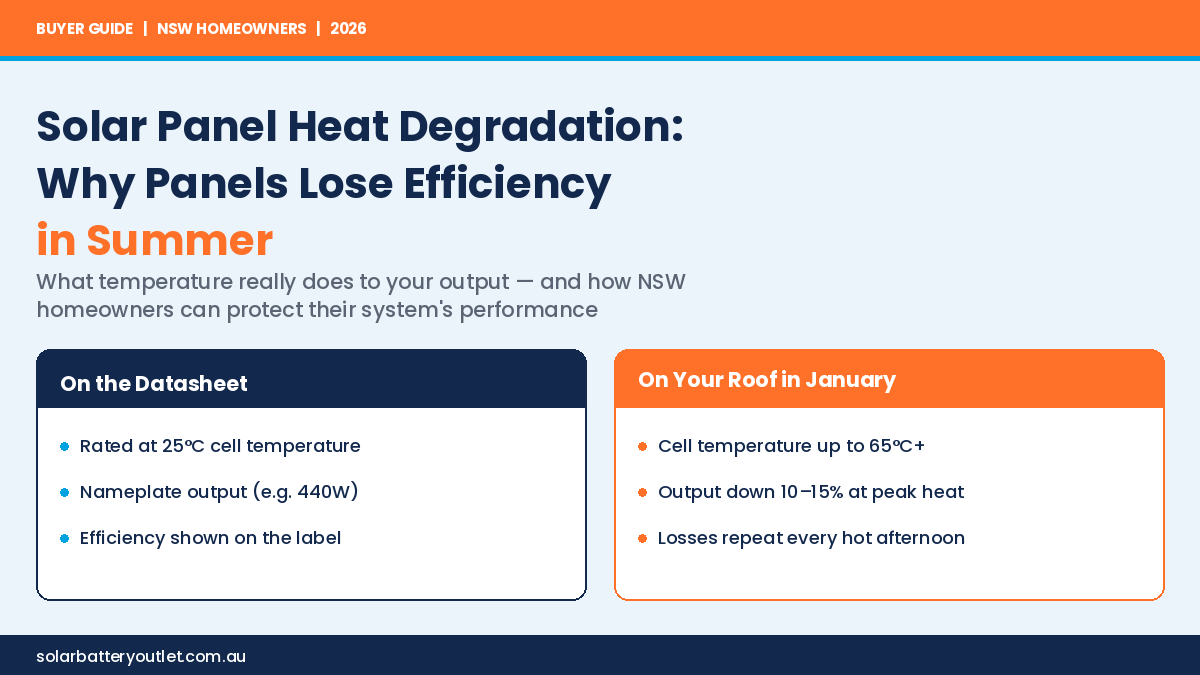
Your solar system carries a rating tested in a cool, controlled lab at 25°C. NSW summer afternoons rarely cooperate with that number. Once panel surfaces climb past it, output starts sliding — quietly, predictably, on almost every hot day from December through February.

This isn’t a fault, and it isn’t damage. It’s solar panel heat degradation, and it explains why a system can underperform on exactly the days you’d expect it to shine brightest. Understanding how heat affects panel output and what actually helps lets you get more from a system you’ve already paid for — whether your roof is in Liverpool, Bankstown, Mudgee, or anywhere else across the state.

This guide walks through the science behind heat-related losses, the real numbers involved, and a practical framework for protecting performance through an NSW summer.

What Is Solar Panel Heat Degradation?

Solar panels are rated under Standard Test Conditions: 25°C cell temperature and 1,000 W/m² of sunlight. Every wattage figure printed on a panel’s specification sheet assumes that lab-controlled temperature.

In the real world, cell temperature climbs well above the surrounding air as sunlight heats the glass, silicon, and backsheet. That heat physically changes how efficiently silicon converts light into electricity, and the effect is captured by a panel’s Pmax temperature coefficient — a figure printed on every datasheet as a negative percentage per degree Celsius.

A typical crystalline silicon panel loses roughly 0.3% to 0.5% of its rated output for every degree above 25°C. On a hot summer afternoon, when cell temperatures reach 60°C or more, that steady decline can add up to a 10–15% drop in power output compared with the rated figure on the box. It’s a normal, engineered characteristic of how silicon behaves under heat — not a sign that anything is wrong with the panel.

Why Summer Heat Hits Harder Than Most Homeowners Expect

The gap between air temperature and panel temperature is bigger than most people assume. A panel’s Nominal Operating Cell Temperature (NOCT) — the temperature it reaches under everyday conditions — typically sits 20 to 25°C above ambient air temperature once you account for mounting, airflow, and roof material.

So on a 35°C day in Western Sydney, a dark-coloured, close-mounted panel can easily reach cell temperatures of 55–60°C, and research from UNSW Sydney has recorded rooftop solar surfaces climbing as high as 70°C during peak summer periods on poorly ventilated installations. That’s a 45°C jump above the 25°C rating point — enough to meaningfully cut into a system’s expected output for hours at a time.

It’s worth noting the trade-off works in the homeowner’s favour overall: total energy output on a hot, sunny day is still typically higher than on a mild, cloudy one, because there’s simply more sunlight hitting the panel. Heat degradation reduces efficiency — it doesn’t cancel out the benefit of a longer, brighter summer day. But it does mean your system is quietly leaving output on the table during exactly the hours your air conditioner is working hardest.

How Much Efficiency Do Solar Panels Really Lose in Heat?
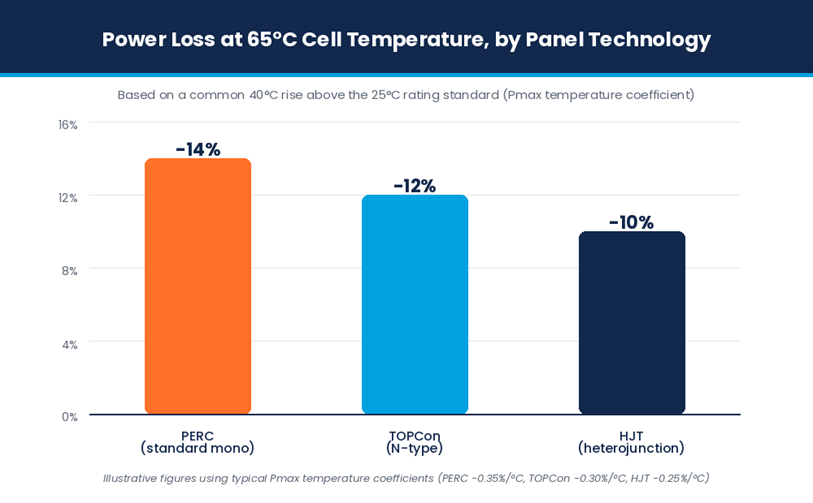
Estimated power loss at 65°C cell temperature, by common panel technology used in Australian installs

The exact loss depends on how far above 25°C the cells run and which technology sits behind the glass. Using a standard mono-PERC panel with a coefficient of around -0.35% per °C, a cell running at 65°C — a realistic peak for a dark roof on a 38–40°C Sydney day — is roughly 40°C above its rating point. That works out to a power loss of about 14% compared with the nameplate figure.

Newer N-type panels handle the same conditions better. TOPCon modules, with a typical coefficient near -0.30% per °C, lose closer to 12% under identical conditions. Heterojunction (HJT) panels, with coefficients around -0.25% per °C, come in lowest at roughly 10%. The chart below sets out how that plays out across the three technologies most commonly quoted for NSW rooftops in 2026.

Over a full summer, these percentage-point differences compound into a real gap in kilowatt-hours generated, which is why the temperature coefficient deserves as much attention as the headline efficiency percentage when comparing panels for a hot-climate install.

Not All Panels Handle Heat the Same Way

Panel technology matters here in a way that’s easy to overlook. Older P-type PERC cells contain boron-oxygen complexes that become more active at higher temperatures, adding a secondary degradation pathway on top of the standard temperature-coefficient loss. This is part of why older-generation panels can feel like they’re ageing faster on hot, north-facing roofs.

Newer N-type cells — TOPCon and HJT — don’t carry that same boron-oxygen chemistry, so they avoid this extra heat-driven pathway and tend to hold their output more consistently through summer. For homeowners in warmer parts of NSW, including inland areas like Mudgee where summer days regularly push past 35°C, a lower temperature coefficient is a genuine long-term yield advantage, not just a spec-sheet number.

None of this means older PERC panels are a poor choice — they remain a cost-effective, reliable technology across most of Australia. It simply means the temperature coefficient is worth comparing line-by-line when a quote lands on the table, the same way you’d compare efficiency percentage or warranty length.

Heat Loss vs Long-Term Degradation: Two Different Problems

It’s easy to conflate two separate effects, so it’s worth being precise. Heat-related output loss from the temperature coefficient is instant and reversible — output dips on a hot afternoon and recovers as soon as the panel cools down in the evening or on a milder day. It happens every summer, every year, for the life of the system.

Long-term degradation is a different mechanism entirely. It refers to the slow, permanent decline in a panel’s maximum output over its 25-to-30-year lifespan, caused by factors like UV exposure, micro-cracking, and light-induced degradation. Most quality panels degrade by around 0.4–0.6% per year on this measure, backed by manufacturer performance warranties.

The two interact, though. Panels that spend more hours per year at high cell temperatures — think an unventilated roof in Mudgee versus a breezy coastal install — tend to sit at the higher end of that annual degradation range. Keeping cell temperatures down doesn’t just help today’s output; it protects the panel’s long-term performance curve too.

4 Ways to Cut Heat Loss on an NSW Roof
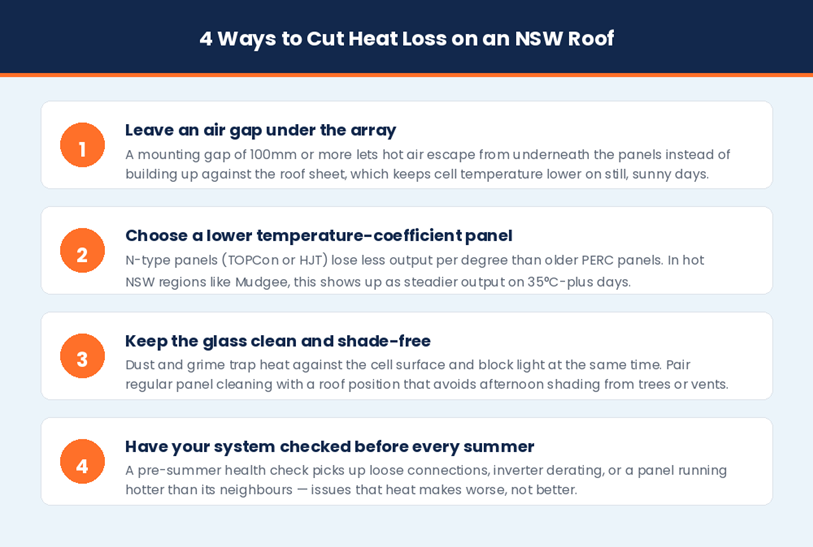
A practical framework for reducing heat-related output loss on residential NSW installs.

None of these fixes require replacing a working system, and most are worth raising with your installer before the next summer, not during it.

Airflow underneath the array is the single biggest lever available at install time — a mounting gap of 100mm or more lets hot air escape rather than pooling against the roof sheet. If your panels sit flush against the roof, ask a technician whether a standoff mount is feasible.

For anyone comparing panel brands as part of a new quote or an upgrade to an existing system, the temperature coefficient on the datasheet is worth weighing alongside price and warranty, particularly for larger north or west-facing arrays that see the most direct summer sun.

Clean panels also run cooler. A layer of dust or grime absorbs and traps heat against the cell surface on top of blocking light, so pairing regular cleaning with a position that avoids afternoon shade from trees or roof vents helps on both fronts. And because heat-related strain tends to surface first as loose connections or inverter derating, a pre-summer system health check is the cheapest way to catch a small issue before a 40°C week turns it into a bigger one.

Real-World Example: A 6.6kW System in Western Sydney

Take a common NSW setup — a 6.6kW system using standard PERC panels, roof-mounted with limited airflow, facing north. On a 38°C January afternoon, cell temperature on that roof commonly reaches 62–65°C. Applying a -0.35%/°C coefficient across that 37–40°C rise above the 25°C rating point works out to a power loss of roughly 13–14% during peak sun hours.

For a system rated to produce around 5.3kW at those irradiance levels, that’s a real-world output closer to 4.6kW during the hottest part of the day — a gap of roughly 700W, or enough to notice on a hot-day generation graph. Switch to a lower-coefficient TOPCon panel and the same conditions produce a loss closer to 11%, recovering a meaningful slice of that missing output across a full summer.

None of this shows up as a fault code or an error message. It simply shows up as a slightly flatter curve on your monitoring app around 1–3pm — which is exactly why understanding the temperature coefficient matters more than most homeowners realise.

For homeowners who want to verify installer credentials, Solar Accreditation Australia (SAA) keeps a public list of accredited installers, and the Clean Energy Council keeps a list of approved products. The Bureau of Meteorology publishes… long-term temperature and solar exposure data for NSW that installers use when designing for local conditions.

If your system is due for a refresh, our guide to upgrading an existing solar system covers when it makes sense to add newer, more heat-tolerant panels, and our solar panel cleaning service page explains how regular cleaning helps panels run cooler through summer.

Frequently Asked Questions
Do solar panels really lose efficiency in hot weather?

Yes. Once a panel’s cell temperature rises above the 25°C rating point, output declines steadily according to its temperature coefficient, typically -0.3% to -0.5% per °C. On a hot NSW summer afternoon, this can mean a 10–15% drop in output compared with the panel’s rated figure.

At what temperature do solar panels start losing power?

Efficiency loss begins the moment cell temperature climbs above 25°C — the Standard Test Condition benchmark. It’s a gradual, predictable decline rather than a sudden drop-off, and it becomes noticeable once cells pass around 35–40°C, which happens on most sunny NSW days.

Is heat-related efficiency loss the same as panel degradation?

No. Heat-related loss is temporary and reverses once the panel cools down. Long-term degradation is a separate, permanent decline in maximum output over a panel’s 25-to-30-year lifespan, usually around 0.4–0.6% per year, and is covered by the manufacturer’s performance warranty.

Which solar panels perform best in NSW summer heat?

N-type panels — TOPCon and heterojunction (HJT) — generally have lower temperature coefficients than older PERC panels, meaning they lose less output per degree of heat. For hotter inland NSW locations, this can be a worthwhile factor to weigh alongside price when comparing quotes.

Can I reduce how much heat affects my solar panels?

Yes. Ensuring good airflow underneath the array, keeping panels clean, avoiding unnecessary afternoon shading, and choosing a lower temperature-coefficient panel where practical can all reduce heat-related output loss on an NSW roof.

Does solar panel heat degradation void my warranty?

No. Temperature-related output loss is a normal, expected characteristic disclosed on every panel’s datasheet — it isn’t a defect and doesn’t affect your manufacturer or performance warranty.

Get Your System Checked Before the Next Heatwave
Disclaimer

This article is general information about how heat affects solar panel performance and is not a substitute for a site-specific assessment of your system. Actual output loss depends on panel technology, mounting, roof orientation, and local weather conditions, and can vary from the illustrative figures used here. Solar Battery Outlet does not guarantee specific generation outcomes for any individual property.

Always seek personalised advice before making a purchasing decision.
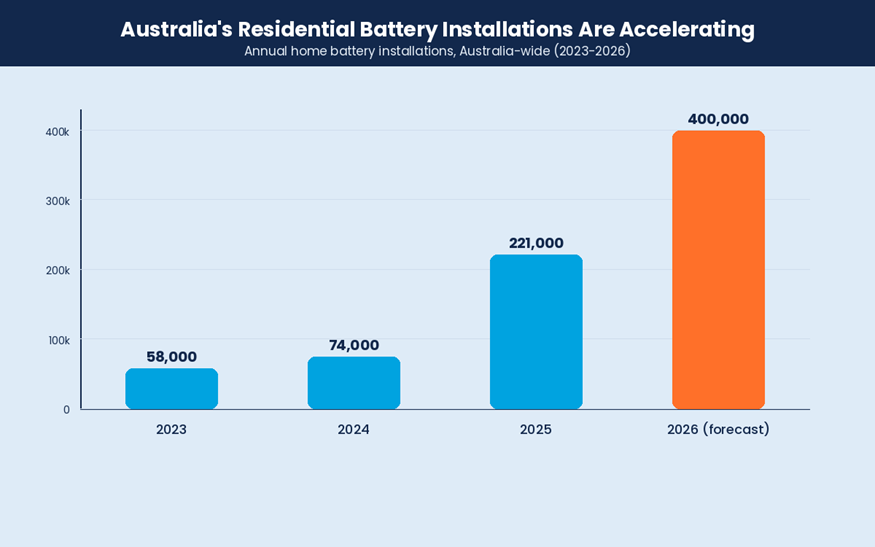
Home battery sales in Australia are no longer a niche trend — they are a mainstream shift in how solar households manage power. In 2025, Australians installed a record 221,000 residential battery systems, almost three times the volume installed in 2024, and industry analyst SunWiz expects the 2026 calendar year to add roughly 400,000 more. For NSW homeowners who already have rooftop solar, or are weighing it up, this surge changes the maths, the market, and the timing of a smart decision. Here is what is actually driving the boom, what it means for your household, and how to use the momentum to your advantage.

Australia's residential battery installations rising from 58,000 in 2023 to a forecast 400,000 in 2026

The scale of the shift is hard to overstate. Australians spent close to $8.69 billion on home batteries in just the first five months of 2026, according to a Reuters calculation built on SunWiz installation data. Between January and May 2026 alone, households installed 7.7 gigawatt-hours of battery storage — more than the previous six years combined. By mid-2026, more than 466,000 residential battery systems had been connected under the federal Cheaper Home Batteries Program since it launched in July 2025, delivering over 12 gigawatt-hours of new storage capacity nationwide.

NSW is playing a leading role in that growth. Government data to March 2026 shows four of the twelve highest-uptake postcode regions in the country sit in outer and western Sydney, accounting for 6,590 installations between them. Today, roughly one in twenty Australian homes has a battery, up from a small fraction just two years ago, and the trajectory keeps climbing. This is not a short-lived spike. It reflects a structural change in how solar households value the power they generate.

Why More NSW Homeowners Are Looking at Batteries

Three forces are converging at once, and together they explain why so many solar owners are moving from “maybe one day” to “book a quote.”

1. Feed-in tariffs have kept shrinking

From 1 July 2026, NSW solar buyback rates dropped again, to as low as 3c/kWh on many plans, while the same household still pays roughly 30 to 40c/kWh to buy power back after dark. That gap is the entire financial case for storage: a solar-only home effectively gives away its cheap daytime power and buys it back at ten times the price a few hours later.

2. Electricity bills remain historically elevated

The average NSW household is paying close to $1,450 a year on a market offer, and while the 2026-27 Default Market Offer trimmed flat rates by roughly 3.4 to 5.0 percent, that follows a much larger increase the year before. A battery reduces exposure to further rises because it lets you use your own stored solar instead of buying from the grid at peak.

3. The federal rebate steps down on a schedule

Since 1 May 2026 the Cheaper Home Batteries Program has used a tiered structure. The upfront discount depends on the battery’s usable size and the current STC rate, and the rate reduces every six months through to 2030. Waiting does not remove the rebate; it just shrinks it a little further each cycle, which is exactly why installation volumes keep climbing rather than tapering off.

What the Surge Means If You Already Have Solar

If your panels have been running solar-only for a few years, you are part of the group installers now describe as their fastest-growing customer base. Industry reporting shows a majority of battery installations are retrofits onto existing rooftop solar rather than new combined systems, which means you do not need to replace your panels to benefit. Most modern inverters and panel setups are compatible with a retrofitted battery.

The surge also strengthens your negotiating position. More installers are competing for retrofit customers, more battery brands are available at competitive pricing, and virtual power plants (VPPs) are actively recruiting existing solar households to join, often stacking a separate NSW incentive on top of the federal rebate. That combination, a mature retrofit market plus rising VPP demand, means existing solar owners are, in many cases, well placed to get a fast, well-priced install.

What the Surge Means If You’re Still Deciding

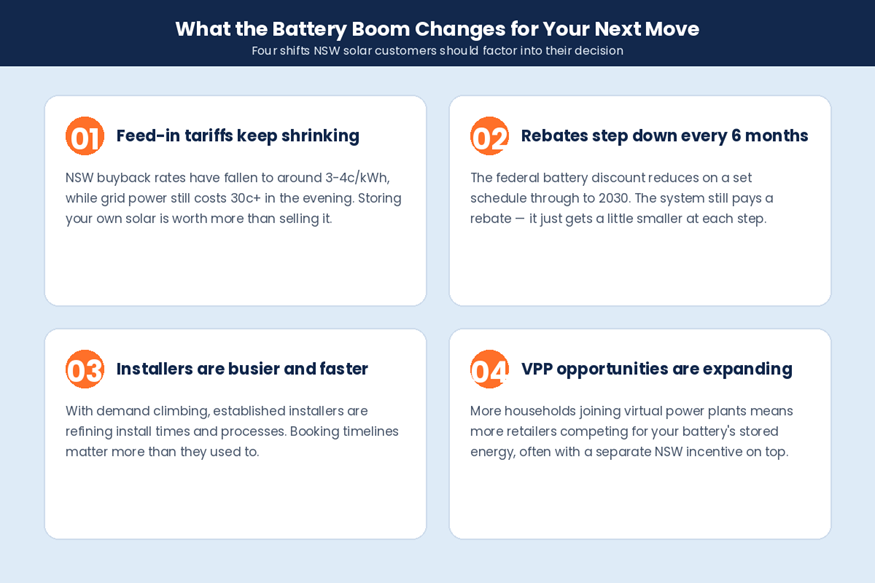
four ways rising battery sales change the decision for NSW solar customers

If you have not installed solar and a battery yet, the calculation has shifted from “is this worth it” to “what size and when.” Feed-in tariffs will likely keep falling rather than recovering, which increases the value of storing your own power over time. The rebate step-down is scheduled and predictable, so you can plan around it rather than react to it. Reputable installers are refining their processes to handle higher demand, so booking early in a rebate cycle tends to mean a shorter wait for your installation date. And VPP participation can add extra credits or payments for some households, as more retailers compete for access to household batteries during peak demand periods. Amounts vary by plan.

None of this means every household should rush. It means the case for comparing a proper, itemised quote has become stronger, because the gap between a well-sized system and an oversized or poorly matched one is now worth more than it used to be.

Three Steps Before You Get a Quote

1. Pull your last 12 months of electricity bills and check how much power you use after sunset. This is what actually determines whether a battery pays for itself.

2. Confirm your existing solar system’s age and output before adding storage, since a battery cannot fix an underperforming or degraded solar array.

3. Compare at least three written quotes that show the federal rebate as a dollar figure, not a verbal promise, and ask each installer how the NSW VPP incentive applies to your postcode.

Working through these three steps before you sign anything protects you from both extremes: rushing into an oversized system, and delaying so long that a rebate step-down costs you more than waiting was worth.

You can see how this plays out in practice in our related breakdown of why home battery uptake in Australia is surging, and if your panels have been running solar-only for a while, our guide on adding a battery to an existing rooftop solar system walks through the retrofit process step by step.

Frequently Asked Questions

Is now a good time to buy a solar battery in NSW?

For many households, yes. Feed-in tariffs are low, bills remain elevated, and the federal rebate is still active. But “good time” depends on your usage pattern and your solar system’s condition, so compare written quotes before committing to a size or brand.

Why are so many more Australians installing batteries in 2026?

A combination of the federal Cheaper Home Batteries Program discount, falling feed-in tariffs, and elevated retail electricity prices has made storing solar power more valuable than exporting it. SunWiz data shows installations roughly tripled between 2024 and 2025.

Do I need new solar panels to add a battery?

Usually not. Most battery installations recorded in the last two years have been retrofits onto existing rooftop solar systems. A qualified installer can confirm your inverter and panels are compatible before quoting.

Will the battery rebate run out if I wait?

The Cheaper Home Batteries Program is currently scheduled to run until 2030, with the discount reducing every six months. Government programs can change, so check the official program page for the latest rules.

How do I know if a battery will actually save me money?

It depends on how much electricity you use in the evening after your solar stops generating. A reputable installer should review your last 12 months of bills before recommending a battery size.

Disclaimer

This article is general information about home battery trends in NSW and is not personal financial, legal, or energy advice. Rebate rates, feed-in tariffs, and electricity prices referenced here were accurate at the time of publication and are subject to change by the relevant government body or your retailer. Every home’s usage pattern, solar system, and eligibility differ, so actual savings and payback periods will vary. Always seek personalised advice before making a purchasing decision.
If you installed solar panels five, eight, or even ten years ago, you are sitting on an asset that is quietly becoming more valuable — and less rewarded by the grid. Feed-in tariffs have fallen every year since 2020, while evening electricity prices keep climbing. As a result, hundreds of thousands of Australian households are taking the same next step: adding a battery to the solar system they already own, rather than exporting cheap power and buying it back expensive.

This shift is not a niche trend. It is now the dominant pattern in the Australian solar market, and understanding why can help you decide whether the same move makes sense for your home.

The Retrofit Boom, By the Numbers

Australia has more rooftop solar than almost anywhere on earth. The Clean Energy Regulator puts the national total at roughly 4.3 to 4.5 million homes and small businesses with solar panels installed — around 40 per cent of all households. Yet until recently, only about one in eight of those systems included a battery.

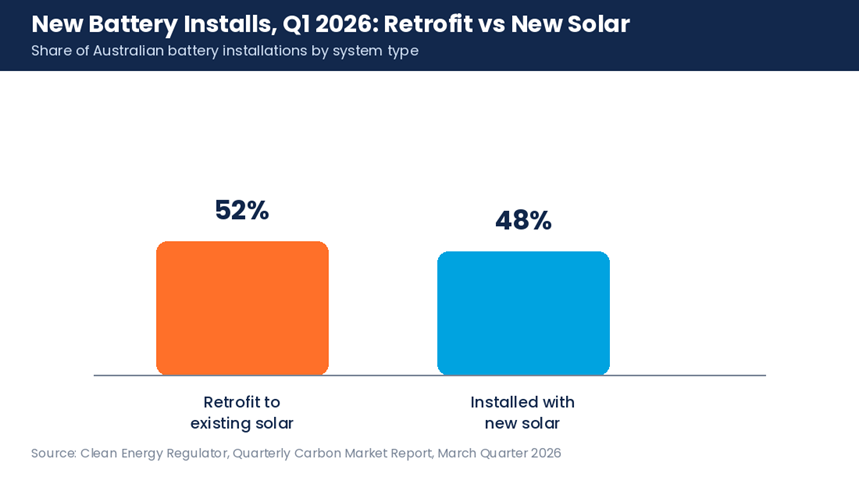
That gap is closing fast. Clean Energy Regulator data for the March quarter of 2026 shows that 52 per cent of all new battery installations were retrofits, added to solar systems already sitting on the roof, with no change to the panels themselves. The remaining 48 per cent went in alongside brand-new solar. Industry analyst SunWiz reports that stand-alone, battery-free solar installations have become rare, making up just 7 per cent of the market today. Almost every household getting solar now gets a battery with it, and just as many are going back to add one to a system they already have.

Roughly 3.7 million Australian homes currently have solar and no battery. That is the retrofit opportunity driving this trend, and it is one every solar owner should understand.

52% of new battery installs in Q1 2026 were retrofits to existing solar, versus 48% installed alongside new solar

Why Now? Three Forces Are Lining Up at Once

Three separate trends are converging, and together they explain the timing.

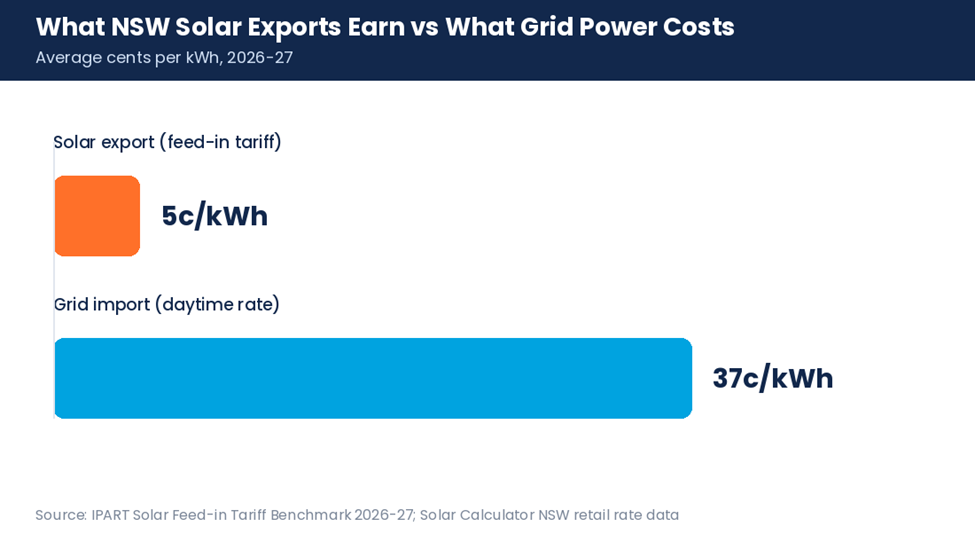
Feed-in tariffs keep shrinking. IPART’s benchmark for NSW solar exports has fallen from 4.8–7.3 cents per kWh in 2025–26 to just 3.4–6.5 cents per kWh for 2026–27. Compare that with the average NSW retail electricity price of around 36–37 cents per kWh, and the maths becomes clear: every kilowatt-hour you use yourself is worth roughly five to ten times more than the same kilowatt-hour exported to the grid.

The federal rebate made batteries dramatically cheaper. Since the Cheaper Home Batteries Program (CHBP) began on 1 July 2025, it has funded an upfront discount on eligible battery systems through Small-scale Technology Certificates (STCs). It started at around 30 per cent and has reduced since 1 May 2026.The scheme has already supported more than 350,000 household installations, and its budget has grown from $2.3 billion to an estimated $7.2 billion, targeting two million battery installations and 40 gigawatt-hours of storage by 2030.

Grid electricity prices are not falling. Even as wholesale daytime prices drop — part of why feed-in tariffs are shrinking — evening peak import rates in NSW remain high, commonly 30 to 40 cents per kWh, and higher again in some network areas during the 4 pm to 9 pm window.

Bar chart comparing the NSW solar feed-in tariff (about 5 cents per kWh) with the grid import rate (about 37 cents per kWh)

Put those three trends together, and a battery is worth a serious look for many solar systems that are earning less and less for the power they send away.

What Adding a Battery Actually Involves

Retrofitting a battery is more straightforward than most homeowners expect, and in most cases your existing panels do not need to change at all.

A qualified installer will assess your existing inverter, switchboard, and meter setup, then usually recommend one of two approaches. An AC-coupled battery connects independently to your switchboard and works alongside your existing solar inverter — the most common retrofit option, since it does not disturb your current solar setup. A hybrid inverter replacement swaps your existing inverter for one built to manage solar and battery together, which can suit older or underperforming systems.

Either way, a straightforward retrofit for a well-maintained system typically takes a single day, and your solar continues generating throughout. The Clean Energy Regulator requires all rebate-eligible installations to be completed by a Solar Accreditation Australia (SAA) accredited installer using an approved product, so it is worth confirming accreditation before booking.

A Practical Example: What Retrofitting Can Look Like

Consider a typical Liverpool household — this example is illustrative, not an individual case study — with a 6.6 kW solar system installed around 2018 and average evening electricity use of roughly 12 kWh per day. Under the current NSW feed-in tariff, that household might earn only 40–60 cents a day exporting that surplus. Storing it in a 10 kWh battery and using it after sunset instead of buying grid power at 36 cents per kWh could be worth around $3 a day on sunny days (after the lost feed-in credit), and less in winter — a meaningfully different outcome from the same solar panels, simply because the power is used rather than exported.

This is the calculation worth running with your real bills before committing, and it is exactly the kind of assessment a good installer should walk through with you at no cost.

Is Your Home a Good Candidate for a Retrofit?

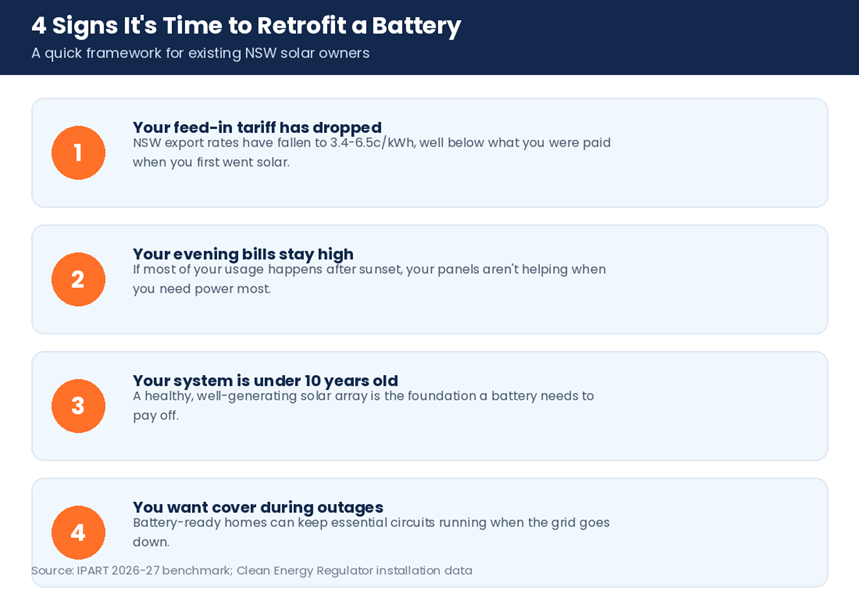
Not every solar system benefits equally from adding storage. Use this quick framework to check your own situation before requesting quotes.

Four signs it may be time to retrofit a battery onto your existing solar system

If most of these apply to your household, a retrofit is likely to pay off. If your solar system is older, underperforming, or you are mostly home during the day already using your solar directly, it is worth getting a system health check first — see our guide on upgrading an existing solar system for what that involves.

Rebate Timing Still Matters

The federal rebate is not disappearing — it runs until 2030 — but it does keep shrinking. From 1 May 2026, the STC factor used to calculate the discount dropped from 8.4 to 6.8, and a new tiered structure now reduces support for batteries above 14 kWh. For a standard 10 kWh battery, that works out to roughly $530 less rebate than installing before the change. For larger batteries above 14 kWh, the difference can run to $1,000–$1,800 or more, since the tiering applies on top of the factor drop.

The rebate is recalculated every six months, each January and July, so it will continue to taper gradually. None of this means you need to rush, but if you have already compared quotes and are ready to proceed, timing can shift the numbers meaningfully, particularly for larger systems.

Choosing an Installer for Your Retrofit

The quality of your installer affects your outcome more than the timing of your rebate. Ask for the rebate to appear as a dollar figure on a written quote, confirm the installer’s SAA accreditation number, and check that your battery model is on the approved product list before signing anything. We cover the full checklist of what separates a reliable installer from a risky one in our guide on solar battery rebate timing

Can any solar system have a battery added later?

Most systems can be retrofitted, though older inverters, undersized switchboards, or systems near end of warranty may need extra work first. A qualified installer can confirm compatibility during a free assessment.

Does adding a battery affect my existing solar warranty?

A properly installed retrofit should not affect your panel warranty. It is worth confirming your inverter warranty terms if you are adding an AC-coupled battery rather than replacing the inverter.

Is it cheaper to retrofit a battery or buy solar and battery together?

Retrofitting is often more cost-effective if your existing solar system is still performing well, since you are only paying for the battery and its installation, not new panels.

How long does a battery take to pay for itself?

Payback depends on your electricity usage pattern and battery size, but typical NSW households see payback in the range of six to eight years under current tariffs and rebates, with the battery continuing to save money well beyond that.

Will my feed-in tariff keep falling?

It is likely to keep trending downward as more rooftop solar comes online and daytime wholesale prices soften. This is one of the main reasons more solar owners are shifting toward self-consumption rather than relying on exports.

Not Sure If a Retrofit Is Right for You?

We provide free, no-obligation assessments for solar homeowners across Liverpool, Bankstown, and Mudgee. We will check your existing system, review your bills, and give you an honest answer about whether adding a battery makes financial sense for your household, before you spend a cent. Call 1800 000 777 or visit solarbatteryoutlet.com.au to book your assessment.

Disclaimer: This article is general information only and does not constitute financial, technical, or legal advice. Feed-in tariffs, rebate values, and electricity prices vary by retailer, network area, and household usage, and figures in this article are indicative estimates based on published sources current as of publication. Actual savings and payback periods will differ depending on your specific solar system, electricity plan, and consumption pattern. Rebate eligibility depends on your installer’s accreditation and product approval status at the time of installation. Always seek personalised advice before making a purchasing decision.
Home battery uptake in Australia is no longer a niche trend among early adopters. It has turned into a mainstream shift in how households manage power. In just under a year, hundreds of thousands of homes have added battery storage to their existing solar systems, largely thanks to the federal Cheaper Home Batteries Program. For homeowners across NSW, this surge raises a practical question: what does it actually mean for your electricity bill?

This article breaks down the latest uptake data, unpacks what is driving it, and offers a simple framework to help you decide whether now is the right time to invest in solar batteries for your own home.

Australia’s Home Battery Boom, By the Numbers

Since the Cheaper Home Batteries Program launched in July 2025, uptake has moved from steady to remarkable. More than 260,000 households, businesses, and organisations installed a battery within the program’s first ten months, and daily installation rates climbed from a few hundred to well over a thousand. By May 2026, the total reached 380,712 systems, representing 10.7 GWh of storage capacity, according to Minister for Climate Change and Energy Chris Bowen. Analyst SunWiz now projects the country will pass 400,000 installations before the end of 2026, with total capacity climbing toward 11.2 GWh.

To put that growth in perspective, look at the chart below. Installations moved from roughly 260,000 in late 2025 to more than 380,000 just six months later, a pace that has genuinely surprised policymakers. Uptake has already outpaced the government’s own electric vehicle tax discount, and demand shows no sign of slowing, even as the rebate steps down twice a year through to 2030.

Cumulative home battery installations under the Cheaper Home Batteries Program

Why Everyone Is Suddenly Talking About Home Batteries

Three forces are driving this surge together, and each one is worth understanding on its own.

First, the economics changed. The Cheaper Home Batteries Program gives an upfront discount on eligible battery systems between 5kWh and 100kWh, through small-scale technology certificates. The amount depends on the battery’s usable size and the current STC rate. That single change turned batteries from a luxury upgrade into a realistic purchase for far more households.

Second, electricity prices kept climbing. Time-of-use tariffs now charge many NSW households 40 to 55 cents per kWh during the 3pm to 9pm peak window, exactly when families get home, cook dinner, and run the air conditioning. A battery lets you store cheap daytime solar and use it instead of buying expensive peak-rate power later.

Third, feed-in tariffs kept falling. Exporting solar power back to the grid in NSW now earns most households only 3 to 10 cents per kWh, well below what that same power is worth if you store it and use it yourself. That widening gap is pushing more solar owners toward storage rather than simply exporting their surplus.

Together, these shifts explain why uptake has moved from early-adopter territory into the mainstream, and why it is translating into measurable bill savings for the households that made the switch.

What Rising Battery Uptake Means for Your Electricity Bill

This is the part that matters most to homeowners. According to the Australian Competition and Consumer Commission’s latest Electricity Market Inquiry report, households with solar and battery systems paid electricity bills between roughly $329 and $909 lower over a year compared with customers relying on grid electricity alone, a saving of 20 to 52 percent. Homes that went a step further and joined a virtual power plant did even better, saving between $762 and $1,093 a year, or 57 to 63 percent, with roughly 24 percent of solar-and-battery customers now taking part in a VPP.

The chart below shows how these three scenarios stack up against each other.

Estimated annual bill saving range by household setup (ACCC, 2026)

Consider a hypothetical example. A family in Western Sydney on a standard time-of-use tariff, paying around $2,000 a year for grid electricity, could realistically bring that down toward the $1,100 to $1,670 range once solar and a battery are added, based on the ACCC’s published figures. Joining a VPP on top of that could push savings further still. Actual results always depend on your usage pattern, tariff, and battery size, but the direction is now well established.

The NSW Angle: Higher Prices, Bigger Savings

NSW households have a particular stake in this trend. The state has some of the highest electricity prices in the country, and NSW Government figures show around 13,000 new batteries are now being installed across the state every month, on top of the more than half of NSW houses that already have solar. That combination of high prices and fast uptake means NSW is where the bill-saving case for storage is strongest.

The NSW Government has backed this shift with its own incentives. The Peak Demand Reduction Scheme supports Virtual Power Plant participation, and the newer Home Energy Saver program adds an interest-free loan of up to $15,000, alongside discounts of up to $4,000 for eligible households upgrading their home energy setup. If you are weighing up whether to move quickly, our guide on whether to rush a solar battery before the rebate drops walks through the exact questions to ask before booking an installer.

A 4-Step Framework: Should You Add a Battery Now?

With uptake this high, it helps to have a clear, unemotional way to decide whether a battery makes sense for your home right now, rather than reacting to marketing pressure.

  • Step 1 — Check your evening usage. Pull up your last 12 months of bills and see how much power you use after 3pm. Batteries deliver the most value to households that use most of their electricity in the evening, after solar stops generating.
  • Step 2 — Confirm your solar is performing well. A battery only stores what your panels generate. If your system is more than 10 years old or under-performing, get a health check before adding storage.
  • Step 3 — Size for your actual usage, not the biggest option available. The rebate is now tiered, so a right-sized 10 to 13kWh system paired with existing solar typically sits in the value sweet spot for most homes.
  • Step 4 — Compare at least three written quotes and check installer accreditation. Confirm the rebate appears as a dollar figure on the quote itself, and verify the installer’s SAA accreditation before signing anything.

What This Means for Liverpool, Bankstown, and Mudgee Homeowners

If you live across Liverpool, Bankstown, or Mudgee, this national surge is playing out locally too. Solar Battery Outlet has watched local demand for solar batteries climb alongside the national numbers, with more households asking about right-sized systems, VPP participation, and how to stack the federal rebate with NSW incentives. Homeowners exploring solar battery Liverpool options are increasingly asking the same question this article set out to answer: not whether to get a battery, but how to size and time it correctly for their home. Our recent postcode guide on rebates across Liverpool, Bankstown, and Mudgee breaks down what is available suburb by suburb.

Frequently Asked Questions
How many home batteries have been installed in Australia in 2026?

More than 400,000 home battery systems have been installed across Australia since the Cheaper Home Batteries Program launched in July 2025, representing well over 11 GWh of storage capacity, according to SunWiz and Clean Energy Regulator data current as of mid-2026.

How much can a solar battery save on electricity bills?

The ACCC’s Electricity Market Inquiry found households with solar and battery systems saved between $329 and $909 a year (20 to 52 percent) compared with grid-only customers, rising to $762 to $1,093 (57 to 63 percent) for households also participating in a virtual power plant.

Is it still worth installing a solar battery in NSW in 2026?

For many households, yes. It depends on your evening usage, tariff and solar system. NSW electricity prices remain among the highest in Australia, and the federal rebate, while tapering gradually every six months through 2030, still covers around 30 percent of the upfront cost for eligible systems, alongside state incentives like the Peak Demand Reduction Scheme.

What size battery should I get?

Most NSW homes fall into the 10 to 13kWh sweet spot, since the rebate structure applies the strongest support up to 14kWh of usable capacity, with reduced support above that threshold.

Do I need a Virtual Power Plant to save money with a battery?

No, but it helps. Even standalone solar-and-battery homes save materially on bills, while VPP participation adds further savings by earning payments for sharing stored power with the grid during peak demand periods.

Solar Battery Outlet offers free, no-obligation quotes for homeowners across Liverpool, Bankstown, and Mudgee. We will check your solar performance, review your usage, and tell you honestly whether a battery, and which size, makes sense for your home. Call 1800 000 777 or visit solarbatteryoutlet.com.au to get started.

Disclaimer

This article is general information only and does not constitute financial, legal, or personalised energy advice. Statistics on installation numbers, capacity, and bill savings are sourced from government and industry reports current as of July 2026 and reflect national or state averages; individual results depend on your electricity usage, tariff, solar system size, and battery specifications, and are not guaranteed. Rebate amounts and eligibility rules referenced in this article are subject to change under the Cheaper Home Batteries Program and NSW Government schemes, so always confirm current rates with the relevant government agency before purchasing. Always seek personalised advice before making a purchasing decision.

Your solar inverter is often capable of generating far more power than your home is legally allowed to send back to the grid. Many NSW homeowners discover this the first time they check their monitoring app and notice the export numbers do not match what the panels are producing. Across New South Wales, distribution networks set a legal cap on how much solar electricity your system can export at any moment — and that cap has nothing to do with how many panels sit on your roof.

This rule matters more than ever in 2026. Australia now has 28.3 GW of rooftop solar across more than 4.3 million homes. Networks must manage how much power these systems send through ageing infrastructure.

This guide explains why export limits exist, what NSW networks allow, and how homeowners can use solar power they cannot export.

What Is a Solar Export Limit?

A solar export limit sets the maximum amount of electricity, measured in kilowatts, that your system can send back into the grid at any given moment. It differs from your system size and your inverter’s rated output. Your local distribution network service provider (DNSP) sets the export limit at your point of connection and applies it to each phase of your electrical connection.

A 10 kW solar system can generate well above its export limit at midday. However, the system may only send a fraction of that power to the grid. When production exceeds the approved limit, the inverter automatically throttles its output. It does not shut down. Your household appliances still use the power they need first. Only the surplus above your household’s usage faces the export cap. Any extra generation beyond your home’s needs and the network’s export limit is curtailed. This means you cannot turn it into savings or feed-in tariff income unless you store it first.

Why Your Network Caps How Much Solar You Can Export

Australia built its electricity networks decades before rooftop solar became common. These networks originally carried power in one direction: from power stations to homes. Today, rooftop PV provides over 14% of total electricity generation in some parts of NSW. As more homes send power back to the grid, local networks can experience voltage fluctuations and congestion.

According to the Australian Energy Regulator, only 27% of customers with rooftop solar exported energy back to the grid in 2024, and just 4% combined solar and battery to export during peak periods, reflecting how much curtailment already shapes everyday solar outcomes. Export limits protect grid stability without requiring every street’s infrastructure to undergo a complete rebuild. NSW networks set these limits based on the physical capacity of local transformers and the number of solar systems already connected nearby. This particularly affects high-solar-density suburbs and regional towns such as Mudgee, where many rural transformers were never designed to handle hundreds of homes exporting electricity simultaneously.

NSW Export Limits by Network: Ausgrid, Endeavour Energy and Essential Energy

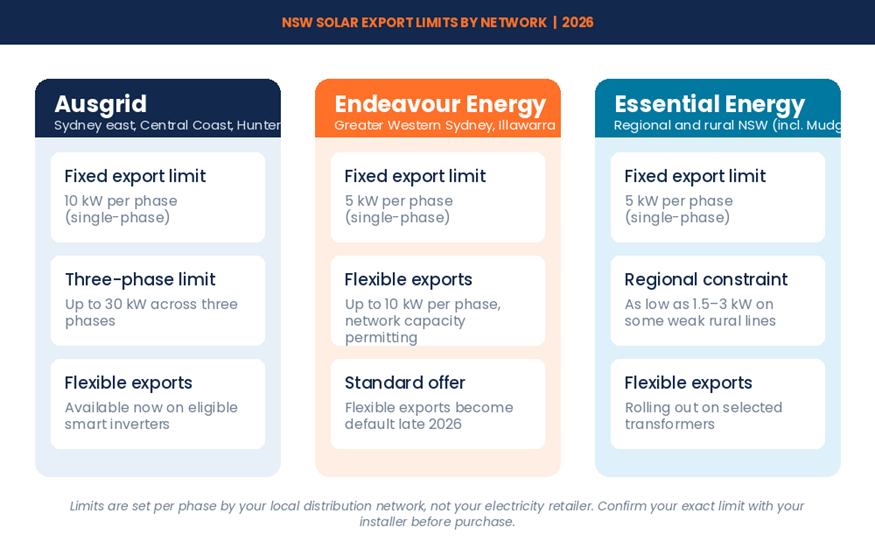
NSW solar export limits by network, 2026

Your export limit depends entirely on which distribution network services your address, not on your electricity retailer. NSW has three networks, and each takes a slightly different approach.

Ausgrid covers Sydney’s east, the Central Coast and the Hunter. It generally allows the highest fixed limit of the three networks: 10 kW per phase for single-phase homes. Endeavour Energy covers greater western Sydney and the Illawarra. It applies a lower fixed limit of 5 kW per phase. However, flexible exports can raise this to 10 kW when the local network has spare capacity. This will become the standard connection offer for new and upgraded systems from late 2026. Essential Energy services regional NSW, including Mudgee. It also defaults to 5 kW per phase. However, some weaker rural lines can limit exports to as little as 3 kW.

If you are unsure which network covers your street, check your latest electricity bill or your distributor’s online connection portal before assuming what your system can export.

Fixed vs Flexible (Dynamic) Export Limits

A fixed export limit stays the same around the clock, regardless of how much spare capacity the local grid has at any given time. A flexible, or dynamic, export limit works differently. It relies on an internet-connected smart inverter that communicates with the network in real time using the Common Smart Inverter Profile (CSIP-AUS) protocol. When the local grid has spare capacity, your export limit rises above the standard fixed cap; when the network is under strain, it throttles back accordingly.

For homeowners planning a new system in 2026, asking an installer about flexible export connections can significantly increase the solar power they send to the grid. This helps prevent wasted energy during sunny midday periods. It also prepares the system for future virtual power plants and demand-response programs, which increasingly rely on two-way communication.

What Curtailment Really Costs You

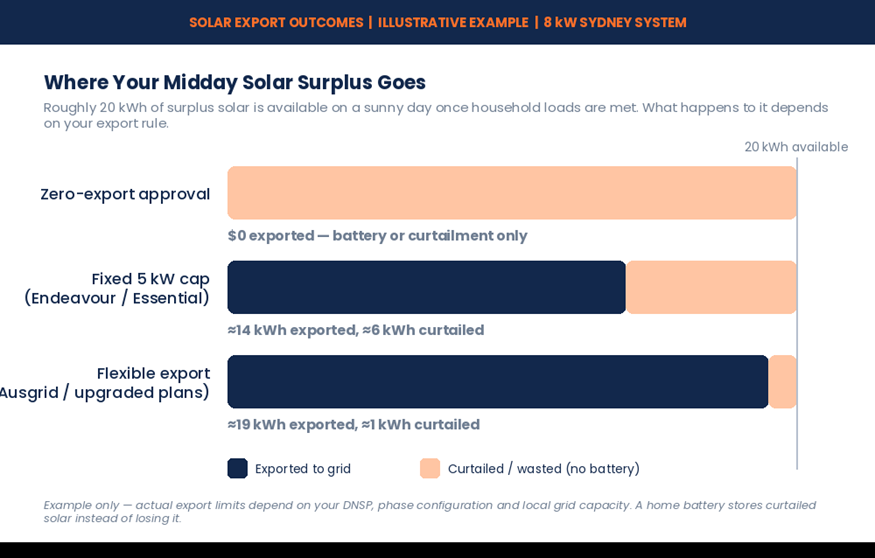
Where midday solar surplus goes under different export rules

Consider a typical 8 kW solar array in Sydney sitting behind a fixed 5 kW export cap. On a sunny day, that system might export somewhere between 12 and 16 kWh, earning roughly $1 to $2 at today’s feed-in tariff rates of 2 to 10 cents per kWh. Any generation above the cap that the household is not using at the time is curtailed—it simply never gets converted into either savings or income.

Here is the part that catches most homeowners out: self-consumed solar is worth far more than exported solar. At 5 to 8 cents per kWh for exports versus 25 to 35 cents per kWh saved on grid electricity you would otherwise buy, every kilowatt-hour you use yourself is worth roughly four to eight times more than one you export. That gap makes curtailment a real financial loss, not just a technical footnote, and it is the main reason export limits matter far more to your bottom line than most sales conversations suggest.

How to Capture More Value From the Solar You Can’t Export

A home battery is the most direct way to stop curtailed solar going to waste. Instead of your inverter throttling output once you hit your export limit, a battery captures that surplus energy and releases it later, when your household needs it most — typically in the evening peak, when grid electricity can cost 30 cents or more per kWh in NSW. We covered how this shift is already playing out on the network in our article on free midday power and NSW home batteries, which looks at how batteries are reshaping demand during the exact hours export limits bite hardest.

Beyond storage, it is worth asking your installer to size your system around your own usage pattern first, rather than maximising panel count. A system matched to your daytime and evening consumption, paired with a correctly sized battery and — where available — a flexible export connection, gives you the best chance of using nearly everything your roof produces rather than losing a meaningful share to curtailment.

Actionable Framework: Check Your Export Limit Before You Buy

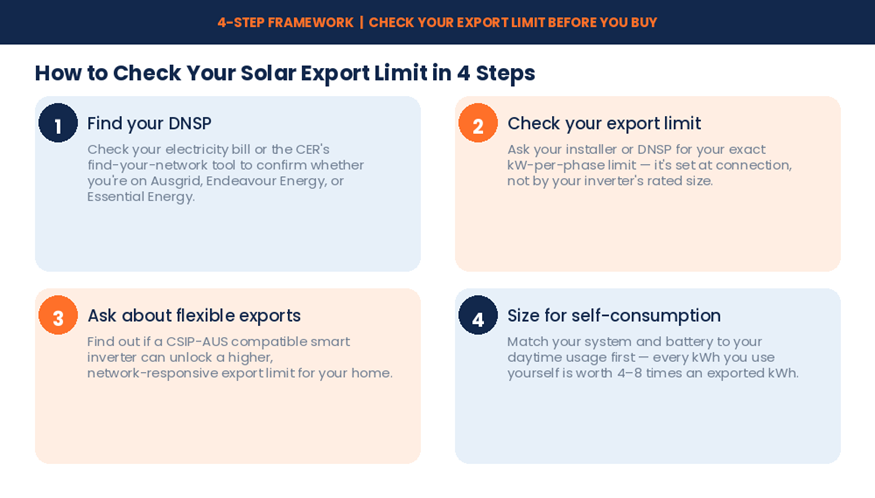
4 steps to confirm your export limit before you sign a solar or battery quote

Before you commit to a system size or a battery, work through four simple checks: confirm which DNSP services your address, ask for your exact export limit in writing, find out whether a flexible export connection is available, and size your system around your own daytime and evening usage rather than panel count alone. A good installer will walk you through all four without being asked.

Frequently Asked Questions
How do I find out my exact solar export limit?

Check your latest electricity bill, ask your installer to confirm it in writing before you sign a quote, or contact your DNSP (Ausgrid, Endeavour Energy or Essential Energy) directly through their online connection portal.

Does a higher export limit mean I get paid more for my solar?

Not necessarily. Feed-in tariffs sit between roughly 2 and 10 cents per kWh in 2026, so export volume alone has a smaller impact on your bill than how much solar you use yourself. A higher export limit still helps, but pairing it with better self-consumption or storage usually delivers a bigger financial benefit.

Can I apply for a higher export limit than the standard allowance?

In some cases, yes. Endeavour Energy customers, for example, can apply for special permission to connect for additional inverter capacity or a higher export limit. Approval depends on the condition of the local grid in your neighborhood, so outcomes vary from street to street.

Will a home battery help if I already have an export limit in place?

Yes. A battery stores the solar surplus your export limit would otherwise curtail, letting you use that energy in the evening instead of losing it. This is typically the single biggest lever available to homeowners on a restrictive fixed export limit.

Is my export limit the same as my solar inverter’s size limit?

No. These are two different numbers. The installation guidelines (now managed by Solar Accreditation Australia) allow a DC-to-AC oversizing ratio of up to 1.33, so a 5 kW inverter can support up to roughly 6.65 kW of panels — but your export limit is a separate figure set by your network, independent of your inverter or panel capacity.

A Note on Timing and Rebates

Export limits sit alongside — not instead of — the rebate decisions many NSW homeowners are weighing in 2026. If you are also comparing whether to install a battery now or later, our guide on whether to rush a solar battery before the rebate drops walks through that separate decision in detail.

Talk to a Local Installer About Your Export Limit

Every export limit is different, and the only way to know yours with certainty is to have your address checked against your DNSP’s records. Solar Battery Outlet provides free, no-obligation quotes for homeowners across Liverpool, Bankstown and Mudgee. We check your network, your export limit and your usage pattern before recommending a system size — so you are not paying for export capacity you will never actually use. Call 1800 000 777 or visit solarbatteryoutlet.com.au to get started.

Disclaimer

This article is general information only and does not constitute personal financial, technical or legal advice. Solar export limits, network rules and feed-in tariff rates vary by distribution network, address, phase configuration and inverter type, and are set and changed by your DNSP and the Australian Energy Regulator, not by Solar Battery Outlet. Figures on export volumes, curtailment and self-consumption value in this article are illustrative examples based on publicly available industry data current as of July 2026 and are not a guarantee of savings, export capacity or system performance for any individual home. Always seek personalised advice before making a purchasing decision. Solar Battery Outlet complies with Australian Consumer Law and does not use high-pressure sales tactics or misleading claims about rebates, export limits or savings.
A $0-upfront solar offer is one of the easiest pitches to say yes to. No deposit, no big invoice, and a promise of cheaper power from the day the installer packs up their ladder. But “no upfront cost” doesn’t mean no cost. It usually means the cost has been moved somewhere less visible: into an interest rate, a buy-back margin, or a contract that runs for 10 to 25 years. If you’re comparing solar quotes in Liverpool, Bankstown, Mudgee or anywhere else in NSW this year, understanding where that cost actually sits is the difference between a genuinely good deal and one you’ll be paying off long after a cash-purchase system would have paid for itself.

This guide breaks down the three most common no-upfront-cost structures on the NSW market, shows a real worked example of what each one costs over 10 years, and gives you a short framework to sanity-check any quote before you sign.

What “No Upfront Cost” Solar Actually Means

Not every $0-deposit offer works the same way. In the NSW residential market, it almost always falls into one of three structures:

  • Solar loan — a lender pays the installer, and you own the system immediately while repaying the loan plus interest over an agreed term, typically 5 to 10 years.
  • Power Purchase Agreement (PPA) — a third party owns, installs and maintains the system on your roof, and you buy the electricity it generates at a set rate for the length of the contract, often 10 to 25 years.
  • Solar lease or buy-now-pay-later (BNPL) plan — you pay a fixed periodic fee to use equipment you don’t own, with ownership only transferring (if at all) at the end of the term.

Each of these is a legitimate finance product. The issue isn’t that they exist; it’s that the marketing usually stops at “no upfront cost” and doesn’t explain which structure you’re signing, who owns the system, or what happens to the federal rebate.

Where the Hidden Cost Really Hides

Four places absorb the cost that a cash buyer simply doesn’t pay:

1. Interest and dealer fees on solar loans

A loan advertised on a low headline rate can still carry a dealer or origination fee baked into the financed price. That fee is often absorbed into the total you’re financing rather than shown as a separate line item, so the true cost only becomes visible when you compare the cash price against the financed price side by side, and check the comparison rate rather than the advertised rate alone.

2. Buy-back margins on PPAs and leases

On a PPA, the rate you pay per kWh is set by the provider, not the market. It’s typically lower than your retailer’s tariff, but because you’re locked in for the contract term, you don’t benefit from switching retailers, using government feed-in tariff changes to your advantage, or paying down the system faster.

3. Escalation clauses

Some PPAs and leases include an annual price escalator of 2–5%. It looks small in year one and compounds meaningfully by year ten, especially against a cash-purchase system whose only ongoing cost is occasional maintenance.

4. Who claims the rebate

On a cash or loan purchase, the Small-scale Technology Certificate (STC) rebate is factored into your quoted price and you’re the one who benefits. On many PPAs and leases, the installer or financier assigns the STCs to themselves as part of how they fund the “free” system — which is a normal part of the structure, but it means the rebate isn’t reducing your out-of-pocket cost the way it would on a purchase.

A Worked Example: Cash vs Loan vs PPA

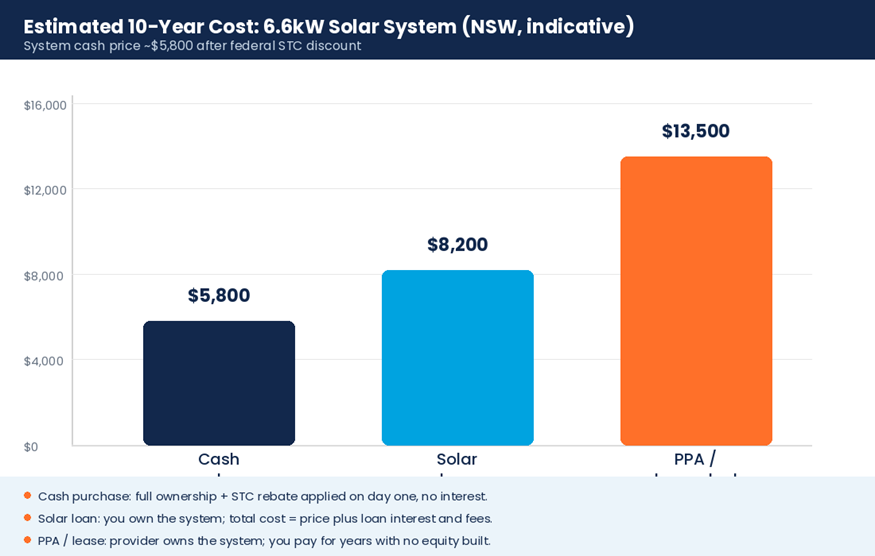
Take a typical 6.6kW rooftop system, which costs around $5,800 after applying the federal STC discount—broadly in line with Solar Choice’s July 2026 Price Index, which estimates the average cost of a residential solar system in Australia at roughly $0.88–$0.95 per watt installed after the STC discount.

10-year indicative cost comparison for a 6.6kW NSW solar system: cash purchase, solar loan, and PPA/lease.

Check the comparison table/chart shows on the page (on mobile too), and add the assumptions under it (interest rate, PPA rate, escalator %, term). Still, the pattern holds consistently: the cash buyer pays the least in total and owns the asset outright from day one. The loan buyer pays more in total but still owns the system. The PPA or lease customer pays the most over time and, in most structures, never owns the equipment on their roof.

Red Flags to Watch For in NSW

Regulators have flagged the solar and battery finance space for closer scrutiny as more households take up subsidised systems. As

ACCC Commissioner Anna Brakey put it: “As more Australian households switch to battery and solar plans, the deals on offer must be fair, accurate and easy to understand. The ACCC will be watching carefully and actively monitoring consumer complaints.”

Unsolicited door-to-door sales are a particular concern. Consumer Action Law Centre CEO Stephanie Tonkin has raised similar issues around third-party lead generation in solar sales, noting that

“we think companies are using lead generation to get around the very limited protections that do exist”

Under Australian Consumer Law, sales made door-to-door or by telephone carry a mandatory 10 business day cooling-off period, and a valid contract must be signed and dated by both you and the salesperson on the front page. If a salesperson pressures you to sign today or waives the cooling-off period, that’s a clear signal to slow down.

How to Check If a “No Upfront Cost” Quote Is Actually Good Value

Before signing anything, run the quote through this five-point check:

  • Ask for the cash price and the financed price side by side — the gap is your real interest and fee cost.
  • Confirm who owns the system and who is claiming the STC rebate.
  • Request the comparison rate or effective annual cost, not just the headline interest rate or per-kWh rate.
  • Read the exit and buy-back clause — what does it cost to end the contract early or sell the property?
  • Get your 10-day cooling-off right confirmed in writing before you sign.

For a closer look at how the current federal and NSW battery incentives affect timing, our earlier guide on whether it’s worth rushing before the rebate drops walks through how the Cheaper Home Batteries Program and NSW VPP incentive interact with your purchase timing.

FAQ: No Upfront Cost Solar Deals in NSW

Is a solar PPA the same as a solar loan?

No. A solar loan means you own the system from day one and repay a lender directly. A Power Purchase Agreement means a third party owns the system, and you buy the electricity it produces at an agreed rate for the contract term.

Do I own the system with a no-upfront-cost deal?

It depends on the structure. Loans usually transfer ownership to you immediately. Some BNPL plans do too, but others work like a lease — check your contract. Leases and PPAs keep ownership with the provider for the length of the agreement, sometimes with a buyout option at the end.

Can I cancel if I change my mind?

If the sale happened door-to-door or by phone, Australian Consumer Law gives you a 10 business day cooling-off period. Outside that window, cancellation depends entirely on your contract’s terms, so review the exit clause carefully before signing.

Who gets the federal rebate on a PPA or lease?

In most PPA and lease structures, the provider assigns the STC rebate to themselves as part of financing the “free” installation, rather than passing that value on as a lower price to you.

The Bottom Line

A no-upfront-cost deal isn’t automatically a bad one, but it’s rarely the cheapest one. If cash flow is genuinely the barrier, a straightforward solar loan with a transparent comparison rate usually costs less over time than a PPA or lease, and it leaves you owning the asset on your roof. Before you commit to any structure, get an itemised, upfront-cost quote to compare it against — that’s the only way to see what the “free” offer is actually costing you.

If you’re in Liverpool, Bankstown or Mudgee and want a transparent, upfront quote to compare against a finance offer you’ve been given, get in touch with our team—we’ll show you the real numbers before you sign anything.

Disclaimer

This article is general information only and does not constitute financial, legal or credit advice. Solar loan rates, PPA terms, and buy-back rates vary by provider and change over time, so always confirm current figures directly with your chosen installer or lender before signing a contract. Cooling-off rights and consumer protections referenced here reflect Australian Consumer Law at the time of writing and may not apply to every sale method. Always seek personalised advice before making a purchasing decision.
Type “solar battery rebate NSW” into Google and you get the same explainer a hundred times over: what the Cheaper Home Batteries Program is, what STCs are, and a vague “up to 30% off” headline. None of that tells you what you will actually pay in Liverpool, Bankstown, or Mudgee.

Your rebate is not one number that applies Australia-wide. It is a stack—a federal certificate value, a state VPP incentive, and, in theory, a local council contribution—and each layer depends on where your meter sits, not only which battery you buy. This guide walks through that stack for each of our three service areas and lands you on a real dollar range for your suburb, instead of another generic scheme summary.

What Actually Determines Your Rebate Amount

Three factors determine your rebate: your solar zone rating, your battery’s usable capacity, and the STC price on your installation date.

Under the Clean Energy Regulator’s postcode zone map, Liverpool, Bankstown, and Mudgee are all in Zone 3. This is the same rating used for much of Sydney, Adelaide, and Perth. That matters because some installers suggest regional customers receive a “country loading.” For batteries, however, postcode does not change the federal rebate. The calculation is based on usable battery capacity.

Since 1 May 2026, battery size has become more important. The scheme provides the full STC factor of 6.8 STCs per usable kWh for the first 14 kWh. A reduced rate applies to the next 14 kWh. Capacity above that receives much less support. A typical 10–13.5 kWh battery falls entirely within the highest tier. Larger 20 kWh systems may receive less value for capacity above 14 kWh.

The STC price also changes daily on the open market. Installers commonly use approximately $37 per certificate, while the Clean Energy Regulator’s Clearing House benchmark may be slightly higher.

Local councils do not currently offer direct cash rebates for home batteries in Liverpool, Canterbury-Bankstown or Mudgee. Council support usually involves development guidance or general sustainability advice. If your quote includes a “council rebate”, ask the installer to identify the exact program.

Straight from the regulator and the minister
Federal Energy Minister Chris Bowen has described uptake of the battery scheme as “a program of success and strength”, pointing to enthusiasm for the rebate as the reason for the May 2026 changes.

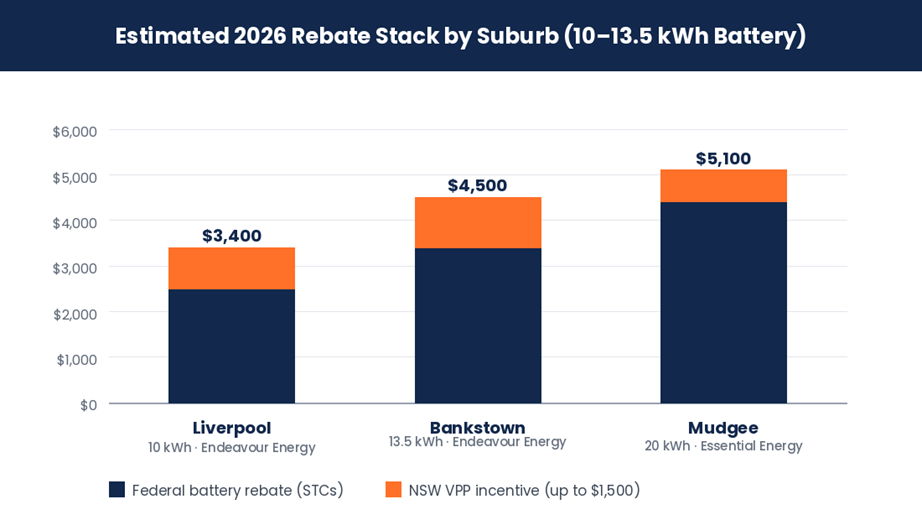
Liverpool sits in the Endeavour Energy network area, and most homes here run a 6.6–10 kW solar system paired with a mid-sized battery. For a typical 10 kWh battery installed in the second half of 2026:

  • Federal battery discount only: around $2,500 (10 kWh × 6.8 STCs × approximately $37 per STC)
  • NSW Peak Demand Reduction Scheme incentive: Eligible households who connect an approved battery to an approved Virtual Power Plant (VPP) may receive an additional incentive, subject to current scheme rules and eligibility requirements.
  • Total available incentives will depend on battery size, STC values, VPP eligibility and current program settings.

Based on an assumed STC value of approximately $37. STC values can change over time and your quote will show the actual discount available to your installation.

That figure assumes solar is already installed and a standard-sized battery is being added. If solar and battery are going in together, the panel component is calculated separately using the Zone 3 rating and adds its own STC value on top. Liverpool households with evening-heavy usage — working families out during the day, home from around 5pm—tend to see the strongest return from this stack, since the battery discharges stored solar exactly when grid electricity is most expensive.

Also within Endeavour Energy territory, Bankstown mirrors Liverpool’s zone rating and network loss factor, but homes here more often step up to a 13.5 kWh battery — the size of a Tesla Powerwall 3 — to cover larger households or dual-occupancy properties. Running the same method on a 13.5 kWh system:

  • Federal battery discount only: around $3,400 (13.5 kWh × 6.8 STCs × approximately $37 per STC)
  • With the NSW Peak Demand Reduction Scheme incentive (if you connect an eligible battery to an approved Virtual Power Plant): additional incentives may be available, subject to current scheme rules and eligibility requirements.
  • Total available incentives will depend on battery size, STC values, VPP eligibility and current program settings.

Based on an assumed STC value of approximately $37. STC values can change over time and your quote will show the actual discount available to your installation.

If a solar battery Bankstown installation is what you’re comparing quotes for, this is the number to hold your installer to. A good Bankstown quote shows the STC deduction as a line item on the invoice, not a verbal estimate, and it names which VPP provider the state incentive is coming through, since not every retailer offers the same terms.

Mudgee sits on the Essential Energy network—regional NSW’s distributor—rather than Endeavour Energy, but the network loss factor used in the incentive calculation is identical to Bankstown’s and Liverpool’s. Where Mudgee genuinely differs is system size and VPP access. Larger rural blocks and bigger roofs mean 20 kWh batteries are common, and fewer retailers currently run VPP plans on the Essential Energy network, so the state incentive can be smaller, or occasionally unavailable.

  • Federal battery discount only: around $4,400 (20 kWh battery using the applicable tiered rebate calculation and assumed STC value).
  • NSW Peak Demand Reduction Scheme incentive: Eligible households who connect an approved battery to an approved Virtual Power Plant (VPP) may be able to receive an additional incentive, subject to current scheme rules and eligibility requirements.
  • Total available incentives will depend on battery size, STC values, VPP eligibility and current program settings.

Based on an assumed STC value of approximately $37. STC values can change over time, and your quote will show the actual discount available to your installation.

Before budgeting on the VPP figure, ask the installer to confirm — by name — which retailer will run the VPP contract in Mudgee. “Should be available” is not the same as confirmed.

Common Reasons People Get Quoted the Wrong Number

Four mistakes account for almost every inflated or understated rebate quote we see:

1. Contract date versus installation date. The rebate locks in on the day the battery is commissioned, not the day the contract is signed. A quote based on the STC factor in the contract month is only accurate if installation happens in that same window.

2. Nameplate capacity instead of usable capacity. STCs are calculated on usable kWh, typically 90–95% of the battery’s nameplate size. A 13.5 kWh nameplate battery might carry a rebate calculated on closer to 12.8 kWh.

3. Ignoring the tiered structure. Anyone quoting a flat per-kWh rate on a battery over 14 kWh is either rounding generously or working from a spreadsheet that has not been updated since April 2026.

4. Assuming VPP participation is automatic. The NSW incentive only applies once a VPP retailer contract is actually signed — it is not bundled into every battery purchase by default.

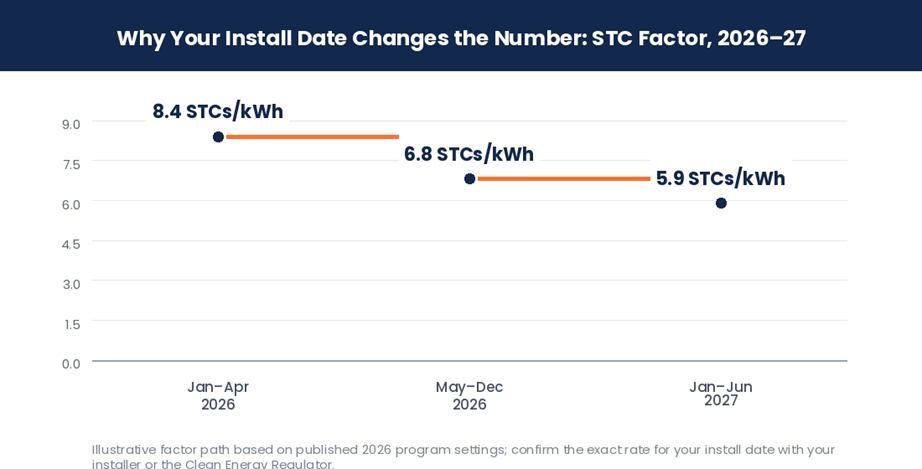
Timeline chart showing the federal STC factor declining from 8.4 to 6.8 to 5.9 STCs per kWh between 2026 and 2027

Because the STC factor changes twice a year now, instead of once, a quote that felt accurate in March can already be stale by August. This is one reason the Clean Energy Regulator has started pushing back publicly on overly optimistic installation timelines. The regulator’s executive general manager, Carl Binning, warned that “deceptive or misleading behaviour will not be tolerated”, and urged installers to keep quotes tied to realistic scheduling.

How to Verify Your Quote Already Has the Rebate Applied

Before signing anything, run the written quote through this five-point check:

1. Is the STC discount shown as a dollar figure on the invoice? It should reduce the total price directly, not appear as a separate rebate to be claimed later.

2. Does the quote state the battery’s usable capacity, not just its nameplate size? The rebate is calculated on usable kWh.

3. Is the installer SAA-accredited, and can they show the number? Only accredited installs are eligible for the federal rebate.

4. Is the VPP incentive named to a specific retailer, with an approximate payment window? “Up to $1,500” with no provider attached is a placeholder, not a quote.

5. Does the quote reference an installation date, not just a contract date? If installation slips into the next STC period, the rebate amount changes — and that should be flagged before signing, not after.

Any reputable solar battery installation company will walk a customer through these five points without being asked. If an installer will not put the numbers in writing, treat that as a warning sign.

Frequently Asked Questions

Do I need to apply for the rebate separately?

No, this is not the case for most installations. The installer or retailer usually handles both incentives. This includes the federal STC discount and the NSW VPP incentive. They create the certificates and pass the value on as a point-of-sale discount. Homeowners can technically create and trade STCs directly through the REC Registry. However, very few choose this option. It is mainly suitable for homeowners who are comfortable navigating the registry themselves.

Can rebates be backdated if a battery is already installed?

Generally, no. The rebate follows the STC factor and scheme rules in effect when the system was installed and commissioned. Systems installed before the scheme existed cannot claim the rebate retroactively. Eligibility also requires an approved product and an accredited installer. One exception is adding new battery capacity. The added capacity can generate STCs if it is at least 5 kWh and stays within the scheme’s cap.

What if I rent? Can I still get the rebate?

The rebate is tied to the equipment and property connection, not home ownership. A landlord can install a battery at a rental property and claim it. Tenants generally cannot claim the rebate directly. Renters interested in a battery should discuss the option with their landlord.

A Note on Accuracy

This article is general information only and does not take into account personal circumstances, electricity usage, or property details. Rebate values, STC prices, and NSW incentive amounts are estimates based on publicly available program settings as of July 2026, and can change without notice, including reductions to the STC factor every six months. Nothing here constitutes financial, legal or tax advice.

Always seek personalised advice before making a purchasing decision. For the confirmed rebate value on a specific installation, request a written, itemised quote from an SAA-accredited installer.
From 1 July 2026, something that once sounded like a marketing gimmick became a real, government-backed electricity offer: three hours of completely free power in the middle of every day. Under the new Solar Sharer Offer, eligible households in NSW, South East Queensland, and South Australia can now use electricity from 11am to 2pm at no cost, up to a daily cap.

This did not happen by accident. It happened because Australian households and businesses installed batteries faster than almost anyone predicted, and those batteries are now doing a job that used to belong to expensive gas power stations. For NSW homeowners who already have a battery, or who are weighing one up, this is one of the more significant shifts in how solar batteries pay for themselves that we have seen in years.

In this guide, we will unpack exactly what the Solar Sharer Offer means for NSW households, why batteries are now displacing gas at the evening peak, and how to build a simple framework around your own energy use so you get the most out of both the free window and your battery.

What Is the Solar Sharer Offer, Exactly?

The Solar Sharer Offer is a regulated electricity plan introduced by the Australian Government and administered by the Australian Energy Regulator (AER). It requires energy retailers with more than 1,000 customers in Default Market Offer areas, which includes NSW, to give eligible households at least three hours of free electricity every day, timed to the middle of the day when solar generation is at its highest.

For NSW and South East Queensland, the free window runs from 11am to 2pm. In South Australia, it runs from 12pm to 3pm. Households can access up to 24 kilowatt-hours of free electricity during that window each day, which the AER calibrated to roughly match a five-person household’s typical daily usage. You do not need rooftop solar panels to use it, and it is available to renters as well as homeowners, since it is an opt-in plan you request through your electricity retailer rather than a rebate tied to owning equipment.

It is worth being clear about what the offer does not do. Your entire bill does not become free, and you still pay your daily supply charge and for any electricity used outside the three-hour window. For most households without a way to shift or store energy, the practical saving comes down to whatever they can genuinely use, such as running the dishwasher, washing machine, or pool pump, during that specific window.

Why the Grid Can Suddenly Afford to Give Power Away

The Solar Sharer Offer only exists because the economics of the electricity grid have shifted underneath it. Rooftop and grid-scale batteries have been installed at a pace that has genuinely surprised energy regulators, and that build-out is doing double duty: soaking up surplus midday solar that used to go to waste, and then discharging that stored power during the evening demand peak that gas plants used to cover almost exclusively.

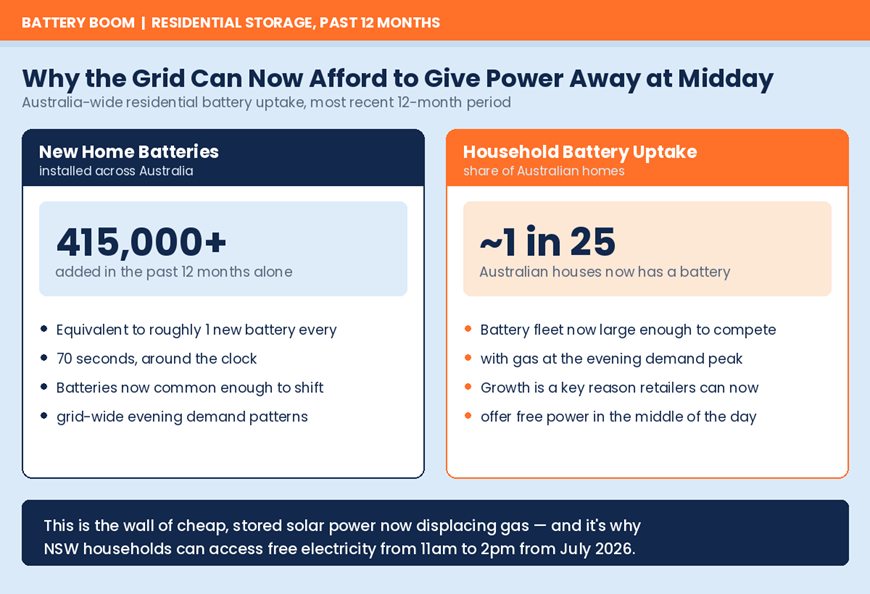
Two stat cards showing 415,000+ new home batteries added in the past 12 months and roughly 1 in 25 Australian homes now having a battery

More than 415,000 residential batteries were added across Australia in the past year alone, or roughly one for every 25 houses in the country. That is a large enough fleet to genuinely change how the grid behaves at 6pm, which is traditionally the most expensive and gas-dependent hour of the day.

Clair Savage, who chairs the Australian Energy Regulator, has pointed to this directly as the reason wholesale prices have flattened out. “Batteries have been displacing more expensive gas and hydro in the evenings, and we’ve just seen flatter prices through the whole day,” she said, adding that the shift has translated into lower forward electricity contract prices. Tennant Reed, climate change and energy director at the Australian Industry Group, made a similar point about the evening peak specifically: “The role of gas used to be in the evening to meet the evening peak and that came at a cost, because gas is not a cheap fuel. But more and more every day, it is batteries that are surging into the market at 6 p.m.”

Why a Battery Changes the Value of the Free Window

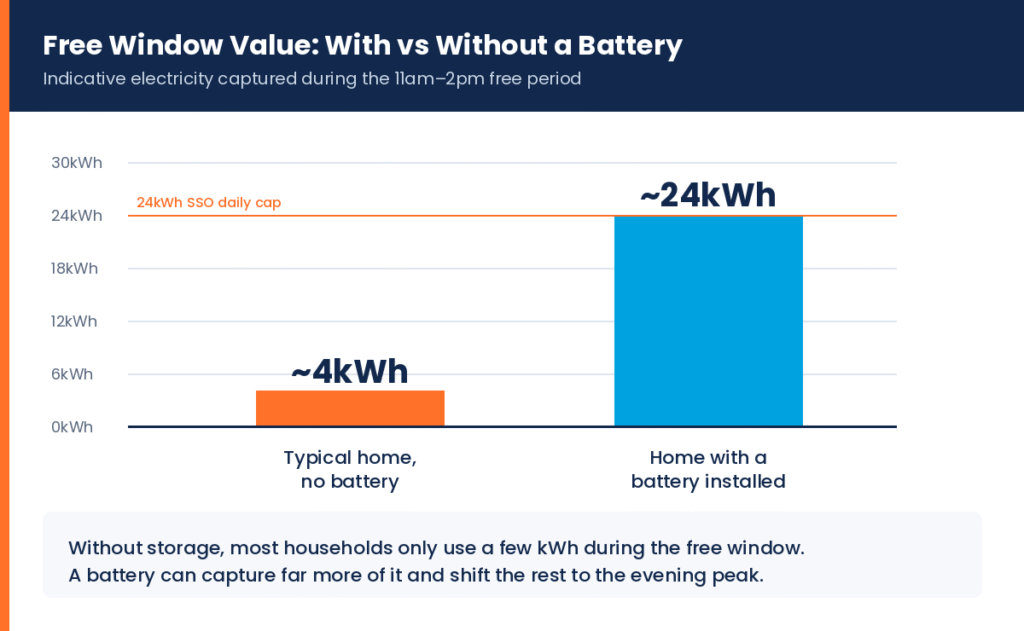
Here is the part that matters most for anyone in NSW deciding whether a home battery is worth it in 2026: without a battery, you can only benefit from the Solar Sharer Offer in real time. If nobody is home between 11am and 2pm to run appliances, most of that free power simply goes unused.

free window, with and without a battery

A household with a correctly sized battery can behave very differently. Instead of relying on someone being home to use appliances in real time, the battery can charge from the grid during the free window, capturing far more of the available 24 kilowatt-hour allowance, and then discharge that stored energy during the evening when electricity would otherwise cost the most. This is exactly the same load-shifting principle that is driving battery uptake at the grid level, just applied to a single household.

These figures are indicative only. Actual free-window capture and evening savings depend on your battery’s capacity, your retailer’s specific Solar Sharer Offer terms, your household’s usage pattern, and your existing tariff, so results will vary from home to home.

An Actionable Framework for NSW Households

Whether you already own a battery or are comparing options for the first time, use this five-step framework to make sure you are actually capturing the value of the free midday window rather than leaving it on the table.

  1. Confirm you have a smart meter. The Solar Sharer Offer requires one, since retailers need interval data to apply the free-power period accurately to your bill.
  2. Opt in through your retailer. The offer is not automatic, even if you are eligible. Contact your electricity retailer directly or compare offers via Energy Made Easy to opt in.
  3. Check your battery’s charge scheduling. Most modern inverters and battery management apps let you set a forced-charge window, so confirm yours is set to draw from the grid, not just solar, between 11am and 2pm.
  4. Size your evening discharge around real usage. Look at 30 days of your evening consumption data, typically 5pm to 9pm, and check your battery’s usable capacity can realistically cover it after a midday charge.
  5. Review your tariff structure annually. As more states introduce free-window offers and time-of-use pricing evolves, the most cost-effective charge-and-discharge pattern for your household may shift year to year.
A note on choosing an installer
Getting the charge-scheduling and battery sizing right is where a qualified installer earns their fee. As a solar battery installation company working across Liverpool, Bankstown, and Mudgee, if you’re on a Solar Sharer plan, we can set your battery to charge in the free window, and we can also reprogram an existing battery’s charge schedule during a routine service visit.

Choosing the Right Battery for a Free-Window Strategy

Not every battery on the market is well suited to this new charge-midday, discharge-evening pattern. A battery that is too small will fill up quickly during the free window and have little left to offer for a full evening peak, while an oversized battery may add cost without meaningfully improving your outcome if your evening usage is modest.

If you are comparing the best solar batteries in Australia for this specific use case, prioritise usable capacity in the 10 to 13 kilowatt-hour range for an average NSW household, confirm the inverter supports scheduled grid-charging (not just solar-charging), and check the manufacturer’s cycle life, since a free-window strategy means more frequent daily cycling than a solar-only setup.

If you are in South West Sydney, a local solar battery Bankstown installer can walk through your actual smart meter data with you, rather than relying on rule-of-thumb sizing, and set the charge schedule up correctly from day one.

Frequently Asked Questions
Do I need solar panels to get the Solar Sharer Offer?

No. The Solar Sharer Offer is available to households with or without rooftop solar, and to renters as well as homeowners. You need a smart meter and must opt in through your electricity retailer.

Does the Solar Sharer Offer make home batteries unnecessary?

No. The free window only benefits you in real time unless you can shift usage into it. A battery lets you capture power during the free hours and use it later in the evening peak, which is when electricity is normally most expensive.

Is the Solar Sharer Offer available everywhere in NSW?

It is available across NSW as one of the Default Market Offer areas, alongside South East Queensland and South Australia. Other states and territories are expected to introduce similar offers from 2027, subject to further government decisions.

Will my whole electricity bill be free during the Solar Sharer window?

No. Only electricity used within the three-hour window, up to the 24 kilowatt-hour cap, is free. You still pay for electricity used outside that window and your daily supply charge.

Disclaimer

This article is general information only and does not constitute financial or energy market advice. Details of the Solar Sharer Offer, including free power windows, usage caps, and eligible regions, are based on Australian government and Australian Energy Regulator information available as of July 2026 and may change. Savings and consumption figures referencing third-party sources (including CleanTechnica and The Cool Down) are indicative estimates, not guaranteed outcomes, and actual results depend on your retailer’s terms, battery specifications, and household usage. Always seek personalised advice before making a purchasing decision.
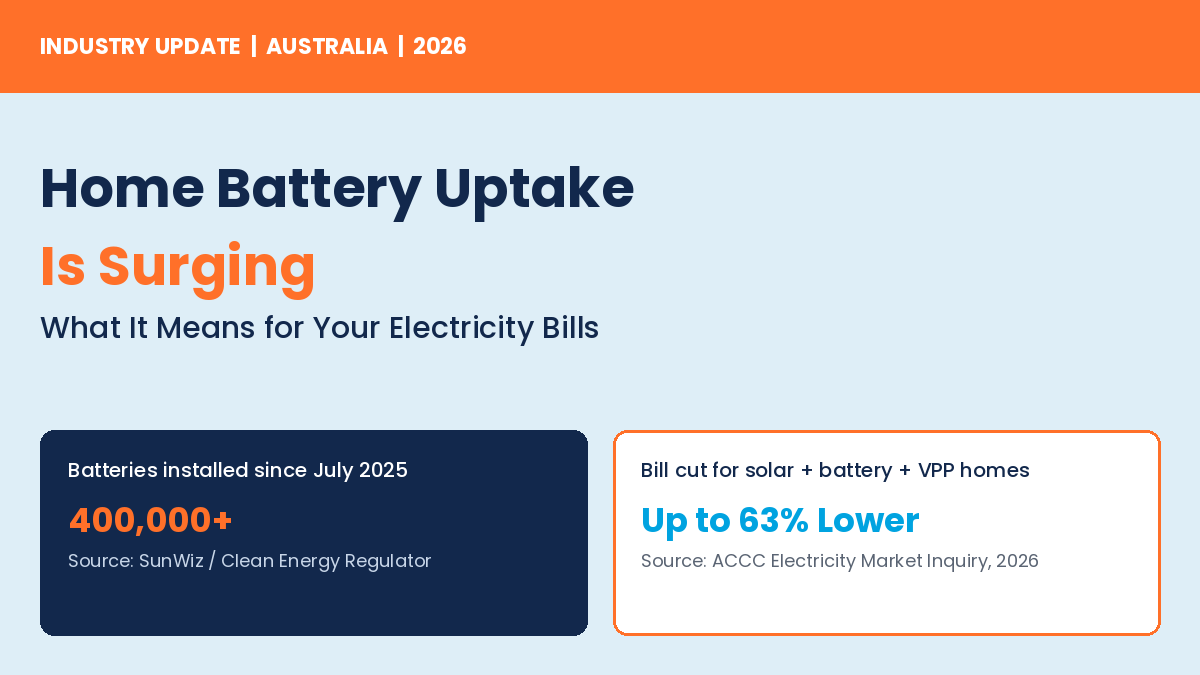
Want Your Battery Set Up for the Free Window?
We help NSW households across Liverpool, Bankstown, and Mudgee choose, size, and correctly schedule a solar battery to make the most of the Solar Sharer Offer, whether you’re installing a new system or reconfiguring an existing one. Call us: 1800 000 777, or visit solarbatteryoutlet.com.au for a free assessment of your usage patterns and battery options.

If you live in a house in NSW, adding a solar battery is now a fairly well-worn path: get quotes, check your usage, claim the rebate, and get it installed. If you live in an apartment, the path has looked very different—until recently, it barely existed at all.

That is changing quickly. The NSW Solar for Apartment Residents (SoAR) grant now supports apartment buildings. New state battery rebate categories also support shared systems. Strata law reforms make sustainability upgrades easier to approve. Together, these changes give apartments and strata buildings across Sydney and regional NSW a realistic path to shared solar battery storage.

This guide walks through exactly what has changed, what a shared battery system actually looks like in an apartment building, what it costs, and the framework your strata committee can use to move from “we should look into this” to an approved, installed system.

Why Apartment Batteries Were Stuck Until Now

For years, manufacturers designed home batteries around a single meter and a single roof. This model works for detached houses but not for buildings with dozens of separate electricity accounts sharing one roof. Strata schemes also had to navigate common property rules, and many buildings required unanimous or 75% owner approval before owners could install shared solar, let alone a battery.

The numbers show how far apartments have fallen behind. Solar Choice researched approximately 49,000 NSW strata schemes with five or more lots. Fewer than 3% have shared rooftop solar installed. Battery storage penetration remains below 1%.

Jeff Sykes is Solar Choice’s CEO. He describes strata buildings as one of Australia’s last untapped frontiers for rooftop solar. He says the barriers have never been technical. Instead, they involve ownership, decision-making, and fair benefit-sharing among residents.

3% of NSW strata schemes have shared solar and under 1% have shared battery storage

Three things have shifted that picture in 2026: government funding aimed specifically at strata buildings, a battery rebate category built for shared systems, and a lower voting threshold that makes approval realistic.

What’s Actually Changed for NSW Strata in 2026

1. The Solar for Apartment Residents (SoAR) grant

The NSW Government’s Solar for Apartment Residents grant funds up to 50% of the cost of a shared rooftop solar system, capped at $150,000 per building. It is open to owners corporations and strata managing agents rather than individual lot owners, and applications must be authorised by a sustainability infrastructure resolution passed at a general meeting.

2. A battery rebate built for shared systems

Previously, the federal Cheaper Home Batteries Program assumed one battery per household — which effectively locked apartments out. From September 2026, the NSW Peak Demand Reduction Scheme introduced a new category that allows an entire apartment building to share one large battery, with certificates calculated per apartment up to a 5 kWh cap per dwelling. This can stack on top of the federal rebate, meaningfully improving the payback case for a building-wide system rather than requiring each resident to install their own.

3. Strata voting reform

Getting 75% of owners to agree on anything is difficult. Recent NSW reforms dropped the threshold for sustainability infrastructure proposals — including solar and battery installations on common property — to a simple 50% majority of those voting, and strata committees can no longer block rooftop solar purely based on how it looks, except in heritage-listed buildings. This single change has removed the biggest practical obstacle for many committees.

How a Shared Apartment Battery Actually Works

Unlike a single-home installation, an apartment battery system needs a way to distribute stored solar energy fairly across multiple electricity accounts. There are a few established approaches used across NSW buildings today:

  • Solar-sharing hardware: technology such as Allume’s SolShare allows one rooftop solar array, paired with a shared battery, to distribute stored energy across up to 30 apartments through the existing switchboard, with each resident metered individually.
  • Embedded networks: the building operates its own private electricity network, purchasing bulk power and reselling it to residents, which can include a shared battery as part of the network’s supply.
  • Common-property battery: a battery sized to offset shared services like lifts, lighting, and car park power, funded and owned via the owners corporation rather than distributed to individual lots.

Mio Dart, Head of Operations at Allume Energy, said the company designed its newest hardware generation specifically to close this gap for residents. Dart explained that the company redesigned SolShare 2 with batteries in mind, allowing apartment residents to access battery storage in ways that were previously unavailable. The technology now enables multi-unit buildings to share both solar power and battery storage, rather than relying solely on solar sharing.

$381 average annual savings from shared solar only to $756 with shared solar plus battery storage

Allume’s own performance data illustrates the difference storage makes: shared solar alone has delivered average annual savings of around $381 per resident, while pairing that solar with a shared battery has lifted average savings to around $756 per year in early deployments. These figures depend heavily on building consumption, solar output, battery size, and each resident’s electricity tariff, so actual results vary from one strata scheme to another.

What It Costs — and the Actionable Framework for Your Strata Committee

A shared battery system for an apartment building is a bigger project than a single home installation, and the cost depends heavily on building size, battery capacity, and whether solar already exists on the roof. As a working framework, strata committees weighing this up should work through five steps in order:

  1. Check your existing solar. If your building already has rooftop solar under a previous SoAR-funded project, a shared battery add-on is usually far more cost-effective than starting from scratch.
  2. Get an energy usage assessment. A reputable installer should review 12 months of common-area and, where available, individual unit consumption before recommending a battery size — not just quote off the roof area.
  3. Compare at least two quotes from SAA-accredited installers working for NETCC Approved Sellers, as SoAR applications require, and confirm that both the federal Cheaper Home Batteries rebate and the NSW PDRS shared-battery category appear as dollar deductions on the written quotes.
  4. Pass a sustainability infrastructure resolution at a general meeting. Under the current rules this needs only a 50% majority of those voting, with no quorum requirement.
  5. Confirm the benefit-sharing model in writing before signing so every lot owner understands how the body corporate will distribute the savings—whether proportionately to unit entitlements, through individual metering via solar-sharing hardware, or as deductions from body corporate levies.

Choosing the Right Approach for Your Building

Not every strata scheme needs the same solution. A smaller block of 6–10 units with a straightforward switchboard may suit a solar-sharing hardware approach with a moderate shared battery, while a larger complex running lifts, shared lighting, and basement car parking may get more value from a common-property battery sized around those services. Buildings already on an embedded network have a third option again, since the battery can sit inside the network’s existing billing structure.

This is also where it pays to talk to a team that has done the comparison work already. Whether you’re weighing up the best solar batteries in Australia for a single dwelling or scoping a shared system for a 40-lot strata scheme, the right battery size and configuration should always follow an honest look at usage data — not the other way around.

If your building is in South West Sydney, a solar battery installer working across Bankstown and neighbouring suburbs can visit the site, review the switchboard capacity, and map out which of the three approaches above suits your roof, your metering setup, and your owners corporation’s appetite for the project.

Frequently Asked Questions

Can individual apartment owners apply for the NSW battery rebate themselves?

No. For shared building systems, the application must come through the owners’ corporation or an authorised strata managing agent — individual lot owners cannot apply for the SoAR grant or the shared-battery PDRS category on their own. Raising it at the next strata meeting is the correct first step, not calling an installer directly.

Does my building need existing solar before we can add a shared battery?

No, but it helps the economics. A building with no existing solar can still apply for a combined solar-plus-battery project, though buildings that already have SoAR-funded solar typically see a faster payback when adding storage, since the panels are already paying for themselves.

How is the savings from a shared battery divided between residents?

This depends on the system. Solar-sharing hardware like SolShare meters and credits each apartment individually. A common-property battery offsetting shared services typically reduces the whole building’s electricity costs, thereby lowering strata levies in proportion to unit entitlements rather than crediting individual units directly.

What size battery does a typical apartment building need?

There is no single answer — the number of lots, existing solar capacity, and the amount of power residents use after solar generation stops each day determine the required battery size. Under the NSW shared-battery rebate category, the scheme caps certificates at 5 kWh per apartment, providing a rough starting point. However, property owners should review 12 months of usage data before committing to a system to determine the appropriate size.

Disclaimer

This article is general information only and does not constitute financial, legal, or strata governance advice. Rebate amounts, eligibility criteria, and voting thresholds referenced above are based on NSW Government and industry information available as of July 2026 and are subject to change without notice. Strata committees should obtain independent advice specific to their scheme, by-laws, and building configuration before passing any resolution or entering a contract. Savings figures cited from third-party sources (including Allume Energy and Solar Choice) are averages based on specific deployments and are not guaranteed outcomes for every building. Always seek personalised advice before making a purchasing decision.
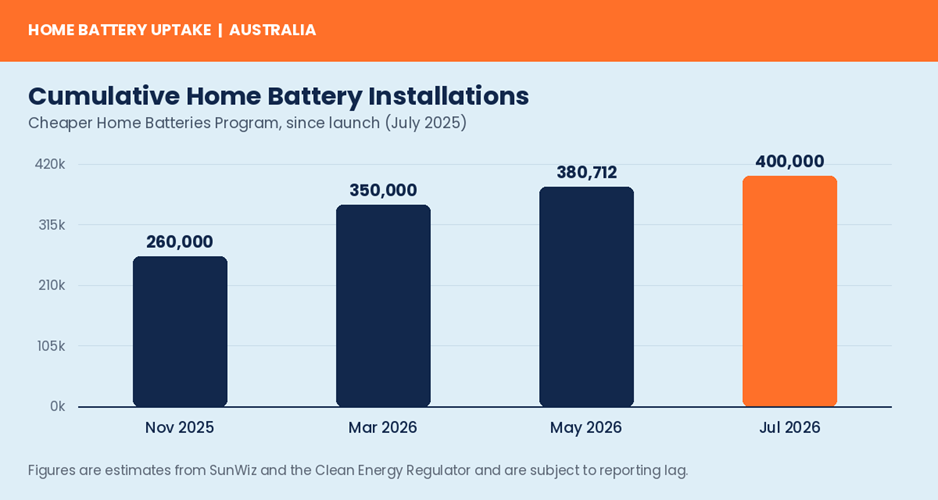
If you live in NSW, the rules may now work in your favour. Many households have delayed solar or batteries because of upfront costs. In June 2026, the NSW Government launched the Home Energy Saver program. The headline offer is simple: an interest-free loan of up to $15,000. You can use it for solar panels, a home battery, or other eligible energy upgrades.

Here is the honest, no-hype version. This is a loan, not free money. You must repay every dollar you borrow. However, you pay no interest, so your savings come from avoiding interest charges rather than receiving a discount. This guide explains how the loan works and who qualifies. It also covers how the loan works with existing rebates. Finally, it shows how homeowners in Liverpool, Bankstown, and Mudgee can use the program

What Exactly Is the NSW Home Energy Saver Program?

Home Energy Saver is a $557 million NSW Government initiative. It replaces and expands the older Empowering Homes scheme. The new program offers a higher loan cap and a much higher income threshold. It has two separate parts. You should understand the difference before applying for either one.

The loan component opened first on 17 June 2026, and two approved finance providers, Brighte and Plenti, currently offer it. The discount component, worth up to $4,000, targets lower-income households, and Creditex is expected to launch it later in 2026 through a separate provider.

The full list of eligible upgrades goes well beyond solar and batteries. It also covers switchboard upgrades, reverse-cycle air conditioning, insulation, ceiling fans, draft-proofing, and EV chargers. This flexibility matters if you plan more than one upgrade at once because you can bundle several upgrades into a single loan up to the $15,000 cap.

Loan or Discount

How the Loan Stacks With Rebates You Already Qualify For

This is the part most homeowners get wrong: the Home Energy Saver loan is not a replacement for the federal battery rebate or the NSW VPP incentive. It is designed to sit alongside them. The smart order is to apply every rebate and discount you are eligible for first, so those reduce the total system cost, and only then take out a loan to cover whatever balance is left.

Here is what that looks like in practice for a typical solar-and-battery installation.

Saving Stack

In this example, a household only needs to finance $5,600 rather than the full $10,000, and because the loan is interest-free, that is also the total amount repaid over the ten-year term. Compare that with a typical commercial loan at around 8% interest, where the same $15,000 borrowed over ten years would add close to $6,800 in interest on top of the amount repaid — a gap that makes the zero-interest structure the real value in this scheme (Lenergy, 2026, lenergy.com.au).

Who Actually Qualifies for the Loan?

Eligibility is checked by your finance provider, Brighte or Plenti, based on documents including your most recent Notice of Tax Assessment. In broad terms, you need to meet the following:

  • Be an Australian citizen or permanent resident with a combined, annual, taxable household income of $210,000 or less.
  • Own the property where the upgrade is being installed — this includes landlords installing on a rental property.
  • Not have already received $15,000 in upgrades under a previous Home Energy Saver loan on that property.
  • Not be applying for social or community housing, or a short-stay accommodation property.

Renters cannot apply for the loan directly, since it is tied to property ownership. Once the discount component opens later in 2026, renters will be able to apply for that instead, provided their landlord (and strata manager, where relevant) agrees to the upgrade in writing.

What the Numbers Say — and What the Experts Are Saying

More than half of NSW homes already have rooftop solar, according to the NSW Government. The state also adds around 13,000 new home batteries each month. This momentum helps explain the shift toward financing instead of another flat rebate. For households still waiting, upfront cost—not demand—has been the main barrier.

NSW Minister for Climate Change and Energy Penny Sharpe has framed the program as part of a broader shift toward household electrification, noting that upgrades like these help families “enjoy a cooler home in summer, a warmer home in winter, and smaller power bills every month”.

On the industry side, Smart Energy Council chief executive David McElrea has pointed out that a combined solar and battery system typically costs between $10,000 and $40,000, depending on system size and a household’s electrification needs, which is exactly the price range where a $15,000 interest-free loan makes the most practical difference (Zecar, 2026, zecar.com).

Whichever installer you compare quotes with, the underlying advice from most industry commentary lines up: apply every rebate first, only finance what is left, and choose a solar battery installation company that shows the rebate as a line-item deduction on a written quote, not a verbal promise.

How to Apply, Step by Step

  • Check your eligibility against the official loan guidelines, or use the NSW Energy Savings Finder tool.
  • Choose your upgrade — solar, battery, or both — and use the Energy Savings Calculator to estimate bill savings.
  • Get a written quote from an SAA-accredited, program-approved installer.
  • Pick a finance provider, Brighte or Plenti, and apply through your accredited installer.
  • The loan funds go directly to your installer once the work is confirmed — you never handle the money yourself.

Frequently Asked Questions

Is the $15,000 Home Energy Saver loan free money?

No. It is an interest-free loan, which means you repay the full amount you borrow, just without any interest charged over the term. The separate $4,000 discount, opening later in 2026, does not need to be repaid.

Can I use the loan for a solar battery in Bankstown or Liverpool specifically?

Yes. The loan is available across all of NSW, including Liverpool, Bankstown, and Mudgee. Eligibility depends on your household income and property ownership, not your suburb.

Can I combine this loan with the federal battery rebate?

Yes. The federal Cheaper Home Batteries Program and the NSW VPP incentive should be applied first to reduce your system cost, and the Home Energy Saver loan can then cover the remaining balance.

Do renters qualify for the loan?

Not for the loan itself, since it requires property ownership. Renters will be able to apply for the separate $4,000 discount once it opens later in 2026, with their landlord’s written permission.

How do I find a reliable solar battery installation company to work with?

Look for SAA accreditation, a written quote with rebates itemised, and an installer willing to check your electricity usage before recommending a battery size. Comparing solar battery Bankstown and Liverpool quotes side by side is the best way to spot a fair price.

Ready to Find Out What You Qualify For?
We help NSW homeowners across Liverpool, Bankstown and Mudgee understand which rebates, incentives and financing options may be available for their installation. We also assist with the installation paperwork, including applicable grid connection and system registration requirements. Call us: 1800 000 777 Or visit solarbatteryoutlet.com.au and complete the 60-second eligibility form — no pressure, just information tailored to your home.
About Solar Battery Outlet
We are a Liverpool-based solar battery installer, part of GWM Group Pty Ltd, servicing homes across Liverpool, Bankstown and Mudgee. All installations are carried out by SAA-accredited electricians, and we handle all rebate and loan paperwork on your behalf.

Disclaimer

This article provides general information only. It does not constitute financial, legal, or personal advice. The details of the NSW Home Energy Saver program, including eligibility criteria, loan terms, and discount availability, reflect published NSW Government information as of July 2026. These details may change without notice. The finance provider, either Brighte or Plenti, determines loan approval. Solar Battery Outlet does not make this decision. Approval depends on your individual financial circumstances. Always check current eligibility and terms on the official NSW Government Home Energy Saver page before applying, and always seek personalised advice before making a purchasing decision.
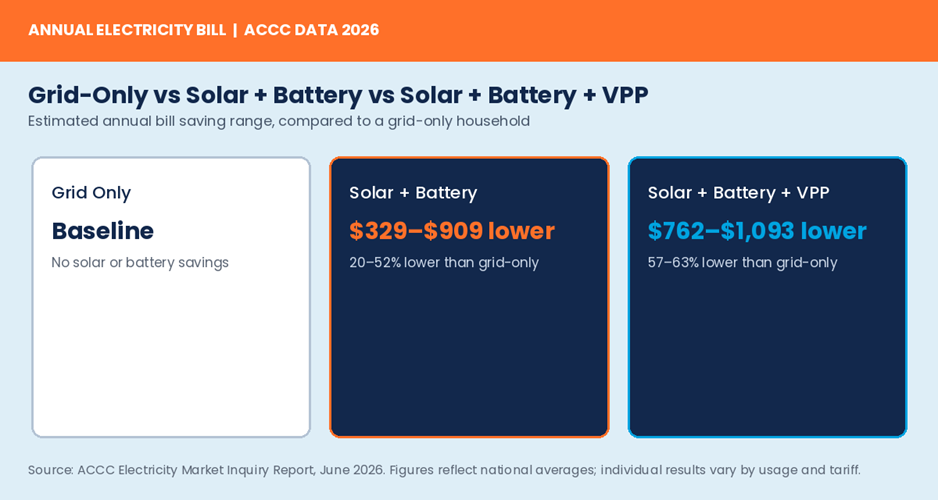
php