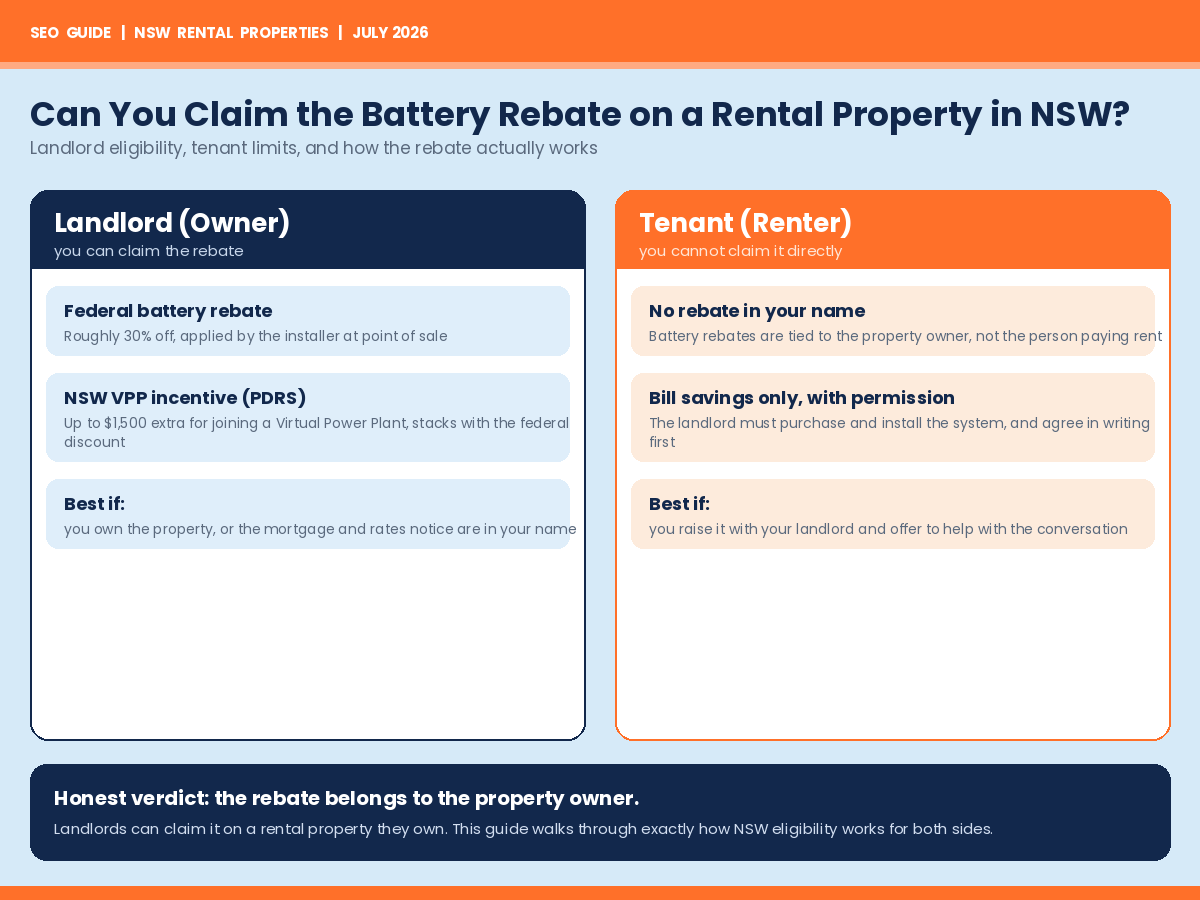
If you own a rental property in NSW, you are probably wondering whether the battery rebate on a rental property in NSW is even worth chasing, or whether it only applies to owner-occupiers. The short answer is that the rebate belongs to whoever owns and pays for the battery, not to whoever pays the electricity bill. That means landlords are eligible. Tenants, on their own, are not.

This guide walks through exactly who can claim, what it is worth on a typical rental in 2026, and how to avoid the mistakes that get landlord applications knocked back.

Quick Answer: Who Actually Owns the Rebate

Yes, landlords can claim the solar battery installation rebate on a rental property they own in NSW. Eligibility for both the federal Cheaper Home Batteries Program and NSW’s own incentives is tied to property ownership and to whoever purchases the system, not to who lives there or pays the power bill. A tenant cannot apply for the rebate in their own name, even if they are the one covering the electricity account.

There is a practical nuance worth flagging early. Renters can sometimes access the savings indirectly, but only with the landlord’s written agreement, because the landlord is the one signing the contract with the installer and the one whose name goes on the compliance paperwork.

The Federal Cheaper Home Batteries Program on a Rental Property

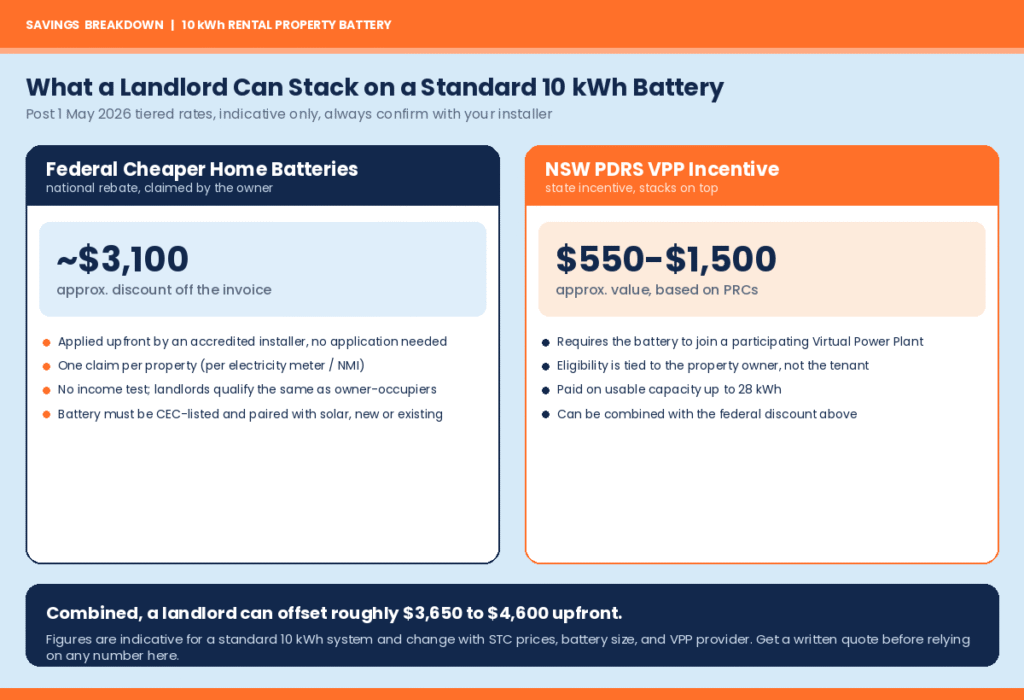
The national scheme, run through the Small-scale Renewable Energy Scheme, gives an upfront discount based on the battery’s usable size and the current STC rate. There is no income test, and landlords qualify on exactly the same terms as a homeowner living in the property. Investors with several rental properties can even claim once per address, provided each property has its own electricity meter, or NMI.

A few conditions apply specifically to rental situations:

  • The person who purchases the system, generally the landlord, is the one who benefits from the discount, since the invoice and compliance certificate are issued in their name.
  • The battery must be new, listed on the Clean Energy Council’s approved product list, and installed by an installer accredited by Solar Accreditation Australia.
  • Grid-connected systems must be capable of joining a Virtual Power Plant, though actually joining one is optional for the federal rebate.
  • From 1 May 2026, the rebate is tiered: the full rate applies to the first 14 kWh of usable capacity, a reduced rate to the next 14 kWh, and a much smaller rate above that, up to a 50 kWh cap.

On a standard 10 to 13 kWh system, most rental properties still sit comfortably in the full-rate tier, so the reduction from May mostly affects larger commercial-style installs rather than typical suburban homes.

NSW State Incentives: PDRS VPP Incentive and the Home Energy Saver Program

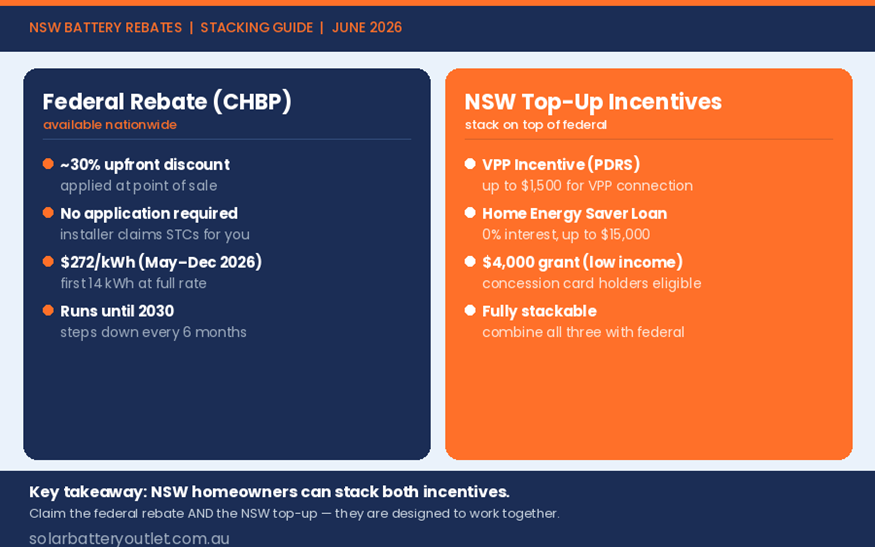
On top of the federal discount, NSW runs the Peak Demand Reduction Scheme, which pays a one-off incentive worth roughly $550 to $1,500 for connecting an eligible battery to a Virtual Power Plant. As with the federal rebate, eligibility sits with the property owner. If a tenant wants their landlord’s battery connected to a VPP, the landlord still needs to be the one signing the VPP agreement.

NSW also launched the Home Energy Saver Program on 17 June 2026, offering zero-interest loans of up to $15,000 for eligible upgrades, including batteries. Importantly, this loan is open to landlords as well as owner-occupiers, which is unusual compared to some earlier state schemes that excluded investment properties entirely. A separate discount for lower-income households is expected to open later in 2026, and renters will be able to access that discount stream only with written landlord permission.
Can a Renter Claim Anything Themselves?

Not directly. Every current NSW and federal program requires the applicant to be the property owner or the person who purchased the system. A renter cannot lodge a claim in their own name, even for a battery they are paying to run.

Emerging policy has made battery ownership more interesting. Advocacy groups want renters and apartment residents to install plug-in balcony batteries without landlord approval. They support reforms similar to those already underway in parts of Europe. NSW has not finalized this framework yet. Renters should discuss battery installation with their landlord instead of applying independently.

Why It Is Worth Raising With Your Landlord Anyway

More than 30% of Australian households currently rent, according to analysis referenced in recent reporting on solar standards for rentals, and that share keeps growing. Yet very few rental properties carry solar or battery storage, largely because of what economists call the split incentive: the landlord pays the upfront cost, while the tenant captures the ongoing bill savings.

Uptake nationally is still accelerating despite that gap. As of early June 2026, the federal government reported more than 420,000 Cheaper Home Batteries installed, representing over 12 gigawatt-hours of usable storage capacity, according to independent coverage of the official announcement. Landlords who act now are still installing well ahead of the curve compared to the broader rental market.

Finn Peacock, a Chartered Electrical Engineer and founder of SolarQuotes.com.au, has pointed out that tenants are often willing to pay more rent for a solar-equipped property, citing research commissioned by Origin Energy in which roughly two-thirds of renters said they would pay at least $5 more a week for a home with solar, and over half said they would pay $10 or more. Actual market data cited in the same piece put the real average premium at around $19 a week for solar-equipped rentals.

Solar advocacy group Solar Citizens has separately described renters as one of the groups missing out most on rooftop solar and storage savings, and has called for a national target for solar uptake across rental housing. For a landlord, the combination of federal and state incentives, a rental premium tenants appear willing to pay, and a stronger sale price down the track makes the split incentive far less of a barrier than it used to be.

Step-by-Step: How a NSW Landlord Claims the Rebate

  • Confirm ownership documents. You will need a recent rates notice or title document showing you as the registered owner of the rental property.
  • Get at least two quotes from solar battery companies that use SAA-accredited installers, including one in your local area, whether that is Liverpool, Parramatta, or regional NSW.
  • Confirm the battery model appears on the SAA approved products list before signing anything.
  • Ask your installer to apply the federal Small-scale Technology Certificate discount directly off the invoice, so you never have to claim it separately.
  • Ask whether the system will be VPP-capable, and separately, whether you want to opt into a VPP for the additional NSW PDRS payment.
  • Keep the electrical compliance certificate on file. This is the document that confirms the system was installed and triggers the rebate.
  • If your tenant is covering electricity costs, consider a short written note confirming who benefits from any bill savings, to avoid disputes later.

Common Mistakes That Get Rental Claims Rejected

A handful of avoidable errors account for most rejected or delayed rental property claims:

  • Applying with a tenant’s name on any part of the paperwork instead of the owner’s.
  • Using a second-hand or relocated battery, which is not eligible under the federal program.
  • Skipping the SAA approved products list check, only to find out after installation that the specific model is not eligible.
  • Assuming the rebate applies automatically. It only applies once an accredited installer completes the paperwork and issues a compliance certificate.
  • Not checking whether the property already has a NMI-linked rebate claim from a previous owner or installation at that address.

Choosing the Right Installer for a Rental Property

Because the rebate, the VPP agreement, and the compliance certificate all run through your installer, the choice of solar battery installation company matters more on a rental than on an owner-occupied home. Look for SAA-accredited installers, a track record with investment properties specifically, and clear documentation you can hand to your property manager. Independent comparisons of the best solar batteries in Australia is a useful starting point before you request quotes, since battery choice affects both your rebate tier and your long-term running costs.

Frequently Asked Questions

Can a landlord claim the battery rebate on an investment property in NSW?

Yes. Landlords are eligible for the same federal and state battery incentives as owner-occupiers, provided they purchase and install the system and meet the standard eligibility criteria.

Can a tenant apply for the battery rebate themselves?

No. Every current program requires that the applicant be the property owner or the purchaser of the system. A tenant would need the landlord’s agreement and involvement to access any rebate.

Does the NSW battery rebate apply to strata or apartment rentals?

The owners’ corporation or strata manager generally claims shared battery systems in apartment buildings, not an individual tenant or unit owner acting alone.

How much can a landlord save on a typical rental battery installation?

Federal battery discount only: around $2,500 (10 kWh × 6.8 STCs × approximately $37 per STC). With the NSW Peak Demand Reduction Scheme incentive (if you join an eligible VPP): additional incentives may be available, subject to current scheme rules and eligibility requirements. Based on an assumed STC value of approximately $37. STC values can change over time, and your quote will show the actual discount available to your installation.

Does installing a battery increase what a landlord can charge in rent?

There is no guaranteed rent increase, but research cited by industry sources suggests many tenants are willing to pay a premium for a solar and battery-equipped rental, and the improvement can lift the property’s resale value over time.

Ready to Check Your Rental Property’s Eligibility?

Solar Battery Outlet works with landlords across NSW to confirm eligibility, compare SAA-approved battery options, and handle the paperwork for both the federal rebate and the NSW PDRS incentive. Get in touch for a free, no-obligation quote and find out exactly what your rental property qualifies for.

Disclaimer

This article provides general information about NSW and federal battery rebate eligibility as at the date of publication and is not personal financial, legal, or tax advice. Rebate values, eligibility rules, and program funding change regularly and may differ by installer, battery size, and VPP provider. Landlords and tenants should confirm current eligibility and figures directly with Solar Battery Outlet or an accredited installer before making a purchasing decision.
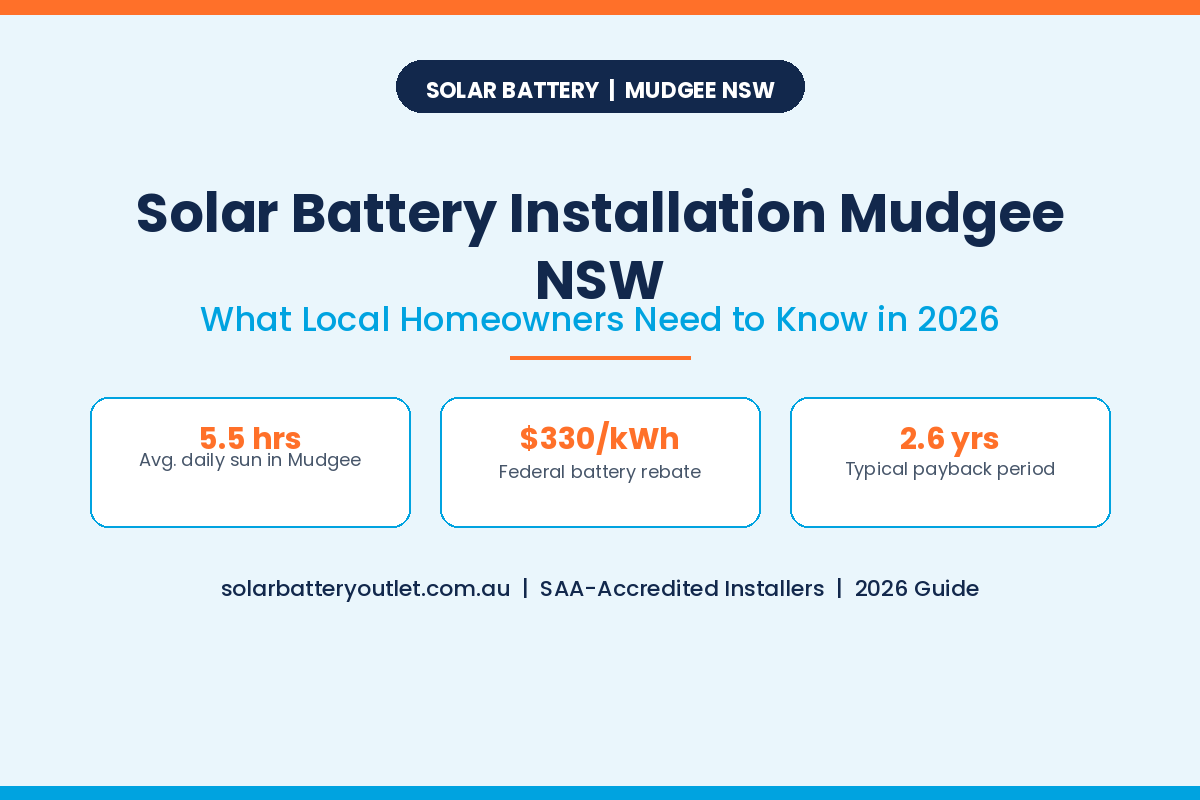
If you live in Mudgee or the surrounding Mid-Western Regional area, you have probably noticed more battery vans parked outside neighbours’ driveways over the past year. That is not a coincidence. Regional NSW is installing home batteries faster than almost anywhere else in the country, and 2026 brings a fresh set of rebate changes, network rules, and installer standards that every local homeowner should understand before signing a contract.

This guide walks through what has changed, what a solar battery installation actually looks like in Mudgee, what realistic payback looks like on your bill, and how to pick a solar battery installation company you can trust. No sales pressure — just the facts you need to make a confident decision.

What’s Changing for Mudgee Homeowners in 2026

The federal Cheaper Home Batteries Program is still running and remains the single biggest reason for the explosion in battery uptake across regional NSW. Nationally, home battery installations surged by roughly 260 per cent year-on-year, with more than 268,000 units installed by the end of 2025 alone.

As Clean Energy Council CEO Jackie Trad put it, households are “taking control of their own power bills in record numbers.” That momentum has reached Mudgee too, with the Clean Energy Regulator recording steady month-on-month growth in regional NSW postcode data.

However, the rebate rate is not fixed. The STC factor used to calculate your discount steps down every six months, and from 1 May 2026, a tiered structure further reduced support for batteries with usable capacity above 14 kWh. The rebate itself continues until 2030 — it simply gets a little smaller over time, so the date you install affects your discount — but choosing the right system matters more than rushing.

Why Mudgee’s Solar & Battery Landscape Is Different

Mudgee sits within the Essential Energy network, which covers regional and rural NSW rather than metro Sydney. Essential Energy has introduced two-way pricing tariffs that reward households for exporting solar power during the 5pm–8pm peak window rather than the 10am–3pm solar trough — a detail that changes how much a battery can genuinely save you compared to a Sydney household on Ausgrid.

Regional network charges also run higher than metro areas, since Essential Energy maintains infrastructure across a much larger geographic footprint per customer. That makes shifting evening usage onto stored solar even more valuable for Mudgee households than for their city counterparts.

Mudgee also enjoys around 5.5 hours of peak sunlight a day on average, which is a solid resource for charging a battery fully most of the year, including winter. Combined with strong local uptake, New South Wales now leads the national battery market by a clear margin under the federal program, according to Clean Energy Regulator postcode data current to 31 May 2026.

Solar battery installer in Mudgee

The 5-Step Installation Roadmap for Mudgee Homes

A solar battery installation in Mudgee generally follows the same core process everywhere in NSW, but a few regional details are worth planning for early. Here is the roadmap we recommend to every local homeowner before they book an installer.

Here are the steps:
1. Get 3 Written Quotes — Compare SAA-accredited installers on price, battery brand and confirmed install dates — not just the headline rebate figure.

2. Check Your Roof & Switchboard — Mudgee’s older homes often need a switchboard upgrade before a battery can be safely connected. Ask for this in writing.

3. Confirm Rebate Stacking — Combine the federal Cheaper Home Batteries discount with any applicable NSW rebate. Ask your installer to itemise both on the quote.

4. Schedule Installation — Regional NSW bookings can take 2–4 weeks longer than metro Sydney. Lock in a confirmed date, not just a signed contract.

5. Register for VPP & Monitor — Join a Virtual Power Plant where available and monitor performance in the first 90 days to confirm expected savings.

Two steps trip up more Mudgee homeowners than any others: switchboard readiness and installer scheduling. Older regional homes often carry legacy switchboards that need upgrading before a battery can be connected safely, and regional bookings can run several weeks behind metro Sydney during peak demand periods. Building both into your timeline avoids nasty surprises.

What Battery Payback Really Looks Like in Mudgee

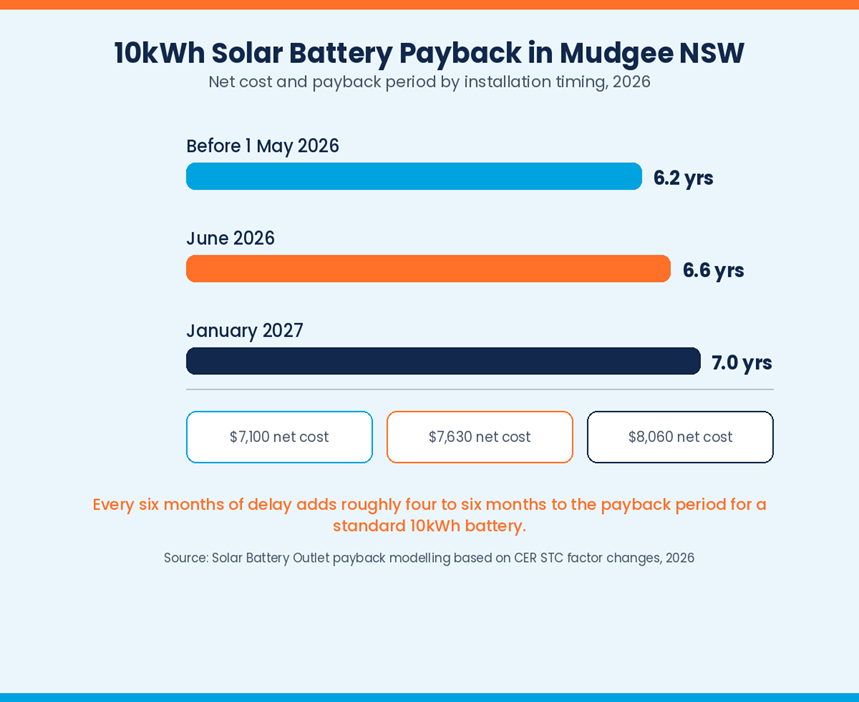
Numbers matter more than marketing here. For a standard 10 kWh battery, the payback period lengthens the longer you wait, purely because the rebate discount shrinks every six months while the annual saving from the battery itself stays roughly the same.

10kWh solar battery payback in Mudgee

Carl Binning, Executive General Manager at the Clean Energy Regulator, recently confirmed the scheme has “just breached 430,000 households.” The program is scheduled to run until 2030, with the discount reducing every six months.

For context, Mudgee households typically use 15 to 22 kWh per day, meaning a well-sized 10 kWh battery covers a meaningful share of evening consumption without over-investing in capacity you rarely draw down. A good installer will model this against your actual bills rather than a generic household average.

Choosing the Right Solar Battery Installation Company

Timing and rebates matter, but the single biggest factor in how your installation turns out is the solar battery installation company you choose. Mudgee’s growing market has attracted both excellent local installers and some less scrupulous operators chasing rebate demand.

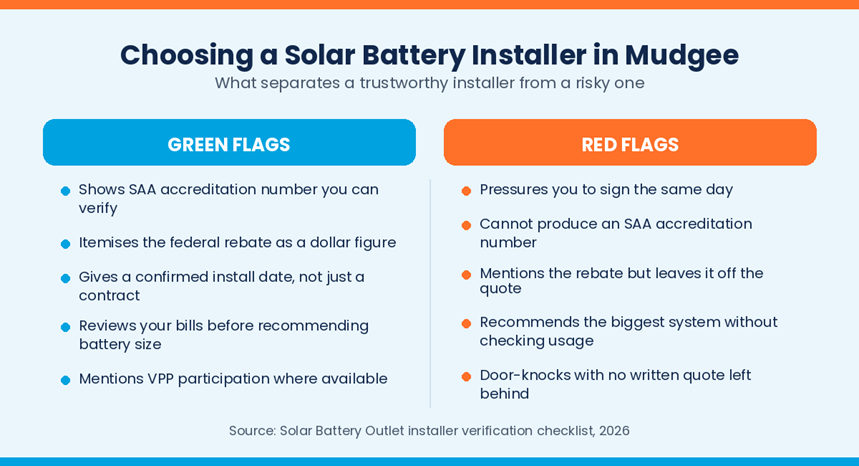
Look for SAA-accredited electricians, a written quote that itemises the rebate as a dollar figure rather than a verbal promise, and a confirmed installation date rather than just a signed contract. If you are comparing brands, the best solar batteries Australia homeowners currently favour include Tesla Powerwall, BYD, Sungrow, Enphase and Growatt — check the exact model is on the Clean Energy Council approved product list. Avoid any installer who pressures you to sign on the spot, cannot produce an accreditation number, or recommends the largest possible system without reviewing your electricity bills first. A legitimate installer is happy for you to take a written quote home and compare it against others.

Frequently Asked Questions

Is Mudgee eligible for the same battery rebate as Sydney?

Yes. The federal Cheaper Home Batteries Program applies nationally, including Mudgee and the wider Mid-Western Regional Council area. Your rebate amount depends on your battery’s usable capacity and the STC factor at the time of installation, not your location.

How long does a typical installation take in Mudgee?

Most straightforward residential installations take about a day once scheduled. However, regional bookings in Mudgee can take two to four weeks longer to secure than metro Sydney during peak demand, so plan your timeline accordingly.

Do I need to upgrade my switchboard before adding a battery?

Not always, but many older Mudgee homes do. Ask your installer to inspect your switchboard during the quoting stage and include any upgrade cost in writing, rather than discovering it on installation day.

Can I combine the federal rebate with a state incentive?

In most cases, yes. The federal rebate and any applicable NSW-based incentive are calculated separately and can typically be claimed together, though eligibility depends on your retailer, tariff and system configuration. Confirm the exact figures with your installer in writing.

What size battery suits an average Mudgee home?

Most Mudgee households use between 15 and 22 kWh of electricity per day, which makes a 10 kWh battery a common and cost-effective starting point. Larger families, homes with an EV, or all-electric households may benefit from a bigger system after a proper usage assessment.

Disclaimer

This article is general information only and does not constitute financial, legal or professional advice. Rebate amounts, eligibility criteria and payback figures are indicative, based on publicly available data at the time of writing, and may change without notice under federal or NSW government programs. Always obtain a written, itemised quote from an SAA-accredited installer and verify current rebate rates before making a purchasing decision. Solar Battery Outlet recommends comparing at least three quotes and reviewing your own electricity usage before committing to any solar battery installation.
About Solar Battery Outlet: We are a Liverpool-based solar battery installer, part of GWM Group Pty Ltd, servicing homes across Liverpool, Bankstown and Mudgee. All installations are carried out by SAA-accredited electricians, and we manage all rebate paperwork on your behalf.

Australia’s home battery boom shows no sign of slowing in 2026. The federal Cheaper Home Batteries Program has pulled thousands of new households into the market, and that surge has attracted its fair share of installers who talk a big game but skip the fine print on compliance.

Before you let anyone touch your switchboard, you need one simple confirmation: is this person actually an SAA-accredited solar battery installer, or are they relying on an outdated “SAA-accredited” claim that no longer applies? Getting this wrong doesn’t just risk a shoddy install; it can cost you your rebate entirely.

This guide breaks down exactly what SAA accreditation means, walks through a four-step framework you can use in five minutes, and flags the warning signs that separate a genuine professional from a risky sales pitch.

What Does “SAA-Accredited” Actually Mean?

Solar Accreditation Australia (SAA) is the national body responsible for accrediting the individuals who design and install rooftop solar and battery systems. The Clean Energy Regulator appointed SAA to run this scheme, so accreditation isn’t a marketing badge; it’s a government-recognised qualification tied directly to your eligibility for small-scale technology certificates (STCs) and state rebates.

Accreditation isn’t one-size-fits-all, either. An installer can hold separate endorsements for Grid-Connected Photovoltaic systems, grid-connected battery storage, and stand-alone power systems, plus a design-only, install-only, or combined design-and-install status. Consequently, an electrician accredited to install solar panels isn’t automatically qualified to install a battery. You need to confirm the specific battery storage endorsement, not just a general solar accreditation.

To hold accreditation, an installer must also carry an unrestricted electrical licence, current public liability insurance, and a working-at-heights certificate, and they must complete at least 100 continuing professional development points every 12 months to keep their status current.

Why “CEC Accredited” Isn’t the Full Story Anymore

For 16 years, the Clean Energy Council administered installer accreditation, and plenty of homeowners still search for a “CEC-accredited installer” out of habit. However, the CER transferred this function to SAA, with the changeover formally completing on 29 May 2024. Since that date, installers must hold current SAA accreditation to claim STCs; a lapsed or historical CEC number no longer qualifies a system for the rebate.

This matters because some installers still reference their old CEC credentials on websites and brochures that haven’t been refreshed. That isn’t necessarily dishonest, but it does mean you shouldn’t take a printed CEC logo at face value. Instead, ask directly whether the installer has transitioned to SAA and request their current accreditation number.

The Clean Energy Council hasn’t disappeared, though. It still maintains the approved product lists for panels, inverters, and batteries, and it continues offering CPD-eligible training that SAA recognises. So you’ll likely see both organisations mentioned in a compliant quote: SAA for the installer’s personal accreditation, and CEC for the equipment’s approval status.

The 4-Step SAA Verification Framework

You don’t need to be a compliance expert to run this check; it takes about five minutes once you have the right details in hand.

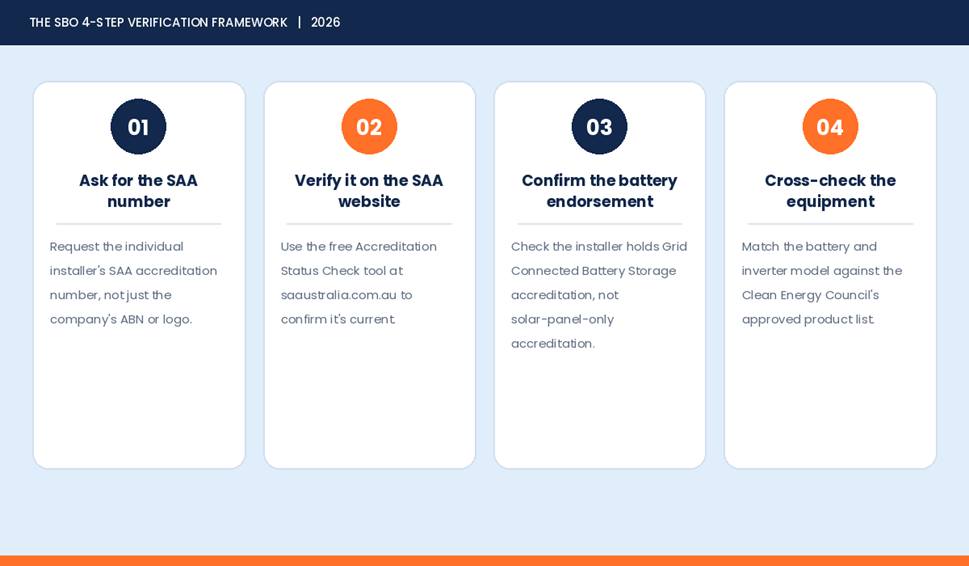
First, ask for the installer’s full name and SAA accreditation number before you sign anything. A properly accredited installer provides this without hesitation. Second, head to the SAA website and use the free Accreditation Status Check tool to confirm the number is current and active. Third, confirm the accreditation specifically covers Grid Connected Battery Storage, since a solar-only endorsement doesn’t extend to batteries. Fourth, cross-check the exact battery and inverter model against the Clean Energy Council’s approved product list, because using an unapproved product voids STC eligibility even with a fully accredited installer.

Run through these four checks with every quote you receive, and keep a screenshot of the verification result for your records. If a retailer sub-contracts the physical install, apply the same checklist to the sub-contractor, not just the salesperson who wrote your quote.

Green Flags vs Red Flags When Vetting an Installer

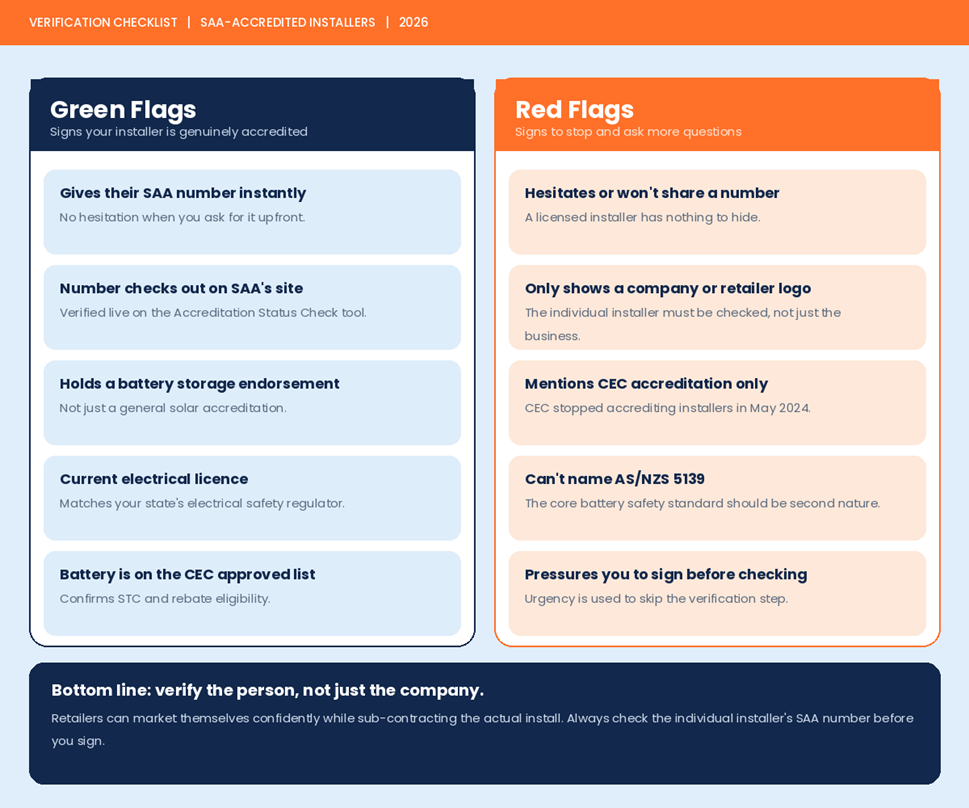
Genuine SAA-accredited installers tend to behave in consistent, reassuring ways throughout the sales process. They share their accreditation number immediately, their number checks out live on SAA’s database, and they confirm their battery storage endorsement without prompting. They also hold a current electrical license for your state and quote equipment that already appears on the CEC’s approved list.

By contrast, a few behaviours should make you pause and ask more questions. Hesitation or vague answers when you request an accreditation number is one of the clearest warning signs, since a compliant installer has nothing to hide. Similarly, be cautious of quotes that only mention a company name or an old CEC reference, because the individual performing the on-site work is what actually determines your rebate eligibility, not the business logo on the invoice.

High-pressure tactics deserve extra scrutiny too. If someone pushes you to sign before you’ve had a chance to verify their details, that urgency is often designed to bypass exactly the checks outlined in this guide.

Green flags vs red flags when vetting a solar battery installer

Why Accreditation Checks Protect Your Rebate and Your Home

Skipping this verification step carries consequences well beyond an awkward conversation. Under the Renewable Energy (Electricity) Amendment (Cheaper Home Batteries Program) Regulations 2025, installers must supply a written compliance statement confirming they met accreditation, design, and on-site attendance requirements, and they must supply geotagged, timestamped photos matching serial numbers in the REC Registry. Without a genuinely accredited installer, none of that documentation stands up, and your rebate claim can be rejected outright.

Safety matters just as much as paperwork. Australian Standard AS/NZS 5139 governs where a battery can sit relative to windows, doorways, and habitable rooms, alongside cabling and fire-rated backing requirements. An installer who can’t confidently explain how your proposed battery location complies with AS/NZS 5139 likely hasn’t had the training to install it safely in the first place.

Ultimately, accreditation checking protects three things at once: your government rebate, your product warranty (many manufacturers void warranties if installation wasn’t performed by an accredited professional), and the physical safety of everyone living in your home.

A Local Example: Vetting a Solar Battery Installer in Liverpool, NSW

Demand for solar battery Liverpool households has climbed sharply as the Cheaper Home Batteries Program made storage more affordable across South-West Sydney. That growth has brought more installers into the area, which is good for competition but makes the verification habit even more important locally.

When you’re comparing quotes from installers servicing Liverpool, Bankstown, or Mudgee, treat the accreditation check as step one, not an afterthought once you’ve picked a favourite. A reputable installer in the region will happily walk you through their SAA number, their battery storage endorsement, and the approved product list for the exact system they’re proposing.

At Solar Battery Outlet, our SAA-accredited professionals carry out every installation, and we gladly provide our accreditation details upfront so you can verify them before committing to anything.

Verify These Details Yourself

You don’t have to take our word for it. Check accreditation status and program rules directly with the official sources below.

Solar Accreditation Australia – Accreditation Status Check

Clean Energy Regulator – Solar Battery Installers and Designers

Frequently Asked Questions

Is SAA the same as CEC accreditation?

No. Solar Accreditation Australia (SAA) took over the installer and designer accreditation function from the Clean Energy Council, with the transition completing on 29 May 2024. The CEC still manages approved product lists, but installer accreditation now sits entirely with SAA.

How do I find my installer’s SAA number?

Ask your installer directly for their full name and accreditation number, then confirm it using the free Accreditation Status Check tool on the SAA website. Never rely solely on a number printed on a business card or invoice without checking it online.

Does my battery need separate accreditation from my solar panels?

Yes. Installers hold distinct accreditation classes for grid-connected solar, battery storage, and stand-alone power systems. A solar-panel accreditation alone doesn’t qualify someone to install a battery, so confirm the battery storage endorsement specifically.

What happens if my installer isn’t SAA-accredited?

Your system won’t be eligible for Small-scale technology certificates or related rebates, and you may also void your battery’s manufacturer’s warranty. Non-accredited installs can also fail to meet AS/NZS 5139 safety requirements.

Should I check the retailer or the individual installer?

Both, but the individual matters most for compliance. A retailer’s accreditation doesn’t automatically extend to every subcontractor it uses, so always verify the specific person attending your site.

Ready to Work With SAA-Accredited Installers?

Solar Battery Outlet’s installers are SAA-accredited and happy to share their credentials before you commit to anything. Get a free, obligation-free quote and a straight answer on accreditation, approved equipment, and rebate eligibility for your home.

Disclaimer

This article provides general information about solar battery installer accreditation in Australia and does not constitute personalised financial, legal, or technical advice. Accreditation rules, rebate values, and eligibility criteria under the Cheaper Home Batteries Program and the Small-scale Renewable Energy Scheme can change, so always confirm current requirements directly with Solar Accreditation Australia, the Clean Energy Regulator, or a licensed professional before signing a contract. Solar Battery Outlet makes no guarantee regarding rebate approval, as eligibility is ultimately determined by the relevant government body.

Australia has more rooftop solar than almost any country on earth. Yet for years, most of that solar power went straight to the grid—at a feed-in tariff of just 4 to 7 cents per kWh. The Cheaper Home Batteries Program changes that equation entirely. Since July 2025, eligible NSW homeowners can access an upfront discount on the cost of a home battery, based on its usable size and the current STC rate—with no paperwork, no income test, and no wait for a rebate check.

This guide explains exactly how the program works, who qualifies, what the rebate is worth right now, and how to stack it with the NSW VPP incentive. If you’ve been considering storage but felt unsure about the costs, read this first.

What Is the Cheaper Home Batteries Program?

The Cheaper Home Batteries Program is the Australian government’s initiative to cut the cost of home battery storage. It runs under the Small-scale Renewable Energy Scheme (SRES)—the same mechanism that has discounted rooftop solar for over a decade.

In December 2025, the government expanded total funding from $2.3 billion to $7.2 billion. That expansion supports more than two million battery installations by 2030, delivering around 40 gigawatt hours of additional storage capacity nationally. The program is not means-tested. Every eligible NSW household — regardless of income — can access the discount.

How Does the Rebate Actually Work?

The discount reaches you through Small-scale Technology Certificates (STCs). Your accredited installer creates and trades these certificates on your behalf. Then they deduct the STC value directly from your invoice. You never lodge a claim or chase a payment.

How the Cheaper Home Batteries Program works — 4 steps from eligibility check to start saving for NSW homeowners 2026

Because your installer handles everything, the process is straightforward. However, one step is critical on your end: always confirm the rebate is shown as a line item on your written quote. A legitimate quote will list the STC value separately and deduct it clearly from the gross price.

What Changed on 1 May 2026?

Two significant changes came into effect on 1 May 2026. Both affect how much the rebate is worth. Consequently, understanding these changes helps you make a better-informed decision about timing.

Change 1: The STC factor reduced from 8.4 to 6.8. This lowered the per-kWh rebate value from approximately $311 to approximately $252 for most standard batteries. The government adjusted this to reflect falling battery hardware prices. Furthermore, the factor will now step down every six months (in January and July) rather than annually.

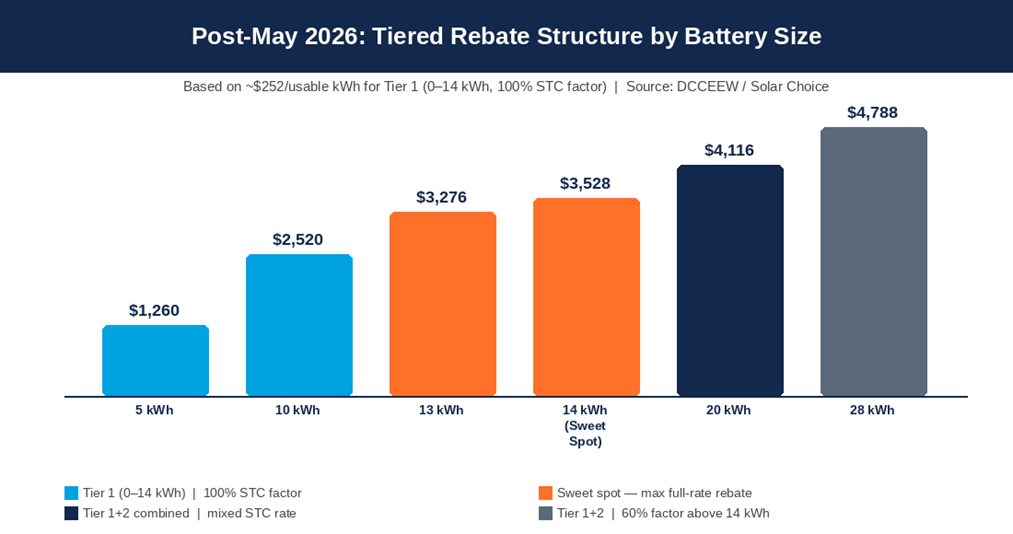
Change 2: The rebate now uses a tiered structure based on battery size. Previously, every eligible kWh received the same discount rate. Now, the STC factor tapers based on how much storage you install:

  • 0 to 14 kWh — 100% STC factor (full rebate rate)
  • 14 to 28 kWh — 60% STC factor (reduced rate)
  • 28 to 50 kWh — 15% STC factor (significantly reduced)
Post-May 2026 tiered federal battery rebate by system size

This tiered approach means 14 kWh is now the sweet spot for NSW homeowners. At that size, the full STC factor applies to every kWh. Beyond that, each additional kWh earns a smaller discount. In practical terms, a 13 kWh battery currently attracts a rebate of approximately $3,276 — making it one of the strongest value propositions in the market.

Who Qualifies for the Cheaper Home Batteries Program in NSW?

Eligibility is broader than many NSW homeowners realise. Therefore, it’s worth checking whether you qualify even if your property situation seems unusual.

You are eligible if:

  • Your property has a separate electricity meter (NMI)
  • Your battery system is between 5 kWh and 100 kWh in nominal capacity
  • Your installer is accredited by Solar Accreditation Australia (SAA)
  • Your system is VPP-capable at the time of installation (joining a VPP is optional)
  • Your battery appears on the SAA approved products list

Importantly, you can also qualify if:

  • You don’t yet have solar panels—the program supports standalone battery installations
  • You are a landlord — the rebate is available per eligible property, each with its own NMI
  • You own a small business or community organisation with an eligible premises

How NSW Homeowners Can Stack the Rebate

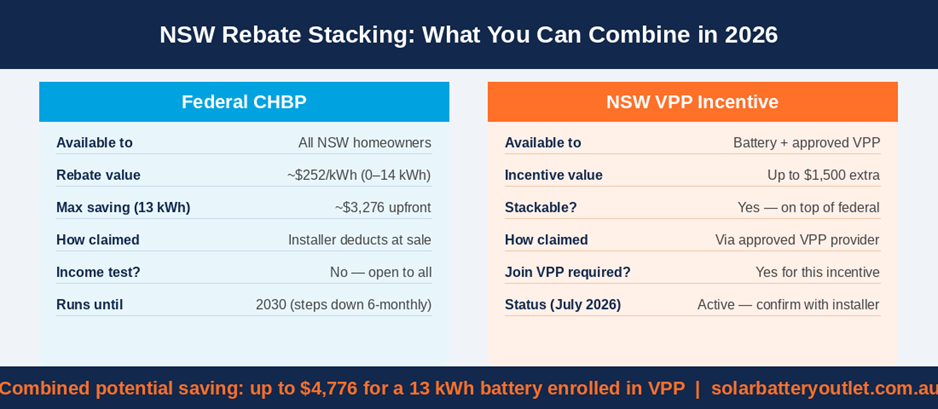
This is where NSW homeowners have a real advantage over other states. The federal Cheaper Home Batteries Program can stack with the NSW VPP incentive—meaning you can access two sources of financial support from a single battery installation.

NSW rebate stacking 2026 — combining the federal Cheaper Home Batteries Program with the NSW VPP incentive

From 1 July 2025, the NSW Government increased the VPP incentive to up to $1,500 for households that connect their battery to an approved Virtual Power Plant. The exact amount depends on your battery size. Notably, this stacks cleanly on top of the federal rebate.

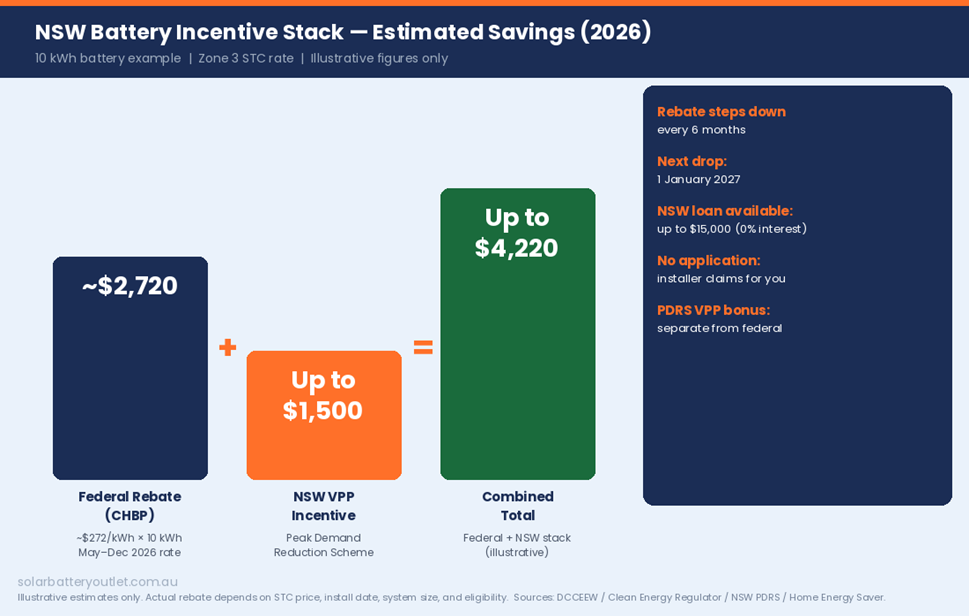
For a 13 kWh battery, the combined saving could therefore reach approximately $4,776—before you account for any ongoing electricity bill reductions from self-consumption. Homeowners looking at solar panel Liverpool, Bankstown, and surrounding suburbs should ask their installer specifically about VPP-approved providers in their area, since not all brands qualify.

How Much Will a Battery Actually Save You in NSW?

The rebate reduces your upfront cost. However, your ongoing savings depend on how you use the battery. Consider a typical NSW family with a 6.6 kW solar system that currently exports most of their midday generation at 5 cents per kWh.

After adding a 13 kWh battery — with the federal rebate reducing the net cost to roughly $7,000–$8,500 installed — they start storing that midday solar for evening use instead. At a grid price of 35 cents per kWh, and giving up about 5 cents of feed-in credit, storing 10 kWh on a sunny day saves about $3. Over a year, allowing for cloudy and winter days, that may be roughly $800–$1,000. A VPP may add more, depending on the plan [add source]. Payback depends on your price, usage and tariff.

If you want help sizing a battery correctly for your usage, a good installer—whether you’re in western Sydney or anywhere else across NSW—will review three months of electricity bills before recommending a size. Bigger is not always better under the new tiered structure.

What to Watch Out for When Getting Quotes

The surge in battery installations has unfortunately attracted some poor-quality operators. Moreover, the ACCC and NSW Fair Trading have issued warnings about high-pressure solar battery sales tactics. Here is what to look out for.

  • The rebate should appear as a separate line item on every written quote. If it doesn’t, ask for it explicitly.
  • Installers must be accredited by Solar Accreditation Australia. Ask for their SAA number before you proceed.
  • Door-to-door and cold-call pressure to sign on the same day is a red flag. Under Australian Consumer Law, you have the right to a 10-business-day cooling-off period for unsolicited contracts.
  • Get at least three written quotes before committing. Price differences of $2,000 or more for the same battery are common in the NSW market.
  • Confirm the battery model appears on the SAA-approved products list before signing. An ineligible product means no rebate.

Frequently Asked Questions

Does the Cheaper Home Batteries Program apply to existing solar systems?

Yes. The program supports both new installations and batteries added to existing solar systems. This is one of the most frequently misunderstood aspects of the scheme.

Is there an income limit to access the rebate?

No. The Cheaper Home Batteries Program has no income or means test. Every eligible NSW household can access the discount regardless of income level.

Will the rebate run out before 2030?

The government expanded funding to $7.2 billion in December 2025 specifically to avoid the program running out early. At current installation rates, the program is expected to remain funded through to 2030. However, the per-kWh value steps down every six months, so earlier installation delivers a higher discount.

Can I get the rebate without joining a VPP?

Yes. Your battery must be VPP-capable, but you are not required to actually join a virtual power plant to receive the federal rebate. Joining a VPP is optional — though it unlocks the additional NSW VPP incentive of up to $1,500.

Is there a solar battery rebate specific to Bankstown or western Sydney?

There is no suburb-specific rebate. However, the federal program applies equally across all of NSW. Homeowners looking for solar battery options in Bankstown or across the greater western Sydney region can access the same federal CHBP discount as the rest of the state. The NSW VPP incentive is also available statewide.

Disclaimer: The rebate values, savings estimates, battery sizes, STC factors, and electricity prices in this article are illustrative only and not a guarantee of future performance. Actual outcomes vary by location, usage, tariff, battery configuration, and eligibility. Program details are subject to change. Please seek personalised advice from a qualified installer before purchasing.

A 2026 NSW homeowner’s guide to comparing battery savings against export earnings

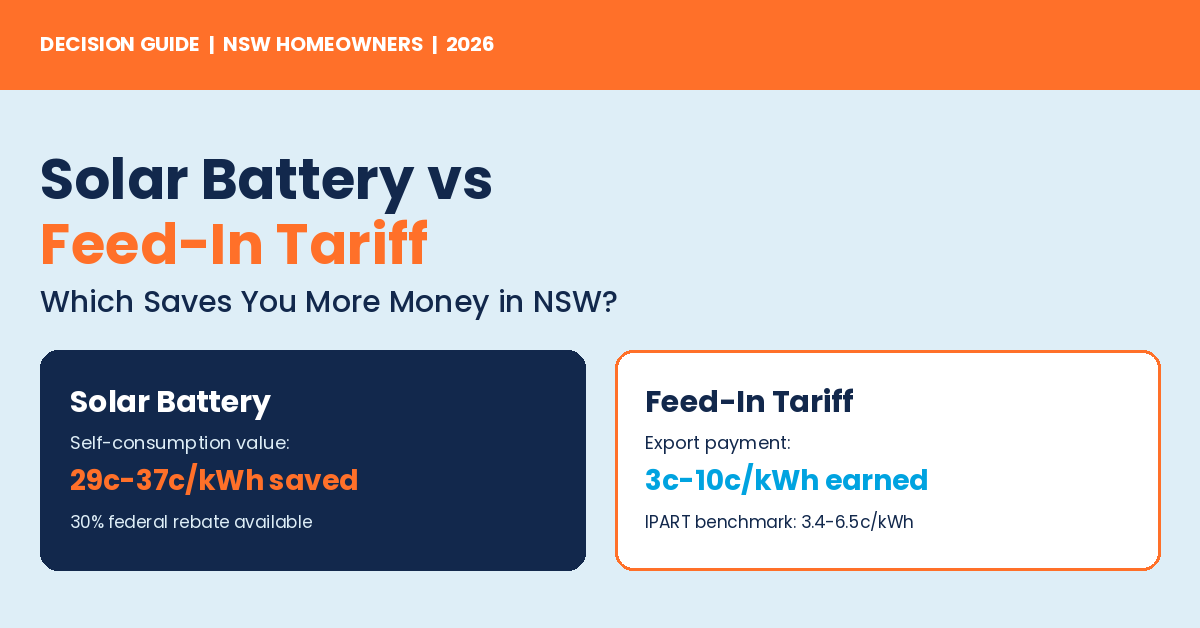
Every NSW solar owner eventually asks the same question. Should you export your surplus power for a feed-in tariff credit or store it in a battery for later use? In 2026, that question matters more than ever. Feed-in tariffs have been falling for years. At the same time, the federal Cheaper Home Batteries Program gives an upfront discount on eligible batteries, based on the battery’s usable size and the current STC rate. This guide explains the real numbers behind both options. It will help you decide which choice could save you more money on your NSW electricity bill.

What Is a Feed-In Tariff, and How Has It Changed in 2026?

A feed-in tariff (FiT) is the credit your electricity retailer pays for each kilowatt-hour of surplus solar energy you export to the grid. NSW removed its mandatory minimum FiT in 2016. Since then, retailers have set their own rates. Some now pay as little as zero.

The Independent Pricing and Regulatory Tribunal (IPART) publishes an annual benchmark that shows what a fair feed-in tariff looks like. For 2025–26, the benchmark ranges from 4.8c to 7.3c/kWh. From 1 July 2026, it is set to fall further to between 3.4c and 6.5c/kWh. In practice, some retailers already offer lower rates. EnergyAustralia has reduced its flat NSW feed-in tariff to 3c/kWh. AGL has removed feed-in tariffs for customers on standard retail contracts. Meanwhile, Alinta Energy and GloBird Energy still offer up to 10c/kWh on selected plans. Market-linked retailer Amber Electric can occasionally pay more than 25c/kWh during periods of peak demand.

That spread, from 0c to 10c on standard plans and far higher on volatile market plans, is exactly why a single ‘feed-in tariff’ figure means very little without checking your own retailer’s rate first.

How Much Is Your Solar Export Really Worth?

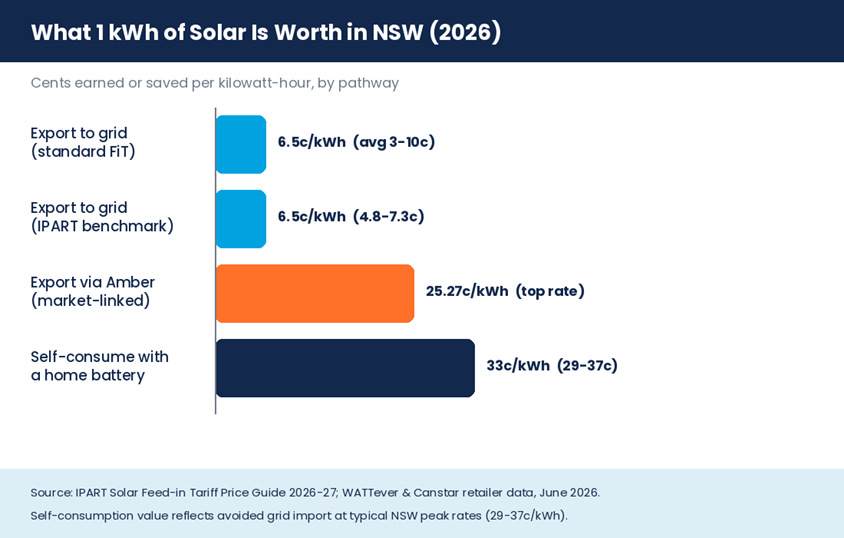
To compare fairly, it helps to see every pathway for your solar energy side by side: exporting on a standard plan, exporting on a premium plan, and self-consuming through a battery. The chart below lays out typical 2026 NSW figures for each.

Cents earned or saved per kWh across NSW solar pathways, June 2026

The pattern is consistent across almost every NSW retailer: exporting electricity earns far less than not buying it back later. NSW households typically pay 29c to 37c/kWh for grid electricity, depending on network and time of use. So every kilowatt-hour you store and use yourself is effectively worth three to ten times what the same kilowatt-hour earns as an export credit.

This is the core economic shift driving battery uptake. Solar batteries let you capture the gap between what retailers pay you for exports and what they charge you for imports. If your system is set up for backup, they can also power some of your home during an outage.

How a Solar Battery Changes the Maths

A home battery stores your excess daytime solar generation and discharges it in the evening, when grid electricity is most expensive and feed-in rates no longer apply. For a typical 10kWh battery, that can mean covering most of an average household’s evening and overnight usage without touching the grid.

Under the federal Cheaper Home Batteries Program, eligible batteries get an upfront discount based on usable size and the current STC rate. The first 14kWh of usable capacity gets the full rate. NSW households may also be able to add the NSW VPP incentive when they connect an eligible battery to an approved VPP of up to $1500. Your payback depends on your usage, tariff and system price — we’ll show you an estimate in your quote.

Real-World Example: Comparing Both Paths in Bankstown

Consider a typical home running a 6.6kW solar system in Bankstown, exporting around 12kWh of surplus solar daily. On a standard 6.5c/kWh feed-in tariff, that household earns roughly $0.78 a day, or about $285 a year, in export credits.

Example only: Now compare this to adding a 10kWh battery. Say the household stores about 9kWh a day (a 10kWh battery can’t hold 12kWh, and some energy is lost charging and discharging) and uses it in the evening instead of buying power at about 33c/kWh. It also gives up the 6.5c feed-in credit on that energy. The net saving is about 9 × (33c − 6.5c) ≈ $2.40 a day, or roughly $870 a year. Your own payback depends on your usage and quote. After that, they continue saving on every evening kilowatt-hour.

This is why, for most NSW homes with meaningful evening electricity use, pairing solar batteries with the right-sized system tends to outperform relying on feed-in tariffs alone, even where the headline rebate news focuses on the upfront battery rebate rather than the ongoing import savings.

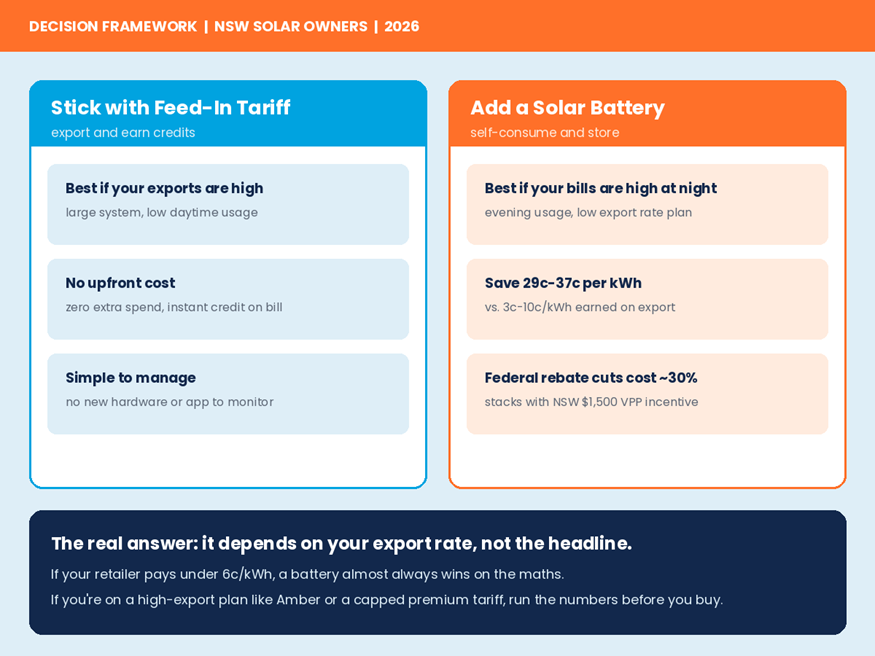
Solar Battery vs Feed-In Tariff: A Decision Framework

There is no single right answer for every household. Use the framework below to work out which option fits your situation.

A simple decision framework for NSW solar households, 2026.
  • Check your current feed-in rate first. If it is below the IPART benchmark of roughly 6c/kWh, storing your solar is usually worth more per kWh than exporting it. Whether the battery pays for itself depends on its price and your evening usage.
  • Map your usage pattern. Households with high evening or overnight electricity use benefit most from storing solar rather than exporting it.
  • Know how the rebate works. The federal rebate steps down every six months, so your quote will show the current amount. Choosing the right system matters more than rushing.
  • Get quotes from an SAA-accredited installer. A good installer will model your own usage data rather than relying on generic averages.

If you are still unsure, request a tailored quote. A qualified solar battery specialist can model your actual export and consumption data, rather than relying on averages, to show your real payback period.

Frequently Asked Questions

Is a solar battery worth it if my feed-in tariff is already high?

If you are on a genuinely high, capped-rate plan, such as a premium retailer offer that pays 10c/kWh or more on the first block of exports, the gap becomes smaller. Even then, self-consumption usually delivers greater savings. That’s because evening electricity usage is still expensive. Import rates remain much higher than even the best premium export rates.

Will the feed-in tariff keep dropping in NSW?

IPART’s own benchmark is scheduled to fall to 3.4-6.5c/kWh from 1 July 2026, and several major retailers have already cut rates or removed FiTs for standard contracts. The long-term trend points downward as more rooftop solar floods the grid at midday.

How much does the federal battery rebate save in 2026?

The rebate gives an upfront discount on the first 14kWh of usable capacity, based on the current STC rate (about $252 per usable kWh at $37 per STC). Larger systems receive a lower level of support. The exact rebate amount depends on your battery size and the STC rate at the time of installation. Check the latest figures with your installer before signing any agreement.

Can I combine a battery with the NSW Solar Sharer Plan?

Yes. Some NSW retailers offer a Solar Sharer plan with three free hours around midday to eligible smart-meter households who opt in. A usage cap applies. A battery complements this by capturing any solar you generate beyond your midday usage and shifting it to cover the evening peak, when the free-hours window has ended.

What size battery suits an average Bankstown household?

Most three-to-four-person Bankstown households see strong results from a 10-13kWh battery paired with a 6.6-10kW solar system, though the right size depends on your evening usage pattern and existing system output.

Ready to Stop Guessing and Start Saving?

If you’re comparing a solar battery with your current feed-in tariff, Solar Battery Outlet can assess your export and electricity usage data. We’ll recommend the right-sized system for your home. We install solar batteries across NSW, including Bankstown and Sydney’s western suburbs, and we help homeowners check which rebates they are eligible for. This includes the federal Cheaper Home Batteries Program discount and the NSW VPP incentive. Request a free, no-obligation quote today. We’ll show you how much a solar battery could save compared to your current feed-in tariff.

Disclaimer

This article provides general information about NSW feed-in tariffs and solar battery incentives as of June 2026. It is not personal financial or energy advice. Feed-in tariff rates, rebate amounts, and STC factors change regularly. They also vary by retailer, network, and battery size. Always confirm the latest figures with your electricity retailer or an SAA-accredited installer before making a purchase decision. The savings examples in this article are for illustration only. Actual results depend on your electricity usage, system size, and location. Always seek personalised advice before making a purchasing decision.
If you installed solar panels three, five, or even eight years ago, you have a new opportunity. Feed-in tariffs in NSW have fallen to 4–7 cents per kWh. However, grid electricity still costs 31–43 cents per kWh. A battery stores excess solar energy generated during the day. You can then use that stored power in the evening. This helps reduce electricity costs when grid prices are highest.

The good news is that yes, most existing solar systems in NSW can accept a battery—and the federal Cheaper Home Batteries Program gives an upfront discount based on the battery’s usable size. This guide walks you through exactly how it works, what it costs, how long payback takes, and what questions to ask your installer before you sign anything.

Yes, You Can Retrofit a Battery—Here Is How It Works

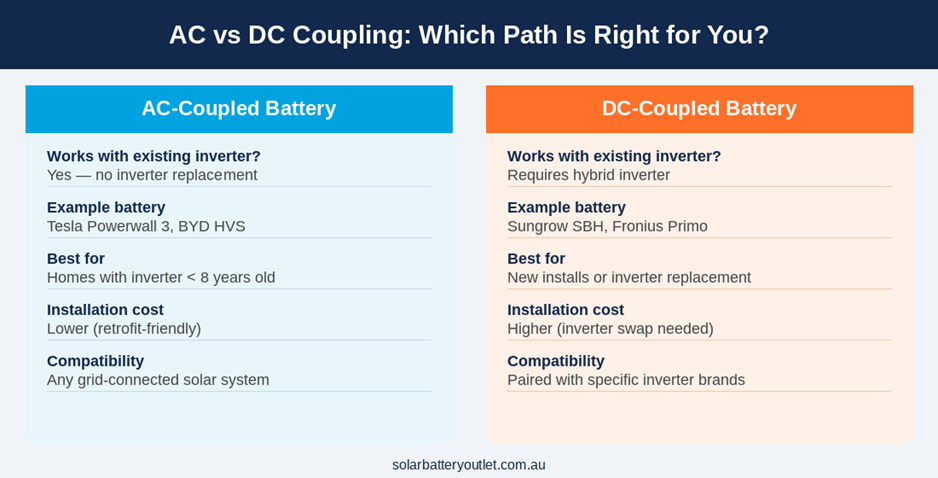
The most important thing to understand is the concept of coupling type. When you add a battery to an existing solar system, you choose between two technical paths: AC-coupled or DC-coupled. Each has different cost implications and compatibility requirements.

AC-coupled batteries connect on the AC side of your switchboard. They include their own built-in inverter and work with most existing grid-connected solar setups. Your installer will still check your inverter, switchboard and network export limits first. This is the most common retrofit path for NSW homeowners and keeps installation costs lower because you do not need to replace your solar inverter.

DC-coupled batteries connect through a hybrid inverter that manages both the solar panels and the battery as a unified system. They deliver slightly higher efficiency but require a compatible hybrid inverter. In most retrofit situations, this means replacing your existing solar inverter, which adds several thousand dollars to the project.

AC vs DC Coupling Comparison—Choosing the right retrofit path for NSW homeowners

For most homeowners doing a solar system upgrade in NSW, AC coupling is the simpler and more cost-effective choice. A qualified installer will assess your switchboard, existing inverter, and roof wiring before recommending which path makes sense for your home.

The Federal Battery Rebate Makes This More Affordable Than Ever

Since July 2025, the Australian Government’s Cheaper Home Batteries Program has given an upfront discount on eligible home batteries. The rebate runs to 2030 and steps down every six months, so your quote will show the current amount.

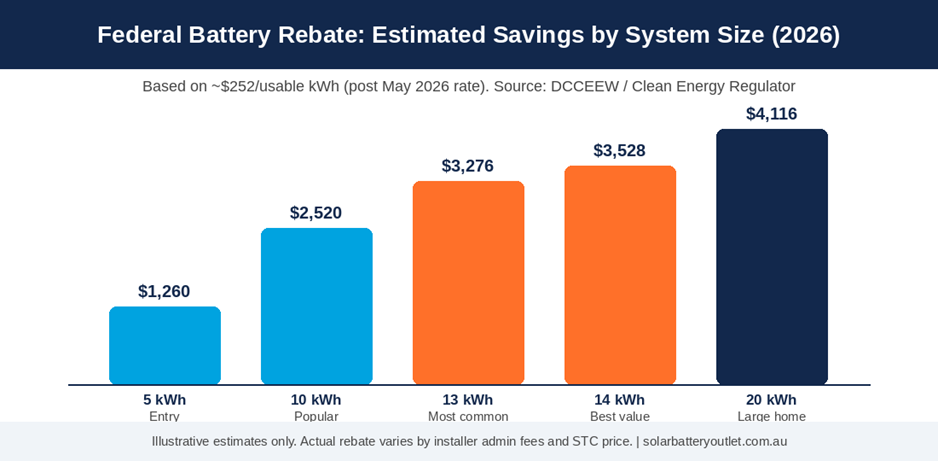
The rebate works through Small-scale Technology Certificates (STCs). Your installer applies the discount directly on your invoice, meaning you never have to claim anything back. As of mid-2026, the rebate is worth approximately $252 per usable kWh for the first 14 kWh of storage. For a 13 kWh battery—one of the most popular sizes for NSW households—the saving comes to around $3,276 upfront.

Federal Battery Rebate estimated savings by system size, 2026
NSW-Specific Note: VPP Incentive The NSW Government ended its direct battery rebate in June 2025, but it significantly expanded the Virtual Power Plant (VPP) incentive from 1 July 2025. NSW homeowners who install a battery and connect it to an approved VPP program can stack the federal rebate with additional NSW VPP payments. Ask your installer whether your chosen battery model qualifies.

What Battery Size Do You Actually Need in NSW?

Battery sizing depends on three things: how much power your household consumes in the evening, how much your existing solar system generates during the day, and whether you want backup power during blackouts.

Many NSW households use roughly 15–20 kWh a day, but families with pools, EVs or ducted air use more. Check your bill for your own number. A 10–14 kWh battery usually covers most evening energy demand. A larger battery may suit homes with an EV, higher electricity use, or a need for backup power during extended outages.

If you are looking for a solar battery installer in Western Sydney, ask for a bill analysis first. This applies whether you live in Liverpool, Bankstown, or nearby suburbs. A bill analysis helps determine the right battery size. A well-matched battery often delivers better savings than an oversized battery that stays partly unused.

The key practical tip: bigger is not always better. The federal rebate also tapers for batteries above 14 kWh of usable capacity, so right-sizing your battery around that threshold often delivers the best combination of coverage and rebate value under the current rules.

How Long Until a Battery Pays for Itself in NSW?

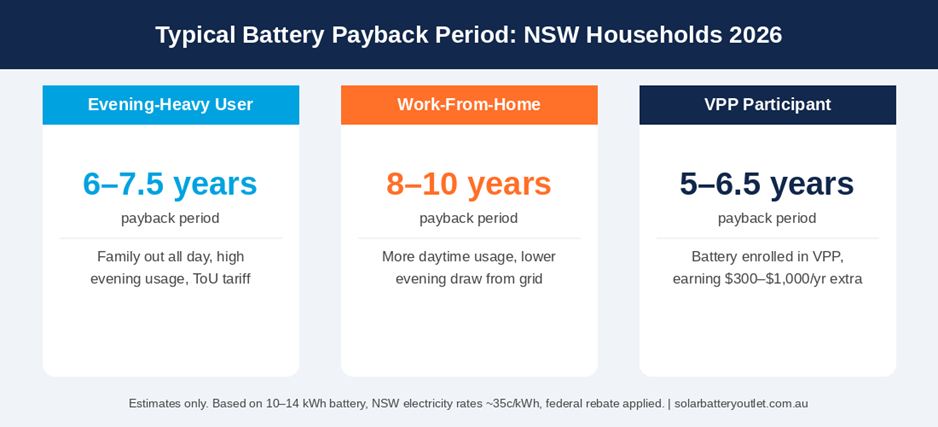
The honest answer depends on your usage pattern, your tariff structure, and whether you participate in a VPP.

Typical battery payback period for NSW households in 2026

According to the Australian Energy Regulator, NSW grid electricity now costs between 31 and 43 cents per kWh, depending on your retailer and plan.

Example: a 13 kWh battery that is mostly emptied on 300 evenings a year could replace about 3,500 kWh of grid power (after charging losses). At 35c/kWh, minus the feed-in credit you give up (about 6c), that is roughly $1,000 a year. A VPP may add some extra credit — ask what your chosen VPP actually pays.

4 Questions to Answer Before You Call an Installer

Before you book a consultation, work through these practical questions. The answers will help you have a better conversation and avoid the most common mistakes NSW homeowners make when adding storage.

  • 1. What is my evening electricity consumption? Check your most recent bill and look for usage after 5pm if your retailer provides that breakdown.
  • 2. How old is my solar inverter? AC-coupled batteries work with virtually any inverter. But if yours is over 10 years old, it may be worth discussing replacement at the same time.
  • 3. Do I want blackout protection? Not all batteries provide backup power during a grid outage by default. If blackout protection matters to you, confirm this at the quote stage — it can change both the equipment and the price.
  • 4. Am I willing to join a VPP? NSW homeowners can access the state VPP incentive by enrolling their battery in an approved program. Many VPPs let you keep a reserve level for your home and pay credits or other rewards — check the terms of the VPP you join.

Example: What This Could Look Like for a Real NSW Household

This is an illustrative example not a real customer, consider a family in Bankstown with a 6.6 kW solar system installed in 2019. Their inverter is in good working order, and their evening usage averages around 14 kWh per day. Feed-in tariff payments bring in roughly $180 per year, while their nightly grid purchases cost them over $1,500 annually.

They added a 13.5 kWh battery through AC coupling, so no inverter replacement was needed. The battery now covers most evening electricity demand using stored solar energy. The federal rebate reduces the installed cost to about $7,000–$8,500. VPP income of around $500 per year further improves the return. The estimated payback period is 6 to 7 years. If you are comparing solar battery options in Bankstown or nearby suburbs, ask for this type of bill analysis with every installation quote.

Frequently Asked Questions

Can I add a battery to any solar system in NSW?

In most cases, yes. AC-coupled batteries are compatible with virtually all existing grid-connected solar systems regardless of inverter brand. DC-coupled batteries require a hybrid inverter. Your installer will assess compatibility during the quote stage.

Will my solar panels still work if I add a battery?

Absolutely. Adding a battery does not change how your solar panels generate power. The battery simply stores excess generation that would otherwise be exported to the grid at a low feed-in tariff rate, so you can use it in the evening instead.

Does adding a battery qualify for the federal rebate?

Yes — the Cheaper Home Batteries Program applies to batteries added to existing solar systems as long as the system meets eligibility requirements. The battery must have 5 to 100 kWh of usable capacity, be on the approved product list, be installed by an SAA-accredited installer, and be VPP-capable. Only the first 50 kWh gets the rebate.

How do I choose a solar battery installer in NSW?

Look for installers accredited by Solar Accreditation Australia (SAA). Get at least three written quotes. A good installer will review your electricity bills, assess your existing system, and recommend a battery size based on your actual usage pattern — not just a standard package.

Does a solar battery work during a blackout?

It depends on the battery and how it is configured. Many batteries include a backup mode that isolates your home from the grid during an outage. You must specify this requirement before installation, as it can affect both the equipment choice and the wiring. Not all standard installations include blackout protection by default.

Disclaimer: The savings estimates, payback periods and rebate amounts in this article are illustrative examples based on a hypothetical NSW household and are not a guarantee of actual results. The Cheaper Home Batteries Program and NSW Peak Demand Reduction Scheme are subject to eligibility criteria and may change without notice. Actual outcomes vary based on your location, usage, tariff, system size, and weather conditions. Please seek personalised advice before making a purchasing decision.
If you’ve ever heard someone say solar batteries are useless in winter, this article is for you. It’s one of the most common misconceptions in Australian solar circles—and it’s costing homeowners real money.

The short answer is: yes, a solar battery still helps in winter. But the ‘how much’ depends on your home, your usage, and how well you configure your system. This guide gives you the full picture—including real data, illustrative savings examples, a 5-step optimisation framework, and honest caveats.

What Actually Happens to Solar in the Australian Winter?

First, let’s separate myth from fact. Solar panels in Australia do not stop working in winter. They produce less energy — but not by as much as many people assume.

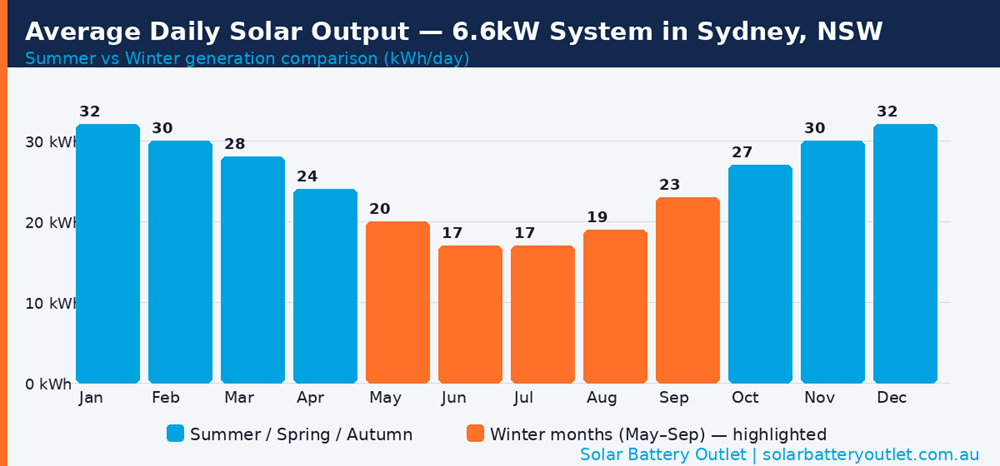
According to BrightFuture Energy’s seasonal performance data, a 6.6kW rooftop system in Sydney can generate around 26 kWh on a sunny summer day, while mid-winter days typically yield 16–20 kWh—roughly 60–70% of summer output. That’s still a meaningful amount of energy.

Average daily solar output 6.6kW system Sydney NSW winter vs summer monthly comparison chart

The dip happens for three main reasons. First, days are shorter — the solar production window in NSW narrows from roughly 10 am–4 pm in summer to 11 am–2 pm in June. Second, the sun sits lower in the sky, reducing the angle of incidence on your panels. Third, cloud cover increases, though overcast days in NSW still allow panels to generate at 10–40% capacity.

Here’s the key insight most people miss: cool temperatures actually improve panel efficiency. Solar panels lose roughly 0.3–0.5% efficiency per degree above 25°C. So while your system generates fewer kWh in winter due to fewer daylight hours, each kWh it does generate is produced at slightly better conversion efficiency than on a scorching 38°C summer afternoon.

The Real Question: What Does a Battery Actually Do in Winter?

A solar battery doesn’t generate electricity — it stores it. This distinction is critical when thinking about winter performance. Your panels still collect energy during the day (just a bit less of it). Your battery stores that energy and releases it in the evening, when the sun has gone down and your heating, lighting, and appliances kick in.

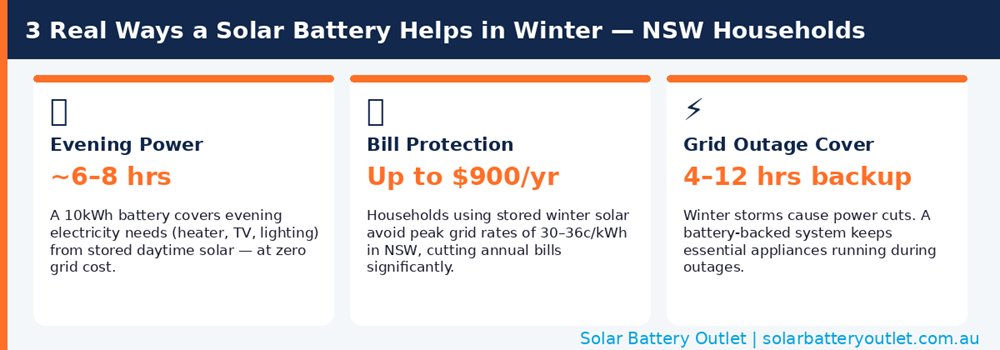
In winter, this storage function becomes more valuable, not less. Here’s why: Australian winters bring higher evening electricity demand (heating, longer nights, cooking earlier) paired with higher peak electricity prices. In NSW, peak grid rates run at 30–36 cents per kWh during evening shoulder and peak periods.

Three ways solar battery helps in Australian winter — evening power, bill savings, backup cover NSW

Example: A Sydney Family in Bankstown

Take a family of four in Bankstown (this is an illustrative example, not a real customer). They use around 22 kWh per day in winter — more than the summer average of 18 kWh due to electric heating. Their 10kWh battery (a BYD HVS or Tesla Powerwall 3) charges to around 7–8 kWh on a typical winter day, covering their 5 pm–10 pm peak usage almost entirely. Instead of paying 33c/kWh from the grid, they use stored solar. The only thing they give up is the small feed-in credit they would have earned by exporting it..

Over a winter quarter (90 days), that’s roughly 630–720 kWh of avoided grid electricity — worth $208–$238 in bill savings from winter alone. Scale that across the full year with summer performance included, and the total saving potential reaches $900–$1,100 per year for a well-sized battery setup. These are illustrative estimates — actual outcomes depend on your tariff, usage pattern, and system configuration.

Where Batteries Shine in Winter — and Where They Fall Short

Battery Adds the Most Winter Value

  • Evening heating loads: If you run reverse-cycle air conditioning or an electric heat pump for heating, the battery covers this load without touching grid electricity.
  • Grid outage protection: Winter storms in NSW, particularly in areas like Liverpool, Bankstown, and Mudgee, cause power cuts. If your system is set up for backup, a battery can keep some essentials running during an outage. How long depends on battery size, charge level and what you run. Not every battery setup provides backup, ask us which setups can.
  • Time-of-Use tariff arbitrage: Households on TOU tariffs can benefit. The battery charges from solar (or cheaper off-peak power) and discharges during the 5–9 pm peak. The saving per kWh is the peak rate minus what that kWh cost you to charge, less some charging losses.
  • Virtual Power Plant (VPP) earnings: Under the NSW Peak Demand Reduction Scheme, households who connect an eligible battery to an approved Virtual Power Plant (VPP) may receive a one-off upfront incentive. The incentive amount varies depending on battery capacity and other factors. Some VPP providers may also offer additional ongoing credits or payments, which vary by provider, which happen more frequently in winter cold snaps.

Winter Does Limit Battery Performance

  • Smaller charge window: With only 3–4 peak solar hours in June–July (vs 6–7 in summer), a large 20kWh+ battery may not reach full charge on overcast winter days.
  • Sequential cloudy days: Extended cloudy periods (3+ days) can exhaust battery reserves and force a switch to grid power — though this is uncommon in most of NSW.
  • Oversized batteries in small homes: A 13.5kWh battery in a home that only uses 14kWh per day will cycle less efficiently in winter when charge input drops.
Pro Tip from Solar Battery Outlet: In winter, we recommend setting your battery’s target charge window to 10 am–2 pm — the narrower NSW solar peak.

Solar Battery ROI in Winter: The Numbers NSW Homeowners Need

One of the most common questions from NSW homeowners is: does the ROI calculation change in winter? The answer is: not significantly — and here’s why.

Your battery’s ROI is calculated over its full 10–15 year lifespan. Winter months contribute proportionally less solar income but proportionally more grid bill savings (because evening usage and peak prices are higher). These effects partially cancel each other out. The overall annual saving figure remains robust even with winter’s reduced generation.

Popular batteries such as the Tesla Powerwall 3, BYD HVS and Sungrow SBH work well in NSW winter conditions. Some energy is always lost when charging and discharging — check the round-trip efficiency on each product’s datasheet. LFP batteries generally handle mild cool weather well, but charging can slow near freezing.

The Cheaper Home Batteries Program (launched July 2025) gives an upfront discount on eligible batteries. For a 10kWh usable battery it is currently about $2,500, based on the STC rate on the day. This significantly improves winter-adjusted payback periods across all NSW regions.

The 5-Step Winter Battery Optimisation Framework

If you already have a solar battery installed — or you’re about to have one installed by the best solar battery installer in your area — use this framework to maximise your winter output.

Step 1 — Set your charge window: Check your battery app settings so the battery charges from your midday solar surplus. Ask your installer what settings suit your system.

Step 2 — Adjust your reserve percentage: In summer, a 10–15% battery reserve is standard. In winter, you may want to lift this to 20–30% so you keep some stored power for early mornings — and, if your system is set up for backup, for outages. This setting takes 60 seconds to change.

Step 3 — Switch to a Time-of-Use tariff: If you’re on a flat-rate tariff, compare it with a Time-of-Use plan on Energy Made Easy. TOU can save money if your battery covers the evening peak, but it can cost more if you use a lot of peak power. Your battery discharging during the 5–9 pm peak is usually your biggest saving lever.

Step 4 — Join a NSW Virtual Power Plant: Under the NSW Peak Demand Reduction Scheme, households who connect an eligible battery to an approved Virtual Power Plant (VPP) may receive a one-off upfront incentive. The incentive amount varies depending on battery capacity and other factors. Some VPP providers may also offer additional ongoing credits or payments, which vary by provider and sharing stored energy during demand events. Winter cold snaps are prime VPP activation windows. You stay in control — the VPP takes a small, brief amount of stored energy during events.

Step 5 — Book a pre-winter panel inspection: A dirty or partially shaded panel can reduce your winter output by 5–10% — amplifying the seasonal dip. Book a solar panel cleaning and health check before May each year. This is especially important in areas like Bankstown and Mudgee, where dust and bird activity are common.

Who Benefits Most From a Battery in Winter? A Quick Diagnostic

Not every NSW household gets the same winter value from a battery. Use these four profile questions to gauge your likely benefit:

  • Evening-heavy household: If 60%+ of your electricity use happens after 4 pm, you will see strong winter battery savings regardless of generation dip. Shift workers, families with kids, and work-from-home households that heat and cook in the evening all fall into this category.
  • Electric heating users: If you rely on reverse-cycle air conditioning or a heat pump for winter heating, your 5–9 pm load is substantial. A 10kWh+ battery can cover a good part of this load on sunny winter days.
  • Homes with existing solar (5kW+): Larger solar systems generate more in winter, giving the battery more to work with. If you have a 6.6kW+ system, a battery is a natural complement even through June–August.
  • Homes on poor feed-in tariffs: Many NSW solar households receive feed-in tariffs of only a few cents per kWh for exported electricity. IPART’s 2026-27 benchmark range is 3.4 to 6.5 c/kWh, although actual retailer rates vary. Exporting surplus winter solar earns almost nothing. Using stored solar in the evening is worth several times more per kWh than exporting it.

The National Picture: Why Australians Are Installing Batteries Year-Round

The scale of Australia’s battery adoption in 2025–26 makes clear that winter concerns aren’t stopping the market. The Clean Energy Council reported a record 183,245 batteries sold in Australia in H2 2025 alone, more than the previous four years combined. NSW recorded 15,418 battery installations by the end of August 2025, according to data released by the Clean Energy Regulator. Australians continued installing batteries through winter because of their year-round value.

Average battery size in NSW reached 19.6 kWh. The Clean Energy Council also notes that participation in a Virtual Power Plant (VPP) may provide additional benefits, with ACCC analysis showing VPP customers achieved average quarterly bill savings around $106 higher than comparable customers. Actual benefits vary by provider and household.

Frequently Asked Questions
Does a solar battery charge at all on a cold, overcast winter day in NSW?

Yes — it charges, just at a reduced rate. Overcast days in NSW still allow solar panels to generate at 10–40% of peak capacity, depending on cloud density. On a typical cloudy winter day in Sydney, a 6.6kW system might generate 6–10 kWh rather than 17–20 kWh. A 10kWh battery would reach 60–100% charge on most winter days in NSW. Extended overcast periods of 3+ consecutive days are uncommon across most of the state.

Will a solar battery power my reverse-cycle heating at night in winter?

This depends on your battery capacity and your heater’s power draw. A reverse-cycle air conditioner in heating mode typically draws 1–3 kW. A 10kWh battery at 90% usable capacity can run a 2kW heater for approximately 4.5 hours — covering the 5 pm–9 pm evening peak. For larger homes using higher-output heating, a 13.5kWh+ battery provides more comfortable headroom.

Is a solar battery worth installing before or during winter in NSW?

Installing before winter is generally a sound strategy — you’ll capture the June–August storage savings from the moment installation is complete. The Cheaper Home Batteries Program federal rebate applies regardless of installation season. Speak to a qualified installer who will review your system’s performance data to confirm sizing. Homeowners in the Solar Battery Bankstown area and surrounding suburbs can contact Solar Battery Outlet for a no-obligation winter assessment.

Do the best solar batteries Australia offers perform differently in winter?

Modern lithium iron phosphate (LFP) batteries — including the popular solar batteries BYD HVS, Sungrow SBH, and Tesla Powerwall 3 work well in NSW winter conditions (typically 5–18°C in NSW). Unlike some older lithium-ion chemistries, LFP batteries do not significantly degrade in cold weather. The main winter variable is solar generation input, not battery chemistry performance.

Two major electricity changes took effect for NSW households on 1 July 2026. First, the Australian Energy Regulator (AER) finalised its Default Market Offer (DMO) 8 determination. This reduced residential standing-offer electricity prices across all three NSW distribution zones.

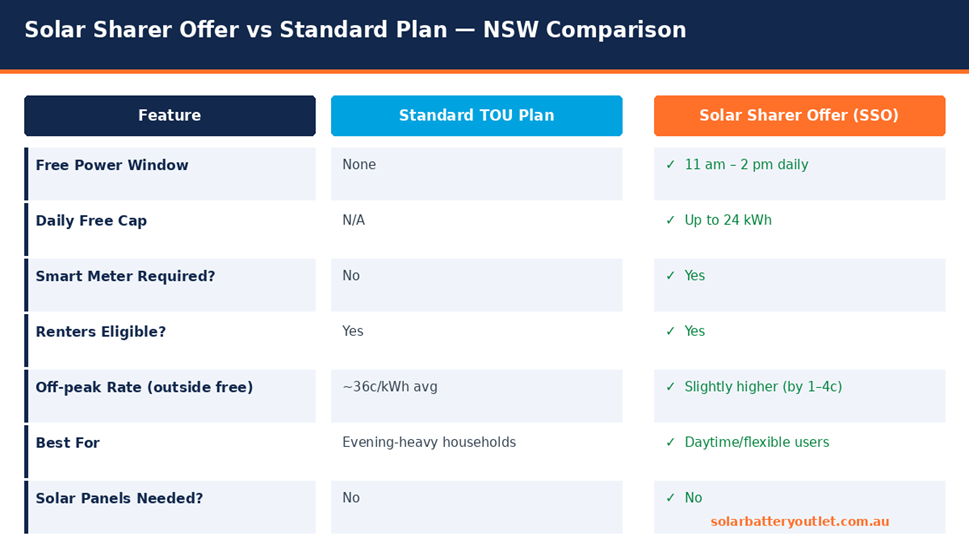
Second, every retailer in the DMO area must now offer the Solar Sharer Offer (SSO). This new opt-in plan gives households with smart meters three hours of free electricity every day from 11 am to 2 pm, with a daily limit of 24 kWh.

If you have solar panels, a home battery, or both, these changes could work together to significantly reduce your annual electricity bill. In addition, the federal Cheaper Home Batteries Program remains available through 2030, and its rebate continues to provide substantial savings after May 2026.

This article explains what these changes mean for NSW households. It also provides a practical framework to help you maximise savings during the 2026–27 financial year.

What Is the Solar Sharer Offer (SSO)?

The Solar Sharer Offer is a regulated, opt-in electricity plan introduced as part of the DMO 8 framework. Its core mechanic is straightforward: eligible households receive a three-hour window of free electricity — 11 am to 2 pm daily in NSW — capped at 24 kWh per day. That cap is well above the midday consumption of most households; the CSIRO estimates average five-person household daily use at around 20 kWh, meaning the cap is unlikely to be an issue for most families.

Importantly, you do not need rooftop solar to access the SSO. Renters are eligible, provided they have a smart meter installed. If you do not currently have a smart meter, contact your retailer—for most NSW households, smart meter installation is available at no upfront cost.

The SSO is designed to solve a structural challenge in the National Electricity Market. Australia now has more than 4.2 million rooftop solar systems, generating over 25 GW of daytime capacity. As a result, wholesale electricity prices often fall to zero or even become negative during the middle of the day. Instead of letting this excess solar energy go to waste, the SSO passes the cost savings directly to households that can shift their electricity use into the free energy window.

Solar Sharer Offer vs Standard TOU plan comparison

What Is the DMO 8 and How Much Can NSW Households Save?

The Default Market Offer (DMO) is the regulated benchmark price set by the AER each year. It acts as a safety net for households who remain on standing-offer electricity plans. According to the Australian Energy Regulator, around 8% of residential customers in Default Market Offer regions (NSW, South Australia and South East Queensland) remain on standing offers. It also functions as a comparison reference price that helps all electricity customers evaluate market offers.

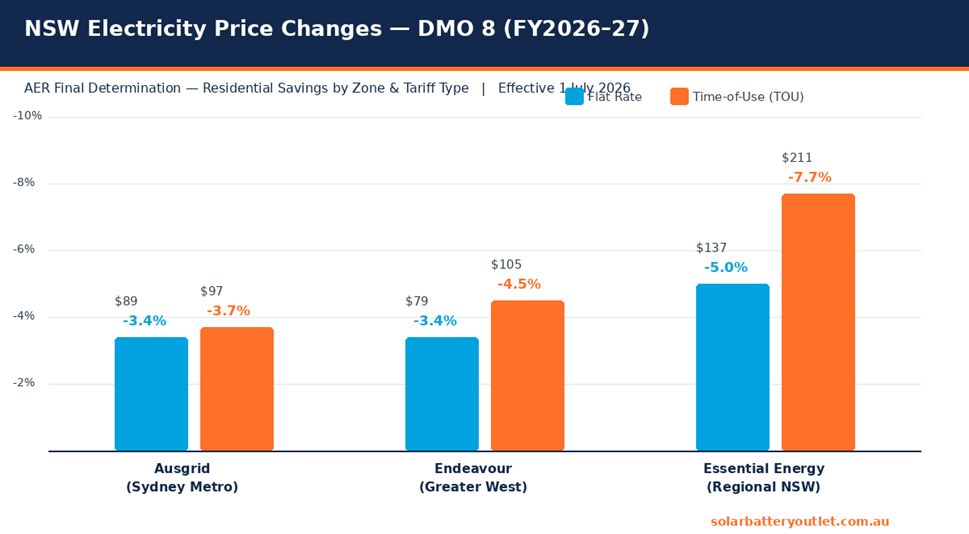
The AER’s Final DMO 8 Determination, released 26 May 2026, confirmed residential price reductions across all three NSW distribution zones from 1 July 2026. The reductions were driven by lower wholesale electricity costs, reduced environmental scheme costs, and declining retail operating expenses.

NSW DMO 8 electricity price reduction by zone 2026-27

NSW DMO 8 Residential Savings at a Glance

For the Ausgrid zone (Sydney Metro): flat-rate customers save -3.4% (up to $89/yr); TOU customers save -3.7% (up to $97/yr).

Endeavour Energy zone (Greater Western Sydney/Blue Mountains): flat-rate customers save -3.4% (up to $79/yr); TOU customers save -4.5% (up to $105/yr).

Essential Energy zone (Regional NSW): the largest savings—flat-rate customers save -5.0% (up to $137/yr); TOU customers save -7.7% (up to $211/yr). This zone benefits most from the correction of elevated wholesale costs that disproportionately affected regional NSW in 2022–24.

These savings apply to standing-offer customers. If you are on a competitive market offer—and you should be—you may already be paying up to 20% below the DMO. The DMO’s value is as a benchmark for comparing plans on the Australian Government’s free comparison tool, Energy Made Easy.

The Federal Cheaper Home Batteries Program—Still Active in FY2026–27

The Cheaper Home Batteries Program is a $7.2 billion federal initiative. It provides an upfront discount on eligible home batteries with 5–100 kWh of usable capacity, based on usable size and the STC rate (see the tiers below). The program is delivered through the Small-Scale Renewable Energy Scheme (SRES). The discount is applied at the point of sale, so there is no separate application process. There is also no means test, making the program available to all eligible households and businesses.

What changed on 1 May 2026: The STC factor dropped from 8.4 to 6.8 per kWh of usable capacity, and a new tiered structure was introduced for larger batteries. Specifically:

  • Tier 1 (0–14 kWh): Full STC rate — about $252 per usable kWh at $37 per STC (it moves with the STC price) in NSW (Zone 3)
  • Tier 2 (14–28 kWh): 60% of the full rate applies
  • Tier 3 (28–50 kWh): Only 15% of the full rate applies

For a 10 kWh usable battery, the current rebate is about $2,500–$2,700, depending on the STC price on the day. The rebate steps down every six months (next on 1 January 2027), so your quote will show the current amount. Choosing the right system matters more than rushing. The program runs through 2030.

NSW Rebate Stacking — How to Maximise Your Battery Savings

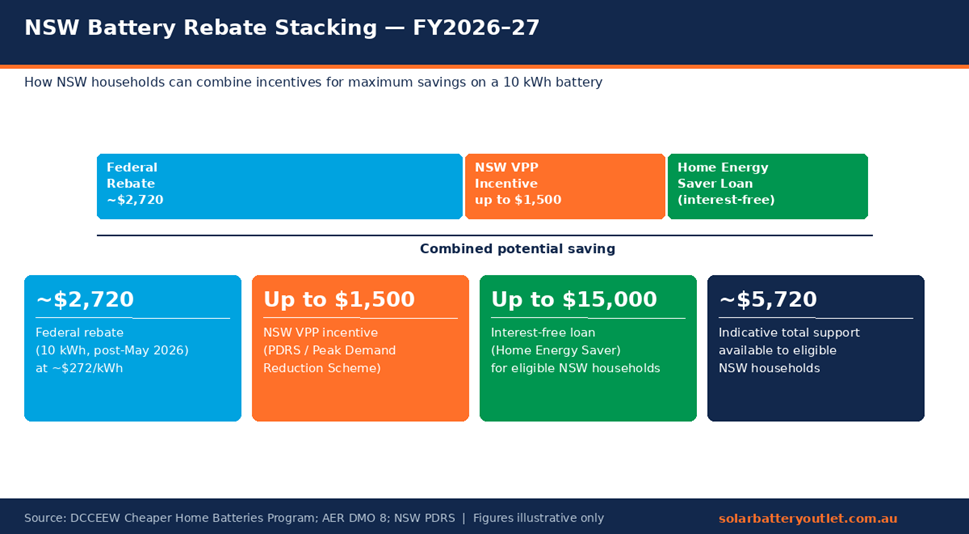
NSW households can combine several incentives to maximise their savings. Some NSW households can combine several incentives.

Available NSW Incentive Stack

  • Federal Cheaper Home Batteries Program: ~$2,720 for a 10 kWh system (post-May 2026), applied as a point-of-sale discount by your accredited installer
  • NSW VPP Incentive (PDRS): Households who connect an eligible battery to an approved Virtual Power Plant (VPP) may receive a one-off upfront incentive under the NSW Peak Demand Reduction Scheme. Incentive amounts vary depending on battery capacity and other factors. Some VPP providers may also offer ongoing credits or payments, with amounts varying by provider.
  • NSW Home Energy Saver — Interest-Free Loan: Eligible homeowners and landlords with a combined household income of up to $210,000 may access a zero-interest loan of up to $15,000, repayable over 10 years. A separate discount of up to $4,000 is available to eligible concession card holders and households with a combined income of up to $80,000.

An eligible NSW household may be able to combine the federal discount with the NSW VPP incentive. A loan is not a discount — it must be repaid. Eligibility conditions apply. Speak to an accredited installer or visit energy.gov.au for more details.

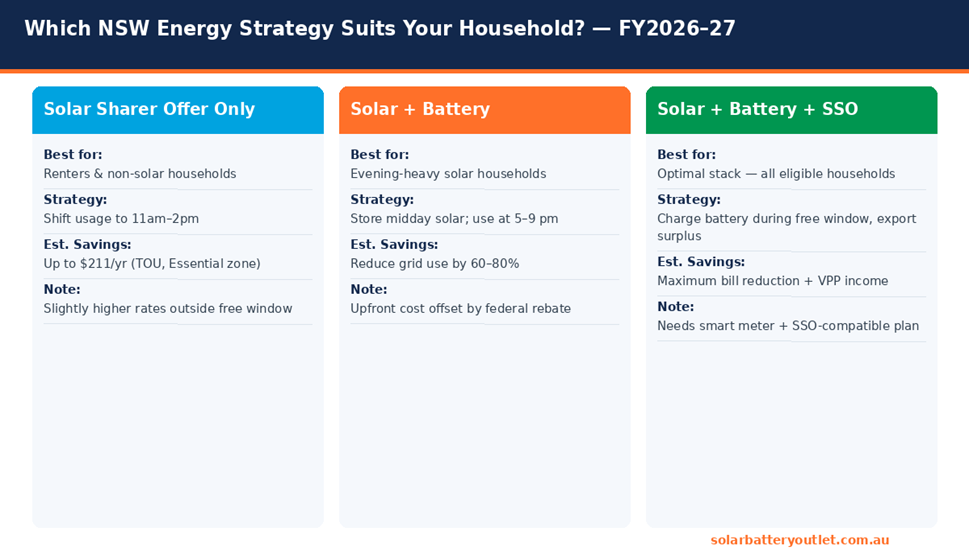
Which Strategy Suits Your Household? A Practical FY2026–27 Framework

Not every NSW household benefits from every option. The right strategy depends on your usage pattern, whether you have solar, and what tariff you are currently on. Here is a straightforward framework to guide your decision.

NSW energy plan decision framework Solar Sharer solar battery 2026

Strategy 1 — Solar Sharer Offer Only

Best for renters, apartment residents, or any household without solar panels who can shift appliance use to the 11 am–2 pm window. Running your dishwasher, washing machine, pool pump, or EV charger during the free window is where the savings are. Savings depend on how much use you can move into the free window.

Strategy 2 — Existing Solar + Battery

Best for households with an existing solar system that generates strong daytime output. A home battery stores surplus solar generated during the free window and discharges it during the 5–9 pm evening peak—when grid electricity typically costs 36 cents or more per kWh. A well-sized battery can cut a large share of evening grid use.

Strategy 3 — Solar + Battery + SSO (The Optimal Stack)

The most powerful combination for eligible households. During the 11 am–2 pm free window, the battery charges from the grid at zero cost. Any surplus solar is exported to the grid at feed-in tariff rates (currently 4–10 c/kWh across NSW retailers).

In the evening, the battery discharges — avoiding peak rates. Some VPPs pay incentives or credits — check whether a VPP can be used together with a Solar Sharer plan, as some VPPs require a specific retailer plan. For many households this combination can give strong savings.

An Illustrative Example — A Household in Parramatta

Consider a four-person household in Parramatta (Endeavour Energy zone) on a TOU standing offer, using 15 kWh per day with most usage in the evenings. Prior to FY2026–27, their annual electricity bill was approximately $2,328 (DMO 7 TOU reference price).

Under DMO 8, their standing-offer TOU price drops by -4.5%, saving approximately $105 per year automatically—without changing a thing.

By switching to the Solar Sharer Offer and shifting their dishwasher, washing machine, and air-conditioner pre-cool to the 11 am–2 pm window (about 3 kWh per day), they capture an additional estimated saving of $130–$180 per year.

They add a 10 kWh solar battery using the federal rebate (~$2,720 discount), reducing their out-of-pocket cost to approximately $5,000–$6,000 after the rebate. Their evening grid draw drops from roughly 9 kWh to 1–2 kWh per night. Annual electricity bill savings from the battery alone are estimated at $800–$1,200, suggesting a payback period of approximately 5–7 years under current tariffs.

This is a simplified illustrative example. Actual outcomes depend on household usage, system size, tariff structure, solar exposure, and other factors. See our contact page to get personalised advice for your home.

The Smart Meter Requirement — What NSW Households Need to Know

Access to the Solar Sharer Offer requires a smart meter. Smart meters record electricity usage at 30-minute intervals and transmit data to your retailer, enabling time-of-use billing. Without a smart meter, TOU plans — including the SSO — are not accessible.

The good news: for most NSW households, smart meter installation is available free of charge through your electricity retailer or distributor. Contact your retailer and ask specifically about smart meter installation ahead of the 1 July 2026 SSO launch. Check the exact exemption rule on the AER website and link it. Otherwise: ‘Some smaller retailers may not have to offer the SSO, but most major retailers do.’

Frequently Asked Questions

Do I need rooftop solar to access the Solar Sharer Offer in NSW?

No. The Solar Sharer Offer is available to all NSW households in DMO-regulated zones with a smart meter, regardless of whether you have solar panels. Renters are also eligible.

Is the Solar Sharer Offer free electricity, or are there strings attached?

The SSO provides free electricity between 11 am and 2 pm, up to 24 kWh per day. However, the overall plan cost is calibrated to equal the DMO TOU reference price — meaning rates outside the free window are approximately 1–4 cents per kWh higher than a standard TOU plan. Households that can shift usage to the free window benefit; those who cannot may find a standard market offer more cost-effective.

Can I still claim the federal battery rebate in FY2026–27?

Yes. The Cheaper Home Batteries Program runs through 2030. Post-May 2026, the rebate is approximately $252–$272 per usable kWh for systems under 14 kWh (Zone 3 NSW). The next step-down is 1 January 2027, so the current half-year window offers the highest available rebate in FY2026–27.

Can I stack the federal battery rebate with NSW state incentives?

Yes. The federal Cheaper Home Batteries Program is stackable with the NSW VPP Incentive (up to $1,500) and the NSW Home Energy Saver interest-free loan (up to $15,000 for eligible households). Eligibility conditions apply.

What happens if I use more than 24 kWh during the Solar Sharer free window?

Usage above the 24 kWh daily cap during the free window is charged at the applicable ‘reasonable use rate’, as set out in your Energy Price Fact Sheet. For most households, 24 kWh far exceeds midday consumption, so hitting the cap is unlikely.

How do I compare Solar Sharer plans across retailers?

Use the Australian Government’s free, independent comparison tool at energymadeeasy.gov.au. From July 2026, retailers must list their Solar Sharer Offer plans on the site. Compare the off-peak rates, daily supply charges, and any feed-in tariffs included with the SSO.

Your FY2026–27 Energy Action Plan — 5 Steps
  • Step 1 — Check your smart meter status. Contact your retailer to confirm you have a smart meter, or arrange installation (free for most NSW households).
  • Step 2 — Map your usage pattern. Review your electricity bills from the last three months. If you can shift more than 20–30% of your electricity use to the 11 am–2 pm window, you will likely benefit from the Solar Sharer Offer.
  • Step 3 — Compare plans on Energy Made Easy. Use energymadeeasy.gov.au to compare your current plan against available Solar Sharer offers in your zone.
  • Step 4 — Get at least 3 battery quotes. If you are considering a battery, compare a minimum of three written quotes from accredited installers. Ask each installer to confirm the federal rebate amount, any VPP incentive, and your eligibility for the NSW Home Energy Saver loan.
  • Step 5 — Check the current rebate in your quote.
Ready to Maximise Your NSW Energy Savings in FY2026–27?

Whether you want to understand how the Solar Sharer Offer works for your home, explore the federal battery rebate, or stack NSW incentives for maximum savings — our team is here to help.

Get a Free Quote from Solar Battery Outlet → or call us on 1800 000 777—serving NSW households across Sydney, Parramatta, Newcastle, Wollongong, and regional NSW.

Disclaimer: The figures, savings estimates, rebate amounts, and tariff reductions in this article are illustrative examples only and are not a guarantee of future savings or outcomes. Actual results vary depending on your location, usage pattern, tariff, solar system, battery size, and eligibility for government incentives. Information is accurate at the date of publication and is subject to change. Please seek personalised advice before switching plans or making a purchasing decision.

Short answer: yes. NSW homeowners can access both the federal Cheaper Home Batteries Program and at least one NSW-specific incentive—and in many cases, two. What surprises most people is that these incentives stack. You do not have to choose between them.

However, the two programs work differently, come from different government departments, and have separate eligibility conditions. If you simply ask your installer about ‘the rebate,’ you may only hear about the federal one. This guide explains both, shows you how to stack them, and gives you the numbers you need to make an informed decision.

What Is the Federal Cheaper Home Batteries Program (CHBP)?

The federal Cheaper Home Batteries Program launched on 1 July 2025. It applies nationwide and is delivered through the existing Small-Scale Renewable Energy Scheme (SRES)—the same mechanism that has been funding rooftop solar rebates in Australia for over a decade.

Rather than paying you cash, the program creates Small-scale Technology Certificates (STCs) based on your battery’s usable capacity. Your accredited installer claims these certificates on your behalf and deducts the value from your upfront quote. No paperwork. No waiting. The rebate is already factored into the price you see.

From 1 May 2026, the rebate uses a tiered structure:

  • First 14 kWh of usable capacity: full STC factor (6.8 STCs per kWh — about $252 per kWh at $37 per STC)
  • 14 kWh to 28 kWh: STC factor reduced to 60% of the rate
  • 28 kWh to 50 kWh: STC factor reduced to 15% of the rate

For a 10 kWh usable battery, the rebate is about $2,500–$2,700 under the May–December 2026 rate. For a 13.5 kWh usable battery like the Tesla Powerwall 3, it is about $3,400–$3,670, depending on the STC price. These figures are based on the STC factor and market price — your installer will confirm the exact amount at the time of installation.

The rebate steps down every six months (next on 1 January 2027), so your quote will show the current amount. The program runs until the end of 2030. Choosing the right system matters more than rushing..

Does NSW Have Its Own Battery Rebate on Top of the Federal One?

Yes — but the structure changed significantly in 2025 and 2026. The previous standalone NSW battery rebate (which operated independently of the federal scheme) wound back to avoid overlap once the Cheaper Home Batteries Program launched. Today, NSW support works mainly through the VPP incentive and the Home Energy Saver program, alongside the federal rebate.

In 2026, NSW homeowners have access to three state-level incentives that stack on top of the federal rebate:

The NSW Peak Demand Reduction Scheme pays you for connecting your battery to a Virtual Power Plant (VPP). Your battery stays in your home. A VPP is simply a software connection that allows an approved operator to draw a small amount of stored energy during peak demand periods — typically hot summer afternoons when the grid is under pressure.

In return, you receive Peak Reduction Certificates (PRCs). Eligible households who connect an approved battery to an approved Virtual Power Plant (VPP) may receive a one-off incentive under the NSW Peak Demand Reduction Scheme. Incentive amounts vary depending on battery size and other eligibility factors, and are typically applied through your installer or VPP provider..

  • Available to eligible NSW households who connect an approved, VPP-capable battery to an approved VPP.
  • Stackable directly on top of the federal CHBP rebate.
  • Run under the NSW Peak Demand Reduction Scheme (IPART is the scheme regulator)

On 17 June 2026, the NSW Government launched the $557 million Home Energy Saver program. The program provides financial support for eligible households undertaking approved energy-saving upgrades. The Home Energy Saver interest-free loan offers eligible homeowners and landlords’ access to up to $15,000 for approved upgrades, including batteries, solar, heat pumps, EV chargers and other eligible technologies. Loans are available to households with a combined income of up to $210,000 and can be repaid over up to 10 years.

  • 0% interest on eligible loans
  • Up to $15,000 for approved energy-saving upgrades, including solar batteries
  • Available to eligible households with a combined income of up to $210,000 per year
  • Repayable over up to 10 years
  • May be used alongside other available incentives, subject to eligibility requirements

Separate Home Energy Saver discounts of up to $4,000 are available for eligible concession card holders and households with a combined income of up to $80,000, subject to program eligibility criteria.

Alongside the loan, the Home Energy Saver program includes a targeted grant of up to $4,000 for households with an income under $80,000 per year, or those holding a valid concession card. This grant does not need to be repaid and stacks on top of both the federal rebate and the interest-free loan.

For eligible lower-income households, the federal rebate, the VPP incentive and this extra support can greatly reduce the cost of a 10 kWh battery. Your quote will show the exact amount you pay..

Federal vs NSW incentive comparison—both programs are designed to stack.

How the NSW + Federal Stack Works in Practice

Here is how the three layers combine for a typical NSW homeowner installing a 10 kWh battery in the second half of 2026. These numbers are illustrative—your actual savings depend on your STC zone, battery size, install date, and eligibility.

Estimated incentive stack for a 10 kWh battery in NSW (2026).

As the chart shows, the federal CHBP alone provides an estimated ~$2,720 in savings for a 10 kWh battery. Stack the NSW VPP incentive on top and the combined savings reach up to $4,220. For households eligible for the targeted grant, savings climb further still.

The key point is that these incentives come from different funding pools. Claiming the federal rebate does not exclude you from the NSW incentives. Your accredited installer handles the CHBP at the point of sale. The VPP incentive is arranged through your VPP operator (which your installer can recommend). The Home Energy Saver Loan is applied for separately through the NSW Government portal.

Who Is Eligible for the NSW Battery Incentives in 2026?

Eligibility for the federal CHBP is straightforward: install a CEC-approved battery (5 kWh to 100 kWh) through an SAA-accredited installer. There is no income test and no application form.

The NSW incentives have additional conditions:

IncentiveEligibilityMax Value
Federal CHBPAll Australians, no income test, 5–100 kWh battery~$2,720 (10 kWh, May–Dec 2026)
NSW VPP / PDRSNSW homeowners with VPP-capable battery, Ausgrid or Endeavour areaUp to $1,500
Home Energy Saver LoanNSW residents, income <$210,000/yrUp to $15,000 (0% interest)
Targeted GrantNSW residents, income <$80,000/yr or concession cardUp to $4,000

Solar Battery Liverpool and Western Sydney: What Local Homeowners Need to Know

For homeowners in Liverpool, Bankstown, Mudgee, and the broader Western Sydney region, the incentive stack is particularly relevant. Many homes in this area already have rooftop solar— and battery attachment rates are rising rapidly as households look to capture more of the energy they already generate.

Bankstown is in the Ausgrid network area and Liverpool is in the Endeavour Energy network area. Your installer can confirm VPP incentive eligibility for your address. Mudgee falls within the Essential Energy network. VPP eligibility is subject to network operator conditions—your installer can confirm whether your specific address qualifies.

If you are researching solar battery Liverpool options, the key questions to ask any installer are (1) which batteries on their quote are CEC-approved and VPP-capable, (2) which VPP operators they work with, and (3) whether they can register the PDRS incentive on your behalf. A quality installer handles all three as a standard part of the installation process.

The federal rebate applies regardless of your location in NSW. The tiered structure that came into effect on 1 May 2026 means the best rebate-per-dollar value sits in the 10 to 14 kWh range — which also happens to suit most three- and four-bedroom homes in Western Sydney.

Ready to See What Your Stack Looks Like?

Every home is different. The right battery size, the right VPP operator, and the right combination of incentives depend on your electricity usage, your solar system, and your income. The numbers in this article are illustrative — but they give you a realistic picture of what is possible.

Solar Battery Outlet serves NSW homeowners across Liverpool, Bankstown, Mudgee, and the surrounding region. We use CEC-approved batteries and SAA-accredited installers, and we handle the federal rebate paperwork. We can also help you with the VPP connection.

Get a written quote that shows all applicable incentives—contact Solar Battery Outlet today and we will walk you through the full incentive stack for your home.

Frequently Asked Questions

Can I claim the NSW battery rebate if I already have solar panels?

Yes. The federal CHBP applies to battery-only installations — you do not need to install new solar panels. The NSW VPP incentive also applies to standalone battery installations. If your existing solar system is less than 10 years old and generating well, adding a battery is straightforward.

Is the NSW battery rebate the same as the federal one?

No. They are separate programs. The federal Cheaper Home Batteries Program provides an upfront point-of-sale discount through the STC mechanism. The NSW incentives (VPP incentive and Home Energy Saver Loan) are state-funded and have different eligibility rules. You can claim all of them at the same time.

Does the federal battery rebate apply in NSW?

Yes. The Cheaper Home Batteries Program applies in every Australian postcode including all of NSW. There is no location restriction. The rate is based on the battery’s usable capacity and the STC price, so it works the same way across Australia.

Which home batteries qualify for the rebates in NSW?

A battery qualifies for the federal rebate if it is on the approved product list, is VPP-capable, and is installed by an SAA-accredited installer. Popular options in NSW include the Tesla Powerwall 3 (13.5 kWh), Sungrow SBR series, BYD Battery-Box, and GoodWe Lynx Home. For the NSW VPP incentive, the battery also needs to be VPP-capable — most modern units are. Your installer can confirm eligibility for your specific model.

Does the federal battery rebate step down in NSW?

Yes. The STC factor steps down every six months under the revised program rules that took effect on 1 May 2026. The next reduction is 1 January 2027. The rebate steps down every six months (next on 1 January 2027), so your quote will show the current amount. The program runs until the end of 2030. Choosing the right system matters more than rushing.

Disclaimer—Please note all figures, rebate amounts, savings estimates, and eligibility details in this article are illustrative only and are not a guarantee of outcomes. Actual results vary based on your location, battery size, usage, tariff, and eligibility. Incentive rates change every six months. Please seek personalised advice before making a purchasing decision.
Choosing the right solar system size is one of the biggest decisions a homeowner makes. Go too small, and you will still rely heavily on the grid. Go too big, and you pay for capacity you never use. So, what size actually fits your home?

In 2026, the answer depends on three things: how much electricity you use each day, how much sun your roof receives, and what you plan to add in the next few years. An electric vehicle, a heat pump, or a battery can change the right size dramatically.

This guide walks through the exact formula installers use, a quick sizing table for common household types, real Sydney output data, and the questions to ask before you commit. Whether you are buying your first system or planning to upgrade solar system capacity to support a future battery, the same fundamentals apply.

Start With Your Electricity Bill, Not Your Roof

The most reliable starting point is your actual electricity usage, not roof size or budget. Your bill shows total kilowatt-hours (kWh) used over the billing period. Divide that figure by the number of days to get your daily average.

Most Australian households use between 12 and 30 kWh per day. Smaller, energy-efficient homes sit at the lower end. Larger households, or homes with a pool, electric hot water, or an EV, sit much higher. If possible, use a full 12-month average rather than a single quarter, because summer and winter usage can differ by 30 percent or more.

Once you have your daily average, the sizing formula is straightforward. Multiply your daily usage by 1.25 to account for system losses. Then divide by your area’s peak sun hours. The result is your minimum recommended system size in kilowatts.

Quick Sizing Table for Common Australian Households

Every home is different, but these ranges give a solid starting point. They reflect typical Sydney conditions, where peak sun hours average around 3.9 to 4.5 hours per day, slightly lower than Brisbane or Perth.

Recommended solar system size by household type, 2026

Why 6.6kW Remains the Most Popular Choice in 2026

A 6.6kW system has been Australia’s most common residential install for several years, and 2026 is no exception. It suits most three to four-person households, fits comfortably on a standard roof, and strikes a good balance between cost and output.

In Sydney, a north-facing 6.6kW system produces roughly 24 to 28 kWh per day on average (add source). Output is higher on long summer days and lower in winter.

Seasonal output of a 6.6kW system, Sydney NSW

When Bigger Makes Sense: EVs, Heat Pumps and Batteries

A common mistake is sizing for today’s usage only. Many households add an electric vehicle, heat pump hot water, or a battery within a few years of installing solar, and then wish their system were larger.

An EV typically adds 8 to 10 kWh per day for an average commute, pushing many households from the 6.6kW range into 8.8kW or 10kW territory. Heat pump hot water adds a smaller but steady load, often 2 to 4 kWh per day.

If you are planning to add a battery later, oversizing your solar array slightly now gives the battery more surplus midday energy to store. Households exploring solar battery Liverpool options, for example, may find that a larger solar array gives a 10kWh battery more surplus to store, which can improve the value of the battery, simply because there is more excess solar to redirect into storage rather than exporting it for a low feed-in tariff.

Roof Space, Orientation and the 13.3kW Ceiling

Each modern panel needs around 1.7 square metres of roof space. A 6.6kW system needs roughly 16 to 17 panels, while a 10kW system needs around 24 panels. Most homes have enough roof area, but orientation matters more than total space.

North-facing panels produce the most energy in Australia. East and west-facing arrays produce 15 to 20 percent less, but splitting panels across both sides of a dual-pitch roof can smooth your generation curve across the day, which is useful if you use more power in the morning and evening.

If your household needs more than 6.6kW, the next decision is whether to upgrade to three-phase power, which opens access to larger single inverters above 10kW, your local network (Ausgrid, Endeavour or Essential) sets limits on how much inverter capacity and export a single-phase home can have, so your installer will check this. An SAA-accredited installer should also confirm your switchboard capacity before recommending a larger system.

A Simple Framework for Choosing Your System Size

Use these four steps before requesting quotes. Each step takes only a few minutes and helps you compare installer recommendations with confidence.

  1. Calculate your baseline. Use your 12-month average daily usage, not a single bill.
  2. Apply the formula. Multiply by 1.25, then divide by your area’s peak sun hours.
  3. Add future loads. Factor in an EV, heat pump, or battery you may add within five years.
  4. Round to a standard size. Most installers offer set sizes like 5kW, 6.6kW, 8.8kW, 10kW, or 13.3kW.

Frequently Asked Questions

Is 6.6kW enough for an average Australian home?

Yes, for most three- to four-person households using 16 to 24 kWh per day, a 6.6kW system comfortably covers daytime usage and offers reasonable winter output. Households planning a battery or EV often choose 8.8kW or 10kW instead.

How many solar panels do I need for a 10kW system?

With standard 400W to 440W panels, a 10kW system typically needs around 23 to 25 panels, requiring approximately 39 to 43 square metres of roof space, depending on the exact panel wattage chosen.

Can I oversize my solar system if I plan to add a battery later?

Yes, and it is often recommended. A larger solar array generates more midday surplus, which a future battery can store and use overnight, improving the overall value of both the solar and battery investment.

Does roof orientation change what size system I need?

Yes. East or west-facing roofs produce 15 to 20 percent less than north-facing roofs. If your roof is not north-facing, you may need to size up slightly to reach the same daily output as the sizing table suggests.

Disclaimer: The figures, savings estimates, system sizes, battery capacities, payback periods, and rebate amounts mentioned in this article are provided as illustrative examples only and are not a guarantee of future performance or savings. Actual outcomes vary depending on your location, electricity usage, tariff, solar generation, battery configuration, eligibility for government incentives, and other household-specific factors. Please seek personalised advice before making a purchasing decision.
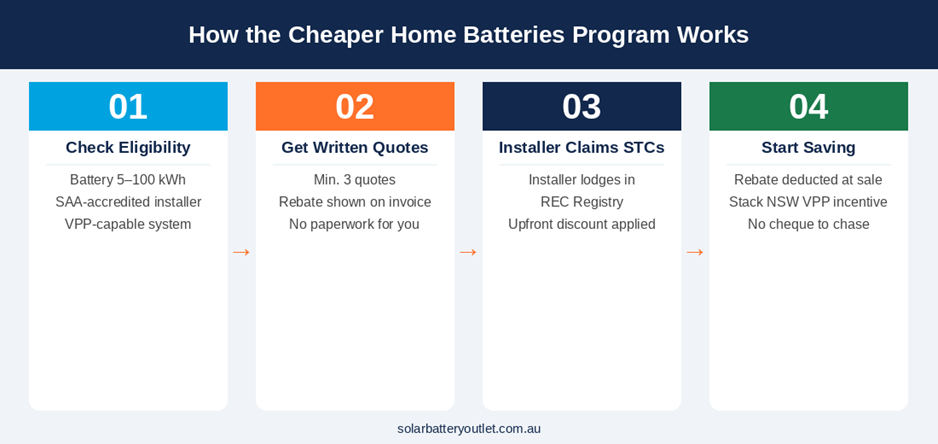
php