Quick answer: The NSW smart inverter changes start in stages from November 2026. New and upgraded rooftop systems up to 200 kW need a CSIP-AUS compliant inverter. These systems also need a working internet connection. Existing systems that stay unchanged need no action.
The NSW smart inverter changes will shape how installers connect new rooftop solar from November 2026. If you plan new solar, an upgrade or a future battery, these rules matter. First, this guide explains what is changing. Next, it shows who must comply and when each network starts. Finally, it lists the questions to ask your installer.
At a glance:
- Who: new and upgraded rooftop solar systems up to 200 kW.
- What: a CSIP-AUS inverter, an internet connection, a capability test and portal registration.
- When: staged by postcode from November 2026, with Ausgrid targeting 22 February 2027 for full coverage.
- Not affected: existing systems you leave unchanged, and battery installations.
What are the NSW smart inverter changes?
The NSW Government is introducing the Emergency Backstop Mechanism. The Australian Energy Market Operator (AEMO) requires this last-resort protection to keep the grid secure. It lets Ausgrid, Endeavour Energy and Essential Energy temporarily reduce rooftop solar exports or pause generation. However, they can only act when AEMO instructs them.
A smart inverter makes that possible. The required standard is Common Smart Inverter Profile – Australia, or CSIP-AUS. A CSIP-AUS inverter talks to the network’s server over the internet in real time. As a result, the network can send a signal during an emergency.
Other states already use similar protections. Western Australia, South Australia, Queensland and Victoria have all introduced a backstop mechanism.
Why is NSW introducing smart inverter rules?
Around one million NSW households and small businesses now have rooftop solar. That equals roughly a quarter of all homes in the state. On sunny days, demand can fall while solar output stays high. Therefore, the grid can face a Minimum System Load event.
In rare cases, that imbalance could cause power outages. AEMO takes many other steps first. For example, it can reduce large-scale generation or raise demand from big energy users. The backstop only applies if those steps fail.
NSW expects to use the backstop rarely. Networks restore exports once AEMO confirms the emergency has passed.
When do the NSW smart inverter changes start?
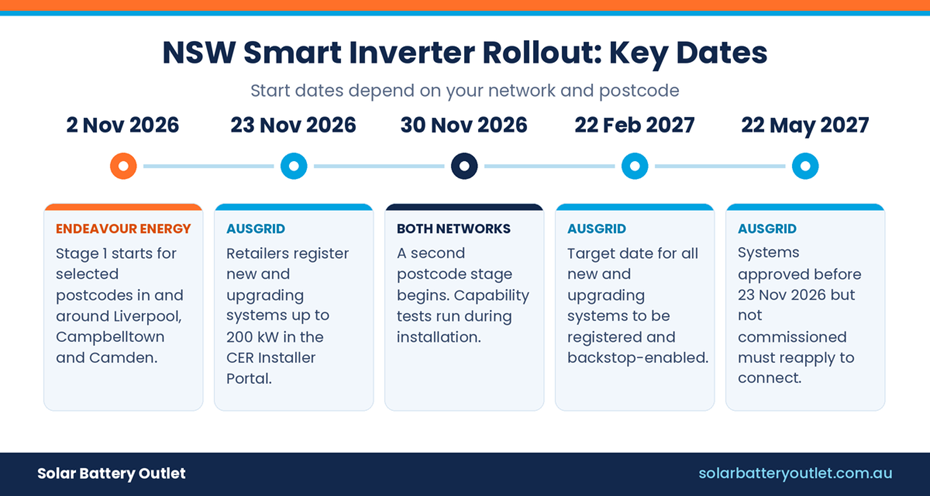
The rules arrive in stages, not on one day. The NSW Government is phasing them in by postcode from November 2026. Your start date therefore depends on your network and address.
Endeavour Energy begins first. Its stage one starts on 2 November 2026 and covers postcodes in and around Liverpool, Campbelltown, Camden and Picton. Stage two follows on 30 November 2026.
Ausgrid starts portal registration on 23 November 2026. Capability testing then phases in by postcode from 30 November. Ausgrid expects every new and upgrading system to meet registration and backstop requirements by 22 February 2027. Also, from 22 May 2027, systems approved before 23 November 2026 but not commissioned must reapply.
Essential Energy customers should check their network’s rollout details. Dates can change, so confirm your postcode with your network before you sign.
Who must follow the new smart inverter rules?
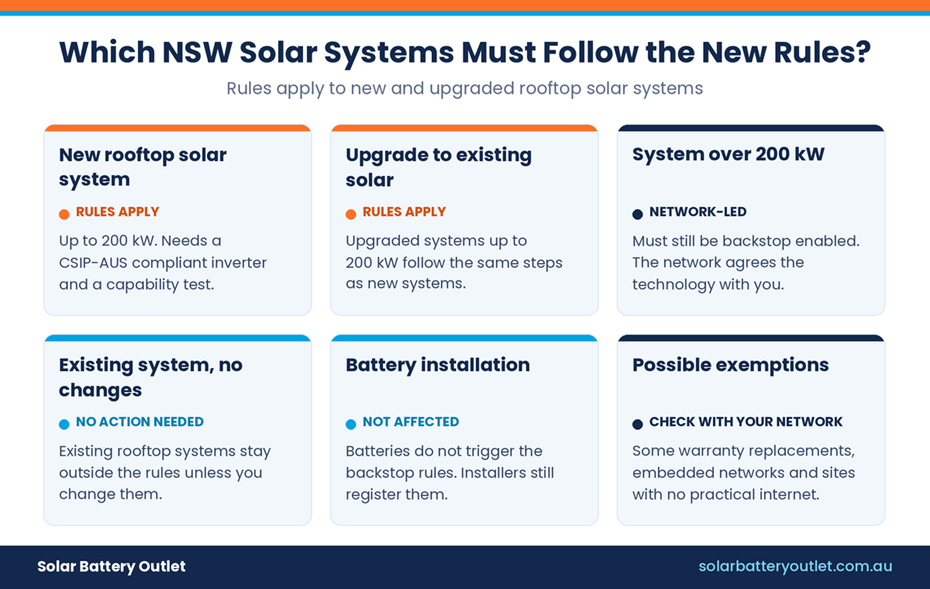
The requirements apply to new and upgraded rooftop solar systems up to 200 kW. Installers must fit CSIP-AUS compliant equipment. They must also register each system through the NSW CER Installer Portal.
However, many owners do not need to act. Existing systems that stay unchanged fall outside the rules. The NSW Government also confirms that battery installations do not fall under these requirements. In addition, some like-for-like warranty replacements, embedded network customers and sites without practical internet access can receive exemptions.
Systems above 200 kW must still support remote curtailment. In those cases, the network works directly with the customer on the right technology.
What must a compliant smart inverter installation include?
Compliant equipment comes first. The inverter must appear on the Clean Energy Council’s approved list of inverters with software communication clients. It must also use a client approved for that specific inverter.
From late 2026, your installer then completes four extra steps:
- Confirm the equipment meets CSIP-AUS.
- Use the CER Installer Portal to confirm installation details.
- Register the device through the manufacturer’s app or portal.
- Run a capability test during commissioning.
The capability test is short and takes place on site. It checks that your system can communicate with the network over the internet. Notably, exemptions may apply to device registration and capability testing. Your network’s connection approval and the portal will show if they do.
Why does your solar system need an internet connection?
Your inverter uses the internet to receive network signals and share monitoring data. It also keeps any flexible export limit you choose. Your installer connects it with Wi-Fi, a plug-in Wi-Fi device or an ethernet cable.
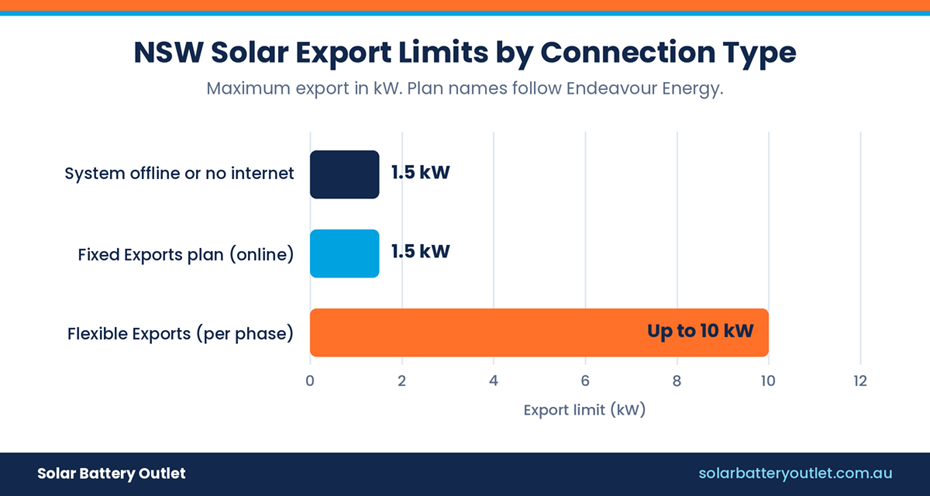
If your site has no internet, installers can still fit solar. However, exports cap at 1.5 kW. That limit does not reduce the solar power you use at home. Similarly, an extended loss of connection triggers the same cap. That change may reduce your feed-in tariff earnings.
Flexible exports offer the upside. Endeavour Energy says eligible customers can export up to 10 kW per phase most of the time. From November 2026, it plans to make flexible exports the default for eligible new and upgraded systems. These customers need an active internet connection, net export metering and a Clean Energy Council listed CSIP-AUS inverter. Customers who prefer a Fixed Exports plan face a 1.5 kW maximum. Other networks set their own export rules, so check yours.
Finally, keep your modem switched on. Reconnect your inverter after you change provider, router or Wi-Fi password.
How do the NSW smart inverter changes affect solar batteries?
Adding a battery to existing solar does not trigger the backstop requirement. However, installers still register battery installations in the CER Installer Portal from November 2026.
Things change if your project also adds or replaces rooftop solar. In that case, the new inverter rules may apply. Therefore, ask your installer to confirm how the rules apply to your exact setup before you sign. A trusted solar battery company can review your inverter, internet set-up and battery plan together.
Battery projects also depend on other 2026 updates. For example, our guide to new government rules for solar battery installations in 2026 covers wider NSW compliance changes.
Rebate timing worrying you? Read our guide on whether to rush to get a solar battery before the rebate drops.
What should solar owners do now?
Use this four-step checklist before you sign a solar or battery contract.
- Define your plan. Decide whether you want new solar, an upgrade, a battery only or no change.
- Check your start date. Look up your postcode with Ausgrid, Endeavour Energy or Essential Energy.
- Confirm the inverter. Ask your installer to show the model on the Clean Energy Council’s approved list.
- Confirm the internet set-up. Ask how the inverter will connect and who supports the app.
Then ask three more questions. Which export plan will my system use? What happens if my internet drops? Who registers my system in the CER Installer Portal?
Never open your inverter or attempt electrical work yourself. For official updates, visit the NSW Government’s Emergency Backstop Mechanism page.
Frequently asked questions about the NSW smart inverter changes
They start in stages from November 2026 and roll out by postcode. Endeavour Energy begins on 2 November 2026. Ausgrid registration begins on 23 November 2026. Check your network for your postcode’s date.
No. The requirements apply to new and upgraded systems. If you have an existing system and make no changes, the NSW Government says you need no action.
CSIP-AUS stands for Common Smart Inverter Profile – Australia. This Australian standard lets compliant equipment communicate with a network’s server over the internet in real time.
It can briefly reduce your exports or pause generation. However, it only happens when AEMO instructs your network during a rare emergency. NSW Government installer guidance says it does not affect electricity supply to your home.
After an extended loss of connection, exports automatically limit to 1.5 kW. You can still use all the solar you generate at home. Reconnect your inverter to return to normal exports.
Battery installations do not fall under the backstop requirement. Installers still register them through the portal. If you also add or replace solar, the rules may apply.
Talk to Solar Battery Outlet About Your Next Step
Not sure whether your plans trigger the NSW smart inverter changes? Solar Battery Outlet is a NSW-based solar battery company serving Liverpool, Bankstown and Mudgee. Our team can discuss your current system, your inverter and your internet set-up. We can also explain your battery options in plain language. Contact our team to talk through your plans.
Disclaimer
This article gives general information about the NSW smart inverter changes as at 26 October 2026. Rules, dates and postcode stages can change, and each network applies its own rollout. The article does not cover every site, system size or exemption. It does not replace advice from your distribution network, a licensed electrician or an accredited installer. Always seek personalised advice before making a purchasing decision.
