
Every solar battery wears out eventually. That is normal, not a fault. But most homeowners install a battery and never ask what happens next.
This guide explains exactly that. You will learn how long a home battery lasts and the warning signs of decline. You will also learn your realistic options once it stops performing well. We also cover how battery recycling works in Australia. As a result, you can plan ahead instead of being caught off guard in ten years’ time.
How Long Does a Home Solar Battery Actually Last?
Most residential batteries installed in Australia today use lithium iron phosphate (LFP) cells. This chemistry is stable, and it generally outlasts older lithium-ion types.
In practice, a home battery typically performs well for 10 to 15 years. That is usually somewhere between 6,000 and 10,000 full charge cycles, whichever limit arrives first.
Manufacturers back this with a warranty, usually running for 10 years. However, a warranty does not promise perfect performance forever. Instead, it guarantees a minimum capacity by a set date. Most brands guarantee at least 70% of original capacity at the 10-year mark. Some premium brands go further, promising 80% capacity or offering 12 to 15-year cover.
That gap between “still working” and “still under warranty” matters. A battery often keeps charging well past its warranty period. Even so, it stores slightly less energy every year. The chart below shows a typical LFP degradation curve against a common 10-year warranty floor.
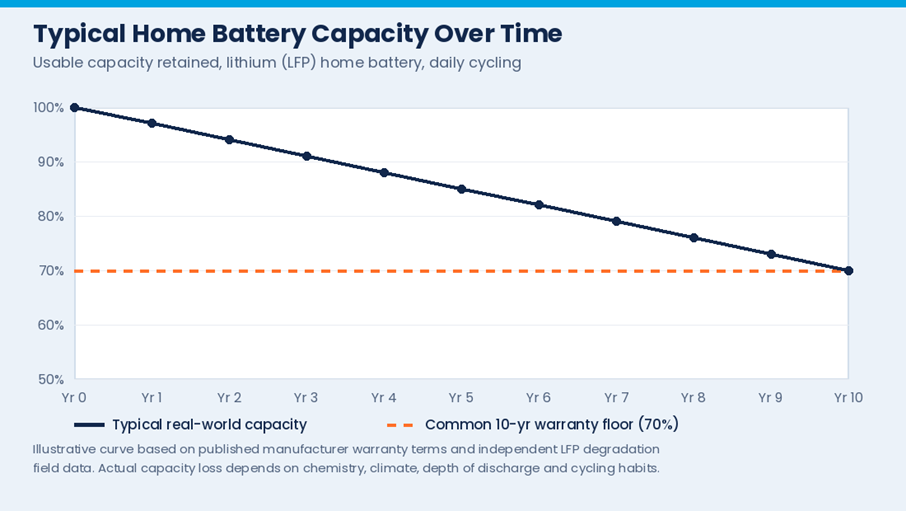
Understanding this curve helps you plan a realistic replacement timeline, rather than guessing.
Signs Your Solar Battery Is Nearing End of Life
A battery rarely fails without warning. Instead, it usually shows gradual signs first:
- Shorter backup time — it empties faster than before, even with the same usage.
- Slower charging — it takes longer to reach full charge from solar.
- App or portal alerts — many systems flag reduced capacity or cell imbalance automatically.
- Physical changes — swelling, unusual heat, or a burning smell.
- Frequent inverter errors — an ageing battery management system throws more fault codes.
If you notice any physical warning sign, switch the battery off immediately. Then call your installer or the manufacturer straight away. This is a safety matter, not routine ageing.
For the more common gradual signs, check your battery’s app first. Most systems display remaining capacity as a percentage of the original rating. A steady decline is expected. A sudden drop, however, usually points to a fault worth investigating sooner rather than later.
What Actually Happens Inside the Battery as It Ages
Lithium batteries degrade through normal chemistry, not sudden breakdown. Every charge and discharge cycle causes tiny, permanent changes inside the cells. Heat, deep discharges, and constant full charging all speed this process up slightly.
This is why installers usually recommend keeping a battery between roughly 20% and 90% charge day-to-day, where practical. It also explains why batteries in a shaded, cool spot often outlast those on a hot garage wall.
None of this means your battery will suddenly stop working. Degradation is gradual and predictable, not a cliff edge. Most homeowners simply notice a slightly shorter evening of coverage each year, long before real replacement is needed.
Your Options When a Battery Reaches End of Life
Once a battery drops to a genuinely unhelpful capacity, you generally have three paths forward.
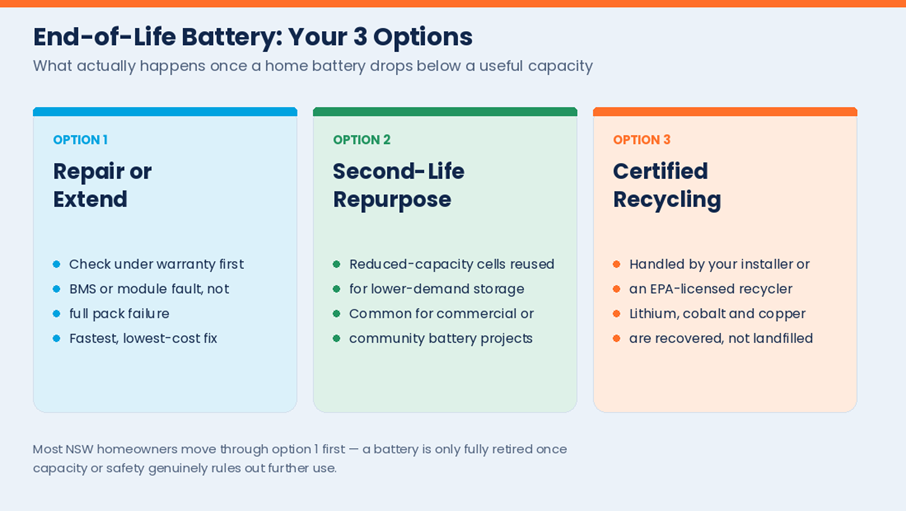
First, repair or extend. If the fault sits in the battery management system or a single module, a repair can restore normal performance. This is always worth checking, particularly while the battery remains under warranty.
Second, second-life repurposing. A battery that no longer suits daily home cycling can sometimes serve a lower-demand role, such as backup-only storage. Several Australian projects are already trialling repurposed cells for community and commercial storage.
Third, certified recycling. When a battery is genuinely finished, recycling recovers valuable materials such as lithium, copper and aluminum for reuse. This is the appropriate option once a battery is damaged, unsafe, or beyond a useful capacity.
A trustworthy installer will walk you through all three options honestly. It will not jump straight to a full replacement quote.
How Solar Battery Recycling Works in Australia
Home battery recycling differs from recycling everyday household batteries. B-cycle, Australia’s national battery stewardship scheme, handles small batteries from remotes, torches, and power tools. However, B-cycle drop-off points do not accept home energy storage batteries. These units are too large, and they need specialist handling.
Instead, a home battery should go back through your installer, the manufacturer’s take-back program, or a licensed lithium battery recycler. These facilities are accredited to safely dismantle and process large lithium batteries.
Never place a home battery in general waste or a household recycling bin. Damaged or swollen lithium cells are a genuine fire risk. They must be stored and transported under strict safety guidelines.
The good news is that lithium batteries are highly recyclable. Materials such as lithium, cobalt, nickel, and copper can be recovered and reused in new batteries. This reduces the need for fresh mining. Government-backed programs continue expanding accredited recycling pathways as more home batteries reach end of life. For more detail on what the scheme accepts, see the Australian Government’s overview of household battery recycling.
What This Means for Your Warranty and Rebate Paperwork
Keep your original battery documentation. This includes the installation certificate, warranty terms, and any rebate paperwork from schemes such as the federal battery rebate. If your battery develops a fault within its warranty period, this paperwork speeds up any claim considerably.
It also matters when you sell your home. Buyers and conveyancers increasingly ask about remaining battery warranty and expected lifespan, much like they ask about solar panel age. Keeping records organised now saves confusion later.
Planning Ahead: Budgeting for Battery Replacement
A solar battery is a long-term asset, not a one-off purchase. Consequently, it is worth budgeting for eventual replacement, much like a hot water system or roof.
Battery prices and technology continue to shift quickly. Our guide on solar batteries in Australia in 2026 and why this is a turning point covers those trends.
Setting aside a small amount each year, or reviewing your battery’s health annually, avoids financial surprises later. A well-maintained battery usually serves its full warranty period comfortably, and often longer.
Talk to a Trusted Solar Battery Company Before You Decide
If your battery is showing signs of ageing, do not guess. A qualified solar battery company can test its actual remaining capacity, check warranty status, and explain your realistic options honestly.
We are a Liverpool-based solar battery installer, part of GWM Group, servicing homes across Liverpool, Bankstown, and Mudgee. Our SAA-accredited installers can assess your existing battery, advise on repair versus replacement, and manage recycling paperwork if needed.
Call us on 1800 000 777, or visit solarbatteryoutlet.com.au to book a free, no-obligation battery health check. No pressure, no countdown timers — just honest advice about your system.
Frequently Asked Questions
How long do solar batteries last in Australia?
Most lithium (LFP) home batteries last 10 to 15 years. They are typically backed by a manufacturer warranty of around 10 years, guaranteeing a minimum capacity, often 70%.
Can I put my old solar battery in a B-cycle bin?
No. B-cycle only accepts small household batteries. Home energy storage batteries must go through your installer, the manufacturer, or a licensed lithium battery recycler.
Does a battery warranty cover normal capacity loss?
Warranties guarantee a minimum capacity, commonly 70%, by a set year. Losing some capacity down to that level is normal. If it drops below the guaranteed level within the warranty period, you can usually make a claim. Your rights under Australian Consumer Law also apply on top of the warranty.
What happens to the materials inside an old solar battery?
Certified recyclers recover lithium, cobalt, nickel, and copper for reuse in new batteries. This reduces landfill risk and lowers demand for new mining.
Should I repair, repurpose, or replace an ageing battery?
It depends on the cause. A faulty module can often be repaired. A battery with reduced but stable capacity may suit second-life use. Full replacement suits batteries that are damaged, unsafe, or below a useful capacity.
Disclaimer
This article provides general information about solar battery lifespan, warranty terms, degradation, and recycling in Australia. It does not constitute financial, legal, or technical advice. Battery lifespan, warranty terms, and capacity retention vary by brand, model, installation conditions, and usage pattern. Figures referenced are illustrative industry benchmarks, not guarantees for any specific product. Always check your own product documentation for exact terms. Recycling requirements and accepted battery types may also vary by state and provider.