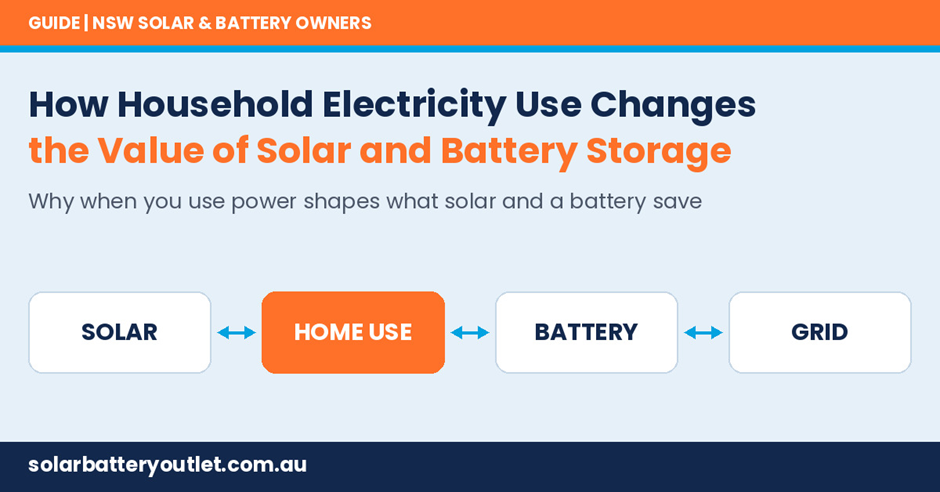
Two homes can install the same solar system and see very different results. In fact, household electricity use explains why. It sets the value of solar and battery storage. When you use power matters as much as how much you use. In NSW, a solar kWh you use at home usually saves more than one you export. This guide explains how your usage pattern changes the numbers in 2026.
Quick answer: Homes that use more power during the day may gain more from solar alone. Homes that use the most power after 4pm may gain more from adding a battery. Your smart-meter data shows which group you belong to.
What Sets the Value of Solar and Battery Storage in Your Home?
First, every solar kWh follows one of two paths. You can use it at home, or you can export it. Exports then earn a feed-in tariff. For 2026-27, IPART sets its all-day benchmark at 3.4 to 6.5 cents per kWh. Retail electricity costs much more than that. Therefore, each solar kWh you use at home usually saves more than it earns from export.
Similarly, IPART tribunal member Jonathan Coppel makes the same point. He says most customers get the best value by using the solar they generate. In short, self-consumption describes this habit. It means the share of your solar output that you use at home.
Of course, household use varies widely. The AER’s reference homes use about 3,900 kWh a year in Ausgrid’s area. In Endeavour’s area, the figure is about 4,900 kWh. However, a home with an EV, a heat pump and a pool can use much more. A battery then changes the choice. Instead of exporting surplus solar at midday, you store it and use it later.
How Does Midday Versus Evening Use Change Your Solar Savings?
Typically, homes use little power at midday and the most after work. WATTever’s analysis of AER half-hourly benchmarks suggests only about 13% of typical daily use falls between 11am and 2pm. Meanwhile, solar output peaks in that same window. As a result, a home with no one in it can export most of its midday solar.
Export value also swings through the day. The chart below shows IPART’s 2026-27 time-of-day benchmarks for the Ausgrid network. For example, midday exports earn about 3.9 to 4.0 cents per kWh. In contrast, exports from 4pm to 9pm earn 17.2 to 18.7 cents. Many retailers still pay a flat rate, so check your own plan. Even so, the pattern shows why evening power carries more value.

How Much Does a Battery Add for Different Households?
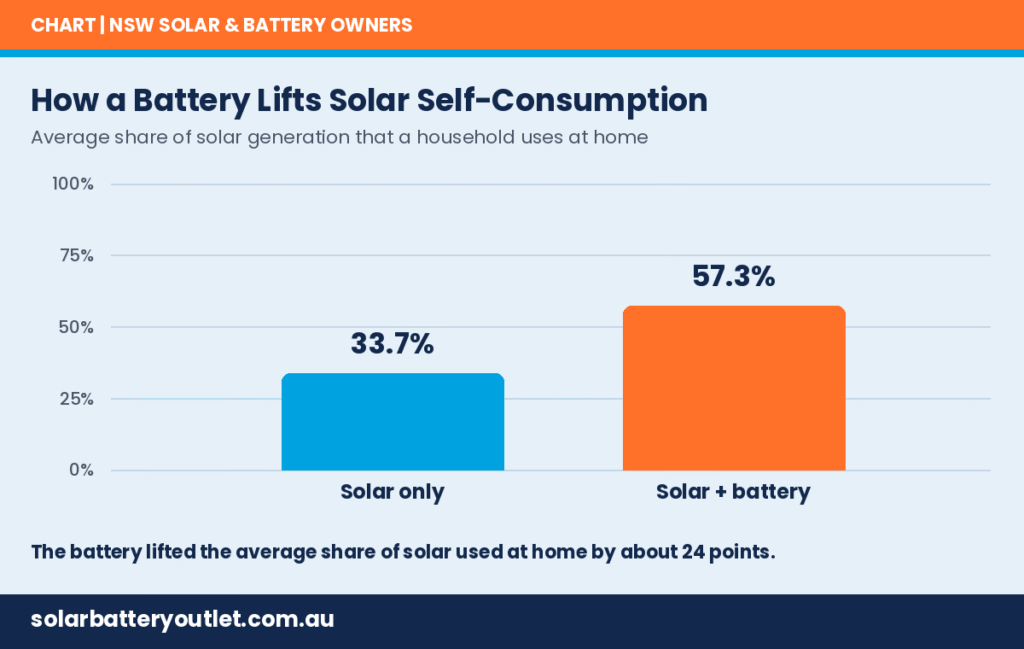
For example, Australian trial data shows the effect. In the ACT NextGen Energy Storage trial, homes without batteries used on average 33.7% of their solar in 2018. In contrast, homes with batteries used 57.3%. The chart below shows that gap of about 24 percentage points.
However, trial homes differ from yours. The trial reports 2018 results, so today’s figures may differ. Your result depends on your usage, battery size and solar system size. Moreover, a bigger battery does not always help. Once the battery covers your evening use, extra capacity may add little. Likewise, researchers have found the same diminishing returns in other studies.
Which Household Profile Gets the Most From Solar and Battery Storage?
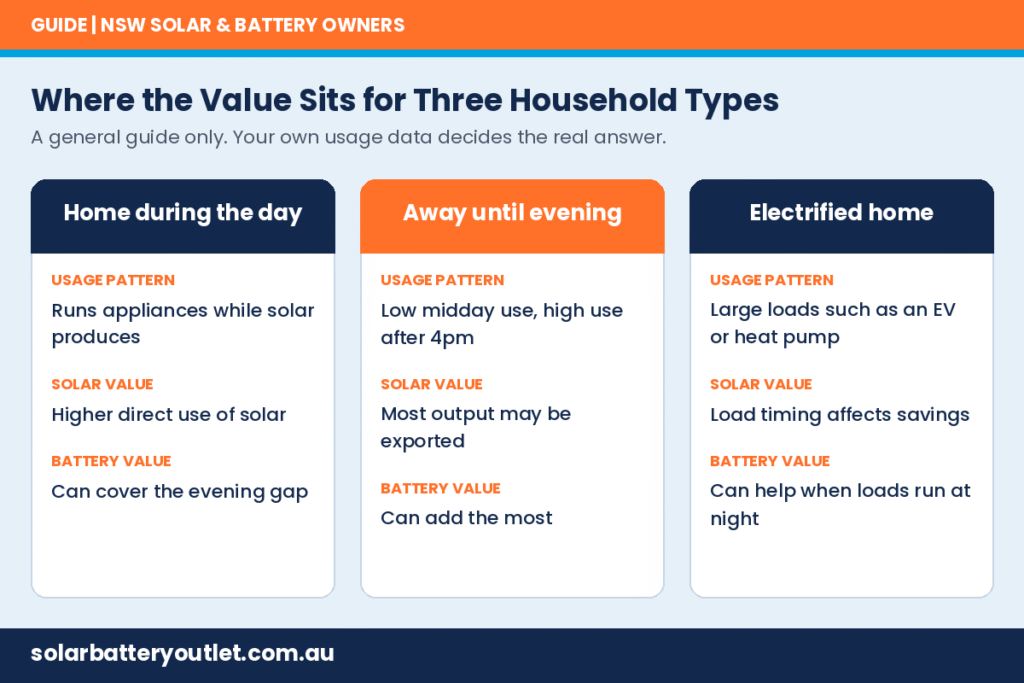
Three common profiles show how usage shapes the value of solar and battery storage. The graphic below summarises them.
Home during the day. These households run laundry, cooling and cooking while solar produces. As a result, solar alone can deliver higher direct savings. A battery can then cover the evening.
Away until evening. These households export most of their solar. Therefore, a battery can add the most value here. It can move surplus power into the 4pm to 9pm peak.
Electrified homes. An EV, heat pump or pool adds large loads. If those loads run at midday, solar covers them cheaply. If they run at night, a battery can help. In both cases, load timing drives the result.
How Do Solar Sharer Plans Change the Equation?
From 1 July 2026, NSW households can opt in to the Solar Sharer Offer. It gives up to 24 kWh of free grid electricity each day from 11am to 2pm. You do not need solar panels to join, but you do need a smart meter. Meanwhile, power outside the window still costs money.
This changes the maths for solar owners. During the free window, grid power costs nothing. As a result, your own midday solar saves less on that plan. A battery can store surplus solar for use after 2pm. Depending on your settings and plan terms, it may also charge from free grid power. However, rates outside the window differ by plan, so compare the full terms before you switch.
How Does the 2026 Rebate Affect Battery Sizing?
The federal Cheaper Home Batteries Program discounts battery costs through small-scale technology certificates (STCs). For installations from May to December 2026, the discount sits at about $272 per usable kWh. Then it steps down to about $228 per kWh from January 2027.
Since 1 May 2026, the discount also tapers by size. The first 14 kWh earns the full rate. Next, the following 14 kWh earns 60%. Finally, capacity from 28 to 50 kWh earns 15%. Clean Energy Regulator executive Carl Binning stresses that the installation date, not the contract date, sets your rebate.
Therefore, sizing a battery to your real evening use may help you avoid paying for unused capacity. For example, a 10 kWh battery installed in late 2026 attracts a discount of roughly $2,700 (10 × $272). This figure is an estimate, not a quote, and eligibility rules apply.
A 4-Step Way to Match Solar and Battery Storage to Your Use
Follow these four steps before you accept any quote. The graphic below shows the same process.
- Read your usage. Ask your retailer for your smart-meter data.
- Split day and night. Compare your midday use with your 4pm to 9pm use.
- Match the battery. Size storage to your evening use, not your roof size.
- Check the plan. Compare feed-in rates, time-of-use rates and Solar Sharer terms.
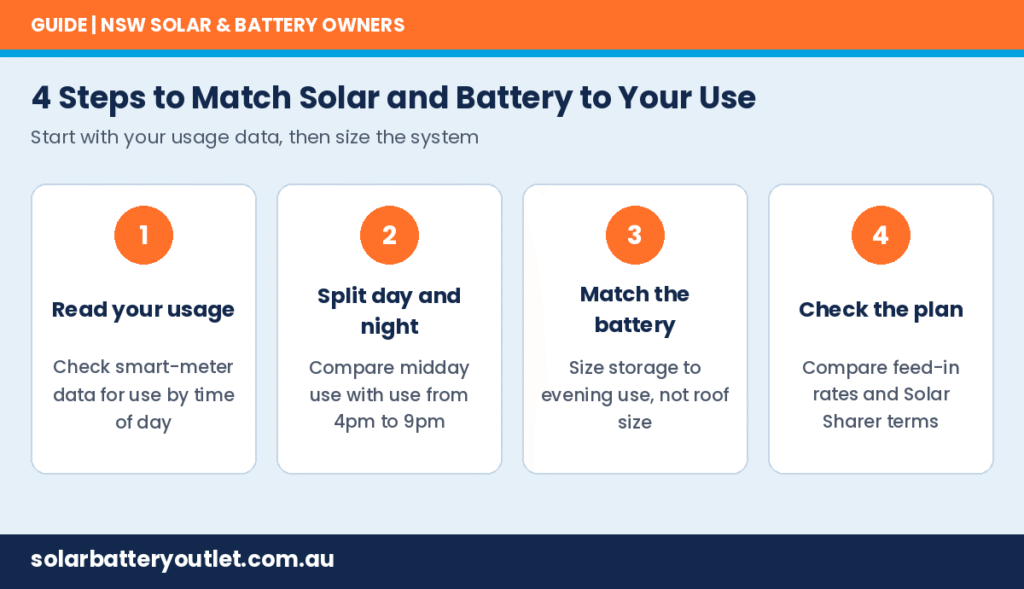
Each step starts with your own numbers. As a result, you can choose a system that suits your home.
Talk to a Local Solar Battery Specialist
Every home uses power differently, so every quote should start with your data. The Solar Battery Outlet team can review your usage and explain your options in plain language. We serve homeowners in Liverpool, Bankstown and Mudgee. As you compare each solar battery company, ask how it uses your data. Ask the same question when you search for the best solar battery installer. Contact our team to start with your own numbers.
Frequently Asked Questions About the Value of Solar and Battery Storage
Not always. Solar gains value when your use matches sunlight hours. A home with high evening use may gain less from solar alone. However, a battery can help bridge that gap.
It can be, because a battery stores daytime solar for night use. Value still depends on battery size, feed-in rates and your evening load. Therefore, check your usage data before you buy.
Self-consumption is the share of your solar generation that you use at home. Higher self-consumption usually means fewer grid imports. In the ACT NextGen trial, batteries lifted the average from 33.7% to 57.3%.
It can reduce the value of your midday solar use. Grid power costs nothing from 11am to 2pm on that plan, up to 24 kWh. Compare the full plan rates before you switch.
Disclaimer: This article gives general information about how household electricity use can affect the value of solar and battery storage. Figures such as feed-in tariff benchmarks, rebate rates and self-consumption results come from public sources. Those sources include IPART, the Clean Energy Regulator and published trial research. The figures were current in October 2026 and can change. Savings depend on your usage pattern, tariff, system size, location and installation date. Examples are illustrative and do not guarantee results. Product performance and rebate outcomes vary between homes. Nothing here is a quote or an offer. Rebate eligibility depends on Cheaper Home Batteries Program rules at the time of installation. This article is not financial advice. Always seek personalised advice before making a purchasing decision