A 2026 NSW homeowner’s guide to comparing battery savings against export earnings
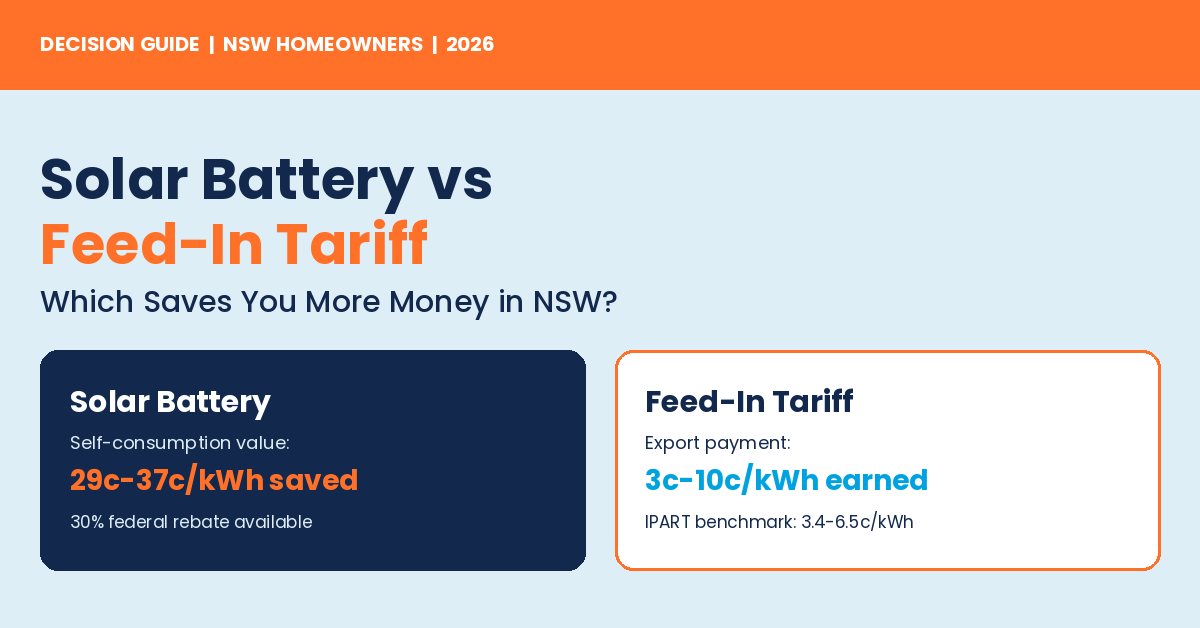
Every NSW solar owner eventually asks the same question. Should you export your surplus power for a feed-in tariff credit or store it in a battery for later use? In 2026, that question matters more than ever. Feed-in tariffs have been falling for years. At the same time, the federal Cheaper Home Batteries Program gives an upfront discount on eligible batteries, based on the battery’s usable size and the current STC rate. This guide explains the real numbers behind both options. It will help you decide which choice could save you more money on your NSW electricity bill.
What Is a Feed-In Tariff, and How Has It Changed in 2026?
A feed-in tariff (FiT) is the credit your electricity retailer pays for each kilowatt-hour of surplus solar energy you export to the grid. NSW removed its mandatory minimum FiT in 2016. Since then, retailers have set their own rates. Some now pay as little as zero.
The Independent Pricing and Regulatory Tribunal (IPART) publishes an annual benchmark that shows what a fair feed-in tariff looks like. For 2025–26, the benchmark ranges from 4.8c to 7.3c/kWh. From 1 July 2026, it is set to fall further to between 3.4c and 6.5c/kWh. In practice, some retailers already offer lower rates. EnergyAustralia has reduced its flat NSW feed-in tariff to 3c/kWh. AGL has removed feed-in tariffs for customers on standard retail contracts. Meanwhile, Alinta Energy and GloBird Energy still offer up to 10c/kWh on selected plans. Market-linked retailer Amber Electric can occasionally pay more than 25c/kWh during periods of peak demand.
That spread, from 0c to 10c on standard plans and far higher on volatile market plans, is exactly why a single ‘feed-in tariff’ figure means very little without checking your own retailer’s rate first.
How Much Is Your Solar Export Really Worth?
To compare fairly, it helps to see every pathway for your solar energy side by side: exporting on a standard plan, exporting on a premium plan, and self-consuming through a battery. The chart below lays out typical 2026 NSW figures for each.
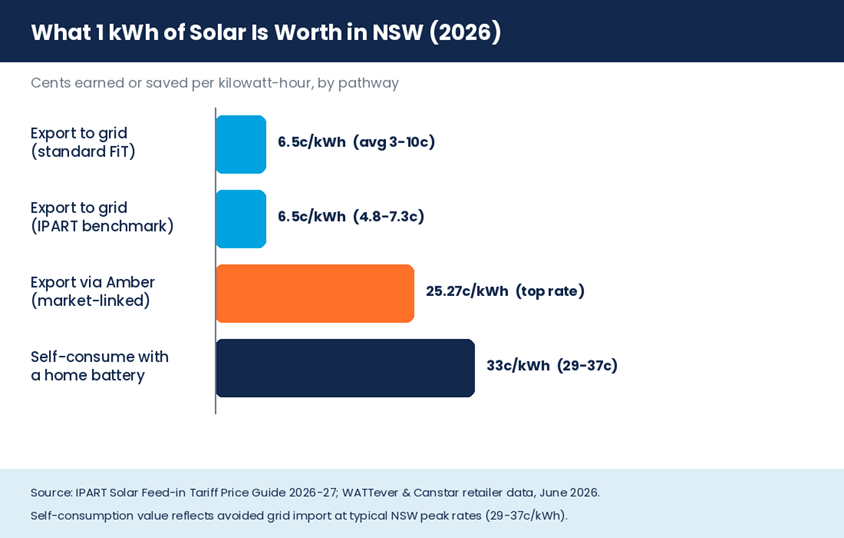
The pattern is consistent across almost every NSW retailer: exporting electricity earns far less than not buying it back later. NSW households typically pay 29c to 37c/kWh for grid electricity, depending on network and time of use. So every kilowatt-hour you store and use yourself is effectively worth three to ten times what the same kilowatt-hour earns as an export credit.
This is the core economic shift driving battery uptake. Solar batteries let you capture the gap between what retailers pay you for exports and what they charge you for imports. If your system is set up for backup, they can also power some of your home during an outage.
How a Solar Battery Changes the Maths
A home battery stores your excess daytime solar generation and discharges it in the evening, when grid electricity is most expensive and feed-in rates no longer apply. For a typical 10kWh battery, that can mean covering most of an average household’s evening and overnight usage without touching the grid.
Under the federal Cheaper Home Batteries Program, eligible batteries get an upfront discount based on usable size and the current STC rate. The first 14kWh of usable capacity gets the full rate. NSW households may also be able to add the NSW VPP incentive when they connect an eligible battery to an approved VPP of up to $1500. Your payback depends on your usage, tariff and system price — we’ll show you an estimate in your quote.
Real-World Example: Comparing Both Paths in Bankstown
Consider a typical home running a 6.6kW solar system in Bankstown, exporting around 12kWh of surplus solar daily. On a standard 6.5c/kWh feed-in tariff, that household earns roughly $0.78 a day, or about $285 a year, in export credits.
Example only: Now compare this to adding a 10kWh battery. Say the household stores about 9kWh a day (a 10kWh battery can’t hold 12kWh, and some energy is lost charging and discharging) and uses it in the evening instead of buying power at about 33c/kWh. It also gives up the 6.5c feed-in credit on that energy. The net saving is about 9 × (33c − 6.5c) ≈ $2.40 a day, or roughly $870 a year. Your own payback depends on your usage and quote. After that, they continue saving on every evening kilowatt-hour.
This is why, for most NSW homes with meaningful evening electricity use, pairing solar batteries with the right-sized system tends to outperform relying on feed-in tariffs alone, even where the headline rebate news focuses on the upfront battery rebate rather than the ongoing import savings.
Solar Battery vs Feed-In Tariff: A Decision Framework
There is no single right answer for every household. Use the framework below to work out which option fits your situation.
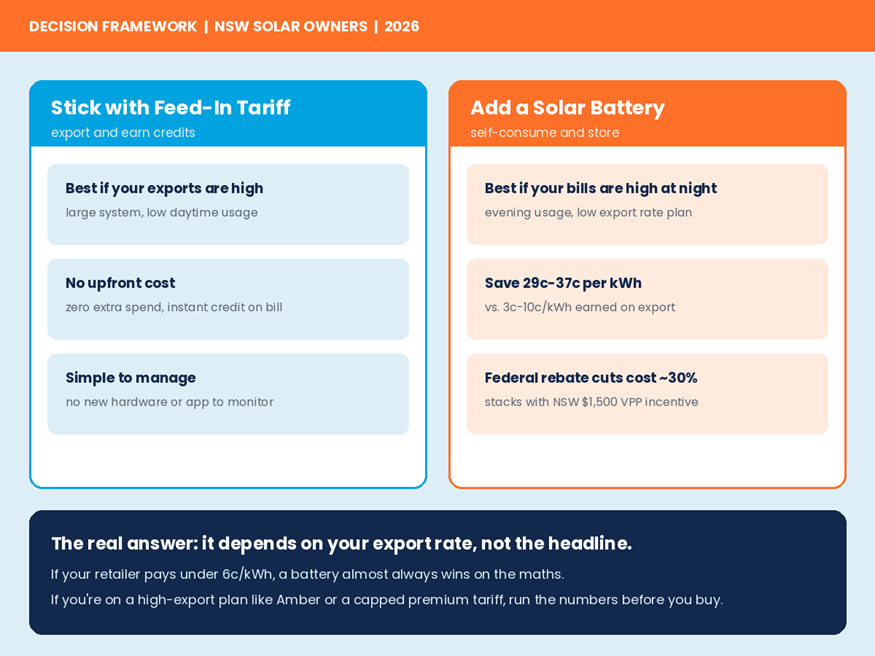
- Check your current feed-in rate first. If it is below the IPART benchmark of roughly 6c/kWh, storing your solar is usually worth more per kWh than exporting it. Whether the battery pays for itself depends on its price and your evening usage.
- Map your usage pattern. Households with high evening or overnight electricity use benefit most from storing solar rather than exporting it.
- Know how the rebate works. The federal rebate steps down every six months, so your quote will show the current amount. Choosing the right system matters more than rushing.
- Get quotes from an SAA-accredited installer. A good installer will model your own usage data rather than relying on generic averages.
If you are still unsure, request a tailored quote. A qualified solar battery specialist can model your actual export and consumption data, rather than relying on averages, to show your real payback period.
Frequently Asked Questions
If you are on a genuinely high, capped-rate plan, such as a premium retailer offer that pays 10c/kWh or more on the first block of exports, the gap becomes smaller. Even then, self-consumption usually delivers greater savings. That’s because evening electricity usage is still expensive. Import rates remain much higher than even the best premium export rates.
IPART’s own benchmark is scheduled to fall to 3.4-6.5c/kWh from 1 July 2026, and several major retailers have already cut rates or removed FiTs for standard contracts. The long-term trend points downward as more rooftop solar floods the grid at midday.
The rebate gives an upfront discount on the first 14kWh of usable capacity, based on the current STC rate (about $252 per usable kWh at $37 per STC). Larger systems receive a lower level of support. The exact rebate amount depends on your battery size and the STC rate at the time of installation. Check the latest figures with your installer before signing any agreement.
Yes. Some NSW retailers offer a Solar Sharer plan with three free hours around midday to eligible smart-meter households who opt in. A usage cap applies. A battery complements this by capturing any solar you generate beyond your midday usage and shifting it to cover the evening peak, when the free-hours window has ended.
Most three-to-four-person Bankstown households see strong results from a 10-13kWh battery paired with a 6.6-10kW solar system, though the right size depends on your evening usage pattern and existing system output.
Ready to Stop Guessing and Start Saving?
If you’re comparing a solar battery with your current feed-in tariff, Solar Battery Outlet can assess your export and electricity usage data. We’ll recommend the right-sized system for your home. We install solar batteries across NSW, including Bankstown and Sydney’s western suburbs, and we help homeowners check which rebates they are eligible for. This includes the federal Cheaper Home Batteries Program discount and the NSW VPP incentive. Request a free, no-obligation quote today. We’ll show you how much a solar battery could save compared to your current feed-in tariff.
Disclaimer
This article provides general information about NSW feed-in tariffs and solar battery incentives as of June 2026. It is not personal financial or energy advice. Feed-in tariff rates, rebate amounts, and STC factors change regularly. They also vary by retailer, network, and battery size. Always confirm the latest figures with your electricity retailer or an SAA-accredited installer before making a purchase decision. The savings examples in this article are for illustration only. Actual results depend on your electricity usage, system size, and location. Always seek personalised advice before making a purchasing decision.