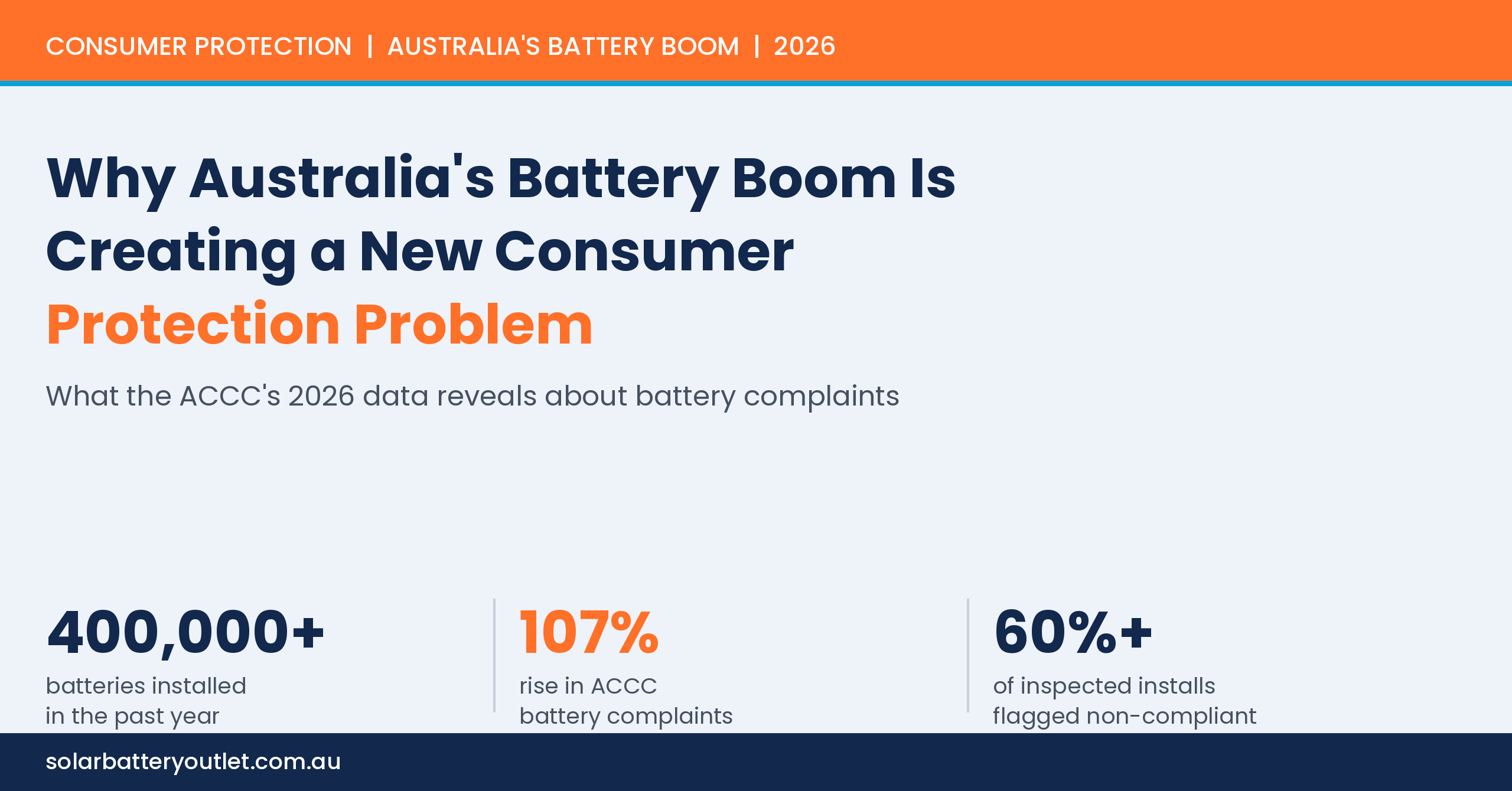
Australia’s home battery boom is reshaping the energy market. More than 400,000 batteries have gone into Australian homes in the past year alone. Government rebates, falling battery prices, and rising electricity bills are driving this surge. Growth this fast, however, has a downside. Consumer complaints are rising even faster than installations. The Australian Competition and Consumer Commission (ACCC) says current rules cannot keep up. This gap between rapid uptake and weak protections is becoming a real problem for everyday households.
Australia’s Battery Boom, By the Numbers
The battery boom shows no sign of slowing. Rebates such as the federal Cheaper Home Batteries Program have made storage more affordable than ever. As a result, uptake has surged across every state. Yet the ACCC’s latest Electricity Market Inquiry report reveals a troubling pattern.
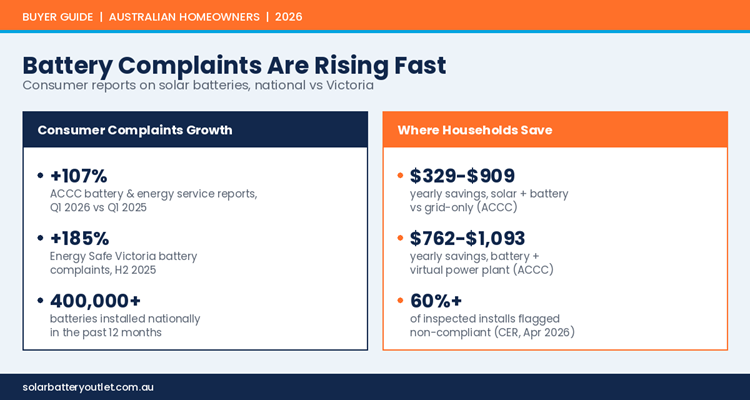
Consumer reports about batteries and new energy services jumped 107% in early 2026, compared to the same period in 2025. State regulators are seeing similar spikes. Energy Safe Victoria, for example, recorded a 185% rise in battery-related complaints in the second half of 2025. Meanwhile, Clean Energy Regulator inspections found more than 60% of checked installations were flagged as non-compliant in 2026. Most of these issues involved labelling and documentation, not faulty batteries themselves. Together, these numbers show an industry growing faster than its safety net.
What’s Going Wrong for Battery Buyers
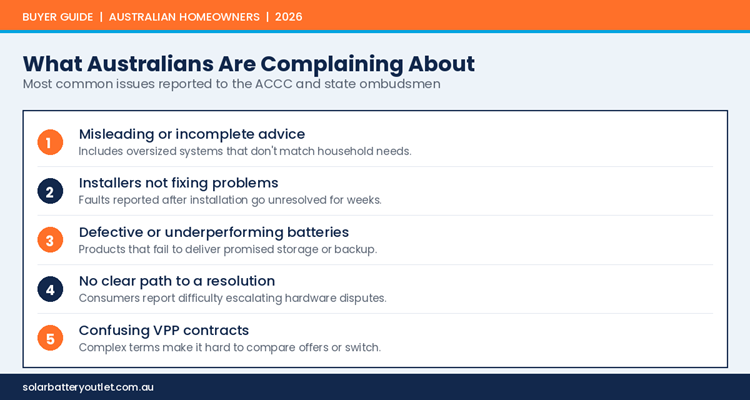
So, what exactly are Australians complaining about? According to the ACCC, the issues fall into a few clear patterns. Many households receive misleading or incomplete advice. This often results in oversized systems that cost more than necessary. Some installers also fail to fix problems once they arise.
Faulty or underperforming batteries frustrate buyers who expected reliable backup power. Most concerning, many consumers have no clear path to a resolution. The ACCC found there is no clear pathway for hardware disputes under current rules. Consequently, households can be left covering repair costs themselves. Comparing offers is difficult too, thanks to complex contracts and limited compatibility between products.
The Virtual Power Plant Trap
Virtual power plants (VPPs) can offer extra savings on top of a standalone battery. According to [add source], households connected to a VPP saved between $762 and $1,093 a year, compared to $329 to $909 for solar and battery alone. Results vary.
That said, VPPs carry real trade-offs. When a household joins a VPP, it hands control of its battery to an operator. In return, the operator draws on stored energy to support the wider grid. This arrangement can work well. However, the ACCC warns that customers carry most of the risk if the operator underperforms. Contracts can also be hard to understand before signing. It pays to read the fine print carefully before committing your battery to any VPP scheme.
Why Current Consumer Protections Fall Short
Right now, the main safeguard for battery buyers is the New Energy Tech Consumer Code (NETCC).
The Clean Energy Council administers this voluntary code, and more than 2,000 retailers across Australia have signed up as approved sellers. Even so, the ACCC says the code has real limits. There is no independent dispute resolution process built into it. Compliance also relies on self-reported audits rather than outside checks. On top of that, there is little transparency when a signatory breaches the code.
ACCC Commissioner Anna Brakey put it plainly: gaps in current protections are stopping consumers from comparing offers, switching providers, or fixing problems when things go wrong. You can read the full ACCC media release for the complete findings. In short, the code sets good standards, and the ACCC wants stronger enforcement to back them up.
What the ACCC Wants to Change
To close these gaps, the ACCC is pushing for reform. Its central recommendation is an overarching consumer duty for the electricity sector. This would require sellers and installers to put customer interests first, rather than just meeting minimum legal standards.
The regulator also wants battery sellers to sign a code of conduct before accessing government rebate schemes. It wants energy ombudsman schemes expanded too, to cover more battery and solar disputes. As Brakey noted, consumer protections need to keep pace as more Australians invest in batteries and virtual power plants. Until these changes take effect, buyers need to do more of their own due diligence.
Questions to Ask Any Solar Battery Company Before You Sign
Given these gaps, choosing the right solar battery company matters more than ever. Start by asking whether the business is a NETCC Approved Seller. This status shows a baseline commitment to consumer protection standards.
NETCC Council Chair Clare Petre has noted that a solar and battery system is often one of the biggest investments a household makes, which is why verifying a seller’s NETCC Approved Seller status is such a useful first step.
- Check the installer holds current Solar Accreditation Australia credentials.
- Ask for a written quote sized to your actual usage, not an oversized system.
- Request clear warranty terms, response times, and fault-handling processes.
- Compare at least two or three quotes before committing to any solar battery company.
A trustworthy provider will answer every one of these questions without hesitation.
Frequently Asked Questions
Complaints are rising because installations are surging under rebate programs. The ACCC recorded a 107% increase in reports in early 2026 alone.
No. The NETCC is voluntary. Only signatory retailers commit to its consumer protection standards.
VPPs can offer strong savings, but customers carry most of the performance risk. Read contract terms carefully before signing up.
Confirm NETCC approved-seller status, installer accreditation, warranty terms, and get multiple quotes.
The ACCC wants an overarching consumer duty and expanded ombudsman coverage for battery disputes.
Choose a Battery Provider That Puts You First
Australia’s battery boom brings real savings, but it also brings real risk. Complaints are rising faster than the rules meant to prevent them. Until reform catches up, ask every provider the questions above.
At Solar Battery Outlet, we size every system around your actual household usage, not a one-size-fits-all quote. We serve homeowners across Liverpool, Bankstown and Mudgee, with installations by SAA-accredited installers and clear warranty support. Get in touch today for an honest assessment before you commit to any battery purchase.
Disclaimer
This article is general information only and does not constitute financial, legal, or professional advice. Battery rebate programs, consumer codes, and regulatory figures referenced here reflect publicly available data as of August 2026 and may change. Always check current eligibility and terms with the relevant government body or provider before purchasing. Always seek personalised advice before making a purchasing decision.