If you live in NSW, the rules may now work in your favour. Many households have delayed solar or batteries because of upfront costs. In June 2026, the NSW Government launched the Home Energy Saver program. The headline offer is simple: an interest-free loan of up to $15,000. You can use it for solar panels, a home battery, or other eligible energy upgrades.
Here is the honest, no-hype version. This is a loan, not free money. You must repay every dollar you borrow. However, you pay no interest, so your savings come from avoiding interest charges rather than receiving a discount. This guide explains how the loan works and who qualifies. It also covers how the loan works with existing rebates. Finally, it shows how homeowners in Liverpool, Bankstown, and Mudgee can use the program
| The 30-second version Up to $15,000, interest-free, repayable over up to 10 years. Available now to owner-occupiers and landlords earning up to $210,000 combined taxable income. A separate discount of up to $4,000 for lower-income households opens later in 2026. Stacks with the federal battery rebate and the NSW VPP incentive — rebates apply first, then the loan covers what is left. |
What Exactly Is the NSW Home Energy Saver Program?
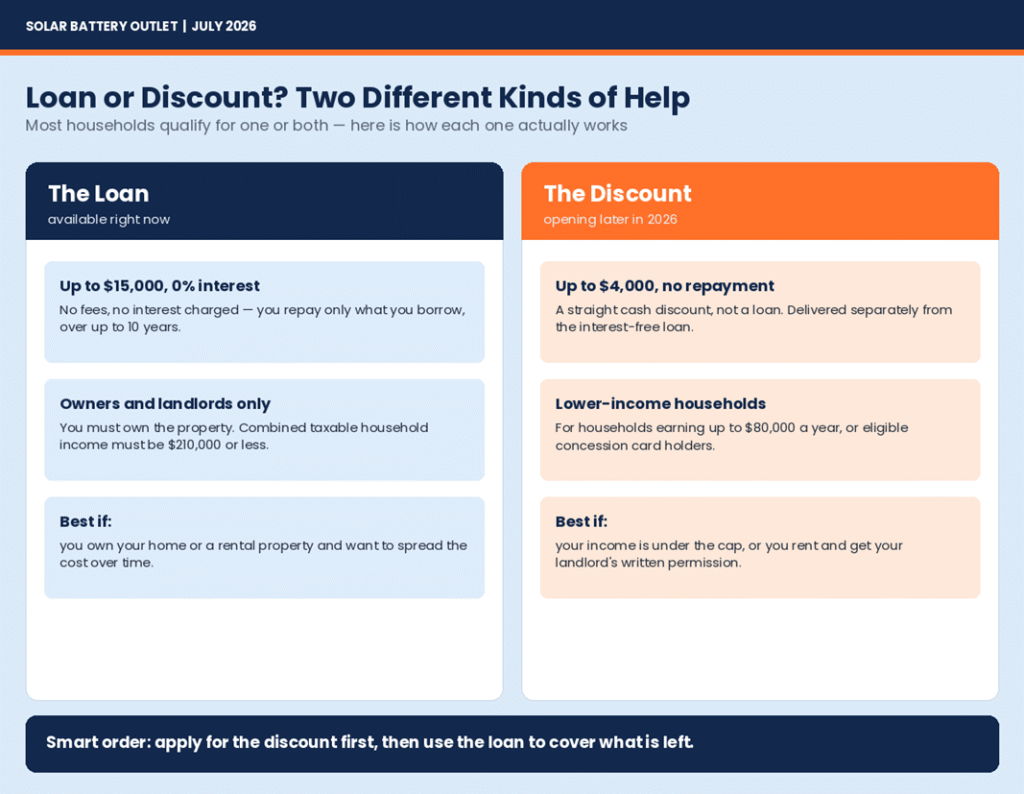
Home Energy Saver is a $557 million NSW Government initiative. It replaces and expands the older Empowering Homes scheme. The new program offers a higher loan cap and a much higher income threshold. It has two separate parts. You should understand the difference before applying for either one.
The loan component opened first on 17 June 2026, and two approved finance providers, Brighte and Plenti, currently offer it. The discount component, worth up to $4,000, targets lower-income households, and Creditex is expected to launch it later in 2026 through a separate provider.
The full list of eligible upgrades goes well beyond solar and batteries. It also covers switchboard upgrades, reverse-cycle air conditioning, insulation, ceiling fans, draft-proofing, and EV chargers. This flexibility matters if you plan more than one upgrade at once because you can bundle several upgrades into a single loan up to the $15,000 cap.
How the Loan Stacks With Rebates You Already Qualify For
This is the part most homeowners get wrong: the Home Energy Saver loan is not a replacement for the federal battery rebate or the NSW VPP incentive. It is designed to sit alongside them. The smart order is to apply every rebate and discount you are eligible for first, so those reduce the total system cost, and only then take out a loan to cover whatever balance is left.
Here is what that looks like in practice for a typical solar-and-battery installation.
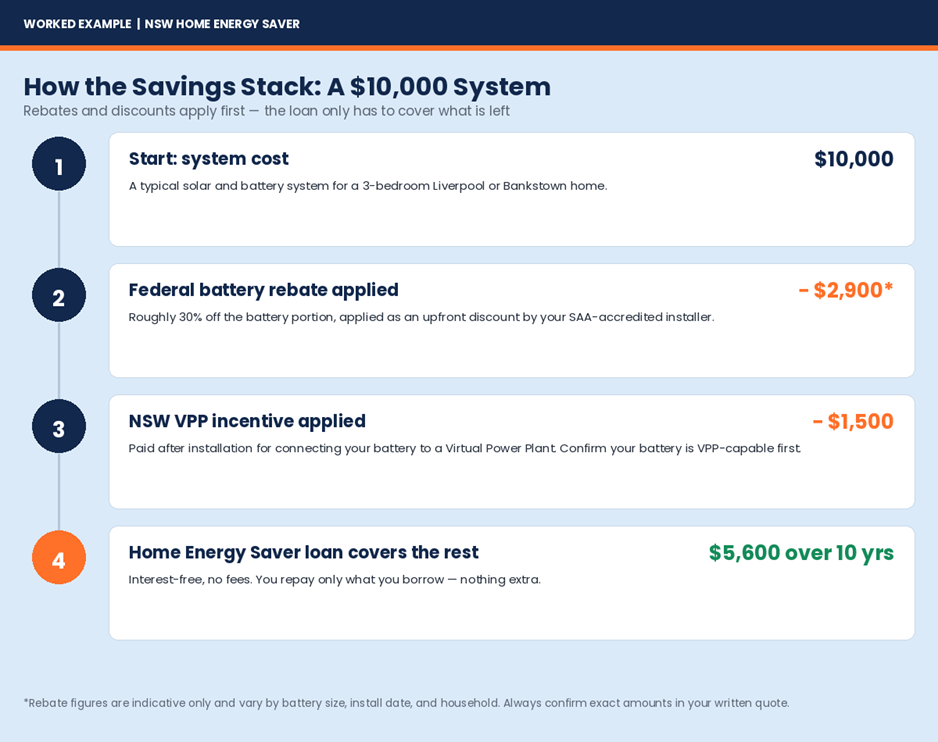
In this example, a household only needs to finance $5,600 rather than the full $10,000, and because the loan is interest-free, that is also the total amount repaid over the ten-year term. Compare that with a typical commercial loan at around 8% interest, where the same $15,000 borrowed over ten years would add close to $6,800 in interest on top of the amount repaid — a gap that makes the zero-interest structure the real value in this scheme (Lenergy, 2026, lenergy.com.au).
Who Actually Qualifies for the Loan?
Eligibility is checked by your finance provider, Brighte or Plenti, based on documents including your most recent Notice of Tax Assessment. In broad terms, you need to meet the following:
- Be an Australian citizen or permanent resident with a combined, annual, taxable household income of $210,000 or less.
- Own the property where the upgrade is being installed — this includes landlords installing on a rental property.
- Not have already received $15,000 in upgrades under a previous Home Energy Saver loan on that property.
- Not be applying for social or community housing, or a short-stay accommodation property.
Renters cannot apply for the loan directly, since it is tied to property ownership. Once the discount component opens later in 2026, renters will be able to apply for that instead, provided their landlord (and strata manager, where relevant) agrees to the upgrade in writing.
What the Numbers Say — and What the Experts Are Saying
More than half of NSW homes already have rooftop solar, according to the NSW Government. The state also adds around 13,000 new home batteries each month. This momentum helps explain the shift toward financing instead of another flat rebate. For households still waiting, upfront cost—not demand—has been the main barrier.
NSW Minister for Climate Change and Energy Penny Sharpe has framed the program as part of a broader shift toward household electrification, noting that upgrades like these help families “enjoy a cooler home in summer, a warmer home in winter, and smaller power bills every month”.
On the industry side, Smart Energy Council chief executive David McElrea has pointed out that a combined solar and battery system typically costs between $10,000 and $40,000, depending on system size and a household’s electrification needs, which is exactly the price range where a $15,000 interest-free loan makes the most practical difference (Zecar, 2026, zecar.com).
Whichever installer you compare quotes with, the underlying advice from most industry commentary lines up: apply every rebate first, only finance what is left, and choose a solar battery installation company that shows the rebate as a line-item deduction on a written quote, not a verbal promise.
How to Apply, Step by Step
- Check your eligibility against the official loan guidelines, or use the NSW Energy Savings Finder tool.
- Choose your upgrade — solar, battery, or both — and use the Energy Savings Calculator to estimate bill savings.
- Get a written quote from an SAA-accredited, program-approved installer.
- Pick a finance provider, Brighte or Plenti, and apply through your accredited installer.
- The loan funds go directly to your installer once the work is confirmed — you never handle the money yourself.
| Before you sign anything Confirm your installer is SAA-accredited — verify the number yourself at saaustralia.com.au. Ask to see the federal rebate and NSW VPP incentive applied as dollar deductions on the written quote. Compare at least three quotes before choosing a solar battery installation company — financing does not fix a bad system size or a rushed install. If you are weighing up brands, our guide to the Best Solar Batteries Australia homeowners are choosing in 2026 is a good place to start. |
Frequently Asked Questions
No. It is an interest-free loan, which means you repay the full amount you borrow, just without any interest charged over the term. The separate $4,000 discount, opening later in 2026, does not need to be repaid.
Yes. The loan is available across all of NSW, including Liverpool, Bankstown, and Mudgee. Eligibility depends on your household income and property ownership, not your suburb.
Yes. The federal Cheaper Home Batteries Program and the NSW VPP incentive should be applied first to reduce your system cost, and the Home Energy Saver loan can then cover the remaining balance.
Not for the loan itself, since it requires property ownership. Renters will be able to apply for the separate $4,000 discount once it opens later in 2026, with their landlord’s written permission.
Look for SAA accreditation, a written quote with rebates itemised, and an installer willing to check your electricity usage before recommending a battery size. Comparing solar battery Bankstown and Liverpool quotes side by side is the best way to spot a fair price.
| Ready to Find Out What You Qualify For? We help NSW homeowners across Liverpool, Bankstown and Mudgee understand which rebates, incentives and financing options may be available for their installation. We also assist with the installation paperwork, including applicable grid connection and system registration requirements. Call us: 1800 000 777 Or visit solarbatteryoutlet.com.au and complete the 60-second eligibility form — no pressure, just information tailored to your home. |
| About Solar Battery Outlet We are a Liverpool-based solar battery installer, part of GWM Group Pty Ltd, servicing homes across Liverpool, Bankstown and Mudgee. All installations are carried out by SAA-accredited electricians, and we handle all rebate and loan paperwork on your behalf. |
Disclaimer
This article provides general information only. It does not constitute financial, legal, or personal advice. The details of the NSW Home Energy Saver program, including eligibility criteria, loan terms, and discount availability, reflect published NSW Government information as of July 2026. These details may change without notice. The finance provider, either Brighte or Plenti, determines loan approval. Solar Battery Outlet does not make this decision. Approval depends on your individual financial circumstances. Always check current eligibility and terms on the official NSW Government Home Energy Saver page before applying, and always seek personalised advice before making a purchasing decision.