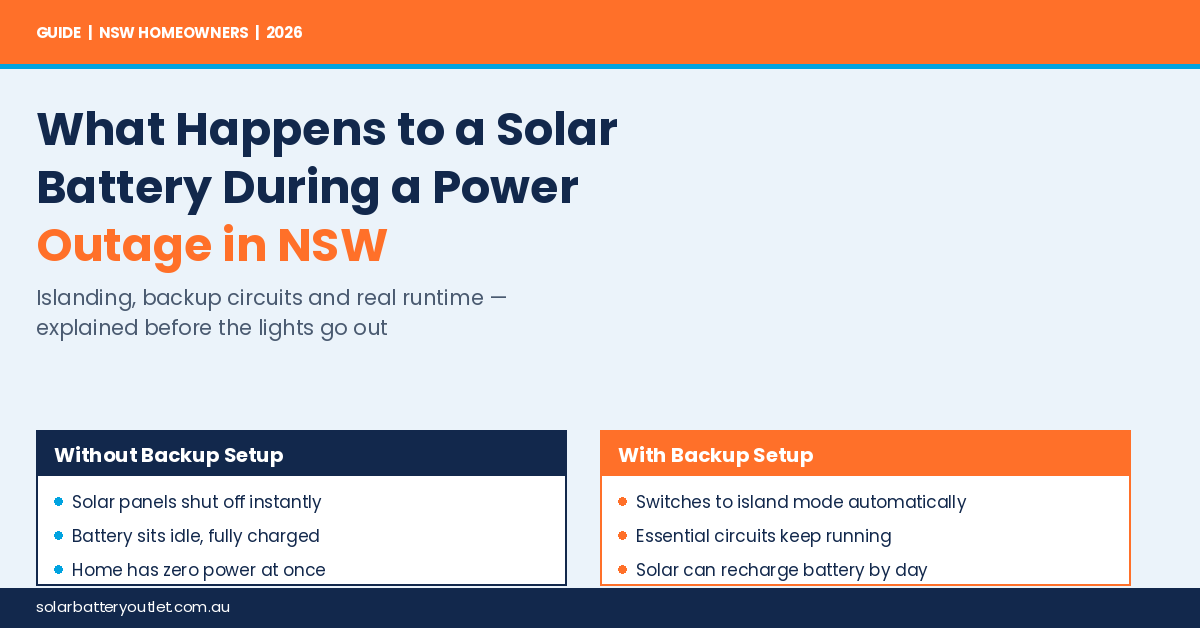
When the grid goes down across New South Wales, most homeowners assume their rooftop solar and battery will simply keep the lights on. In reality, that isn’t automatic. Every standard grid-connected solar system in Australia includes a safety feature called anti-islanding, and it switches your panels off the instant the grid fails, even if the sun is shining and your battery is sitting fully charged. Whether your home actually stays powered during a blackout depends entirely on how your solar batteries installation is configured. This guide walks through exactly what happens, second by second, when the power goes out, how long a typical battery can realistically keep your home running, and the framework our team uses with NSW customers to make sure their system is genuinely blackout-ready before the next storm season arrives.
Why Your Solar Panels Shut Off the Moment the Grid Fails
Under Australian Standard AS/NZS 4777, every grid-connected inverter must disconnect automatically the instant it detects the grid has failed. This rule exists to protect the linespeople who may be repairing damaged infrastructure nearby. If an inverter kept exporting electricity into a supposedly dead line, it could re-energise that line and put a repair crew at serious risk.
The Victorian Government’s official solar and battery backup guidance confirms that standard solar systems are designed to switch off during an outage unless the battery has specifically been configured for backup, sometimes called island mode. This is one of the most common points of confusion for homeowners: owning a battery does not automatically mean backup power. Two extra components are required — a hybrid or multi-mode inverter capable of islanding and a backup switchboard or gateway that physically isolates your home’s wiring from the grid. Backup capability is still frequently sold as an optional extra on solar batteries in NSW quotes, rather than included by default, so it pays to ask directly instead of assuming it’s covered.
Without both components, your panels and battery behave like a standard grid-tied system. They shut down together during an outage. Your home stays dark despite stored battery energy. Ausgrid confirms standard solar systems shut down automatically during outages. The inverter’s built-in safety system handles the shutdown.
How Islanding Mode Actually Takes Over
When a backup-capable system is installed correctly, the transition happens automatically, without any input from you. The inverter continuously monitors grid voltage and frequency, and the moment it detects an outage, a backup gateway isolates your home’s essential circuits from the broader network. Switchover speed varies by product: some gateways switch in a fraction of a second, fast enough that most fridges, routers and LED lights don’t even flicker, while others can take a few seconds, which may cause sensitive electronics like computers to briefly restart. It’s worth asking your installer what switchover time to expect for the specific hardware you’re quoted.
Your home briefly becomes a small, self-contained electrical network. It draws power from the battery instead of Ausgrid, Essential Energy, or Endeavour Energy. During daylight outages, rooftop panels can keep generating and recharge the battery while it remains islanded. This is one of a battery’s biggest advantages over a petrol generator. During overnight outages, the battery works alone until sunrise. Runtime depends on battery size and the number of connected circuits.
Essential Circuits vs Whole-Home Backup: What Actually Stays On
Not every appliance needs power during a blackout. Most NSW systems use one of two backup levels. Essential-circuit backup is the more affordable and common option. It powers the fridge, freezer, lighting, internet, and selected power points. Whole-home backup requires a larger battery and a more powerful inverter. It can run air conditioning, ovens, and hot water systems. However, it drains the battery much faster.
The chart below shows roughly how long four common battery sizes can support each tier during an overnight outage, assuming no solar recharge is available.
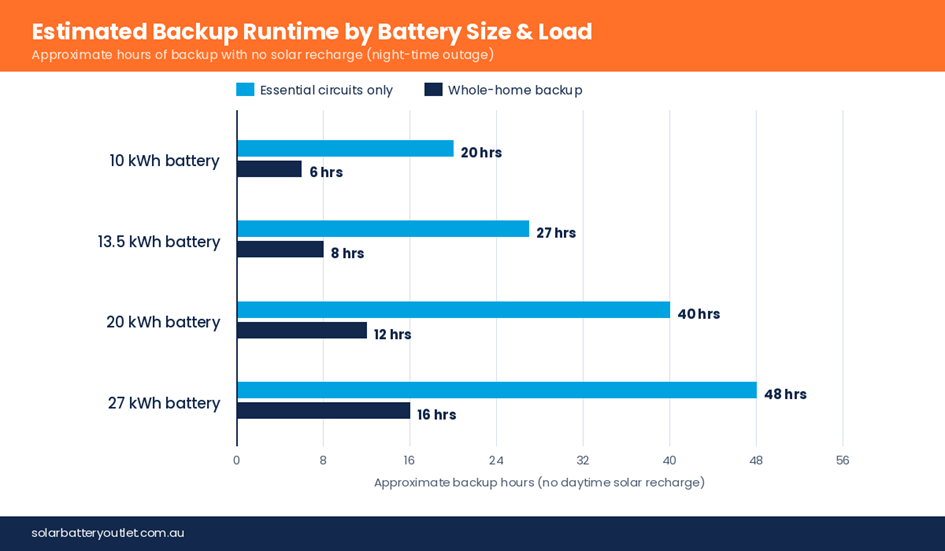
As the numbers show, if your essential circuits draw about 0.5kW, a 10kWh battery might run them for around 20 hours, but only about 6 hours of whole-home load. That gap becomes far more meaningful once you factor in how long NSW outages actually last, which is exactly why local outage data matters when planning a solar batteries installation around genuine backup, rather than best-case assumptions.
Real NSW Outage Data: How Long Blackouts Actually Last
Outage duration varies across NSW. Ausgrid’s Sydney network usually records some of the state’s shortest outages. However, metro suburbs can still experience multi-hour interruptions. Some Sydney areas average more than three hours per outage. Essential Energy serves larger and more exposed regional areas. Crews travel farther, and weather causes longer restoration times.
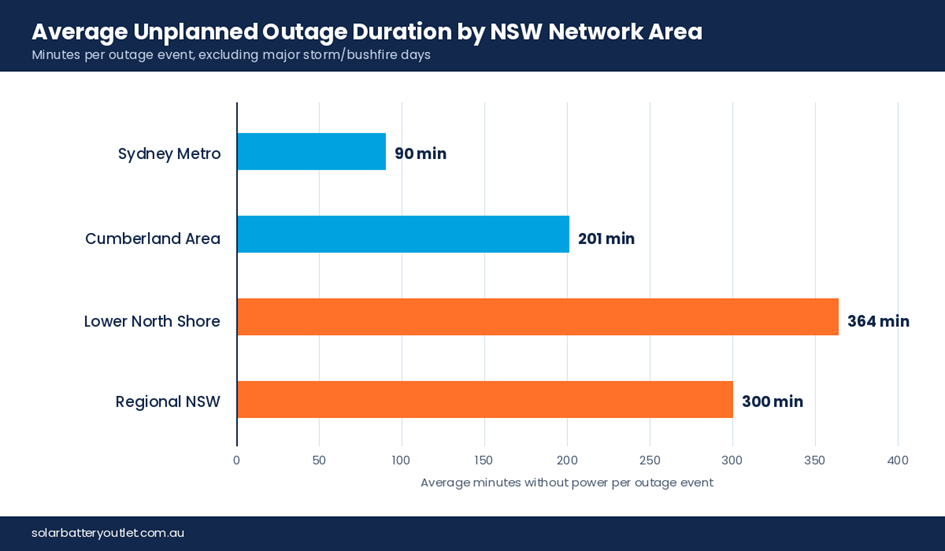
The takeaway is simple. A battery for a short outage is not the same as one for a major NSW blackout. Many NSW areas experience long outages regularly. This is common across Western Sydney, the Blue Mountains, the Hunter, and regional areas. Essential-circuit backup is usually the more practical choice. A mid-sized battery can support essential loads during longer outages.
A Worked Example: What This Looks Like in Practice
To make the numbers easier to understand, consider a hypothetical NSW example rather than a real customer case. Imagine a Bankstown home with a 13.5kWh battery and essential-circuit backup. A summer storm cuts grid power at 9 pm, and electricity returns just after 2 am. The outage lasts five hours. The battery keeps the fridge, freezer, lights, NBN modem, and home office power points running without interruption. These essential loads use relatively little power, so the battery still has useful capacity when the grid returns. If the household had chosen whole-home backup and run air conditioning during the outage, the battery would likely have drained well before sunrise.
A 4-Step Framework to Make Your Battery Blackout-Ready
Use this simple sequence with your installer before signing off on a battery quote or to check an existing system:
- Confirm the backup capability in writing. Ask whether the quoted inverter and battery support islanding and whether backup is included or sold separately.
- Choose your circuit tier deliberately. Decide, circuit by circuit, what genuinely needs to survive a blackout, such as the fridge, lighting, medical equipment and internet, rather than defaulting to whole-home backup you may not need yet.
- Size around realistic outage length for your postcode, not the best-case scenario. If you’re in a longer-outage area of NSW, size for multi-hour events rather than a brief 20-minute interruption.
- Test islanding mode at least once a year, ideally before storm season. A battery that has never been tested for backup can fail silently at the exact moment you need it most.
If you’re weighing up battery size against budget, it’s also worth factoring in how the federal rebate tiering affects larger systems. We’ve broken that timing decision down in our guide ‘Should I rush to get a solar battery before the rebate drops?’, which is worth reading before you lock in a battery size purely for backup reasons.
Our team at Solar Battery Outlet installs and configures backup-ready battery systems for homes across Liverpool, Bankstown and Mudgee and can walk you through exactly which circuits make sense to protect based on your household and your local outage history.
Frequently Asked Questions
Only if it’s specifically configured for backup. A standard battery without a compatible inverter and backup switchboard shuts down at the same moment as your solar panels because of the mandatory anti-islanding safety rule. A correctly configured backup-capable system switches to island mode automatically.
It depends on battery size, the circuits you’re backing up, and whether solar can recharge it during daylight hours. As a rough guide, a 10kWh battery can typically support essential circuits like the fridge, lights and internet for around 20 hours overnight, but only a fraction of that running whole-home loads such as air conditioning.
No, not unless your system has backup hardware installed. Anti-islanding rules mean the panels shut down with the grid regardless of battery charge, unless a backup gateway has isolated your home into its own self-contained circuit.
In most cases, yes. Many existing solar systems can be retrofitted with a compatible battery, inverter and backup switchboard, though compatibility depends on your existing inverter brand and switchboard setup, so it’s worth confirming with a licensed installer before assuming it’s plug-and-play.
No. A VPP is about your battery exporting stored energy to the grid to earn credits or support the network at peak times, while backup power is about your battery isolating from the grid to keep your home running during an outage. A well-configured system can do both, but they are separate functions.
Disclaimer
This article is general information only and does not constitute personal financial, electrical or engineering advice. Backup runtime figures are estimates based on typical battery specifications and average NSW outage data; actual performance depends on your specific battery, inverter, household energy use and installation configuration. Always confirm backup capability, circuit configuration and expected runtime with a licensed, SAA-accredited installer before purchasing. Always seek personalised advice before making a purchasing decision.