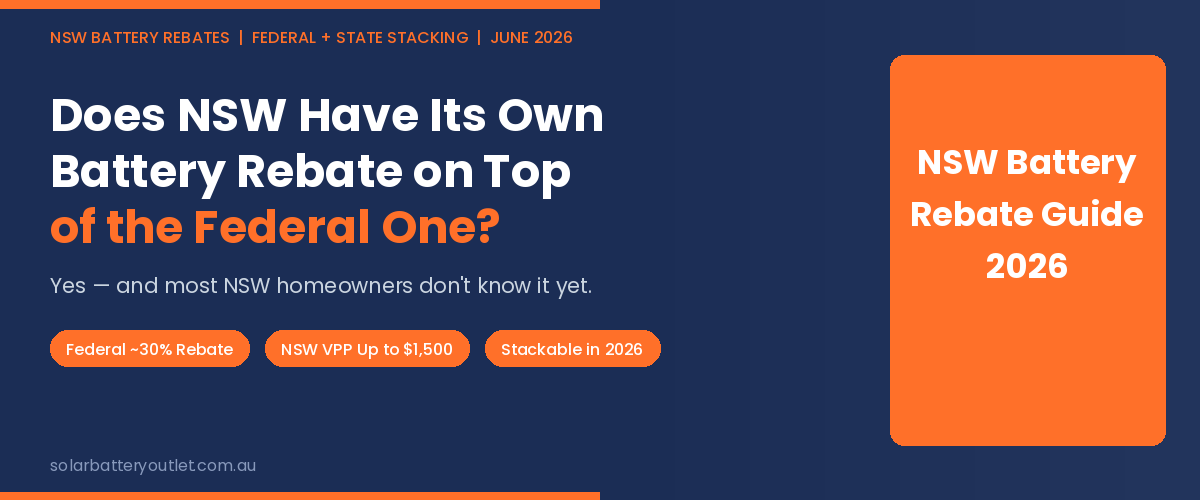
Short answer: yes. NSW homeowners can access both the federal Cheaper Home Batteries Program and at least one NSW-specific incentive—and in many cases, two. What surprises most people is that these incentives stack. You do not have to choose between them.
However, the two programs work differently, come from different government departments, and have separate eligibility conditions. If you simply ask your installer about ‘the rebate,’ you may only hear about the federal one. This guide explains both, shows you how to stack them, and gives you the numbers you need to make an informed decision.
| Quick Summary: In 2026, eligible NSW homeowners may be able to combine the federal Cheaper Home Batteries Program discount with the NSW VPP incentive. Eligible households can also apply for the NSW Home Energy Saver interest-free loan, which is repaid over time. Some lower-income households may qualify for additional support. Eligibility criteria and program conditions apply to each incentive. |
What Is the Federal Cheaper Home Batteries Program (CHBP)?
The federal Cheaper Home Batteries Program launched on 1 July 2025. It applies nationwide and is delivered through the existing Small-Scale Renewable Energy Scheme (SRES)—the same mechanism that has been funding rooftop solar rebates in Australia for over a decade.
Rather than paying you cash, the program creates Small-scale Technology Certificates (STCs) based on your battery’s usable capacity. Your accredited installer claims these certificates on your behalf and deducts the value from your upfront quote. No paperwork. No waiting. The rebate is already factored into the price you see.
From 1 May 2026, the rebate uses a tiered structure:
- First 14 kWh of usable capacity: full STC factor (6.8 STCs per kWh — about $252 per kWh at $37 per STC)
- 14 kWh to 28 kWh: STC factor reduced to 60% of the rate
- 28 kWh to 50 kWh: STC factor reduced to 15% of the rate
For a 10 kWh usable battery, the rebate is about $2,500–$2,700 under the May–December 2026 rate. For a 13.5 kWh usable battery like the Tesla Powerwall 3, it is about $3,400–$3,670, depending on the STC price. These figures are based on the STC factor and market price — your installer will confirm the exact amount at the time of installation.
The rebate steps down every six months (next on 1 January 2027), so your quote will show the current amount. The program runs until the end of 2030. Choosing the right system matters more than rushing..
Does NSW Have Its Own Battery Rebate on Top of the Federal One?
Yes — but the structure changed significantly in 2025 and 2026. The previous standalone NSW battery rebate (which operated independently of the federal scheme) wound back to avoid overlap once the Cheaper Home Batteries Program launched. Today, NSW support works mainly through the VPP incentive and the Home Energy Saver program, alongside the federal rebate.
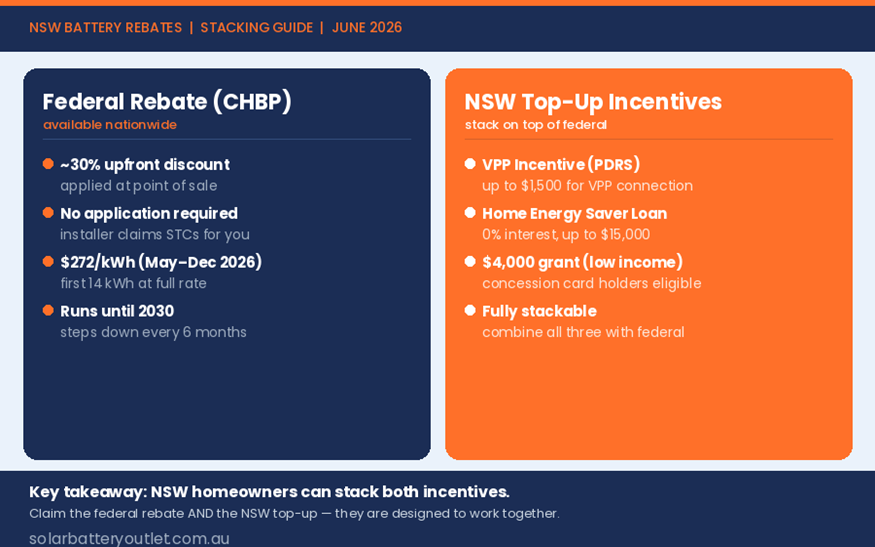
In 2026, NSW homeowners have access to three state-level incentives that stack on top of the federal rebate:
1. NSW VPP Incentive — Peak Demand Reduction Scheme (PDRS)
The NSW Peak Demand Reduction Scheme pays you for connecting your battery to a Virtual Power Plant (VPP). Your battery stays in your home. A VPP is simply a software connection that allows an approved operator to draw a small amount of stored energy during peak demand periods — typically hot summer afternoons when the grid is under pressure.
In return, you receive Peak Reduction Certificates (PRCs). Eligible households who connect an approved battery to an approved Virtual Power Plant (VPP) may receive a one-off incentive under the NSW Peak Demand Reduction Scheme. Incentive amounts vary depending on battery size and other eligibility factors, and are typically applied through your installer or VPP provider..
- Available to eligible NSW households who connect an approved, VPP-capable battery to an approved VPP.
- Stackable directly on top of the federal CHBP rebate.
- Run under the NSW Peak Demand Reduction Scheme (IPART is the scheme regulator)
2. NSW Home Energy Saver Loan — Launched June 2026
On 17 June 2026, the NSW Government launched the $557 million Home Energy Saver program. The program provides financial support for eligible households undertaking approved energy-saving upgrades. The Home Energy Saver interest-free loan offers eligible homeowners and landlords’ access to up to $15,000 for approved upgrades, including batteries, solar, heat pumps, EV chargers and other eligible technologies. Loans are available to households with a combined income of up to $210,000 and can be repaid over up to 10 years.
- 0% interest on eligible loans
- Up to $15,000 for approved energy-saving upgrades, including solar batteries
- Available to eligible households with a combined income of up to $210,000 per year
- Repayable over up to 10 years
- May be used alongside other available incentives, subject to eligibility requirements
Separate Home Energy Saver discounts of up to $4,000 are available for eligible concession card holders and households with a combined income of up to $80,000, subject to program eligibility criteria.
3. Targeted $4,000 Grant for Low-Income Households
Alongside the loan, the Home Energy Saver program includes a targeted grant of up to $4,000 for households with an income under $80,000 per year, or those holding a valid concession card. This grant does not need to be repaid and stacks on top of both the federal rebate and the interest-free loan.
For eligible lower-income households, the federal rebate, the VPP incentive and this extra support can greatly reduce the cost of a 10 kWh battery. Your quote will show the exact amount you pay..
How the NSW + Federal Stack Works in Practice
Here is how the three layers combine for a typical NSW homeowner installing a 10 kWh battery in the second half of 2026. These numbers are illustrative—your actual savings depend on your STC zone, battery size, install date, and eligibility.
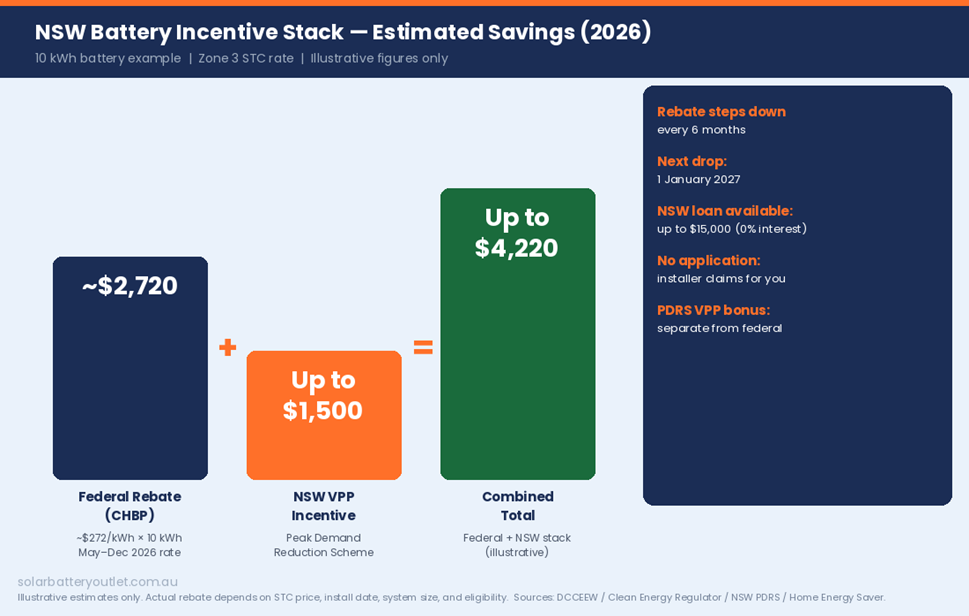
As the chart shows, the federal CHBP alone provides an estimated ~$2,720 in savings for a 10 kWh battery. Stack the NSW VPP incentive on top and the combined savings reach up to $4,220. For households eligible for the targeted grant, savings climb further still.
The key point is that these incentives come from different funding pools. Claiming the federal rebate does not exclude you from the NSW incentives. Your accredited installer handles the CHBP at the point of sale. The VPP incentive is arranged through your VPP operator (which your installer can recommend). The Home Energy Saver Loan is applied for separately through the NSW Government portal.
Who Is Eligible for the NSW Battery Incentives in 2026?
Eligibility for the federal CHBP is straightforward: install a CEC-approved battery (5 kWh to 100 kWh) through an SAA-accredited installer. There is no income test and no application form.
The NSW incentives have additional conditions:
| Incentive | Eligibility | Max Value |
| Federal CHBP | All Australians, no income test, 5–100 kWh battery | ~$2,720 (10 kWh, May–Dec 2026) |
| NSW VPP / PDRS | NSW homeowners with VPP-capable battery, Ausgrid or Endeavour area | Up to $1,500 |
| Home Energy Saver Loan | NSW residents, income <$210,000/yr | Up to $15,000 (0% interest) |
| Targeted Grant | NSW residents, income <$80,000/yr or concession card | Up to $4,000 |
Solar Battery Liverpool and Western Sydney: What Local Homeowners Need to Know
For homeowners in Liverpool, Bankstown, Mudgee, and the broader Western Sydney region, the incentive stack is particularly relevant. Many homes in this area already have rooftop solar— and battery attachment rates are rising rapidly as households look to capture more of the energy they already generate.
Bankstown is in the Ausgrid network area and Liverpool is in the Endeavour Energy network area. Your installer can confirm VPP incentive eligibility for your address. Mudgee falls within the Essential Energy network. VPP eligibility is subject to network operator conditions—your installer can confirm whether your specific address qualifies.
If you are researching solar battery Liverpool options, the key questions to ask any installer are (1) which batteries on their quote are CEC-approved and VPP-capable, (2) which VPP operators they work with, and (3) whether they can register the PDRS incentive on your behalf. A quality installer handles all three as a standard part of the installation process.
The federal rebate applies regardless of your location in NSW. The tiered structure that came into effect on 1 May 2026 means the best rebate-per-dollar value sits in the 10 to 14 kWh range — which also happens to suit most three- and four-bedroom homes in Western Sydney.
Ready to See What Your Stack Looks Like?
Every home is different. The right battery size, the right VPP operator, and the right combination of incentives depend on your electricity usage, your solar system, and your income. The numbers in this article are illustrative — but they give you a realistic picture of what is possible.
Solar Battery Outlet serves NSW homeowners across Liverpool, Bankstown, Mudgee, and the surrounding region. We use CEC-approved batteries and SAA-accredited installers, and we handle the federal rebate paperwork. We can also help you with the VPP connection.
Get a written quote that shows all applicable incentives—contact Solar Battery Outlet today and we will walk you through the full incentive stack for your home.
Frequently Asked Questions
Yes. The federal CHBP applies to battery-only installations — you do not need to install new solar panels. The NSW VPP incentive also applies to standalone battery installations. If your existing solar system is less than 10 years old and generating well, adding a battery is straightforward.
No. They are separate programs. The federal Cheaper Home Batteries Program provides an upfront point-of-sale discount through the STC mechanism. The NSW incentives (VPP incentive and Home Energy Saver Loan) are state-funded and have different eligibility rules. You can claim all of them at the same time.
Yes. The Cheaper Home Batteries Program applies in every Australian postcode including all of NSW. There is no location restriction. The rate is based on the battery’s usable capacity and the STC price, so it works the same way across Australia.
A battery qualifies for the federal rebate if it is on the approved product list, is VPP-capable, and is installed by an SAA-accredited installer. Popular options in NSW include the Tesla Powerwall 3 (13.5 kWh), Sungrow SBR series, BYD Battery-Box, and GoodWe Lynx Home. For the NSW VPP incentive, the battery also needs to be VPP-capable — most modern units are. Your installer can confirm eligibility for your specific model.
Yes. The STC factor steps down every six months under the revised program rules that took effect on 1 May 2026. The next reduction is 1 January 2027. The rebate steps down every six months (next on 1 January 2027), so your quote will show the current amount. The program runs until the end of 2030. Choosing the right system matters more than rushing.
Disclaimer—Please note all figures, rebate amounts, savings estimates, and eligibility details in this article are illustrative only and are not a guarantee of outcomes. Actual results vary based on your location, battery size, usage, tariff, and eligibility. Incentive rates change every six months. Please seek personalised advice before making a purchasing decision.