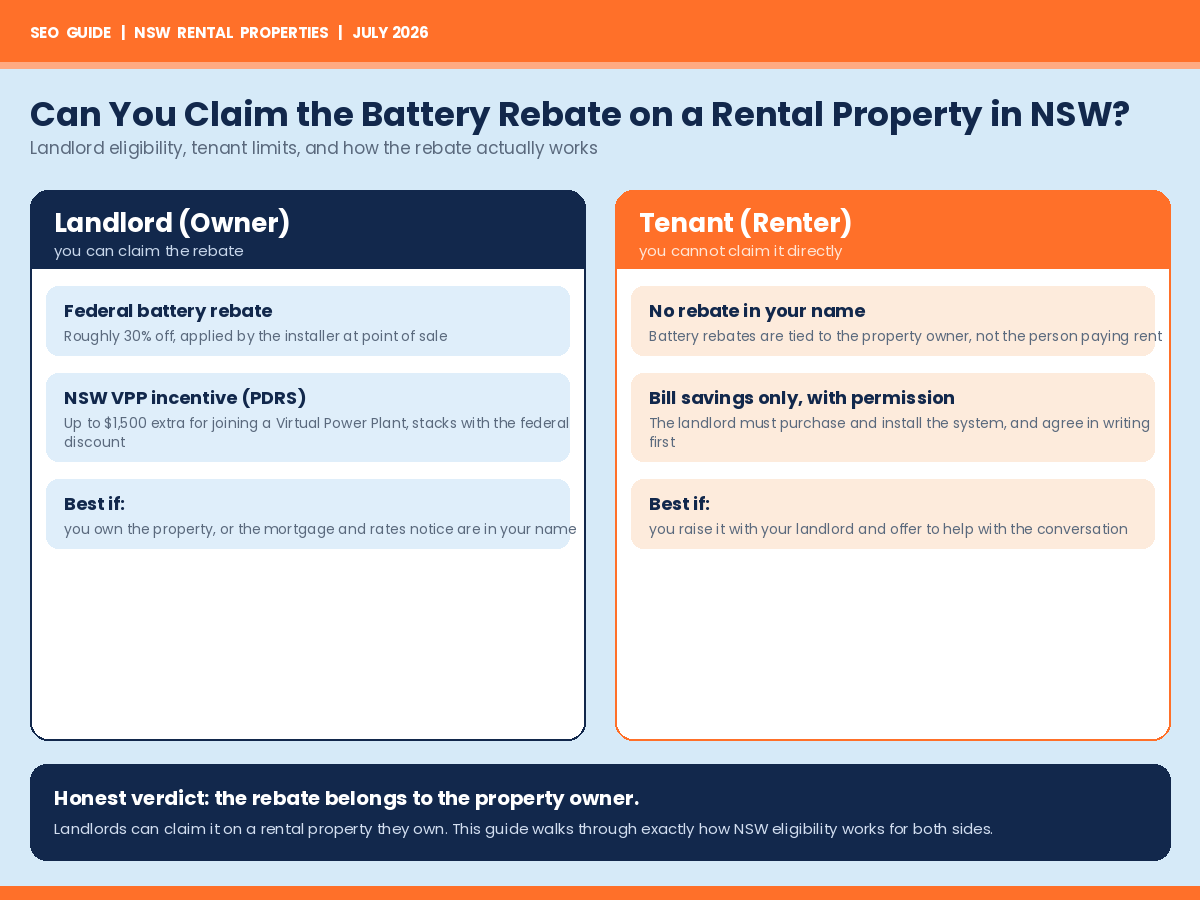
If you own a rental property in NSW, you are probably wondering whether the battery rebate on a rental property in NSW is even worth chasing, or whether it only applies to owner-occupiers. The short answer is that the rebate belongs to whoever owns and pays for the battery, not to whoever pays the electricity bill. That means landlords are eligible. Tenants, on their own, are not.
This guide walks through exactly who can claim, what it is worth on a typical rental in 2026, and how to avoid the mistakes that get landlord applications knocked back.
Quick Answer: Who Actually Owns the Rebate
Yes, landlords can claim the solar battery installation rebate on a rental property they own in NSW. Eligibility for both the federal Cheaper Home Batteries Program and NSW’s own incentives is tied to property ownership and to whoever purchases the system, not to who lives there or pays the power bill. A tenant cannot apply for the rebate in their own name, even if they are the one covering the electricity account.
There is a practical nuance worth flagging early. Renters can sometimes access the savings indirectly, but only with the landlord’s written agreement, because the landlord is the one signing the contract with the installer and the one whose name goes on the compliance paperwork.
The Federal Cheaper Home Batteries Program on a Rental Property
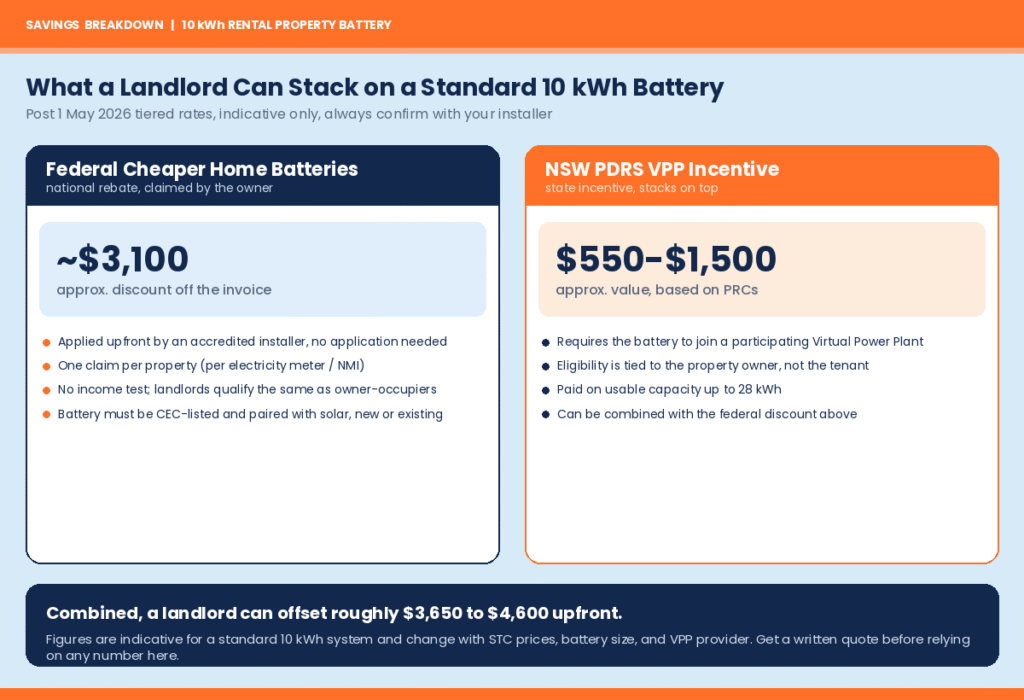
The national scheme, run through the Small-scale Renewable Energy Scheme, gives an upfront discount based on the battery’s usable size and the current STC rate. There is no income test, and landlords qualify on exactly the same terms as a homeowner living in the property. Investors with several rental properties can even claim once per address, provided each property has its own electricity meter, or NMI.
A few conditions apply specifically to rental situations:
- The person who purchases the system, generally the landlord, is the one who benefits from the discount, since the invoice and compliance certificate are issued in their name.
- The battery must be new, listed on the Clean Energy Council’s approved product list, and installed by an installer accredited by Solar Accreditation Australia.
- Grid-connected systems must be capable of joining a Virtual Power Plant, though actually joining one is optional for the federal rebate.
- From 1 May 2026, the rebate is tiered: the full rate applies to the first 14 kWh of usable capacity, a reduced rate to the next 14 kWh, and a much smaller rate above that, up to a 50 kWh cap.
On a standard 10 to 13 kWh system, most rental properties still sit comfortably in the full-rate tier, so the reduction from May mostly affects larger commercial-style installs rather than typical suburban homes.
NSW State Incentives: PDRS VPP Incentive and the Home Energy Saver Program
On top of the federal discount, NSW runs the Peak Demand Reduction Scheme, which pays a one-off incentive worth roughly $550 to $1,500 for connecting an eligible battery to a Virtual Power Plant. As with the federal rebate, eligibility sits with the property owner. If a tenant wants their landlord’s battery connected to a VPP, the landlord still needs to be the one signing the VPP agreement.
NSW also launched the Home Energy Saver Program on 17 June 2026, offering zero-interest loans of up to $15,000 for eligible upgrades, including batteries. Importantly, this loan is open to landlords as well as owner-occupiers, which is unusual compared to some earlier state schemes that excluded investment properties entirely. A separate discount for lower-income households is expected to open later in 2026, and renters will be able to access that discount stream only with written landlord permission.
Can a Renter Claim Anything Themselves?
Not directly. Every current NSW and federal program requires the applicant to be the property owner or the person who purchased the system. A renter cannot lodge a claim in their own name, even for a battery they are paying to run.
Emerging policy has made battery ownership more interesting. Advocacy groups want renters and apartment residents to install plug-in balcony batteries without landlord approval. They support reforms similar to those already underway in parts of Europe. NSW has not finalized this framework yet. Renters should discuss battery installation with their landlord instead of applying independently.
Why It Is Worth Raising With Your Landlord Anyway
More than 30% of Australian households currently rent, according to analysis referenced in recent reporting on solar standards for rentals, and that share keeps growing. Yet very few rental properties carry solar or battery storage, largely because of what economists call the split incentive: the landlord pays the upfront cost, while the tenant captures the ongoing bill savings.
Uptake nationally is still accelerating despite that gap. As of early June 2026, the federal government reported more than 420,000 Cheaper Home Batteries installed, representing over 12 gigawatt-hours of usable storage capacity, according to independent coverage of the official announcement. Landlords who act now are still installing well ahead of the curve compared to the broader rental market.
Finn Peacock, a Chartered Electrical Engineer and founder of SolarQuotes.com.au, has pointed out that tenants are often willing to pay more rent for a solar-equipped property, citing research commissioned by Origin Energy in which roughly two-thirds of renters said they would pay at least $5 more a week for a home with solar, and over half said they would pay $10 or more. Actual market data cited in the same piece put the real average premium at around $19 a week for solar-equipped rentals.
Solar advocacy group Solar Citizens has separately described renters as one of the groups missing out most on rooftop solar and storage savings, and has called for a national target for solar uptake across rental housing. For a landlord, the combination of federal and state incentives, a rental premium tenants appear willing to pay, and a stronger sale price down the track makes the split incentive far less of a barrier than it used to be.
Step-by-Step: How a NSW Landlord Claims the Rebate
- Confirm ownership documents. You will need a recent rates notice or title document showing you as the registered owner of the rental property.
- Get at least two quotes from solar battery companies that use SAA-accredited installers, including one in your local area, whether that is Liverpool, Parramatta, or regional NSW.
- Confirm the battery model appears on the SAA approved products list before signing anything.
- Ask your installer to apply the federal Small-scale Technology Certificate discount directly off the invoice, so you never have to claim it separately.
- Ask whether the system will be VPP-capable, and separately, whether you want to opt into a VPP for the additional NSW PDRS payment.
- Keep the electrical compliance certificate on file. This is the document that confirms the system was installed and triggers the rebate.
- If your tenant is covering electricity costs, consider a short written note confirming who benefits from any bill savings, to avoid disputes later.
Common Mistakes That Get Rental Claims Rejected
A handful of avoidable errors account for most rejected or delayed rental property claims:
- Applying with a tenant’s name on any part of the paperwork instead of the owner’s.
- Using a second-hand or relocated battery, which is not eligible under the federal program.
- Skipping the SAA approved products list check, only to find out after installation that the specific model is not eligible.
- Assuming the rebate applies automatically. It only applies once an accredited installer completes the paperwork and issues a compliance certificate.
- Not checking whether the property already has a NMI-linked rebate claim from a previous owner or installation at that address.
Choosing the Right Installer for a Rental Property
Because the rebate, the VPP agreement, and the compliance certificate all run through your installer, the choice of solar battery installation company matters more on a rental than on an owner-occupied home. Look for SAA-accredited installers, a track record with investment properties specifically, and clear documentation you can hand to your property manager. Independent comparisons of the best solar batteries in Australia is a useful starting point before you request quotes, since battery choice affects both your rebate tier and your long-term running costs.
Frequently Asked Questions
Yes. Landlords are eligible for the same federal and state battery incentives as owner-occupiers, provided they purchase and install the system and meet the standard eligibility criteria.
No. Every current program requires that the applicant be the property owner or the purchaser of the system. A tenant would need the landlord’s agreement and involvement to access any rebate.
The owners’ corporation or strata manager generally claims shared battery systems in apartment buildings, not an individual tenant or unit owner acting alone.
Federal battery discount only: around $2,500 (10 kWh × 6.8 STCs × approximately $37 per STC). With the NSW Peak Demand Reduction Scheme incentive (if you join an eligible VPP): additional incentives may be available, subject to current scheme rules and eligibility requirements. Based on an assumed STC value of approximately $37. STC values can change over time, and your quote will show the actual discount available to your installation.
There is no guaranteed rent increase, but research cited by industry sources suggests many tenants are willing to pay a premium for a solar and battery-equipped rental, and the improvement can lift the property’s resale value over time.
Ready to Check Your Rental Property’s Eligibility?
Solar Battery Outlet works with landlords across NSW to confirm eligibility, compare SAA-approved battery options, and handle the paperwork for both the federal rebate and the NSW PDRS incentive. Get in touch for a free, no-obligation quote and find out exactly what your rental property qualifies for.
Disclaimer
This article provides general information about NSW and federal battery rebate eligibility as at the date of publication and is not personal financial, legal, or tax advice. Rebate values, eligibility rules, and program funding change regularly and may differ by installer, battery size, and VPP provider. Landlords and tenants should confirm current eligibility and figures directly with Solar Battery Outlet or an accredited installer before making a purchasing decision.