
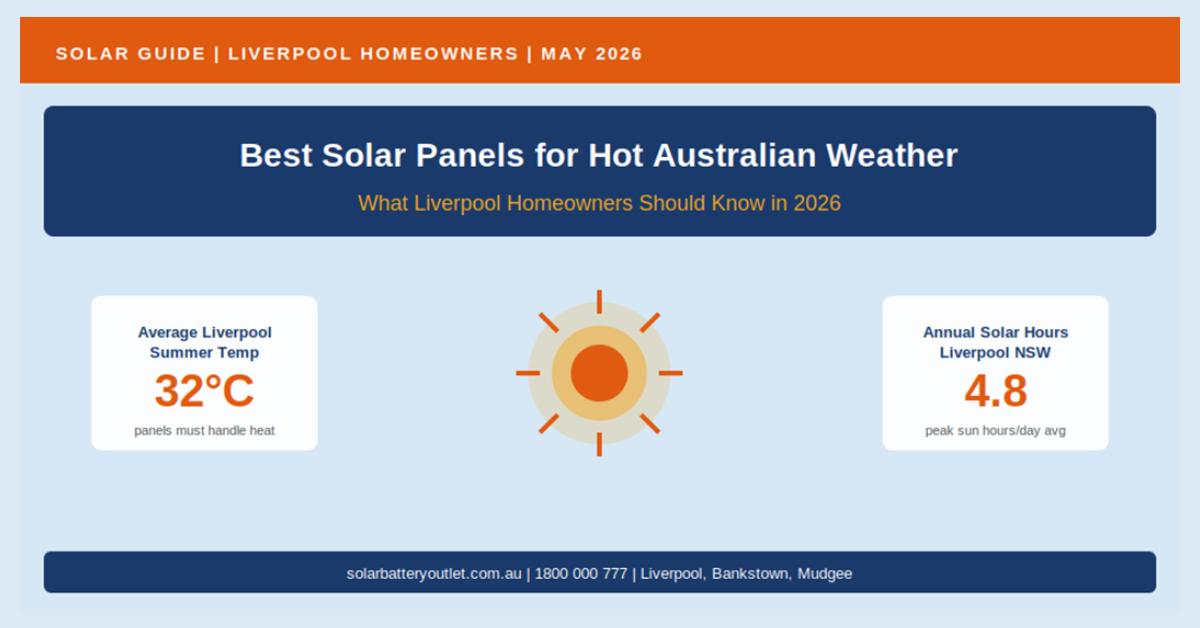
If you have ever noticed your electricity bill barely budges during a 38-degree January day, even with solar panels on your roof, there is a straightforward explanation: heat hurts solar panel output. In Liverpool and across South West Sydney, summer temperatures regularly push past 35°C, and roof surface temperatures can reach 50°C or higher. That matters a great deal when you are comparing panels.
The solar industry has a term for this: the temperature coefficient. It is the single most important specification for anyone buying solar panels in hot Australian climates, and it is a number worth checking on every quote. This guide explains what it means, which panel types handle heat best, and what Liverpool homeowners specifically need to know before signing any contract.
Why Heat Is the Enemy of Solar Output
Solar panels are rated under Standard Test Conditions (STC), which assume a cell temperature of 25°C and solar irradiance of 1,000 W/m². These laboratory conditions differ from real-world operating conditions. During hot weather, solar panel cell temperatures can rise well above 25°C, which may reduce power output depending on the panel’s temperature coefficient. Panels with a lower temperature coefficient generally experience less performance loss as temperatures increase.
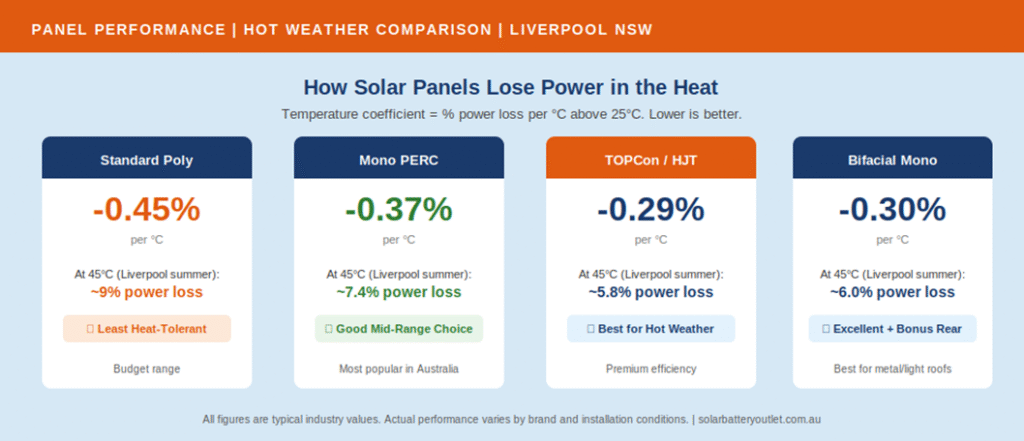
Every degree above 25°C causes a panel to lose a percentage of its rated output. That percentage is the temperature coefficient, expressed as %/°C. A panel rated at -0.45%/°C loses 0.45% of its capacity for every degree above 25°C. At a cell temperature of 45°C — a very ordinary Liverpool summer afternoon — that panel is already running at roughly 9% below its rated output before clouds, shading, or soiling even enter the picture. For a 6.6kW system, 9% represents around 594 watts of continuous lost capacity. Over a full Australian summer, that adds up to hundreds of kilowatt hours of lost generation — and lost savings on your electricity bill.
What Temperature Coefficient Should You Look For?
For hot Australian climates, look for a temperature coefficient of -0.35%/°C or better. Many modern TOPCon and HJT panels achieve approximately -0.29%/°C to -0.32%/°C, while some older panel technologies have higher temperature-related performance losses.
The industry benchmark has shifted significantly in recent years. Many older polycrystalline solar panels carried temperature coefficients of around -0.45%/°C or higher. Monocrystalline PERC panels commonly achieve temperature coefficients of approximately -0.35%/°C to -0.40%/°C. Newer technologies such as TOPCon and HJT (heterojunction) typically achieve temperature coefficients in the range of approximately -0.29%/°C to -0.32%/°C, helping to reduce performance losses in higher operating temperatures.
That difference may look small on paper. It is not small on your roof in February.
| Quick Rule: What to Look For on the Spec Sheet When comparing solar panels, review the manufacturer’s published temperature coefficient. In warmer Australian climates, panels with a lower (better) temperature coefficient generally experience less performance loss as operating temperatures increase. Many modern TOPCon and HJT panels have published temperature coefficients in the range of approximately -0.29%/°C to -0.32%/°C, while some older panel technologies may have higher temperature-related performance losses. Actual system performance will depend on factors including panel specifications, installation conditions and weather. |
Here is how temperature coefficient can affect real-world performance in hot conditions. Solar panel output generally decreases as cell temperature rises above standard test conditions, and panels with a lower (better) temperature coefficient will typically experience less performance loss during hot weather.
TOPCon and HJT panels commonly achieve temperature coefficients in the range of approximately -0.29%/°C to -0.32%/°C, compared with around -0.45%/°C for many older polycrystalline panels. Actual energy production and bill savings will depend on system design, installation conditions, weather patterns and electricity usage. Your installer can provide generation estimates for your specific site.
Over a 25-year system life, that gap compounds significantly.
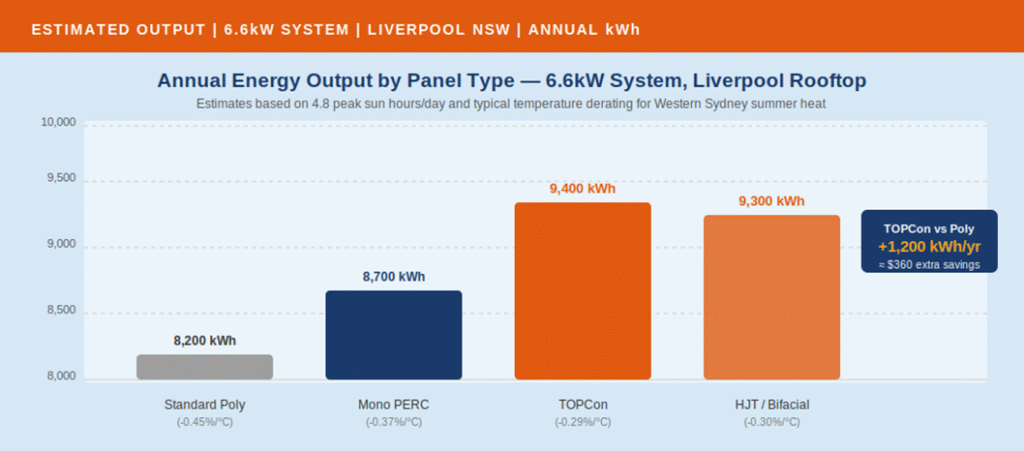
The example above is illustrative only. Actual generation and savings will vary depending on panel specifications, roof orientation, shading, weather conditions and electricity tariffs.
Solar Panel Types That Work Best in Australian Heat
Not all solar panel technologies handle heat the same way. Here is what you need to know about each category available to Liverpool homeowners in 2026.
Monocrystalline PERC — The Proven Standard
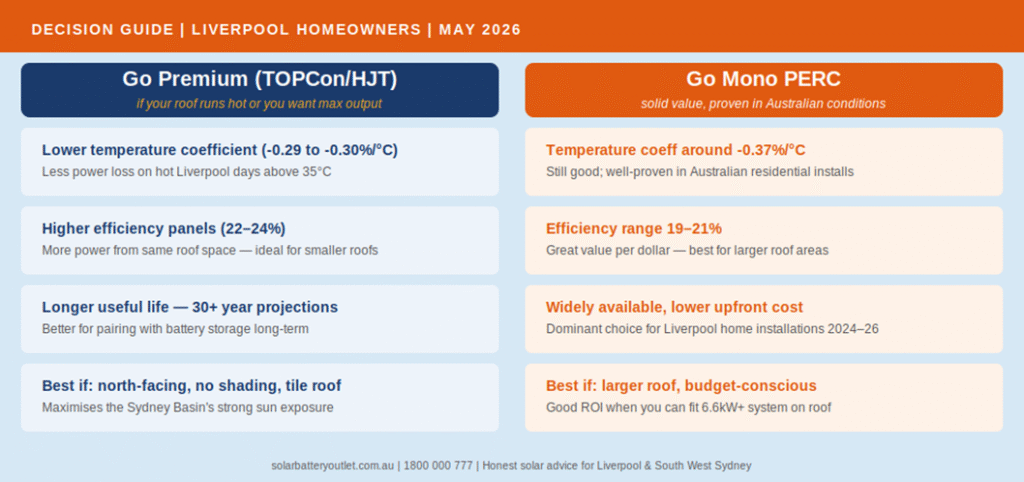
Mono PERC remains the dominant technology on Australian rooftops and for good reason. It offers a solid balance of efficiency (19–21%), heat performance (-0.37%/°C), and cost. For Liverpool homeowners with a standard north-facing roof and adequate space, a quality Mono PERC system from a tier-one brand is a reliable, well-supported choice. Brands like REC, Jinko Solar (Tiger Pro range), Longi, and Canadian Solar all manufacture reputable Mono PERC panels with strong Australian market presence and local warranty support.
TOPCon — The Heat Champion
Tunnel Oxide Passivated Contact (TOPCon) technology has become the premium choice for hot-climate performance. With coefficients around -0.29% to -0.32%/°C and efficiencies reaching 22–24%, these panels are purpose-built for the conditions Liverpool homeowners deal with every summer. They maintain output better when the roof heats up, degrade less over time, and carry superior low-light performance as well. If your roof is on the smaller side or you want to maximise output from limited space, TOPCon panels are worth the premium — typically 10–15% more upfront over Mono PERC.
Key brands in Australia: Jinko Neo (N-Type TOPCon), Longi Hi-MO 6, REC Alpha Pure-R, and Trina Solar Vertex N.
HJT (Heterojunction) — Premium Hot-Weather Performance
Heterojunction panels combine a crystalline silicon wafer with thin-film amorphous silicon layers, producing some of the lowest temperature coefficients available — around -0.26% to -0.30%/°C. HJT panels also carry the lowest degradation rates in the industry, typically 0.25% per year versus 0.45–0.55% for standard mono panels. They are more expensive than TOPCon, but for Liverpool homeowners who plan to pair their system with a battery and want maximum long-term output, HJT deserves serious consideration.
Bifacial Panels — Worth It on Certain Roofs
Bifacial panels generate power from both sides — the front captures direct sunlight while the rear harvests reflected light. In Liverpool, bifacial panels perform best on Colorbond steel rooftops in lighter colours (white, cream, pale grey), where reflectivity is high. On dark tile roofs, the rear-side gain is minimal and the bifacial premium is harder to justify. Temperature coefficients for bifacial monocrystalline panels are similar to standard mono (-0.30%/°C), so the heat advantage comes from the rear-generation bonus rather than from intrinsic temperature resistance.
What Liverpool Homeowners Specifically Need to Know
Liverpool sits in the Western Sydney Basin — one of the hottest urban environments in Australia. Unlike coastal Sydney suburbs that benefit from sea breezes, Western Sydney locations such as Liverpool typically experience higher summer temperatures than coastal parts of Sydney. Local weather conditions can affect solar panel operating temperatures and system performance. This is not a hypothetical concern: Penrith has recorded temperatures above 47°C during extreme heat events, highlighting the importance of considering panel performance in hot weather.
Four practical considerations matter specifically for Liverpool and South West Sydney installations.
1. Roof Material and Colour
Concrete tile roofs — by far the most common in Liverpool’s residential suburbs — absorb more heat than Colorbond steel. A dark concrete tile can reach 70°C+ on a hot day. That heat conducts to the underside of panels and drives cell temperatures well above ambient air temperature. This makes the temperature coefficient argument even stronger for Liverpool than for a coastal suburb. If you have dark roof tiles, prioritise panels with the lowest temperature coefficient you can justify within your budget.
2. Racking and Airflow
Standard pitched racking leaves a 30–50mm gap between the panel and the roof surface. That gap allows some airflow but not much. Higher-profile racking with a 100mm+ gap significantly reduces cell operating temperatures and can recover 2–5% of output on hot days. Not all installers offer this — ask specifically. The performance gain on a Liverpool summer is measurable.
3. Inverter Placement
Your inverter should never be installed in direct sunlight, in a non-ventilated roof space, or on a west-facing wall that receives afternoon sun. In Liverpool’s heat, inverter operating temperature directly affects conversion efficiency and longevity. A shaded, ventilated garage wall or south-facing external wall will extend your inverter’s life and maintain its output quality throughout summer.
4. System Sizing for Daytime Use
Liverpool households that work from home, have retirees, or run air conditioning heavily during the day should size their system to meet that daytime peak demand directly — not just to export. A larger system (8.8kW–13.3kW) using high-efficiency panels covers air conditioning load directly from solar, avoiding expensive grid draw during peak periods. Pair that with a battery for evening usage, and you have a genuinely high-performing energy setup for the Liverpool climate.
| Liverpool Fact Worth Knowing Liverpool receives approximately 4.8 peak sun hours per day, making it a suitable location for rooftop solar generation — higher than Melbourne (3.9) and comparable to Queensland coastal areas. The challenge is not the quantity of sunlight; it is managing the heat that comes with it. The right panel technology extracts significantly more value from those sun hours, even as temperatures climb. |
How to Read a Solar Quote in Liverpool — What to Actually Check
Most solar quotes you receive will include a specification sheet for the panel being proposed. Here is what to check before you sign anything.
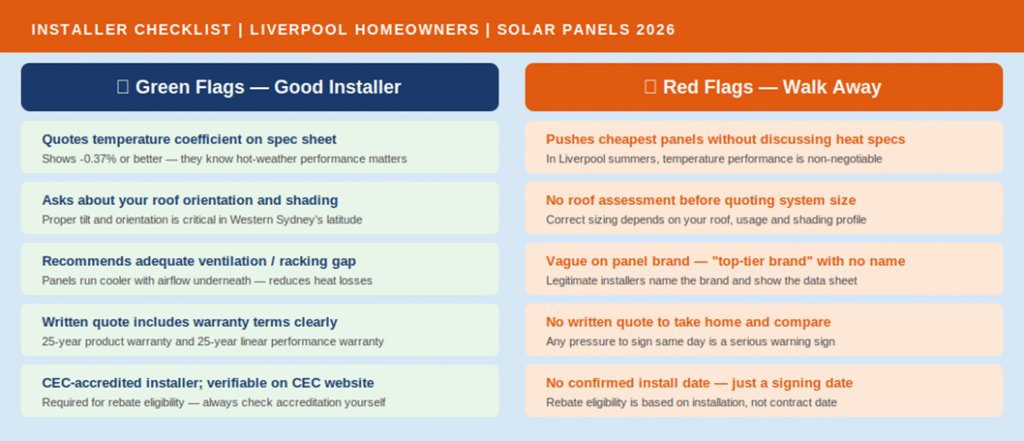
- Temperature coefficient — listed as Pmax temp coefficient on the spec sheet. Look for -0.37%/°C or better. If it is not on the quote, ask for it.
- Product warranty — check the length (many brands offer 12–25 years) and compare it across your quotes.
- Linear performance warranty — should guarantee at least 80–82% output at year 25. Avoid any panel that only guarantees 75–78%.
- Panel efficiency — listed as conversion or module efficiency. Above 20% is good; above 22% is premium for 2026.
- CEC approval — panels must appear on the Clean Energy Council approved products list for rebate eligibility.
- Installer SAA accreditation — your installer must be SAA-accredited.
- Written installation date — not just a contract signing date. Rebates are triggered by the installation date, not when you sign.
Should You Pair Solar Panels with a Battery in Liverpool?
Liverpool’s electricity usage patterns make battery storage a strong complement to solar for many households. The typical Liverpool household uses significant power in the evenings — air conditioning after sunset, cooking, TV, devices charging — and this is exactly the window that solar panels cannot cover without storage.
Pairing a battery with solar panels may help eligible households increase their use of solar energy generated on-site. A battery can store excess solar generation during the day and discharge it during the evening when household electricity demand is often higher. Combined with high-efficiency solar panel technologies such as TOPCon or HJT, a battery system may help households make greater use of their solar generation throughout the year. Actual bill savings will depend on factors including electricity usage, tariff structure, solar generation, battery performance and installation costs. Your installer should provide estimates based on your household’s circumstances.
The federal Cheaper Home Batteries Program provides an upfront discount on eligible battery installations, subject to program rules and eligibility requirements. Eligible households who connect an approved battery to an approved Virtual Power Plant (VPP) may also be able to receive a separate incentive under the NSW Peak Demand Reduction Scheme. The incentive amount depends on the battery, the VPP provider and current scheme rules, and should be confirmed in your quote. Eligible households may be able to receive both incentives, subject to program eligibility requirements and conditions.
| Solar Panels + Battery: The Liverpool Case A solar battery can store excess solar energy generated during the day for use later when solar generation is lower. For households with existing or new solar installations, battery storage may increase the amount of solar energy used on-site rather than exported to the grid. Actual energy usage, bill savings and battery performance will depend on factors including household electricity consumption, tariff structure, solar generation, battery capacity and installation costs. Your installer should provide estimates based on your household’s circumstances. |
Frequently Asked Questions
Does shade matter as much as heat for Liverpool panels?
Both matter, but they work differently. Shade causes immediate, severe output drops — even partial shading of one panel can affect the whole string in older string-inverter systems. Heat causes a steady, predictable reduction across the entire array. Modern micro-inverters and DC optimisers mitigate the shading problem panel by panel. The temperature coefficient issue affects every panel regardless of inverter type, which is why choosing the right panel technology is important for every Liverpool installation.
Are Chinese-brand panels acceptable for Australian heat conditions?
Yes, provided you choose from tier-one manufacturers. Longi, Jinko Solar, Trina Solar, and Canadian Solar all manufacture panels with genuinely strong temperature performance and carry full Australian warranty support infrastructure. The country of manufacture matters far less than the quality tier, temperature coefficient specification, and the integrity of the local warranty support. All of the brands above have Australian operations and CEC-listed products.
How long do solar panels last in Australia’s UV environment?
Quality tier-one panels in Australian conditions typically maintain above 80% of their rated output at year 25. UV degradation is factored into linear performance warranties. Panels with lower degradation rates — notably HJT panels at around 0.25% per year — retain more output across the system life. In Liverpool specifically, choosing a panel with a strong linear performance warranty matters more than upfront efficiency rating alone.
Can I add more panels to an existing solar system?
Yes, in most cases, but there are important compatibility considerations. Your existing inverter must have capacity headroom for additional panels, and any added panels should match or exceed the temperature coefficient of your existing ones to avoid a mixed-performance array. Solar Battery Outlet offers solar system assessments and can advise on whether your existing setup supports an upgrade.
Is it better to install now or wait for cheaper panels?
Panel prices have fallen substantially over the past decade and the rate of further decline has slowed considerably. Panel prices have fallen a lot over the past decade, and the rate of decline has slowed. The better question is: have you compared at least three written quotes, chosen the right technology for your roof and usage, and confirmed the installation date in writing? Install when you’re ready.
| Not Sure Which Solar Panels Are Right for Your Liverpool Roof? We do free, no-obligation assessments for Liverpool, Bankstown, and Mudgee homeowners. We will look at your roof, your usage, and your budget—and tell you honestly which panel technology makes sense for your home and Liverpool’s summer heat. No pressure. No countdown timer. Just the numbers. ☎ Call us: 1800 000 777 Or visit solarbatteryoutlet.com.au — fill in the 60-second eligibility form, and we will be in touch. |
| About Solar Battery Outlet We are a Liverpool-based solar panel and battery installer, part of GWM Group Pty Ltd, servicing homes across Bankstown and Mudgee. All installations are performed by SAA-accredited electricians. We handle all rebate paperwork, so you do not have to. |
Data Sources
| # | Source | Article / Page Title | Website | Data Used From This Source |
|---|---|---|---|---|
| 1 | Bureau of Meteorology (BOM) | Climate Data Online – Sydney & Western Sydney Weather Stations | bom.gov.au | Historical temperature records and extreme heat events for Western Sydney |
| 2 | Bureau of Meteorology (BOM) | Australian Climate Averages | bom.gov.au | Long-term climate conditions relevant to Liverpool NSW |
| 3 | PV Education | Temperature Effects on Solar Cell Performance | pveducation.org | Explanation of temperature coefficients and solar panel performance |
| 4 | NREL (National Renewable Energy Laboratory) | Photovoltaic Performance Resources | nrel.gov | Solar panel performance and temperature-loss concepts |
| 5 | Jinko Solar | Tiger Neo TOPCon Technical Datasheet | jinkosolar.com | TOPCon temperature coefficient specifications and product data |
| 6 | LONGi Solar | Hi-MO Series Technical Datasheets | longi.com | Monocrystalline panel specifications and temperature coefficients |
| 7 | REC Solar | Alpha Pure Series Datasheet | recgroup.com | HJT/TOPCon performance and warranty information |
| 8 | Clean Energy Council (CEC) | Approved PV Modules List | cleanenergycouncil.org.au | Verification of approved solar panel products |
| 9 | Solar Choice | Solar Panel Efficiency & Temperature Coefficient Guide | solarchoice.net.au | Industry comparison of panel technologies and temperature coefficients |
| 10 | SolarQuotes | Solar Panel Temperature Coefficient Explained | solarquotes.com.au | Consumer explanation of heat-related solar panel performance |
Disclaimer: Data used in this article is sourced from publicly available weather data, approved solar panel technical specifications, industry performance resources and government information current at the time of publication.