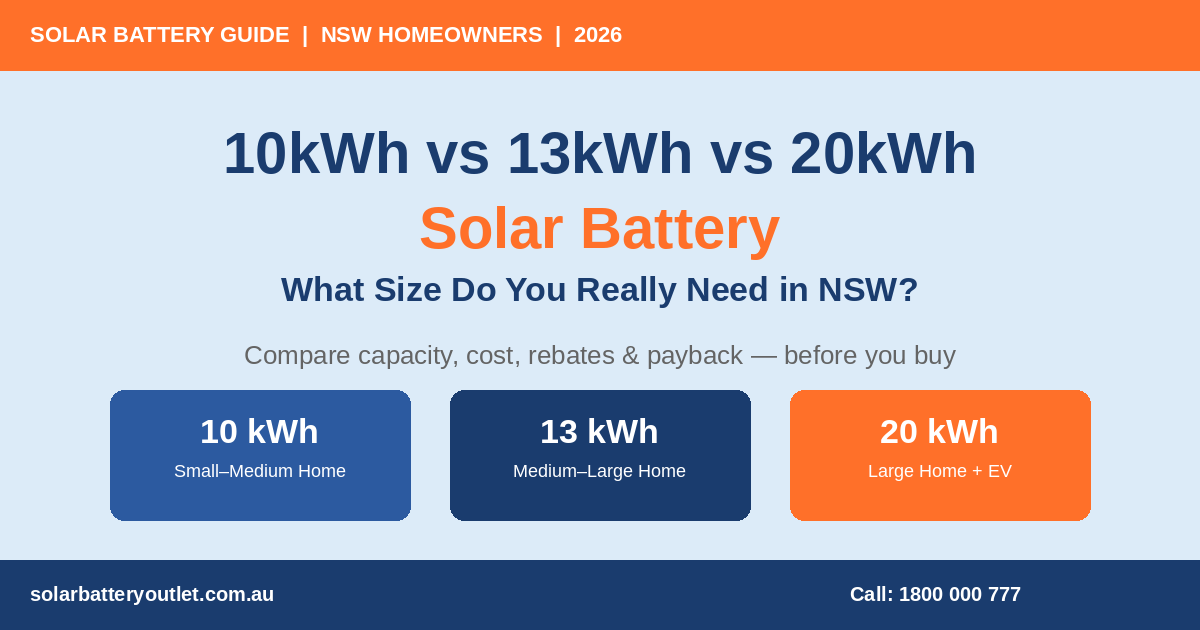
If you are shopping for a solar battery in NSW, the most common question is also the most important one: what size do you actually need? Buying too small means your battery fills up early and you still pay peak rates for evening electricity. Buying too large means you spend thousands more upfront — and a portion of that battery capacity sits idle every day.

This guide breaks down the three most common residential battery sizes — 10 kWh, 13 kWh, and 20 kWh — and shows you exactly which one suits which household. We cover real costs, rebate entitlements, annual savings, and payback periods for NSW homeowners in 2026.

First, understand what battery capacity actually means.

Battery capacity is measured in kilowatt-hours (kWh). One kWh is roughly what a typical split-system air conditioner uses in 30 minutes, or what a fridge uses in about 7 hours. Therefore, a 10 kWh battery holds ten times that amount of stored energy.

However, the number on the box is not always the number you can use. Most batteries have a usable capacity of 90–100% of their rated storage — this is called the depth of discharge (DoD). For example, a BYD Battery-Box 10 kWh has 100% usable capacity, while some older models only allowed 80%.

When comparing quotes, always ask about usable capacity — not just the headline figure.

How Much Power Does a NSW Home Use Each Evening?

To size a battery correctly, you need to know how much electricity your household draws after sunset — typically from around 4 pm to 10 pm. This is the window when electricity costs the most in NSW, particularly if you are on a time-of-use tariff.

Here is how NSW households break down by daily evening usage:

  • 1–2 person household: 7–12 kWh per day total, with roughly 5–8 kWh used after 4 pm
  • 3–4 person household: 15–22 kWh per day total, with 8–14 kWh used after 4 pm
  • 4–6 person household with EV or pool: 25 kWh+ per day, with 14–20 kWh after 4 pm

The goal is to match your battery’s usable capacity to your evening demand. A battery that runs out by 8 pm is undersized. A battery that still has 60% charge remaining at midnight is oversized for your situation.

Battery Size Comparison: 10 kWh vs 13 kWh vs 20 kWh
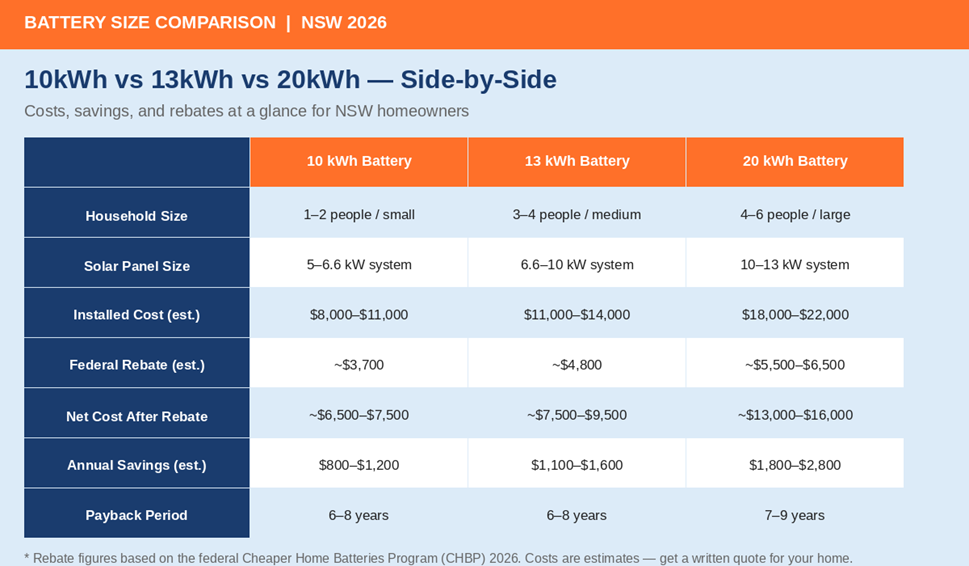
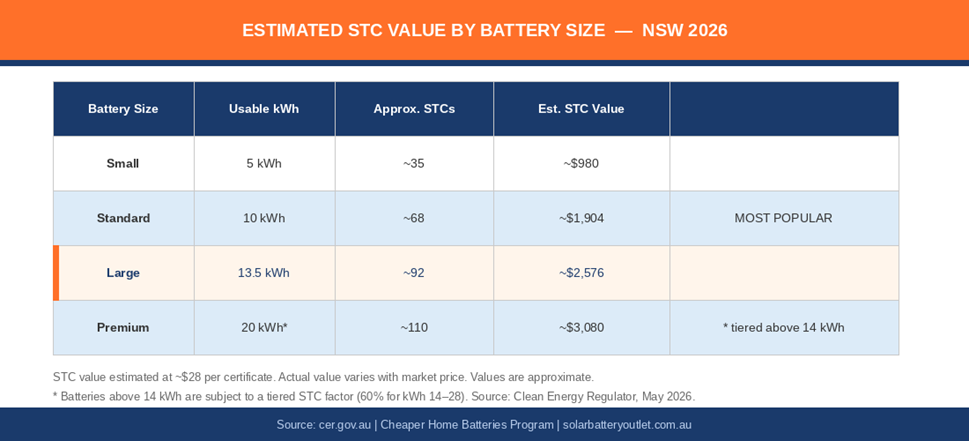
Solar battery size comparison table NSW

The table above summarises the key numbers. However, the figures are estimates based on typical NSW installations — your actual quote will depend on your solar system, switchboard condition, and installer. Always get three written quotes before committing.

For detailed information on government rules affecting your installation, the new 2026 installation requirements for NSW homeowners cover what has changed and what your installer must comply with.

The 10 kWh Battery: Who Is It Best For?

A 10 kWh battery is often a practical option for many NSW households. It can help store excess solar energy generated during the day for use in the evening, although the upfront cost, bill savings and payback period will depend on factors including electricity usage, tariff structure, installation costs and available incentives.

This size suits you well if:

  • Your household has 1–2 people, or 3 people who are home and using power during the day
  • Your total daily electricity use is under 15 kWh
  • You already have a 5–6.6 kW solar system
  • Your main goal is to reduce your evening electricity bill, not full energy independence
  • You are on a standard tariff rather than a time-of-use plan with high peak rates

The 10 kWh category includes popular models such as the BYD Battery-Box 10 kWh and various Sungrow and Growatt options. These batteries are widely available, well-supported, and CEC-approved — which matters if you want to access the federal rebate and the NSW VPP incentive.

One important consideration: if you plan to add an electric vehicle within the next few years, a 10 kWh battery will likely feel undersized. Charging an EV overnight typically adds 8–15 kWh of demand on its own.

The 13 kWh Battery: The NSW Sweet Spot

For most NSW families, the 13–13.5 kWh range is the practical sweet spot. This is the size tier where the federal rebate provides the most benefit relative to capacity, where annual savings are substantial, and where the payback period remains manageable.

The Tesla Powerwall 3 (13.5 kWh) sits squarely in this category and is a popular choice in NSW. The BYD Battery-Box 13.8 kWh is a strong alternative, offering a slightly larger capacity at a competitive price point.

This size suits you well if:

  • Your household has 3–4 people with typical appliance use
  • Your daily electricity consumption is between 15–25 kWh
  • You have a 6.6–10 kW solar system
  • You run the dishwasher, washing machine, and AC during peak evening hours
  • You want a comfortable energy buffer without a premium price

A 13 kWh battery provides additional storage capacity for households with higher energy consumption or greater evening electricity demand. The upfront cost, available incentives, bill savings and payback period will depend on factors including electricity usage, tariff structure, solar generation, battery performance and installation costs.

It is also worth noting that the 13 kWh size tier falls within the most favourable portion of the federal Cheaper Home Batteries Program rebate structure. For specifics on which batteries qualify for the 2026 federal rebate in NSW, including eligible brands and models, check the full eligibility list.

Matching Battery Size to Your Household: A Quick Reference
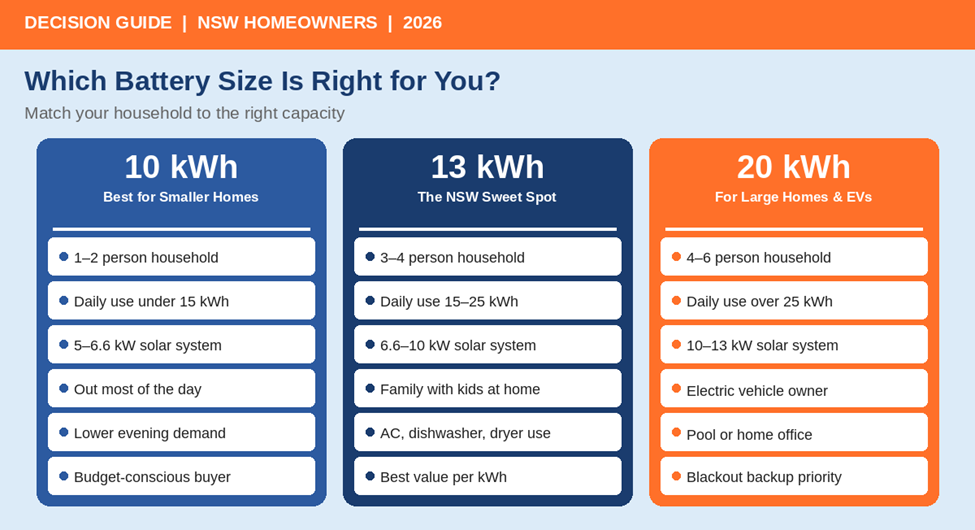
Decision guide — which solar battery size suits your NSW household, 10kWh, 13kWh or 20kWh

The decision guide above makes the size decision straightforward. Furthermore, keep in mind that the right battery size is not just about your current usage — it is about where your household is heading over the next 3–5 years.

If you are planning to switch to an electric vehicle, install an induction cooktop, or add more occupants to the house, factor that future demand into your decision now. Upgrading a battery system later involves additional labour and potential equipment costs.

The 20 kWh Battery: When Bigger Makes Sense

A 20 kWh battery is not for everyone — and that is by design. However, for a specific type of NSW homeowner, it is genuinely the right call rather than an oversized purchase.

This size suits you well if:

  • Your household has 4–6 people with high appliance usage
  • You own or plan to own an electric vehicle
  • You have a pool, home office, or other high-draw equipment
  • Blackout protection and energy independence are a priority
  • You have a 10–13 kW solar system that generates surplus power daily

The 20 kWh tier typically requires either two battery units stacked together (for example, two BYD 10 kWh batteries) or a single large-format unit designed for residential or light commercial use. Installation costs are proportionally higher, and the switchboard may need upgrading depending on your home’s existing electrical capacity.

Moreover, from 1 May 2026, the federal rebate structure introduced tiered support — which means larger batteries above 14 kWh attract a smaller proportional subsidy than before. Consequently, the relative financial case for a 20 kWh battery is slightly less favourable than it was pre-May. That said, if your household genuinely needs the capacity, the payback still stacks up.

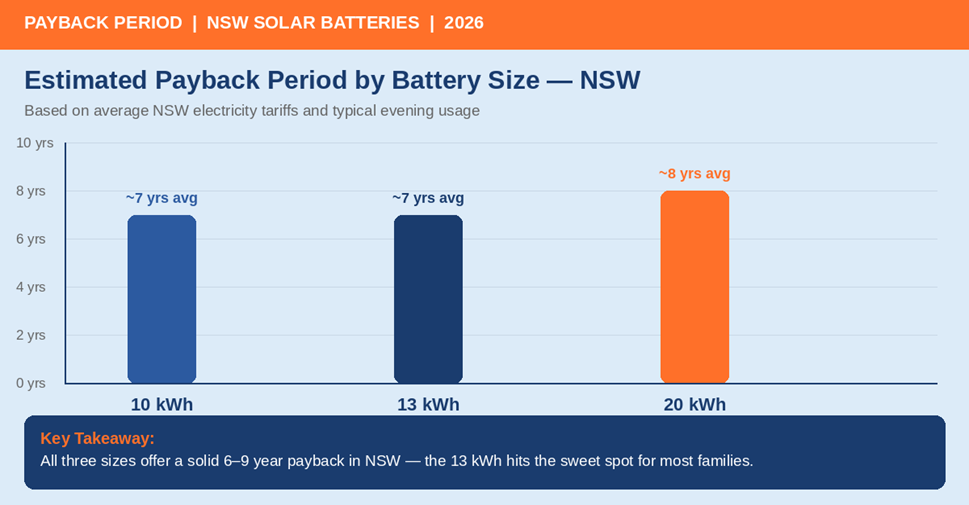
Solar battery payback period by size NSW 2026 — 10kWh, 13kWh, 20kWh estimated years to payback

As the chart shows, all three sizes deliver a reasonable payback period in NSW — typically 6 to 9 years. The exact figure depends on your electricity tariff, your evening usage pattern, and whether you participate in the NSW Virtual Power Plant (VPP) incentive through the Peak Demand Reduction Scheme.

Participation in a Virtual Power Plant (VPP) may provide additional benefits, subject to the provider’s program terms and conditions. Actual financial outcomes, bill savings and payback periods will vary depending on household energy usage, tariff structure and battery performance. Ask your installer whether the battery they are recommending is VPP-compatible.

What Affects Your Battery’s Actual Performance in NSW?

Choosing the right size is only part of the equation. Even with the perfect capacity, your battery will underperform if the following factors are not in order.

Your solar system’s output

A battery only charges from excess solar production. If your panels are aged, shaded, or undersized, they will not generate enough surplus to fill the battery each day.

Before adding storage, ask your installer to assess your current solar system. The CER registration rules for NSW solar panel installers explain the credentials your installer must hold for the installation to qualify for rebates.

Your tariff type

On a flat tariff, a battery saves you the difference between the grid price and the feed-in credit you would have earned by exporting that solar. On a time-of-use tariff — which many NSW households are now on — the savings are larger, because you avoid paying the higher peak rates during the evening hours. The higher your peak rate, the faster your battery pays back.

Installation quality

A properly installed battery on a compatible solar system outperforms a poorly installed one regardless of size. Wiring standards matter — the battery wiring standard in Australia sets out what a compliant installation must include. Make sure your installer follows AS/NZS 3000 and AS/NZS 5139 (the battery installation standard) requirements.

Rebates Available in NSW in 2026: What You Can Stack

NSW homeowners in 2026 can access two separate incentives — and they stack together, which makes a significant difference to the net cost.

  • Federal Cheaper Home Batteries Program (CHBP): Eligible battery installations may receive an upfront discount. The discount amount is based on the battery’s usable capacity, the applicable STC value and current program rules.
  • NSW Peak Demand Reduction Scheme (PDRS) VPP Incentive: Eligible households who connect an approved battery to an approved Virtual Power Plant (VPP) may receive a one-off incentive under the NSW Peak Demand Reduction Scheme. The incentive amount depends on the battery, the VPP provider and current scheme rules, and will be confirmed in your quote.

Combined, these programs may reduce the upfront cost of an eligible battery installation. The actual incentive available will depend on battery size, installer pricing, eligibility requirements and current program rules. Your installer should confirm the incentives available to you in your quote.

Quick Checklist: Before You Choose a Battery Size

Before you sign anything, work through these five checks. They take 10 minutes and will save you from buying the wrong size.

  • Check your last 12 months of electricity bills. Look at your total daily usage and identify how much you draw after 4 pm. Your retailer’s app or your smart meter data will show this.
  • Find out what solar system you have. Note the total panel capacity (kW) and the inverter size. A 5 kW inverter may not support a 20 kWh battery without an upgrade.
  • Ask whether your switchboard needs upgrading. Some older NSW homes need a switchboard upgrade before a battery can be safely added. This adds $500–$1,500 to the project cost and should appear on your written quote.
  • Confirm the battery is CEC-approved and VPP-capable. Both are needed for the federal rebate, and VPP connection is needed for the NSW PDRS incentive.
  • Get three written quotes. Size recommendations vary between installers. If one quote recommends a 10 kWh system and another recommends 20 kWh for the same home, ask both to justify the recommendation with your actual usage data.

Frequently Asked Questions

Is a 10 kWh battery enough to run a typical NSW home overnight?

It depends on your evening usage. A 10 kWh battery is sufficient for a 1–2 person household or a family that uses most of its power during the day. For a 3–4 person family running AC, the dishwasher, and the TV from 4 pm onwards, 10 kWh will often run out before midnight. In that case, 13 kWh is a safer choice.

Does the federal rebate cover the full cost difference between a 10 kWh and 13 kWh battery?

Not entirely. The rebate is calculated per kWh of usable capacity — so a 13 kWh battery attracts a larger absolute rebate than a 10 kWh battery. However, the total installed cost of the 13 kWh system is also higher. The net cost difference between the two is typically $1,000–$2,500 after rebates.

Can I install two 10 kWh batteries instead of one 20 kWh unit?

Yes. Many NSW homeowners choose to install one 10 kWh or 13 kWh battery initially, then add a second unit later as demand grows. However, adding a second battery in a future installation involves additional labour costs compared to installing both at once. If you know your usage is high, installing the full capacity upfront is usually the better financial decision.

How does my solar panel size affect which battery I should choose?

Your solar panels charge your battery. A 5 kW solar system in NSW typically generates 18–22 kWh on a good day. After powering daytime loads, it might produce 8–12 kWh of surplus available to charge a battery. Therefore, installing a 20 kWh battery on a 5 kW solar system means the battery will rarely be fully charged, which reduces your annual savings and stretches the payback period.

Do all battery sizes qualify for the NSW VPP incentive?

The PDRS VPP incentive applies to batteries connected to an approved Virtual Power Plant provider. The incentive value scales with battery size, with larger systems receiving up to $1,500. However, the battery must be VPP-capable (able to discharge to the grid on demand) — not all models support this. Ask your installer specifically about VPP compatibility before purchasing.
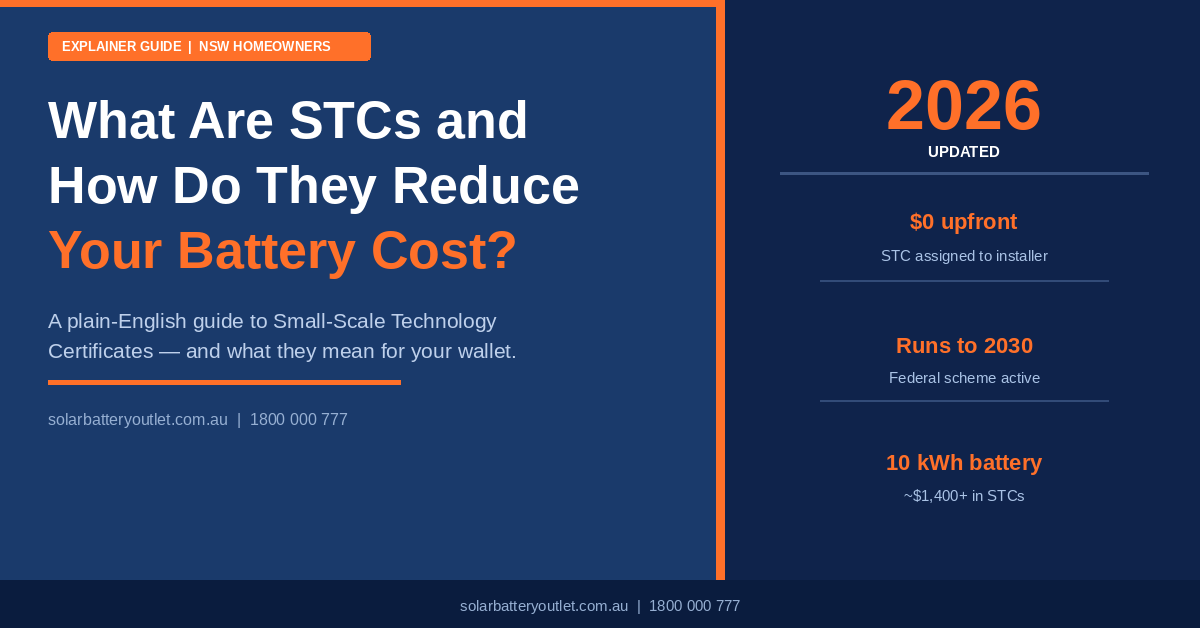
If you have received a quote for a solar battery recently, you may have noticed a line called the ‘federal rebate’ or ‘government rebate’ reducing the total price. That is not marketing spin. It is a real, government-backed mechanism called the Small-Scale Technology Certificate scheme — and in 2026, it is one of the most valuable financial tools available to NSW homeowners installing a battery.

This article explains, in plain English, exactly what STCs are, how they are calculated, what they are worth in 2026, and — most importantly — how they end up saving you money before you ever hand over a cent.

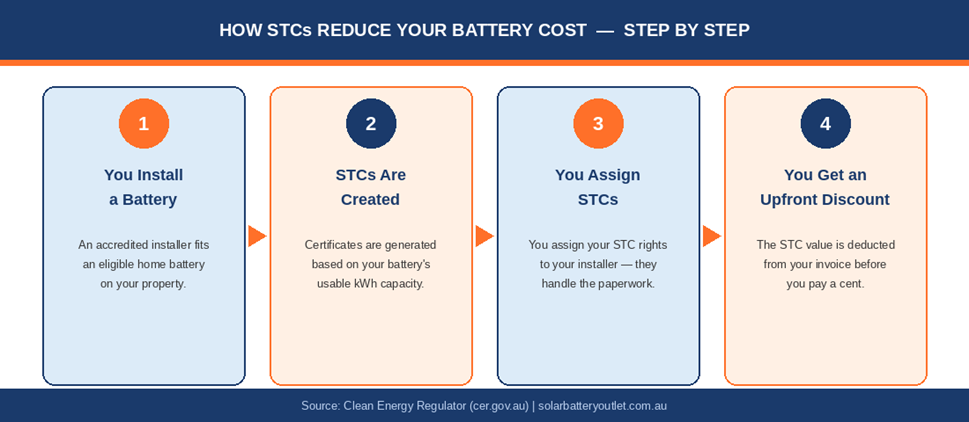
In plain English: STCs are government certificates created when you install an eligible battery. You assign them to your installer, who sells them — and that sale is deducted from your invoice as an upfront discount.

You never touch the certificates yourself. Your installer does the work. You just pay less.

What Are STCs, Really?

STC stands for Small-Scale Technology Certificate. You will also hear them called ‘the solar rebate’, ‘the federal rebate’, or simply ‘the government discount’. Technically, they are none of those things — but they function exactly like one.

STCs are part of Australia’s Renewable Energy Target, administered under the Small-scale Renewable Energy Scheme (SRES). The scheme has existed since 2011, originally to make rooftop solar more affordable. From 1 July 2025, it was expanded under the federal Cheaper Home Batteries Program to also cover eligible home battery systems.

When you install an eligible battery, your installation generates a set number of certificates. Those certificates have a dollar value. You assign your right to those certificates to your accredited installer. The installer sells them, and the proceeds are passed back to you as a deduction on your quote. The end result is a lower price on the day you pay.

How Are STCs Calculated for a Battery?

How STCs reduce your solar battery cost

The number of STCs your installation generates depends on two things: the usable capacity of your battery in kilowatt-hours (kWh), and the STC factor that applies on the date of installation.

The STC Factor

The STC factor is a multiplier set by the government. It determines how many certificates are created per kWh of usable battery capacity. It is designed to step down over time as battery costs fall — the idea being that the rebate reflects how much financial help is needed, not a fixed handout.

The formula is straightforward:

Number of STCs = Usable kWh × STC Factor (rounded down to the nearest whole certificate)

From 1 May 2026, a tiered STC factor applies for batteries above 14 kWh of usable capacity. This is how it works:

This tiering means a 20 kWh battery does not simply get twice the STCs of a 10 kWh battery — it gets 14 kWh worth at full factor, then 6 kWh at 60% of factor. The total is still significant, but it is worth understanding the structure before assuming proportional savings.

What Is Each STC Worth?

The value of Small-scale Technology Certificates (STCs) depends on current program rules and certificate values at the time of installation. Your installer will calculate the applicable discount and include it in your written quote. The upfront discount available through the Cheaper Home Batteries Program is based on eligible battery capacity and the applicable STC rate.

The exact amount will vary between installations and should be confirmed in your quote. How Does the Discount Appear on Your Quote? When you receive a written quote from an accredited installer, any applicable incentive or certificate-based discount should be clearly identified. The quote should generally show:

  • Gross cost of the battery and installation
  • Applicable discounts or certificate deductions
  • Net amount payable by the customer

Eligible households who connect an approved battery to an approved Virtual Power Plant (VPP) may also be able to receive a NSW Peak Demand Reduction Scheme incentive, subject to current program rules and eligibility requirements. Any available incentive amount should be confirmed in your quote.

Actual costs, incentives and savings vary depending on system size, battery capacity, installer pricing, eligibility requirements and program rules at the time of installation

How Is The Battery Discount Calculated?

Illustrative example only. Certificate values and available discounts vary and will be confirmed in your quote

The examples above are illustrative only. The discount available through the Cheaper Home Batteries Program depends on the battery selected, the applicable certificate value and the program rules in place at the time of installation.

In general, larger eligible batteries may attract a larger upfront discount than smaller systems, although the amount available will vary between installations. Your installer will calculate the applicable discount and include it in your written quote. The discount is applied before installation, reducing the upfront cost of an eligible battery system. The exact amount available to you should be confirmed in your quote.

How Does the STC Saving Actually Show Up on Your Quote?

This is where things get practical. When you receive a written quote from an accredited installer, the STC value should appear as a separate line item — a deduction from the gross price. The quote should show you:

  • Gross cost of the battery and installation
  • STC deduction (shown as a dollar amount, not a vague ‘rebate’)
  • Net cost — what you actually pay

The reason it works this way is that you are technically transferring your legal right to create and trade those certificates to your installer. They do the paperwork through the Clean Energy Regulator’s REC Registry. They handle the compliance requirements — including the photo documentation requirements introduced in early 2026. In return, they pass the value back to you upfront, rather than making you wait for a government reimbursement.

If you want to understand the compliance requirements your installer must meet, our guide on new government rules for solar battery installations in 2026 covers this in detail.

Does the STC Scheme Apply to All Batteries?

No. Not all batteries qualify. To generate STCs, a battery system must meet the eligibility criteria under the Cheaper Home Batteries Program. The key requirements are:

  • The battery must be installed by an SAA-accredited installer
  • The battery must be on the approved battery list and be VPP-capable
  • The usable capacity must be between 5 and 100 kWh (STCs are only created for the first 50 kWh)
  • The installation must comply with all relevant Australian Standards
  • The installer must register the installation with the Clean Energy Regulator

If any of these conditions are not met — for example, if the installer is not properly accredited or the battery model is not on the approved list — no STCs are generated and no discount applies. This is another reason why installer quality matters as much as product quality.

How Does the STC Factor Change Over Time?

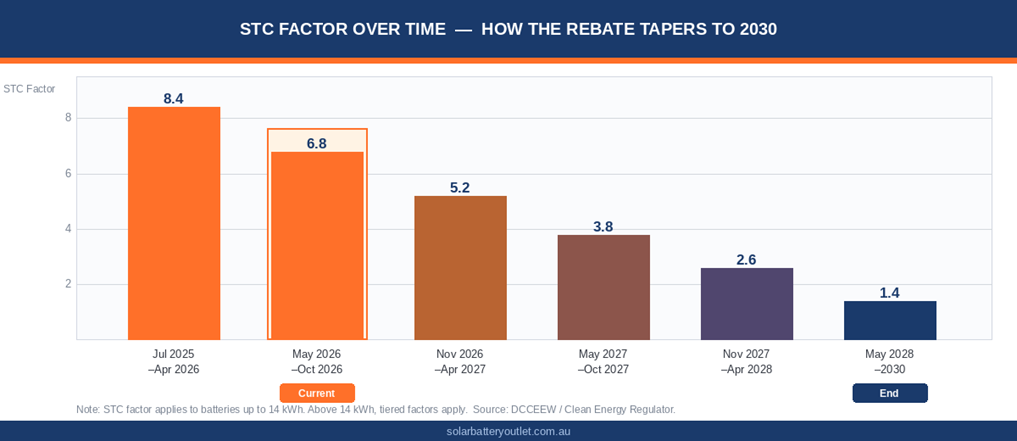
STC factor decline timeline 2025 to 2030 — bar chart showing how the solar battery rebate tapers over time in Australia

The STC factor for batteries reduces every six months under a schedule set by the government. The principle is simple: as battery costs fall over time, the government support tapers proportionally. The scheme is designed to wind down by 2030.

The factor steps down every six months, so your quote will show the amount that applies on your installation date. Each six-month period that passes reduces the certificates available — and therefore the upfront saving on your battery cost.

The scheme is not ending abruptly. It is tapering gradually. Choosing the right system matters more than rushing.

Can You Stack STCs With Other Incentives?

Yes — and this is where the full picture becomes compelling. STCs are a federal scheme. They sit alongside, not instead of, state-level incentives that NSW homeowners can also access.

  • NSW Peak Demand Reduction Scheme (PDRS): Eligible households who connect an approved battery to an approved Virtual Power Plant (VPP) may receive a one-off incentive under the NSW Peak Demand Reduction Scheme. The amount depends on the battery, the VPP provider and current scheme rules, and will be confirmed in your quote.
  • Virtual Power Plant (VPP) participation: Some VPP providers may offer ongoing credits or payments in accordance with their program terms and conditions. Amounts vary by provider.
  • Time-of-use tariff savings: A battery may allow households to store excess solar energy generated during the day and use it during peak electricity pricing periods. Actual savings depend on electricity usage, tariff structure and battery performance.
Example: Combining Available Battery Incentives in NSW
Federal battery discount: Available for eligible battery installations, subject to program rules.
NSW VPP incentive: May be available for eligible households connecting an approved battery to an approved Virtual Power Plant (VPP).
Combined upfront benefit: The total value of any available incentives depends on the battery selected, eligibility requirements and current program rules. 
The incentives available to you will be confirmed in your written quote.

Do You Need to Do Anything to Claim STCs?

In most cases, NO. The standard process is:

  1. Your installer confirms you are eligible and includes the STC deduction in the written quote.
  2. You sign the assignment agreement — typically a single form included with your contract.
  3. The installer completes the installation, takes the required compliance photos, and submits the STC application to the Clean Energy Regulator.
  4. The certificates are registered and sold. You have already received the value as a discount on your invoice.

You can also choose to create and trade STCs yourself through the REC Registry — but the vast majority of homeowners choose to assign them to their installer for simplicity.

For more on what the Clean Energy Regulator now requires at installation — including photo documentation — see our article on CER registration rules for NSW solar panel installers.

Frequently Asked Questions
Are STCs the same as the NSW state battery rebate?

No. STCs are a federal mechanism, separate from any state programs. In NSW, state incentives like the Peak Demand Reduction Scheme are additional to STCs, not a replacement. You can claim both if you are eligible for both.

Do STCs apply if I’m only installing a battery?

Yes. Eligible batteries may qualify for STCs when connected to an existing solar PV system, so you do not need to install new solar panels at the same time. Eligibility requirements apply.

What happens if I already have solar panels — do I still get STCs for adding a battery?

Yes. Adding a battery to an existing solar system qualifies for its own STC entitlement under the Cheaper Home Batteries Program. The battery STCs are calculated independently of any STCs that were claimed when you originally installed your solar panels.

Does the wiring standard affect whether my installation qualifies?

Yes — indirectly. Your installation must comply with AS/NZS 5139 and related Australian Standards. Non-compliant wiring can mean the installation fails CER registration, which means no STCs. This is another reason to choose an accredited installer who knows the current standards.

When does the STC scheme end?

The Cheaper Home Batteries Program’s STC component runs until 2030. The factor tapers every six months, Choosing the right system matters more than rushing.

If you have been comparing solar quotes recently, you may have noticed that some installers clearly explain government rebates while others provide little detail. The reason often comes down to whether the installer is registered and approved under the Clean Energy Regulator (CER) requirements.

New rules introduced across 2025 and 2026 have tightened the requirements around who can legally install a solar system and claim the rebate on your behalf. For NSW homeowners — whether you are in Liverpool, Bankstown, or anywhere else in the state — this directly affects whether you receive your full entitlement, whether your installation is safe, and whether it will pass inspection.

This guide outlines the CER registration rules, explains why regulators introduced them, and shows you what to check before signing a contract with a solar installer.

What Is the CER and Why Does It Set the Rules?

The Clean Energy Regulator is the Australian Government body responsible for administering the Small-scale Renewable Energy Scheme (SRES) — the program that funds the rebate that reduces the upfront cost of solar panels and batteries for homes across Australia.

When a solar installer completes a job, they do not just put panels on your roof and leave. To trigger your rebate, they must create Small-scale Technology Certificates (STCs) in the government’s REC Registry. Those certificates are only valid — and your rebate is only real — if the installer meets a specific set of CER registration requirements at the time of installation.

The CER does not just set these rules once and walk away. It actively monitors compliance, suspends installers who breach the rules, and publishes regular compliance updates. As of the most recent update covering January to March 2026, the CER permanently suspended registration of Phenix Trading Pty Ltd following regulatory actions by state regulations in NSW and Victoria — a reminder that enforcement is real and ongoing.

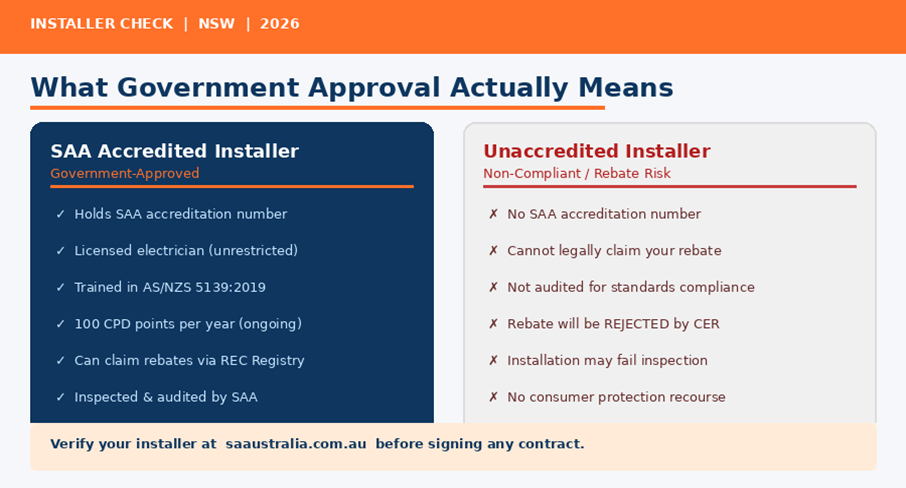
SAA accredited vs unaccredited solar installer NSW comparison

The Core Rule: Only SAA Accredited Installers Can Legally Claim Your Rebate

The single most important requirement is this: your solar system must be designed and installed by a Solar Accreditation Australia (SAA) accredited installer. This is not optional or a formality — it is a hard legal requirement under the Renewable Energy (Electricity) Regulations.

Solar Accreditation Australia (SAA) took over the accreditation role from the Clean Energy Council in 2024. As of 2024, only SAA accredited designers and installers can interact with the CER’s Small-scale Renewable Energy Scheme. Any installer claiming to offer you a rebate without holding a current SAA accreditation number is not legally able to do so.

To hold SAA accreditation, an installer must:

  • Hold a current electrical licence (for install accreditation)
  • Complete an approved solar training course for their accreditation category
  • Complete a minimum of 100 continuing professional development (CPD) points every 12 months
  • Carry current public liability insurance
  • Comply with SAA guidelines, Australian Standards, and all relevant regulations

SAA requires accredited installers to maintain their skills through annual CPD training and may suspend or de-accredit those who fail to comply with Australian standards.

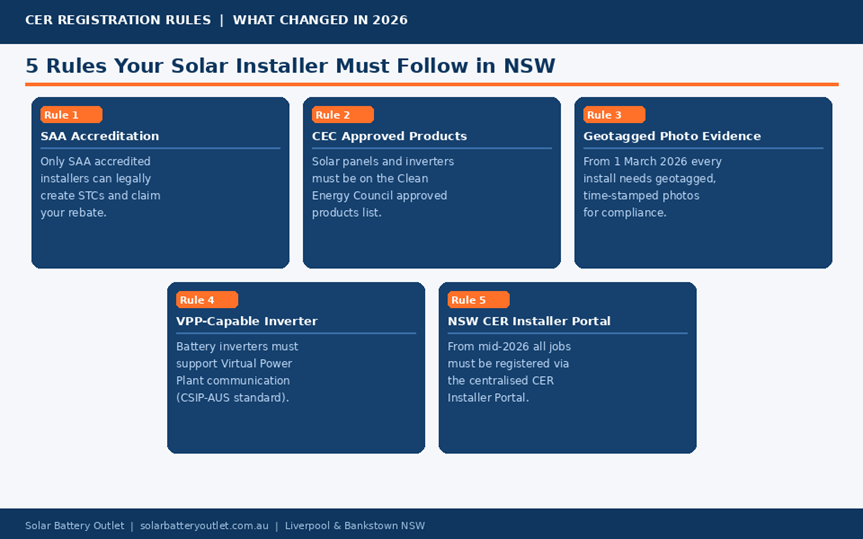
The 5 CER Registration Rules That Apply to Your Installation in 2026

Beyond SAA accreditation, the CER now requires installers and solar businesses to follow specific rules for registering, documenting, and reporting solar installations. Here is what every NSW homeowner should understand.

5 CER registration rules your solar panel installer in NSW

Rule 1 — SAA Accreditation Is Mandatory, Not Optional

As covered above, this requirement forms the foundation of STC eligibility. Every system claiming STCs must have an SAA-accredited installer complete the installation. The installer must be physically present on site, as phone-based supervision or remote oversight does not meet the requirement. SAA requires accredited installers to supervise installations on site and follow its installation rules.

Rule 2 — All System Components Must Be on the CEC Approved List

Your solar panels and inverters must appear on the Clean Energy Council’s approved products list. This list is maintained and updated by the CEC. Installing panels or inverters that are not on this list means your system is not eligible for STCs — regardless of who installs it. A legitimate installer will only quote products that are currently on the approved list and will confirm this if you ask. If you are looking at a home solar panel system Liverpool quote or anywhere else in NSW, this is one of the first things to verify.

Rule 3 — Geotagged, Time-Stamped Photo Evidence Is Now Required

From 1 March 2026, the CER introduced new photo evidence requirements for eligible solar battery installations claiming STCs, including geotagged and timestamped photos of critical safety labelling. Every installation must be accompanied by geotagged, time-stamped photographic evidence confirming that the system complies with Australian Standard labelling requirements.

The Clean Energy Regulator introduced these requirements after inspection programs identified compliant battery labelling as a key area for improvement in solar battery installations. An accredited installer will build this documentation into their standard process. If an installer seems unaware of this requirement or dismisses it, that is a significant warning sign.

Rule 4 — VPP-Capable Inverter Required for Battery Installations

To be eligible for the federal Cheaper Home Batteries Program, battery systems must be capable of participating in a Virtual Power Plant (VPP), subject to the program’s eligibility requirements. In NSW, new and upgraded systems may also need to comply with network requirements, including Common Smart Inverter Profile – Australia (CSIP-AUS) communications standards and Emergency Backstop requirements where applicable. Check the current eligibility and connection requirements before installation.

You do not have to actually join a VPP — but the system must have the technical capability. This requirement affects which inverters are eligible, and an accredited installer will be across it when specifying your system.

Rule 5 — The NSW Consumer Energy Resources (CER) Installer Portal

The NSW Government’s Consumer Energy Resources (CER) Installer Portal is a new system used to register new and upgraded rooftop solar and battery installations in NSW. The portal provides a single registration process across NSW distribution networks and supports reporting requirements such as the Australian Energy Market Operator’s (AEMO) Distributed Energy Resources Register (DERR).

According to the NSW Government, solar businesses will begin using the portal from 2 November 2026 for eligible new and upgraded rooftop solar and battery systems, subject to the implementation timetable published by the NSW Government. Source: NSW Consumer Energy Resources Installer Portal.

The portal covers all three NSW distribution networks — Ausgrid, Endeavour Energy, and Essential Energy — and automatically confirms that each system meets national technical standards.

As a homeowner, you do not interact with the portal yourself — your installer does. However, a legitimate accredited installer will be fully aware of this requirement. An installer who seems unfamiliar with the CER portal should prompt caution when you are getting quotes for solar panels Bankstown, Liverpool, or any other part of NSW.

How to Verify Your Installer Before You Sign Anything

Knowing the rules is useful. Knowing how to check that your installer actually follows them is what protects you. Here is a practical guide to verifying any installer before you commit.

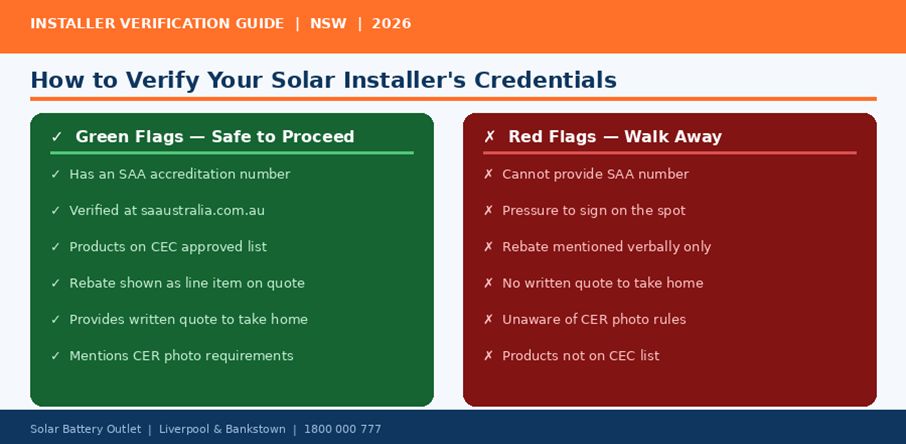
solar panel installer credentials NSW green and red flags

Step 1: Ask for the SAA Accreditation Number

Every SAA accredited installer has a publicly listed accreditation number. Ask for it — and then check it yourself at saaustralia.com.au. This takes under two minutes and tells you whether the accreditation is current, what category it covers (grid-connected PV, battery, standalone), and whether it is in good standing.

Step 2: Confirm Products Are on the CEC List

Ask the installer which solar panels and inverters they included in the quote, then verify those products in the Clean Energy Council’s approved products database. If you find that the products are not on the approved list, you could lose access to government rebates before the installation even begins.

Step 3: Ask How They Handle the CER Photo Requirements

A compliant installer will know exactly what you mean when you ask about the March 2026 photo requirements. They should be able to explain that they take geotagged, time-stamped photos at each installation phase as a standard part of their compliance process. Vagueness here is a red flag.

Step 4: Get Everything in Writing Before You Sign

The rebate should appear as a dollar figure on your written quote — not mentioned verbally and applied later. A legitimate installer will provide a written quote you can take home, compare, and consider. If anyone pressures you to sign on the day without providing a written quote, walk away. This applies whether you are looking at a home solar panel system in Liverpool, Bankstown, or anywhere else in NSW.

Why These Rules Exist — And Why They Protect You

It is worth being direct about something: these CER registration rules are not bureaucratic red tape. They exist because there has been a documented pattern of non-compliant installations in the Australian solar market — installers cutting corners on labelling, incorrect system sizing, products that do not meet Australian standards, and in some cases, outright fraud in the STC system.

When you choose a properly registered installer, you are not just protecting the rebate. You are protecting the investment itself — the panels on your roof, the system’s performance over its 25-year design life, and the safety of your home.

If you are planning a full solar panels installation in NSW and want to understand the complete picture — from system sizing to battery storage options — the same rules apply. Every component of a compliant installation, from panels to batteries, must be covered by an accredited installer.

Frequently Asked Questions

How Can I Check Whether My Solar Installer Holds SAA Accreditation?

Go to saaustralia.com.au and use the accreditation search. Enter the installer’s name or accreditation number. The result will show you the current accreditation status, the type of accreditation held (e.g. Grid-Connected PV, Battery), and whether it is currently active. Always verify this before signing any quote, whether you are getting a home solar panel system or solar panel installation services in Bankstown.

Can an unaccredited installer do the work if an accredited person signs off on it?

The CER and SAA are explicit: the accredited person must be present on site for the installation. Supervision must be on site and in accordance with SAA rules. Remote sign-off or paper-based oversight does not satisfy the requirement. If an installer’s arrangement does not meet this standard, any STCs created may be invalid.

Does the accreditation requirement apply to solar panel-only systems, or just batteries?

Both. SAA accreditation is required for both solar PV installations and battery installations under the SRES. The category of accreditation differs (Grid-Connected PV vs Battery), but the core requirement — that only accredited installers can legally create STCs — applies to all system types claiming government rebates.

What if my installer says they will handle the accreditation paperwork themselves?

The installer handling the rebate paperwork (STC assignment) is standard practice and expected. What you want to verify is that they hold the accreditation themselves — not that someone else on the paperwork does. Ask for their SAA number and verify it directly. The paperwork process is separate from the accreditation requirement.

Will the CER registration rules change again after mid-2026?

The CER regularly updates its compliance requirements as part of its annual enforcement priorities. The core requirement for SAA accreditation is unlikely to change. However, documentation requirements, photo evidence standards, and portal registration processes are updated periodically. A reputable installer stays current with these updates as part of their ongoing CPD requirements.

DATA SOURCES & REFERENCES

Small-scale renewable energy systems: https://cer.gov.au/schemes/renewable-energy-target/small-scale-renewable-energy-scheme/small-scale-renewable-energy-systems

Solar battery installers and designers: https://cer.gov.au/schemes/renewable-energy-target/renewable-energy-target-participants-and-industry/solar-battery-installers-and-designers

Clean Energy Regulator—Compliance update January to March 2026: https://cer.gov.au/about-us/our-compliance-approach/compliance-and-enforcement-priorities/compliance-and-enforcement-priorities-2025-26/compliance-update-january-to-march-2026

Clean Energy Council — Approved Products List: https://www.cleanenergycouncil.org.au/industry-advocacy/renewable-energy-systems/approved-products

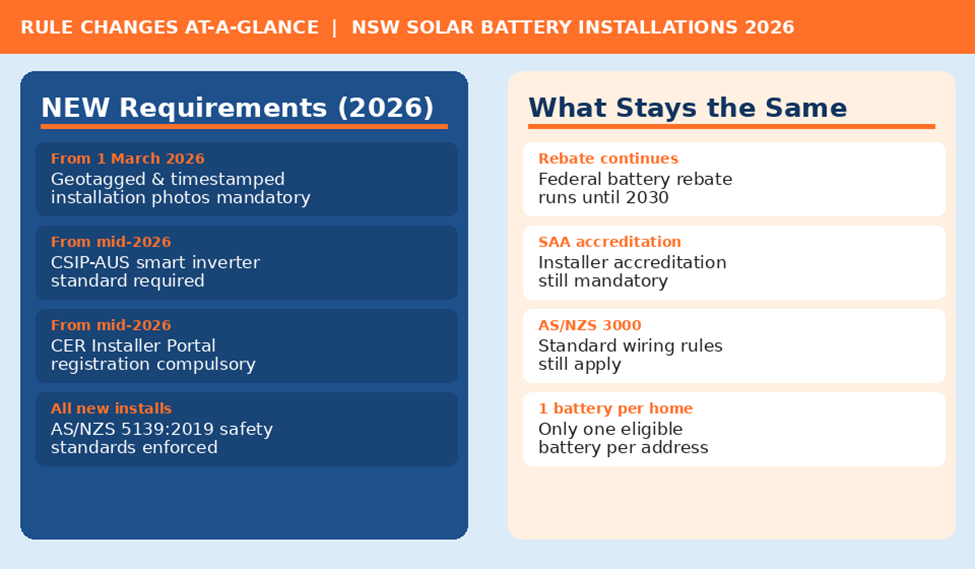
If you are planning to install a solar battery in NSW in 2026, the rules have changed — and not in a small way. Three separate regulatory updates have landed this year, covering how batteries are photographed at installation, how inverters must communicate with the grid, and how your installer registers the job.

None of these changes end the rebate or make batteries less worthwhile. However, they do change what you should be asking your installer before you sign anything. Therefore, this guide covers every new requirement in plain language and tells you what to do — and what to watch out for — when comparing quotes.

What Has Changed in 2026: The Three Key Updates

Solar Battery Installations 2026

1. Mandatory Photo Documentation — From 1 March 2026

The Clean Energy Regulator (CER) introduced a mandatory photo requirement for every solar battery installation in Australia from 1 March 2026. This is now legislated under the Renewable Energy (Electricity) Regulations 2001 and applies to all accredited installers.

Every installer must now take geotagged and timestamped photos of critical labelling at the time of installation. These photos are submitted as part of the compliance paperwork, and the Clean Energy Regulator (CER) uses automated processes, including AI-assisted checks, to review submissions as part of the Small-scale Renewable Energy Scheme compliance process. If the photos are missing or incorrect, your rebate claim will be delayed or rejected.

What this means for you: Ask your installer upfront to confirm they will handle the photo documentation correctly. A compliant installer will do this automatically. One who is unaware of the requirement is a red flag.

2. NSW Emergency Backstop Mechanism — From Mid-2026

From mid-2026, the NSW Government is implementing the Emergency Backstop Mechanism (EBM) — a technical requirement designed to protect the electricity grid during rare emergency conditions known as Minimum System Load events. These occur on mild, sunny days when rooftop solar exports can exceed the grid’s capacity to absorb them.

Under the new rules, all new and upgraded rooftop solar systems under 200 kW must be backstop-enabled. In practice, this means your system’s inverter must comply with a new Australian technical standard called Common Smart Inverter Profile Australia (CSIP-AUS). A compliant inverter can receive instructions from your distribution network to temporarily reduce exports during a grid emergency.

What this means for you: This mechanism is a last-resort safeguard and will be a rare event. It will not affect your daily solar savings under normal conditions. If you are installing after mid-2026, ask your installer to confirm your inverter is CSIP-AUS compliant. Many newer inverters support this standard, but not all — your installer should confirm your inverter model is listed as CSIP-AUS compliant. If you already have solar and are not adding or upgrading equipment, these requirements do not apply to you.

3. NSW CER Installer Portal — From Mid-2026

Alongside the Emergency Backstop Mechanism, the NSW Government is launching a new CER Installer Portal — a centralised registration system that replaces manual entry into AEMO’s DER Register.

From mid-2026, all solar and battery installers in NSW must use this portal to register every new installation. It creates a single registration process across all three NSW distribution networks (Ausgrid, Endeavour Energy, and Essential Energy) and automatically confirms each system meets national technical standards.

What this means for you: You do not interact with the portal directly — your installer handles it. However, a legitimate accredited installer will be aware of this requirement. An installer who seems unaware of the CER portal or CSIP-AUS standard should prompt caution.

Safety Rules That Have Not Changed — But Still Matter

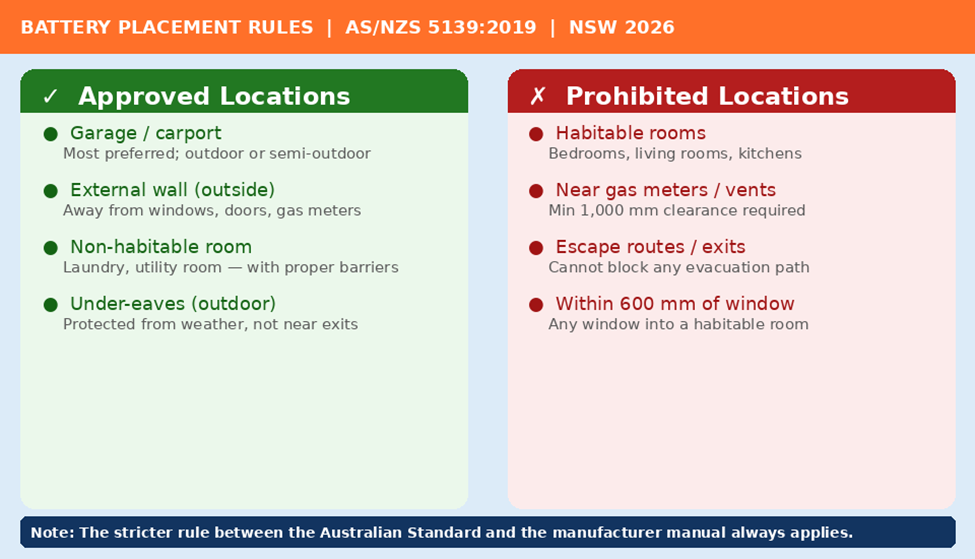
While the three updates above are new for 2026, the core safety rules for how and where a battery can be physically installed have been in place since AS/NZS 5139:2019. These rules are non-negotiable, and every reputable installer will already follow them.

battery placement rules

Clearance Requirements

Your battery must maintain specific distances from potential hazards. Battery installations must comply with applicable safety requirements, including AS/NZS 5139 and any relevant gas network clearance requirements. Required separation distances can vary depending on the battery location, nearby equipment and site conditions. Your installer will confirm the exact clearances and installation requirements for your site.

Fire Barrier Requirements

If a battery is mounted on or within 300 mm of a wall backing onto a habitable room, a non-combustible fire barrier is required under AS/NZS 5139. Therefore, your installer should assess this automatically before recommending an installation location.

No Escape Route Obstruction

Under AS/NZS 5139 and NSW Fair Trading rules, installers cannot place a battery in an escape route or evacuation path. In practical terms, they should not install a battery where it could block a garage door or doorway used for emergencies.

The Stricter Rule Always Applies

When the manufacturer’s installation manual requires greater clearances than the Australian Standard, the manufacturer’s requirements apply. A compliant installer will check both and apply whichever is more demanding.

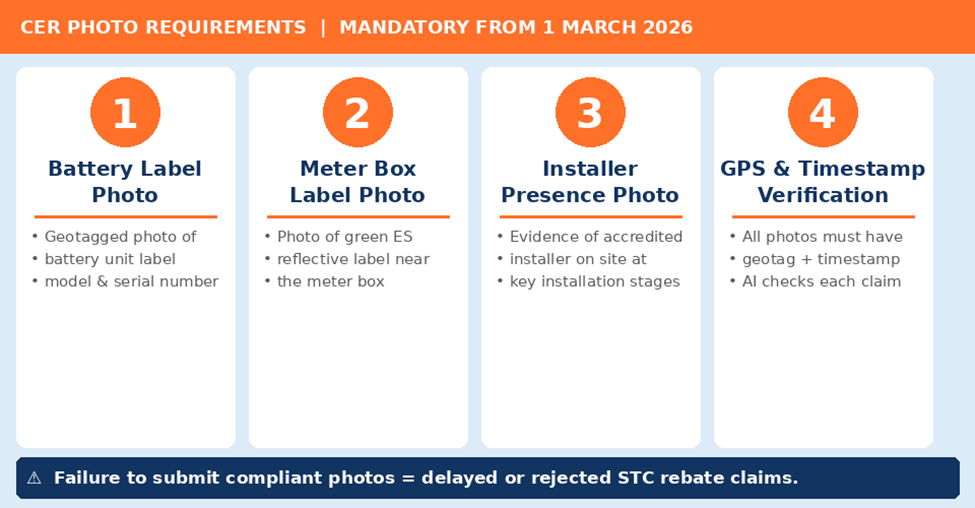
New Photo Requirements: What Your Installer Must Document

CER Photo Requirements

The CER’s mandatory photo requirements from 1 March 2026 cover four categories of documentation that your installer must submit for every job:

  • A clear, geotagged photo of the battery unit label showing the model and serial number
  • A photo of the green circular “ES” reflective label near the meter box — providing critical information for emergency services
  • Evidence of the accredited installer’s presence on site during the main installation stages
  • All photos must include GPS location data and a timestamp—the CER uses automated processes, including AI-assisted checks, to support the verification of submissions.

If labeling does not meet the required standard, the claim fails, and the installer must return to the site to rectify it before the STC rebate can be processed. That’s why choosing an experienced, CER-compliant installer matters more than ever—a poorly documented job can delay your rebate by weeks.

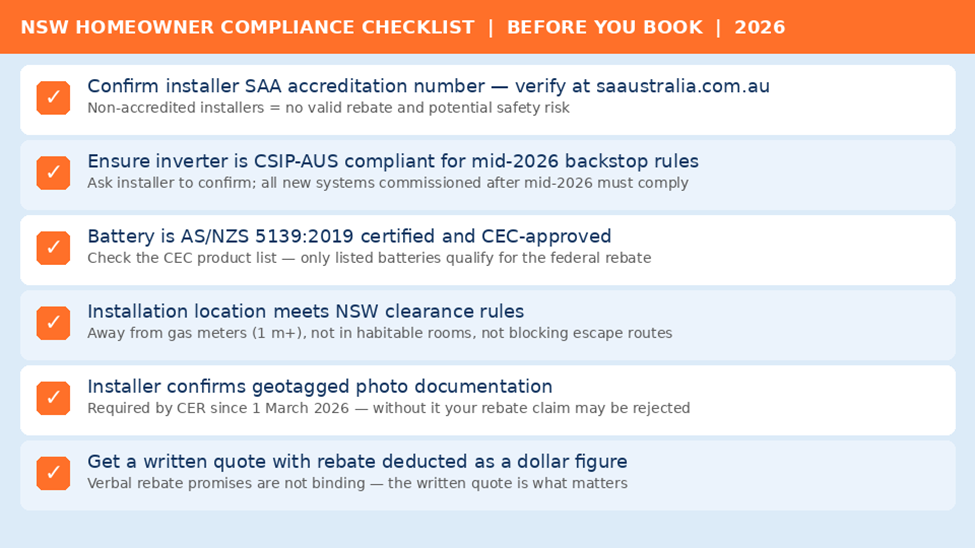
Your NSW Homeowner Compliance Checklist

Before you book any solar battery installation in NSW, work through this checklist. A legitimate, compliant installer will be able to answer yes to all of these without hesitation.

NSW Homeowner Compliance Checklist

Questions to Ask Before Signing

  • Is the installer who will do my job SAA-accredited? Can you give me their accreditation number to check at saaustralia.com.au?
  • Will the inverter be CSIP-AUS compliant — is it on the Clean Energy Council’s approved list for the NSW Backstop Mechanism?
  • Is the battery on the approved battery list and VPP-capable?
  • Will you handle the geotagged photo documentation required by the CER from 1 March 2026?
  • Can you provide a written quote showing the rebate as a dollar deduction — not just a verbal promise?
  • What is the confirmed installation date — not just the contract signing date?
Do I need to do anything about the emergency backstop mechanism if I already have solar?

No. If you are not installing new equipment or upgrading your existing system, the Backstop Mechanism requirements do not apply. Existing systems continue to operate under their current arrangements.

How do I know if my installer is SAA-accredited?

Ask them for their accreditation number and check it yourself at saaustralia.com.au. If an installer won’t give you this number, be cautious — the federal rebate needs an SAA-accredited installer.

My installer said the rebate is reflected in the price — is that enough?

No. The rebate must appear as an itemised dollar deduction on your written quote. A verbal promise does not protect you if the rebate is processed incorrectly. Insist on seeing it in writing before you sign.

What batteries qualify for the federal rebate in 2026?

To qualify, the battery must be on the approved battery list, be VPP-capable, and be installed by an SAA-accredited installer following AS/NZS 5139. Well-known compliant brands include Tesla Powerwall, BYD, Sungrow, Enphase, and Growatt — but you should always verify that the specific model appears on the CEC approved list.

Is the NSW VPP incentive still available?

Yes. The NSW Peak Demand Reduction Scheme is a separate state incentive for eligible households that connect an approved battery to an approved Virtual Power Plant (VPP). The incentive amount depends on the battery, the VPP provider and current scheme rules. Eligibility requirements apply. Ask your installer whether your chosen battery is VPP-compatible.

Ready to Get Compliant Quotes for Your NSW Home?

Solar Battery Outlet installs CEC-approved solar batteries for homes across Liverpool, Bankstown, and Mudgee. Every installation is completed by SAA-accredited electricians, with full CER photo documentation and rebate paperwork handled for you.

If you have questions about the new 2026 rules — or want to know whether your home qualifies for the federal rebate and the NSW VPP incentive — we are happy to talk through it without any sales pressure

DATA SOURCES

1. Clean Energy Regulator — Solar Battery Photo Guide: cer.gov.au/document/solar-battery-photo-guide

2. Clean Energy Regulator — Solar Batteries eligibility rules: cer.gov.au

3. NSW Climate & Energy Action — Emergency Backstop Mechanism: energy.nsw.gov.au

4. NSW Climate & Energy Action — CER Installer Portal: energy.nsw.gov.au

5. Ausgrid — Information for Solar Installers / Emergency Backstop: ausgrid.com.au

6. Endeavour Energy — NSW Emergency Backstop Mechanism: endeavourenergy.com.au

7. AS/NZS 5139:2019 — Battery Energy Storage System installation safety standard

8. AS/NZS 4777.2:2020 — Grid connection of energy systems via inverters

9. ERAC — Battery Energy Storage System installation clarifications: erac.gov.au