Electricity bills keep climbing across Australia in 2026. Feed-in tariffs keep falling in nearly every state. This gap between grid prices and solar export rates is growing. That’s why more homeowners are turning to battery storage.

Choosing the best solar batteries in Australia for saving money on electricity bills now matters more than ever. Rebates are still generous, but they shrink every six months. This guide breaks down which batteries perform best in 2026, what households are actually saving, and how to avoid overpaying. We built it from official government data and independent battery scorecards, with links to the sources below — not sales brochures.

Why Battery Storage Matters More in 2026

Australian electricity prices are not slowing down. The ACCC’s December 2025 report found residential electricity prices rose 6% across the National Electricity Market in 2025. Meanwhile, solar feed-in tariffs keep sliding lower. In NSW, the standard buyback rate dropped from 4c to 3c per kilowatt-hour from 1 July 2026.

Export a kilowatt-hour to the grid and you earn a few cents. Buy it back at night and you can pay ten times more. This value gap is the real engine behind battery savings. A solar battery lets you store cheap daytime solar power. Use it after sunset instead of selling it cheaply and buying it back at a premium. The chart below shows just how wide that gap has become in NSW during 2026.
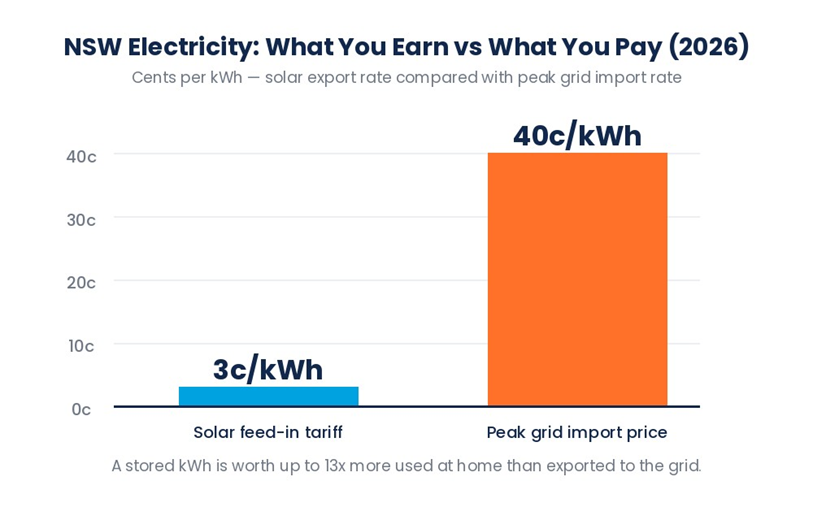
NSW Electricity. What you earn vs what you pay

The Best Solar Batteries in Australia for 2026

Not every battery suits every home. Independent reviewers assessed performance, warranty terms, safety and expandability for the 2026 season. According to Solar Choice’s 2026 Battery Scorecard, the strongest performers this year include GoodWe, Enphase, Alpha ESS, Sigenergy and Sungrow. Each earns its place for different reasons.

  • Sigenergy SigenStor suits homes that want a modular system they can expand later.
  • Tesla Powerwall 3 remains popular for its smart app, and it can provide backup power when installed with backup set up.
  • Sungrow and Alpha ESS offer strong value for money on mid-size homes.
  • GoodWe’s newer modular range suits budget-conscious retrofits.
  • Enphase batteries pair well with existing microinverter solar systems.

Picking the right battery is only half the job. The solar battery company installing it decides whether you get proper sizing, honest advice and paperwork done correctly. A brilliant battery installed too small, or by an unaccredited installer, will underperform no matter how good the brand is. Always confirm your installer holds current SAA accreditation before signing anything.

How Much You Can Actually Save

Savings vary a lot by household. As a rough guide only, based on [add source] and typical NSW tariffs, a well-sized 10kWh battery may save around $600 to $900 a year, 13–14kWh around $900 to $1,400, and 16kWh-plus around $1,200 to $2,000, depending on your evening usage, tariff and VPP. Your quote will show an estimate for your home.
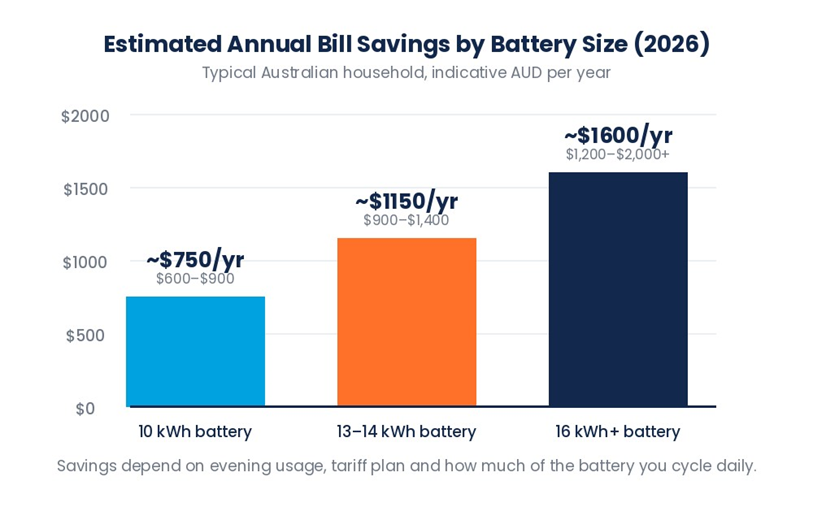
Estimated annual bill savings by battery size,

Payback periods have shortened as prices fall and rebates apply. Battery payback periods vary depending on installation cost, household electricity usage, tariff structure, available incentives and battery performance. Your installer should provide an estimate based on your individual circumstances. Homes with high evening use, an electric vehicle, or a Virtual Power Plant (VPP) agreement often break even faster. If you join an eligible VPP, the NSW Peak Demand Reduction Scheme may add an extra incentive (the amount depends on your battery size and current scheme rules). This can stack on top of the federal rebate.

Run your own numbers before committing. A battery only saves real money when it replaces electricity you would otherwise buy at peak rates.

The Federal Rebate: Still Worth It in 2026?

The federal Cheaper Home Batteries Program remains the biggest lever for cutting upfront cost. It still gives eligible batteries an upfront discount, funded through small-scale technology certificates rather than a cheque you wait for. The amount depends on the battery’s usable size and the current STC rate. Your installer applies the discount directly to your quote.

The catch is timing. The STC factor that sets your rebate value steps down every six months through to 2030. It dropped from 8.4 to 6.8 STCs per usable kilowatt-hour on 1 May 2026, and it will keep falling. Larger batteries above 14kWh now receive a tapered rate on the extra capacity.

None of this means you should rush. We covered this timing question in our guide on why 2026 is a turning point for solar batteries in Australia. The smarter question is not how fast you move. It’s whether your home, solar system and usage pattern are actually ready. A rebate saving of a few hundred dollars means little if you end up with the wrong battery size.

For the current rebate rate and eligibility rules, check the official Cheaper Home Batteries Program page on the Department of Climate Change, Energy, the Environment and Water website, since figures are updated as the STC factor steps down.

How to Choose the Right Battery for Your Home

Start with your electricity bills, not the battery brand. Look at how much power you use after the sun goes down. A family running the oven, dishwasher and air-conditioning from 5pm needs a bigger battery. A household that’s out most evenings needs less.

Next, check your solar system’s age and output. A battery charges from your panels, so a tired 10-year-old system limits how much you can store. Confirm your installer’s SAA accreditation directly, rather than taking their word for it.

The Clean Energy Council publishes an approved battery list, and Solar Accreditation Australia (SAA) lists accredited installers. You can check both yourself. Finally, check your eligibility for the federal rebate on the government’s Cheaper Home Batteries Program page. Requirements around installation and battery size do change.

A well-sized battery, fitted by an accredited installer, can deliver real savings. The marketing on the box doesn’t.

Frequently Asked Questions

1. What is the best solar battery in Australia in 2026?

There is no single best battery for every home. Solar Choice’s 2026 Battery Scorecard rates GoodWe, Enphase, Alpha ESS, Sigenergy and Sungrow among the top performers, and Tesla Powerwall 3 remains a popular choice. The right choice depends on your budget, solar system size and evening electricity use.

2. How much can a solar battery save on electricity bills?

As a rough guide, savings may range from about $600 to $2,000 a year, depending on battery size, your tariff and how much power you use after sunset. Your results will vary. Larger batteries paired with high evening usage generally deliver the biggest annual savings.

3. Is the federal battery rebate still available in 2026?

Yes. The Cheaper Home Batteries Program still discounts eligible batteries by around 30%, though the rebate rate steps down every six months until 2030.

4. How long does a solar battery take to pay for itself?

Payback often falls around seven to nine years, but it depends on your price, usage, tariff and rebates. Homes with high evening usage, an EV, or a VPP agreement often pay back faster.

5. Do I need a big battery to save money?

Not necessarily. A correctly sized battery matched to your evening usage saves more, on average, than an oversized one that never fully cycles each night.

Get a Free, No-Obligation Battery Quote

Ready to see what a solar battery would actually save on your bills? Solar Battery Outlet gives free, no-obligation quotes for homeowners across Liverpool, Bankstown and Mudgee. We check your bills and assess your existing solar system. Then we recommend a battery size that matches your real usage, not the biggest box we can sell.

Call 1800 000 777 or visit solarbatteryoutlet.com.au to get started.

Disclaimer

This article is general information only and does not constitute financial, legal or personalised energy advice. Savings figures, rebate amounts and payback periods are estimates. They’re based on publicly available data and typical household usage, so your actual results will vary. Battery pricing, rebate rates and feed-in tariffs change regularly. They may differ from the figures shown here by the time you read this. Always seek personalised advice before making a purchasing decision. This content does not constitute an offer. Nothing here should be read as a guarantee of savings, performance or rebate eligibility.
Every solar battery wears out eventually. That is normal, not a fault. But most homeowners install a battery and never ask what happens next.

This guide explains exactly that. You will learn how long a home battery lasts and the warning signs of decline. You will also learn your realistic options once it stops performing well. We also cover how battery recycling works in Australia. As a result, you can plan ahead instead of being caught off guard in ten years’ time.

How Long Does a Home Solar Battery Actually Last?

Most residential batteries installed in Australia today use lithium iron phosphate (LFP) cells. This chemistry is stable, and it generally outlasts older lithium-ion types.

In practice, a home battery typically performs well for 10 to 15 years. That is usually somewhere between 6,000 and 10,000 full charge cycles, whichever limit arrives first.

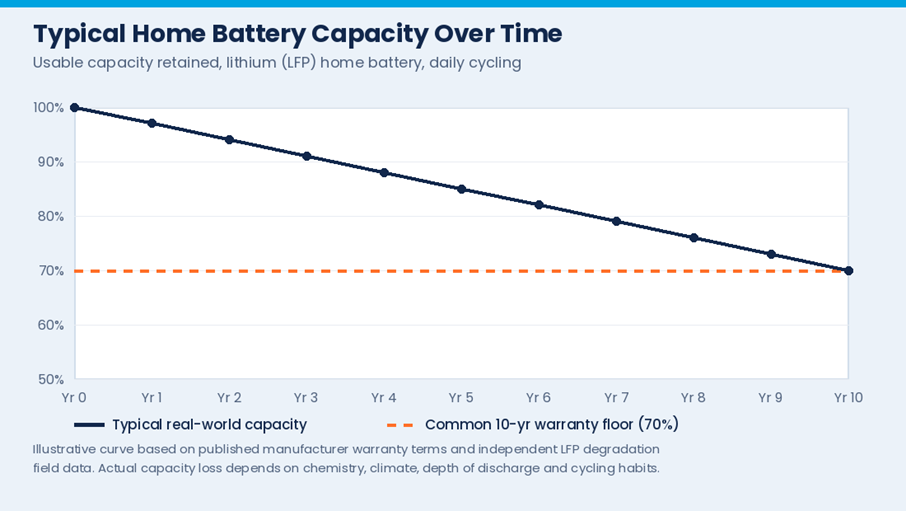
Manufacturers back this with a warranty, usually running for 10 years. However, a warranty does not promise perfect performance forever. Instead, it guarantees a minimum capacity by a set date. Most brands guarantee at least 70% of original capacity at the 10-year mark. Some premium brands go further, promising 80% capacity or offering 12 to 15-year cover.

That gap between “still working” and “still under warranty” matters. A battery often keeps charging well past its warranty period. Even so, it stores slightly less energy every year. The chart below shows a typical LFP degradation curve against a common 10-year warranty floor.

typical home battery capacity retention over 10 years compared with a common warranty floor

Understanding this curve helps you plan a realistic replacement timeline, rather than guessing.

Signs Your Solar Battery Is Nearing End of Life

A battery rarely fails without warning. Instead, it usually shows gradual signs first:

  • Shorter backup time — it empties faster than before, even with the same usage.
  • Slower charging — it takes longer to reach full charge from solar.
  • App or portal alerts — many systems flag reduced capacity or cell imbalance automatically.
  • Physical changes — swelling, unusual heat, or a burning smell.
  • Frequent inverter errors — an ageing battery management system throws more fault codes.

If you notice any physical warning sign, switch the battery off immediately. Then call your installer or the manufacturer straight away. This is a safety matter, not routine ageing.

For the more common gradual signs, check your battery’s app first. Most systems display remaining capacity as a percentage of the original rating. A steady decline is expected. A sudden drop, however, usually points to a fault worth investigating sooner rather than later.

What Actually Happens Inside the Battery as It Ages

Lithium batteries degrade through normal chemistry, not sudden breakdown. Every charge and discharge cycle causes tiny, permanent changes inside the cells. Heat, deep discharges, and constant full charging all speed this process up slightly.

This is why installers usually recommend keeping a battery between roughly 20% and 90% charge day-to-day, where practical. It also explains why batteries in a shaded, cool spot often outlast those on a hot garage wall.

None of this means your battery will suddenly stop working. Degradation is gradual and predictable, not a cliff edge. Most homeowners simply notice a slightly shorter evening of coverage each year, long before real replacement is needed.

Your Options When a Battery Reaches End of Life

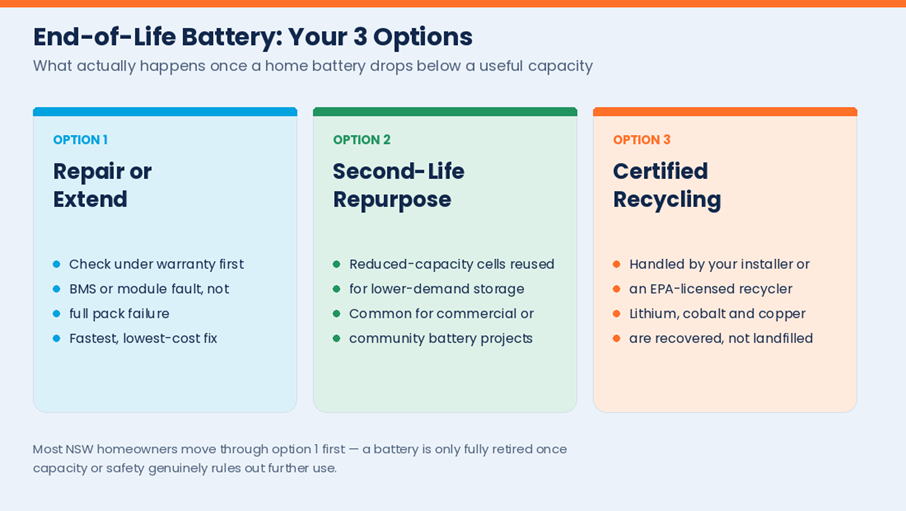
Once a battery drops to a genuinely unhelpful capacity, you generally have three paths forward.

Three options for an end-of-life solar battery: repair or extend, second-life repurpose, or certified recycling

First, repair or extend. If the fault sits in the battery management system or a single module, a repair can restore normal performance. This is always worth checking, particularly while the battery remains under warranty.

Second, second-life repurposing. A battery that no longer suits daily home cycling can sometimes serve a lower-demand role, such as backup-only storage. Several Australian projects are already trialling repurposed cells for community and commercial storage.

Third, certified recycling. When a battery is genuinely finished, recycling recovers valuable materials such as lithium, copper and aluminum for reuse. This is the appropriate option once a battery is damaged, unsafe, or beyond a useful capacity.

A trustworthy installer will walk you through all three options honestly. It will not jump straight to a full replacement quote.

How Solar Battery Recycling Works in Australia

Home battery recycling differs from recycling everyday household batteries. B-cycle, Australia’s national battery stewardship scheme, handles small batteries from remotes, torches, and power tools. However, B-cycle drop-off points do not accept home energy storage batteries. These units are too large, and they need specialist handling.

Instead, a home battery should go back through your installer, the manufacturer’s take-back program, or a licensed lithium battery recycler. These facilities are accredited to safely dismantle and process large lithium batteries.

Never place a home battery in general waste or a household recycling bin. Damaged or swollen lithium cells are a genuine fire risk. They must be stored and transported under strict safety guidelines.

The good news is that lithium batteries are highly recyclable. Materials such as lithium, cobalt, nickel, and copper can be recovered and reused in new batteries. This reduces the need for fresh mining. Government-backed programs continue expanding accredited recycling pathways as more home batteries reach end of life. For more detail on what the scheme accepts, see the Australian Government’s overview of household battery recycling.

What This Means for Your Warranty and Rebate Paperwork

Keep your original battery documentation. This includes the installation certificate, warranty terms, and any rebate paperwork from schemes such as the federal battery rebate. If your battery develops a fault within its warranty period, this paperwork speeds up any claim considerably.

It also matters when you sell your home. Buyers and conveyancers increasingly ask about remaining battery warranty and expected lifespan, much like they ask about solar panel age. Keeping records organised now saves confusion later.

Planning Ahead: Budgeting for Battery Replacement

A solar battery is a long-term asset, not a one-off purchase. Consequently, it is worth budgeting for eventual replacement, much like a hot water system or roof.

Battery prices and technology continue to shift quickly. Our guide on solar batteries in Australia in 2026 and why this is a turning point covers those trends.

Setting aside a small amount each year, or reviewing your battery’s health annually, avoids financial surprises later. A well-maintained battery usually serves its full warranty period comfortably, and often longer.

Talk to a Trusted Solar Battery Company Before You Decide

If your battery is showing signs of ageing, do not guess. A qualified solar battery company can test its actual remaining capacity, check warranty status, and explain your realistic options honestly.

We are a Liverpool-based solar battery installer, part of GWM Group, servicing homes across Liverpool, Bankstown, and Mudgee. Our SAA-accredited installers can assess your existing battery, advise on repair versus replacement, and manage recycling paperwork if needed.

Call us on 1800 000 777, or visit solarbatteryoutlet.com.au to book a free, no-obligation battery health check. No pressure, no countdown timers — just honest advice about your system.

Frequently Asked Questions

How long do solar batteries last in Australia?

Most lithium (LFP) home batteries last 10 to 15 years. They are typically backed by a manufacturer warranty of around 10 years, guaranteeing a minimum capacity, often 70%.

Can I put my old solar battery in a B-cycle bin?

No. B-cycle only accepts small household batteries. Home energy storage batteries must go through your installer, the manufacturer, or a licensed lithium battery recycler.

Does a battery warranty cover normal capacity loss?

Warranties guarantee a minimum capacity, commonly 70%, by a set year. Losing some capacity down to that level is normal. If it drops below the guaranteed level within the warranty period, you can usually make a claim. Your rights under Australian Consumer Law also apply on top of the warranty.

What happens to the materials inside an old solar battery?

Certified recyclers recover lithium, cobalt, nickel, and copper for reuse in new batteries. This reduces landfill risk and lowers demand for new mining.

Should I repair, repurpose, or replace an ageing battery?

It depends on the cause. A faulty module can often be repaired. A battery with reduced but stable capacity may suit second-life use. Full replacement suits batteries that are damaged, unsafe, or below a useful capacity.

Disclaimer

This article provides general information about solar battery lifespan, warranty terms, degradation, and recycling in Australia. It does not constitute financial, legal, or technical advice. Battery lifespan, warranty terms, and capacity retention vary by brand, model, installation conditions, and usage pattern. Figures referenced are illustrative industry benchmarks, not guarantees for any specific product. Always check your own product documentation for exact terms. Recycling requirements and accepted battery types may also vary by state and provider.

Selling your home doesn’t mean losing the value of your solar investment. Understanding what happens to your solar battery when you sell your house can protect real value. It can also prevent last-minute contract disputes.

A battery raises questions a standard property sale doesn’t. Is it a fixture, or can you remove it? What happens to your VPP contract? Does the warranty transfer to the new owner? This guide answers each question for NSW homeowners in 2026, from contract wording through to buyer due diligence.

Is Your Solar Battery a Fixture or Something You Can Take?

Under NSW property law, anything permanently attached to a house usually becomes part of the land. Conveyancers call this a fixture. Solar panels are treated this way, and a wall-mounted or garage-fixed battery generally follows the same principle.

That means your battery normally passes to the buyer automatically, unless the contract says otherwise. According to Bartier Perry’s guidance on solar panels in a contract of sale, vendors should list every doubtful item clearly. Each item should be listed either as an inclusion or an exclusion to avoid disputes after settlement.

If you plan to take the battery with you, list it as an exclusion before you exchange contracts. If you’re leaving it behind, list it as an inclusion for clarity. Ambiguity causes disputes, not the battery itself. Talk to your conveyancer early, since a battery is a far more expensive asset than panels alone.

How Much Value Does a Solar Battery Add at Sale?

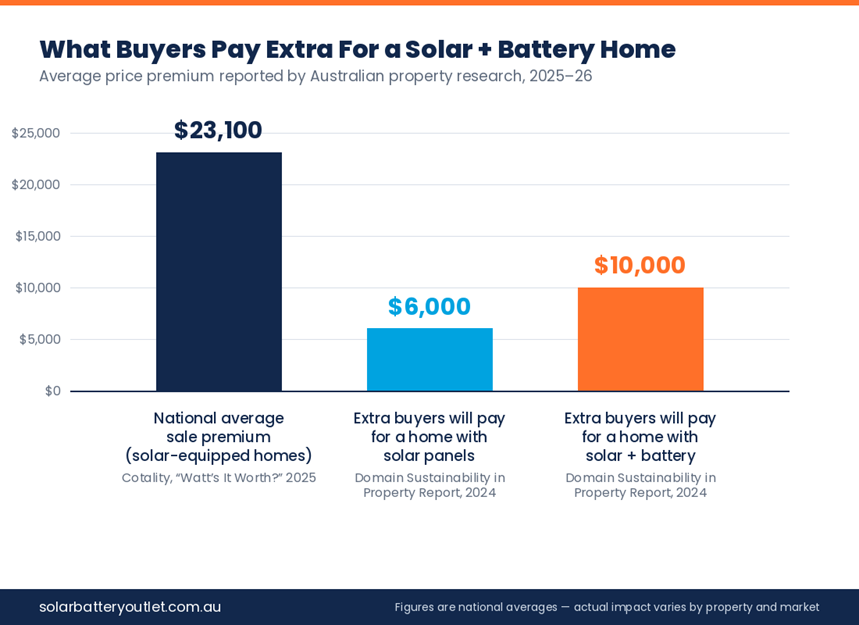
A solar battery isn’t just a fixture question. It’s also a value question. National data shows solar-equipped homes sell for an average 2.7% premium, worth around $23,100, according to Cotality’s 2025 property research.

Battery storage appears to lift this further. Domain’s Sustainability in Property Report found many buyers will pay $6,000 more for solar alone. Close to 60% said they’d pay at least $10,000 more for a home with both solar and a battery.

home sale price premiums for solar and solar-plus-battery properties in Australia

This buyer appetite reflects a bigger shift. Australia is moving through what many call a turning point for solar adoption. Buyers increasingly expect energy resilience as standard, not as a bonus. Presenting your battery’s specifications and savings history can help justify a stronger asking price.

Sort Out Your VPP Contract Before You List

Many NSW batteries are enrolled in a Virtual Power Plant (VPP), earning bill credits for exported power. This contract sits with you, the account holder, not automatically with the property.

Before listing your home, check three things. Does your VPP contract end automatically when you move? Can it transfer to the new owner? Are there exit fees for leaving early?

Some providers allow a straightforward transfer. Others require the buyer to sign a fresh agreement. Either way, tell your real estate agent about the VPP arrangement early. It should be disclosed during the sale, not discovered afterward.

Transferring Warranties and Handing Over Documentation

A well-documented battery reassures buyers and protects your sale price. Before settlement, gather your compliance certificate, product warranty, and your SAA-accredited installer’s details.

Most battery manufacturers offer warranties of 10 years or longer. Many are transferable to a new owner, but some require formal notification within a set period after the sale. Check your warranty terms, and notify the manufacturer if needed.

Handing over your monitoring app login, or transferring the account, also matters. It lets new owners track performance from day one. A simple folder of documents costs nothing and can make your listing far more attractive to informed buyers.

Selling a House With a Financed or Leased Battery

Some batteries are financed or leased rather than owned outright. If you still owe money on the system, settlement usually requires paying out the remaining balance. This works much like clearing a car loan before a sale.

Leased batteries are more complex. The finance company, not you, may own the equipment. Selling the house doesn’t automatically transfer a lease. Buyers may need to take over repayments, or you may need to pay out the lease before settlement.

Speak to your financier or a solar battery company early if this applies to you. Sorting the paperwork before you list avoids delays at exchange or settlement.

Do You Need to Disclose Rebates and Incentives?

If your battery was installed under a government incentive, honesty matters. Under the Cheaper Home Batteries Program, retailers must confirm the system is for permanent, ongoing use.

Selling your house with the battery still installed generally doesn’t breach this condition. The equipment stays in permanent use; only the owner changes. Problems can arise if you remove the battery to take it with you, since this may affect the rebate’s standing.

Under Australian Consumer Law, you must not mislead a buyer about rebates, warranties, or system condition. If unsure how a rebate interacts with your sale, check with the Clean Energy Regulator or your conveyancer.

A Quick Checklist for Sellers

  • Confirm whether the battery is included or excluded in the contract of sale
  • Review your VPP contract for transfer or exit conditions
  • Gather compliance certificates, warranties, and installer details
  • Pay out or transfer any battery finance or lease
  • Brief your real estate agent on the system’s specifications and savings
  • Notify your battery’s manufacturer or retailer of the change of ownership

What Buyers Should Check Before Making an Offer

Buyers benefit from due diligence too. Before making an offer, ask whether the battery is included in the sale price. Request the compliance certificate and the remaining warranty period.

Check whether a VPP contract is attached, and read its terms rather than assuming it transfers automatically. Ask for recent performance or savings data if the seller has it available.

A well-documented, SAA-approved battery is a genuine asset. An undocumented one is a question mark. A few questions before exchange can save confusion after settlement.

Does a solar battery automatically stay with the house when it’s sold?

Generally, yes. A battery fixed to the property is treated as a fixture under NSW law. It passes to the buyer unless the contract of sale excludes it.

Can I take my solar battery with me when I move?

Yes, but you must list it as an exclusion in the contract of sale before exchange. Removal must be done by a licensed electrician, and taking the battery may affect the rebate you received — check with the Clean Energy Regulator first. Removing it without disclosure can lead to a dispute or a compensation claim.

Does selling my house affect my battery rebate?

Selling a house with the battery still installed generally doesn’t affect a rebate like the Cheaper Home Batteries Program. The system stays in permanent use, and removing the battery may be treated differently.

What happens to my VPP contract when I sell?

It depends on the provider. Some VPP contracts transfer to the new owner, while others end automatically or require a new agreement. Always check the contract terms before listing.

Does a solar battery increase my home’s sale price?

It can. National research shows solar-equipped homes sell for a measurable premium. Many buyers also report they would pay more for a home with both solar and a battery.

A solar battery can be one of the most attractive features on your listing, if it’s handled correctly. Sort your VPP contract, gather your documentation, and disclose your rebate history before you list. Buyers respond well to transparency, and it protects you from disputes after settlement.

If you’re planning a sale in Liverpool, Bankstown, or Mudgee, our team can help. We can walk you through your battery’s transferability and next steps. Contact Solar Battery Outlet today for tailored advice before you list.

Disclaimer

This article provides general information about solar batteries and property sales in NSW as of 2026. It is not personal financial, energy, or legal advice. Rules around fixtures, rebates, and VPP contracts can vary by contract, provider, and individual circumstances. Confirm rebate and warranty conditions with the relevant provider, and consult a licensed conveyancer for contract advice. Always seek personalised advice before making a purchasing decision.