Solar battery storage is no longer a niche add-on. It is now the standard next step for Australian homes with rooftop solar. But one question trips up almost every homeowner. How much solar battery storage do you actually need?
Buy too small, and you miss out on evening savings. Buy too large, and you pay for capacity you rarely use. Get the size wrong, and your payback period stretches out for years.
This guide breaks down real 2026 data on household electricity use. It also covers current battery sizing trends across Australia, plus a simple framework for your own home. We look at how the Cheaper Home Batteries Program rebate now rewards right-sized systems over oversized ones.
Maybe you live in a two-person unit in Bankstown. Or maybe it’s a large family home in Mudgee. Either way, the answer depends on your evening usage, not a one-size-fits-all number.
What Does “Average” Really Mean for Solar Battery Storage?
“Average” hides more than it reveals. National figures blend one-person apartments with five-bedroom family homes. Before you size a battery, you need to understand two different numbers.
Nominal capacity is the total energy a battery can technically store. Usable capacity is what you can actually draw down, once the manufacturer’s depth-of-discharge limit applies. Most modern lithium batteries release 90 to 95 percent of nominal capacity. So a “13.5 kWh” battery often delivers closer to 12.5 kWh of usable energy per cycle.
This distinction matters at quote time. Rebate calculations, sizing guides, and marketing material sometimes mix the two figures together. Always ask your installer which number they are quoting. That way, you compare every brand on equal terms.
How Much Electricity Does the Average Australian Home Use Per Day?
Household electricity use is the real starting point for battery sizing. Your roof size matters less than your evening habits. Benchmark data from the Australian Energy Regulator shows daily use climbs steadily with occupancy.
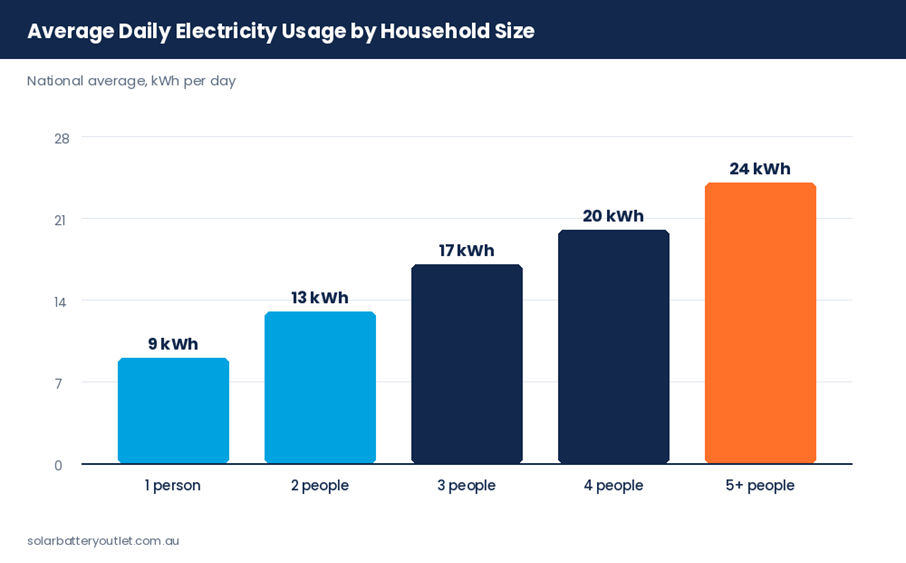
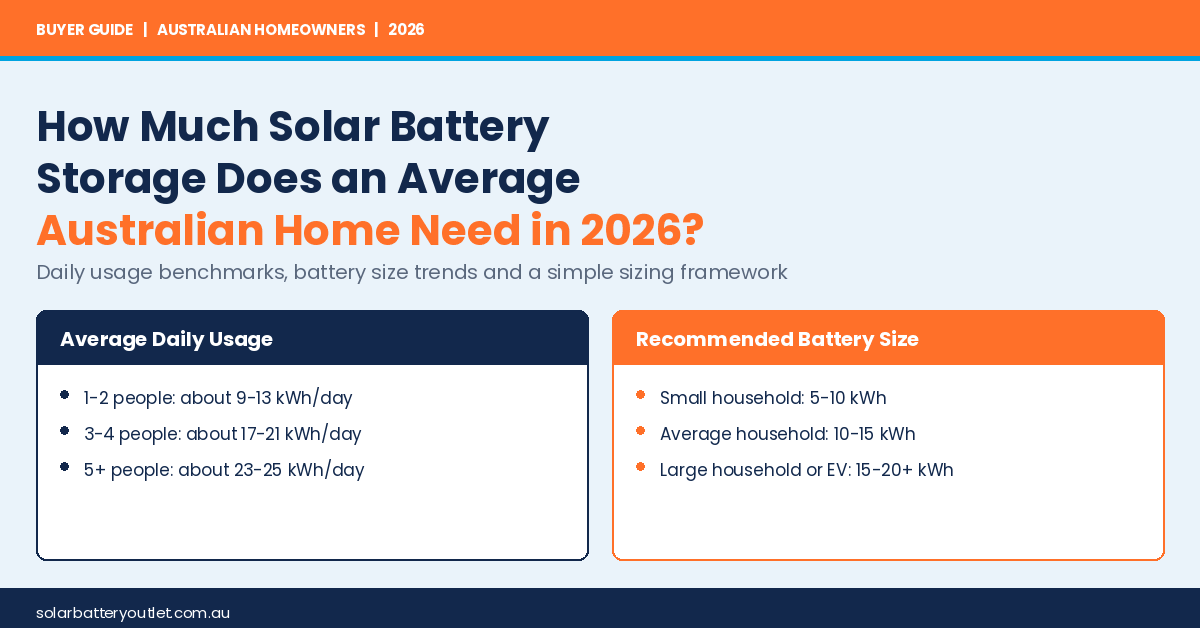
A single-person household typically uses around 9 kWh per day. A two-person household sits closer to 13 kWh. A family of four climbs to roughly 20 kWh per day. Larger households with five or more people often use 23 to 25 kWh per day.
These figures cover the whole day, though. Your battery only needs to cover the hours after the sun goes down. Many Australian homes use a large share of their daily electricity in the evening — check your own bill or smart meter app. So your real target is smaller than your total daily figure suggests.
What Is the Average Solar Battery Size Installed in Australia Right Now?
Battery sizing trends have shifted fast. According to SunWiz market reporting, average nominal battery size rose from 11.8 kWh in 2024 to 21.6 kWh in 2025. Australia added more than 221,000 residential battery systems in 2025 alone. Battery ownership now sits at 4.6 percent of Australian homes.
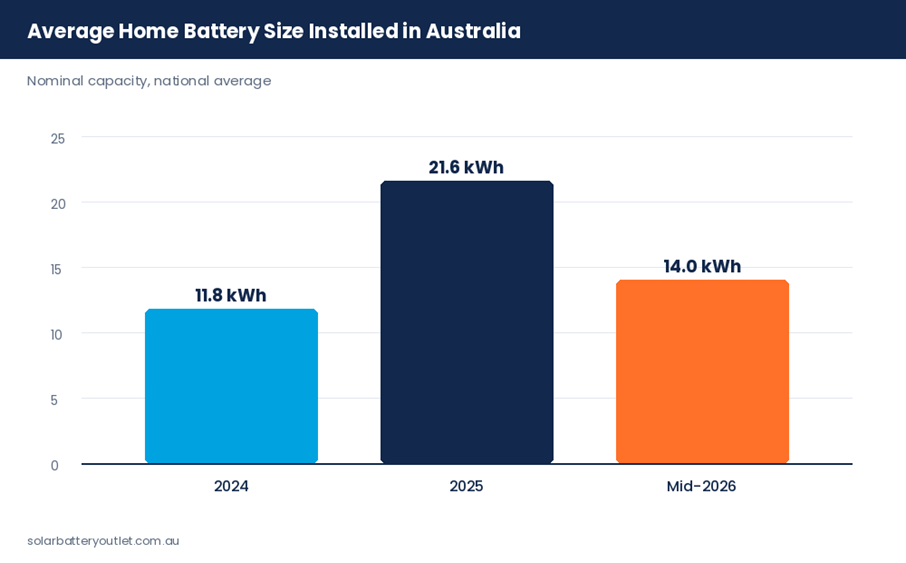
That growth is not only about backup power. Larger batteries let households participate more fully in Virtual Power Plants. They also help households cover more of their own evening use.
Even so, bigger is not automatically better for every home. The federal Cheaper Home Batteries Program is run through the Department of Climate Change, Energy, the Environment and Water. It now applies a tapered rebate structure above 14 kWh of usable capacity. We covered the mechanics of that change in our guide on whether you should rush before a rebate drops. For most households, a right-sized system between 10 and 15 kWh captures the strongest rebate value.
A Simple Four-Step Framework to Size Your Solar Battery Storage
Use this framework before you request a quote. It keeps the sizing decision grounded in your own numbers, not a generic recommendation.
Step 1: Find your evening usage. Check your bill or smart meter app for consumption between 4pm and 10pm. This is the window your battery needs to cover.
Step 2: Match capacity to that figure. Do not size against your total daily use. Your solar panels already cover most daytime consumption directly.
Step 3: Add a buffer for future changes. If an EV, a pool, or a larger family is on the horizon, add headroom now. Roughly 20 percent extra on your evening figure is a sensible buffer.
Step 4: Check the 14 kWh rebate threshold. Staying under it currently maximises your rebate per kilowatt-hour.
Work through these steps with your last three electricity bills in hand. Most households land between 10 kWh and 15 kWh once they finish the exercise.
Solar Battery Size Guide by Household Type
Every home is different. But these ranges give you a sensible starting point before your installer runs the numbers. Light evening users in one or two-person households often do well with 5 to 8 kWh. Average families of three or four generally suit 10 to 13.5 kWh.
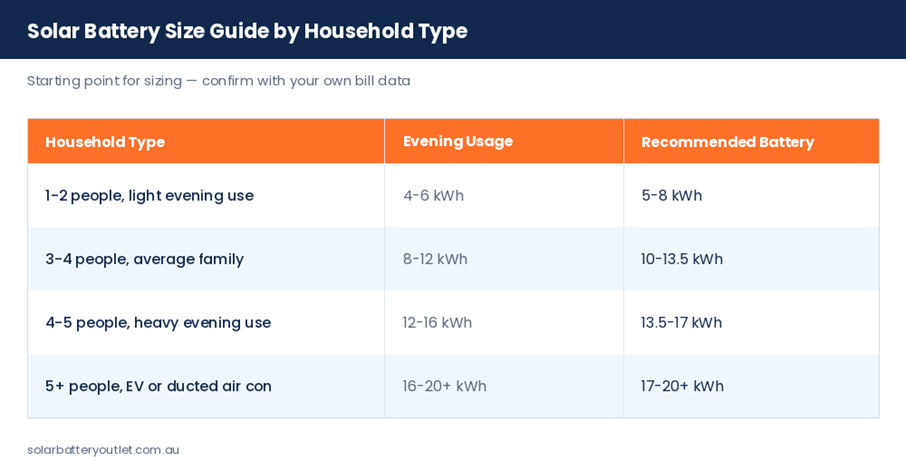
Larger households with heavier evening demand may need 13.5 to 17 kWh. Homes with an EV or ducted air conditioning often push past 17 kWh. Treat this table as a starting conversation, not a final answer. A good installer will always confirm sizing against your actual usage pattern first.
Solar Batteries Liverpool: A Local Example of Right-Sizing
A four-person family in Liverpool recently asked us to review their quote for a 20 kWh battery. Their evening usage, pulled from twelve months of bills, averaged only 11 kWh. A 20 kWh system would have cost thousands more upfront. Most of that extra capacity would have gone unused most nights.
We recommended a 13.5 kWh system instead. We sized it with headroom for an EV they plan to buy next year. It qualified for the full rebate rate and matched their real usage. This is exactly why solar batteries Liverpool households choose should always start with a bill review, not a brochure size.
Getting Solar Batteries Installation Right the First Time
Correct sizing only pays off with a correct installation. Every solar batteries installation should start with a review of your last twelve months of bills. It should never start with a guess based on your home’s floor plan.
Ask your installer for their SAA accreditation number before you book. Confirm it directly through the SAA database. A trustworthy installer will show the rebate as a dollar figure on your written quote, not just a verbal promise.
Why Bigger Is Not Always Better: Rebate Tapering Explained
The Cheaper Home Batteries Program calculates your discount using Small-scale Technology Certificates. These are administered through the Clean Energy Regulator. From 1 May 2026, the STC factor tapers across battery capacity bands. Support drops sharply for systems above 14 kWh.
In practice, this means an oversized battery can cost you twice. You pay more upfront for capacity you rarely use. You also receive a smaller rebate percentage on the portion above the threshold. Right-sizing your battery to your actual evening usage pays off twice over. It protects your upfront cost, and it protects your rebate value.
Frequently Asked Questions
Most Australian homes need a solar battery between 10 kWh and 15 kWh of usable capacity. The exact figure depends on your evening electricity use and household size. It also depends on whether you plan to add an EV or another major appliance.
NSW households typically use between 15 and 20 kWh per day. This depends on household size and climate. A family of four in NSW commonly uses close to 20 kWh daily, based on AER benchmark data.
No. Batteries above 14 kWh receive a reduced rebate rate under the Cheaper Home Batteries Program from 1 May 2026. Oversized systems also cost more upfront for capacity many households never fully use.
Check your bill or smart meter app for usage between 4pm and 10pm. That is the window your battery covers. Match your battery’s usable capacity to that evening figure, then add a small buffer.
Yes. Daily electricity use rises with household size. It ranges from around 9 kWh for one person to 23-25 kWh for five or more people, per AER data.
You can still install a larger battery. But the rebate value tapers above 14 kWh of usable capacity under current program rules. Confirm the exact rebate figure with your installer before you sign.
Not sure which battery size fits your home? Solar Battery Outlet offers free, no-obligation quotes for homeowners across Liverpool, Bankstown, and Mudgee. We review your last twelve months of bills and confirm your evening usage. Then we recommend a system sized to your home, not a brochure figure. Call 1800 000 777 or fill in our 60-second eligibility form to get started.
Disclaimer
This article provides general information about solar battery sizing and the Cheaper Home Batteries Program as at August 2026. Battery sizing, electricity usage, and rebate figures vary by household, location, and provider. Program rules may also change over time. Nothing in this article constitutes financial, legal, or professional advice. Always seek personalised advice before making a purchasing decision.
