A solar battery warranty looks simple on a quote. The paperwork says “10 years”, and most buyers stop reading there. However, the real terms run deeper. Your solar battery warranty usually ends when you reach the first of three limits: years, cycles or throughput. This guide explains each limit in plain English. You will also learn what a 10-year warranty actually covers and what it often leaves out.
| Quick answer: A typical 10-year solar battery warranty covers manufacturing defects and a guaranteed minimum capacity, often 60% to 70%. Cover ends at the first limit you reach: the time limit, a cycle cap or a throughput cap in MWh. Terms vary by brand and model, so read the warranty document before you buy. |
What Is a Solar Battery Warranty?
A solar battery warranty is a written promise from the manufacturer. It sets out how long the maker will repair or replace a faulty battery. Most warranties cover two things. First, the product warranty covers defects in materials and workmanship. Second, the performance warranty guarantees a minimum capacity at the end of the term.
In simple terms, capacity means usable energy, measured in kilowatt-hours (kWh). Also, most modern home batteries use lithium iron phosphate (LFP) chemistry. Over time, every battery loses some capacity. The warranty sets how much loss the manufacturer accepts before it steps in.
Importantly, a warranty is not the same as a lifespan. A battery can keep working after the warranty ends. Likewise, a battery can lose its cover early if you reach a usage limit.
The Three Solar Battery Warranty Limits: Years, Cycles and Throughput
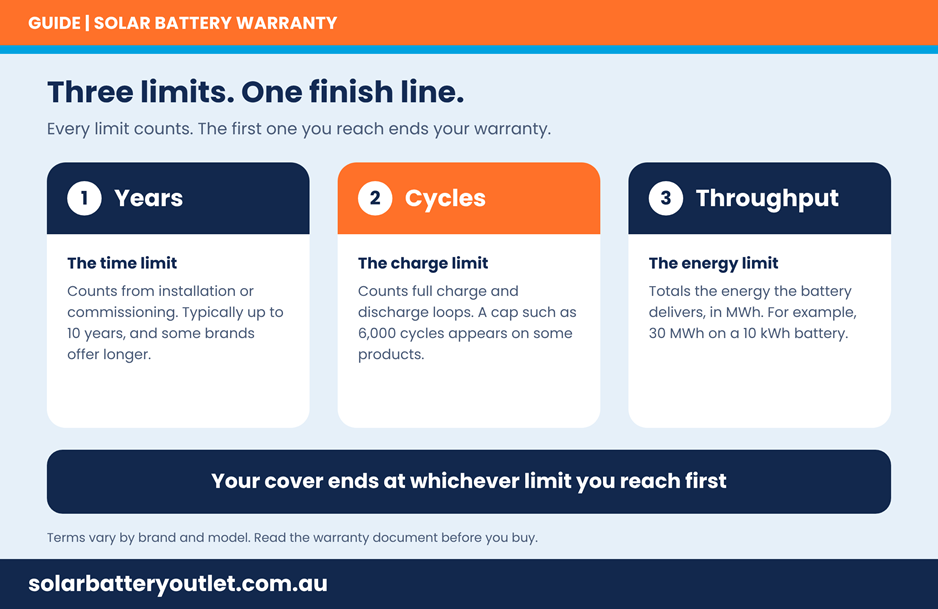
Most Australian battery warranties combine up to three limits. The warranty ends at whichever limit you reach first. Therefore, you need to understand all three before you sign.
Years: the time limit
The time limit usually counts from installation or commissioning. Ten years is common for home batteries, and some brands offer longer terms. In addition, check the start date in writing. Some warranties may count from a different date.
Cycles: the charge limit
A cycle is one full charge and discharge. Two half-discharges add up to one cycle. Some manufacturers rate their batteries at around 6,000 cycles. Others set different caps, and some set none. Always confirm the exact figure for your model.
Throughput: the energy limit
Throughput is the total energy a battery delivers over the warranty. Manufacturers measure it in megawatt-hours (MWh), and one MWh equals 1,000 kWh. Throughput combines cycles and depth of discharge into one number. For example, a 10 kWh battery with a 30 MWh limit supports about 3,000 full cycles. Some makers instead state throughput as a multiple of nominal capacity.
How Quickly Do You Reach the Throughput Limit?
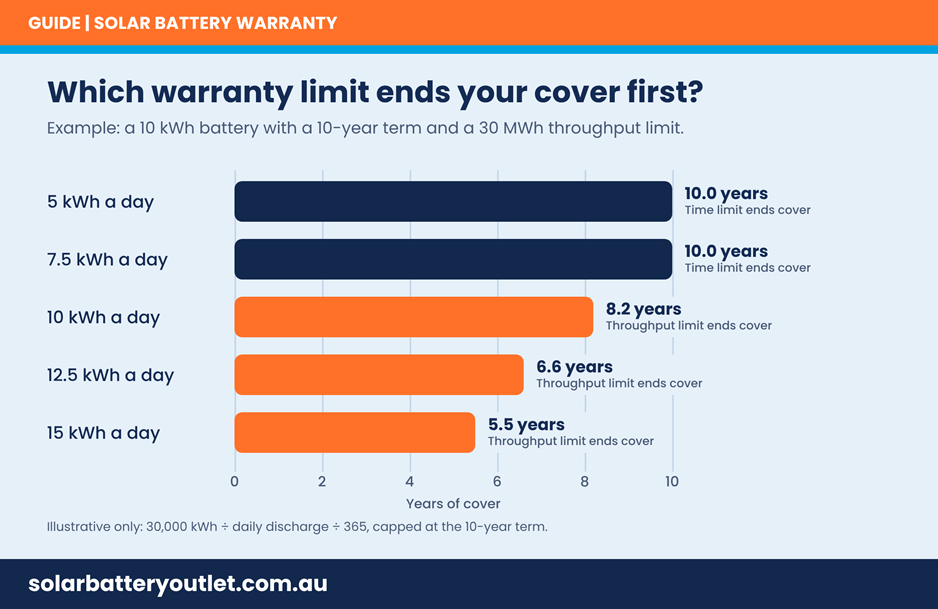
Naturally, heavy daily use drains the throughput allowance faster. Consider a hypothetical 10 kWh battery with a 10-year term and a 30 MWh limit. At 5 kWh a day, you need 16.4 years to reach 30 MWh. As a result, the 10-year time limit ends your cover first.
At 10 kWh a day, you reach the throughput limit in 8.2 years. At 15 kWh a day, you reach it in about 5.5 years. Consequently, a large household with high evening use can use up its allowance early. In contrast, a light user will likely finish the full term.
This example uses made-up figures, not a real product. Instead, use your own battery size and daily usage. Ask your installer to run the numbers for your home.
What Does Capacity Retention Mean?
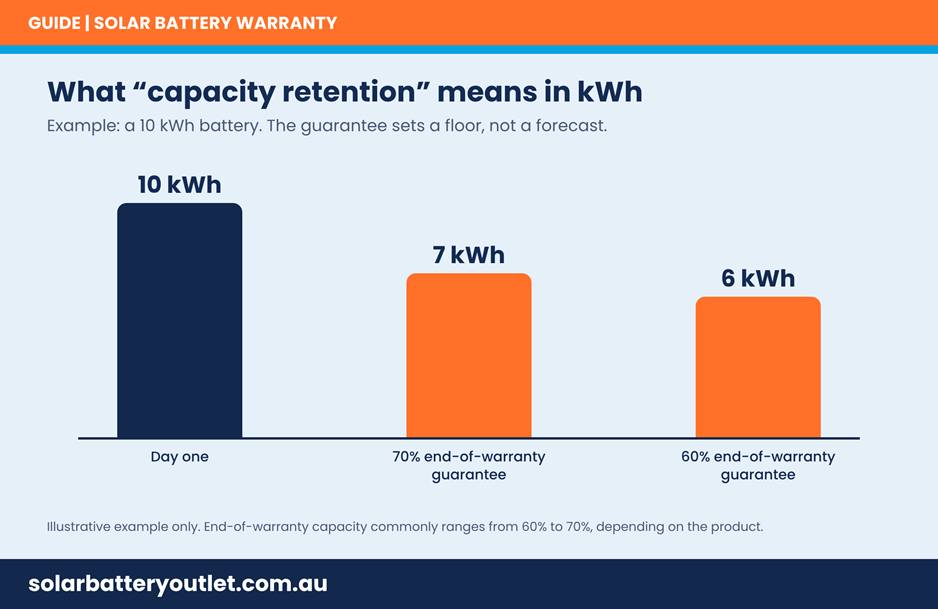
Capacity retention is the minimum capacity the maker guarantees at the end of the warranty. Many warranties set it between 60% and 70%. On a 10 kWh battery, a 70% guarantee means at least 7 kWh remains. Similarly, a 60% guarantee means at least 6 kWh.
In short, this figure sets a floor, not a forecast. Your battery may hold more. Still, compare the number across brands. Also check how the maker measures it, including the test conditions.
What Does a 10-Year Solar Battery Warranty Actually Cover?
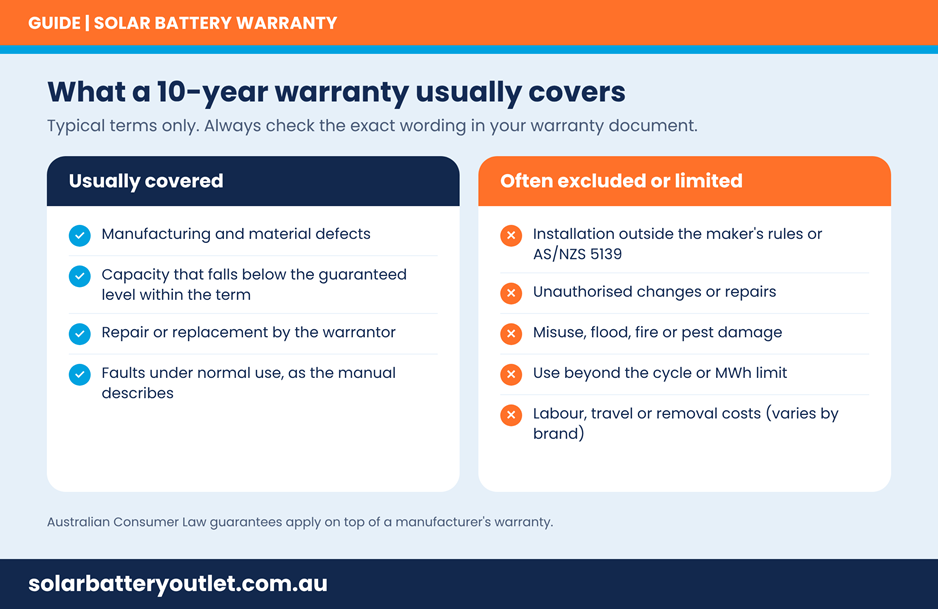
Most 10-year warranties cover similar core items. They typically cover manufacturing defects and capacity that falls below the guaranteed level. They also include repair or replacement by the warrantor.
However, exclusions matter just as much. Many warranties exclude installation that breaks the maker’s rules, unauthorised changes, and damage from misuse, flood, fire or pests. They also exclude use beyond the cycle or MWh cap. In addition, some warranties cover parts only, so labour, travel and removal costs can vary.
Finally, confirm who honours the warranty in Australia. Local support matters if a fault appears in year seven.
Conditions That Can Affect Your Warranty
Besides limits, warranties usually come with conditions. If you miss one, you may reduce your cover. Common conditions include:
- Installation by a suitably accredited installer, following AS/NZS 5139, the Australian and New Zealand standard for battery installations.
- Operation within the stated temperature range.
- An active internet connection or registration on some products.
- Charge and discharge within the rated limits.
- Compliance with the maker’s rules for virtual power plant (VPP) participation, because extra cycling can count toward your cap.
Therefore, ask your installer to point out each condition in the document. Also keep your invoice, commissioning paperwork and serial numbers.
Australian Consumer Law and the NETCC: Extra Protection
A manufacturer’s warranty does not replace your legal rights. Australian Consumer Law (ACL) consumer guarantees apply automatically. They include acceptable quality, durability and fitness for purpose. A manufacturer’s warranty cannot take these guarantees away. Your exact rights depend on your circumstances.
The New Energy Tech Consumer Code (NETCC) adds another layer. The Clean Energy Council administers this voluntary code, and the ACCC authorises it. The code includes this promise: “We will honour all guarantees and warranties you may be entitled to.” The ACCC reauthorised the code on 28 August 2026. Meanwhile, an updated version takes effect on 1 December 2026. Ask any seller whether it is a NETCC-approved seller, then check the NETCC website.
How the Cheaper Home Batteries Program Links to Your Warranty
The federal Cheaper Home Batteries Program lowers the upfront cost of eligible batteries. The battery must be Clean Energy Council (CEC) approved and meet AS/NZS 5139. Solar Accreditation Australia (SAA) accredited installers must complete the work.
Notably, the Clean Energy Regulator sets a minimum installation period. The battery must stay at your premises until after 2030, or until the warranty period ends. The later date applies. As a result, a 10-year warranty can extend how long the battery must stay in place. Program settings changed on 1 May 2026, so confirm the current rules before you sign.
Seven Questions to Ask Before You Buy
Next, use this checklist with every installer. Write down the answers, and compare them across quotes.
- What is the warranty term, and when does it start?
- Is there a cycle cap, and what is the figure?
- What is the throughput limit in MWh?
- What capacity does the maker guarantee at the end, and how does it measure that?
- Who handles claims in Australia, and who pays for labour and removal?
- Which installation, temperature and VPP conditions apply?
- Can I read the full warranty document before I sign?
| Not Sure What Your Battery Warranty Really Covers? Talk to Us First. No countdown timer. No pressure. Just clear answers. A solar battery warranty only helps if you understand it. Our team can read the warranty terms with you, explain the limits and compare quotes side by side. Call us: 1800 000 777, or fill in the 60-second eligibility form and we will be in touch. |
Solar Battery Warranty FAQs
Ten years is common for home batteries, and some brands offer longer terms. However, most warranties also include a cycle or throughput limit. Cover ends at the first limit you reach, so check all three.
A cycle counts one full charge and discharge. Throughput measures the total energy the battery delivers, in MWh. Throughput therefore captures both cycles and how deeply you discharge.
Your warranty ends at that point, even if the calendar term has years left. The battery may keep working. However, you would then lose the maker’s repair or replacement cover.
No. Most warranties guarantee a minimum capacity at the end of the term, often between 60% and 70%. Your battery will gradually lose some capacity during that time.
Not necessarily, but it depends on the manufacturer’s terms. VPP participation can add cycles, and those cycles count toward any cap. Therefore, confirm the details with your installer and the manufacturer in writing.
They can. Consumer guarantees apply for a reasonable period. That period depends on the product, its price and how you use it.
The New Energy Tech Consumer Code is a voluntary consumer protection code for solar and battery sellers. It covers marketing, quotes, installation, and warranties and support.
Disclaimer
This article gives general information about solar battery warranties only. It does not offer financial, legal or technical advice. Warranty terms vary by brand and model, and the examples use made-up figures that do not represent any specific product, performance or saving. Government program settings, STC amounts and NETCC requirements can change, so confirm the current details with the relevant authority. Always read the warranty document for your battery. Always seek personalised advice before making a purchasing decision.
| About Solar Battery Outlet: We are a Liverpool-based solar battery installer, part of GWM Group Pty Ltd. Talk to our team about warranty terms before you buy. |
