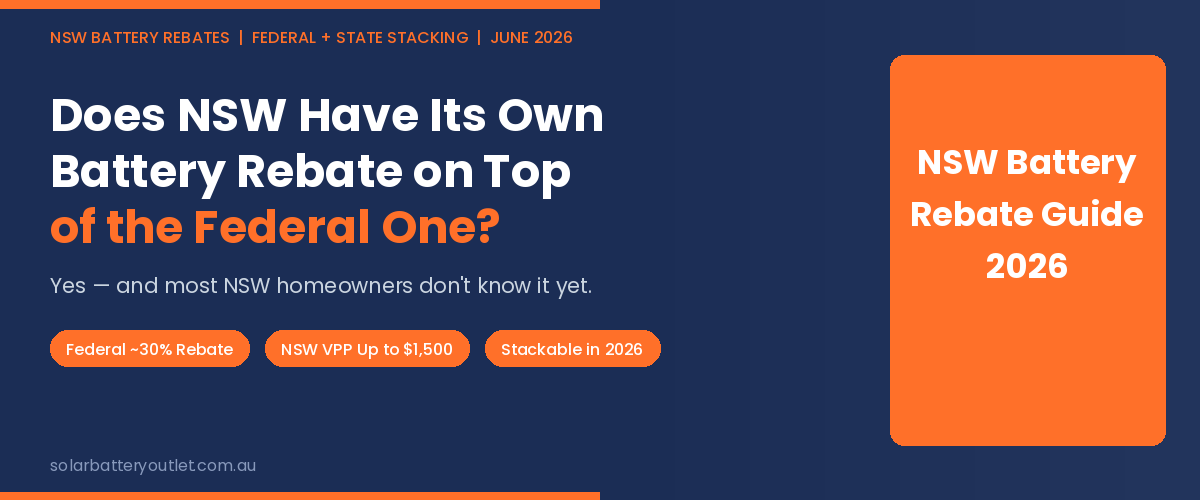
Short answer: yes. NSW homeowners can access both the federal Cheaper Home Batteries Program and at least one NSW-specific incentive—and in many cases, two. What surprises most people is that these incentives stack. You do not have to choose between them.

However, the two programs work differently, come from different government departments, and have separate eligibility conditions. If you simply ask your installer about ‘the rebate,’ you may only hear about the federal one. This guide explains both, shows you how to stack them, and gives you the numbers you need to make an informed decision.

What Is the Federal Cheaper Home Batteries Program (CHBP)?

The federal Cheaper Home Batteries Program launched on 1 July 2025. It applies nationwide and is delivered through the existing Small-Scale Renewable Energy Scheme (SRES)—the same mechanism that has been funding rooftop solar rebates in Australia for over a decade.

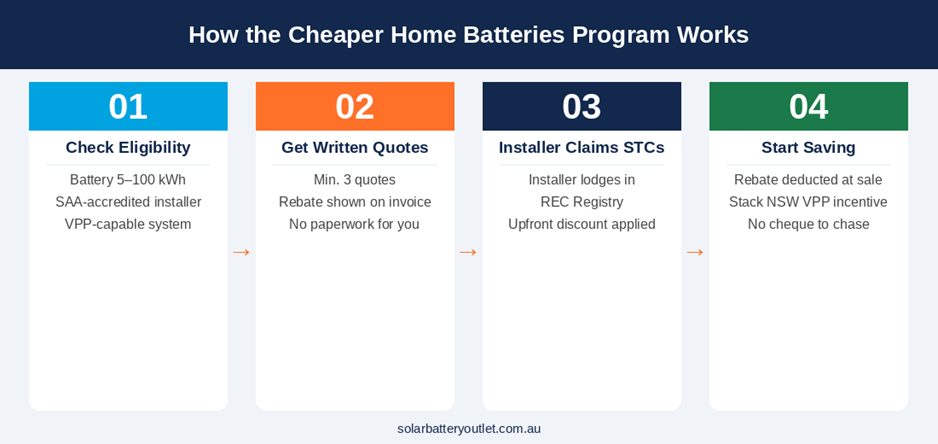
Rather than paying you cash, the program creates Small-scale Technology Certificates (STCs) based on your battery’s usable capacity. Your accredited installer claims these certificates on your behalf and deducts the value from your upfront quote. No paperwork. No waiting. The rebate is already factored into the price you see.

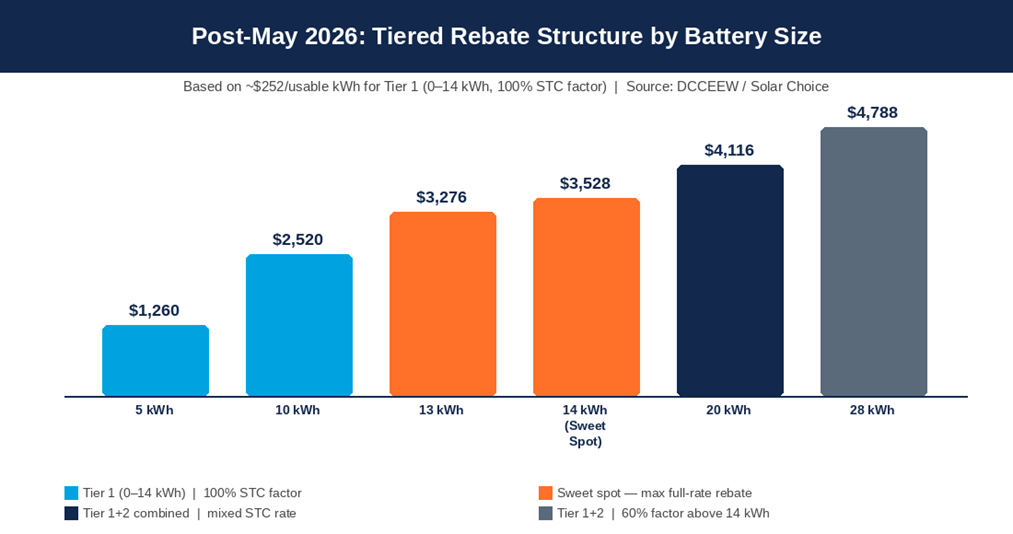
From 1 May 2026, the rebate uses a tiered structure:

  • First 14 kWh of usable capacity: full STC factor at $272 per kWh (May to December 2026)
  • 14 kWh to 28 kWh: STC factor reduced to 60% of the rate
  • 28 kWh to 50 kWh: STC factor reduced to 15% of the rate

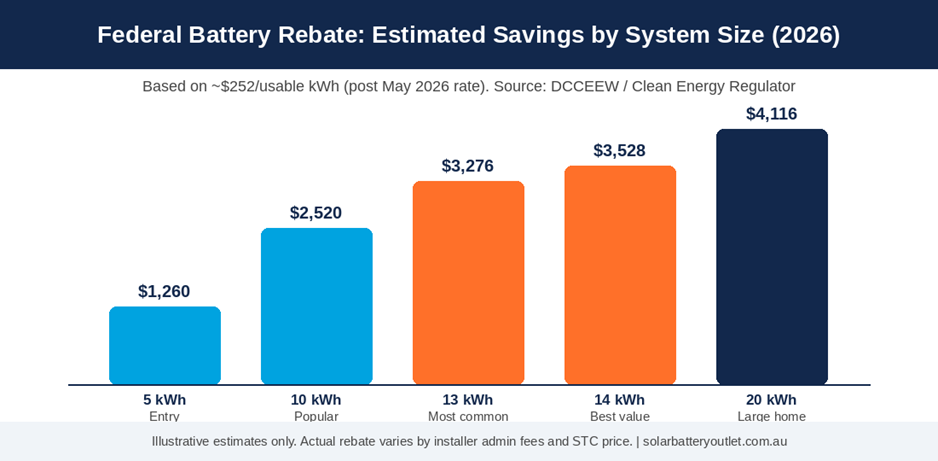
For a standard 10 kWh home battery, the rebate works out to approximately $2,720 under the May–December 2026 rate. For a 13.5 kWh system like the Tesla Powerwall 3, the illustrative saving is around $3,674. These figures are based on the STC factor and market price — your installer will confirm the exact amount at the time of installation.

Importantly, the rebate steps down every six months. After 1 January 2027, the rate decreases again. Installing sooner locks in a higher rebate, though the program itself runs until the end of 2030.

Does NSW Have Its Own Battery Rebate on Top of the Federal One?

Yes — but the structure changed significantly in 2025 and 2026. The previous standalone NSW battery rebate (which operated independently of the federal scheme) wound back to avoid overlap once the Cheaper Home Batteries Program launched. What replaced it is actually more valuable for most households, provided you claim both parts.

In 2026, NSW homeowners have access to three state-level incentives that stack on top of the federal rebate:

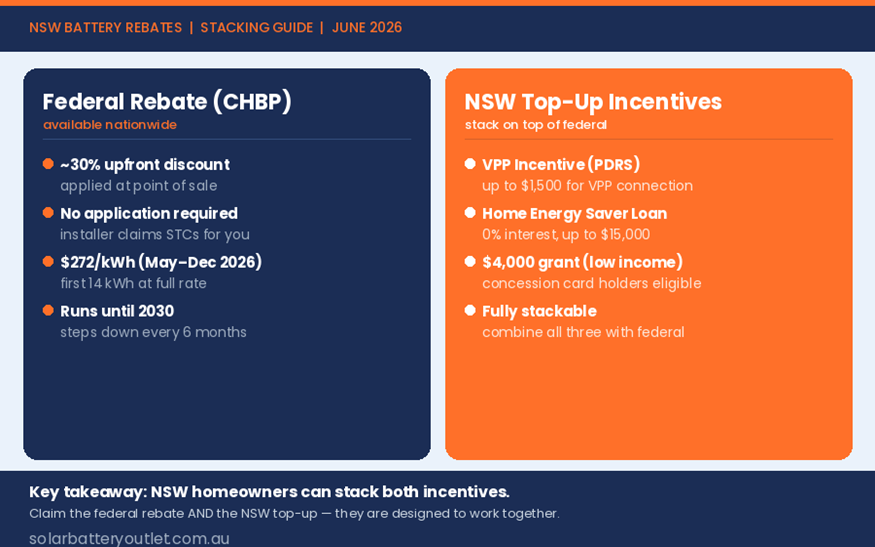
The NSW Peak Demand Reduction Scheme pays you for connecting your battery to a Virtual Power Plant (VPP). Your battery stays in your home. A VPP is simply a software connection that allows an approved operator to draw a small amount of stored energy during peak demand periods — typically hot summer afternoons when the grid is under pressure.

In return, you receive Peak Reduction Certificates (PRCs). These translate into a cash payment — typically between $400 and $1,500 depending on your battery size. The value is paid upfront through your installer or VPP operator when you connect.

  • Available to all NSW homeowners installing a CEC-approved, VPP-capable battery
  • Stackable directly on top of the federal CHBP rebate
  • Does not require you to stay with a VPP contract — you can leave after the incentive is paid
  • Managed by the NSW Government through IPART and the Electricity Infrastructure Roadmap

On 17 June 2026, the NSW Government launched the $557 million Home Energy Saver program. This is a significant new addition to the incentive stack for NSW residents.

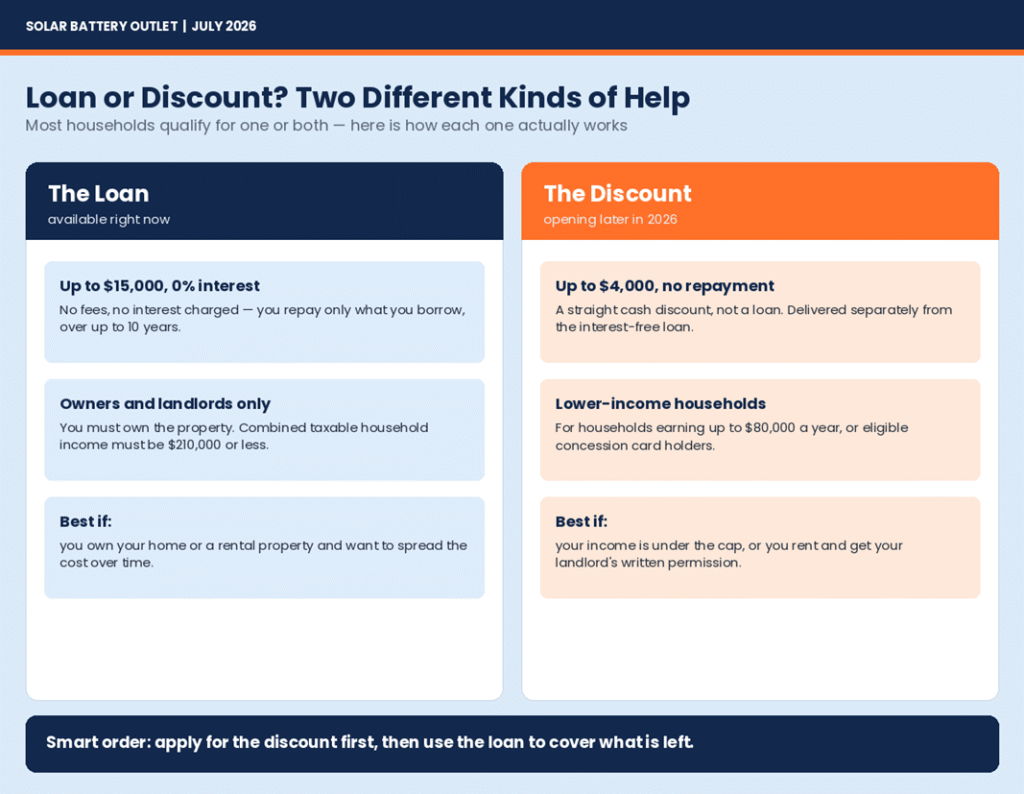
The Home Energy Saver Loan offers an interest-free loan of up to $15,000 for eligible NSW homeowners to install batteries, solar, heat pumps, EV chargers, and other approved energy upgrades. The loan is repaid over 10 years and is available to households with a combined income under $210,000 per year.

  • 0% interest — no fees on the loan itself
  • Up to $15,000 for eligible energy upgrades including solar batteries
  • Income threshold: household income under $210,000 per year
  • Repaid over 10 years — monthly repayments of approximately $125 for a $15,000 loan
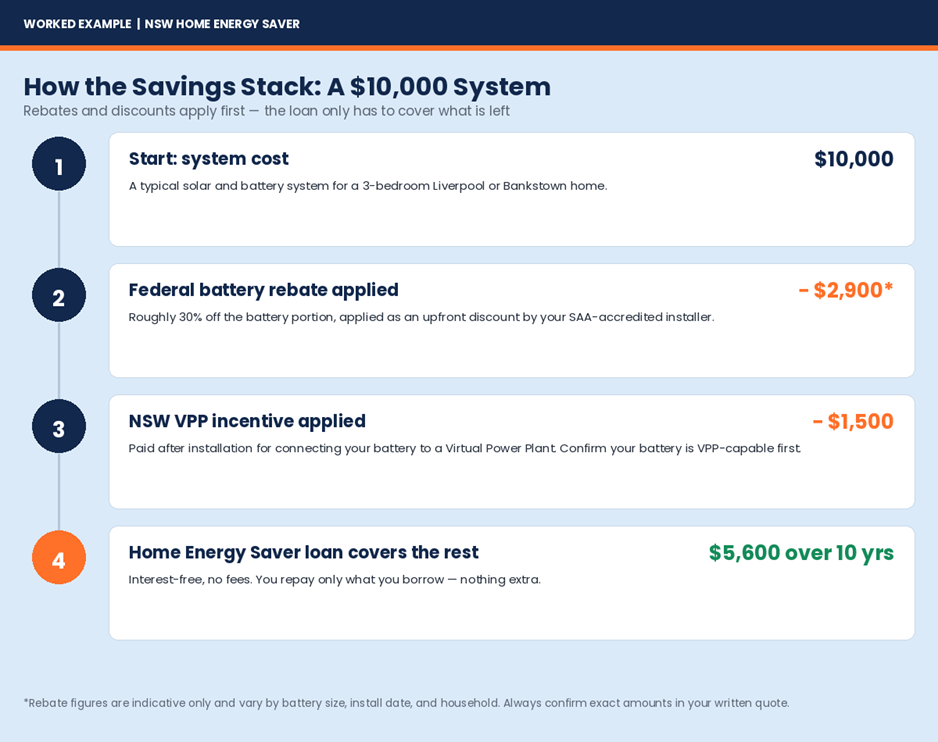
  • Can be used to cover the balance after the federal rebate is applied

Alongside the loan, the Home Energy Saver program includes a targeted grant of up to $4,000 for households with an income under $80,000 per year, or those holding a valid concession card. This grant does not need to be repaid and stacks on top of both the federal rebate and the interest-free loan.

For eligible low-income households in areas like Liverpool and Western Sydney, the combined value of the federal rebate, the VPP incentive, and this grant can bring a standard 10 kWh battery installation within reach of $0 upfront.

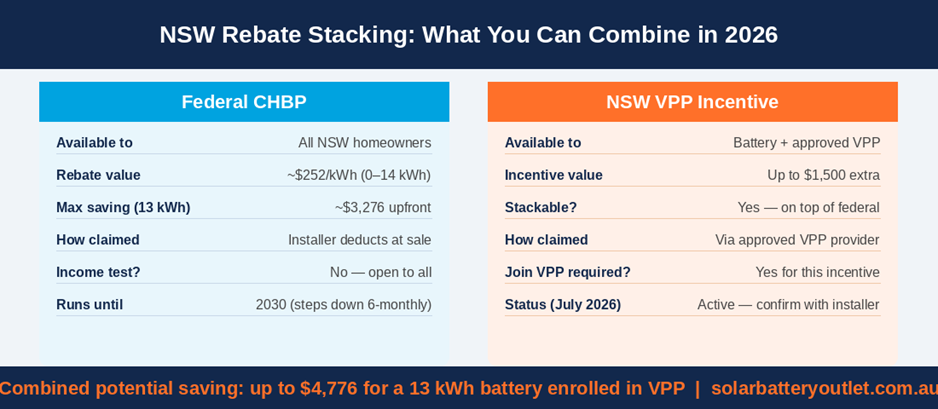
Federal vs NSW incentive comparison—both programs are designed to stack.

How the NSW + Federal Stack Works in Practice

Here is how the three layers combine for a typical NSW homeowner installing a 10 kWh battery in the second half of 2026. These numbers are illustrative—your actual savings depend on your STC zone, battery size, install date, and eligibility.

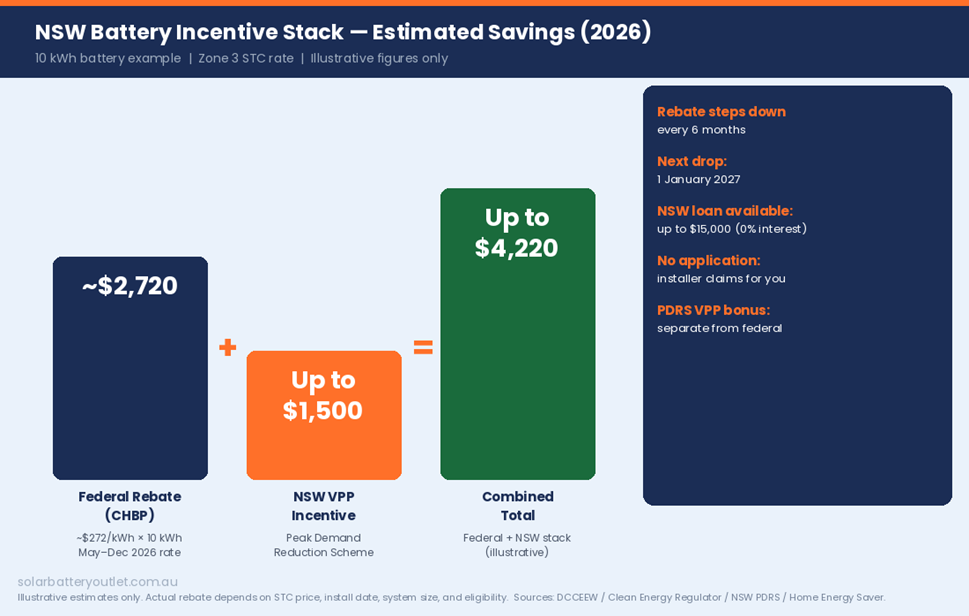
Estimated incentive stack for a 10 kWh battery in NSW (2026).

As the chart shows, the federal CHBP alone provides an estimated ~$2,720 in savings for a 10 kWh battery. Stack the NSW VPP incentive on top and the combined savings reach up to $4,220. For households eligible for the targeted grant, savings climb further still.

The key point is that these incentives come from different funding pools. Claiming the federal rebate does not exclude you from the NSW incentives. Your accredited installer handles the CHBP at the point of sale. The VPP incentive is arranged through your VPP operator (which your installer can recommend). The Home Energy Saver Loan is applied for separately through the NSW Government portal.

Who Is Eligible for the NSW Battery Incentives in 2026?

Eligibility for the federal CHBP is straightforward: install a CEC-approved battery (5 kWh to 100 kWh) through an SAA-accredited installer. There is no income test and no application form.

The NSW incentives have additional conditions:

IncentiveEligibilityMax Value
Federal CHBPAll Australians, no income test, 5–100 kWh battery~$2,720 (10 kWh, May–Dec 2026)
NSW VPP / PDRSNSW homeowners with VPP-capable battery, Ausgrid or Endeavour areaUp to $1,500
Home Energy Saver LoanNSW residents, income <$210,000/yrUp to $15,000 (0% interest)
Targeted GrantNSW residents, income <$80,000/yr or concession cardUp to $4,000

Solar Battery Liverpool and Western Sydney: What Local Homeowners Need to Know

For homeowners in Liverpool, Bankstown, Mudgee, and the broader Western Sydney region, the incentive stack is particularly relevant. This area has some of the highest rooftop solar penetration in Australia — and battery attachment rates are rising rapidly as households look to capture more of the energy they already generate.

Liverpool and Bankstown fall within the Ausgrid network area, which means VPP connections qualify for the NSW PDRS incentive. Mudgee falls within the Essential Energy network. VPP eligibility is subject to network operator conditions—your installer can confirm whether your specific address qualifies.

If you are researching solar battery Liverpool options, the key questions to ask any installer are (1) which batteries on their quote are CEC-approved and VPP-capable, (2) which VPP operators they work with, and (3) whether they can register the PDRS incentive on your behalf. A quality installer handles all three as a standard part of the installation process.

The federal rebate applies regardless of your location in NSW. The tiered structure that came into effect on 1 May 2026 means the best rebate-per-dollar value sits in the 10 to 14 kWh range — which also happens to suit most three- and four-bedroom homes in Western Sydney.

Ready to See What Your Stack Looks Like?

Every home is different. The right battery size, the right VPP operator, and the right combination of incentives depend on your electricity usage, your solar system, and your income. The numbers in this article are illustrative — but they give you a realistic picture of what is possible.

Solar Battery Outlet serves NSW homeowners across Liverpool, Bankstown, Mudgee, and the surrounding region. Our team works with CEC-approved batteries and SAA-accredited installers, and we handle the federal rebate, VPP connection, and NSW incentive paperwork as part of every installation.

Get a written quote that shows all applicable incentives—contact Solar Battery Outlet today and we will walk you through the full incentive stack for your home.

Frequently Asked Questions

Can I claim the NSW battery rebate if I already have solar panels?

Yes. The federal CHBP applies to battery-only installations — you do not need to install new solar panels. The NSW VPP incentive also applies to standalone battery installations. If your existing solar system is less than 10 years old and generating well, adding a battery is straightforward.

Is the NSW battery rebate the same as the federal one?

No. They are separate programs. The federal Cheaper Home Batteries Program provides an upfront point-of-sale discount through the STC mechanism. The NSW incentives (VPP incentive and Home Energy Saver Loan) are state-funded and have different eligibility rules. You can claim all of them at the same time.

Does the federal battery rebate apply in NSW?

Yes. The Cheaper Home Batteries Program applies in every Australian postcode including all of NSW. There is no location restriction. The rate varies slightly by STC zone — NSW is in Zone 3, which gives a slightly lower per-kWh rate than Queensland but is otherwise the same program.

What is the best home battery in Australia for the NSW rebate?

Any CEC-approved battery qualifies for the federal rebate. Popular options in NSW include the Tesla Powerwall 3 (13.5 kWh), Sungrow SBR series, BYD Battery-Box, and GoodWe Lynx Home. For the NSW VPP incentive, the battery also needs to be VPP-capable — most modern units are. Your installer can confirm eligibility for your specific model.

Does the federal battery rebate step down in NSW?

Yes. The STC factor steps down every six months under the revised program rules that took effect on 1 May 2026. The next reduction is 1 January 2027. Installing sooner locks in the current (higher) rate, though the program continues until the end of 2030.

Disclaimer—Please note all figures, rebate amounts, savings estimates, and eligibility details in this article are illustrative only and are not a guarantee of outcomes. Actual results vary based on your location, battery size, usage, tariff, and eligibility. Incentive rates change every six months. Please seek personalised advice before making a purchasing decision.
Choosing the right solar system size is one of the biggest decisions a homeowner makes. Go too small, and you will still rely heavily on the grid. Go too big, and you pay for capacity you never use. So, what size actually fits your home?

In 2026, the answer depends on three things: how much electricity you use each day, how much sun your roof receives, and what you plan to add in the next few years. An electric vehicle, a heat pump, or a battery can change the right size dramatically.

This guide walks through the exact formula installers use, a quick sizing table for common household types, real Sydney output data, and the questions to ask before you commit. Whether you are buying your first system or planning to upgrade solar system capacity to support a future battery, the same fundamentals apply.

Start With Your Electricity Bill, Not Your Roof

The most reliable starting point is your actual electricity usage, not roof size or budget. Your bill shows total kilowatt-hours (kWh) used over the billing period. Divide that figure by the number of days to get your daily average.

Most Australian households use between 12 and 30 kWh per day. Smaller, energy-efficient homes sit at the lower end. Larger households, or homes with a pool, electric hot water, or an EV, sit much higher. If possible, use a full 12-month average rather than a single quarter, because summer and winter usage can differ by 30 percent or more.

Once you have your daily average, the sizing formula is straightforward. Multiply your daily usage by 1.25 to account for system losses. Then divide by your area’s peak sun hours. The result is your minimum recommended system size in kilowatts.

Quick Sizing Table for Common Australian Households

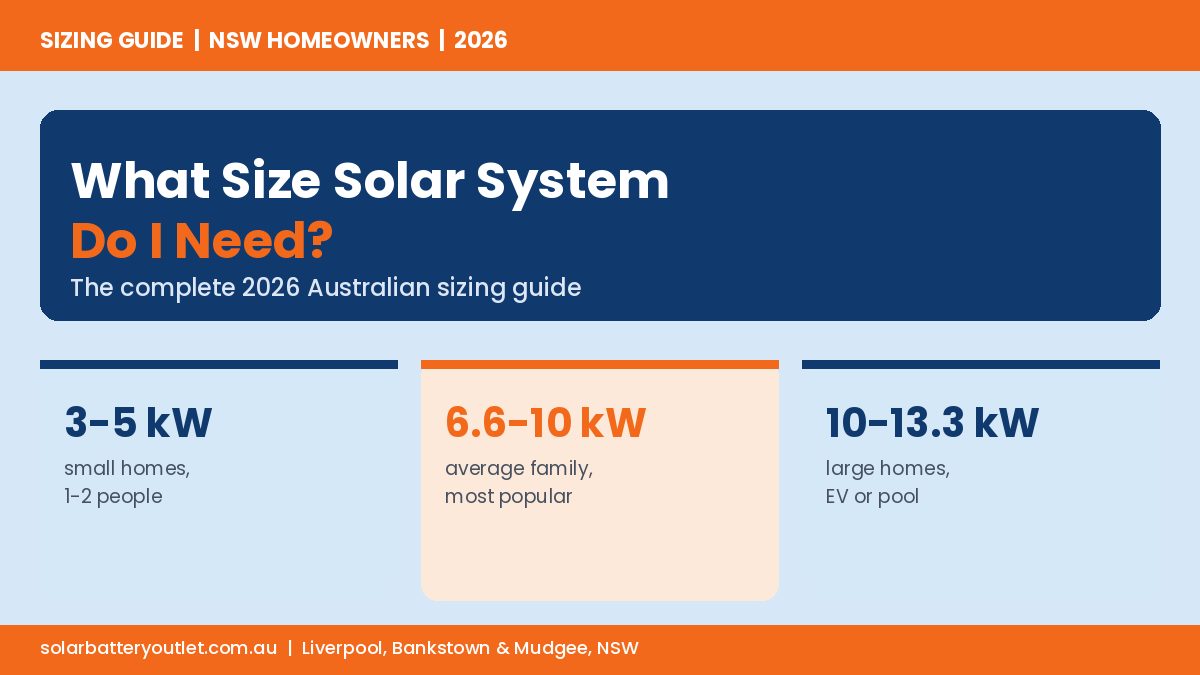
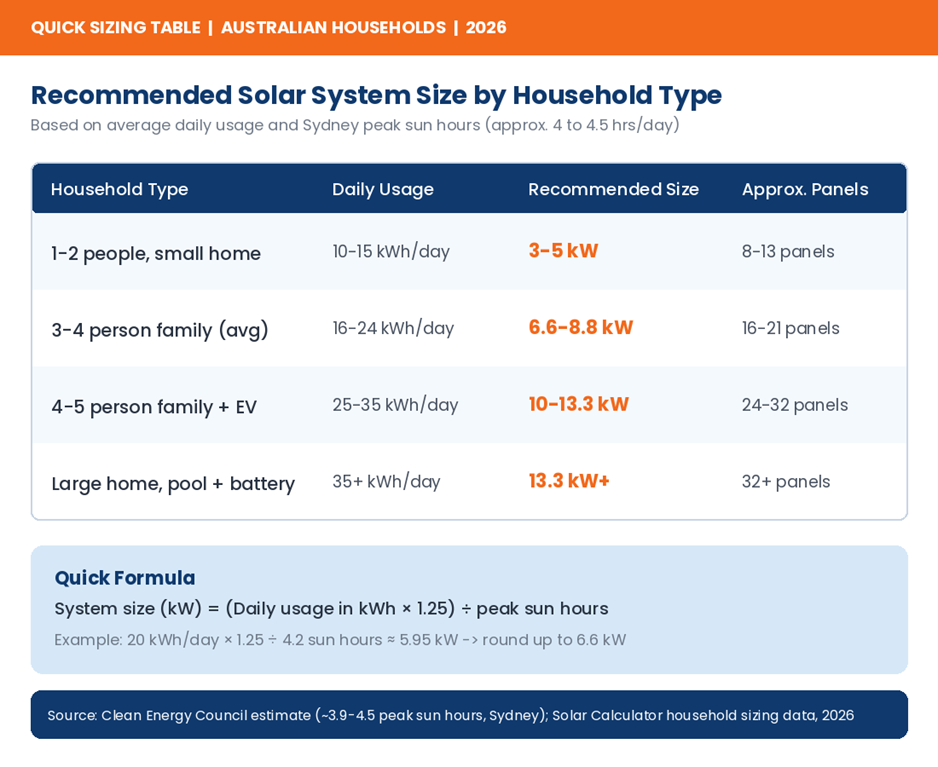
Every home is different, but these ranges give a solid starting point. They reflect typical Sydney conditions, where peak sun hours average around 3.9 to 4.5 hours per day, slightly lower than Brisbane or Perth.

Recommended solar system size by household type, 2026

Why 6.6kW Remains the Most Popular Choice in 2026

A 6.6kW system has been Australia’s most common residential install for several years, and 2026 is no exception. It suits most three to four-person households, fits comfortably on a standard roof, and strikes a good balance between cost and output.

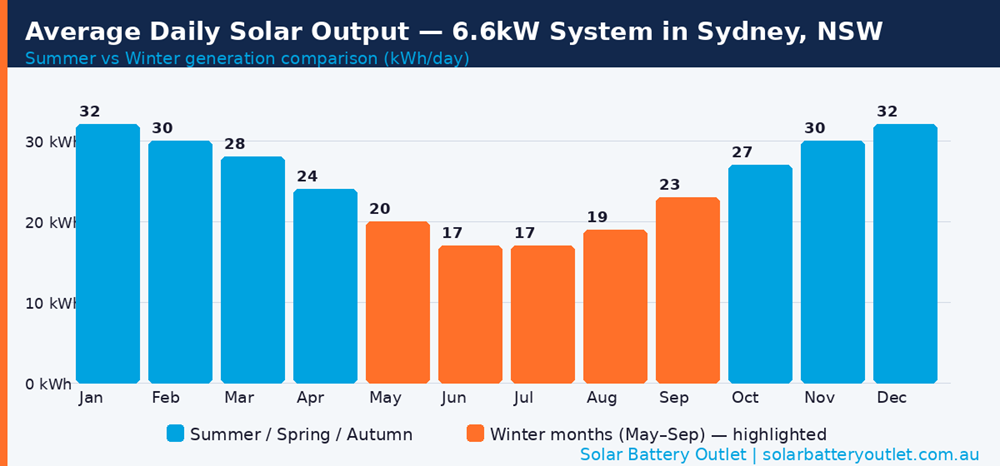
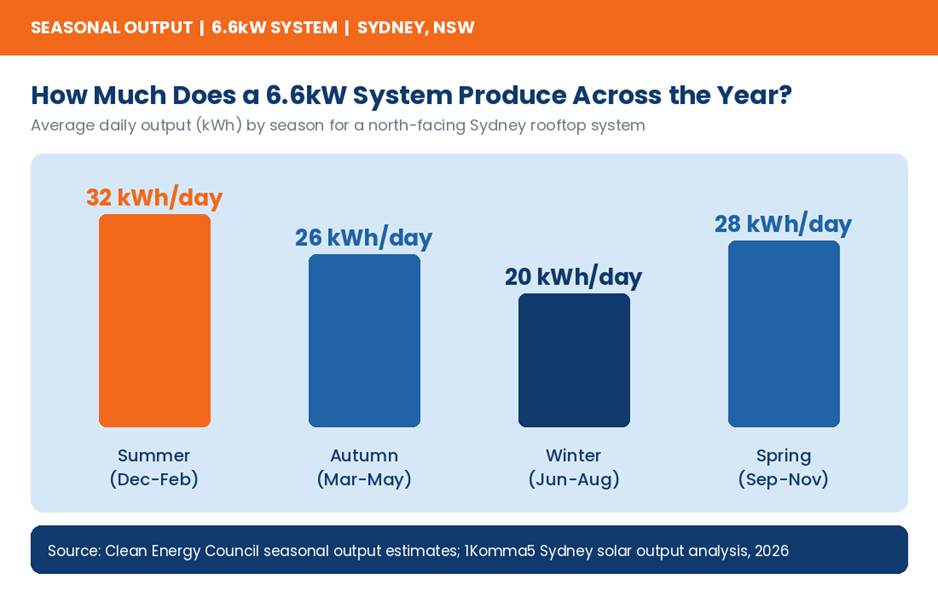
In Sydney, a north-facing 6.6kW system produces roughly 26 to 32 kWh per day on average, though output swings noticeably with the seasons. Summer days can push generation toward 32 to 36 kWh, while shorter winter days bring it down closer to 20 kWh.

Seasonal output of a 6.6kW system, Sydney NSW

When Bigger Makes Sense: EVs, Heat Pumps and Batteries

A common mistake is sizing for today’s usage only. Many households add an electric vehicle, heat pump hot water, or a battery within a few years of installing solar, and then wish their system were larger.

An EV typically adds 8 to 10 kWh per day for an average commute, pushing many households from the 6.6kW range into 8.8kW or 10kW territory. Heat pump hot water adds a smaller but steady load, often 2 to 4 kWh per day.

If you are planning to add a battery later, oversizing your solar array slightly now gives the battery more surplus midday energy to store. Households exploring solar battery Liverpool options, for example, often find that pairing a 10kW solar array with a 10kWh battery captures far more value than a smaller array paired with the same battery, simply because there is more excess solar to redirect into storage rather than exporting it for a low feed-in tariff.

Roof Space, Orientation and the 13.3kW Ceiling

Each modern panel needs around 1.7 square metres of roof space. A 6.6kW system needs roughly 16 to 17 panels, while a 10kW system needs around 24 panels. Most homes have enough roof area, but orientation matters more than total space.

North-facing panels produce the most energy in Australia. East and west-facing arrays produce 15 to 20 percent less, but splitting panels across both sides of a dual-pitch roof can smooth your generation curve across the day, which is useful if you use more power in the morning and evening.

If your household needs more than 6.6kW, the next decision is whether to upgrade to three-phase power, which opens access to larger single inverters above 10kW, or install two separate inverter systems to reach similar capacity without rewiring your switchboard. According to the Clean Energy Council, a CEC-accredited installer should always confirm your switchboard capacity before recommending a system above 10kW.

A Simple Framework for Choosing Your System Size

Use these four steps before requesting quotes. Each step takes only a few minutes and helps you compare installer recommendations with confidence.

  1. Calculate your baseline. Use your 12-month average daily usage, not a single bill.
  2. Apply the formula. Multiply by 1.25, then divide by your area’s peak sun hours.
  3. Add future loads. Factor in an EV, heat pump, or battery you may add within five years.
  4. Round to a standard size. Most installers offer set sizes like 5kW, 6.6kW, 8.8kW, 10kW, or 13.3kW.

Frequently Asked Questions

Is 6.6kW enough for an average Australian home?

Yes, for most three- to four-person households using 16 to 24 kWh per day, a 6.6kW system comfortably covers daytime usage and offers reasonable winter output. Households planning a battery or EV often choose 8.8kW or 10kW instead.

How many solar panels do I need for a 10kW system?

With standard 400W to 440W panels, a 10kW system typically needs around 23 to 25 panels, requiring approximately 39 to 43 square metres of roof space, depending on the exact panel wattage chosen.

Can I oversize my solar system if I plan to add a battery later?

Yes, and it is often recommended. A larger solar array generates more midday surplus, which a future battery can store and use overnight, improving the overall value of both the solar and battery investment.

Does roof orientation change what size system I need?

Yes. East or west-facing roofs produce 15 to 20 percent less than north-facing roofs. If your roof is not north-facing, you may need to size up slightly to reach the same daily output as the sizing table suggests.

Disclaimer: The figures, savings estimates, system sizes, battery capacities, payback periods, and rebate amounts mentioned in this article are provided as illustrative examples only and are not a guarantee of future performance or savings. Actual outcomes vary depending on your location, electricity usage, tariff, solar generation, battery configuration, eligibility for government incentives, and other household-specific factors. Please seek personalised advice before making a purchasing decision.
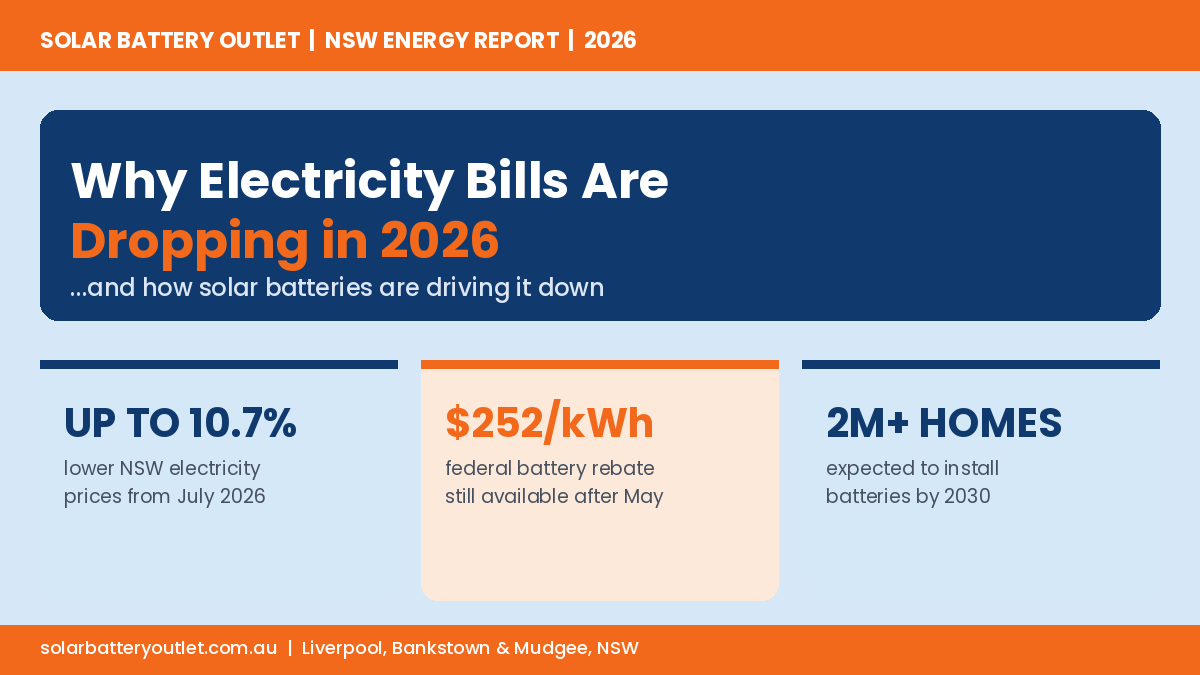
For the first time in years, NSW households are opening their electricity bills and seeing a number that has actually gone down. From 1 July 2026, the Australian Energy Regulator confirmed price cuts of up to 10.7 percent on standard offers across New South Wales, with similar falls in South East Queensland. After several years of steep increases, this is welcome news — and it is not happening by accident.

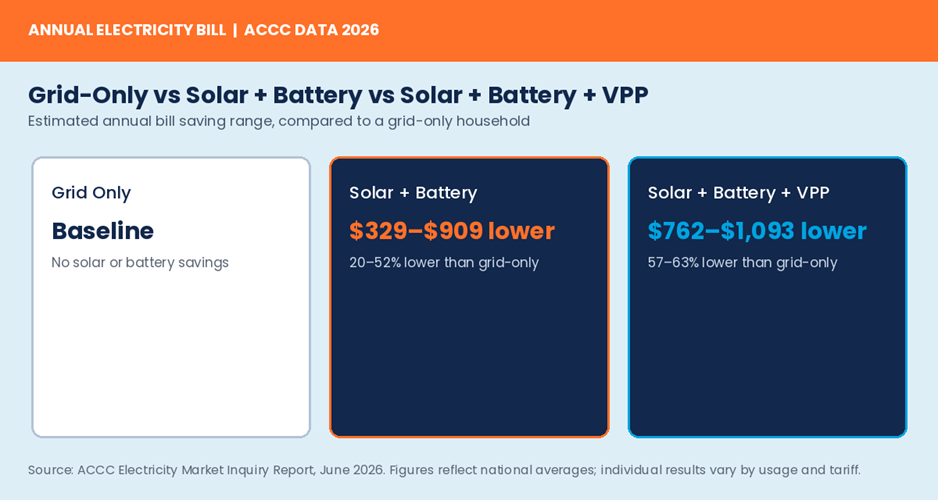
Behind this shift sits one technology more than any other: the home solar battery. As hundreds of thousands of batteries plug into the grid each year, they soak up cheap daytime solar power and release it during expensive evening peaks. This reduces strain on the network, lowers wholesale prices, and ultimately flows through to everyone’s bill—whether or not they own a battery themselves.

In this guide, we will break down exactly why electricity prices are falling in 2026, what role solar batteries play in that shift, the real numbers behind NSW pricing changes, and how homeowners considering solar batteries NSW can position themselves to benefit from both falling grid prices and remaining rebates.

The 2026 Turning Point: Electricity Prices Are Finally Falling

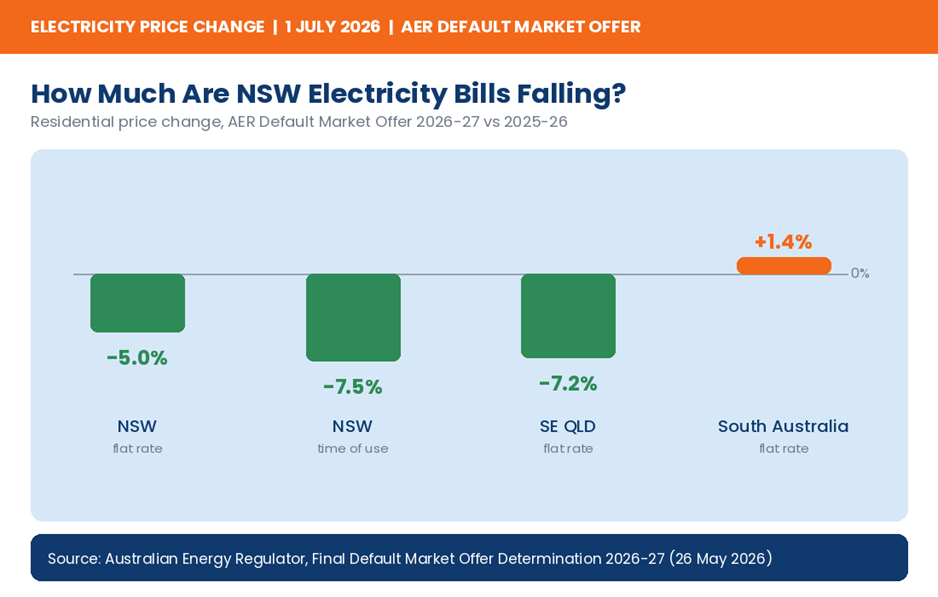
For most of the past five years, Australian households have braced for annual price increases. That trend reversed in 2026. The Australian Energy Regulator’s final Default Market Offer determination for 2026–27, released in late May 2026, confirmed that residential flat-rate prices in NSW will fall between 3.4 and 5.0 percent from 1 July, while time-of-use customers in NSW could save up to 7.5 percent. South East Queensland recorded the largest single drop at 7.2 percent, while South Australia was the only region to see a small increase of 1.4 percent.

The regulator pointed to three drivers behind the fall: lower wholesale electricity contract prices, reduced spot price volatility, and a meaningful increase in output from wind and battery generation during the evening peak. Put simply, when batteries—both household and grid-scale—release stored solar power exactly when demand spikes, expensive gas generators are needed less often, and wholesale prices come down for everyone.

NSW and SE QLD residential price changes, AER DMO 2026-27

How Solar Batteries Are Reshaping the Grid — And the Price You Pay

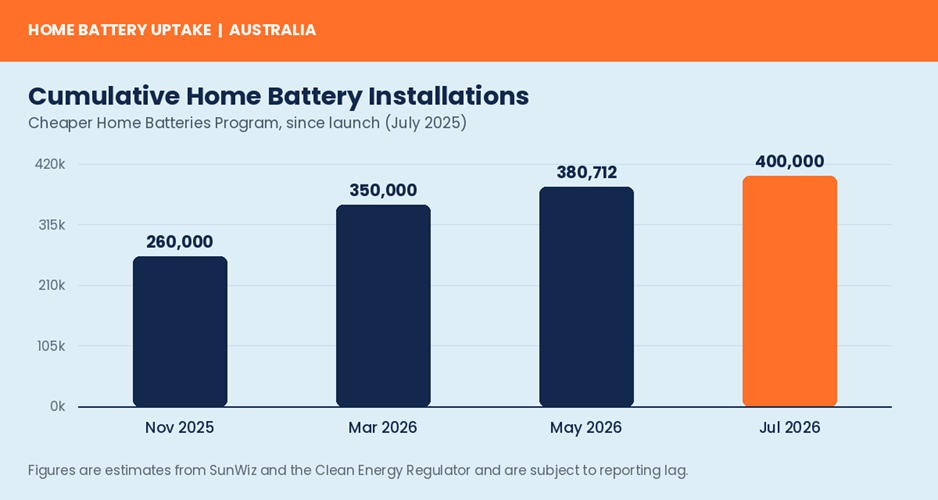
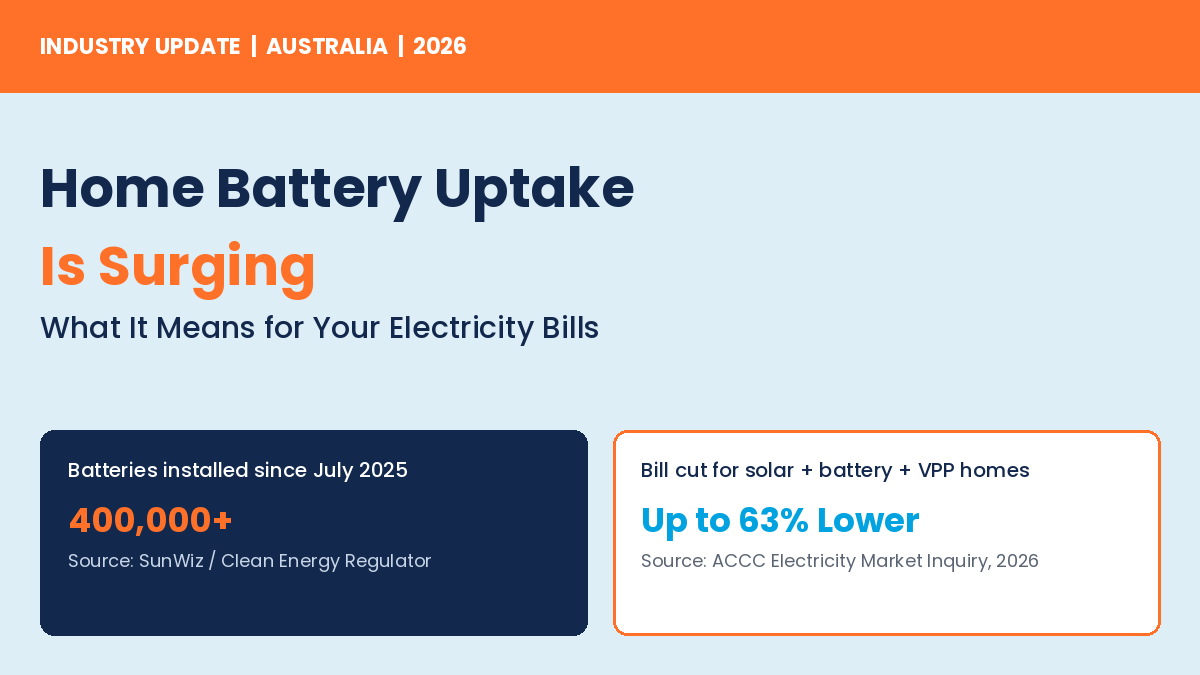
One in three Australian homes already has solar panels, but historically, only a small fraction had a battery to store that energy. That is changing fast. The federal Cheaper Home Batteries Program has already supported around 250,000 home battery installations since its launch, and the expanded budget — now $7.2 billion over four years — is expected to bring more than two million Australians into battery ownership by 2030, adding roughly 40 gigawatt hours of storage to the grid.

Why does this matter for prices? During the day, rooftop solar floods the grid with cheap power, sometimes pushing wholesale prices toward zero or even negative. In the evening, demand spikes just as solar generation drops off, traditionally forcing the grid to rely on costly gas peaking plants. Home batteries break this pattern. They store the midday surplus and discharge it during the evening peak, smoothing out the daily price curve. Industry analysts now describe this shift plainly: it is renewables, firmed by batteries, that increasingly set the price of power, not gas.

For households running a solar battery Liverpool installation or anywhere across Southwest Sydney, this means two things at once: your own bill drops because you are using stored solar instead of buying grid power at peak rates, and the broader grid becomes more stable because fewer homes are drawing power simultaneously during the 5 pm to 9 pm crunch.

What This Means for Your Household Savings

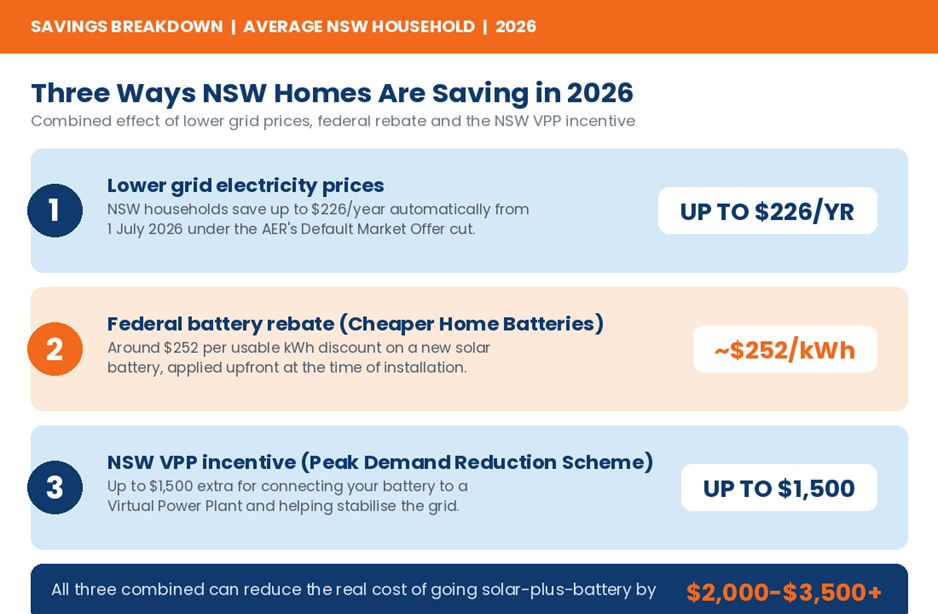
For a typical NSW household, three separate savings streams are now stacking together, and understanding each one helps you see the full financial picture rather than focusing on a single rebate figure.

1. Automatic bill reductions from 1 July 2026. Even households without a battery will see lower default electricity rates simply because the AER has reset the benchmark pricing downward.

2. The federal battery rebate. From 1 May 2026, the Cheaper Home Batteries Program discount sits at roughly $252 per usable kilowatt-hour for most standard batteries, applied as an upfront price reduction on your installation quote — no separate claim required.

3. The NSW VPP incentive. The NSW Peak Demand Reduction Scheme adds up to $1,500 on top for households that connect their battery to a virtual power Plant — a separate state-level incentive that runs independently of the federal rebate.

Three stacking savings sources for NSW solar battery households in 2026

Combined, these three elements can cut the upfront cost of a solar battery system by around $2,000 to $3,500 for an average NSW household. This estimate does not include the ongoing savings from using stored solar energy instead of grid electricity at night. If you’re deciding whether to install now or wait for future rebate changes, compare these potential savings with your electricity bills before making a decision.

Real-World Example: A Liverpool Household Switching to Solar-Plus-Battery

Consider a household in Liverpool, NSW, with a 6.6kW solar system and a quarterly electricity bill of about $450. After installing a 10kWh battery, the home can reduce evening grid usage significantly. Instead of sourcing 60% to 70% of evening power from the grid, it may draw less than 15%, with the battery supplying energy for cooking, lighting, and household appliances.

Layer on the falling NSW default market. Offer rates from July 2026, and the household benefits twice over: the electricity they still buy from the grid costs less per kilowatt-hour than it did a year earlier, and they are buying far less of it overall. For households exploring options through a solar battery Liverpool installer, this combination—falling grid rates plus a battery that minimises grid reliance — is exactly the scenario the 2026 policy settings were designed to encourage.

Why This Trend Is Likely to Continue Beyond 2026

Three long-term trends suggest prices will continue to fall. First, the federal battery rebate remains available until 2030. This will support battery adoption, even as the rebate gradually decreases every six months. Second, regulators and network operators are introducing new tariffs to ease grid demand. One example is the Solar Sharer Offer, which provides three hours of free electricity during the middle of the day.

Third, battery costs continue to decline as global manufacturing expands. This improves the economics of home energy storage, even without government incentives. Together, these trends are creating a grid that relies more on distributed batteries and less on gas generation. As a result, households with battery storage are likely to see the greatest benefits.

A Simple Framework: Should You Add a Battery Now?

Rather than reacting to deadline pressure, walk through these four checks before deciding on timing.

  1. Check your evening usage. If most of your electricity use happens after 5 pm, a battery has the most to work with.
  2. Confirm your solar system’s health. A battery only stores what your panels generate, so an underperforming system should be assessed first.
  3. Compare written quotes. Get at least three quotes that show the federal rebate as a dollar deduction, not a verbal promise.
  4. Ask about VPP eligibility. Confirm your installer will register your system for the NSW VPP incentive at installation.
Why are NSW electricity prices falling in 2026 after years of increases?

The Australian Energy Regulator’s 2026–27 Default Market Offer reflects lower wholesale electricity costs, reduced price volatility, and higher output from wind and battery generation during peak periods. Together, these factors have lowered the benchmark used to calculate household electricity bills.

Do I need a solar battery to benefit from the lower electricity prices?

No. The Default Market Offer price reduction applies to all households, regardless of battery ownership. Battery owners can save even more by using stored energy during evening peak periods. This reduces the amount of electricity they need to buy from the grid.

Is the federal battery rebate still worth claiming after May 2026?

Yes. The rebate is available until 2030 and currently provides around $252 per usable kilowatt-hour. The value decreases every six months, so applying sooner can secure a higher discount. However, it will continue to offer significant upfront savings beyond 2026.

How much can a home battery realistically save on an NSW electricity bill?

Savings vary based on battery size and evening energy use. However, households that rely on stored solar power for most of their evening consumption can cut grid electricity usage by 50% to 80%. These savings come in addition to the lower electricity rates introduced in July 2026.

Sources & Data References

If you run a small business, manage a commercial property, or operate from a home office, you have probably wondered whether a solar battery can reduce your tax bill. The short answer—backed by ATO guidance and confirmed by the 2026-27 Federal Budget — is yes. A solar battery can be tax-deductible for Australian small businesses, and the rules in 2026 are more favourable than they have ever been.

This guide cuts through the noise. No jargon, no sales pitch. Just a clear walkthrough of how the deduction works, who qualifies, what you can claim, and what mistakes to avoid.

What Does Tax Deductible Actually Mean Here?

When we say a solar battery is “tax deductible” for a business, we mean you can reduce the taxable income your business reports to the ATO by the cost of the battery — either in full (if the asset qualifies for the Instant Asset Write-Off) or gradually over time (through depreciation).

This is not the same as a rebate. The federal battery rebate (under the Cheaper Home Batteries Program) reduces your upfront purchase price. A tax deduction reduces the income you pay tax on. They are separate benefits, and eligible businesses can access both.

Example: How the two incentives stack up for a small business

How the two incentives stack up for a small business

The Instant Asset Write-Off: Your Main Vehicle in 2025-26

The Instant Asset Write-Off (IAWO) is the primary mechanism most small businesses will use to claim a solar battery deduction. It allows you to claim the full cost of the asset in the year it is installed and ready for use — rather than depreciating it over 20 years.

Who qualifies for solar battery tax deduction Australia 2026

Who is eligible?

To use the instant asset write-off for a solar battery in 2025-26, your business must:

  • Have an aggregated annual turnover of less than $10 million
  • Have the battery installed and ready for use between 1 July 2025 and 30 June 2026 (for FY2025-26 claims)
  • Use the battery wholly or primarily for business purposes
  • Claim the GST-exclusive cost (if your business is GST registered)

What is the threshold?

For FY2025-26, the threshold is $20,000 per asset (excluding GST). If your solar battery costs less than $20,000 after the federal rebate, you can write it off immediately. The threshold applies per asset — you can write off multiple assets in the same financial year, each under $20,000.

What If the Battery Costs More Than $20,000?

Larger commercial battery systems — particularly those paired with rooftop solar installation for warehouses, offices, or multi-unit residential properties — may exceed the $20,000 threshold. In that case, the asset goes into the small business general depreciation pool.

YearDepreciation RateOn a $28,000 BatteryCumulative Claimed
Year 115%$4,200$4,200
Year 230%$7,140$11,340
Year 330%$5,004$16,344
Year 430%$3,503$19,847
Year 530%$2,452$22,299

Note: The 15% first-year rate and 30% subsequent-year rate apply under the simplified small business depreciation pool. The ATO has assigned solar systems an effective life of 20 years, but the simplified pool rules allow faster write-down. Always verify with your registered tax agent.

Three Business Types That Can Claim—and How

1. Sole Traders and Small Business Owners

If you run a registered business — a cafe, trade business, retail shop, professional practice, or any other commercial enterprise — and you install a solar battery at your business premises, the ATO treats the battery as a depreciating business asset. You can claim the full cost under the Instant Asset Write-Off (if under $20,000 after rebate) in the year of installation.

If your business uses solar battery installation at premises that are also partly residential (e.g. a live-in shopfront), you need to apportion your claim to reflect only the business-use percentage.

2. Landlords and Commercial Property Owners

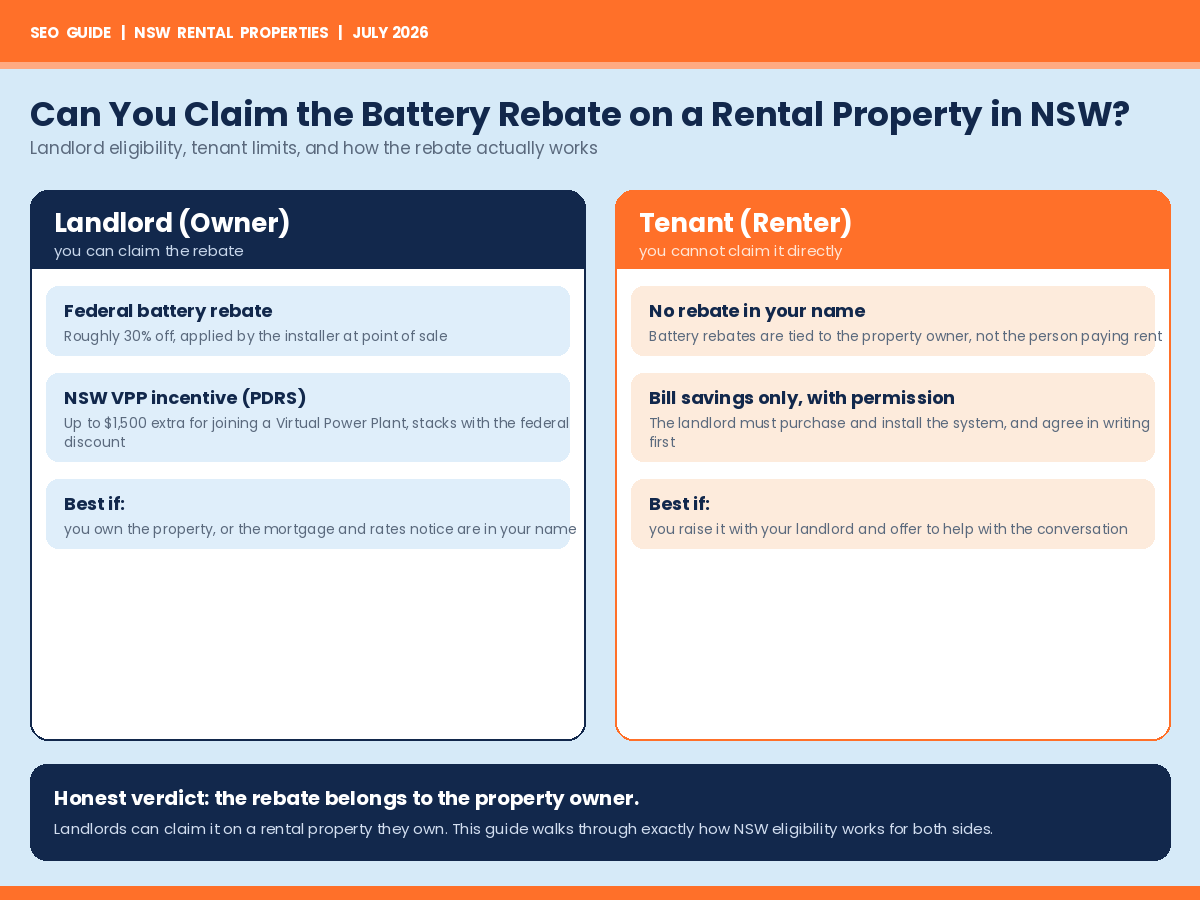
Landlords who install a solar battery on their own commercial or residential rental property can claim the cost as a depreciating asset — but only if the landlord purchases and installs the system, not the tenant. The ATO makes this distinction clearly.

For residential rental properties, the deduction is available only for the portion of the property used for income-producing purposes. A purely personal residence does not qualify. A property rented at arm’s length to tenants does qualify.

3. Home-Business Owners and Sole Traders Working Remotely

If you run your business from a dedicated area of your home—a home office, a workshop, a studio—you may be able to claim the business-use portion of your solar battery system. The ATO confirmed in guidance to industry media that a solar system can be claimed under the $20,000 Instant Asset Write-Off when it is bought and used by an eligible small business to generate electricity for business use.

The key requirement: you must make a genuine and defensible apportionment. If 40% of your home’s electricity is used for business, you may be able to claim 40% of the battery cost. Document this carefully — the ATO expects a reasonable basis for the split.

Solar battery tax savings chart Australian small business

Can You Claim Both the Rebate and the Tax Deduction?

Yes. The federal battery rebate (delivered through the STC scheme under the Cheaper Home Batteries Program) and the Instant Asset Write-Off tax deduction are entirely separate incentives. You can access both, and doing so is the correct and legal approach.

Here is how they interact: the rebate reduces the upfront cost at the point of sale. Your tax deduction is then based on the net cost you actually paid (i.e. after the rebate is applied). You do not claim a deduction on the full retail price — only on what your business actually spent out of pocket.

For businesses looking at the best solar batteries Australia has to offer—BYD, Tesla Powerwall 3, Sungrow, or Enphase—the combination of a rebate and a write-off makes the effective cost significantly lower than the sticker price suggests.

Key ATO Rules You Need to Know

The ATO is specific about what is required to make a valid claim. Getting this wrong means lost deductions or, worse, a disallowance and penalties. Here are the rules that matter most:

Rules that protect your claim ✔  Asset installed & ready for use in same FY
✔  Separate invoice for battery (not bundled)
✔  GST-exclusive amount claimed if GST registered
✔  Written record of business-use percentage
✔  Installer confirms battery operates independently
✔  Keep records for at least 5 years
 Mistakes that void your deduction
✔  Claiming in year deposit paid, not year installed
✔  Bundled solar + battery on one invoice
✔  Claiming 100% when property has personal use
✔  No documentation for business-use apportionment
✔  Claiming on full retail price including rebate
✔  Claiming on a purely personal residential property
ATO documentation checklist solar battery tax claim

What About the NSW VPP Incentive?

If your commercial property or home business is in NSW, you may also be eligible for the Peak Demand Reduction Scheme (PDRS)—commonly called the VPP incentive — worth up to $1,500 for connecting your battery to a Virtual Power Plant program. This is a state-level incentive administered separately from the federal rebate and is not affected by tax treatment.

The NSW VPP incentive is available to eligible premises regardless of whether the battery owner is a homeowner, landlord, or business operator. It continues to 2030. It does not affect your tax claim — it simply adds another layer of upfront saving.

The Verdict: Is It Worth It for Your Business in 2026?

Let’s be direct. If you are a small business owner, landlord, or home-business operator with taxable income, a solar battery in 2026 offers a combination of financial benefits that is unusually strong:

  • The federal battery rebate reduces your upfront cost by $1,000 to $1,800+ depending on battery size
  • The Instant Asset Write-Off — now permanent — lets you claim up to $20,000 immediately against your taxable income
  • The ongoing electricity savings from the battery reduce your operating costs for 10 to 15 years
  • If in NSW, the VPP incentive adds up to another $1,500 on top

The businesses that benefit most are those with:

  • A clear, documentable business use for the electricity stored in the battery
  • A registered ABN and annual turnover under $10 million
  • An accountant or registered tax agent who can structure the claim correctly
  • A net battery cost (after rebate) under $20,000 — putting them squarely in Instant Asset Write-Off territory

The businesses that should take more care are those with mixed-use properties where personal and business electricity are difficult to separate, or those with purely residential properties. In those cases, the claim is still possible, but it requires careful apportionment and solid documentation.

Important: This article is general information only and does not constitute tax advice. Tax rules can change, and your circumstances are unique. Always consult a registered tax agent or accountant before making a deduction claim. The ATO website (ato.gov.au) has the latest Instant Asset Write-Off guidance.
Frequently Asked Questions
Can I claim a solar battery and solar panels separately under the write-off?

Yes — if they are invoiced separately and each costs less than $20,000 (excluding GST), you can claim both individually. The $20,000 threshold is per asset, not per project. Ask your installer to issue separate invoices for the solar system and the battery if you want to maximise this.

Does the solar battery have to be used exclusively for business?

No. You claim only the business-use portion. If your battery powers a mix of personal and business consumption, apportion the claim accordingly. Document the basis of your apportionment — the ATO expects a reasonable, defensible methodology.

What if I finance the battery through a chattel mortgage or commercial loan?

You can still claim the Instant Asset Write-Off even if you finance the purchase — you do not need to pay cash upfront. Under a chattel mortgage, the asset is legally treated as yours from day one, so you can claim the full deduction in the year of installation, then repay the finance over time. Discuss this structure with your accountant and your lender.

Can I claim the deduction if the battery is installed during June but I haven’t received the invoice yet?

The deduction applies in the financial year the asset is installed and ready for use — not the year the invoice is issued or paid. If the battery is commissioned in June 2026, it counts as FY2025-26 regardless of invoice timing. Keep the installation certificate as documentation.

Does the permanent instant asset write-off mean I can wait until next year?

For tax purposes, the permanent extension means there is no urgency created by a sunset clause. However, the federal battery rebate does continue to reduce in value every six months (the STC rate adjusts). If reducing upfront cost is your priority, acting sooner rather than later on the rebate side still makes sense.

Data Sources and References

The information in this article is drawn from the following sources:

  • Australian Tax Office (ATO) — Instant Asset Write-Off guidance: ato.gov.au/businesses/depreciating-assets
  • Australian Government business.gov.au — 2026-27 Federal Budget small business summary: business.gov.au/news/budget-2026-27
  • SmartCompany — ‘$20,000 instant asset write-off to become permanent’, published May 2026
  • SolarQuotes Australia — ‘Federal Budget 2026: What It Means For Home Electrification’, published May 2026
  • Choice Energy Australia — ‘Solar Panels Tax Deduction for Businesses’ (AU-specific ATO interpretation): choiceenergy.com.au
  • AusPac Solar — ‘How to Maximise Tax Deductions on Your Business Solar System’: auspacsolar.com.au
  • Why Solar Australia — ‘Instant Asset Write-Off for Solar: Can Your Business Claim It in 2026?’: whysolar.com.au
  • Energy Matters Australia — ‘Can I Claim a Home Solar System on Tax?’: energymatters.com.au
  • Journey Finance Australia — ‘The $20,000 Write-Off Deadline Is 30 June 2026’: journeyfinance.com.au
  • NSW Government — Peak Demand Reduction Scheme (VPP incentive): energysaver.nsw.gov.au

Note: All figures in this article are estimates for general illustration only. Tax outcomes depend on individual business circumstances, applicable tax rates, business-use percentages, and asset costs. Always consult a registered Australian tax agent before making a deduction claim.

When homeowners think about solar battery safety, they usually think about fire risk from the battery itself — a legitimate concern and one that good brands like BYD and Sungrow take seriously. But there is a second risk that almost nobody talks about: the wiring behind the wall.

Across New South Wales, a significant number of solar battery installations are wired incorrectly. Not badly—incorrectly. There is a specific Australian Standard that governs how batteries must be wired into your home, and many homeowners have no idea it exists, let alone whether their own installer followed it.

This article explains what the standard is, what it requires, and the three questions you should ask any installer before you sign anything.

Battery Safety Guide

The Standard You Have Never Heard Of: AS/NZS 3000:2018

Australian electrical installations — including solar battery storage systems — are governed by AS/NZS 3000:2018, commonly known as the Wiring Rules. Every licensed electrician in NSW is legally required to follow it. The problem is not that the standard does not exist. The problem is that nobody tells homeowners about it, which means nobody thinks to check.

In 2019, the standard was updated with a companion document specifically for battery energy storage systems: AS/NZS 5139:2019. Together, these two documents set out exactly how a battery must be wired — from the cable sizing, to the isolator placement, to the earthing arrangement — to be considered safe and compliant.

Why Most Homeowners Miss It

The solar and battery industry in NSW has grown rapidly. With that growth has come pressure on installers to move quickly, keep costs low, and compete on price. In that environment, some corners get cut — and wiring compliance is one of the first places shortcuts appear.

Here is what non-compliant wiring typically looks like in practice:

  • The installation connects the battery to an existing circuit that already serves other loads, instead of using a dedicated run
  • The cable used is undersized for the continuous discharge current of the battery — creating heat at the cable over time
  • The DC isolator is missing, poorly placed, or not rated for the battery’s voltage and current
  • No Certificate of Compliance is issued after the install — meaning there is no official record that the work meets the standard

None of these shortcuts are visible once the wall is closed. You would not know. Your installer might not even acknowledge the issue. But your insurer might — particularly if something goes wrong.

The Insurance Problem Nobody Warns You About

Home insurance policies in Australia typically contain a clause that voids coverage for damage caused by non-compliant electrical work. If your battery is wired incorrectly and causes a fire or electrical fault, your insurer can — and in some cases will — refuse to pay.

This is not about fearmongering. The vast majority of battery installations are done correctly. But a ‘mostly fine’ installation rate is not the same as a ‘yours is definitely fine’ guarantee. Given that a compliant install and a non-compliant install often look identical from the outside, the only way to know is to ask the right questions before you sign.

Compliance Checklist

The Three Questions to Ask Any Installer

You do not need to become an electrician to protect yourself. These three questions will quickly tell you whether an installer knows their obligations — and whether they are willing to meet them.

Question 1: Which wiring standard governs battery installations in NSW?

The correct answer is AS/NZS 3000:2018 (the Wiring Rules) and AS/NZS 5139:2019 (the battery-specific standard). An installer who cannot name either document — or who looks uncertain — is a red flag. This is not obscure knowledge. It is the legal foundation of their work.

Every licensed installer in NSW should hold current accreditation. You can verify your installer’s accreditation here before you agree to anything — it takes less than a minute and gives you immediate peace of mind.

Question 2: Will you provide a Certificate of Compliance after installation?

This certificate, sometimes called a Certificate of Compliance for Electrical Work (CCEW), is issued by a licensed electrician to confirm that the installation meets the required standard. It is not optional. If an installer says they do not usually provide one, or that you can request it separately, be cautious. It should be offered as standard.

Question 3: Will the battery have its own dedicated circuit?

A compliant battery installation requires a dedicated circuit — not a circuit shared with other appliances or with your existing solar setup. If the answer is vague or the installer suggests they will reuse existing wiring, that is a flag worth exploring further before proceeding.

Solar Installer Guide

A Note on NSW VPP Incentives and Compliance

If you plan to participate in a Virtual Power Plant (VPP) to access the NSW VPP battery incentive — which can add up to $1,500 on top of the federal rebate — you must ensure your battery installation passes a network assessment before enrollment.

That assessment includes a review of how the system is wired. If your installation doesn’t meet AS/NZS 3000 or 5139 standards, it won’t pass the network check. A simple wiring shortcut could end up costing you the entire incentive If you want to understand more about how the VPP incentive works in NSW, this guide to the NSW VPP battery incentive explains the full requirements and eligibility process.

What a Compliant Installation Includes

To be clear about what you should expect from a professional battery installation in NSW. Here is what the standards require:

  • A dedicated battery circuit, separate from all other household wiring
  • AC and DC cables sized correctly for the battery’s continuous discharge current
  • A DC isolator installed between the battery and inverter, rated for the system voltage
  • Correct earthing and bonding in line with AS/NZS 3000:2018
  • Battery location meeting the clearance and ventilation requirements of AS/NZS 5139:2019
  • A Certificate of Compliance issued by the licensed electrician who performed the work

None of this is expensive or time-consuming when done from the start. The problem only arises when an installer tries to save time by skipping steps — and the homeowner does not know what to ask.

The Honest Bottom Line

Solar batteries are safe when installed correctly. The Australian standards exist precisely because someone — or many someones — worked out what ‘correctly’ looks like in detail. They are not bureaucratic box-ticking. They are the engineering consensus on what a battery installation needs to look like to be reliably safe over its working life.

The single most effective thing you can do as a homeowner is ask the three questions above before you sign. A good installer will answer them clearly and confidently. A poor installer will not.

Ask anyway. The answer will tell you everything you need to know.

The Australian energy landscape has shifted dramatically. With rising electricity tariffs and the introduction of sophisticated grid-balancing incentives, the math behind home energy storage has evolved. For homeowners in NSW and across the country, the question is no longer just “Does it work?” but rather, “How fast does it pay for itself?”

In this guide, we break down the financial reality of solar battery storage in 2026 and whether the elusive five-year payback period is finally within reach.

The 2026 Energy Climate: Why the Math Changed

In previous years, solar batteries were often viewed as a luxury for the eco-conscious or those seeking off-grid independence. However, three major factors in 2026 have accelerated the Return on Investment (ROI):

  1. The Rise of VPPs (Virtual Power Plants): Programs like the NSW Battery Incentive now offer upfront discounts and ongoing grid-sharing credits.
  2. Time-of-Use (ToU) Arbitrage: With peak electricity prices occurring between 5 PM and 9 PM, discharging a battery during these hours saves significantly more than selling solar back to the grid for a measly feed-in tariff.
  3. Hardware Efficiency: Modern lithium-iron-phosphate (LFP) batteries now boast 90%+ round-trip efficiency and longer cycle lives.
The Price Gap

The 2026 Energy Gap: Why storing your own power is now 8x more valuable than selling it back.

Can You Hit the 5-Year Payback Mark?

The “Holy Grail” of solar investment is a five-year payback. While the national average still hovers around 7–9 years, specific conditions in 2026 make a 5-year window possible for many households.

The “Perfect Storm” for 5-Year Payback:

  • High Self-Consumption: You use a lot of energy in the evening (AC, cooking, EV charging).
  • Incentive Stack: You combine the federal STC (Small-scale Technology Certificate) with state-specific rebates.
  • Strategic Location: In high-density residential hubs such as Liverpool or Bankstown, where grid demand is high, VPP participation rates are often more aggressive, offering higher “event” credits.

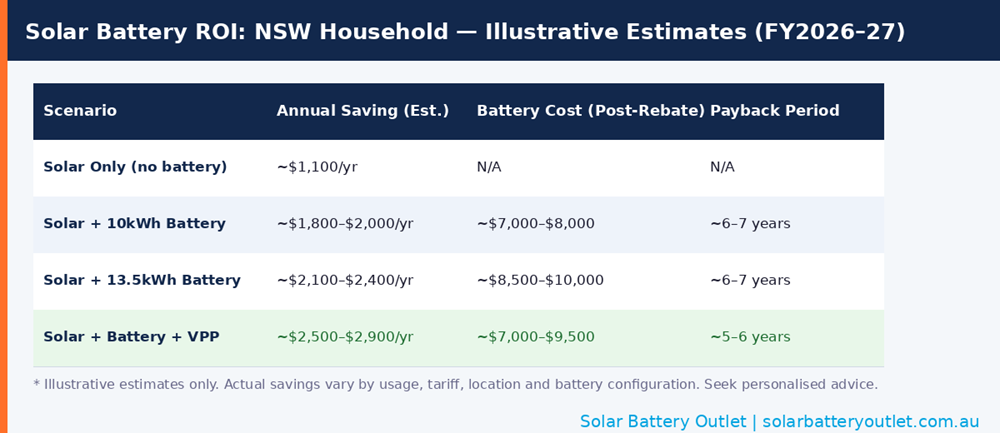
The Calculation (A 10kWh System Example):

  • Upfront Cost (Post-Incentive): ~$8,500 – $10,000
  • Annual Savings (Bill Offset): ~$1,400
  • Annual VPP Earnings: ~$400 – $600
  • Total Annual Benefit: ~$1,900
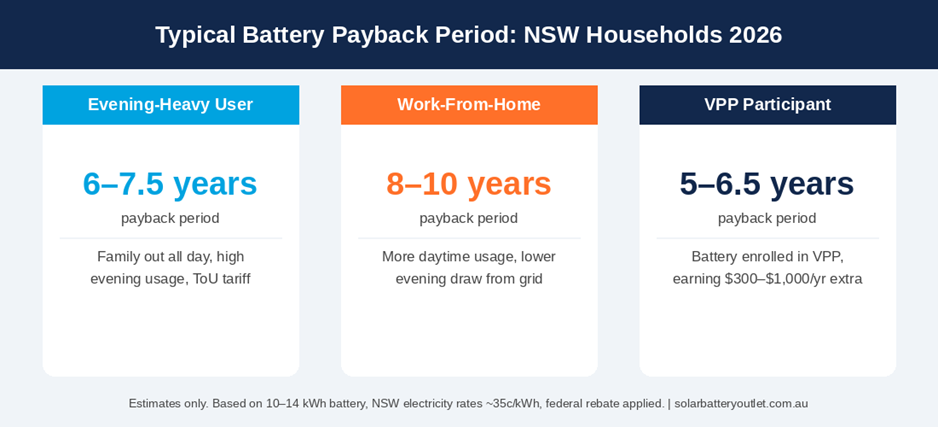
  • Payback Time: ~4.7 to 5.2 Years.
5-Year Roadmap

5-Year Roadmap: From Investment to Pure Profit and Energy Independence.

Regional Spotlight: Solar Battery in Liverpool and Bankstown

The Western Suburbs of Sydney have become a primary focus for energy efficiency. If you are looking for a solar battery in Liverpool, you are positioned in a zone with excellent solar irradiance and a high concentration of retailers competing for VPP enrollment.

Similarly, residents seeking a solar battery in Bankstown benefit from local council initiatives and a network of installers specializing in high-capacity systems for larger family homes. Because these areas often experience high summer temperatures, the ability to run air conditioning via battery storage during peak evening hours—without hitting the grid—is a massive financial win.

Navigating the NSW Battery Incentive (2026 Update)

The current incentive structure is the “secret sauce” for a 5-year payback. Unlike old grants that were flat rebates, the 2026 model rewards predictability.

  • Upfront Discount: Most households receive between $1,600 and $2,400 off the battery price at the point of sale.
  • VPP Enrollment: To get the full incentive, you must agree to let the grid “borrow” a small percentage of your battery during extreme demand peaks. In exchange, you receive a secondary payment every year.

By integrating a solar battery in Australia into these smart-grid programs, you aren’t just buying a box for your wall; you are investing in a micro-utility.

Maintenance and Longevity: Protecting Your ROI

To ensure your battery actually reaches that 5-year payback and continues to provide value for another decade, consider the following:

  1. Thermal Management: Batteries in hotter climates, like Western Sydney, should be installed in shaded, well-ventilated areas. Extreme heat can degrade battery health, slowing your ROI.
  2. Software Monitoring: Use your app to track “Cycle Life.” Modern systems allow you to prioritize either “Backup Power” (keeping the battery full for blackouts) or “self-consumption” (using it every day to save money). For the fastest payback, Self-Consumption is the priority.
  3. Warranty Check: Ensure your installer offers a 10-year performance warranty. If a battery fails in Year 4 and isn’t covered, your ROI is wiped out.

The Verdict: Is it Worth It?

In 2026, the financial case for a solar battery in Australia is stronger than it has ever been. While 5 years requires a combination of high energy usage and smart incentive participation, a 6-to-7-year payback is now the standard for almost everyone.

If you live in high-demand areas and are looking for a solar battery in Liverpool or Bankstown, the local competition among installers and specific grid incentives make this the ideal year to transition.

Summary of the 2026 Math:

  • Traditional Payback (Pre-2024): 10-12 Years.
  • Modern Payback (With VPP & Rebates): 5-7 Years.
  • System Lifespan: 12-15 Years.

The “Solar+Battery” combo is no longer a “feel-good” environmental choice; it is a calculated, strategic financial move to protect your household from the volatility of the Australian energy market.

Ready to see your custom payback period? 
At Solar Battery Outlet, we handle the full process—securing your federal rebate and NSW VPP incentive, providing SAA-accredited installation, battery backup payback guide, and managing your VPP enrollment—ensuring you reach your 5-year payback without leaving a cent on the table. 

GET A 2026 SOLAR BATTERY QUOTE 
Call us: 1800 000 777
About Solar Battery Outlet: We are a Liverpool-based solar battery installer, part of GWM Group Pty Ltd, servicing homes across South West Sydney, Bankstown, Campbelltown, and the greater NSW region. SAA-accredited electricians do all installations. We handle all rebate paperwork so you do not have to.

What We Actually Recommend After Installing Hundreds of Them

Here’s the truth about “best solar battery” lists you find online.

Most of them are written by people who’ve never installed a battery in their life. They copy spec sheets, rank by storage capacity, and slap an affiliate link at the bottom. The brand that pays the most commission usually wins.

We do this differently.

Our team installs solar batteries every week across Liverpool, Bankstown, Campbelltown and South West Sydney. We see which batteries perform quietly for years. We see which ones throw error codes at 2am. We see which brands actually show up when something goes wrong under warranty — and which ones leave homeowners waiting months for a response.

This guide is based on that experience. Not sponsored rankings. Not manufacturer spec sheets. Just what we’ve genuinely seen work well in NSW homes in 2026 — and what the right choice looks like depending on your situation.


Before we get into it: The federal battery rebate rate drops after 1 May 2026. Every battery on this list qualifies for it. For a 10 kWh system, installing before May saves around $530 compared to waiting. All prices in this guide are shown after the current rebate rate. See exactly how the rebate works here.


First — What Makes a Battery “Best” in NSW Specifically?

This matters because NSW has specific conditions that affect which battery suits your home.

Heat. Western Sydney summers are brutal. Batteries sitting in garages or on west-facing walls in Bankstown, Liverpool and Campbelltown experience higher ambient temperatures than coastal suburbs. Heat degrades batteries faster. Battery chemistry and thermal management matter more here than they do in Melbourne or Adelaide.

Ausgrid network requirements. Most of NSW — including all of South West Sydney — runs on the Ausgrid network. Ausgrid has specific requirements around how batteries connect and register. Not every battery brand’s firmware plays nicely with every network. An experienced local installer knows which combinations work cleanly.

VPP eligibility. The NSW Peak Demand Reduction Scheme pays you up to $1,500 for connecting your battery to a Virtual Power Plant. Not all batteries are VPP-capable under the scheme. Every battery we recommend below qualifies — but it’s worth knowing this is a NSW-specific filter that rules out some cheaper imported options.

Storm season backup. South West Sydney gets hit hard in summer storms. Blackout protection isn’t just a nice feature here — for a lot of families it’s the whole point. How reliably a battery switches to backup mode when the grid drops is a real performance question, not a marketing checkbox.

With that context, here’s what we actually recommend.

The Best Solar Batteries for NSW Homes in 2026

best solar battery NSW comparison

1. BYD Battery-Box HVM — Best Overall for NSW Families

Best for: Most NSW homeowners. Families wanting flexibility. Anyone planning an EV in the next few years.

If we had to recommend one battery to the average NSW family in 2026 — this is it. Not because it’s the flashiest. Because it’s the most sensible combination of performance, price, flexibility and warranty we’ve seen at this price point.

BYD is the world’s largest battery manufacturer. They make batteries for everything from home storage to electric buses to grid-scale projects. That manufacturing scale shows up in consistent quality and genuinely responsive warranty support in Australia.

The modularity is the standout. You start at 8.3 kWh and add modules later up to 22.1 kWh. If you’re not sure how much storage you need right now — or if an EV is coming in the next couple of years — this lets you start with what makes sense today and grow without replacing anything.

The 10-year warranty covers 70% capacity retention. That’s the higher threshold among mid-range options and it means in year 10, your battery should still hold more than two-thirds of its original capacity.

Real numbers for NSW after rebates:

  • 8.3 kWh: approximately $4,500–$6,500 installed
  • 10 kWh: approximately $5,500–$8,000 installed
  • 13.8 kWh: approximately $7,500–$10,500 installed

Watch out for: Needs a compatible hybrid inverter. If you have an older string inverter, confirm compatibility before accepting a quote. This is the most common issue we see with BYD retrofits.

2. Tesla Powerwall 3 — Best Premium Option and Best for EV Owners

Best for: EV owners. Families who want automatic blackout protection. Homes wanting a single all-in-one unit.

The Powerwall 3 earns its reputation. It’s a single 13.5 kWh unit with a built-in inverter — everything in one box, fewer components, cleaner installation, fewer failure points over 10 years.

The blackout protection is the best we’ve seen in a residential battery. When the grid drops, the Powerwall switches automatically. No manual input, no delay, no noticing it happened. For families with medical equipment or just anyone who’s been through one too many summer blackouts in South West Sydney, this matters.

The EV integration is genuinely useful if you’re in the Tesla ecosystem. The Powerwall manages solar generation, home storage and car charging as one system through the Tesla app — deciding when to charge the car from solar versus battery versus grid based on your usage patterns and time-of-use pricing. No other battery on this list matches that level of integration.

Real numbers for NSW after rebates:

  • 13.5 kWh: approximately $9,000–$13,000 installed

Watch out for: Fixed capacity — you can’t expand it modularly. If your storage needs grow significantly, you add a second unit. Also the most expensive option on this list. If you’re not in the Tesla EV ecosystem, you’re paying a premium for features you may not fully use.

For a full head-to-head between Powerwall 3 and BYD, we’ve written a detailed Tesla Powerwall 3 vs BYD Battery-Box comparison specifically for NSW homeowners.

3. Sungrow SBR — Best Value for Performance

Best for: Value-focused buyers. Homes already running a Sungrow inverter. Households wanting larger storage without Tesla’s price tag.

Sungrow is the world’s largest solar inverter manufacturer. Their SBR battery range is built on the same engineering heritage — and it shows. The cycle rating on the SBR is among the best in this price bracket, rated at around 6,000 cycles. Over a 10-year period, that’s solid.

It scales from 9.6 kWh up to 25.6 kWh, which makes it a strong option for larger homes or households with higher evening usage. If you’ve already got a Sungrow inverter from a previous solar install — which is common across South West Sydney — the SBR is usually the cleanest and most cost-effective battery to add. No inverter replacement needed.

The 10-year warranty covers 60% capacity retention — slightly lower than BYD and Tesla’s 70% threshold, but at this price point the trade-off is reasonable for most households.

Real numbers for NSW after rebates:

  • 9.6 kWh: approximately $4,500–$7,000 installed
  • 12.8 kWh: approximately $6,000–$8,500 installed

Watch out for: Works best with Sungrow inverters. AC-coupling to other brands is possible but adds cost and complexity. Confirm your inverter compatibility before getting a quote.

4. Enphase IQ Battery 5P — Best for Long-Term Peace of Mind

Best for: Long-term homeowners who want the longest warranty available. Retrofits onto any existing inverter. Fire-safety conscious buyers.

The Enphase IQ Battery 5P is the only battery available in Australia right now with a 15-year warranty. Everything else on this list is 10 years. If you’re planning to stay in your home for 15 years and you want certainty over that entire window, that warranty alone is a significant differentiator.

It’s fully AC-coupled, which means it connects to almost any existing solar inverter without replacing anything. If your current setup is a few years old and you want to add a battery with the least disruption, Enphase is often the cleanest retrofit technically.

Fire safety credentials are worth mentioning given how hot South West Sydney gets. The IQ 5P carries UL 9540 and UL 9540A certification — the highest fire safety standard available for residential batteries. For homes in bushfire-adjacent areas west of Sydney, this isn’t a small thing.

Real numbers for NSW after rebates:

  • 10 kWh setup: approximately $5,500–$9,000 installed

Watch out for: Higher cost per kWh than BYD or Sungrow. Each module is a separate physical unit — you can’t stack them, they sit side by side. For tight spaces this can be a consideration.

5. Sungrow SBH — Best Mid-Range Newcomer Worth Watching

Best for: Mid-range buyers wanting newer technology. Homes with Sungrow inverters wanting an upgrade path.

The SBH is Sungrow’s newer residential battery range and it’s been getting strong reviews from installers across NSW. Better thermal management than the SBR, slightly cleaner firmware, and good compatibility with Sungrow’s latest hybrid inverters.

We’ve been installing it for a few months now and the early feedback from customers has been solid. It’s not as proven in the long-term as BYD or Tesla simply because it hasn’t been around as long — but the engineering behind it is strong and Sungrow’s local support in Australia is responsive.

Real numbers for NSW after rebates:

  • 9.6 kWh: approximately $5,000–$7,500 installed

Watch out for: Shorter Australian track record than BYD and Tesla. Ask your installer specifically about local warranty support before committing.

Quick Comparison — All Five Side by Side

BatteryCapacityExpandableWarrantyAfter NSW RebatesBest For
BYD Battery-Box HVM8.3–22.1 kWhYes10yr / 70%$4,500–$10,500Most NSW families
Tesla Powerwall 313.5 kWhNo (add unit)10yr / 70%$9,000–$13,000EV owners, premium
Sungrow SBR9.6–25.6 kWhYes10yr / 60%$4,500–$8,500Value, Sungrow homes
Enphase IQ 5P5–15 kWhYes15yr / 70%$5,500–$9,000Long-term owners
Sungrow SBH9.6–19.2 kWhYes10yr / 70%$5,000–$7,500Mid-range upgrade

How to Choose the Right One for Your NSW Home

how to choose best solar battery NSW 2026 guide

Stop looking at the spec table and ask yourself these four questions instead. They’ll narrow it down faster than any comparison chart.

Do you have or plan to get a Tesla EV? Yes → Powerwall 3. The integration is genuinely worth the premium in this case.

Do you already have a Sungrow inverter? Yes → Sungrow SBR or SBH. Cleanest retrofit, most cost-effective.

Do you want to expand storage later — especially for an EV? Yes → BYD Battery-Box HVM. Start where you need to and add modules.

Do you want the longest warranty and simplest retrofit onto any existing system? Yes → Enphase IQ Battery 5P.

Is value your main driver and you want solid performance without the premium? Sungrow SBR or BYD depending on your inverter.

If you’ve answered those questions and you’re still not sure — that’s what a no-obligation quote call is for. Any reputable installer, including us, should be able to look at your existing setup and give you a straight recommendation in 10 minutes.

What the NSW Rebates Look Like for Each Battery

Every battery on this list qualifies for both the federal Cheaper Home Batteries Program and the NSW VPP incentive. Here’s how that stacks for a typical 10 kWh install:

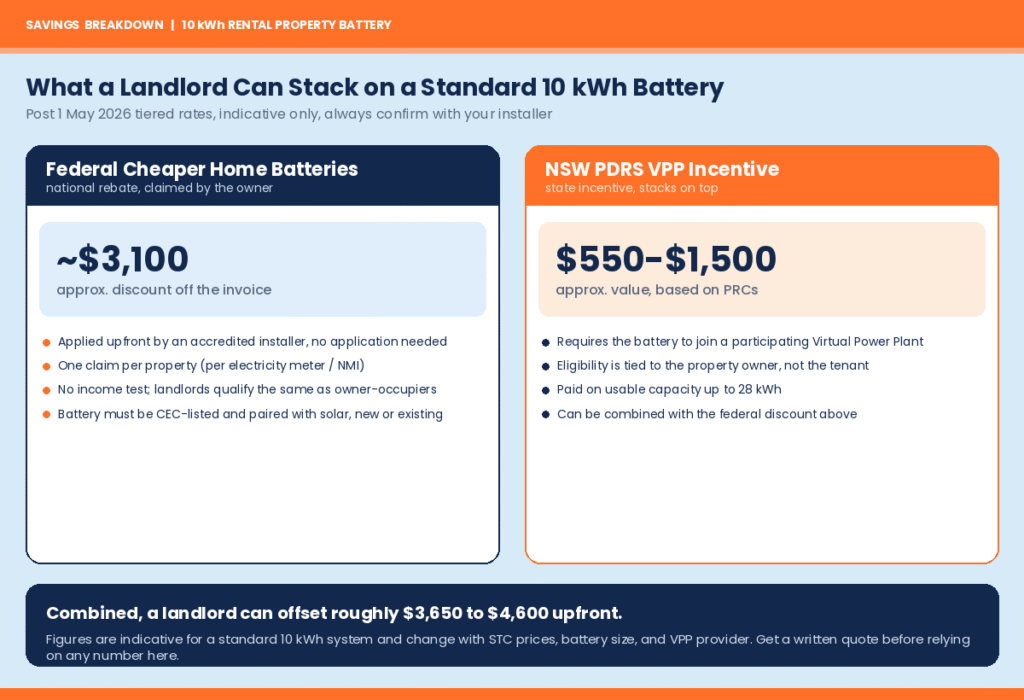
  • Federal rebate: ~$3,100 off upfront (applied directly on your invoice by your installer)
  • NSW VPP incentive: up to $1,500 paid to you after installation for connecting to a Virtual Power Plant

Combined: up to $4,600 in savings before your first electricity bill reduction kicks in.

The federal rate drops after 1 May 2026. For anything over 14 kWh — like the Powerwall 3 — the drop is more significant because of the new tiered structure. For standard 10 kWh batteries, it’s around $530 less if you wait past May. Not a cliff, but real money.

For the exact numbers on what changes and when, our Solar Battery Rebate Drops 1 May 2026 guide has the full breakdown.

What to Ask Any Installer Before You Sign

A few things we see trip people up when getting quotes for any of these batteries across NSW:

The cheapest quote is not always the best value. A BYD installed with the wrong inverter or poor cable management will give you more headaches than a Sungrow installed properly at a higher price.

Make sure the federal rebate shows as a line item on the quote — not a verbal promise. You should be able to see exactly how much the rebate is reducing your invoice.

Ask specifically: does this installation include blackout protection? Not all system designs include automatic backup even when the battery supports it.

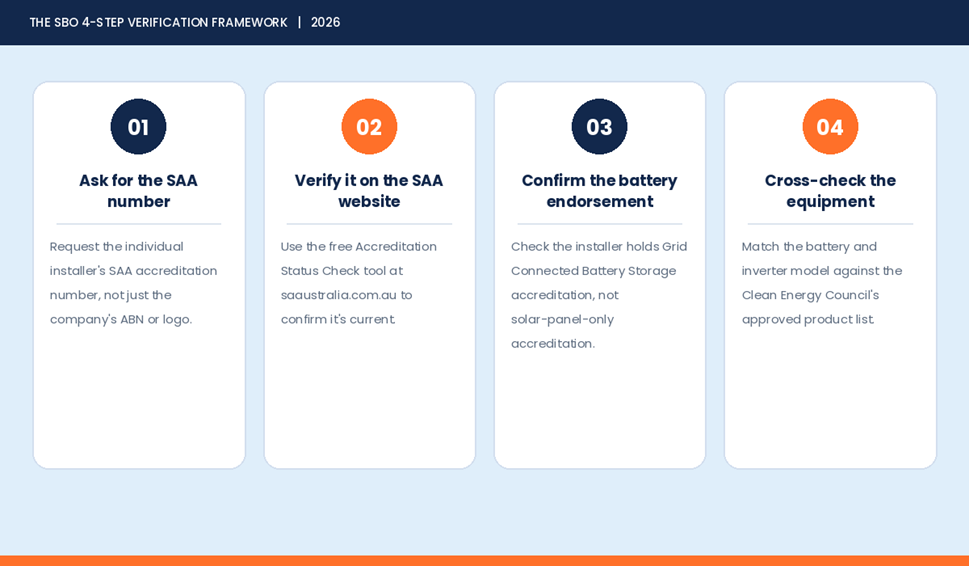
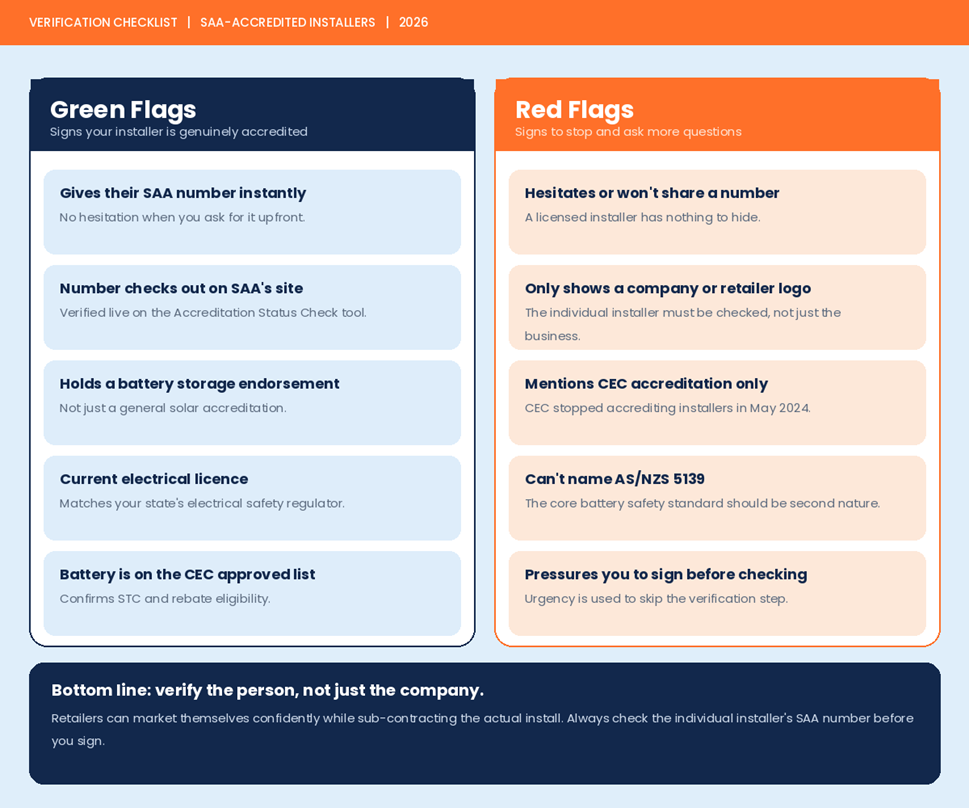
Confirm the installer is SAA-accredited before signing anything. Verify at saaustralia.com.au — takes 30 seconds. Without SAA accreditation your installer cannot process the federal rebate.

Ask who handles the NSW VPP paperwork. Some installers skip this step because it’s extra compliance work. A good installer processes both rebates as standard.

For everything else to check — including the questions that catch installers out — our Solar Battery Installer Liverpool NSW guide covers what to look for and what to avoid.


Frequently Asked Questions

Is the BYD Battery-Box actually as good as Tesla?

For most NSW families — yes. Tesla wins on automatic blackout switching and EV integration. BYD wins on price, flexibility and the ability to expand. If you’re not in the Tesla ecosystem, BYD gives you equivalent quality at a lower cost. That’s why it’s our most installed battery across Liverpool, Bankstown and Campbelltown.

Which battery lasts longest in Australian heat?

All five batteries on this list use LFP chemistry, which handles heat better than older lithium-ion. Enphase has the longest warranty at 15 years. In terms of real-world longevity in hot Western Sydney conditions, BYD and Sungrow have the largest local install base and the longest track record in Australian conditions. For more on what actually affects lifespan, see our How Long Does a Solar Battery Last in Australia guide.

Can I get a solar battery without existing solar panels?

No — the federal rebate requires existing or simultaneously installed solar panels. A battery alone doesn’t qualify. If you don’t have panels yet, a combined solar and battery install is actually good timing and the rebate applies to the battery portion. For the full eligibility checklist, see our Federal Battery Rebate NSW 2026 guide.

What size battery do I actually need for a NSW home?

For most families in South West Sydney using power mainly in evenings, 10 kWh covers the majority of overnight usage comfortably. If you have an EV or high usage, 13–15 kWh makes more sense. A good installer will look at your last 3 electricity bills and size it properly rather than just recommending the biggest option. Our Solar Battery Cost Sydney 2026 guide breaks down sizing and cost together.

Are solar batteries worth it in NSW right now?

For most homeowners with existing solar and evening-heavy usage — yes. The combination of low feed-in tariffs, high evening rates and the current rebate makes the numbers work better than they have at any point in the last five years. For an honest payback analysis, our Are Solar Batteries Worth It in Australia guide covers the full case.


Want a straight recommendation for your home? Tell us your suburb, your existing inverter brand, and your last quarterly bill — and we’ll tell you exactly which battery makes sense and what it’ll cost after rebates.

Call 1800 000 777 or fill in our 60-second form at solarbatteryoutlet.com.au We’re based in Liverpool and Bankstown. No pressure, no pushy sales.

php