The appliances that use the most battery power in an Australian home are easy to spot. They include ducted air conditioning, EV chargers, electric hot water, pool pumps and clothes dryers. Together, these loads can drain a home battery in just a few hours. As a result, knowing each appliance’s power draw helps you choose the right solar battery size in 2026. This guide uses 2026 figures from Australian Government and industry sources.

Which Appliances Drain a Home Battery Fastest?

First, here is the short answer. Ranked by power draw while running, the biggest battery drainers are:

  • Ducted air conditioning: about 3 to 7 kW while it works hard, depending on the system size.
  • EV wall chargers: 7 kW on a standard single-phase home charger.
  • Large split systems: about 1 to 2.5 kW in a big living area.
  • Older single-speed pool pumps: about 1 to 2 kW for hours each day.
  • Electric storage hot water: roughly 6 kWh a day for a typical household.
  • Vented clothes dryers: about 2.5 to 4 kWh for each full load.
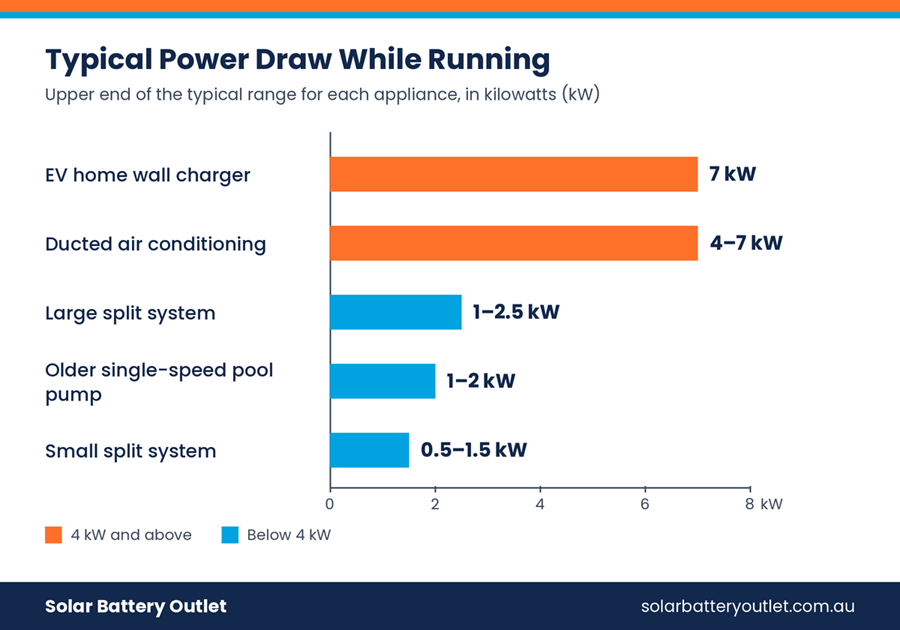
Typical Power Draw While Running

In short, a few high-draw appliances account for most of the battery drain. The sections below explain each one.

kW vs kWh: How Battery Power Really Works

Two units decide how well a battery runs your appliances. First, kilowatt-hours (kWh) measure stored energy, or capacity. Second, kilowatts (kW) measure how fast the battery can deliver power.

For example, a 10 kWh battery limited to 5 kW can run a 5 kW load for two hours. However, a 7 kW load would exceed that limit. Also, check the usable capacity, because it can sit below the headline figure. Therefore, compare both numbers, not just the kWh rating.

Why Heating and Cooling Use the Most Battery Power

The Australian Government says heating and cooling can use up to 50% of household energy. The exact share depends on your climate zone. Consequently, air conditioning usually tops any appliance list.

Next, consider size. A small split system in a bedroom typically draws 0.5 to 1.5 kW. A larger split in a living area draws about 1 to 2.5 kW. Ducted systems, however, can draw 4 to 7 kW while they work hard.

For example, a 7 kW ducted system could empty a 10 kWh battery in about 1.5 hours. Even at 4 kW, the same battery lasts only about 2.5 hours. These runtimes assume a full battery and no other appliances running.

On the positive side, YourHome says reverse-cycle air conditioners are the most energy-efficient heating and cooling choice. Choosing a correctly sized unit also reduces the load on your battery. In addition, air conditioners carry a Zoned Energy Rating Label. It scores heating and cooling from 0 to 10 stars across three climate zones.

EV Chargers: The Biggest Single Draw

An EV charger is often the largest single load in a home. A dedicated home charger delivers 7 to 22 kW, according to energy.gov.au. Most single-phase homes install a 7 kW unit.

Also, daily energy use depends on how far you drive. The average Australian drives about 33 km a day. Most EVs use 13 to 25 kWh per 100 km. Therefore, a typical daily top-up adds roughly 4 to 8 kWh.

However, the charging rate matters more for battery sizing. At 7 kW, an EV charger would drain a 10 kWh battery in about 1.4 hours. Many owners charge from solar during the day instead. Others use stored solar energy for overnight top-ups.

Electric Hot Water Systems Add a Steady Load

Next, consider water heating. It is the second-largest energy use in most homes. The Australian Government puts it at 15% to 27% of household energy, depending on location.

The average household uses around 120 to 130 litres of hot water a day. Heating 120 litres with a standard electric element takes roughly 6 kWh a day, before standing losses.

A heat pump water heater uses far less electricity. The ACT Government says heat pumps run about 50% to 70% cheaper than gas or standard systems. In addition, you can schedule a heat pump to run on midday solar.

Some homes put electric hot water on a separate controlled-load circuit. As a result, your battery may not power it at all. Ask your installer to confirm which circuits connect to your battery.

Pool Pumps Run for Hours Every Day

Similarly, pool pumps deserve a close look. For the 1.1 million Australian homes with a pool, the pump can be the single largest electricity user. Energy.gov.au says it can make up around 18% of the electricity bill.

Real-world data backs this up. Ku-ring-gai Council’s pool pump rebate program recorded older single-speed pumps averaging 7.02 kWh a day. New variable-speed pumps averaged 2.19 kWh.

Energy.gov.au also reports that a 5-star variable-speed pump uses 55% less energy than a 1-star single-speed pump. Since 2022, mandatory energy labels help you compare models. Finally, pool pumps run on timers, so you can schedule them for sunny hours. Also, heat your pool only when needed.

Clothes Dryers, Fridges and Other Everyday Appliances

Dryers rank high, too. A vented dryer uses roughly 2.5 to 4 kWh per full load. A heat pump dryer often uses half to a third of that. YourHome says dryers can account for up to 15% of energy use in heavy-use households.

Fridges and freezers never switch off. They account for around 10% of household energy bills, according to energy.gov.au. Because they run all night, they draw steadily from your battery after sunset.

TVs and home entertainment equipment add around 5% on average, says YourHome. Meanwhile, line drying costs nothing, so save the dryer for wet days.

Standby power adds up as well. Many appliances keep using energy when switched off at the machine. Energy.gov.au suggests switching most appliances off at the wall, except fridges and freezers.

How to Match a Solar Battery to Your Biggest Appliances

To finish, follow these four steps to size a battery around your real appliance loads.

  1. List your biggest loads. Start with ducted air conditioning, your EV charger, electric hot water and your pool pump.
  2. Check each appliance’s kW rating and daily kWh. Read its energy label or specifications.
  3. Match capacity and output. Choose enough kWh for the evening and enough kW for your biggest load.
  4. Shift flexible loads to midday. Run pumps, hot water and EV charging on solar, then let the battery cover the evening.
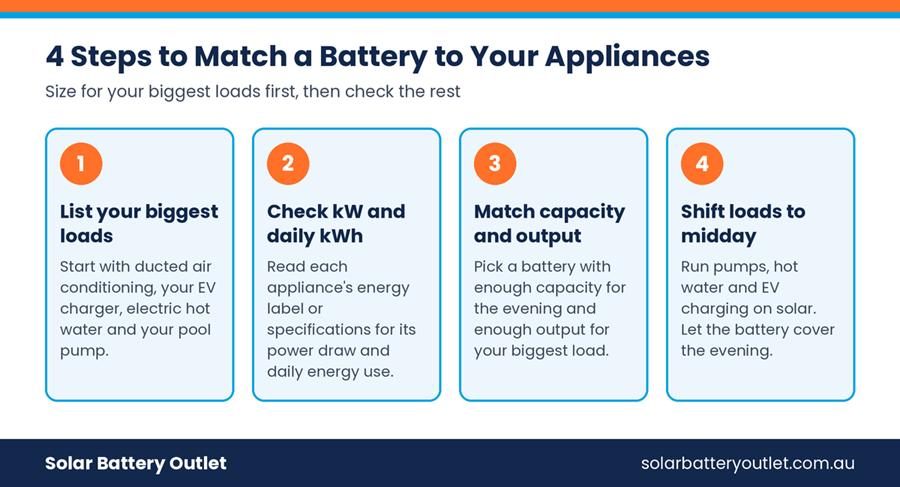
4 steps to match a battery to your appliances

Frequently Asked Questions

What appliance uses the most electricity in an Australian home?

Heating and cooling use the most electricity in most Australian homes. Energy.gov.au says they can account for up to 50% of household energy. Water heating comes second at 15% to 27%. In homes with a pool, the pool pump can rival both.

Can a home battery run an air conditioner?

Yes, but runtime varies. A small split drawing of 0.5 to 1.5 kW may run roughly 6 to 18 hours on a battery with 10 kWh usable before inverter losses and backup reserve settings. A ducted system drawing 4 to 7 kW may drain that battery in about 1.5 to 2.5 hours.

How much battery power does an EV charger use?

A standard 7 kW home charger draws 7 kW while charging. That rate would empty a 10 kWh battery in about 1.4 hours. Many owners therefore charge from solar during the day instead.

Does a pool pump use a lot of battery power?

Older single-speed pumps do. Ku-ring-gai Council recorded 7.02 kWh a day for older pumps, against 2.19 kWh for new variable-speed models. Scheduling your pump for sunny hours reduces its battery use.

What size solar battery do I need for these appliances?

It depends on your daily kWh, your evening use and your largest loads. Add up the appliances you want to run after sunset. Then check the battery’s capacity in kWh and its output in kW. A licensed installer can confirm the right size.

Not sure which appliances your battery should cover? Call Solar Battery Outlet on 1800 000 777 for a no-obligation chat.

Disclaimer

This article offers general information only. Appliance power draw, battery runtime, and running costs vary by model, climate, electricity tariff, and how you use each appliance. The figures here come from published Australian sources and simple calculations, so treat them as estimates. They do not replace advice from a licensed electrician or an accredited installer. Solar Battery Outlet does not guarantee any savings or battery runtime. Always seek personalised advice before making a purchasing decision.

Australian summers push home batteries to their limits. Temperature quietly shapes how much energy your battery stores, how fast it charges, and how long it lasts. Most homeowners focus on battery size and brand. However, temperature affects home battery performance just as much as either factor. NSW felt a fierce heatwave in January 2026, with parts of the state reaching almost 50°C. Western Sydney suburbs such as Penrith regularly top 42°C in summer. Meanwhile, winter mornings in the Blue Mountains and Southern Highlands can dip below freezing. Both extremes change how your lithium battery behaves. This guide explains why temperature matters, what happens inside your battery during heat and cold, and how to protect your investment year-round.

Why Temperature Controls Your Battery’s Chemistry

Your home battery stores energy through chemical reactions inside each cell. Consequently, temperature directly influences how fast those reactions happen. Lithium-ion batteries, including the LiFePO4 chemistry used in most Australian home systems, work best within a narrow temperature band. Outside that band, chemical activity either slows down or speeds up too much. Slower reactions mean less available power. Faster reactions generate extra heat, which stresses internal components. This is why manufacturers publish an operating temperature range for every battery model. Staying inside that range protects both performance and warranty. Straying outside it, even occasionally, adds cumulative wear that shortens your battery’s working life.

How Summer Heat Affects Your Battery’s Performance and Lifespan

Heat is the bigger threat for most Australian homes. SolarQuotes founder Finn Peacock puts it plainly: “Heat is the number one cause of early lithium battery death.” His writing points to direct sun exposure and poorly ventilated garages as common culprits, since radiant heat can push internal battery temperatures well above the surrounding air.

The physics behind this follows the Arrhenius principle, which links chemical reaction speed to temperature. For many electronic components, running just 10°C hotter than the design specification can roughly halve their expected lifespan. Home batteries are no exception. Extra heat accelerates the breakdown of internal materials, and this gradually reduces how much energy the battery can store.

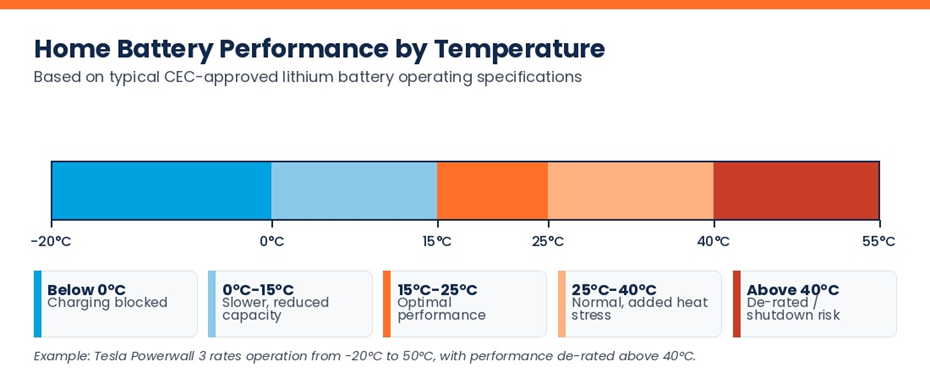
Most CEC-approved batteries include a battery management system that manages this risk automatically. The BMS reduces charge and discharge rates as internal temperatures climb, and it shuts the system down if temperatures become dangerous. Tesla’s Powerwall 3, for example, operates between -20°C and 50°C, but Tesla notes that performance is de-rated above 40°C. That de-rating behaviour is common across the industry, not a fault unique to one brand.

NSW felt this heat firsthand in January 2026. According to Bureau of Meteorology data reported by NASA’s Earth Observatory, Australia recorded its fourth-warmest January since 1910 that month. An intense heatwave swept across NSW, South Australia and Victoria between 26 and 30 January. Western Sydney suburbs such as Penrith topped 42°C for three consecutive days during that stretch. On days like these, an unshaded battery can sit well above its safe operating window for hours.

Home battery performance across temperature zones

How Winter Cold Slows Down Your Battery

Cold weather causes a different problem. Lithium-ion chemistry slows down as temperatures drop, so your battery delivers less usable capacity. Charging is affected even more than discharging. Most lithium batteries reduce or completely stop charging below 0°C to prevent lithium plating, a process that can permanently damage the cells. This protection matters in places like the Southern Highlands, the Blue Mountains, and inland NSW towns such as Mudgee, where winter mornings regularly fall below freezing.

Unlike heat damage, cold-related capacity loss is usually temporary. Once the battery warms back up within its normal range, performance typically returns to normal. Even so, repeated cold starts add mild stress over time. Installing your battery in a sheltered, insulated space helps it recover faster each morning and keeps charging consistent through winter.

The Ideal Temperature Range for NSW Home Batteries

Most home battery manufacturers target an ideal operating range of roughly 15°C to 25°C. Inside this band, batteries charge efficiently, discharge smoothly, and experience minimal long-term stress. The chart above breaks down what happens outside that range, from blocked charging in freezing conditions to de-rated performance above 40°C.

NSW’s climate makes this range harder to hold naturally. Coastal Sydney suburbs sit closer to the ideal range for more of the year. Western Sydney locations, including Liverpool and Bankstown, regularly exceed 35°C in summer, pushing unshaded batteries toward the upper limit. Good site selection is therefore essential, not optional, for any solar battery company installing a system in a hot NSW suburb.

Where You Install Your Battery Changes Everything

Installation location has a bigger impact on temperature exposure than most homeowners expect. AS/NZS 5139:2019 includes requirements for battery installation locations. Amendment 1:2025 was published on 19 December 2025 and updated the standard. Installers should refer to the current edition of the standard for the latest requirements.

Batteries cannot sit in bedrooms, living areas, or ceiling cavities, since these locations trap heat and restrict airflow. A shaded, well-ventilated external wall or garage is usually the safer choice. Direct afternoon sun on an outdoor unit can push its internal temperature well above the surrounding air, even on a mild day. Coastal NSW properties face an added complication too: salt-laden air can corrode battery enclosures faster than expected, so installers often favour a sheltered position with stainless fittings.

An SAA-accredited installer will assess sun exposure, ventilation, and clearance requirements before choosing a final position.. This upfront planning protects performance, safety, and your battery’s warranty for years to come. It is one reason to choose an established, accredited installer rather than simply the cheapest quote.

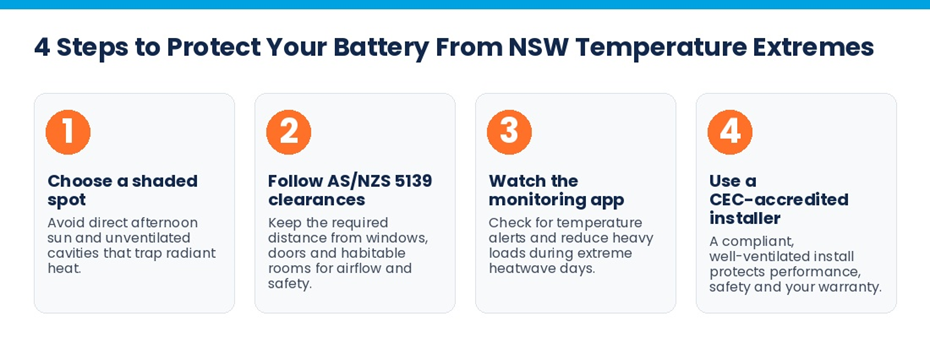
4 Steps to Protect Your Battery From Temperature Extremes

You cannot control the weather, but you can control how your battery experiences it. These four steps help protect performance through both summer heatwaves and winter cold snaps.

Four practical steps to protect a home battery from NSW temperature extremes.

Together, these steps reduce cumulative thermal stress on your system. Over the life of your battery, that can help it keep more of its original capacity. A reliable solar battery company will walk you through each of these checks as part of a standard installation.

Frequently Asked Questions

Does hot weather reduce home battery capacity?

Yes. Extended heat exposure accelerates internal wear and can permanently reduce how much energy your battery stores over time. Short-term heat mainly triggers automatic de-rating rather than permanent loss.

Can I install a solar battery outside in NSW?

Yes, provided the battery is outdoor-rated and installed in a shaded, ventilated position that meets AS/NZS 5139 clearance requirements.

What temperature is too cold for a home battery?

Most lithium batteries stop charging below 0°C to protect the cells. Performance typically returns once the battery warms up again.

Does battery placement affect my warranty?

Yes. Many manufacturers can void or limit warranty claims if a battery is installed in direct sun or a non-compliant location.

How do I know if my battery is overheating?

Check your battery’s monitoring app for temperature alerts, and contact your installer if you notice reduced performance during hot weather.

Ready to Heat-Proof Your Home Battery?

Thinking about where to install your next battery, or wondering if your current system copes with NSW summers? Solar Battery Outlet helps homeowners across Liverpool, Bankstown, and Mudgee choose the right battery and the right location for our climate. Call 1800 000 777 to book a tailored assessment with our team and SAA-accredited installers.

Disclaimer

This article provides general information about how temperature affects home battery performance in Australia. It does not constitute professional, technical, or financial advice, and every property, battery model, and installation site is different. Actual performance and lifespan depend on your specific battery, its installation location, and prevailing weather conditions. Always seek personalised advice before making a purchasing decision.
Battery energy management is the software that decides when your home battery charges, discharges, or holds its energy. Think of it as the brain of your battery. It reads your solar output, your household demand, and your electricity tariff. Then it acts automatically.

Most homeowners focus on battery size. However, settings matter just as much. Two homes with identical batteries can save very different amounts, because each battery follows different rules. In August 2026, Australia passed 500,000 home battery installations under the Cheaper Home Batteries Program. As a result, understanding this control layer matters more than ever.

This guide explains how battery energy management works, which modes you can choose, and which settings shape your bills.

Key takeaways

  • Battery energy management controls when your battery charges and discharges.
  • A battery management system (BMS) protects the cells. An energy management system (EMS) directs energy use.
  • Quality batteries usually offer self-consumption, time-based, and backup-only modes.
  • A virtual power plant (VPP) can add outside control if you opt in.
  • Your reserve level, charging window, and tariff settings shape your results.

What Is Battery Energy Management?

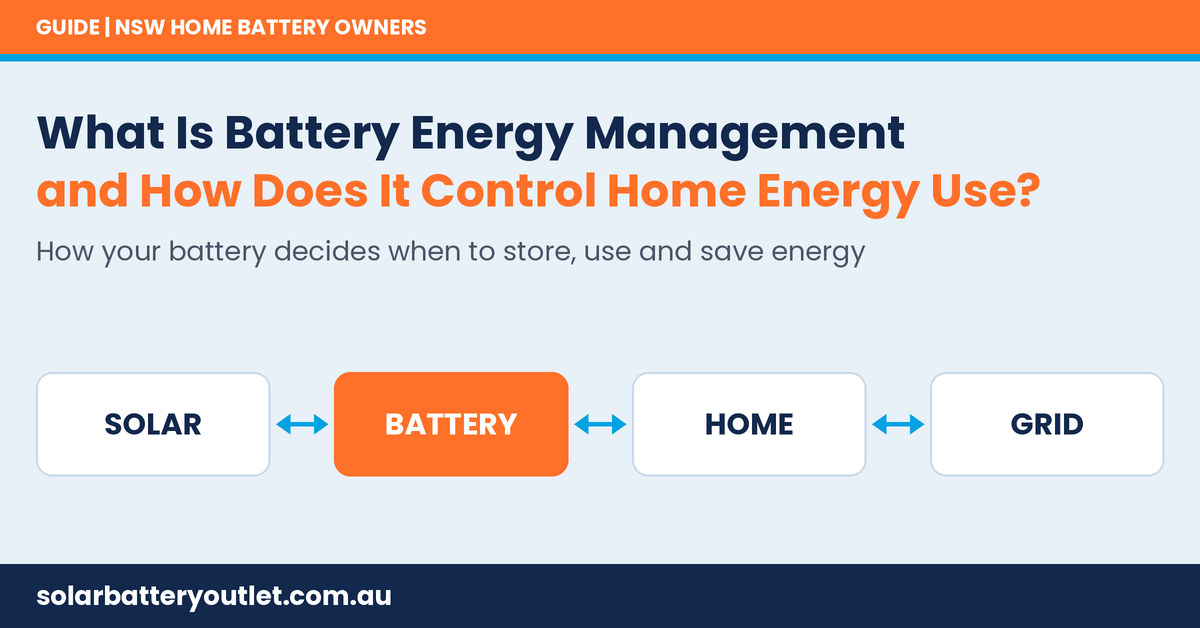
Battery energy management is the set of rules that directs energy through your home. Specifically, it moves energy between your solar panels, battery, home, and the grid. These rules run inside your hybrid inverter or battery controller. You usually view and adjust them through a phone app.

The system decides in real time. For example, it sends solar power to your appliances first. Next, it stores any surplus. Finally, it releases that stored energy when your home needs it, usually after sunset.

Your system relies on a few key inputs. First, it reads solar generation. Second, it tracks household demand. Third, it checks the state of charge, which shows how full the battery is. Many systems also use tariff schedules, so they know when grid power costs more.

This control matters because solar generation and household demand rarely match. Solar output peaks around midday. Meanwhile, household demand often rises in the evening. Battery energy management closes that gap.

Battery Management System vs Energy Management System

People often confuse these two terms. However, they do different jobs.

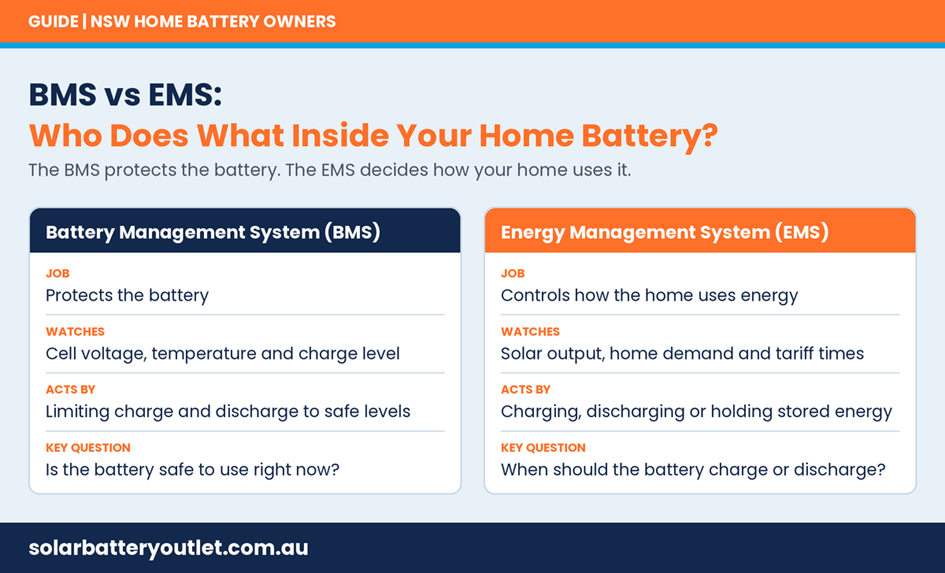
A battery management system (BMS) protects the battery itself. It monitors cell voltage, temperature, and charge level. It also keeps the battery within safe limits.

An energy management system (EMS) protects your bills. It decides when the battery should charge, discharge, or wait. In other words, the BMS keeps the battery safe, while the EMS makes it useful.

BMS vs EMS

Some manufacturers bundle both functions under one brand name. Therefore, ask your installer which settings you can change yourself.

How Battery Energy Management Controls Home Energy Use

Most good batteries offer at least three control modes, according to SolarQuotes. Each mode suits a different tariff and lifestyle.

Self-Consumption Mode

This mode minimises the electricity you draw from the grid overall. Therefore, it suits households on flat-rate plans. The battery charges from surplus solar. Then it discharges whenever your home needs more power than the panels supply.

Time-Based Control Mode

This mode works with time-of-use (ToU) tariffs. Here, the battery avoids expensive grid power. It may even charge from the grid when electricity costs less. Time-of-use tariffs charge less during cheaper periods and more in the evening peak. Check your own NSW plan’s rates, because they vary widely between retailers.

NSW households now have another option. Since 1 July 2026, eligible households can opt in to the Solar Sharer Offer. It provides up to 24 kWh of free electricity between 11am and 2pm. However, you still pay supply charges and any usage outside that window. Depending on your plan and battery, you may shift some midday energy into the evening peak. Check your retailer’s terms first, and read our guide to free midday electricity in NSW.

Backup-Only Mode

This mode keeps the battery fully charged at all times. It prepares you for a blackout. However, it ignores bill savings. Consequently, it suits short periods, such as before a forecast storm.

Virtual Power Plant Control

A VPP adds a fourth layer of control. When wholesale prices spike, the VPP operator can discharge your battery. Wholesale prices can briefly reach very high levels, but what you earn depends on your VPP’s terms, not on the wholesale price. In return, you give up some control. Moreover, heavy use can burn through your battery’s warranted energy throughput faster.

Under the Cheaper Home Batteries Program, on-grid batteries must be VPP-capable. Joining a VPP remains optional, and it needs an ongoing internet connection, according to energy.gov.au.

What a Typical Day Looks Like

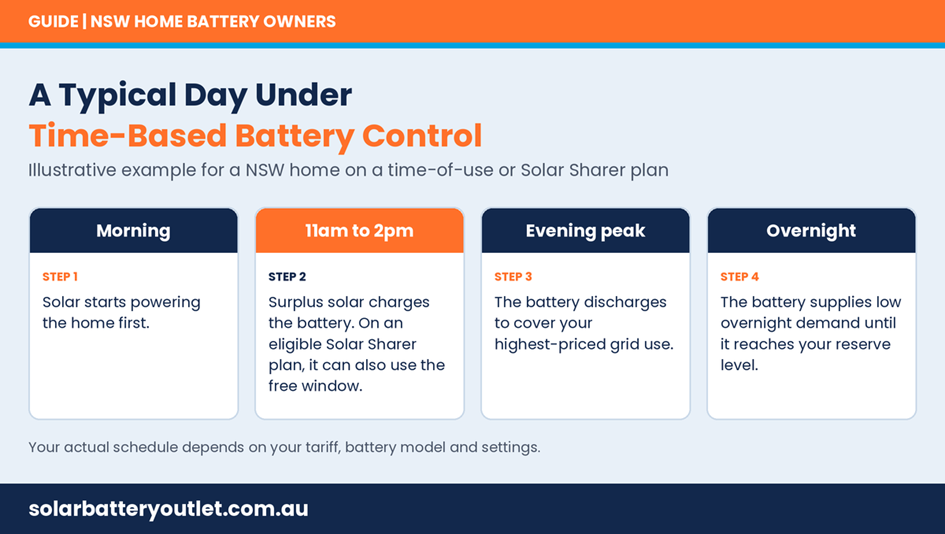
Picture a NSW home on a time-of-use or Solar Sharer plan. In the morning, solar powers the home. Between 11am and 2pm, the battery charges. During the evening peak, it discharges. Overnight, it covers low demand until it reaches your reserve level.

time-based battery control

Your own schedule will differ, because it depends on your tariff, battery model, and settings.

Four Settings That Shape Battery Energy Management

Your battery follows the rules you set or the defaults your installer chose. Therefore, check these four settings. Also, ask any solar battery company which modes and settings your system supports.

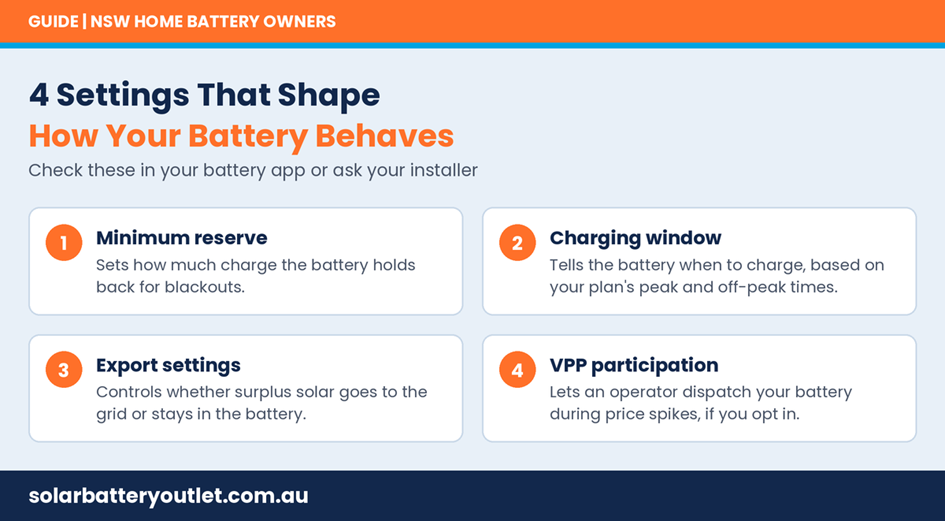
4 setting that shape how your battery behaves

1. Minimum reserve. This setting holds back charge for blackouts. SolarQuotes says even 20% could keep essentials running for hours with efficient lighting and appliances. However, a higher reserve leaves less energy for bill savings.

2. Charging window. Match the schedule to your plan’s actual peak and off-peak times. These times vary between plans, so check your own.

3. Export settings. These settings control whether surplus solar flows to the grid or stays in the battery. Review them each season, because your solar output and usage change.

4. VPP participation. Decide whether outside control suits you. Compare programs carefully, because benefits vary.

Also, keep your battery online. SolarQuotes warns that some warranties can lapse if a battery stays offline too long.

Why Battery Energy Management Matters for NSW Homes

Without careful settings, a battery mainly stores your own solar and releases it later. With good management, it also responds to your tariff, your routine, and your backup needs.

For example, the same battery acts differently in self-consumption mode than in time-based mode. The hardware stays the same. Only the rules change.

NSW households now have more reasons to check their settings. The Cheaper Home Batteries Program has lifted battery uptake sharply. Meanwhile, the Solar Sharer Offer has created a new midday pricing window. As a result, the right settings can change how much grid power you buy.

However, savings vary. The Australian Government’s energy.gov.au site warns that savings may not repay a battery’s cost within its warranted lifetime. Your usage, tariff, and settings all matter. Therefore, ask for advice based on your own bills, not on averages.

Take Control of Your Battery Energy Management

Battery energy management turns a storage unit into a smarter energy tool. The BMS protects the cells, while the EMS steers your energy. Meanwhile, your settings decide how well the system fits your home.

Want your battery set up around your tariff and routine? Talk to Solar Battery Outlet. As a local solar battery company, we install and configure home batteries across Liverpool, Bankstown, and Mudgee. Our team can explain your mode options, backup needs, and VPP capability before you decide. Call 1800 000 777 or contact our team to discuss your home..

Frequently Asked Questions About Battery Energy Management

What is battery energy management?

Battery energy management is the software that controls when a home battery charges, discharges, or holds energy. It uses data on solar output, household demand, and tariffs. As a result, it directs stored energy to the times when your home benefits most.

What is the difference between a BMS and an EMS?

A battery management system (BMS) protects the battery cells by monitoring voltage, temperature, and charge level. An energy management system (EMS) decides when the battery charges or discharges. In short, the BMS focuses on safety, while the EMS focuses on how your home uses energy.

Which battery mode is best?

It depends on your electricity plan. Self-consumption mode suits flat-rate tariffs, while time-based control suits time-of-use tariffs. Backup-only mode prioritises blackout protection over savings. Ask your installer to match the mode to your plan and routine.

Does a VPP take control of my battery?

During a VPP event, the operator can discharge your battery, so you give up some control. VPP participation is optional. However, on-grid batteries under the Cheaper Home Batteries Program must be VPP-capable. Read the program terms and warranty conditions before you sign up.

What minimum reserve should I set?

No single level suits every home. SolarQuotes notes that even 20% could keep essential loads running for hours. However, a higher reserve reduces the energy available for bill savings. Decide which appliances you need in a blackout, then discuss the setting with your installer.

Does battery energy management need an internet connection?

VPP participation needs an ongoing internet connection, according to energy.gov.au. SolarQuotes also warns that some warranties can lapse if a battery stays offline too long. Therefore, update your Wi-Fi details in the battery app whenever you change your router.

Disclaimer

This article provides general information about battery energy management only. It does not consider your personal circumstances, and it is not financial or electrical advice.

Battery modes, settings, and features differ between brands, models, and installations. Electricity tariffs, peak times, and incentives also differ between retailers and networks. Availability of the Solar Sharer Offer depends on your location, meter type, and retailer. Program rules can change, so check current details with official sources.

Savings depend on your usage, tariff, and settings. We cannot guarantee any specific result. Joining a VPP may reduce your control over the battery. It may also use up warranted throughput faster.

Always seek personalised advice before making a purchasing decision.
Your new solar battery is rated at 13.5 kWh. But it never seems to deliver that much power overnight. You are not imagining it, and your battery is not faulty. The gap sits between two numbers on the spec sheet: total battery capacity and usable capacity. Manufacturers advertise the first number. Your household actually runs on the second. More than half a million home batteries are now installed across Australia. In 2026, this distinction can decide how long your battery runs in the evening or during a blackout if your system has backup. This guide breaks down what each term means. It also shows how to size a battery around the number that actually matters.

What Is Total Battery Capacity?

Total battery capacity, also called nominal or nameplate capacity, is the full amount of energy a battery can physically store. It is measured in kilowatt-hours (kWh) and printed on the spec sheet as the headline figure. Think of it as the size of the fuel tank. A “13.5 kWh battery” has a 13.5 kWh tank. However, this number does not tell you how much of that energy you can safely draw out. Every lithium battery reserves a small buffer to protect its cells and extend its lifespan. That reserved portion never reaches your switchboard. Total capacity is useful for comparing raw battery size. But it is the wrong number for planning how long a battery will power your home.

What Is Usable Capacity?

Usable capacity is the energy you can actually withdraw from the battery before it needs recharging. The Australian Government’s YourHome guide explains it clearly. Nominal capacity is the total energy a battery can hold. Usable capacity is how much of that can actually be used, once depth of discharge is factored in. This is the figure that powers your fridge, lights, and air conditioner. It is also the number your installer should use when sizing a system for your household. Two batteries can share the same headline kWh figure. Yet they can still deliver very different real-world performance, simply because their usable capacity differs.

How Depth of Discharge Connects the Two

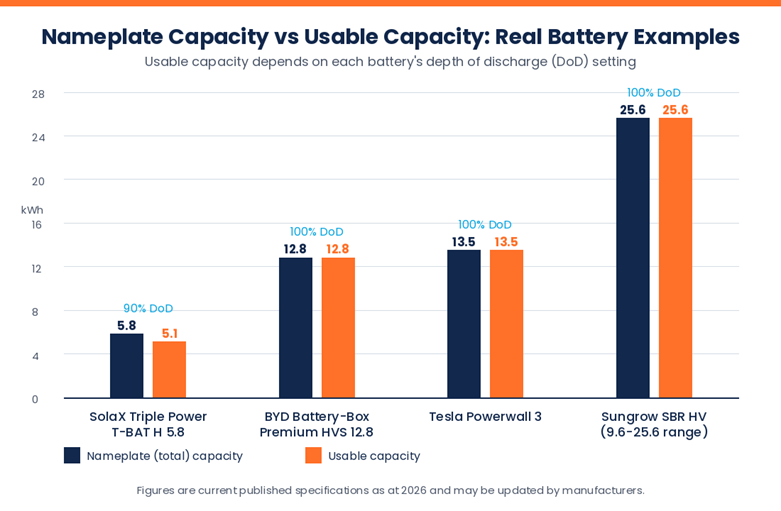
Depth of discharge (DoD) is the bridge between total and usable capacity. It is expressed as a percentage. It tells you how much of the total capacity can be regularly discharged without damaging the battery. The formula is simple: usable capacity equals total capacity multiplied by DoD. Take the SolaX Triple Power T-BAT H 5.8. It has a nominal capacity of 5.8 kWh and a warranted DoD of 90 percent. That works out to 5.1 kWh of usable capacity. Older battery chemistries and lead-acid systems often sit at 50 to 80 per cent DoD. Most modern lithium iron phosphate (LFP) home batteries now claim close to 100 percent. Even then, a small operating buffer usually remains for safety.

Real Battery Examples: Nameplate vs Usable Capacity

The chart below compares published 2026 specifications for several popular home batteries. Tesla Powerwall 3 lists a 13.5 kWh usable capacity at 100 percent DoD, so its nameplate and usable figures match. BYD’s Battery-Box Premium HVS 12.8 behaves the same way, delivering its full 12.8 kWh. Sungrow’s SBR HV range scales from 9.6 kWh to 25.6 kWh, also at 100 percent DoD. The SolaX example tells a different story. Its 5.8 kWh nameplate capacity shrinks to 5.1 kWh usable once the 90 percent DoD is applied. That 0.7 kWh gap will not appear on a quote unless you ask for it. This is exactly why comparing headline numbers alone can be misleading.

Nameplate capacity vs usable capacity across four 2026 home battery models

Why the Difference Matters for NSW Homeowners

This distinction carries real weight for households across Sydney, Bankstown, Liverpool, and regional NSW towns like Mudgee. A battery sized on nameplate capacity alone can fall short during a storm-related blackout. Essential circuits can lose power sooner than expected. It also affects everyday savings. A smaller usable capacity means less stored solar energy for peak evening electricity prices. Brenton Hielscher of Hielscher Electrical puts it simply. He says homeowners should not compare batteries by headline kWh alone. The real question is how much of that battery they can actually use. Clean Energy Regulator data shows the average battery installed under the federal rebate now holds about 18.3 kWh usable. More than half of these systems were fitted as retrofits to existing solar. That is the figure households are actually planning their evenings around.

How to Calculate the Usable Capacity You Actually Need

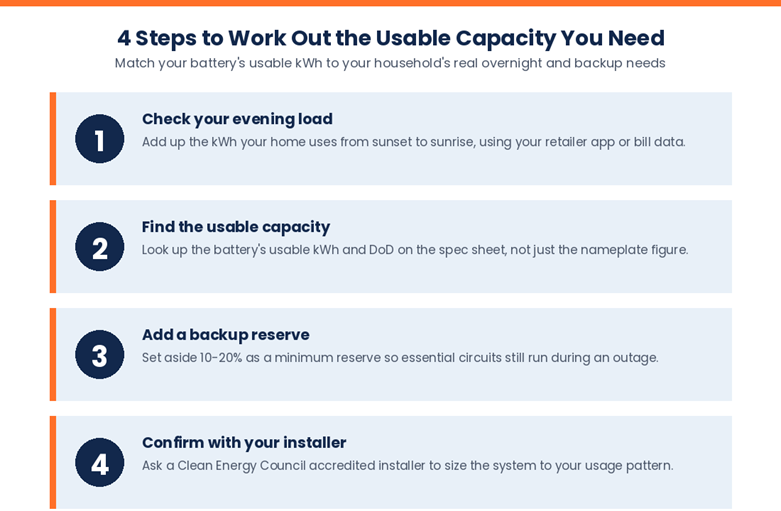
Working out the usable capacity your home needs is more reliable than chasing the biggest nameplate number. Start by reviewing your evening electricity use, from sunset through to sunrise. Then check the usable capacity and DoD on the battery’s actual spec sheet, not just its marketing name. If your system is set up for backup, add a reserve of 10 to 20 percent. This can keep essential circuits, like your fridge and lights, running if the grid goes down. Not every battery setup provides backup, so confirm this with your installer. Finally, confirm the sizing with a Solar Accreditation Australia (SAA) accredited installer. As Daniel McCabe of GI Energy notes, a great installer matters just as much as a great battery. Correct sizing depends on your home, not just the brand on the box.

A simple four-step framework for sizing usable battery capacity

Common Mistakes When Comparing Battery Capacity

A few habits lead buyers astray when comparing solar batteries. The most common is comparing nameplate capacity across brands without checking each one’s DoD. Another is assuming every battery reaches 100 percent DoD just because it is lithium. Some models still sit at 90 percent or lower. Buyers also forget to account for the backup reserve set aside for outages. This further reduces day-to-day usable energy. Finally, many overlook warranty terms. For example, BYD’s current Australian warranty for Battery-Box Premium HVS/HVM products specifies 70% retained Usable Energy over 10 years, subject to the applicable warranty conditions and minimum throughput requirements. This means usable capacity is expected to decline gradually over the system’s life. Always ask for the usable capacity figure in writing before you sign a quote.

Frequently Asked Questions

What is the difference between usable capacity and total battery capacity?

Total battery capacity is the full energy a battery can store, shown as its nameplate kWh figure. Usable capacity is the portion of that energy you can actually draw out, once depth of discharge and any safety reserve are applied.

Why don’t all solar batteries offer 100 percent depth of discharge?

Some battery chemistries and models reserve a buffer to protect their cells and extend cycle life. Most modern LFP home batteries now offer close to 100 percent DoD, but older or budget models may sit at 80 to 90 percent.

How much usable capacity does a typical NSW home need?

It depends on your evening and overnight electricity use. Many NSW households land between 10 and 20 kWh of usable capacity, though an SAA-accredited installer can size this to your actual bills.

Does a higher depth of discharge always mean a better battery?

Not on its own. A high DoD improves usable capacity, but round-trip efficiency, warranty terms, backup features, and installation quality all affect real-world performance too.

Can a battery’s usable capacity change over time?

Yes. Usable capacity typically declines gradually as a battery ages and completes more charge cycles. Manufacturer warranties usually guarantee a minimum retained capacity, often around 60 to 70 percent, after 10 years.

Does the Cheaper Home Batteries Program rebate apply to total or usable capacity?

The federal rebate is calculated using the battery’s usable capacity in kWh, not its nameplate figure. This is another reason to confirm usable capacity before comparing quotes.

Disclaimer

This article provides general information about total and usable battery capacity for solar batteries. It is correct to the best of our knowledge as at the time of publishing. It is not personal financial, electrical, or purchasing advice. Battery specifications, depth of discharge ratings, and rebate rules can change without notice. Always confirm current specifications directly with the manufacturer or your installer before purchasing. Always seek personalised advice before making a purchasing decision, as the right battery size depends on your household’s circumstances.

Australia’s home and grid-scale batteries used to have one job: store solar power for later. That job is changing fast. Across the National Electricity Market (NEM), Australian batteries are becoming grid assets in their own right. They now stabilise voltage, set wholesale prices, and replace ageing coal-fired backup services. For NSW homeowners, this shift changes the case for installing a battery. A battery is no longer just a way to cut your own bill. It is a small piece of shared energy infrastructure. This article explains how that transition works. It also covers the latest 2026 data and what it means for your own system.

Australia’s Battery Boom, By the Numbers

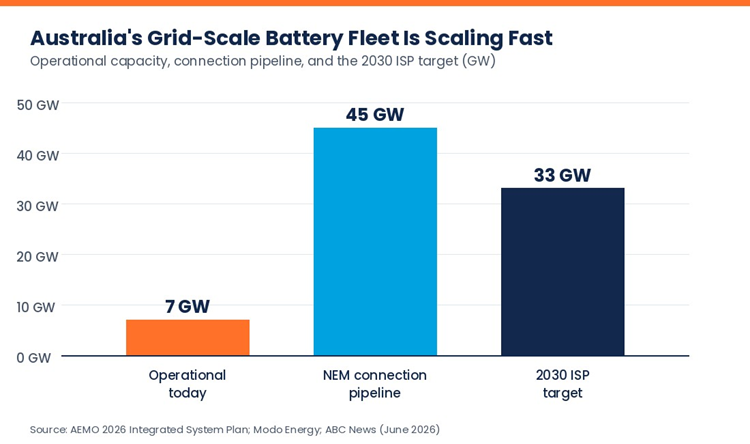
Grid-scale battery storage is expanding at record pace across the NEM. Around 7 gigawatts (GW) of grid-scale batteries are operating today. Another 45 GW sits in AEMO’s connection pipeline, already ahead of the 2030 target. AEMO’s final 2026 Integrated System Plan lifts that 2030 target to 33 GW of grid-scale storage. This is a 40% increase on the draft plan released earlier in the year. Household batteries are growing just as quickly.

According to the Australian Energy Market Operator (AEMO), around 600,000 Australian households had battery storage installed as at June 2026. NSW households have contributed a large share of these new installs. Daniel Westerman, AEMO’s CEO, called batteries a “game-changing force” alongside rooftop solar at Australian Energy Week 2026. He noted that even passive household batteries reduce evening peak grid demand by close to one kilowatt per home. Across 600,000 homes, that adds up to roughly 600 megawatts of peak demand relief.

Australia's grid-scale battery capacity, 2026

How Batteries Earn Their Keep on the Grid

Batteries do more than store energy for later use. They also earn revenue by helping balance the grid in real time. During the first quarter of 2026, grid-scale batteries set the wholesale price in about 32% of all trading intervals. That is a significant jump from previous years. Batteries also tripled their daily energy-shifting activity in the same period. Average discharge reached 359 megawatts (MW) in Q1 2026, up from just 98 MW in Q1 2025. Beyond wholesale energy trading, batteries earn money through Frequency Control Ancillary Services (FCAS). FCAS keeps the grid’s frequency stable within a tight band. In June 2026 alone, residential VPP and aggregator units earned an estimated $13,000 in FCAS revenue. That works out to around $214 per megawatt of registered capacity. That figure is small next to grid-scale earnings. Still, it shows household batteries can now join formal grid markets, not just save on bills.

Grid-Forming Inverters: Batteries Take On Coal’s Old Job

As coal power stations retire, the grid loses an important service called system strength. Coal generators once provided this stability as a byproduct of spinning turbines. Batteries fitted with grid-forming inverters can now step into that role. These inverters set the grid’s voltage and frequency reference, rather than just following it. AEMO data shows grid-forming inverters now feature in 74% of Australia’s battery storage pipeline. NSW transmission operator Transgrid is leading this shift locally. The company launched the country’s biggest tender for grid-forming batteries, targeting 5 gigawatts of capacity over time. Transgrid’s Jason Krstanoski said the fleet would eventually match the stabilising power of around 17 synchronous condensers. The first gigawatt of contracted capacity is expected to deliver services from the second half of 2026. Some batteries, including a site at Darlington in NSW, already provide these services today. For homeowners, this shift matters indirectly. It shows regulators and networks now treat batteries as core infrastructure, not backup hardware. When you choose a solar battery company for your own installation, ask about grid-forming technology. Find out whether the system supports it now or through a future software update.

Virtual Power Plants Turn Rooftops Into Power Stations

Virtual power plants (VPPs) link many home batteries into one coordinated fleet. A VPP operator can call on stored energy across thousands of homes at once. This turns scattered batteries into a single, dispatchable power source. Despite the potential, VPP uptake remains low. Every battery installed under the federal rebate must be VPP-compatible. Yet only around 10% of households with a rebate battery have actually joined a VPP.

AEMO’s Westerman says passive batteries still help the grid, even without VPP orchestration. Coordinated VPP fleets, however, offer far more value during genuine emergencies. In NSW, the Peak Demand Reduction Scheme (PDRS) rewards households that connect to an approved VPP.

From 1 July 2026, eligibility widened to batteries up to 50 kWh, and solar is no longer required. Eligible households who connect an approved battery to an approved Virtual Power Plant (VPP) may receive a one-off incentive under the NSW Peak Demand Reduction Scheme. The incentive amount depends on your battery, your VPP provider and current scheme rules, and the amount available to you will be confirmed in your quote. Joining a VPP can earn a payment and lets your battery support the grid during heatwaves and high-demand evenings. In return, the VPP operator controls some of your battery’s use, which can leave less stored energy for your home and use up warranted throughput faster.

What This Means for NSW Homeowners

This shift changes how NSW homeowners should think about a battery purchase. A system is not just backup power for outages. It is also a way to earn ongoing value from grid services. Before you commit, check that your setup can actually participate.

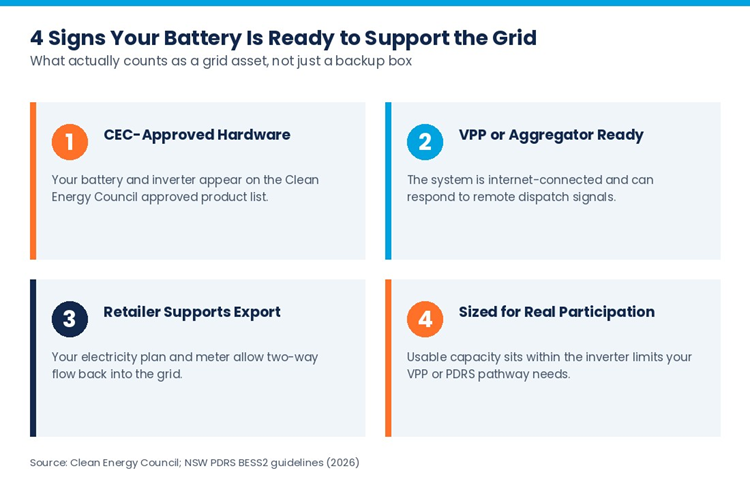
4 signs your battery is ready to support the grid

Choosing the right hardware matters more than ever. If you are comparing options, our guide to the best solar batteries in Australia for 2026 covers capacity and VPP compatibility. A good solar battery company will explain these details clearly, rather than focusing only on backup hours. Look for an installer in your area who holds Solar Accreditation Australia (SAA) accreditation and understands current NSW PDRS rules. Ask direct questions about grid-forming support, VPP partnerships, and export limits on your network. Homeowners across Liverpool, Bankstown, and Mudgee are increasingly asking these questions before they sign a contract. Solar Battery Outlet works with households across these areas to size systems and check eligibility for current rebates and VPP incentives. Want a system built for where the grid is heading, not where it has been? Our team can walk you through your options and your local network rules.

Frequently Asked Questions

What does it mean for a battery to be a grid asset?

A grid asset is a battery that actively supports the wider electricity network, not just one home. This includes batteries that help set wholesale prices, provide frequency control services, or stabilise voltage through grid-forming inverters.

Do I need to join a VPP for my battery to help the grid?

No. AEMO reports that passive batteries already reduce peak demand and support the grid, even without VPP orchestration. Joining a VPP simply lets your battery earn a direct incentive for that support.

What is the NSW VPP incentive worth in 2026?

Under the NSW PDRS BESS2 pathway, the incentive is calculated on usable capacity up to a 28kWh cap. Documented 2026 offers typically range from around $1,000 to $1,500, paid once per battery.

What is a grid-forming inverter?

A grid-forming inverter sets the grid’s voltage and frequency reference itself, rather than just following an existing signal. This function helps replace stability services once provided by coal-fired generators.

How do I know if my battery qualifies for VPP or PDRS incentives?

Check that your battery and inverter appear on the Clean Energy Council approved product list. Then confirm with your retailer or installer that your plan supports two-way export and VPP participation. Call us on 1800 000 777 if you’d like help.

Disclaimer

This article shares general information about Australia’s electricity grid, battery incentives, and VPP programs, current as of September 2026. It does not constitute financial, legal, or investment advice. Incentive amounts, eligibility rules, and program details can change without notice. Solar Battery Outlet does not guarantee specific savings, VPP earnings, or rebate outcomes for any individual property. Always seek personalised advice before making a purchasing decision.
Australia has crossed a line few countries have reached. More than 500,000 home batteries now sit on walls and in garages nationwide. The Prime Minister marked the milestone on 14 August 2026, roughly 13 months after the Cheaper Home Batteries Program opened. Naturally, the celebration focused on power bills and evening peak demand. However, a second question now carries equal weight. With half a million lithium-ion systems installed this quickly, what happens to home battery safety?

Fortunately, we do not have to guess. The Clean Energy Regulator inspects a sample of subsidised installations and publishes the findings. Therefore, this guide walks through what that data actually shows. It also covers what regulators changed during 2026. Finally, it lists what you should verify before signing a quote.

Australia Passed 500,000 Home Batteries in 13 Months

The Cheaper Home Batteries Program opened on 1 July 2025. By 14 August 2026, the Prime Minister and Energy Minister confirmed the half-million mark. Meanwhile, the Clean Energy Regulator recorded 478,176 batteries installed to 30 June 2026, equal to 13.58 GWh of storage.

That growth reshaped the industry quickly. For instance, the number of accredited battery installers doubled to 8,846 across the same period. In addition, the Government reported that more than three quarters of installations landed in outer suburban and regional communities.

Consequently, home batteries stopped being an early-adopter product. They became mainstream household infrastructure in barely more than a year. Rapid scaling always brings a workforce question, though. Specifically, can installation quality keep pace with demand?

What the National Data Says About Home Battery Safety

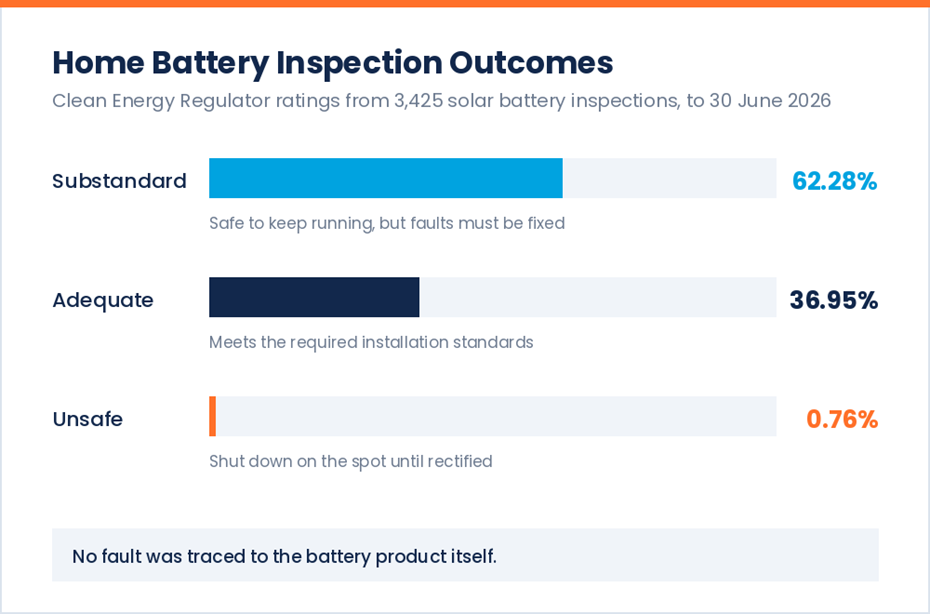
home battery inspection outcomes

The Clean Energy Regulator completed 3,425 solar battery inspections to 30 June 2026. Importantly, it selects most installations randomly from rebate claims. Additionally, it targets extra inspections at installers already found non-compliant.

Of the installations rated so far, 36.95% were adequate and safe. Meanwhile, 62.28% were rated substandard. That label means technically non-compliant, yet safe to remain in operation. Finally, 0.76% were rated unsafe. An unsafe rating triggers an immediate shutdown by the inspector.

At first glance, that substandard figure looks alarming. However, context matters. A substandard rating does not condemn the whole system. Typically, inspectors flag one or two items that do not affect performance. Those items can still create risk for electricians or emergency crews later, so installers must rectify them.

You can review the full dataset, including the state-by-state breakdown, on the Clean Energy Regulator’s solar battery inspection results report. NSW recorded the largest share, with 926 inspections.

The Batteries Passed. The Installations Did Not.

This is the finding that deserves the most attention. The regulator stated it plainly: no installations had issues with the solar battery itself. Instead, every problem traced back to non-compliant installation practices and substandard workmanship.

That distinction changes how you should shop. Product risk is already tightly controlled. Every battery claiming the federal rebate must appear on the Clean Energy Council approved product list. Manufacturers reach that list by passing international cell and system safety testing. A reputable solar battery company will confirm that listing in writing.

The product safety net also works when something slips through. As of 30 June 2026, only one eligible product under the scheme had been recalled. In November 2025, the ACCC issued a voluntary electrical safety recall. It covered certain Sigenergy single-phase energy controllers. Regulators, the manufacturer and installers then worked through rectification.

Therefore, your real variable is not the brand on the wall. It is the quality of the hands that installed it.

Most Faults Were Labelling, Not Live Danger

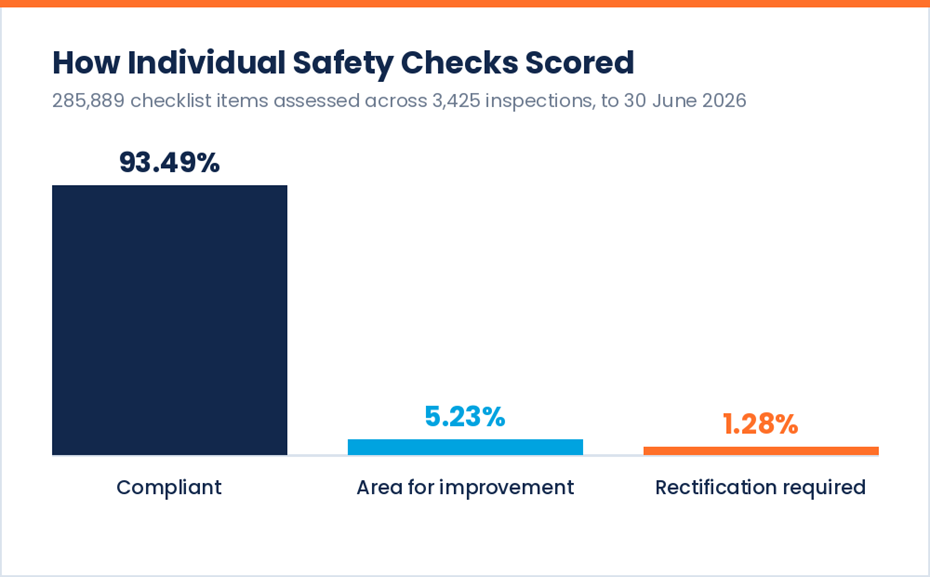
Individual checklist item results across 3,425 inspections

The system-level percentages tell only half the story. Inspectors also score each installation against a checklist of more than 90 items. Across 3,425 inspections, they assessed 285,889 individual items.

Of those items, 93.49% were compliant. A further 5.23% were flagged as areas for improvement, which installers do not have to fix. Only 1.28% required rectification.

Moreover, labelling drove most of the non-compliance. Three faults appeared repeatedly. First, missing or incorrect warning labels at the main switchboard. Second, backed-up circuits that were neither labelled nor grouped together. Third, a missing or badly placed green reflective ‘ES’ label near the meter box.

Labels sound trivial, yet they protect people. Backed-up circuits can stay live even after someone throws the main switch. Some systems also re-energise after a short delay. Consequently, an electrician or firefighter who misses that warning faces a genuine shock risk.

What Made an Installation Unsafe

Only 22 systems earned the unsafe rating in the published state breakdown. Still, the causes are worth understanding, because they are all preventable.

The regulator grouped them under two headings. Under wiring, inspectors found loose connections in pre-assembled battery systems. Associated cabling also showed signs of heat. In addition, some electrical work on pre-assembled systems did not follow Australian Standards. Under protections, inspectors found neutral continuity that was not maintained on alternative supply circuits.

When an inspector finds an unsafe installation, the system gets shut down or otherwise made safe on the spot. The installer must then rectify the fault before the system runs again.

The regulator has not been quiet about enforcement either. Executive General Manager Carl Binning publicly put installers on notice. He warned that unsafe and non-compliant work would be identified. He added that the regulator would not hesitate to use its compliance powers. Those powers include removing an installer from the scheme entirely.

How Regulators Tightened Home Battery Safety Through 2026

The rules did not stand still while volumes climbed. In fact, 2026 brought several meaningful changes.

  • Amendment 1 to AS/NZS 5139:2019 was published on 19 December 2025. It clarified location rules, clearance distances and restricted zones around a battery. NSW treats the amendment as mandatory. Western Australia required full compliance from 19 June 2026.
  • From 1 March 2026, the Clean Energy Regulator made label photos mandatory. Installers must now submit clear, geotagged and timestamped photos of required labels with every claim.
  • The regulator expanded inspections sharply, from 846 in February 2026 to 3,425 by 30 June 2026.
  • It also began formal compliance action against repeat offenders, including warning notices and suspension from the scheme.
  • Alongside Solar Accreditation Australia, it developed additional mandatory training modules targeting the exact faults inspections keep finding.

Politically, the scheme has faced scrutiny too. In September 2026, Energy Minister Chris Bowen defended it in Parliament. He described the Small-scale Renewable Energy Scheme as one of the world’s most rigorous compliance schemes. Moreover, he cited 315 complaints against 800,000 installations over the previous year.

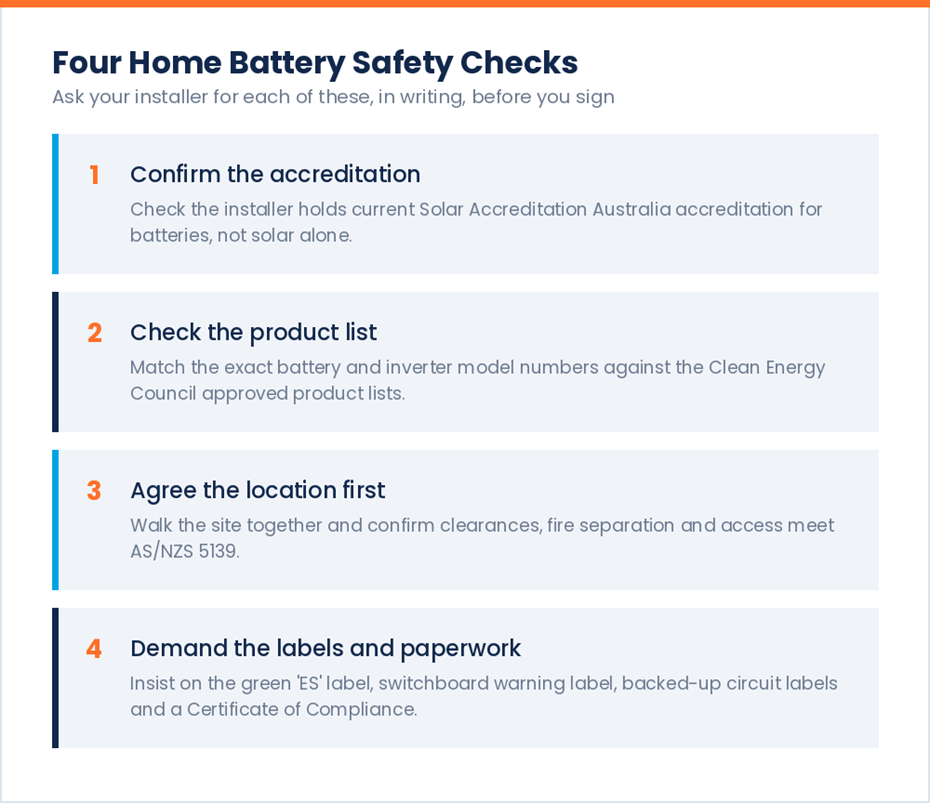
Four Home Battery Safety Checks Before You Sign

Four Home Battery Safety Checks Before You Sign

You do not need to become a standards expert. However, four questions will filter out most weak operators quickly.

Ask for the installer’s Solar Accreditation Australia number and confirm it covers batteries, not solar alone. Next, match the exact battery and inverter model numbers to the Clean Energy Council approved lists. Then walk the proposed location together before install day. Finally, insist that labelling and your Certificate of Compliance form part of the handover.

A reputable solar battery company will answer all four without hesitation. In contrast, a rebate chaser will rush you toward a deposit instead.

Does a Home Battery Still Make Sense in 2026?

On the safety evidence, yes — but whether a battery suits your home still depends on your usage, tariff and site. The hardware performed. The regulatory net caught the one product issue that arose. Furthermore, the workmanship problems are visible, measurable and fixable.

The lesson is simple. Your installer matters as much as your battery. Choosing an experienced, accredited installer in your area protects your safety. Equally, it protects your rebate, since a failed inspection can put certificates at risk.

So treat the decision as two decisions. Start by comparing the best solar batteries available in Australia for 2026 and their real-world running costs. Afterwards, apply the same scrutiny to the person installing it.

Frequently Asked Questions

Are home batteries safe in Australia?

Australian home batteries are regulated products. Every battery claiming the federal rebate must sit on the Clean Energy Council approved list. An accredited installer must also fit it. In inspections to 30 June 2026, no fault was traced to a battery product itself. The regulator rated 0.76% of inspected installations unsafe. Those faults came from workmanship rather than hardware.

What did the Clean Energy Regulator find in its battery inspections?

The regulator completed 3,425 solar battery inspections to 30 June 2026. Of the installations rated so far, 36.95% were adequate. A further 62.28% were substandard but safe to keep operating. Only 0.76% were unsafe. Across 285,889 checklist items, 93.49% were compliant. Another 5.23% were flagged for improvement, and 1.28% required rectification.

What does a substandard battery installation actually mean?

Substandard means the installation breaches at least one clause of an Australian Standard or industry guideline. However, it remains safe to keep running. Labelling faults are the most common cause. Typical examples include a missing green ES label or an incorrect switchboard warning label. Unlabelled and ungrouped backed-up circuits also appear often.

What made some battery installations unsafe?

The regulator listed three causes. First, loose connections in pre-assembled battery systems, with wiring showing signs of heat. Second, electrical work on pre-assembled systems that ignored Australian Standards. Third, neutral continuity that was not maintained on alternative supply circuits.

What changed for battery safety rules in 2026?

Amendment 1 to AS/NZS 5139:2019 was published on 19 December 2025. It clarified location, clearance and restricted-zone requirements. NSW treats it as mandatory. Western Australia required full compliance from 19 June 2026. Separately, the Clean Energy Regulator introduced mandatory geotagged and timestamped label photos from 1 March 2026.

How do I check my own battery installation is compliant?

Start at the meter box. Look for a green reflective ES label that is visible as you approach. Also check for a warning label at the main switchboard. Next, confirm that backed-up circuits are labelled and grouped. Then verify your battery appears on the Clean Energy Council list. Finally, confirm your installer held current battery accreditation on install day. If something is missing, contact your original installer to arrange rectification.

Get Your Installation Checked by Our Local Team and SAA-Accredited Installers

Solar Battery Outlet designs and installs CEC-approved battery systems across Liverpool, Bankstown and Mudgee, using SAA-accredited installers. Perhaps you are planning a new system. Alternatively, you may want a second opinion on an existing one. Either way, our team explains the compliance detail in plain language. Speak with us about a site assessment. Then choose the installer that’s right for your home, with the paperwork to back it up. Call 1800 000 777.

Disclaimer

This article provides general information about home battery safety in Australia. It reflects publicly available data at the time of writing. That includes Clean Energy Regulator inspection results published to 30 June 2026. It is not electrical, safety, legal or financial advice. Inspection percentages come from a sample of installations, not from every system nationally. Therefore, they are not the compliance rate across all Australian home batteries. Standards, rebate settings and eligibility rules can change, and requirements differ between states and territories. Battery suitability, performance and any bill impact depend on your own household, tariff, site conditions and system design. If you believe your installation may be faulty or unsafe, contact your original installer or a licensed electrician. Always seek personalised advice before making a purchasing decision.
For decades, gas-fired generators held one job better than anything else. They started fast. Between 4pm and 9pm, households switched on the oven, the air conditioner, and the television. Gas plants then ramped up and filled the gap.

That job is now shrinking fast. Batteries have taken most of it over. Crucially, a growing share of those batteries sit on the walls of ordinary homes rather than in power stations.

This guide explains what changed and how quickly. It also shows what the home battery’s evening peak shift means for your NSW electricity bill.

What the evening peak actually is

The evening peak is the window when grid demand climbs fastest. AEMO measures it between 4pm and 9pm. Rooftop solar fades during those hours. Meanwhile, people arrive home, cook dinner, run heating or cooling, and charge devices.

Consequently, the grid must find a lot of extra supply in a short space of time. Historically, gas peaking plants did that work. They cost more to run than coal, yet they respond within minutes. For that reason, they also set the wholesale price during those hours more often than their output alone would suggest.

Households feel the same pattern on their bills. Most NSW time-of-use plans charge their highest rate in the late afternoon and evening. Supply simply costs the most then.

Gas has lost most of its evening job

price in the evening peak

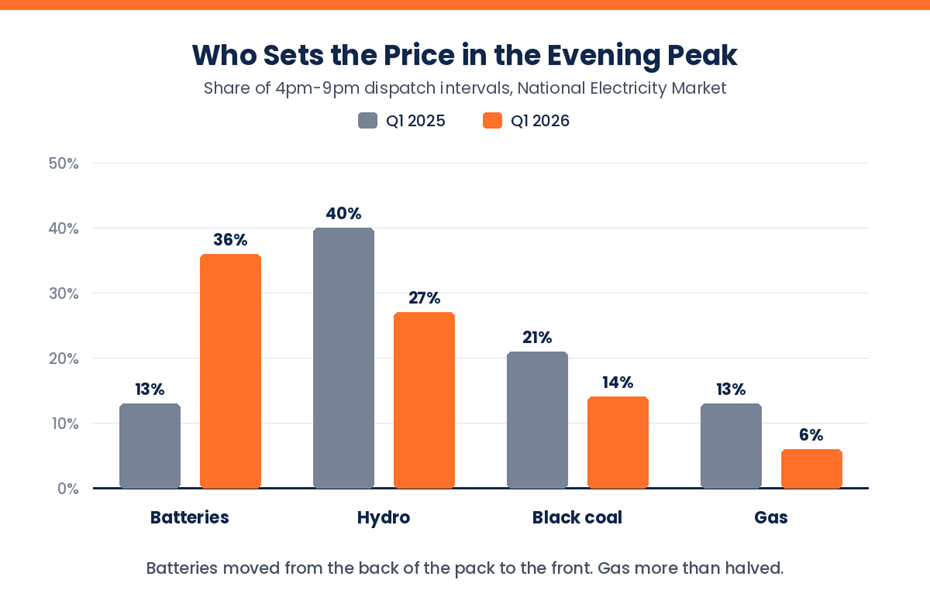
The change shows up clearly in market data. In Q1 2026, the Australian Energy Market Operator reported that batteries delivered 1,115 MW into the evening peak. They also became the market’s most frequent price setter.

Gas moved the other way. Across the same quarter, gas-powered generation averaged 712 MW. That was its lowest quarterly average since 1999. During evening peak hours specifically, gas set the price in just 6% of intervals, down from 13% a year earlier.

Furthermore, the trend accelerated in the following quarter. In Q2 2026, gas-fired generation averaged 1,050 MW, its lowest second-quarter output since 2003. Average gas discharge during the evening peak fell 1,441 MW year on year. Battery discharge, by contrast, set the price in 46% of evening peak intervals.

AEMO’s Violette Mouchaileh summed up the shift plainly. She noted that batteries increasingly reduced reliance on gas and hydro during evening peaks. That change pushed wholesale prices lower year on year in most regions.

Home batteries evening peak discharge is reshaping demand

Grid-scale batteries explain part of the story. However, household storage now moves the needle too, and AEMO has quantified it.

AEMO’s Q2 2026 analysis compared solar-only homes with solar-plus-battery homes. On average, the battery homes cut evening peak grid imports by roughly 0.7 kW. That equals about a 73% reduction in net grid imports across the 4pm to 9pm window.

Multiply that across hundreds of thousands of homes and the effect becomes structural. Indeed, AEMO noted demand is shifting away from the evening peak. More home batteries now supply household consumption after sunset. Daytime demand rose at the same time, because those batteries charge while solar is abundant.

In short, households are doing at a small scale exactly what gas peakers used to do at a large scale. They store cheap energy, then release it when the grid is tight.

Half a million Australian sites have joined in

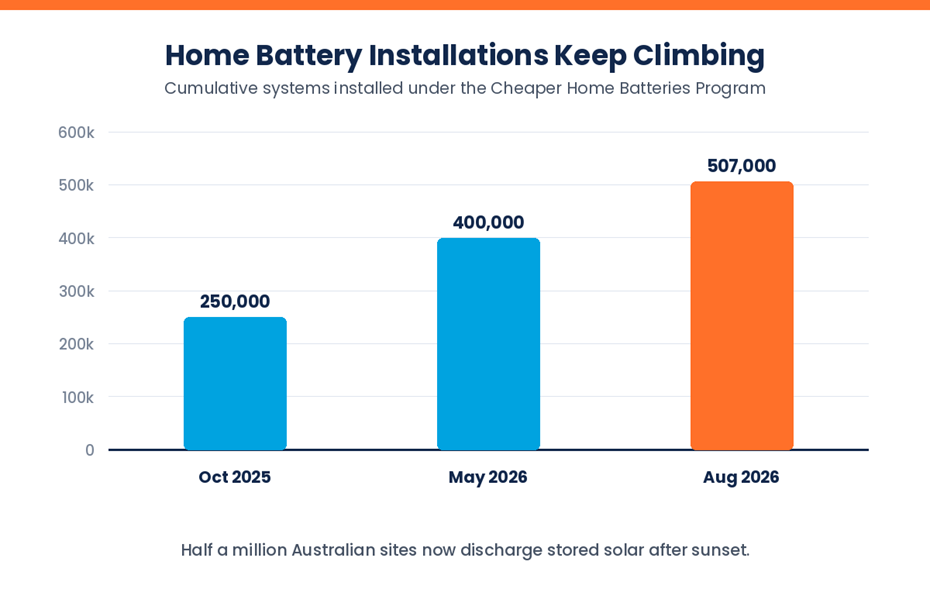
home battery installations under the Cheaper Home Batteries Program from October 2025 to August 2026

The federal Cheaper Home Batteries Program began on 1 July 2025. It drove much of this growth. By 14 August 2026, the Prime Minister and energy minister confirmed 500,000 installations. Later figures put the tally above 507,000.

The installer base grew alongside it. Accredited battery installers in Australia have doubled to 8,846 since the program commenced. Average system size also climbed. It rose from about 25.2 kWh at the 250,000 mark to roughly 28 kWh by 400,000.

Naturally, this scale of uptake changes the national picture. The surge in home battery uptake across Australia is already filtering through to electricity bills. Benefits reach beyond battery owners too, because the market leans less on expensive peaking generation.

Why this matters for your NSW electricity bill

The market shift is interesting. The household maths, though, is what actually decides whether a battery suits your home.

On the Ausgrid network, peak network pricing applies from 2pm to 8pm on weekdays. No peak period applies in April, May, September or October. Retailers then set their own windows and rates on top of that. Take AGL’s 2026 NSW standing offer. Peak usage sits near 65 cents per kWh, while off-peak sits near 30 cents.

Meanwhile, exporting solar at midday earns very little. IPART’s voluntary all-day benchmark for 2026-27 sits between 3.4 and 6.5 cents per kWh. Time-of-use export benchmarks for evening hours are far higher on the Ausgrid and Endeavour networks.

Therefore, the value of a battery comes from one simple swap. You stop buying expensive evening electricity, and you stop selling cheap midday electricity. Your actual result depends on your tariff, your usage pattern, your solar size and your battery size. Rates change, so always check your own plan’s fact sheet before you assume a figure.

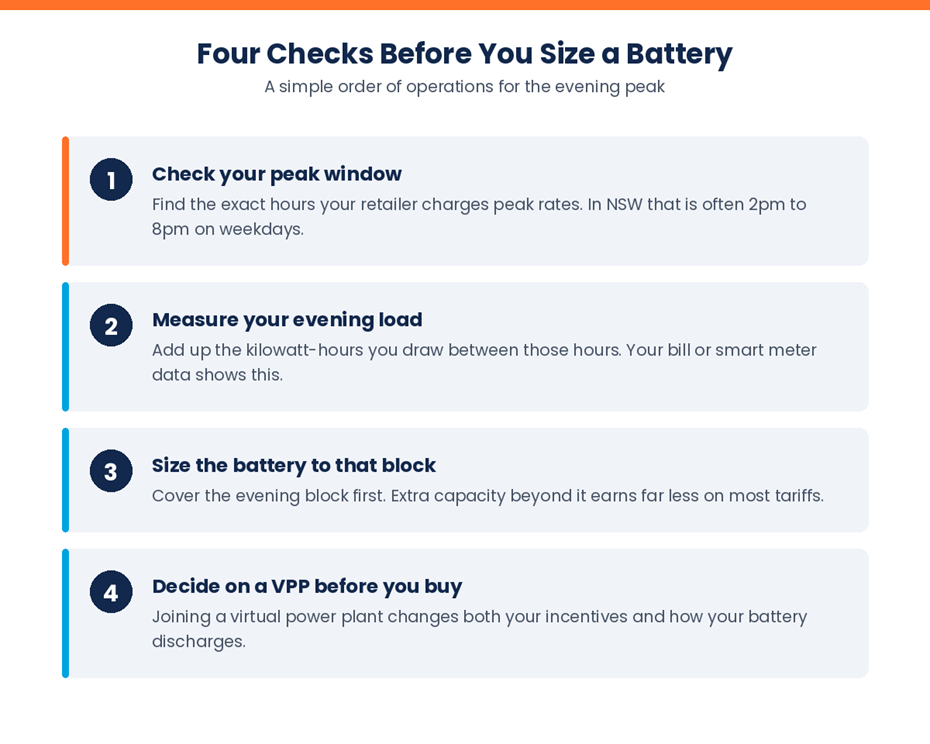
How to size a battery for the evening peak

Most homeowners size a battery around total daily usage. However, the home batteries evening peak advantage lives inside one narrow block of hours. Sizing around that block usually produces a better return.

Check your peak-window usage on your bill, then compare it with the battery’s usable capacity. A good installer will size around your evening block, not around a headline kWh number.

A worked example from Liverpool

Consider an illustrative Liverpool household on a time-of-use plan. Suppose it draws 8 kWh between 2pm and 8pm on a typical weekday. Assume a peak rate near 60 cents per kWh. That block then costs roughly $4.80 a day.

Now suppose the battery covers that block on peak weekdays. Ausgrid has no peak period in April, May, September, or October, so that’s roughly 170 peak weekdays a year. The battery also stores solar you would otherwise export for about 5c. The saving is about 8 kWh × (60c − 5c) × 170 days, or roughly $750 a year on weekday peak charges. This is an estimate only, not a guarantee.

Several things can reduce it. Winter solar output falls, so the battery may not fully recharge every day. Weekend rates differ. Shoulder and off-peak usage still gets billed. Household consumption also varies month to month. Ask your installer to model your own 12 months of bills.

The bottom line

Gas built its business on being the fastest thing on the grid after sunset. Batteries now do that job more cheaply, and households own a growing share of them.

For NSW homeowners, the practical takeaway is simple. The home batteries evening peak shift has made stored solar more valuable than exported solar. For many homes, the question is now less about whether to store energy and more about how much you need and when you use it.

Frequently Asked Questions

Are home batteries really replacing gas during the evening peak?

Partly, yes. AEMO data shows battery discharge set the wholesale price in 46% of evening peak intervals in Q2 2026. Meanwhile gas-fired generation fell to its lowest second-quarter output since 2003. Both grid-scale and household batteries contribute. Gas has not disappeared, though. It still runs during long wind lulls and extreme demand events.

What hours count as the evening peak in Australia?

AEMO measures the evening peak between 4pm and 9pm. Retail tariffs differ. On the Ausgrid network, peak network pricing applies from 2pm to 8pm on weekdays. No peak period applies in April, May, September or October. Check your own plan’s fact sheet for the window that applies to you.

How much does a home battery reduce grid use in the evening?

AEMO compared solar-only homes with solar-plus-battery homes. The battery homes cut evening peak grid imports by about 0.7 kW on average. That equals roughly a 73% reduction in net imports during the 4pm to 9pm window. Your own result depends on your battery size and evening usage.

Does a battery still make sense if I already have solar?

Often it does, because exporting midday solar earns very little now. IPART’s voluntary all-day feed-in benchmark for 2026-27 is 3.4 to 6.5 cents per kWh. Evening peak electricity costs far more to buy. Storing that energy instead of exporting it is where the value sits.

How big should my battery be for evening use?

Size it around the energy you actually draw during your peak window, not your total daily usage. Many NSW households land between 10 kWh and 20 kWh. A reputable solar battery company should read your smart meter data or bills before recommending a capacity.

Is the Cheaper Home Batteries Program still running in 2026?

Yes. The program started on 1 July 2025 and passed 500,000 installations in August 2026. The discount rate steps down over time, so the amount available changes. Confirm the current rate and your eligibility with an accredited installer before you sign anything.

Disclaimer

This article is general information about Australia’s electricity market and home battery storage. It is not financial, energy or engineering advice, and it does not take your personal circumstances into account. All market figures come from the published sources listed below and were accurate at the time of writing. Tariffs, feed-in rates, rebate levels and network peak windows change regularly. The Liverpool saving example is an illustration built on stated assumptions, not a promise of results. Your actual outcome depends on your tariff, solar output, battery size, usage and installation costs. Solar Battery Outlet does not guarantee any specific bill reduction or payback period. Always seek personalised advice before making a purchasing decision.
Plugging your EV into a regular power point overnight feels harmless. It is slow, gentle and easy to forget about. But that slowness comes at a cost you rarely see on your bill breakdown: extra electricity lost as heat before it ever reaches your battery.

So does slow EV charging really use more electricity than fast charging? The short answer is yes, in terms of efficiency — though not by as much as you might fear, and not in a way that changes the bigger picture for most Australian EV owners. Here is what the data actually shows, and how to charge smarter at home.

AC vs DC Charging: What “Slow” and “Fast” Actually Mean

Every EV charger falls into one of two categories: AC or DC. Understanding the difference matters more than most owners realise.

AC (alternating current) charging is what you get from a standard power point, a portable EV cable, or a dedicated wall charger. Power output ranges from about 2.3 kW at a household socket up to 22 kW from a three-phase wall unit. Your car’s onboard charger converts this AC power into DC before it reaches the battery.

DC (direct current) charging is what you find at public fast-charging stations, typically 50 kW to 400 kW. These chargers convert AC to DC before it reaches the car, skipping the onboard charger almost entirely and pushing energy straight into the battery.

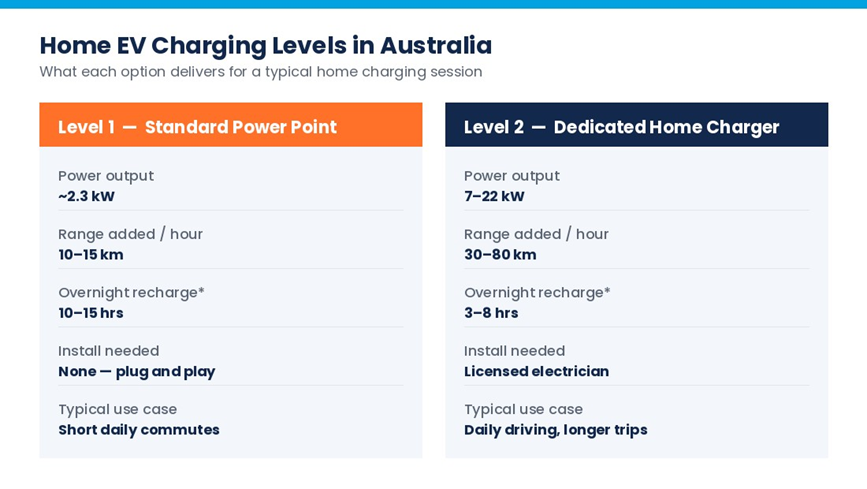
Most home charging in Australia is AC. In fact, energy.gov.au notes that a dedicated home EV charger typically charges an EV three to ten times faster than a standard power point, adding between 30 and 80 km of range per hour of charging. A standard power point, by comparison, usually adds closer to 10 to 15 km per hour.

Does Slow Charging Use More Electricity? The Surprising Answer

Here is the part most owners never see: the slower your AC charging speed, the more electricity is lost as heat inside your car’s onboard charger and cabling before it ever reaches the battery.

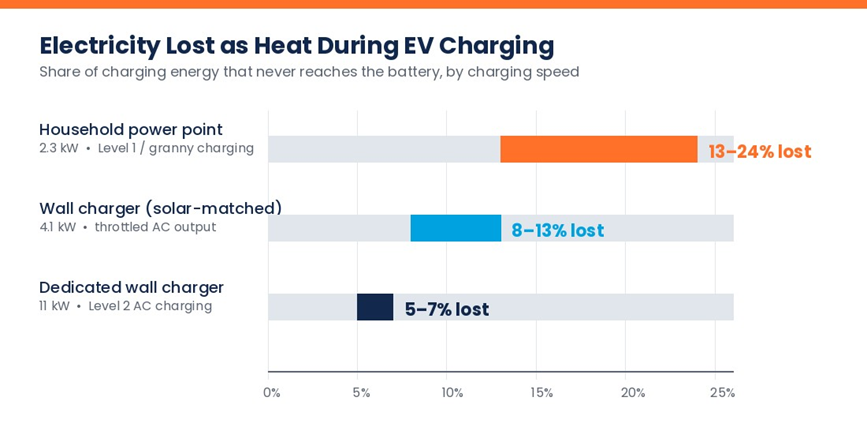
German motoring organisation ADAC recently tested five EV models at three charging speeds, measuring exactly how much electricity actually made it into the battery. The results were consistent across the fleet.

Charging from a household power point lost between 13% and 24% of the electricity drawn from the grid. A dedicated wall charger throttled down to simulate surplus solar charging lost 8% to 13%. A full-speed 11 kW wall charger lost only 5% to 7%. The trend is clear: slower AC charging wastes proportionally more electricity than faster AC charging.

Why Slower AC Charging Wastes More Energy

This seems backwards at first. Surely taking your time is gentler and more efficient? Not quite, and the reason comes down to your car’s onboard charger.

The onboard charger and its cooling systems draw a small amount of fixed power just to operate, regardless of how much energy is flowing through them. At low charging speeds, that fixed overhead makes up a larger share of the total energy used. At higher speeds, the same fixed loss is spread across far more kilowatt-hours, so it barely registers as a percentage.

Cable resistance and battery-management losses add a little more on top, but the onboard charger and vehicle electronics are the main contributors, according to the ADAC testing. A separate 2023 study of onboard chargers across 38 EV models found that reducing charging current for smart charging could increase worldwide charging energy demand by roughly 1% to 10%.

What This Actually Costs You in Australia

The efficiency loss sounds significant on paper, so let’s put it in real terms. Say your EV needs 40 kWh to top up for the week.

  • Charged from a household power point (roughly 18% average loss): your home draws about 48.8 kWh from the grid to deliver that 40 kWh.
  • Charged from a dedicated 11 kW home charger (roughly 6% average loss): your home draws about 42.6 kWh for the same 40 kWh.

That is a difference of around 6 kWh per charge. At a typical NSW residential rate of roughly 30 cents per kWh, slower charging costs an extra $1.80 or so per top-up—not dramatic, but it adds up to roughly $90 to $100 a year for a weekly charger.

These figures are simplified estimates for illustration, since real losses vary by vehicle, cable, and weather. The bigger cost factor is almost always the electricity price itself, not the efficiency loss. In most cases, charging on cheap overnight rates or from your own solar still costs less than a faster but pricier option.

Home Solar, Batteries, and EV Charging: Where It Gets Interesting

For Australian homeowners with rooftop solar, the efficiency conversation changes shape. Charging your EV directly from solar during the day costs very little — mainly the feed-in credit you would otherwise earn (often under 10c per kWh in NSW) — even if the onboard charger is running at a lower, solar-matched output.

A home battery adds another layer. Instead of only charging your EV while the sun is out, a battery stores surplus solar for use later — including overnight top-ups that would otherwise pull more expensive grid electricity through those same efficiency losses. Pairing a home battery with an EV charger also lets you shift charging into free or low-cost windows on time-of-use plans. Some NSW retailers offer Solar Sharer plans with free power from 11am to 2pm for eligible households who opt in, and a usage cap applies. Our guide to NSW Solar Sharer plans explains how this may lower your charging cost.

home EV charging levels in Australia — power output, range added, and overnight charge time by level

If you already have solar and are considering a battery, ask your installer whether your inverter and battery can manage EV charging as part of one connected system. Several current battery models, including Tesla Powerwall 3, integrate EV charging management directly into their app.

How to Charge Your EV More Efficiently at Home

A few simple habits close most of the efficiency gap without any extra spending.

  • Use a dedicated Level 2 charger for regular charging. A wall charger (usually up to about 7 kW on single-phase power, or 11–22 kW if your home has three-phase power and your car supports it) loses less electricity as heat than a standard power point and charges far faster.
  • Reserve the power point for occasional top-ups. Granny charging is fine for light use, but it is the least efficient regular option.
  • Charge during daylight if you have solar. Using your own daytime solar makes the efficiency loss much less important to your bill.
  • Check installation requirements early. A dedicated home charger needs a licensed electrician and may require a switchboard upgrade — see energy.nsw.gov.au for what to expect before you book.

Frequently Asked Questions

Does charging an EV slowly waste electricity?

Yes, to a measurable degree. ADAC testing found that charging from a standard power point lost 13% to 24% of the electricity drawn from the grid, compared with only 5% to 7% loss from a dedicated 11 kW home charger.

Is it cheaper to charge an EV slowly or quickly at home?

Slow home charging is usually still cheaper overall than public DC fast charging, even accounting for the higher electrical losses, because off-peak and solar electricity cost far less per kWh than public charging rates.

Should I install a dedicated EV charger instead of using a power point?

If you drive daily, a dedicated 7–22 kW Level 2 home charger is more efficient and much faster than a power point. Energy.gov.au recommends a dedicated charger for owners who charge regularly rather than occasionally.

Does slow charging damage an EV battery?

Not usually. Slower AC charging generally puts less heat stress on battery cells than DC fast charging and is often the gentler choice for everyday top-ups.

Can I charge my EV from solar panels without a home battery?

Yes. Charging during daylight hours, while your panels are generating, uses solar directly. A home battery simply extends that benefit to overnight charging as well.

Disclaimer

This article explains general findings from third-party EV charging efficiency testing and publicly available Australian Government guidance on home EV charging. It is general information only and does not constitute financial, electrical or purchasing advice. Charging losses, costs and available rebates vary by vehicle, charger, electricity plan and household. Any electrical work, including installing a dedicated home EV charger, must be carried out by a licensed electrician. Always seek personalised advice before making a purchasing decision.
Thinking About Pairing Solar, a Battery and an EV Charger?

If you are charging an EV at home and want to know whether solar, a battery, or both would actually cut your charging costs, we can help you work it out properly — no pressure, no guesswork.

Solar Battery Outlet is a Liverpool-based solar and EV charger installer, part of GWM Group Pty Ltd, servicing homes across Liverpool, Bankstown and Mudgee. All installations are carried out by SAA-accredited electricians.

Call us: 1800 000 777  —  or visit solarbatteryoutlet.com.au for a free, no-obligation quote on solar, batteries and EV charger installation.

Picture this. The power drops out across your street. Your neighbours reach for candles, but you paid for a solar battery. You open the app and see 70% charge. Yet your lights stay off.

This happens in NSW homes more often than many owners expect. Owning a solar battery does not automatically mean you have backup power. The two are related, but they are not the same thing. Understanding the difference could be the reason your fridge keeps running during the next storm, or the reason it does not.

Your System Is Designed to Shut Down in a Blackout, By Law

Here is the part many homeowners don’t know. Every grid-connected solar inverter in Australia must switch off the moment the grid fails. This safety feature is called anti-islanding, and it exists so technicians repairing damaged lines are never exposed to live current flowing back from your roof. The requirement sits inside the AS/NZS 4777.2 standard, which every grid-connected inverter sold in Australia must meet.

The Australian Government’s energy.gov.au confirms that very few grid-connected solar-only systems provide backup power during an outage, simply because the inverter shuts down as soon as it detects one. A battery changes that equation, but only when it has been specifically configured to island itself from the grid and keep running. Buy a battery without that configuration, and you have bought expensive storage that behaves exactly like your old system once the street goes dark.

Reason 1: No Dedicated Backup Circuits Were Ever Wired In

Many installers wire a battery purely for bill savings, not blackout protection. In that setup, the battery simply charges from solar by day and discharges at night, and it does nothing extra when the grid drops.

Real backup needs a separate backup circuit board, sometimes called an essential loads panel. This board isolates your fridge, lights and internet from the rest of the house, so the battery can power them safely while everything else stays switched off. If that board was never installed, your battery cannot send power anywhere during an outage, no matter how full it is. This is one of the most common gaps between what homeowners expect and what they actually paid for.

Reason 2: The Minimum Reserve Setting Was Left Too Low

Most battery systems let you set a minimum reserve level, a slice of capacity held back purely for emergencies. Chartered electrical engineer and SolarQuotes founder Finn Peacock has flagged this reserve setting as one of the most overlooked levers in a battery system, mainly because installers rarely walk customers through it at the point of sale.

If your reserve sits at zero, your battery might discharge fully every evening to maximise your savings. Then a storm rolls through at 9pm, and there is nothing left to draw on. If your system is set up for backup, a sensible reserve trades a small amount of daily saving for backup capacity held in reserve. It is a setting worth asking your installer to explain, and adjust, before you sign off on the system.

Reason 3: The Installation Itself Was Not Done to Standard

Even a correctly specified system can fail if the physical installation is poor, and the compliance data backs this up. Between July 2025 and April 2026, the Clean Energy Regulator inspected more than 1,270 battery installations nationally under the federal battery rebate program.

Battery Installations Inspected

The results were sobering: 60.8% of inspected installs had substandard work, and 1.2% were rated outright unsafe. Common problems included unlabelled backup circuits and missing safety documentation, the exact details that decide whether backup power performs when it matters. NSW’s newer battery incentive settings for businesses and VPP-linked activities starting September 2026 still tie the rebate to installers holding a valid Solar Accreditation Australia (SAA) credential. That requirement exists for a reason: it is one of your main protections against exactly this kind of shortcut.

Reason 4: Nobody Ever Tested It Before the Power Actually Went Out

Backup only proves itself in a real outage, unless you test it first. On a sunny day, with the battery near full, ask your installer or electrician to show you how to safely switch off the grid supply and watch what happens.

If your system is islandable, your panels can keep charging the battery during an outage. This can extend your backup time. If not, you will rely on stored power until the grid returns. A short test with your installer or electrician can confirm how your backup works. It can reveal issues before a real storm or nighttime outage.

Reason 5: The Battery Was Never Sized for What You Actually Run

A battery sized for evening bill savings is not automatically sized for blackout survival. Essential circuits, such as your fridge, lights, internet and a few power points, draw relatively little. Air conditioners, ovens and electric hot water systems draw far more, and they can drain a battery within hours if they stay on backup circuits.

A properly scoped solar battery installation in Liverpool starts with understanding your backup needs. Ask your installer which appliances and circuits will run during an outage. Also, confirm how long the battery can power them under typical use.

How to Make Sure Your Backup Actually Works

Run through these four checks with your installer before you commit, and repeat them if you already own a battery.

4 things a genuine backup system needs

Confirm dedicated backup circuits exist and are clearly labelled. Ask what your minimum reserve is set to, and why. Check the installer’s SAA accreditation number yourself, rather than taking their word for it. Then schedule a real transfer test once the system is commissioned. Backup circuits and testing can add to the price, so ask for them to be listed and priced on your quote. Getting this right is the difference between a battery that earns its keep and one that leaves you in the dark when you need it most.

Not Sure Your Backup Would Actually Work? Ask Us to Check. We offer free, no-obligation system reviews for NSW homeowners across Liverpool, Bankstown and Mudgee. We will check your backup circuits, your reserve setting and your installer’s accreditation, and tell you honestly what your system will do in the next outage.
Call us: 1800 000 777 Or visit solarbatteryoutlet.com.au and fill in the 60-second eligibility form.

Frequently Asked Questions

Will my solar battery automatically switch on during a blackout?

Not unless it has been specifically configured for backup power. Grid-connected solar systems must shut down when the grid fails, under the anti-islanding rule in AS/NZS 4777.2. A battery only bypasses that shutdown if it has dedicated backup circuits and an islanding-capable inverter.

How long will a solar battery run my house during an outage?

It depends on which circuits are on backup and what you are running, not battery size alone. A household running only essentials, like a fridge, lights and internet, might last many hours on a mid-size battery. Add an air conditioner or oven to backup circuits, and that runtime can drop to a couple of hours.

Can I add backup circuits to a battery I already own?

In most cases, yes, though it usually requires an electrician to install a backup panel and reconfigure the inverter. Ask your original installer, or another SAA-accredited electrician, for a quote before assuming backup is unavailable.

What is a minimum reserve setting, and should I change mine?

It is the percentage of battery capacity kept aside for emergencies rather than used for daily savings. A higher reserve means more guaranteed backup power but slightly less day-to-day saving. The right balance depends on how often outages happen in your area.

Disclaimer

This article is general information only and does not constitute personal financial, electrical or legal advice. Backup performance depends on your specific system, installation, appliances and household usage, and results will vary between homes. Compliance figures, standards and program details referenced above are accurate as of publication and may be updated by the relevant regulators or agencies over time. Always seek personalised advice before making a purchasing decision or relying on any system for emergency backup power.

Warranties, rebates and installation rules explained — what NSW homeowners need to know before sizing up.

Many NSW homeowners ask the same question once they compare battery quotes. Can you install a 20kWh battery on a 6.6kW solar system? The short answer is yes, in most cases. The real answer depends on three things. How your inverter is wired matters. What the installation guidelines allow matters too. And your rebate eligibility matters most of all. This guide breaks down the technical rules and the rebate rules together. That way, you know exactly what is possible before you sign a quote. We also cover the questions worth asking any installer first.

The Short Answer: Yes, With Conditions

Yes, you can generally install a battery with more storage capacity than your solar system’s rating suggests. A 6.6kW solar system paired with a 20kWh battery is a common setup across NSW. Nothing in Australian electrical standards bans this pairing outright. That said, three things decide whether it makes sense. First, your inverter’s charge rate limits how fast the battery fills. Second, the installation guidelines (now managed by Solar Accreditation Australia) govern your panel-to-inverter ratio, not your battery-to-panel ratio. Third, your daily solar output decides how much of that extra capacity you can fill from your own solar. A bigger battery without enough solar simply means more nights topping up from the grid. That extra grid use reduces your overall savings.

kWh vs kW: Why This Question Confuses People

Part of the confusion comes from mixing up two different units. Your solar system is rated in kilowatts, or kW. This measures generation power at any given moment. Your battery is rated in kilowatt-hours, or kWh. This measures total stored energy instead. These numbers are not directly comparable, even though people often compare them anyway. A 6.6kW solar system does not automatically cap a 20kWh battery. Instead, what matters is how many kWh your panels produce across a full day. A well-positioned 6.6kW system in Sydney can generate 25 to 28kWh on a sunny day. If your home uses little power during the day, that can be enough to fill a 20kWh battery. On a cloudy winter day, that same system might only produce 12 to 15kWh. The battery then fills only partially. Understanding this distinction helps you set realistic expectations. So, the two numbers don’t need to match, but your winter solar output still matters.

DC-Coupled vs AC-Coupled: Why It Changes Your Options

How your battery connects to your system changes what “bigger” really means. A DC-coupled battery sits between your panels and your inverter. It draws power directly, before conversion happens. Because of this wiring, DC-coupled systems stay tightly linked to your inverter’s specifications. An AC-coupled battery, meanwhile, connects on the household side of the meter. It uses its own dedicated inverter or charger. This setup is largely independent of your original solar inverter’s rating. As a result, AC-coupled batteries usually offer more flexibility for extra storage. Retrofitting an existing solar system with a battery is booming in NSW this year. These retrofits typically use AC coupling for exactly this reason. It sidesteps most of the compatibility questions around older inverters. Ask your installer which configuration suits your setup. The answer changes both your options and your final quote.

The 133% Oversizing Rule, and Why a Battery Changes It

Australia’s oversizing rules matter here too, even though they govern panels and inverters, not batteries directly. For a standard grid-connected system without storage, the installation guidelines cap your panel array at 133% of your inverter’s rated output. A 5kW inverter, for example, tops out at roughly 6.6kW of panels. Add a compliant, DC-coupled battery, and that cap generally lifts. You can then size your panels closer to the inverter manufacturer’s full rated input. That figure is often 150% to 200% of the inverter’s AC output. This matters for the reverse question too. A bigger battery gives your system more room to store solar power. Otherwise, that extra power gets clipped at peak generation and wasted. This rule sits under Solar Accreditation Australia’s installation guidelines. Manufacturer limits still apply on top of it. Always confirm the exact figure with your installer, since it varies by brand.

Does the Federal Rebate Require a Minimum Solar Size?

No, it does not. According to DCCEEW, the federal department behind the scheme, the Cheaper Home Batteries Program sets no minimum solar system size. You can add an eligible battery to a system of any size. You can also install one alongside brand-new panels. The only sizing rule that matters is the battery’s own capacity. It must sit between 5kWh and 100kWh of nominal capacity to qualify. Rebate value uses a tiered STC Factor, with full support on the first 14kWh. Support then tapers down for capacity beyond that threshold. So, technically, a 20kWh battery on a modest 3kW solar system still qualifies for the rebate. Whether that combination makes financial sense is a separate question entirely.

STC Factor tapers as battery capacity rises past 14kWh

Four Questions to Ask Before Sizing Up

Before committing to a bigger battery, work through four checks with your installer. Confirm your inverter type first, since hybrid and AC-coupled systems handle oversizing differently. Next, compare kWh to kW properly, rather than assuming the two numbers should match. Then ask specifically about the oversizing limit for your inverter model. Finally, confirm your chosen battery size still sits inside the 5 to 100kWh rebate window. Running through these checks upfront tends to save homeowners an expensive reconfiguration later.

A simple four-step framework for checking whether your solar system supports a larger battery

When a Bigger Battery Makes Sense, and When It Doesn’t

A larger battery earns its cost when your household uses most power in the evening. That is, after the sun stops generating for the day. It also helps homes planning to add more panels later on. The battery is already sized for that future generation. Families expecting an EV, or shifting to work-from-home hours, are good candidates too. On the other hand, a bigger battery makes less sense in one situation. That is when your existing solar barely charges a standard-sized unit already. In that case, you may pay for capacity you rarely fill from solar. You end up topping it up from the grid instead. This quietly erodes the savings a battery is meant to deliver. The better approach is to size the battery around your actual overnight usage first. Then check whether your solar can realistically keep it topped up across every season.

Getting It Right the First Time

Sizing decisions are hard to reverse once a battery is installed and commissioned. Our guide on why 2026 is a turning point for solar batteries in Australia covers this in more depth. Rebate settings and installation rules keep shifting throughout the year. Getting the sizing conversation right now matters more than ever. A reputable installer will ask about your bills, your usage pattern and your future plans first. They should never simply match a battery to your existing panels by default. If you are comparing quotes for solar battery installation in Liverpool, ask for the sizing calculation in writing. Do not accept a verbal estimate alone. That written detail protects you if the system underperforms later. It also gives you a clear record for warranty or rebate purposes.

Frequently Asked Questions

Can a battery be bigger than my solar system in kWh?

Yes. Battery capacity (kWh) and solar generation (kW) are different measurements. A battery can store more energy than your system produces in an hour. It just needs a full day of sunlight to charge completely.

Does a bigger battery void my solar system’s warranty?

Not directly. Warranty issues usually relate to exceeding your inverter’s rated input, not the battery’s storage size. Check your inverter manufacturer’s oversizing limit first, before you commit to a size.

Will I still get the federal rebate if my battery is bigger than my solar system?

It can. The battery must be 5–100 kWh, on the approved battery list and installed by an SAA-accredited installer, and other scheme rules apply. There is no minimum solar system size. We check your eligibility before quoting.

What is the maximum battery size I can install in NSW?

Batteries up to 100 kWh nominal capacity can be eligible, but the federal discount only applies to the first 50 kWh of usable capacity, and at a lower rate above 14 kWh. Your inverter specifications and your network provider’s export rules may set a lower practical limit.

Should I size my battery for my current panels or for future panels?

Size for your current overnight usage first. Only size up if you have firm plans to add panels soon — otherwise you may pay for capacity you rarely fill.

Disclaimer

This article is general information only and does not constitute personal financial, legal or engineering advice. Battery sizing depends on your specific inverter, wiring, roof space and usage pattern, all of which need an on-site assessment. Rebate rules, STC factors and installation guidelines referenced here reflect the position at the time of publication and may change without notice. Always seek personalized advice before making a purchasing decision.