LFP vs NMC batteries is one of the most common questions Australian homeowners ask before buying storage. Both are lithium-ion chemistries. However, they differ in lifespan, heat tolerance, size and weight.

Quick answer: lithium iron phosphate (LFP) batteries typically offer a longer cycle life and a wider thermal safety margin. Nickel manganese cobalt (NMC) batteries pack more energy into less space. Because a wall-mounted home battery has no weight limit, many current home batteries use LFP.

What Are LFP and NMC Batteries?

LFP stands for lithium iron phosphate. NMC stands for nickel manganese cobalt. Each name describes the cathode, the part of the cell that stores lithium ions. That single material choice shapes how a battery ages, heats and performs.

LFP cells use iron and phosphate, and they contain no cobalt. NMC cells blend nickel, manganese and cobalt. This blend stores more energy per kilogram.

Both chemistries belong to the lithium-ion family. Both also rely on a battery management system (BMS). The BMS monitors voltage, current and temperature, so each cell stays inside its limits.

Real products show the shift. Tesla’s Powerwall 2 used NMC cells, while the Powerwall 3 uses LFP. Similarly, many current home batteries sold in Australia use LFP. Always confirm the cell chemistry on the product datasheet.

LFP vs NMC Batteries: Key Differences at a Glance

  • Cathode: LFP uses iron phosphate. NMC uses nickel, manganese and cobalt.
  • Energy density: NMC typically stores about 150–250 Wh/kg. LFP typically stores about 90–160 Wh/kg.
  • Cycle life: LFP cells commonly list 3,000–6,000 cycles. NMC cells commonly list 1,000–2,500.
  • Thermal stability: LFP typically reaches its critical self-heating point at a higher temperature.
  • Cost: LFP uses cheaper raw materials, so it often costs less to make.
  • Typical use: LFP suits stationary home storage. NMC suits space-limited or weight-limited products.

The energy density gap explains why many electric vehicles still use NMC. A home battery faces no such weight limit. Therefore, the NMC density advantage matters less on a garage wall.

These figures are typical cell-level ranges. Individual products differ, so check the manufacturer’s datasheet and warranty.

Which Lasts Longer: LFP or NMC Batteries?

Cycle life counts full charge and discharge cycles before capacity drops to a set level. Most published comparisons show LFP lasting longer. LFP cells commonly list 3,000 to 6,000 cycles, while NMC cells commonly list 1,000 to 2,500.

comparing typical cycle life of LFP batteries (3,000–6,000 cycles) and NMC batteries

A home battery typically completes about one cycle a day. In theory, 3,000 cycles equals roughly eight years of daily use, and 6,000 cycles equals roughly 16 years. Real results depend on temperature, usage and settings.

However, your warranty sets the guaranteed terms, not cell-level ranges. Many warranties combine a time limit, such as 10 years, with a throughput limit measured in MWh. Read both limits. Also learn what  battery end of life looks like for your system.

Which Is Safer: LFP or NMC Batteries?

Safety starts with thermal runaway. Thermal runaway is a chain reaction in which an overheating cell heats its neighbours. Laboratory tests consistently show that LFP cells react later and at higher temperatures than NMC cells.

One peer-reviewed study of commercial cells found that LFP cells reacted more slowly and at significantly higher temperatures. In a separate overcharge study, every NMC-type cell caught fire or exploded. The LFP cell only released smoke.

Critical Self-Heating Temperature

These results describe single cells under abuse, not finished home systems. Still, a higher temperature margin can give the BMS more time to respond.

Chemistry alone does not decide safety, though. SolarQuotes founder Finn Peacock stresses that a well-installed battery from a major manufacturer is safe. He also warns about cheap batteries with weak control software and inexperienced installers.

Australian rules reinforce this. Rebate-eligible batteries must meet AS/NZS 5139:2019 and appear on the Clean Energy Council (CEC) approved list. Solar Accreditation Australia (SAA) accredited installers must complete the work. If you search for the best solar battery installer, look for SAA accreditation, not only a low price. Then review the key battery safety features in each quote.

How Do Heat and Cold Affect LFP and NMC Batteries?

Australian summers push battery enclosures hard. Heat speeds up ageing in both chemistries. LFP typically tolerates warm conditions with a wider safety margin, yet it still ages faster when it runs hot.

Therefore, location matters as much as chemistry. Choose a shaded, ventilated spot that follows the manufacturer’s clearances. For more detail, read how heat affects battery performance.

Cold weather poses a different challenge. Lithium-ion cells slow down in low temperatures, and LFP typically shows this more strongly. Frosty winters in places like Mudgee make low-temperature charging limits worth checking. Ask your installer for the manufacturer’s operating temperature range.

Does Battery Chemistry Change Your Rebate?

No. The Cheaper Home Batteries Program does not set a chemistry requirement. Instead, the Clean Energy Regulator ties eligibility to size, standards, CEC approval, virtual power plant (VPP) capability and installer accreditation.

Eligible batteries range from 5 kWh to 100 kWh in nominal capacity. The discount applies to the first 50 kWh of usable capacity. Usable capacity is the energy a household can actually draw from the battery.

The STC factor sits at 6.8 from May to December 2026. It falls to 5.7 on 1 January 2027. In addition, support tapers by size. The first 14 kWh earns the full factor. The next 14 kWh earns 60%, and the final 22 kWh earns 15%.

Your actual discount depends on eligibility, battery size, STC pricing and installation date. Ask your installer how the next step-down affects your quote.

How to Choose Between LFP and NMC Batteries

Use four steps to compare quotes. Start with space and weight, then check your climate. Next, compare warranty terms. Finally, confirm compliance. When you assess any solar battery company, ask for the cell chemistry in writing.

4 Steps to Choose Between LFP and NMC

You can also review popular batteries in Australia to compare current models side by side. For most stationary installs, LFP gives a strong balance of lifespan and thermal margin. NMC still suits tight spaces and existing systems.

FAQs About LFP vs NMC Batteries

Is LFP better than NMC for home batteries?

For most stationary home systems, LFP is the more common choice. It typically offers longer cycle life and a higher thermal margin. NMC still suits tight spaces. Software and installation quality matter too.

Is an LFP battery safer than an NMC battery?

Lab tests show LFP cells typically react later and at higher temperatures. However, no chemistry is risk-free. Safety also depends on the BMS, product approval and installation quality.

How long does an LFP battery last?

LFP cells commonly list 3,000 to 6,000 cycles. With daily cycling, that suggests roughly 8 to 16 years in theory. Your warranty sets the guaranteed terms.

Do NMC batteries still make sense in Australia?

Yes, in some cases. NMC suits space-limited installs, and many NMC systems already operate in Australian homes. Owners do not need to replace a working battery because of its chemistry.

Does the federal battery rebate favour LFP?

No. The program sets no chemistry requirement. It applies to eligible batteries, based on usable capacity and the current STC factor.

How do I find out which chemistry a battery uses?

Check the product datasheet, then ask your installer to confirm the cell chemistry in writing.

Talk to Our Team About LFP vs NMC Batteries

Chemistry is only one part of a good battery decision. As a solar battery company serving Liverpool, Bankstown and Mudgee, we explain the cell chemistry in any quote. We also compare it against your daily usage, roof and site conditions.

Ready to compare options? Contact the Solar Battery Outlet team to discuss a home battery for your property. Whether you are searching for the best solar battery installer or comparing quotes, bring your latest bill.

Disclaimer

This article provides general information about LFP and NMC home battery chemistries. Figures are typical cell-level ranges, and individual products, warranties and test results differ. Laboratory results do not predict how a complete, installed system performs.

Rebate settings, STC factors and eligibility rules change over time, so check the Clean Energy Regulator for current details. This article is not a quote, a guarantee of savings, or electrical or financial advice. Eligibility, pricing and outcomes depend on your property and circumstances.

Always seek personalised advice before making a purchasing decision.
Quick answer: The NSW smart inverter changes start in stages from November 2026. New and upgraded rooftop systems up to 200 kW need a CSIP-AUS compliant inverter. These systems also need a working internet connection. Existing systems that stay unchanged need no action.

The NSW smart inverter changes will shape how installers connect new rooftop solar from November 2026. If you plan new solar, an upgrade or a future battery, these rules matter. First, this guide explains what is changing. Next, it shows who must comply and when each network starts. Finally, it lists the questions to ask your installer.

At a glance:

  • Who: new and upgraded rooftop solar systems up to 200 kW.
  • What: a CSIP-AUS inverter, an internet connection, a capability test and portal registration.
  • When: staged by postcode from November 2026, with Ausgrid targeting 22 February 2027 for full coverage.
  • Not affected: existing systems you leave unchanged, and battery installations.

What are the NSW smart inverter changes?

The NSW Government is introducing the Emergency Backstop Mechanism. The Australian Energy Market Operator (AEMO) requires this last-resort protection to keep the grid secure. It lets Ausgrid, Endeavour Energy and Essential Energy temporarily reduce rooftop solar exports or pause generation. However, they can only act when AEMO instructs them.

A smart inverter makes that possible. The required standard is Common Smart Inverter Profile – Australia, or CSIP-AUS. A CSIP-AUS inverter talks to the network’s server over the internet in real time. As a result, the network can send a signal during an emergency.

Other states already use similar protections. Western Australia, South Australia, Queensland and Victoria have all introduced a backstop mechanism.

Why is NSW introducing smart inverter rules?

Around one million NSW households and small businesses now have rooftop solar. That equals roughly a quarter of all homes in the state. On sunny days, demand can fall while solar output stays high. Therefore, the grid can face a Minimum System Load event.

In rare cases, that imbalance could cause power outages. AEMO takes many other steps first. For example, it can reduce large-scale generation or raise demand from big energy users. The backstop only applies if those steps fail.

NSW expects to use the backstop rarely. Networks restore exports once AEMO confirms the emergency has passed.

When do the NSW smart inverter changes start?

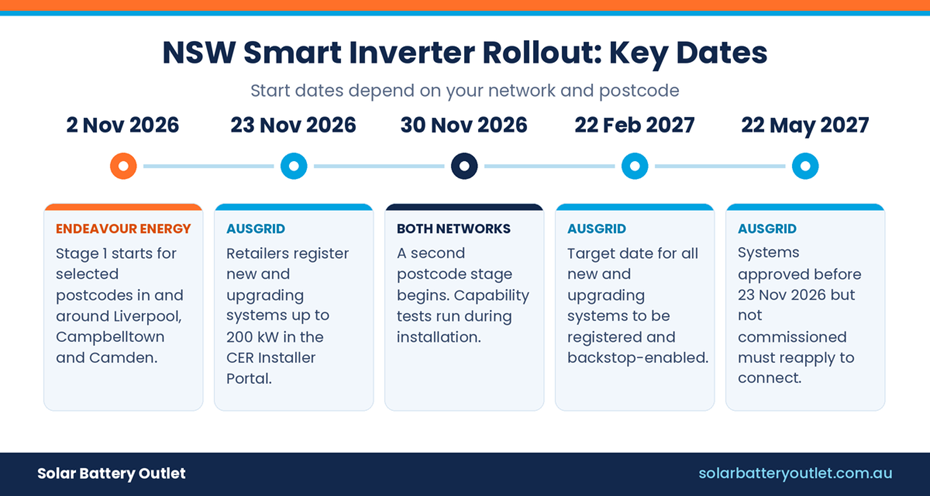
NSW Smart Inverter Rollout

The rules arrive in stages, not on one day. The NSW Government is phasing them in by postcode from November 2026. Your start date therefore depends on your network and address.

Endeavour Energy begins first. Its stage one starts on 2 November 2026 and covers postcodes in and around Liverpool, Campbelltown, Camden and Picton. Stage two follows on 30 November 2026.

Ausgrid starts portal registration on 23 November 2026. Capability testing then phases in by postcode from 30 November. Ausgrid expects every new and upgrading system to meet registration and backstop requirements by 22 February 2027. Also, from 22 May 2027, systems approved before 23 November 2026 but not commissioned must reapply.

Essential Energy customers should check their network’s rollout details. Dates can change, so confirm your postcode with your network before you sign.

Who must follow the new smart inverter rules?

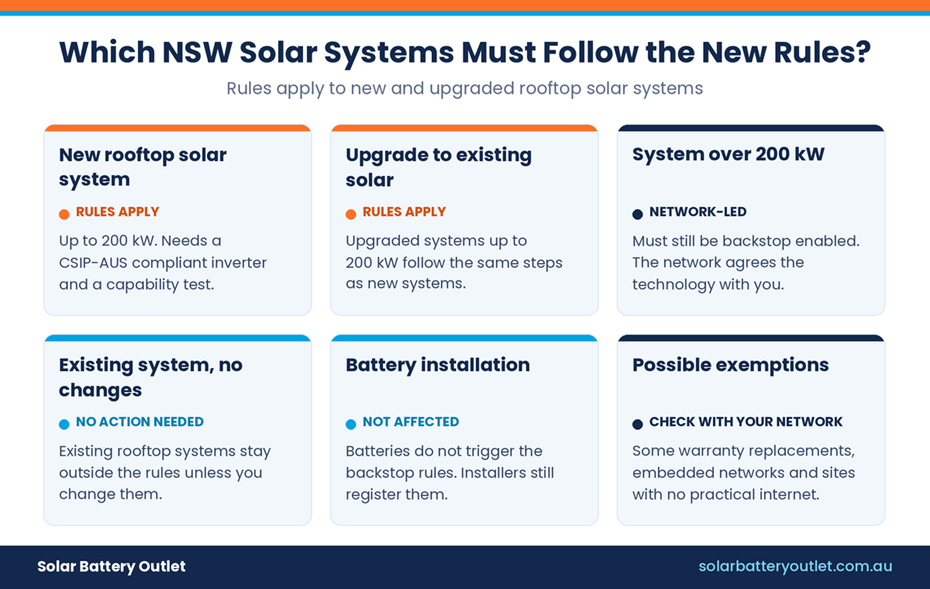
NSW solar systems must follow the new smart inverter rules

The requirements apply to new and upgraded rooftop solar systems up to 200 kW. Installers must fit CSIP-AUS compliant equipment. They must also register each system through the NSW CER Installer Portal.

However, many owners do not need to act. Existing systems that stay unchanged fall outside the rules. The NSW Government also confirms that battery installations do not fall under these requirements. In addition, some like-for-like warranty replacements, embedded network customers and sites without practical internet access can receive exemptions.

Systems above 200 kW must still support remote curtailment. In those cases, the network works directly with the customer on the right technology.

What must a compliant smart inverter installation include?

Compliant equipment comes first. The inverter must appear on the Clean Energy Council’s approved list of inverters with software communication clients. It must also use a client approved for that specific inverter.

From late 2026, your installer then completes four extra steps:

  1. Confirm the equipment meets CSIP-AUS.
  2. Use the CER Installer Portal to confirm installation details.
  3. Register the device through the manufacturer’s app or portal.
  4. Run a capability test during commissioning.

The capability test is short and takes place on site. It checks that your system can communicate with the network over the internet. Notably, exemptions may apply to device registration and capability testing. Your network’s connection approval and the portal will show if they do.

Why does your solar system need an internet connection?

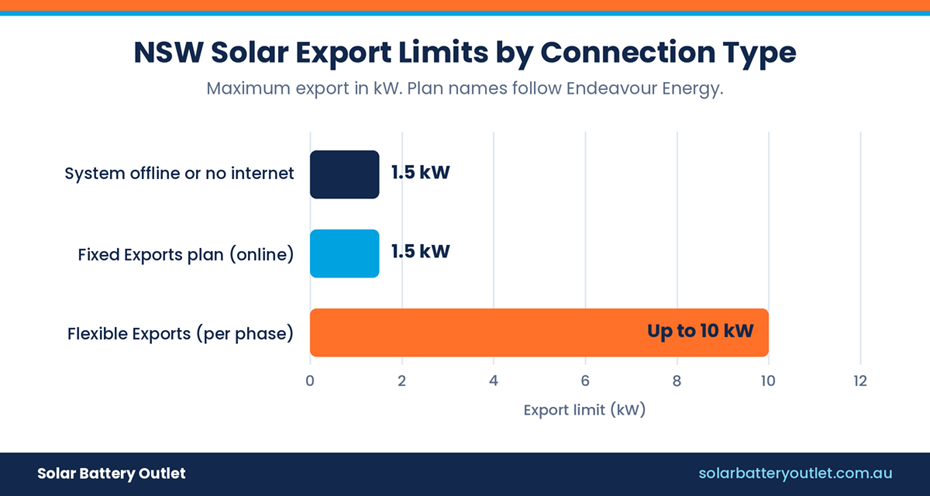
NSW Solar Export Limits by Connection Type

Your inverter uses the internet to receive network signals and share monitoring data. It also keeps any flexible export limit you choose. Your installer connects it with Wi-Fi, a plug-in Wi-Fi device or an ethernet cable.

If your site has no internet, installers can still fit solar. However, exports cap at 1.5 kW. That limit does not reduce the solar power you use at home. Similarly, an extended loss of connection triggers the same cap. That change may reduce your feed-in tariff earnings.

Flexible exports offer the upside. Endeavour Energy says eligible customers can export up to 10 kW per phase most of the time. From November 2026, it plans to make flexible exports the default for eligible new and upgraded systems. These customers need an active internet connection, net export metering and a Clean Energy Council listed CSIP-AUS inverter. Customers who prefer a Fixed Exports plan face a 1.5 kW maximum. Other networks set their own export rules, so check yours.

Finally, keep your modem switched on. Reconnect your inverter after you change provider, router or Wi-Fi password.

How do the NSW smart inverter changes affect solar batteries?

Adding a battery to existing solar does not trigger the backstop requirement. However, installers still register battery installations in the CER Installer Portal from November 2026.

Things change if your project also adds or replaces rooftop solar. In that case, the new inverter rules may apply. Therefore, ask your installer to confirm how the rules apply to your exact setup before you sign. A trusted solar battery company can review your inverter, internet set-up and battery plan together.

Battery projects also depend on other 2026 updates. For example, our guide to new government rules for solar battery installations in 2026 covers wider NSW compliance changes.

Rebate timing worrying you? Read our guide on whether to rush to get a solar battery before the rebate drops.

What should solar owners do now?

Use this four-step checklist before you sign a solar or battery contract.

  1. Define your plan. Decide whether you want new solar, an upgrade, a battery only or no change.
  2. Check your start date. Look up your postcode with Ausgrid, Endeavour Energy or Essential Energy.
  3. Confirm the inverter. Ask your installer to show the model on the Clean Energy Council’s approved list.
  4. Confirm the internet set-up. Ask how the inverter will connect and who supports the app.

Then ask three more questions. Which export plan will my system use? What happens if my internet drops? Who registers my system in the CER Installer Portal?

Never open your inverter or attempt electrical work yourself. For official updates, visit the NSW Government’s Emergency Backstop Mechanism page.

Frequently asked questions about the NSW smart inverter changes

When do the NSW smart inverter changes start?

They start in stages from November 2026 and roll out by postcode. Endeavour Energy begins on 2 November 2026. Ausgrid registration begins on 23 November 2026. Check your network for your postcode’s date.

Do I need to replace my existing solar inverter?

No. The requirements apply to new and upgraded systems. If you have an existing system and make no changes, the NSW Government says you need no action.

What is a CSIP-AUS inverter?

CSIP-AUS stands for Common Smart Inverter Profile – Australia. This Australian standard lets compliant equipment communicate with a network’s server over the internet in real time.

Will the emergency backstop switch off my solar?

It can briefly reduce your exports or pause generation. However, it only happens when AEMO instructs your network during a rare emergency. NSW Government installer guidance says it does not affect electricity supply to your home.

What happens if my inverter loses internet?

After an extended loss of connection, exports automatically limit to 1.5 kW. You can still use all the solar you generate at home. Reconnect your inverter to return to normal exports.

Do the rules apply to solar batteries?

Battery installations do not fall under the backstop requirement. Installers still register them through the portal. If you also add or replace solar, the rules may apply.

Talk to Solar Battery Outlet About Your Next Step

Not sure whether your plans trigger the NSW smart inverter changes? Solar Battery Outlet is a NSW-based solar battery company serving Liverpool, Bankstown and Mudgee. Our team can discuss your current system, your inverter and your internet set-up. We can also explain your battery options in plain language. Contact our team to talk through your plans.

Disclaimer

This article gives general information about the NSW smart inverter changes as at 26 October 2026. Rules, dates and postcode stages can change, and each network applies its own rollout. The article does not cover every site, system size or exemption. It does not replace advice from your distribution network, a licensed electrician or an accredited installer. Always seek personalised advice before making a purchasing decision.
Australia is installing solar at record pace. SunWiz data shows installers registered about 311.8 MW of small-scale solar (systems up to 100 kW) in September 2026. Meanwhile, January to September ran 43% ahead of the same period in 2025. ARENA has now backed robot manufacturing to help ease workforce constraints on large solar builds.

So, could solar installation robots make commercial solar projects faster and safer? This guide separates what works today from what remains early-stage. It also explains what a 10-year warranty actually covers, because that detail matters no matter who builds your system.

What Are Solar Installation Robots?

Solar installation robots are machines that automate heavy, repetitive steps in a solar build. Most fall into two groups. First, panel-placing robots lift modules and set them onto racking. Second, piling robots drive the foundation piles that hold the racking.

Luminous Robotics makes LUMI, a panel-placing robot. Built Robotics makes autonomous piling systems. For LUMI, human crews still complete the final securing of each panel. In fact, Luminous says LUMI helps existing crews install panels rather than replacing them.

Where Do Solar Installation Robots Work in Australia Today?

Robots have already worked on Australian solar farms. Luminous trialled its LUMI fleet at Engie’s 250 MW Goorambat East Solar Farm near Benalla, Victoria. The site installed almost 500,000 panels, with LUMI robots helping, and Luminous reported that LUMI exceeded its target production rate. ARENA also supported LUMI demonstrations in New South Wales.

Then, on 13 October 2026, ARENA committed up to $31.1 million to build solar robots locally. That includes up to $17.8 million for Luminous to support about 100 LUMI robots, made in Melbourne, by 2029. It also includes up to $13.3 million for a Built Robotics Brisbane hub that will manufacture 12 piling systems.

ARENA CEO Darren Miller called foundations and panel placement “two of the most labour-intensive parts of solar farm construction.” Accordingly, ARENA’s new funding targets those two steps.

What Do the Early Numbers Say?

Companies also publish performance estimates. Luminous says LUMI can help crews install panels up to 3.5 times faster, based on United States tests. Built Robotics estimates its piling robots could cut piling time by about 82% and labour costs by 88%. However, treat these figures as company estimates. Results can vary by site, crew and layout.

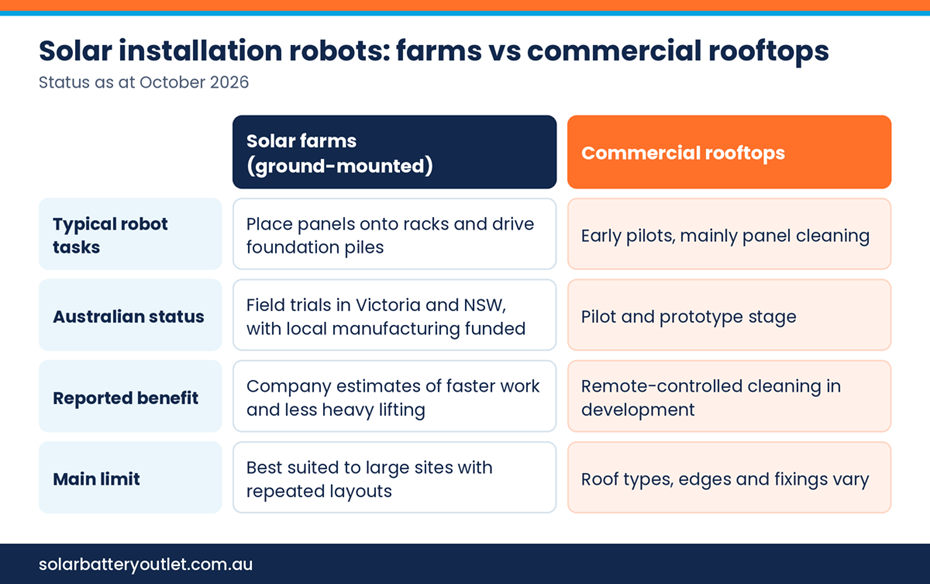
Solar installation robots: farm vs commercial

Can Solar Installation Robots Speed Up Commercial Rooftop Projects?

Not yet, based on published Australian trials. Those trials focus on large ground-mounted farms with repeated layouts. Commercial rooftops differ. Each roof has its own structure, edges, fixings and access limits. Consequently, a robot that suits an open field may not suit a warehouse roof. So far, reported rooftop robots mainly target tasks such as panel cleaning.

Panel placement is also only one stage of a project. Design, approvals, network connection and commissioning take time too. Therefore, faster placing does not automatically mean a faster handover. Likewise, ARENA expects the new robot facilities to ease workforce constraints on large-scale solar. Whether that frees capacity for rooftop projects remains unproven.

Could Solar Installation Robots Make Commercial Solar Safer?

They could reduce some hazards, but they cannot remove the biggest rooftop risk. Falls from height remain the major danger. WorkSafe Victoria reported on 26 August 2026 that, since 2021, falls from height injured over 2,300 workers. Another 20 died. These figures cover Victorian construction, which includes solar installation. Over the same period, WorkSafe prosecuted 42 solar companies for failing to manage falls risks.

SafeWork NSW has also named falls and electrical contact as the two biggest risks in rooftop solar. It adds that most serious falls happen from four metres or less. Robots help most with manual handling. For example, Luminous says LUMI lifts panels weighing about 36 kg, so crews avoid heavy lifting.

However, robots add new risks, such as machines moving near workers. Therefore, site teams still need to assess those risks. WorkSafe Victoria’s Sam Jenkin said “saving 10 or 20 minutes is never worth someone’s life.” That principle applies to any build method.

Importantly, the sources reviewed include no independent injury data for robot-assisted solar sites. So treat safety benefits as company and agency statements, not measured results.

What Do 10-Year Warranties Actually Cover?

Whoever builds your system, the warranty decides who pays when something fails. However, a 10-year headline does not cover every part for the same period. The Australian Government’s Energy.gov.au warranty guide explains why.

Product Warranties

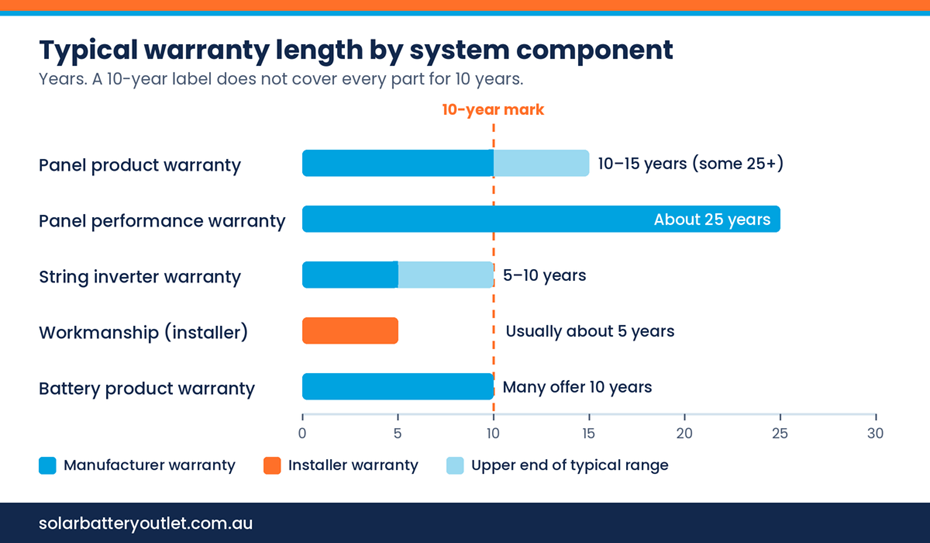
A product warranty covers faulty products. Many panels carry 10 to 15 years, while some reach 25 years or more. Many batteries also carry a 10-year product warranty. However, a maker may guarantee a fixed term or a minimum number of cycles, whichever comes first. Throughput warranties instead cap the total energy delivered.

Performance and Capacity Warranties

A performance warranty promises minimum panel output. Almost all panels carry one for 25 years. A standard example is 90% of output to year 10 and 80% to year 25. Yet Energy.gov.au notes that performance claims can be difficult to enforce. Battery capacity warranties work in a similar way. For example, a maker may guarantee 60% of original capacity for 10 years.

Workmanship Warranties

A workmanship warranty covers installation faults, such as a leaking roof from cracked tiles. It usually lasts about five years. Therefore, a 10-year manufacturer warranty does not extend your installer’s cover.

Typical warranty length by system component

What a 10-Year Warranty Usually Excludes

Most panel warranties exclude hail damage. Energy.gov.au also notes that warranties may not cover damage you or the weather cause. Moreover, many battery warranties add conditions of use. These can limit daily charge cycles, grid charging or weather exposure. Insurance, rather than a warranty, usually covers hail and storm damage. When you compare quotes from any solar battery company, ask for these limits in writing.

How the Australian Consumer Law Fits In

A warranty adds to your rights under the Australian Consumer Law. It does not replace them. The ACCC says consumer guarantees cover goods and services that cost $100,000 or less. Many large commercial systems cost more than $100,000. Consequently, contract warranty terms carry more weight on bigger projects.

How Can You Check a 10-Year Warranty Before You Sign?

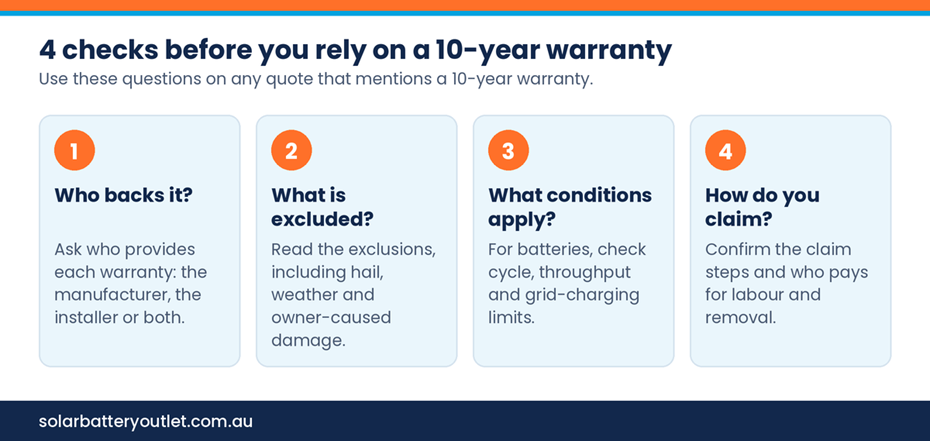
Use four checks on any quote that mentions a 10-year warranty.

  1. First, ask who provides each warranty. The manufacturer usually backs the product, while the installer backs the workmanship.
  2. Second, read the exclusions. Look for hail, weather and owner-caused damage.
  3. Third, check the conditions of use. For batteries, look for cycle, throughput and grid-charging limits.
  4. Finally, ask how to claim. Confirm who pays for labour and removal.
4 checks before you rely on a 10 year warranty

What Should Commercial Buyers Do Now?

You do not need to wait for robots to plan a commercial solar project. Instead, focus on the factors you can control today. Ask your installer how they manage work at height on your roof. Also ask for the safe work method statement that covers the job. Then compare each warranty against the four checks above.

Frequently Asked Questions

What are solar installation robots?

Solar installation robots are machines that automate heavy, repetitive build steps. Some place panels onto racking, while others drive foundation piles. Crews still supervise the work and finish tasks such as securing panels.

Are solar installation robots used in Australia?

Yes, on large solar farms. Luminous trialled LUMI robots in Victoria and New South Wales. On 13 October 2026, ARENA committed up to $31.1 million to build solar robots locally.

Can robots install commercial rooftop solar?

Published Australian trials focus on ground-mounted solar farms. Reported rooftop robots mainly target tasks such as cleaning. Rooftop installs therefore still rely on human crews and on-site safety controls.

Are solar installation robots safer than manual installation?

Robots can reduce heavy lifting on solar farms, which companies and agencies describe as a safety benefit. However, independent injury figures remain limited. On rooftops, falls from height stay the main hazard, so fall protection still matters.

What does a 10-year solar battery warranty cover?

It typically covers faulty batteries. Some warranties also guarantee minimum capacity, such as 60% after 10 years. Makers may also cap cycles or total energy throughput, so read the exclusions and conditions of use.

Does a 10-year warranty cover hail damage?

Usually not. Energy.gov.au notes that most panel warranties exclude hail, and insurance often covers storm damage instead. Check both your policy and your warranty wording.

Do consumer guarantees still apply if I have a warranty?

Yes. A warranty adds to your Australian Consumer Law rights and cannot remove them. The guarantees cover goods and services costing $100,000 or less, so larger commercial purchases may depend more on contract terms.

Disclaimer

This article gives general information about solar installation robots, commercial solar safety and warranty terms in Australia. It does not describe Solar Battery Outlet’s own products, prices or warranty terms. Robot performance figures come from companies and trial sites, and results vary by project. Safety duties, warranty terms and consumer rights depend on your contract, your site and current law, which can change. Nothing here guarantees a faster build, a safer site, savings or any warranty outcome. Information is current as at 16 October 2026. Always seek personalised advice before making a purchasing decision.
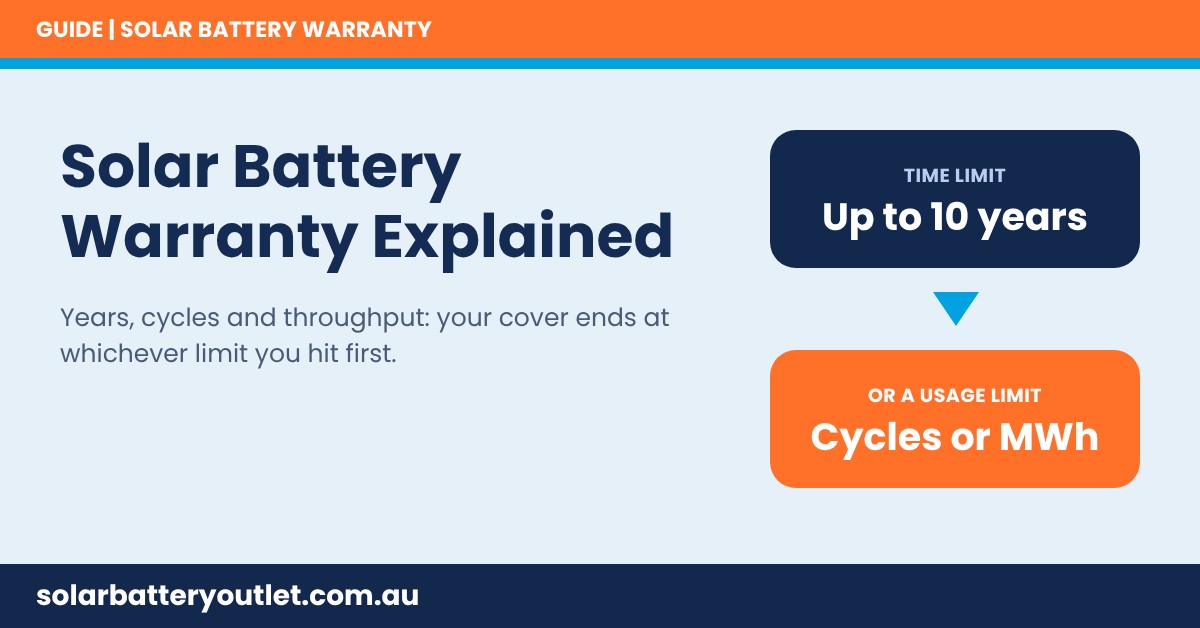
A solar battery warranty looks simple on a quote. The paperwork says “10 years”, and most buyers stop reading there. However, the real terms run deeper. Your solar battery warranty usually ends when you reach the first of three limits: years, cycles or throughput. This guide explains each limit in plain English. You will also learn what a 10-year warranty actually covers and what it often leaves out.

Quick answer: A typical 10-year solar battery warranty covers manufacturing defects and a guaranteed minimum capacity, often 60% to 70%. Cover ends at the first limit you reach: the time limit, a cycle cap or a throughput cap in MWh. Terms vary by brand and model, so read the warranty document before you buy.

What Is a Solar Battery Warranty?

A solar battery warranty is a written promise from the manufacturer. It sets out how long the maker will repair or replace a faulty battery. Most warranties cover two things. First, the product warranty covers defects in materials and workmanship. Second, the performance warranty guarantees a minimum capacity at the end of the term.

In simple terms, capacity means usable energy, measured in kilowatt-hours (kWh). Also, most modern home batteries use lithium iron phosphate (LFP) chemistry. Over time, every battery loses some capacity. The warranty sets how much loss the manufacturer accepts before it steps in.

Importantly, a warranty is not the same as a lifespan. A battery can keep working after the warranty ends. Likewise, a battery can lose its cover early if you reach a usage limit.

The Three Solar Battery Warranty Limits: Years, Cycles and Throughput

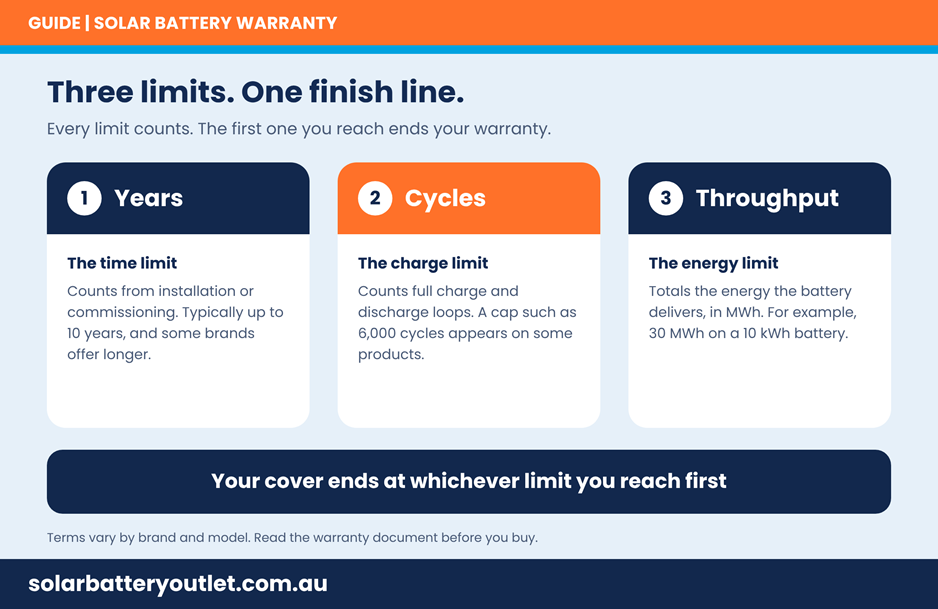
three warranty limits

Most Australian battery warranties combine up to three limits. The warranty ends at whichever limit you reach first. Therefore, you need to understand all three before you sign.

Years: the time limit

The time limit usually counts from installation or commissioning. Ten years is common for home batteries, and some brands offer longer terms. In addition, check the start date in writing. Some warranties may count from a different date.

Cycles: the charge limit

A cycle is one full charge and discharge. Two half-discharges add up to one cycle. Some manufacturers rate their batteries at around 6,000 cycles. Others set different caps, and some set none. Always confirm the exact figure for your model.

Throughput: the energy limit

Throughput is the total energy a battery delivers over the warranty. Manufacturers measure it in megawatt-hours (MWh), and one MWh equals 1,000 kWh. Throughput combines cycles and depth of discharge into one number. For example, a 10 kWh battery with a 30 MWh limit supports about 3,000 full cycles. Some makers instead state throughput as a multiple of nominal capacity.

How Quickly Do You Reach the Throughput Limit?

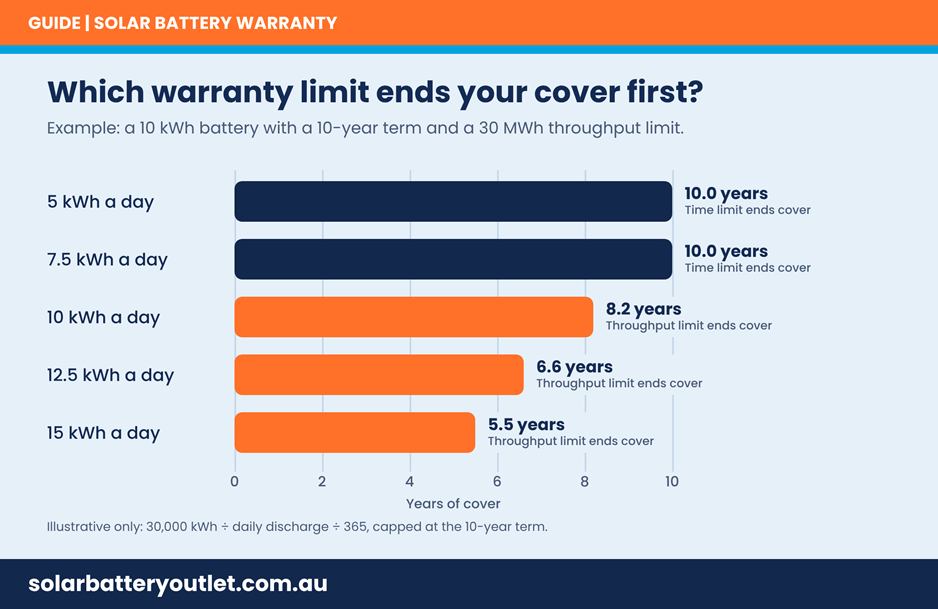
The warranty limit ends first

Naturally, heavy daily use drains the throughput allowance faster. Consider a hypothetical 10 kWh battery with a 10-year term and a 30 MWh limit. At 5 kWh a day, you need 16.4 years to reach 30 MWh. As a result, the 10-year time limit ends your cover first.

At 10 kWh a day, you reach the throughput limit in 8.2 years. At 15 kWh a day, you reach it in about 5.5 years. Consequently, a large household with high evening use can use up its allowance early. In contrast, a light user will likely finish the full term.

This example uses made-up figures, not a real product. Instead, use your own battery size and daily usage. Ask your installer to run the numbers for your home.

What Does Capacity Retention Mean?

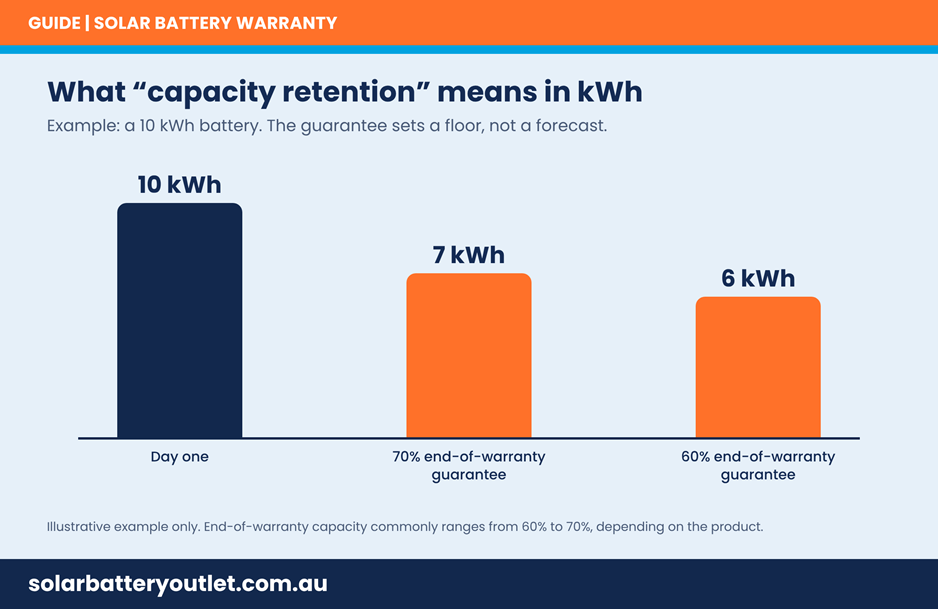
Capacity Retention

Capacity retention is the minimum capacity the maker guarantees at the end of the warranty. Many warranties set it between 60% and 70%. On a 10 kWh battery, a 70% guarantee means at least 7 kWh remains. Similarly, a 60% guarantee means at least 6 kWh.

In short, this figure sets a floor, not a forecast. Your battery may hold more. Still, compare the number across brands. Also check how the maker measures it, including the test conditions.

What Does a 10-Year Solar Battery Warranty Actually Cover?

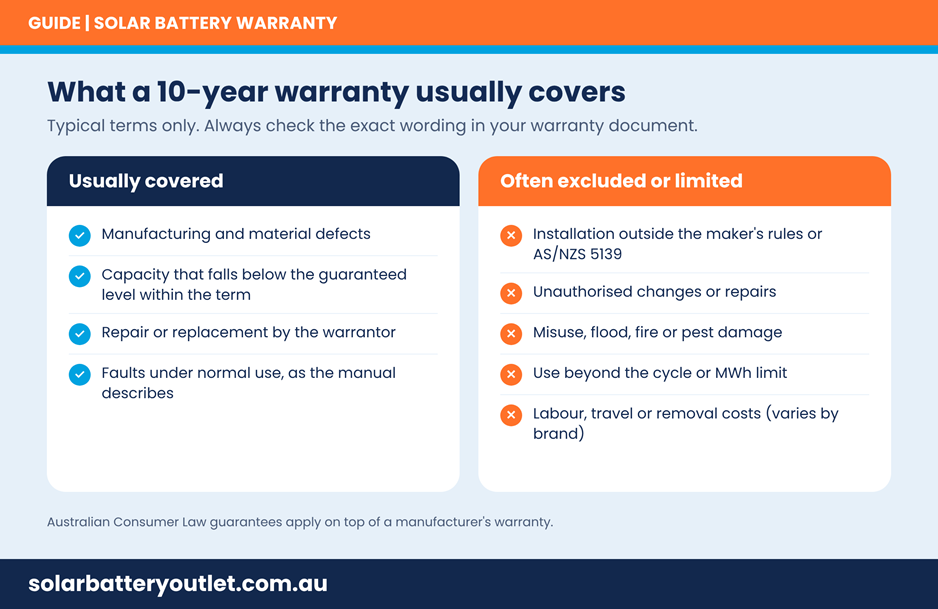
10-year warranty covered vs excluded

Most 10-year warranties cover similar core items. They typically cover manufacturing defects and capacity that falls below the guaranteed level. They also include repair or replacement by the warrantor.

However, exclusions matter just as much. Many warranties exclude installation that breaks the maker’s rules, unauthorised changes, and damage from misuse, flood, fire or pests. They also exclude use beyond the cycle or MWh cap. In addition, some warranties cover parts only, so labour, travel and removal costs can vary.

Finally, confirm who honours the warranty in Australia. Local support matters if a fault appears in year seven.

Conditions That Can Affect Your Warranty

Besides limits, warranties usually come with conditions. If you miss one, you may reduce your cover. Common conditions include:

  • Installation by a suitably accredited installer, following AS/NZS 5139, the Australian and New Zealand standard for battery installations.
  • Operation within the stated temperature range.
  • An active internet connection or registration on some products.
  • Charge and discharge within the rated limits.
  • Compliance with the maker’s rules for virtual power plant (VPP) participation, because extra cycling can count toward your cap.

Therefore, ask your installer to point out each condition in the document. Also keep your invoice, commissioning paperwork and serial numbers.

Australian Consumer Law and the NETCC: Extra Protection

A manufacturer’s warranty does not replace your legal rights. Australian Consumer Law (ACL) consumer guarantees apply automatically. They include acceptable quality, durability and fitness for purpose. A manufacturer’s warranty cannot take these guarantees away. Your exact rights depend on your circumstances.

The New Energy Tech Consumer Code (NETCC) adds another layer. The Clean Energy Council administers this voluntary code, and the ACCC authorises it. The code includes this promise: “We will honour all guarantees and warranties you may be entitled to.” The ACCC reauthorised the code on 28 August 2026. Meanwhile, an updated version takes effect on 1 December 2026. Ask any seller whether it is a NETCC-approved seller, then check the NETCC website.

How the Cheaper Home Batteries Program Links to Your Warranty

The federal Cheaper Home Batteries Program lowers the upfront cost of eligible batteries. The battery must be Clean Energy Council (CEC) approved and meet AS/NZS 5139. Solar Accreditation Australia (SAA) accredited installers must complete the work.

Notably, the Clean Energy Regulator sets a minimum installation period. The battery must stay at your premises until after 2030, or until the warranty period ends. The later date applies. As a result, a 10-year warranty can extend how long the battery must stay in place. Program settings changed on 1 May 2026, so confirm the current rules before you sign.

Seven Questions to Ask Before You Buy

Next, use this checklist with every installer. Write down the answers, and compare them across quotes.

  1. What is the warranty term, and when does it start?
  2. Is there a cycle cap, and what is the figure?
  3. What is the throughput limit in MWh?
  4. What capacity does the maker guarantee at the end, and how does it measure that?
  5. Who handles claims in Australia, and who pays for labour and removal?
  6. Which installation, temperature and VPP conditions apply?
  7. Can I read the full warranty document before I sign?

Solar Battery Warranty FAQs

How long is a typical solar battery warranty in Australia?

Ten years is common for home batteries, and some brands offer longer terms. However, most warranties also include a cycle or throughput limit. Cover ends at the first limit you reach, so check all three.

What is the difference between cycles and throughput?

A cycle counts one full charge and discharge. Throughput measures the total energy the battery delivers, in MWh. Throughput therefore captures both cycles and how deeply you discharge.

What happens if I reach the cycle or throughput limit before 10 years?

Your warranty ends at that point, even if the calendar term has years left. The battery may keep working. However, you would then lose the maker’s repair or replacement cover.

Does a 10-year warranty guarantee full capacity for 10 years?

No. Most warranties guarantee a minimum capacity at the end of the term, often between 60% and 70%. Your battery will gradually lose some capacity during that time.

Does joining a virtual power plant void my warranty?

Not necessarily, but it depends on the manufacturer’s terms. VPP participation can add cycles, and those cycles count toward any cap. Therefore, confirm the details with your installer and the manufacturer in writing.

Do consumer guarantees still apply after the warranty ends?

They can. Consumer guarantees apply for a reasonable period. That period depends on the product, its price and how you use it.

What is the NETCC, and why does it matter for battery warranties?

The New Energy Tech Consumer Code is a voluntary consumer protection code for solar and battery sellers. It covers marketing, quotes, installation, and warranties and support.

Disclaimer

This article gives general information about solar battery warranties only. It does not offer financial, legal or technical advice. Warranty terms vary by brand and model, and the examples use made-up figures that do not represent any specific product, performance or saving. Government program settings, STC amounts and NETCC requirements can change, so confirm the current details with the relevant authority. Always read the warranty document for your battery. Always seek personalised advice before making a purchasing decision.
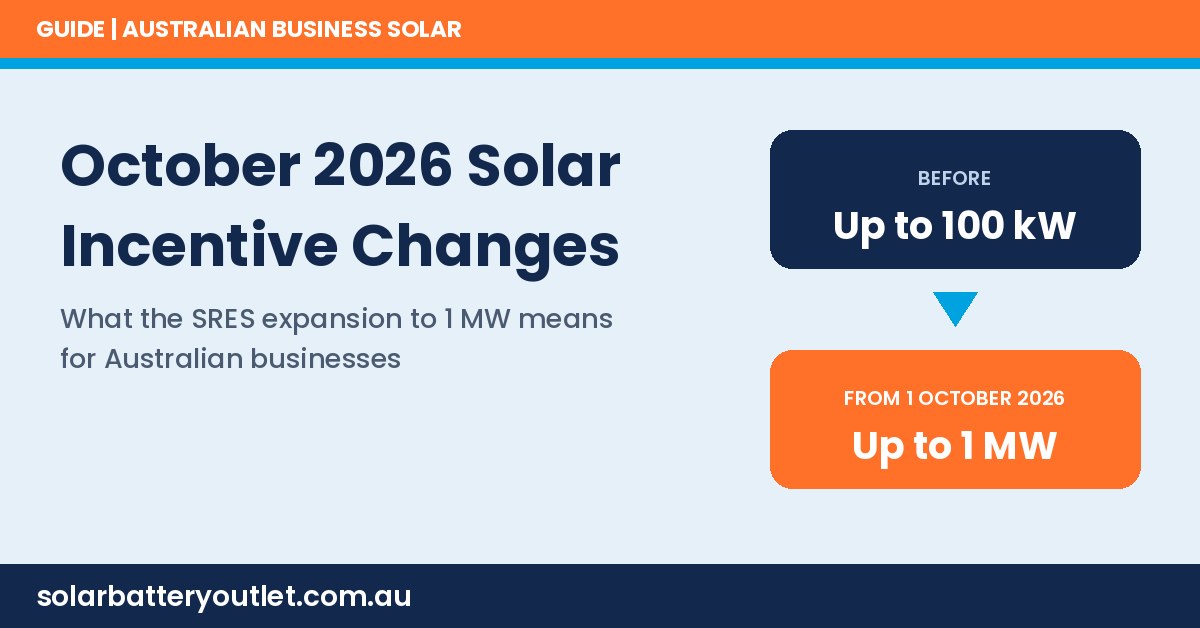
The October 2026 solar incentive changes give larger businesses a new way to cut upfront solar costs. From 1 October 2026, the Small-scale Renewable Energy Scheme (SRES) covers eligible solar PV systems up to 1 MW. Previously, the scheme stopped at 100 kW.

The Australian Government estimates the change could reduce the upfront cost of a mid-scale system by around 20 per cent. Your own result will depend on system size, location and eligibility checks. This guide explains who may qualify, how system size matters and how to estimate your potential saving.

What Are the October 2026 Solar Incentive Changes?

The Australian Government amended the Renewable Energy (Electricity) Regulations 2001 to expand SRES eligibility. Systems above 100 kW and up to 1 MW now fall inside the scheme. The Clean Energy Regulator (CER) calls this category mid-scale solar.

The SRES works through small-scale technology certificates, or STCs. Each STC represents a set amount of expected renewable generation. Installers or system owners create STCs, then sell or assign them. The proceeds reduce the upfront price of the system.

Three dates matter. Your installer must commission eligible systems on or after 1 October 2026. STC applications for mid-scale systems open in mid to late November 2026. After that, the CER begins assessing applications. Read the CER’s mid-scale solar guidance for the latest updates.

The Government is also preparing a rule change request for the Australian Energy Market Commission. This request aims to make it easier for businesses to connect larger solar systems to the network. That change is still in preparation, so connection timelines may not shift yet.

Who May Qualify Under the Expanded SRES?

The rules focus on the solar system, not the type of business. Even so, the Government expects the expansion to help farms, manufacturers, retailers, logistics centres, schools, hospitals and community organisations. Small businesses with larger roofs and strong daytime electricity use may also benefit.

A system must meet several requirements to qualify. The CER lists these in its transitional guidance:

  • Capacity above 100 kW and up to 1 MW.
  • Installation on or after 1 October 2026.
  • Components that appear on the Clean Energy Council approved list.
  • Installation that meets Solar Accreditation Australia (SAA) guidelines and electrical safety rules.
  • Evidence of planning approvals and, where applicable, network connection approvals.

Installers must also keep geotagged, time-stamped photos that show their face during final testing and commissioning. Photos taken afterwards may not count. Therefore, confirm this step with your installer early.

Which Businesses May Benefit Most?

Not every business will gain equally. Several features usually improve the fit:

  • Large roof space with little shading.
  • High daytime electricity use, such as refrigeration, machinery or air conditioning.
  • Planning approvals that look achievable, plus landlord consent for tenants.
  • A site where a network connection looks realistic.

Warehouses, factories, farms, schools and supermarkets often meet several of these points. For example, a coolstore runs refrigeration through the day, which matches solar generation. However, a business with little roof space or low daytime use may see a smaller benefit.

System Size Considerations Under the 1 MW Limit

System size drives your certificate count, so plan it carefully. Five points matter.

First, know the size bands. A system at or below 100 kW stays under the existing SRES rules. A system above 1 MW stays in the Large-scale Renewable Energy Target.

Second, check extensions. Only the extra capacity installed on or after 1 October 2026 earns STCs. For example, an 80 kW system plus a 40 kW extension may count as a 120 kW system. In that case, only the extra 40 kW earns STCs.

Third, watch the combined site limit. The CER looks at related solar on the same or adjoining sites. If existing large-scale solar plus the new system exceeds 1 MW, the new system will not qualify as mid-scale.

Fourth, choose your certificate pathway. You can apply for STCs or join the Renewable Electricity Guarantee of Origin (REGO) scheme. If you choose STCs, you cannot create REGO certificates during the deeming period.

Finally, note the fixed deeming period. Mid-scale systems receive five years of deeming through to 2030. Systems up to 100 kW see a declining deeming period instead.

How to Assess Your Potential Upfront Savings

The STC formula is simple. Multiply system size in kW by your postcode’s zone rating. Then multiply by the deeming period in years. Mid-scale systems use five years. Zone 3 carries a rating of 1.382, and Sydney sits in that zone. Check your own postcode with the CER.

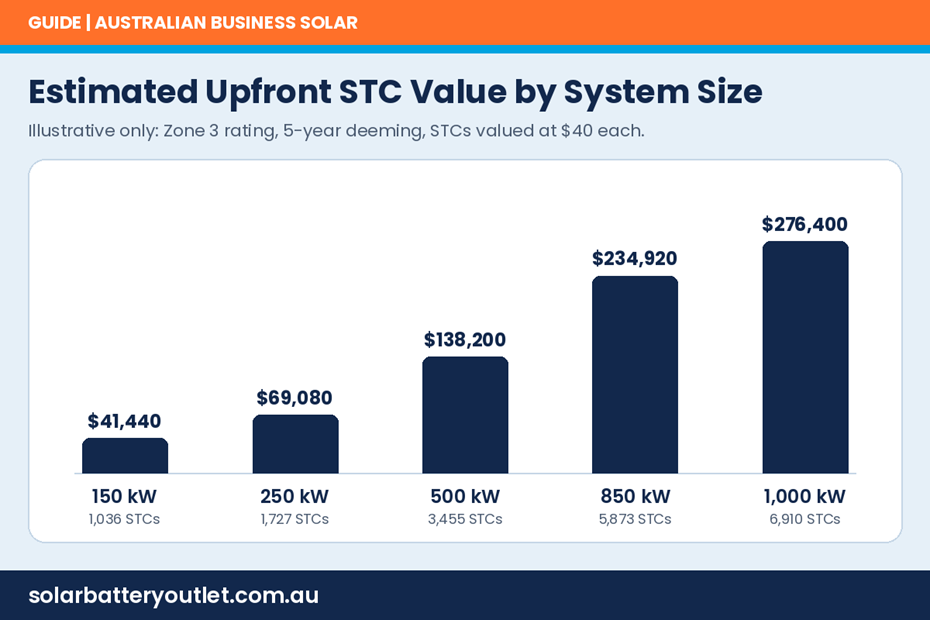
For example, a 250 kW system in Zone 3 earns about 1,727 STCs (250 × 1.382 × 5, rounded down). At $40 per STC, that equals roughly $69,080. The Minister cited about $68,000 for a 250 kW system, which sits close to this estimate. The chart below shows how the estimate scales.

STC Value by System Size

Treat $40 as an upper reference point. Certificate prices vary with how you sell them, and mid-scale sale arrangements may differ. Also remember that STC value reduces the upfront price only. It does not guarantee savings on your power bills.

Use these four steps to build your own estimate.

How to Estimate Your Upfront Saving
A four-step check before you compare quotes.

  1. Confirm system size. Check the size sits above 100 kW and up to 1 MW, including any solar already on site.
  2. Find your zone rating. Match your postcode to a CER zone. Most NSW population centres sit in Zone 3.
  3. Calculate your STCs. Multiply system kW by the zone rating, then by 5 deeming years.
  4. Compare net costs. Ask each installer to show quote costs with and without STC value.

After that, ask each installer to show the system price before and after STC value. This comparison keeps quotes transparent. It also shows whether the quoted discount matches your calculation.

What Should Businesses Do Before Signing a Quote?

Prepare early. These actions help protect your eligibility:

  • Check the installation date. Eligibility depends on the testing and commissioning date, not the purchase date.
  • Confirm accreditation. Ask for the installer’s SAA accreditation and the approved product details.
  • Secure approvals. Gather planning, building and network connection approvals, plus structural engineering reports where needed.
  • Keep records. Store design documents, metering details, electrical compliance certificates and commissioning records.
  • Watch for updates. The CER plans more guidance on related systems, extensions and upgrades.

Talk to Solar Battery Outlet About Your Business Energy Plans

Solar Battery Outlet helps NSW customers understand their energy options. Our team in Liverpool, Bankstown and Mudgee can discuss your site’s daytime and evening electricity use. We can also explain how solar and battery storage may fit together. In addition, we can help you prepare questions for your solar quote.

Please note that this SRES expansion covers solar PV. Battery incentives follow separate rules, so confirm current eligibility before you add storage. When you are ready to talk, contact our team to discuss your business energy goals.

Frequently Asked Questions

What are the October 2026 solar incentive changes?

The Australian Government expanded the Small-scale Renewable Energy Scheme from 100 kW to 1 MW. Eligible solar PV systems that installers commission on or after 1 October 2026 can now create small-scale technology certificates. The Government estimates this could cut the upfront cost of a mid-scale system by around 20 per cent.

Which businesses may qualify for the expanded SRES?

Eligibility depends on the solar system, not the business type. The Government expects farms, manufacturers, retailers, logistics centres, schools, hospitals and community organisations to benefit. Your system must meet size, product, installer, approval and safety requirements.

Does the expansion apply to systems installed before 1 October 2026?

No. The CER states that eligibility depends on the installation date. The installation date is when the system first produces and delivers electricity. Testing and commissioning records show that date.

When can businesses apply for mid-scale STCs?

The CER expects applications to open in mid to late November 2026. The CER will assess eligible systems installed on or after 1 October 2026 against the rules from that date. Your submission date does not change this.

Can a business choose between STCs and REGO certificates?

Yes. Systems from 100 kW to 1 MW can apply for STCs. Alternatively, they can join the Renewable Electricity Guarantee of Origin scheme. If you choose STCs, you cannot create REGO certificates during the deeming period.

Can I expand an existing solar system and claim STCs?

Possibly. Only the additional capacity installed on or after 1 October 2026 can earn STCs. The existing and new components must form one electrically connected system. The combined capacity must exceed 100 kW without passing 1 MW.

Disclaimer

This article provides general information about the expanded Small-scale Renewable Energy Scheme for mid-scale solar, as at 12 October 2026. It does not constitute financial, tax or legal advice. Scheme rules, certificate prices and Clean Energy Regulator guidance may change. The savings figures are illustrative estimates only. They use a Zone 3 rating, a five-year deeming period and $40 per STC. Your outcome depends on your site, system, approvals and how you sell certificates. This article does not guarantee eligibility or any saving. Always seek personalised advice before making a purchasing decision.
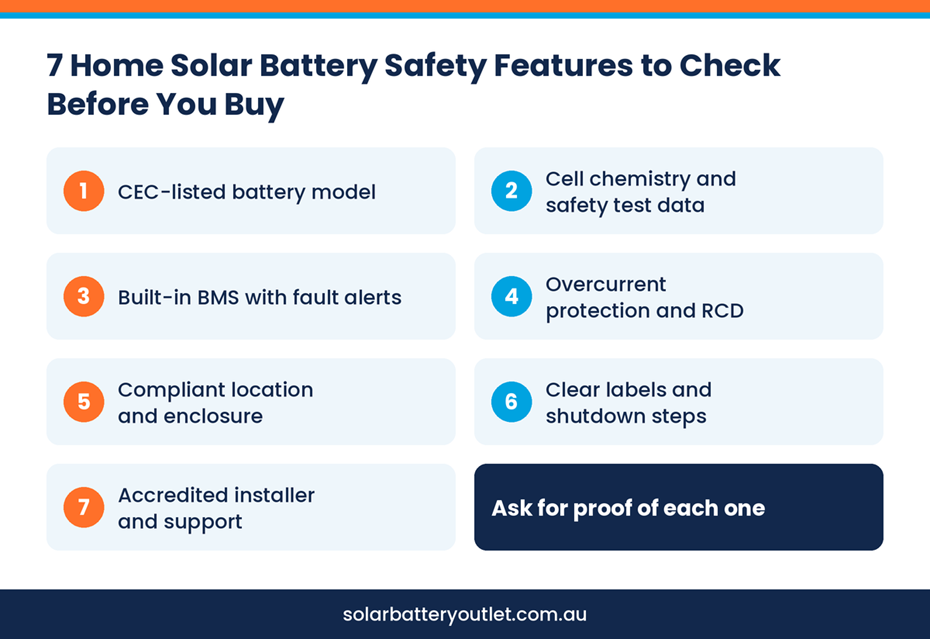
The key home solar battery safety features are certification, manufacturer safety data, and a battery management system. Proper electrical protection, correct labelling, and an accredited installer complete the picture.

However, no battery system is risk-free. Therefore, this guide explains each safety feature in plain language. It also shares what Australian regulators found in 2026 and gives you a checklist to use before you buy.

Quick answer: 7 safety features to look for

  • A Clean Energy Council (CEC) listed battery model
  • Known cell chemistry and manufacturer safety test data
  • A battery management system (BMS) with thermal protection
  • Electrical protection, including overcurrent protection and an RCD
  • A compliant location and a suitable enclosure
  • Clear labels and shutdown steps
  • An accredited installer and ongoing support

Why Home Solar Battery Safety Features Matter in 2026

Australia’s battery boom is moving fast. Households and businesses installed 478,176 solar batteries between 1 July 2025 and 30 June 2026. That equals 13.58 GWh of storage. As a result, safety checks matter more than ever.

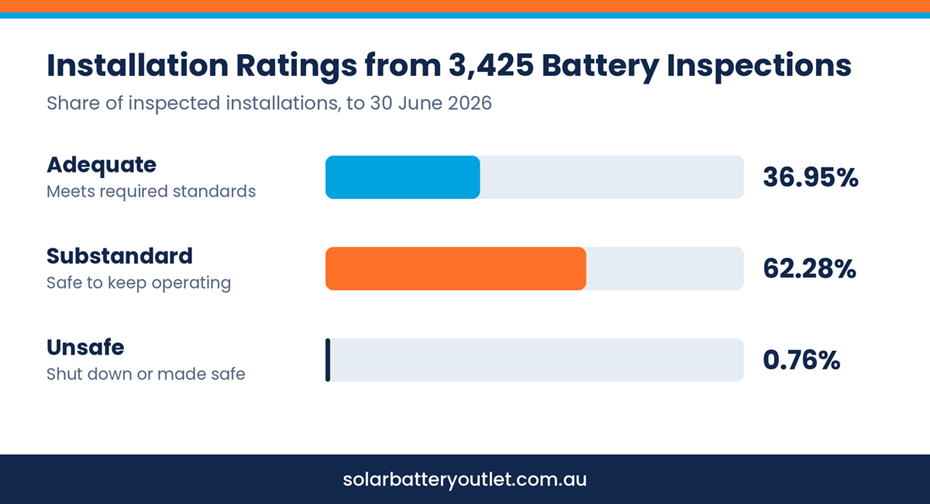
The Clean Energy Regulator (CER) inspects a sample of these installations. In its latest solar battery inspection results report, it reviewed 3,425 systems. It rated 0.76% unsafe, 62.28% substandard but safe to operate, and 36.95% adequate.

Importantly, no inspection found a problem with the battery itself. Instead, every issue traced back to installation practices and workmanship. Labelling was the most common reason for a substandard rating. The CER also notes it is too early to draw strong conclusions about compliance rates.

Installation ratings from 3,425 CER battery inspections to 30 June 2026.

Substandard does not mean the whole system is faulty. Typically, inspectors flag one or two items, such as a missing label. However, those items can still affect electricians and emergency crews later. Consequently, check both the product and the installation.

Feature 1: Known Battery Chemistry and Safety Data

Most home batteries use lithium-ion cells. Two common chemistries are lithium iron phosphate (LFP) and nickel manganese cobalt (NMC).

Thermal runaway is the main hazard in lithium-ion batteries. In this chain reaction, one overheating cell heats its neighbours. Any lithium-ion chemistry can fail under abuse or poor installation.

Therefore, treat chemistry as one layer of protection, not a guarantee. Ask your installer which chemistry the battery uses. Then ask for the manufacturer’s safety test documentation.

Feature 2: Independent Certification and CEC Listing

Certification shows a battery passed independent safety testing. In Australia, the Clean Energy Council (CEC) keeps an approved batteries list. It now includes more than 1,000 lithium-based products. Listed batteries meet the lithium safety standard IEC 62619:2017, plus extra CEC requirements.

The federal Cheaper Home Batteries Program adds two rules. The battery must appear on the CEC list. It must also comply with AS/NZS 5139:2019.

Standards are evolving, too. Standards Australia published SA TS 5398:2025 on 3 October 2025. It is replacing the older Best Practice Guide. From 1 January 2027, the CEC will accept only applications assessed against the new specification.

Some manufacturers also cite UL 9540A, a US and Canadian test method for thermal runaway fire propagation. This adds useful evidence. However, it does not replace CEC listing. Before you buy, ask for the exact model number. Then search for it on the CEC list yourself.

Feature 3: A Battery Management System with Thermal Protection

A battery management system (BMS) acts as the battery’s built-in safety controller. It monitors voltage, current and temperature across the cells. It also guards against overcharging, over-discharging, overcurrent and short circuits. If readings leave safe limits, the BMS can limit power or disconnect the battery.

Heat control matters too. Designs range from passive cooling to fans or liquid systems. Therefore, ask how the unit manages heat in summer. Also ask how it alerts you to faults, for example through an app or an inverter display.

Feature 4: Electrical Protection Beyond the Battery

The battery is only one part of the system. The installer adds the wiring and protective devices around it. The CER’s most common wiring findings included:

  • A missing or incorrectly configured residual current device (RCD)
  • Insufficient mechanical and fire protection
  • Inadequate overcurrent protection on inverter circuits

Moreover, some unsafe ratings involved loose connections showing signs of heat. Therefore, ask your installer to explain each protective device. Also ask them to show you the isolation points.

Feature 5: A Compliant Location and a Suitable Enclosure

AS/NZS 5139 sets the installation rules for home battery systems, and it restricts where a battery can go. Standards Australia published Amendment 1 on 19 December 2025. The NSW Building Commission says it is now mandatory in NSW.

Fire and Rescue NSW advises placing a battery in a cool, ventilated, low-traffic area away from entries and exits. Meanwhile, outdoor installations need a unit with a suitable ingress protection (IP) rating. Where vehicles or impacts could damage the unit, the installer should add mechanical protection.

Suitable locations vary by home. The right spot depends on the battery model, your property layout and the standard. Therefore, expect your installer to assess the site and explain any restrictions.

Feature 6: Clear Labelling and Shutdown Steps

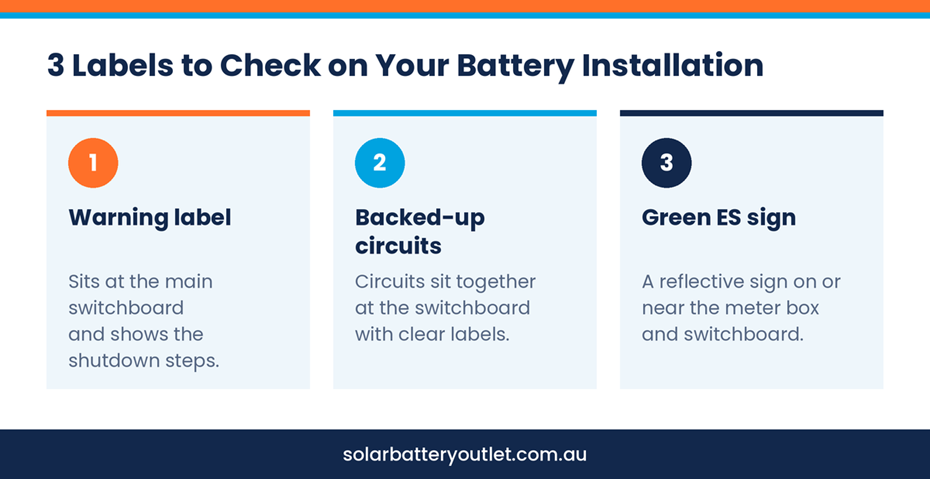
Labels may seem minor. However, they protect electricians, firefighters and your family. The CER found labelling was the most common reason for a substandard rating. Three labels deserve a check at your switchboard.

Three labels to check on a home battery installation

First, a warning label at the main switchboard must show the shutdown procedure. Next, backed-up circuits must sit together at the switchboard with clear labels. Finally, a green reflective “ES” sign must appear on or near the meter box and switchboard.

Emergency crews rely on the ES sign to know a battery is on site. In addition, the CER introduced new photo requirements from 1 March 2026 to improve labelling compliance.

Feature 7: An Accredited Installer and Ongoing Support

A certified battery still needs a skilled installer. The Cheaper Home Batteries Program requires installation by a Solar Accreditation Australia (SAA) accredited installer. That installer must hold a battery endorsement. By certifying the job, the installer confirms it is safe and eligible. Furthermore, the CER can declare installers ineligible if their installations repeatedly fail.

When you shortlist the best solar battery installer, ask these questions:

  • Are you SAA accredited with a battery endorsement?
  • Which CEC-listed model do you recommend, and why?
  • Where will the battery go, and does the location meet AS/NZS 5139?
  • How will you label the system and show me the shutdown steps?
  • What warranty, monitoring and support do you provide?

Support matters after installation too. Register your product, keep your documents and watch for recall notices. As of December 2025, the CER reported one recalled eligible product. That recall involved an energy controller, not a battery. You can check current notices on the ACCC’s Product Safety Australia recalls register.

Your Home Solar Battery Safety Checklist

Use this home solar battery safety features checklist during every quote. A reputable solar battery company will answer each point with documents, not just promises.

Seven home solar battery safety features to check before you buy

Ask for model numbers, certificates and installation photos. Then compare quotes on safety as well as price.

What to Do If Your Battery Shows Warning Signs

Fire and Rescue NSW advises against restarting a damaged system. Damage can include impact, fire or water ingress, including flooding. If your system shows damage:

  • Do not restart the system.
  • Follow the shutdown procedure, but only if it is safe to do so.
  • Contact the manufacturer or your installer for an inspection.

In an emergency, evacuate immediately and call Triple Zero (000). Tell the operator the property has a battery energy storage system. Stay out until authorities give the all-clear. If smoke or chemicals affect anyone, seek medical help.

Talk to Solar Battery Outlet About Battery Safety

Choosing a battery involves more than capacity and price. Live in Liverpool, Bankstown or Mudgee? Our team can explain the home solar battery safety features behind each option. As a NSW-based solar battery company, we can explain certification, location requirements, and labelling in plain language. Contact Solar Battery Outlet today to discuss your home and your options.

Frequently Asked Questions About Home Solar Battery Safety Features

What are the most important home solar battery safety features?

Look for CEC listing, manufacturer safety data, a battery management system and electrical protection. Also check for a compliant location, clear labelling and an accredited installer. Together, these features cover the battery, the wiring and the installation.

Does battery chemistry affect home battery safety?

Chemistry affects how a battery behaves under fault conditions. However, any lithium-ion chemistry can fail under abuse or poor installation. Therefore, ask for certification and safety test documentation.

What certifications should a home solar battery have in Australia?

Check that the model appears on the Clean Energy Council approved batteries list. Listed batteries meet IEC 62619:2017 plus extra CEC requirements. The installation must also comply with AS/NZS 5139, and Amendment 1 applies in NSW.

Where can I install a home solar battery?

AS/NZS 5139 restricts battery locations. Fire and Rescue NSW advises a cool, ventilated, low-traffic area away from entries and exits. Your accredited installer must assess your site and explain any restrictions.

Can a certified battery still be unsafe if installed poorly?

Yes. The CER’s inspections found no issues with the battery itself. However, they rated 62.28% of installations substandard and 0.76% unsafe. Choosing the best solar battery installer therefore matters as much as choosing the battery.

What should I do if my home battery is damaged?

Do not restart it. Follow the shutdown procedure only if it is safe, then contact your installer or the manufacturer. In an emergency, evacuate and call Triple Zero (000).

Disclaimer: This article provides general information only. It is not electrical, fire safety, legal, or financial advice. Battery safety requirements depend on your battery model, property and state or territory rules. Standards, program settings and inspection data change over time. The figures quoted here come from a sample of installations, not every installation. No battery system is risk-free, and this article does not guarantee any outcome. Information is current as at 10 October 2026. Always seek personalised advice before making a purchasing decision.
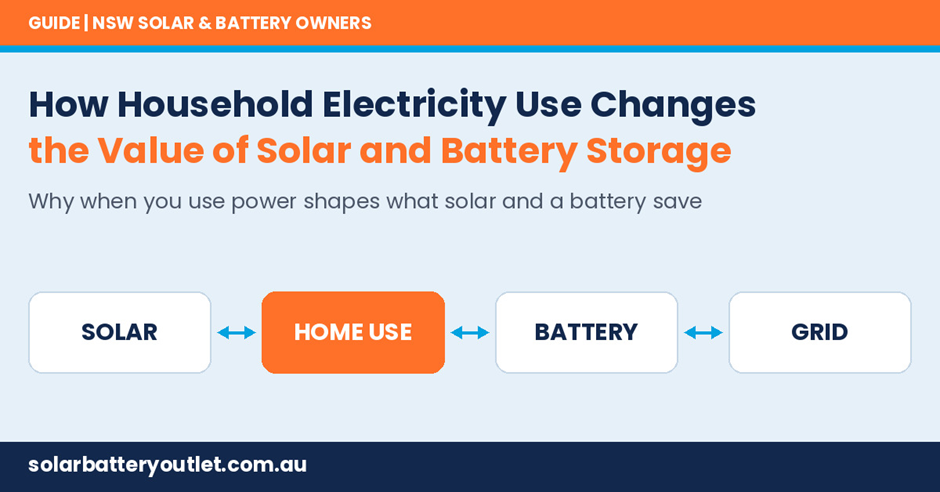
Two homes can install the same solar system and see very different results. In fact, household electricity use explains why. It sets the value of solar and battery storage. When you use power matters as much as how much you use. In NSW, a solar kWh you use at home usually saves more than one you export. This guide explains how your usage pattern changes the numbers in 2026.

Quick answer: Homes that use more power during the day may gain more from solar alone. Homes that use the most power after 4pm may gain more from adding a battery. Your smart-meter data shows which group you belong to.

What Sets the Value of Solar and Battery Storage in Your Home?

First, every solar kWh follows one of two paths. You can use it at home, or you can export it. Exports then earn a feed-in tariff. For 2026-27, IPART sets its all-day benchmark at 3.4 to 6.5 cents per kWh. Retail electricity costs much more than that. Therefore, each solar kWh you use at home usually saves more than it earns from export.

Similarly, IPART tribunal member Jonathan Coppel makes the same point. He says most customers get the best value by using the solar they generate. In short, self-consumption describes this habit. It means the share of your solar output that you use at home.

Of course, household use varies widely. The AER’s reference homes use about 3,900 kWh a year in Ausgrid’s area. In Endeavour’s area, the figure is about 4,900 kWh. However, a home with an EV, a heat pump and a pool can use much more. A battery then changes the choice. Instead of exporting surplus solar at midday, you store it and use it later.

How Does Midday Versus Evening Use Change Your Solar Savings?

Typically, homes use little power at midday and the most after work. WATTever’s analysis of AER half-hourly benchmarks suggests only about 13% of typical daily use falls between 11am and 2pm. Meanwhile, solar output peaks in that same window. As a result, a home with no one in it can export most of its midday solar.

Export value also swings through the day. The chart below shows IPART’s 2026-27 time-of-day benchmarks for the Ausgrid network. For example, midday exports earn about 3.9 to 4.0 cents per kWh. In contrast, exports from 4pm to 9pm earn 17.2 to 18.7 cents. Many retailers still pay a flat rate, so check your own plan. Even so, the pattern shows why evening power carries more value.

solar export value by time of day

How Much Does a Battery Add for Different Households?

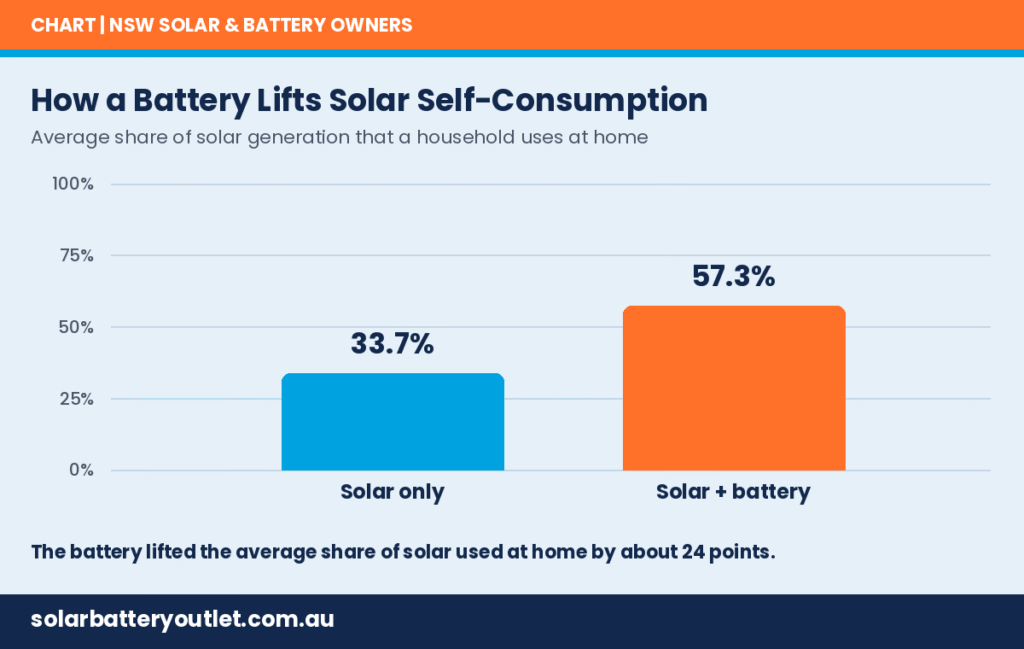
For example, Australian trial data shows the effect. In the ACT NextGen Energy Storage trial, homes without batteries used on average 33.7% of their solar in 2018. In contrast, homes with batteries used 57.3%. The chart below shows that gap of about 24 percentage points.

However, trial homes differ from yours. The trial reports 2018 results, so today’s figures may differ. Your result depends on your usage, battery size and solar system size. Moreover, a bigger battery does not always help. Once the battery covers your evening use, extra capacity may add little. Likewise, researchers have found the same diminishing returns in other studies.

solar self-consumption with battery

Which Household Profile Gets the Most From Solar and Battery Storage?

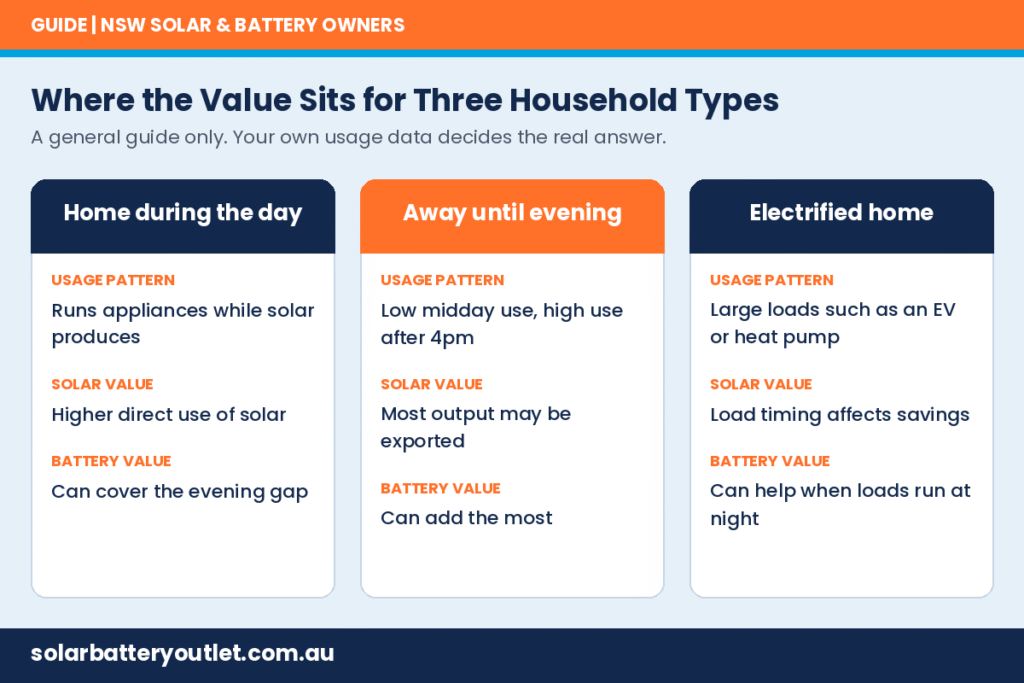
Three common profiles show how usage shapes the value of solar and battery storage. The graphic below summarises them.

Home during the day. These households run laundry, cooling and cooking while solar produces. As a result, solar alone can deliver higher direct savings. A battery can then cover the evening.

Away until evening. These households export most of their solar. Therefore, a battery can add the most value here. It can move surplus power into the 4pm to 9pm peak.

Electrified homes. An EV, heat pump or pool adds large loads. If those loads run at midday, solar covers them cheaply. If they run at night, a battery can help. In both cases, load timing drives the result.

household profiles solar battery value

How Do Solar Sharer Plans Change the Equation?

From 1 July 2026, NSW households can opt in to the Solar Sharer Offer. It gives up to 24 kWh of free grid electricity each day from 11am to 2pm. You do not need solar panels to join, but you do need a smart meter. Meanwhile, power outside the window still costs money.

This changes the maths for solar owners. During the free window, grid power costs nothing. As a result, your own midday solar saves less on that plan. A battery can store surplus solar for use after 2pm. Depending on your settings and plan terms, it may also charge from free grid power. However, rates outside the window differ by plan, so compare the full terms before you switch.

How Does the 2026 Rebate Affect Battery Sizing?

The federal Cheaper Home Batteries Program discounts battery costs through small-scale technology certificates (STCs). For installations from May to December 2026, the discount sits at about $272 per usable kWh. Then it steps down to about $228 per kWh from January 2027.

Since 1 May 2026, the discount also tapers by size. The first 14 kWh earns the full rate. Next, the following 14 kWh earns 60%. Finally, capacity from 28 to 50 kWh earns 15%. Clean Energy Regulator executive Carl Binning stresses that the installation date, not the contract date, sets your rebate.

Therefore, sizing a battery to your real evening use may help you avoid paying for unused capacity. For example, a 10 kWh battery installed in late 2026 attracts a discount of roughly $2,700 (10 × $272). This figure is an estimate, not a quote, and eligibility rules apply.

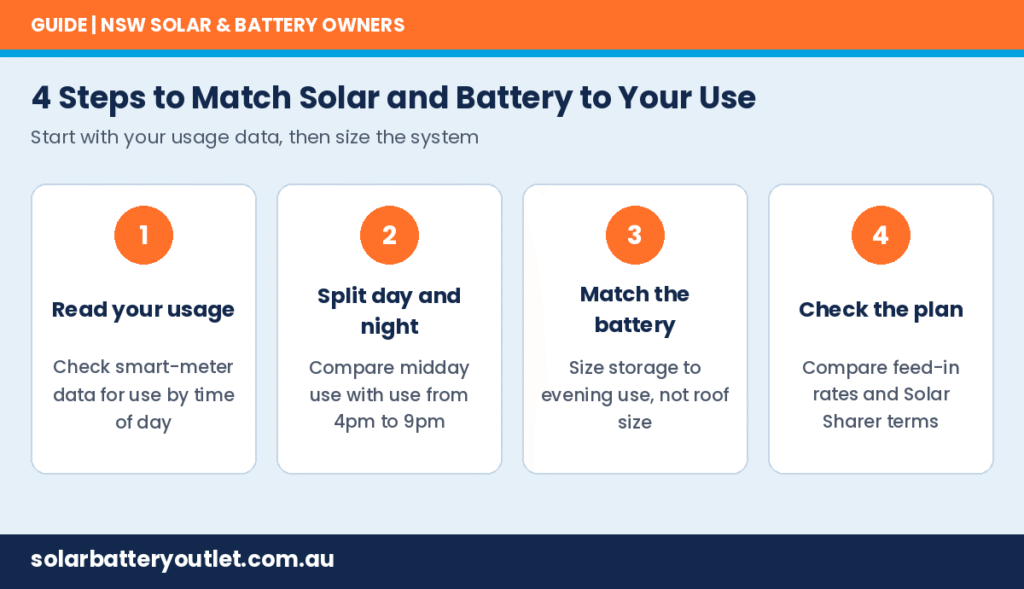
A 4-Step Way to Match Solar and Battery Storage to Your Use

Follow these four steps before you accept any quote. The graphic below shows the same process.

  1. Read your usage. Ask your retailer for your smart-meter data.
  2. Split day and night. Compare your midday use with your 4pm to 9pm use.
  3. Match the battery. Size storage to your evening use, not your roof size.
  4. Check the plan. Compare feed-in rates, time-of-use rates and Solar Sharer terms.
4 steps to match solar battery to use

Each step starts with your own numbers. As a result, you can choose a system that suits your home.

Talk to a Local Solar Battery Specialist

Every home uses power differently, so every quote should start with your data. The Solar Battery Outlet team can review your usage and explain your options in plain language. We serve homeowners in Liverpool, Bankstown and Mudgee. As you compare each solar battery company, ask how it uses your data. Ask the same question when you search for the best solar battery installer. Contact our team to start with your own numbers.

Frequently Asked Questions About the Value of Solar and Battery Storage

Does higher household electricity use make solar more valuable?

Not always. Solar gains value when your use matches sunlight hours. A home with high evening use may gain less from solar alone. However, a battery can help bridge that gap.

Is a battery worth it if I use most power at night?

It can be, because a battery stores daytime solar for night use. Value still depends on battery size, feed-in rates and your evening load. Therefore, check your usage data before you buy.

What is solar self-consumption?

Self-consumption is the share of your solar generation that you use at home. Higher self-consumption usually means fewer grid imports. In the ACT NextGen trial, batteries lifted the average from 33.7% to 57.3%.

Does the Solar Sharer Offer reduce the value of solar?

It can reduce the value of your midday solar use. Grid power costs nothing from 11am to 2pm on that plan, up to 24 kWh. Compare the full plan rates before you switch.

Disclaimer: This article gives general information about how household electricity use can affect the value of solar and battery storage. Figures such as feed-in tariff benchmarks, rebate rates and self-consumption results come from public sources. Those sources include IPART, the Clean Energy Regulator and published trial research. The figures were current in October 2026 and can change. Savings depend on your usage pattern, tariff, system size, location and installation date. Examples are illustrative and do not guarantee results. Product performance and rebate outcomes vary between homes. Nothing here is a quote or an offer. Rebate eligibility depends on Cheaper Home Batteries Program rules at the time of installation. This article is not financial advice. Always seek personalised advice before making a purchasing decision

Yes, a solar battery for high-load appliances works, but only when the battery’s power rating matches the load. Capacity decides how long an appliance runs. Power decides whether it runs at all. Many Australian homeowners overlook that difference, so this guide explains it in plain terms. Furthermore, it covers the 2026 rebate settings that change how you size a battery.

Quick Answer: Can a Solar Battery Run High-Load Appliances?

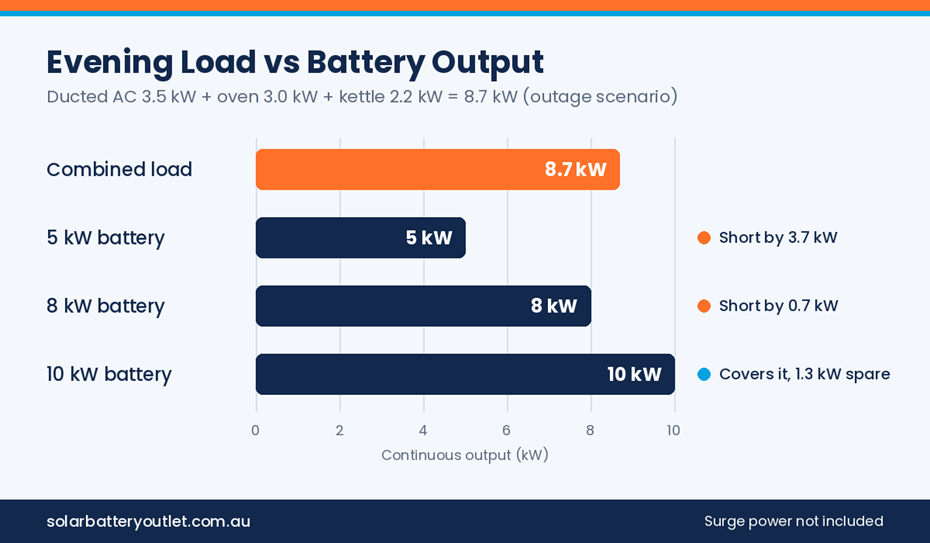
A solar battery runs high-load appliances when its continuous output exceeds the combined draw of everything running at once. We measure output in kilowatts (kW). For example, a ducted air conditioner, an electric oven and a kettle together draw about 8.7 kW. A 5 kW battery cannot carry that load alone during an outage. A 10 kW battery can.

  • Power (kW) decides how many appliances run at the same time.
  • Capacity (kWh) decides how long those appliances keep running.
  • Motor-driven appliances need extra power for a few seconds at start-up.
  • Not every home battery system provides backup during a blackout.

Power vs Capacity: The Two Numbers That Matter

Think of a battery as a water tank with a tap. Capacity, measured in kilowatt-hours (kWh), is the size of the tank. Power, measured in kW, is how wide the tap opens. The Queensland Government’s battery buyers guide separates power into two figures. Peak output is the maximum a battery delivers for a very short burst. Continuous output is what it sustains over time.

Therefore, compare the continuous figure first. 2026 market comparisons list popular models from roughly 5 kW to over 10 kW continuous.

Runtime follows a simple formula: usable kWh divided by load in kW. For instance, a battery with 10 kWh usable runs a 3.5 kW ducted air conditioner for about 2.9 hours. Meanwhile, the same battery runs a 1 kW load of fridge and lights for roughly 10 hours. Real results vary because inverter losses and backup reserve settings reduce the energy you can draw.

Which Appliances Count as High-Load?

High-load appliances draw several kilowatts at once. The NSW Government ranks ducted reverse-cycle air conditioners and hot water systems among the top energy users. The typical running loads below show where your battery works hardest.

  • Ducted air conditioning: roughly 3 to 5 kW while running.
  • Electric oven: roughly 2 to 5 kW.
  • Electric kettle: about 2.2 kW.
  • EV home charger: up to 7.4 kW on single-phase supply.
  • Electric storage hot water: about 14 kWh to heat 300 litres to 60°C, versus 4.7 kWh for a heat pump.

These figures are typical ranges, not guarantees. Always check the rating label on your own appliances.

Combined evening load of 8.7 kW against common battery continuous outputs

As Figure 1 shows, the three-appliance stack overwhelms a 5 kW battery. Likewise, an 8 kW battery falls 0.7 kW short. A 10 kW battery covers the load with 1.3 kW to spare. Grid-connected homes keep drawing any shortfall from the grid, so this limit matters most during outages.

Why Motor Start-Up Surges Matter

Air conditioners, pool pumps and compressors contain motors. Motors briefly draw several times their running power when they start. Engineers call this a surge. Surges last only seconds, so they never appear on your bill. However, they can still trip an undersized inverter during a blackout.

So ask your installer for the battery’s peak rating as well as its continuous rating. Also ask which appliances sit on the backup circuit.

Grid-Connected Use vs Blackout Backup

On a normal day, your battery and the grid share the load. The grid fills any gap, so a heavy appliance rarely stops. During a blackout, the battery carries everything alone. Moreover, the Queensland Government notes that not every home battery system provides backup during outages.

Some systems back up only selected essential circuits. Others back up the whole home. Consequently, confirm your backup setup before you rely on it for ducted air conditioning or an oven.

2026 Rebate Changes: Why Capacity Is Only Half the Story

The federal Cheaper Home Batteries Program changed on 1 May 2026. The Clean Energy Regulator now tapers support by battery size. The first 14 kWh of usable capacity earns 100% of the STC factor. Capacity from 14 to 28 kWh earns 60%. Capacity from 28 to 50 kWh earns 15%. Above 50 kWh, no STCs apply.

The STC factor sits at 6.8 for batteries installed from May to December 2026. It then drops to 5.7 from January 2027. For example, a 20 kWh usable battery earns the full rate on its first 14 kWh. It earns 60% on the remaining 6 kWh. That equals 17.6 full-rate kWh. The dollar value depends on the STC price at the time your installer claims it.

Share of the STC factor paid per kWh of usable capacity, by battery size tier

Importantly, the rebate pays for kWh, not kW, so a solar battery for high-load appliances needs a separate power check. A bigger battery does not automatically run more appliances, because the inverter sets the power limit. Rules for adding battery capacity later can be different, so check with the Clean Energy Regulator or ask us before you decide. It’s usually simpler to size the system for your heaviest loads from the start. To see how the rebate changes over time, read our guide on battery rebate timing..

Smart Ways to Run Heavy Appliances on a Battery

You can reduce the load your battery sees without giving up comfort.

  • Stagger heavy appliances. For example, run the oven and the dryer at different times.
  • Use the midday window. Under the Solar Sharer Offer, some NSW electricity retailers offer eligible households free power from 11am to 2pm. You need to opt in with your retailer, and a usage cap applies. Check with your retailer whether you qualify..
  • Upgrade electric storage hot water to a heat pump. It uses about one-third of the energy.
  • Charge your EV from solar at midday. A 7.4 kW charger drains a battery quickly at night.

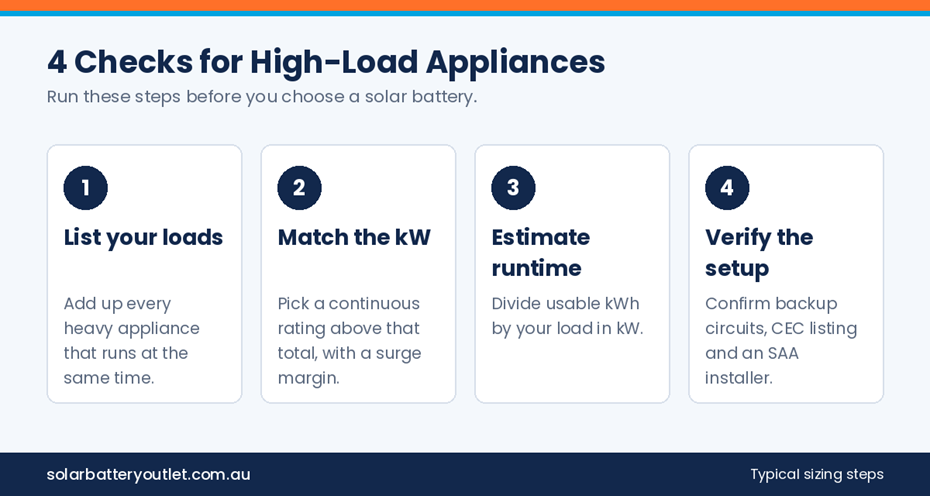
Four Checks Before You Buy a Solar Battery for High-Load Appliances

Four checks for sizing a solar battery around high-load appliances
  • First, list your heaviest appliances and add their running loads together.
  • Second, match the battery’s continuous kW rating to that total, plus a margin for surges.
  • Third, divide usable kWh by that load to estimate runtime. Ask your solar battery company for both ratings in writing.
  • Finally, confirm backup circuits, Clean Energy Council (CEC) listing and Solar Accreditation Australia (SAA) installer accreditation.

Talk to a Local Solar Battery Specialist

Solar Battery Outlet designs and installs home batteries across Liverpool, Bankstown and Mudgee. As a local solar battery company, we size each solar battery for high-load appliances, not just your daily kWh. Choosing the best solar battery installer means checking accreditation, backup design and honest runtime estimates. Call 1800 000 777 or contact our team to discuss a battery that suits your home.

Frequently Asked Questions
Can a solar battery run an air conditioner?

Yes, if its continuous output exceeds the air conditioner’s draw, including start-up. Ducted systems draw roughly 3 to 5 kW. Usable kWh then decides how long the unit runs.

Can a solar battery run an electric oven?

Yes. Ovens draw roughly 2 to 5 kW. However, adding a ducted air conditioner can push the combined load past a 5 kW battery’s limit.

How long will a solar battery run a high-load appliance?

Divide usable kWh by the appliance’s kW draw. A 10 kWh usable battery running a 3.5 kW load lasts about 2.9 hours. Losses and reserve settings shorten that figure.

Does a bigger battery run more appliances?

Not always. Capacity (kWh) sets runtime, while the inverter’s kW rating sets how many appliances run together. The 2026 rebate pays for kWh, so check the kW rating separately.

Can a solar battery charge an electric vehicle?

Yes. However, a home charger can draw up to 7.4 kW on single-phase supply. Charging from midday solar usually protects your battery for the evening.

How do I choose a solar battery installer?

Start with accreditation. The Clean Energy Regulator requires an SAA-accredited installer and a CEC-approved battery for rebate eligibility. The best solar battery installer also explains backup circuits and surge limits clearly.

Disclaimer

This article offers general information about solar batteries and high-load appliances. It does not replace electrical, engineering, financial or legal advice. Appliance loads, battery ratings and runtimes vary by model, installation, usable capacity, temperature and settings. The figures above are typical examples, not guarantees of performance or savings.

Rebate settings, STC factors and retail plans change over time. Eligibility depends on your property, system and installation date. Check current rules with the Clean Energy Regulator and your electricity retailer before you decide.

Always seek personalised advice before making a purchasing decision.