If you installed solar panels five, eight, or even ten years ago, you are sitting on an asset that is quietly becoming more valuable — and less rewarded by the grid. Feed-in tariffs have fallen every year since 2020, while evening electricity prices keep climbing. As a result, hundreds of thousands of Australian households are taking the same next step: adding a battery to the solar system they already own, rather than exporting cheap power and buying it back expensive.

This shift is not a niche trend. It is now the dominant pattern in the Australian solar market, and understanding why can help you decide whether the same move makes sense for your home.

The Retrofit Boom, By the Numbers

Australia has more rooftop solar than almost anywhere on earth. The Clean Energy Regulator puts the national total at roughly 4.3 to 4.5 million homes and small businesses with solar panels installed — around 40 per cent of all households. Yet until recently, only about one in eight of those systems included a battery.

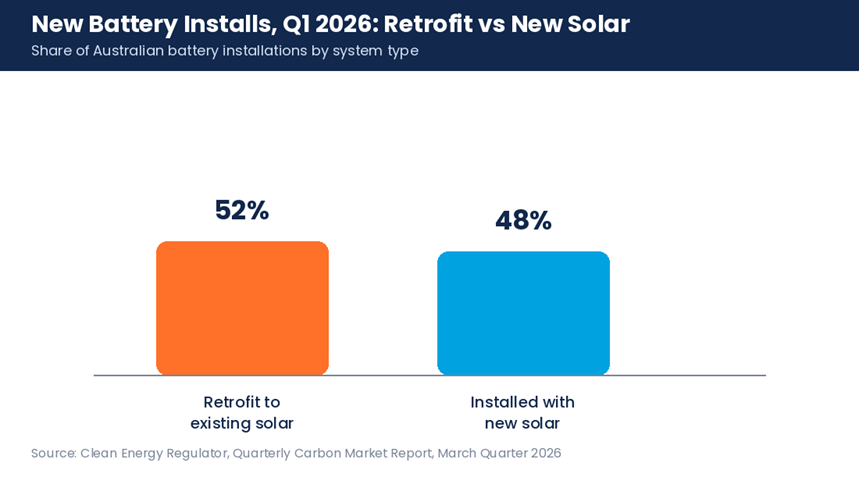
That gap is closing fast. Clean Energy Regulator data for the March quarter of 2026 shows that 52 per cent of all new battery installations were retrofits, added to solar systems already sitting on the roof, with no change to the panels themselves. The remaining 48 per cent went in alongside brand-new solar. Industry analyst SunWiz reports that stand-alone, battery-free solar installations have become rare, making up just 7 per cent of the market today. Almost every household getting solar now gets a battery with it, and just as many are going back to add one to a system they already have.

Roughly 3.7 million Australian homes currently have solar and no battery. That is the retrofit opportunity driving this trend, and it is one every solar owner should understand.

52% of new battery installs in Q1 2026 were retrofits to existing solar, versus 48% installed alongside new solar

Why Now? Three Forces Are Lining Up at Once

Three separate trends are converging, and together they explain the timing.

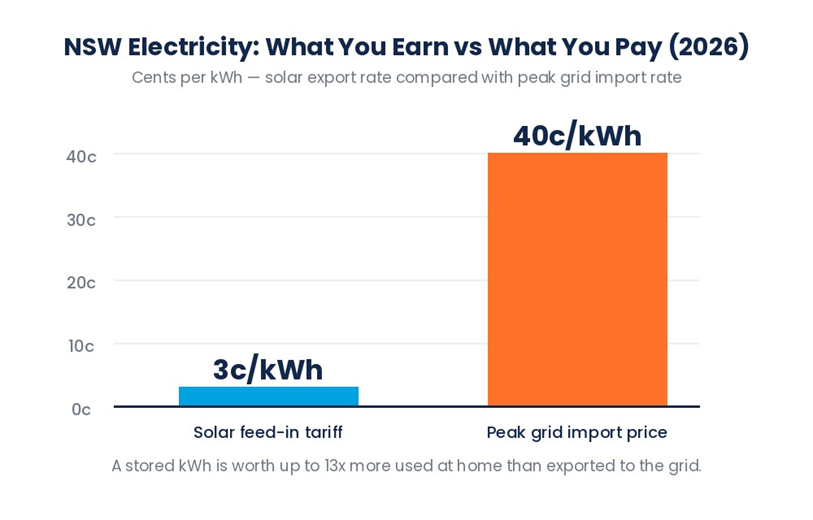
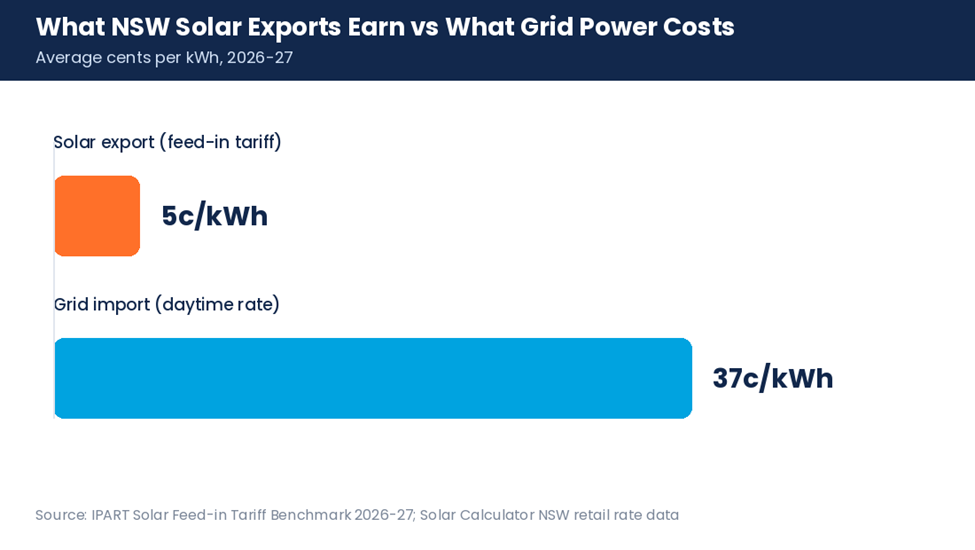
Feed-in tariffs keep shrinking. IPART’s benchmark for NSW solar exports has fallen from 4.8–7.3 cents per kWh in 2025–26 to just 3.4–6.5 cents per kWh for 2026–27. Compare that with the average NSW retail electricity price of around 36–37 cents per kWh, and the maths becomes clear: every kilowatt-hour you use yourself is worth roughly five to ten times more than the same kilowatt-hour exported to the grid.

The federal rebate made batteries dramatically cheaper. Since the Cheaper Home Batteries Program (CHBP) began on 1 July 2025, it has funded a 30 per cent discount on eligible battery systems through Small-scale Technology Certificates (STCs). The scheme has already supported more than 350,000 household installations, and its budget has grown from $2.3 billion to an estimated $7.2 billion, targeting two million battery installations and 40 gigawatt-hours of storage by 2030.

Grid electricity prices are not falling. Even as wholesale daytime prices drop — part of why feed-in tariffs are shrinking — evening peak import rates in NSW remain high, commonly 30 to 40 cents per kWh, and higher again in some network areas during the 4 pm to 9 pm window.

Bar chart comparing the NSW solar feed-in tariff (about 5 cents per kWh) with the grid import rate (about 37 cents per kWh)

Put those three trends together, and a battery stops being a nice-to-have. It becomes the logical next step for a solar system that is earning less and less for the power it sends away.

What Adding a Battery Actually Involves

Retrofitting a battery is more straightforward than most homeowners expect, and in most cases your existing panels do not need to change at all.

A qualified installer will assess your existing inverter, switchboard, and meter setup, then usually recommend one of two approaches. An AC-coupled battery connects independently to your switchboard and works alongside your existing solar inverter — the most common retrofit option, since it does not disturb your current solar setup. A hybrid inverter replacement swaps your existing inverter for one built to manage solar and battery together, which can suit older or underperforming systems.

Either way, a straightforward retrofit for a well-maintained system typically takes a single day, and your solar continues generating throughout. The Clean Energy Regulator requires all rebate-eligible installations to be completed by a Clean Energy Council (CEC) accredited installer using an approved product, so it is worth confirming accreditation before booking.

A Practical Example: What Retrofitting Can Look Like

Consider a typical Liverpool household — this example is illustrative, not an individual case study — with a 6.6 kW solar system installed around 2018 and average evening electricity use of roughly 12 kWh per day. Under the current NSW feed-in tariff, that household might earn only 40–60 cents a day exporting that surplus. Storing it in a 10 kWh battery and using it after sunset instead of buying grid power at 36 cents per kWh could be worth closer to $4 a day — a meaningfully different outcome from the same solar panels, simply because the power is used rather than exported.

This is the calculation worth running with your real bills before committing, and it is exactly the kind of assessment a good installer should walk through with you at no cost.

Is Your Home a Good Candidate for a Retrofit?

Not every solar system benefits equally from adding storage. Use this quick framework to check your own situation before requesting quotes.

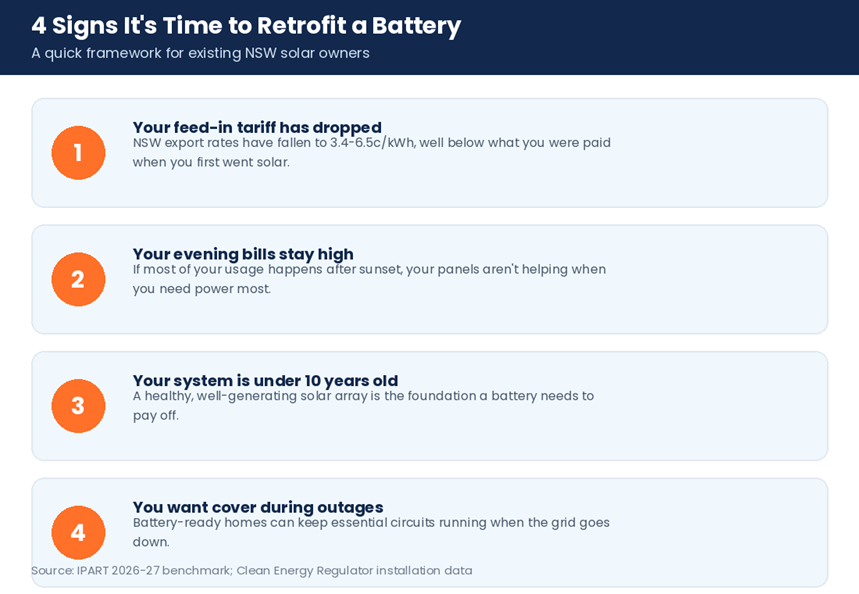
Four signs it may be time to retrofit a battery onto your existing solar system

If most of these apply to your household, a retrofit is likely to pay off. If your solar system is older, underperforming, or you are mostly home during the day already using your solar directly, it is worth getting a system health check first — see our guide on upgrading an existing solar system for what that involves.

Rebate Timing Still Matters

The federal rebate is not disappearing — it runs until 2030 — but it does keep shrinking. From 1 May 2026, the STC factor used to calculate the discount dropped from 8.4 to 6.8, and a new tiered structure now reduces support for batteries above 14 kWh. For a standard 10 kWh battery, that works out to roughly $530 less rebate than installing before the change. For larger batteries above 14 kWh, the difference can run to $1,000–$1,800 or more, since the tiering applies on top of the factor drop.

The rebate is recalculated every six months, each January and July, so it will continue to taper gradually. None of this means you need to rush, but if you have already compared quotes and are ready to proceed, timing can shift the numbers meaningfully, particularly for larger systems.

Choosing an Installer for Your Retrofit

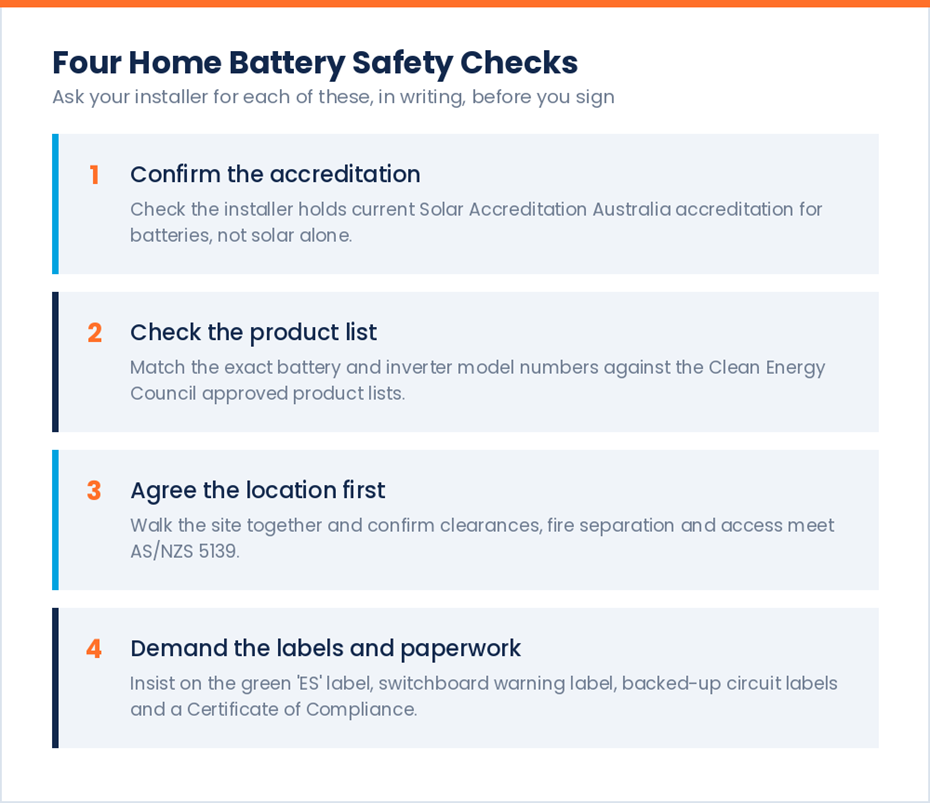
The quality of your installer affects your outcome more than the timing of your rebate. Ask for the rebate to appear as a dollar figure on a written quote, confirm the installer’s SAA accreditation number, and check that your battery model is on the approved product list before signing anything. We cover the full checklist of what separates a reliable installer from a risky one in our guide on solar battery rebate timing

Can any solar system have a battery added later?

Most systems can be retrofitted, though older inverters, undersized switchboards, or systems near end of warranty may need extra work first. A qualified installer can confirm compatibility during a free assessment.

Does adding a battery affect my existing solar warranty?

A properly installed retrofit should not affect your panel warranty. It is worth confirming your inverter warranty terms if you are adding an AC-coupled battery rather than replacing the inverter.

Is it cheaper to retrofit a battery or buy solar and battery together?

Retrofitting is often more cost-effective if your existing solar system is still performing well, since you are only paying for the battery and its installation, not new panels.

How long does a battery take to pay for itself?

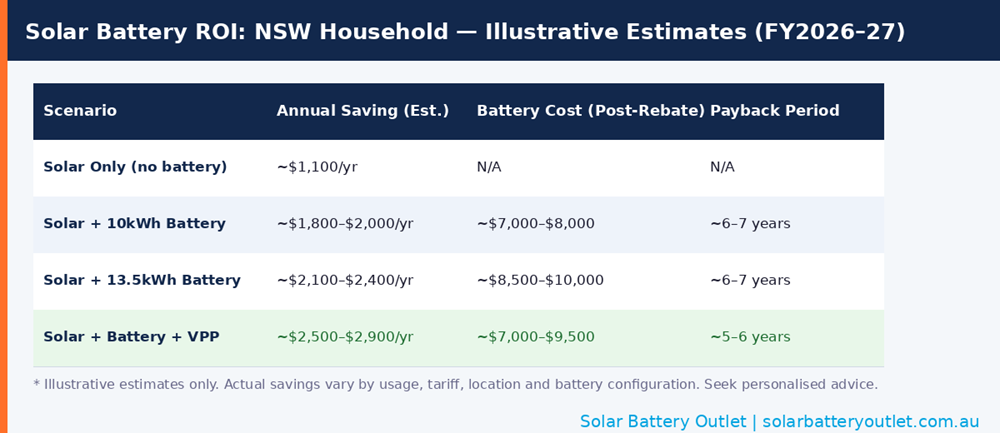
Payback depends on your electricity usage pattern and battery size, but typical NSW households see payback in the range of six to eight years under current tariffs and rebates, with the battery continuing to save money well beyond that.

Will my feed-in tariff keep falling?

It is likely to keep trending downward as more rooftop solar comes online and daytime wholesale prices soften. This is one of the main reasons more solar owners are shifting toward self-consumption rather than relying on exports.

Not Sure If a Retrofit Is Right for You?

We provide free, no-obligation assessments for solar homeowners across Liverpool, Bankstown, and Mudgee. We will check your existing system, review your bills, and give you an honest answer about whether adding a battery makes financial sense for your household, before you spend a cent. Call 1800 000 777 or visit solarbatteryoutlet.com.au to book your assessment.

Disclaimer: This article is general information only and does not constitute financial, technical, or legal advice. Feed-in tariffs, rebate values, and electricity prices vary by retailer, network area, and household usage, and figures in this article are indicative estimates based on published sources current as of publication. Actual savings and payback periods will differ depending on your specific solar system, electricity plan, and consumption pattern. Rebate eligibility depends on your installer’s accreditation and product approval status at the time of installation. Always seek personalised advice before making a purchasing decision.
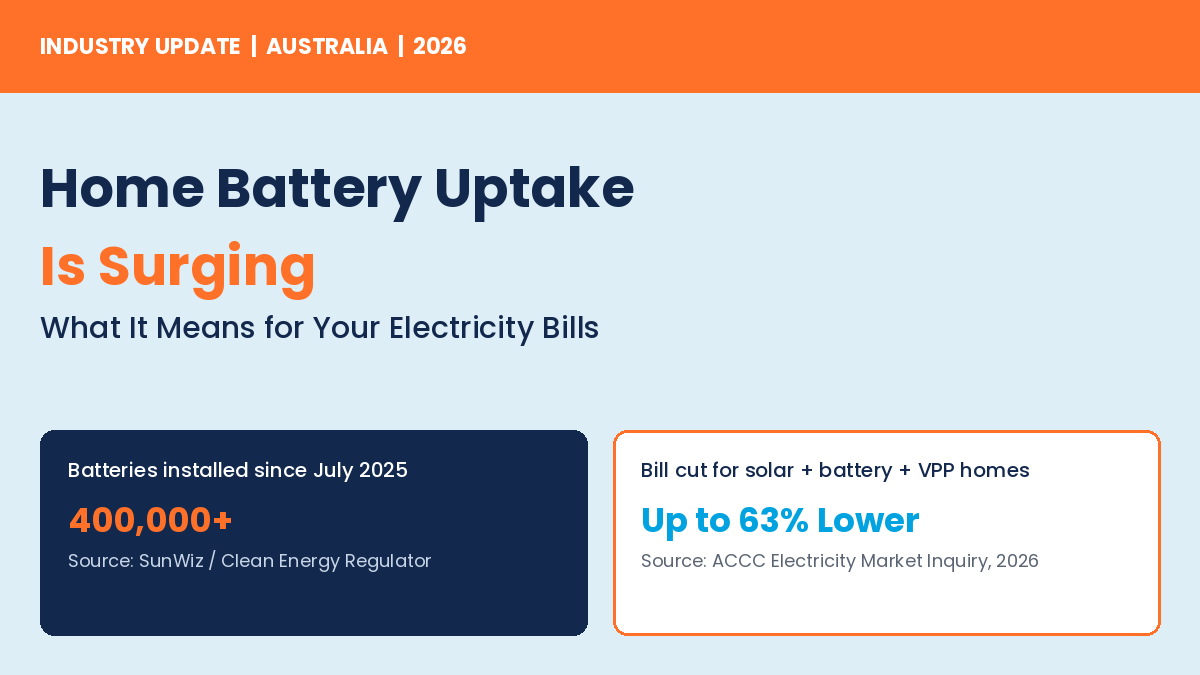
Home battery uptake in Australia is no longer a niche trend among early adopters. It has turned into a mainstream shift in how households manage power. In just under a year, hundreds of thousands of homes have added battery storage to their existing solar systems, largely thanks to the federal Cheaper Home Batteries Program. For homeowners across NSW, this surge raises a practical question: what does it actually mean for your electricity bill?

This article breaks down the latest uptake data, unpacks what is driving it, and offers a simple framework to help you decide whether now is the right time to invest in solar batteries for your own home.

Australia’s Home Battery Boom, By the Numbers

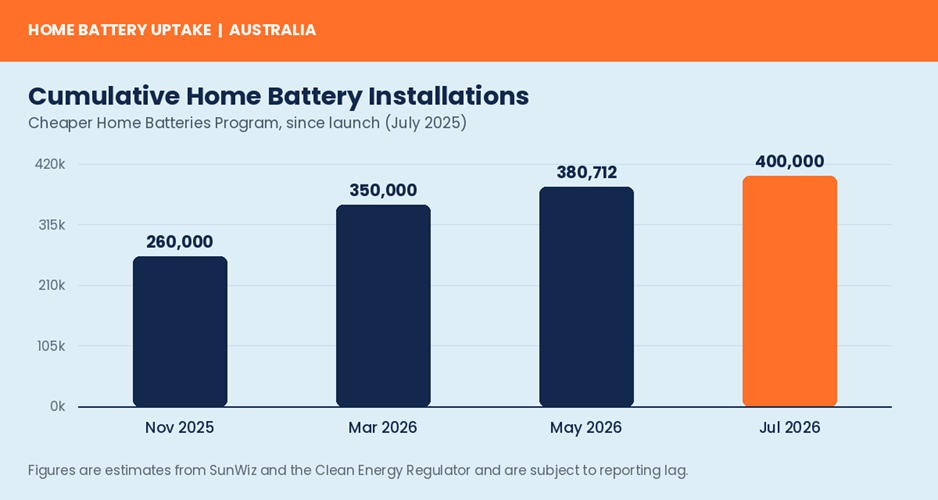
Since the Cheaper Home Batteries Program launched in July 2025, uptake has moved from steady to remarkable. More than 260,000 households, businesses, and organisations installed a battery within the program’s first ten months, and daily installation rates climbed from a few hundred to well over a thousand. By May 2026, the total reached 380,712 systems, representing 10.7 GWh of storage capacity, according to Minister for Climate Change and Energy Chris Bowen. Analyst SunWiz now projects the country will pass 400,000 installations before the end of 2026, with total capacity climbing toward 11.2 GWh.

To put that growth in perspective, look at the chart below. Installations moved from roughly 260,000 in late 2025 to more than 380,000 just six months later, a pace that has genuinely surprised policymakers. Uptake has already outpaced the government’s own electric vehicle tax discount, and demand shows no sign of slowing, even as the rebate steps down twice a year through to 2030.

Cumulative home battery installations under the Cheaper Home Batteries Program

Why Everyone Is Suddenly Talking About Home Batteries

Three forces are driving this surge together, and each one is worth understanding on its own.

First, the economics changed. The Cheaper Home Batteries Program discounts around 30 percent off the upfront cost of eligible battery systems between 5kWh and 100kWh, through small-scale technology certificates. That single change turned batteries from a luxury upgrade into a realistic purchase for far more households.

Second, electricity prices kept climbing. Time-of-use tariffs now charge many NSW households 40 to 55 cents per kWh during the 3pm to 9pm peak window, exactly when families get home, cook dinner, and run the air conditioning. A battery lets you store cheap daytime solar and use it instead of buying expensive peak-rate power later.

Third, feed-in tariffs kept falling. Exporting solar power back to the grid in NSW now earns most households only 3 to 10 cents per kWh, well below what that same power is worth if you store it and use it yourself. That widening gap is pushing more solar owners toward storage rather than simply exporting their surplus.

Together, these shifts explain why uptake has moved from early-adopter territory into the mainstream, and why it is translating into measurable bill savings for the households that made the switch.

What Rising Battery Uptake Means for Your Electricity Bill

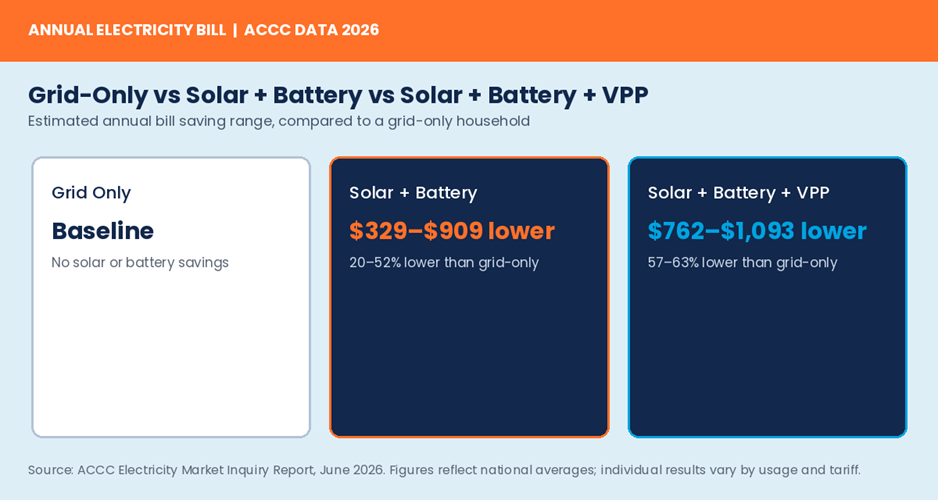
This is the part that matters most to homeowners. According to the Australian Competition and Consumer Commission’s latest Electricity Market Inquiry report, households with solar and battery systems paid electricity bills between roughly $329 and $909 lower over a year compared with customers relying on grid electricity alone, a saving of 20 to 52 percent. Homes that went a step further and joined a virtual power plant did even better, saving between $762 and $1,093 a year, or 57 to 63 percent, with roughly 24 percent of solar-and-battery customers now taking part in a VPP.

The chart below shows how these three scenarios stack up against each other.

Estimated annual bill saving range by household setup (ACCC, 2026)

Consider a hypothetical example. A family in Western Sydney on a standard time-of-use tariff, paying around $2,000 a year for grid electricity, could realistically bring that down toward the $1,100 to $1,670 range once solar and a battery are added, based on the ACCC’s published figures. Joining a VPP on top of that could push savings further still. Actual results always depend on your usage pattern, tariff, and battery size, but the direction is now well established.

The NSW Angle: Higher Prices, Bigger Savings

NSW households have a particular stake in this trend. The state has some of the highest electricity prices in the country, and NSW Government figures show around 13,000 new batteries are now being installed across the state every month, on top of the more than half of NSW houses that already have solar. That combination of high prices and fast uptake means NSW is where the bill-saving case for storage is strongest.

The NSW Government has backed this shift with its own incentives. The Peak Demand Reduction Scheme supports Virtual Power Plant participation, and the newer Home Energy Saver program adds an interest-free loan of up to $15,000, alongside discounts of up to $4,000 for eligible households upgrading their home energy setup. If you are weighing up whether to move quickly, our guide on whether to rush a solar battery before the rebate drops walks through the exact questions to ask before booking an installer.

A 4-Step Framework: Should You Add a Battery Now?

With uptake this high, it helps to have a clear, unemotional way to decide whether a battery makes sense for your home right now, rather than reacting to marketing pressure.

  • Step 1 — Check your evening usage. Pull up your last 12 months of bills and see how much power you use after 3pm. Batteries deliver the most value to households that use most of their electricity in the evening, after solar stops generating.
  • Step 2 — Confirm your solar is performing well. A battery only stores what your panels generate. If your system is more than 10 years old or under-performing, get a health check before adding storage.
  • Step 3 — Size for your actual usage, not the biggest option available. The rebate is now tiered, so a right-sized 10 to 13kWh system paired with existing solar typically sits in the value sweet spot for most homes.
  • Step 4 — Compare at least three written quotes and check installer accreditation. Confirm the rebate appears as a dollar figure on the quote itself, and verify the installer’s SAA accreditation before signing anything.

What This Means for Liverpool, Bankstown, and Mudgee Homeowners

If you live across Liverpool, Bankstown, or Mudgee, this national surge is playing out locally too. Solar Battery Outlet has watched local demand for solar batteries climb alongside the national numbers, with more households asking about right-sized systems, VPP participation, and how to stack the federal rebate with NSW incentives. Homeowners exploring solar battery Liverpool options are increasingly asking the same question this article set out to answer: not whether to get a battery, but how to size and time it correctly for their home. Our recent postcode guide on rebates across Liverpool, Bankstown, and Mudgee breaks down what is available suburb by suburb.

Frequently Asked Questions
How many home batteries have been installed in Australia in 2026?

More than 400,000 home battery systems have been installed across Australia since the Cheaper Home Batteries Program launched in July 2025, representing well over 11 GWh of storage capacity, according to SunWiz and Clean Energy Regulator data current as of mid-2026.

How much can a solar battery save on electricity bills?

The ACCC’s Electricity Market Inquiry found households with solar and battery systems saved between $329 and $909 a year (20 to 52 percent) compared with grid-only customers, rising to $762 to $1,093 (57 to 63 percent) for households also participating in a virtual power plant.

Is it still worth installing a solar battery in NSW in 2026?

Yes. NSW electricity prices remain among the highest in Australia, and the federal rebate, while tapering gradually every six months through 2030, still covers around 30 percent of the upfront cost for eligible systems, alongside state incentives like the Peak Demand Reduction Scheme.

What size battery should I get?

Most NSW homes fall into the 10 to 13kWh sweet spot, since the rebate structure applies the strongest support up to 14kWh of usable capacity, with reduced support above that threshold.

Do I need a Virtual Power Plant to save money with a battery?

No, but it helps. Even standalone solar-and-battery homes save materially on bills, while VPP participation adds further savings by earning payments for sharing stored power with the grid during peak demand periods.

Solar Battery Outlet offers free, no-obligation quotes for homeowners across Liverpool, Bankstown, and Mudgee. We will check your solar performance, review your usage, and tell you honestly whether a battery, and which size, makes sense for your home. Call 1800 000 777 or visit solarbatteryoutlet.com.au to get started.

Disclaimer

This article is general information only and does not constitute financial, legal, or personalised energy advice. Statistics on installation numbers, capacity, and bill savings are sourced from government and industry reports current as of July 2026 and reflect national or state averages; individual results depend on your electricity usage, tariff, solar system size, and battery specifications, and are not guaranteed. Rebate amounts and eligibility rules referenced in this article are subject to change under the Cheaper Home Batteries Program and NSW Government schemes, so always confirm current rates with the relevant government agency before purchasing. Always seek personalised advice before making a purchasing decision.
Australia’s home battery boom shows no sign of slowing in 2026. The federal Cheaper Home Batteries Program has pulled thousands of new households into the market, and that surge has attracted its fair share of installers who talk a big game but skip the fine print on compliance.

Before you let anyone touch your switchboard, you need one simple confirmation: is this person actually an SAA-accredited solar battery installer, or are they relying on an outdated “CEC-accredited” claim that no longer applies? Getting this wrong doesn’t just risk a shoddy install; it can cost you your rebate entirely.

This guide breaks down exactly what SAA accreditation means, walks through a four-step framework you can use in five minutes, and flags the warning signs that separate a genuine professional from a risky sales pitch.

What Does “SAA-Accredited” Actually Mean?

Solar Accreditation Australia (SAA) is the national body responsible for accrediting the individuals who design and install rooftop solar and battery systems. The Clean Energy Regulator appointed SAA to run this scheme, so accreditation isn’t a marketing badge; it’s a government-recognised qualification tied directly to your eligibility for small-scale technology certificates (STCs) and state rebates.

Accreditation isn’t one-size-fits-all, either. An installer can hold separate endorsements for Grid-Connected Photovoltaic systems, grid-connected battery storage, and stand-alone power systems, plus a design-only, install-only, or combined design-and-install status. Consequently, an electrician accredited to install solar panels isn’t automatically qualified to install a battery. You need to confirm the specific battery storage endorsement, not just a general solar accreditation.

To hold accreditation, an installer must also carry an unrestricted electrical licence, current public liability insurance, and a working-at-heights certificate, and they must complete at least 100 continuing professional development points every 12 months to keep their status current.

Why “CEC Accredited” Isn’t the Full Story Anymore

For 16 years, the Clean Energy Council administered installer accreditation, and plenty of homeowners still search for a “CEC-accredited installer” out of habit. However, the CER transferred this function to SAA, with the changeover formally completing on 29 May 2024. Since that date, installers must hold current SAA accreditation to claim STCs; a lapsed or historical CEC number no longer qualifies a system for the rebate.

This matters because some installers still reference their old CEC credentials on websites and brochures that haven’t been refreshed. That isn’t necessarily dishonest, but it does mean you shouldn’t take a printed CEC logo at face value. Instead, ask directly whether the installer has transitioned to SAA and request their current accreditation number.

The Clean Energy Council hasn’t disappeared, though. It still maintains the approved product lists for panels, inverters, and batteries, and it continues offering CPD-eligible training that SAA recognises. So you’ll likely see both organisations mentioned in a compliant quote: SAA for the installer’s personal accreditation, and CEC for the equipment’s approval status.

The 4-Step SAA Verification Framework

You don’t need to be a compliance expert to run this check; it takes about five minutes once you have the right details in hand.

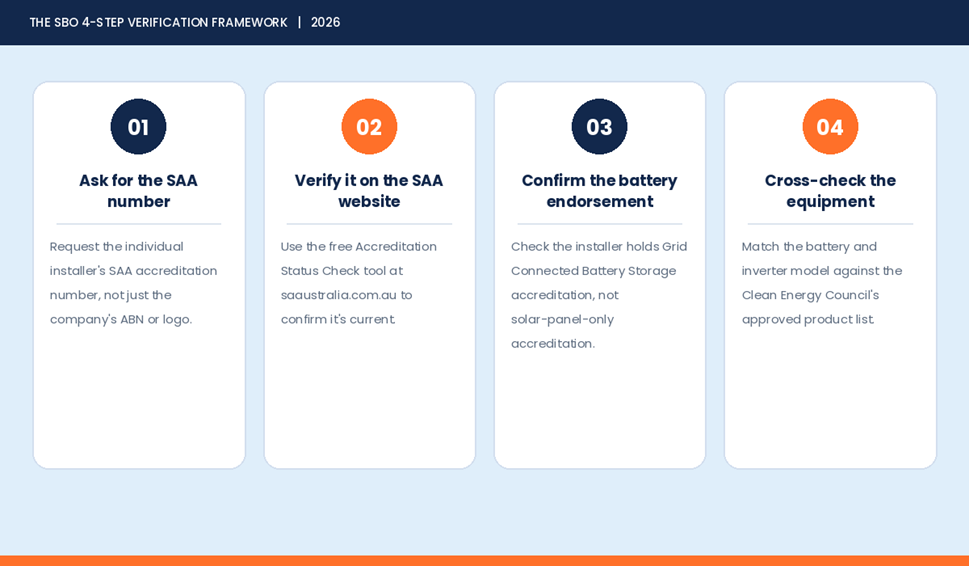
First, ask for the installer’s full name and SAA accreditation number before you sign anything. A properly accredited installer provides this without hesitation. Second, head to the SAA website and use the free Accreditation Status Check tool to confirm the number is current and active. Third, confirm the accreditation specifically covers Grid Connected Battery Storage, since a solar-only endorsement doesn’t extend to batteries. Fourth, cross-check the exact battery and inverter model against the Clean Energy Council’s approved product list, because using an unapproved product voids STC eligibility even with a fully accredited installer.

Run through these four checks with every quote you receive, and keep a screenshot of the verification result for your records. If a retailer sub-contracts the physical install, apply the same checklist to the sub-contractor, not just the salesperson who wrote your quote.

Green Flags vs Red Flags When Vetting an Installer

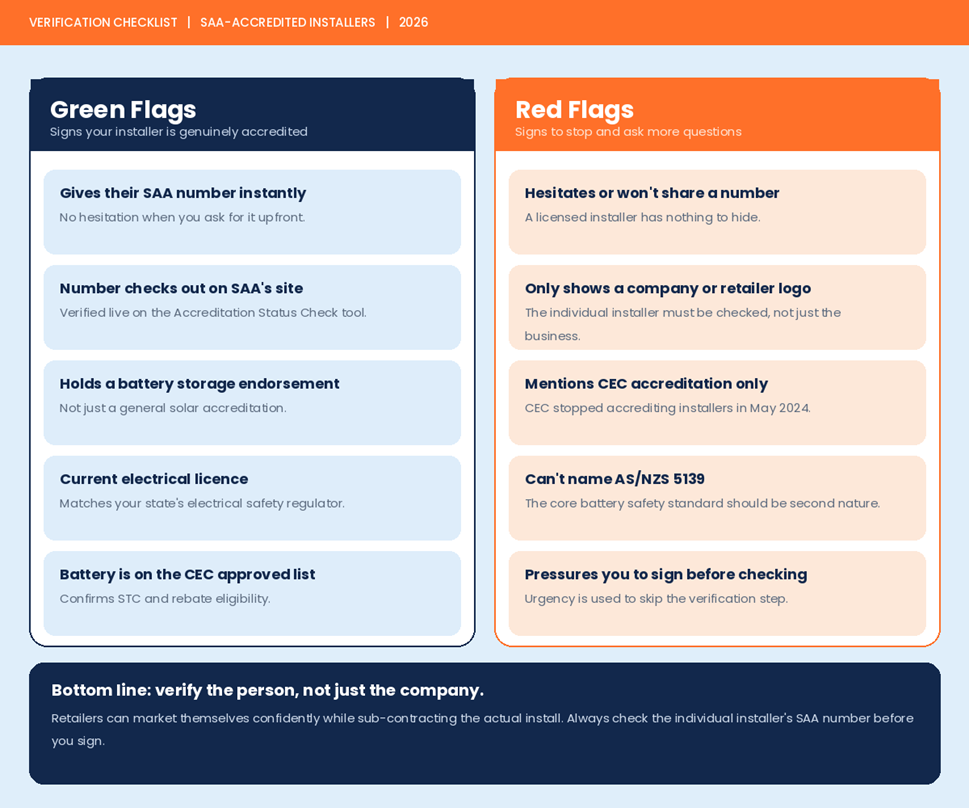
Genuine SAA-accredited installers tend to behave in consistent, reassuring ways throughout the sales process. They share their accreditation number immediately, their number checks out live on SAA’s database, and they confirm their battery storage endorsement without prompting. They also hold a current electrical license for your state and quote equipment that already appears on the CEC’s approved list.

By contrast, a few behaviours should make you pause and ask more questions. Hesitation or vague answers when you request an accreditation number is one of the clearest warning signs, since a compliant installer has nothing to hide. Similarly, be cautious of quotes that only mention a company name or an old CEC reference, because the individual performing the on-site work is what actually determines your rebate eligibility, not the business logo on the invoice.

High-pressure tactics deserve extra scrutiny too. If someone pushes you to sign before you’ve had a chance to verify their details, that urgency is often designed to bypass exactly the checks outlined in this guide.

Green flags vs red flags when vetting a solar battery installer

Why Accreditation Checks Protect Your Rebate and Your Home

Skipping this verification step carries consequences well beyond an awkward conversation. Under the Renewable Energy (Electricity) Amendment (Cheaper Home Batteries Program) Regulations 2025, installers must supply a written compliance statement confirming they met accreditation, design, and on-site attendance requirements, and they must supply geotagged, timestamped photos matching serial numbers in the REC Registry. Without a genuinely accredited installer, none of that documentation stands up, and your rebate claim can be rejected outright.

Safety matters just as much as paperwork. Australian Standard AS/NZS 5139 governs where a battery can sit relative to windows, doorways, and habitable rooms, alongside cabling and fire-rated backing requirements. An installer who can’t confidently explain how your proposed battery location complies with AS/NZS 5139 likely hasn’t had the training to install it safely in the first place.

Ultimately, accreditation checking protects three things at once: your government rebate, your product warranty (many manufacturers void warranties if installation wasn’t performed by an accredited professional), and the physical safety of everyone living in your home.

A Local Example: Vetting a Solar Battery Installer in Liverpool, NSW

Demand for solar battery Liverpool households has climbed sharply as the Cheaper Home Batteries Program made storage more affordable across South-West Sydney. That growth has brought more installers into the area, which is good for competition but makes the verification habit even more important locally.

When you’re comparing quotes from installers servicing Liverpool, Bankstown, or Mudgee, treat the accreditation check as step one, not an afterthought once you’ve picked a favourite. A reputable, best solar battery installer in the region will happily walk you through their SAA number, their battery storage endorsement, and the approved product list for the exact system they’re proposing.

At Solar Battery Outlet, our SAA-accredited professionals carry out every installation, and we gladly provide our accreditation details upfront so you can verify them before committing to anything.

Verify These Details Yourself

You don’t have to take our word for it. Check accreditation status and program rules directly with the official sources below.

Solar Accreditation Australia – Accreditation Status Check

Clean Energy Regulator – Solar Battery Installers and Designers

Frequently Asked Questions

Is SAA the same as CEC accreditation?

No. Solar Accreditation Australia (SAA) took over the installer and designer accreditation function from the Clean Energy Council, with the transition completing on 29 May 2024. The CEC still manages approved product lists, but installer accreditation now sits entirely with SAA.

How do I find my installer’s SAA number?

Ask your installer directly for their full name and accreditation number, then confirm it using the free Accreditation Status Check tool on the SAA website. Never rely solely on a number printed on a business card or invoice without checking it online.

Does my battery need separate accreditation from my solar panels?

Yes. Installers hold distinct accreditation classes for grid-connected solar, battery storage, and stand-alone power systems. A solar-panel accreditation alone doesn’t qualify someone to install a battery, so confirm the battery storage endorsement specifically.

What happens if my installer isn’t SAA-accredited?

Your system won’t be eligible for Small-scale technology certificates or related rebates, and you may also void your battery’s manufacturer’s warranty. Non-accredited installs can also fail to meet AS/NZS 5139 safety requirements.

Should I check the retailer or the individual installer?

Both, but the individual matters most for compliance. A retailer’s accreditation doesn’t automatically extend to every subcontractor it uses, so always verify the specific person attending your site.

Ready to Work With an Accredited Team?

Solar Battery Outlet’s installers are SAA-accredited and happy to share their credentials before you commit to anything. Get a free, obligation-free quote and a straight answer on accreditation, approved equipment, and rebate eligibility for your home.

Disclaimer

This article provides general information about solar battery installer accreditation in Australia and does not constitute personalised financial, legal, or technical advice. Accreditation rules, rebate values, and eligibility criteria under the Cheaper Home Batteries Program and the Small-scale Renewable Energy Scheme can change, so always confirm current requirements directly with Solar Accreditation Australia, the Clean Energy Regulator, or a licensed professional before signing a contract. Solar Battery Outlet makes no guarantee regarding rebate approval, as eligibility is ultimately determined by the relevant government body.

Australia has more rooftop solar than almost any country on earth. Yet for years, most of that solar power went straight to the grid—at a feed-in tariff of just 4 to 7 cents per kWh. The Cheaper Home Batteries Program changes that equation entirely. Since July 2025, eligible NSW homeowners can access an upfront discount of around 30% on the cost of a home battery—with no paperwork, no income test, and no wait for a rebate check.

This guide explains exactly how the program works, who qualifies, what the rebate is worth right now, and how to stack it with the NSW VPP incentive. If you’ve been considering storage but felt unsure about the costs, read this first.

What Is the Cheaper Home Batteries Program?

The Cheaper Home Batteries Program is the Australian government’s initiative to cut the cost of home battery storage. It runs under the Small-scale Renewable Energy Scheme (SRES)—the same mechanism that has discounted rooftop solar for over a decade.

In December 2025, the government expanded total funding from $2.3 billion to $7.2 billion. That expansion supports more than two million battery installations by 2030, delivering around 40 gigawatt hours of additional storage capacity nationally. The program is not means-tested. Every eligible NSW household — regardless of income — can access the discount.

How Does the Rebate Actually Work?

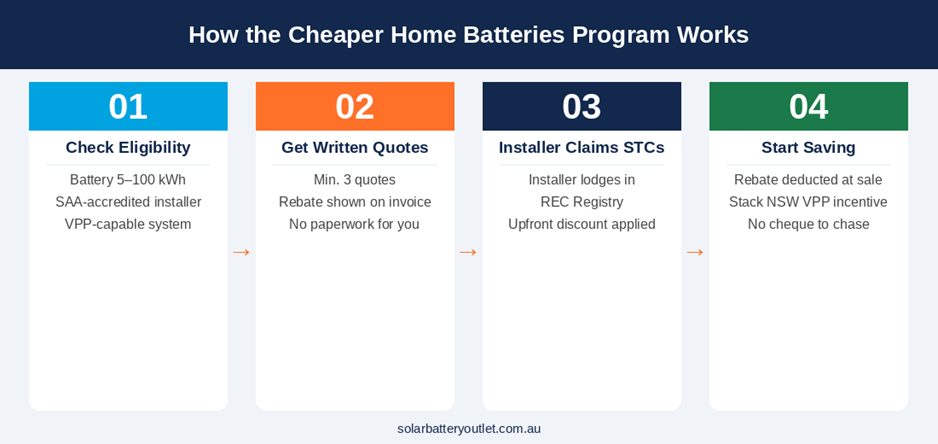
The discount reaches you through Small-scale Technology Certificates (STCs). Your accredited installer creates and trades these certificates on your behalf. Then they deduct the STC value directly from your invoice. You never lodge a claim or chase a payment.

How the Cheaper Home Batteries Program works — 4 steps from eligibility check to start saving for NSW homeowners 2026

Because your installer handles everything, the process is straightforward. However, one step is critical on your end: always confirm the rebate is shown as a line item on your written quote. A legitimate quote will list the STC value separately and deduct it clearly from the gross price.

What Changed on 1 May 2026?

Two significant changes came into effect on 1 May 2026. Both affect how much the rebate is worth. Consequently, understanding these changes helps you make a better-informed decision about timing.

Change 1: The STC factor reduced from 8.4 to 6.8. This lowered the per-kWh rebate value from approximately $311 to approximately $252 for most standard batteries. The government adjusted this to reflect falling battery hardware prices. Furthermore, the factor will now step down every six months (in January and July) rather than annually.

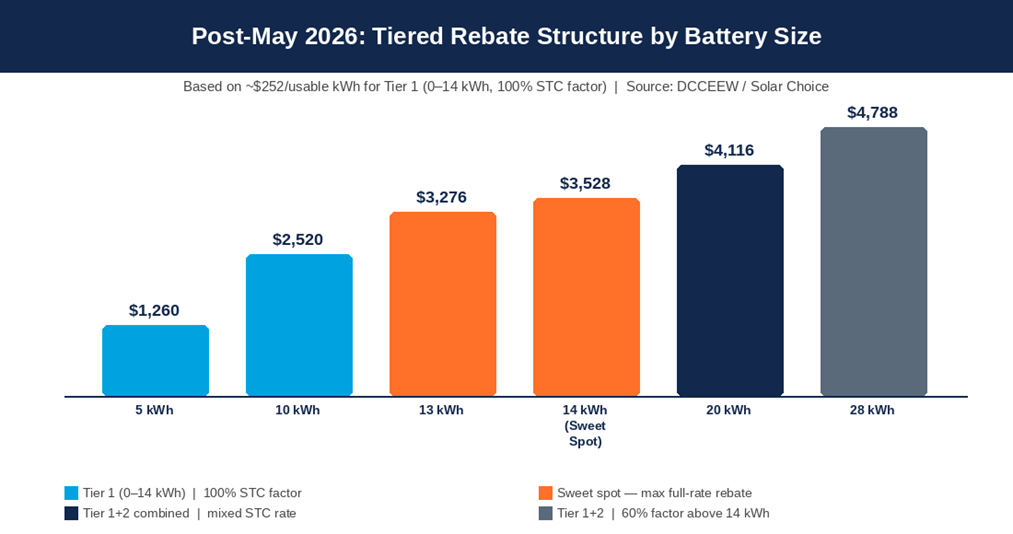
Change 2: The rebate now uses a tiered structure based on battery size. Previously, every eligible kWh received the same discount rate. Now, the STC factor tapers based on how much storage you install:

  • 0 to 14 kWh — 100% STC factor (full rebate rate)
  • 14 to 28 kWh — 60% STC factor (reduced rate)
  • 28 to 50 kWh — 15% STC factor (significantly reduced)
Post-May 2026 tiered federal battery rebate by system size

This tiered approach means 14 kWh is now the sweet spot for NSW homeowners. At that size, the full STC factor applies to every kWh. Beyond that, each additional kWh earns a smaller discount. In practical terms, a 13 kWh battery currently attracts a rebate of approximately $3,276 — making it one of the strongest value propositions in the market.

Who Qualifies for the Cheaper Home Batteries Program in NSW?

Eligibility is broader than many NSW homeowners realise. Therefore, it’s worth checking whether you qualify even if your property situation seems unusual.

You are eligible if:

  • Your property has a separate electricity meter (NMI)
  • Your battery system is between 5 kWh and 100 kWh in nominal capacity
  • Your installer is accredited by Solar Accreditation Australia (SAA)
  • Your system is VPP-capable at the time of installation (joining a VPP is optional)
  • Your battery appears on the CEC approved products list

Importantly, you can also qualify if:

  • You don’t yet have solar panels—the program supports standalone battery installations
  • You are a landlord — the rebate is available per eligible property, each with its own NMI
  • You own a small business or community organisation with an eligible premises

How NSW Homeowners Can Stack the Rebate

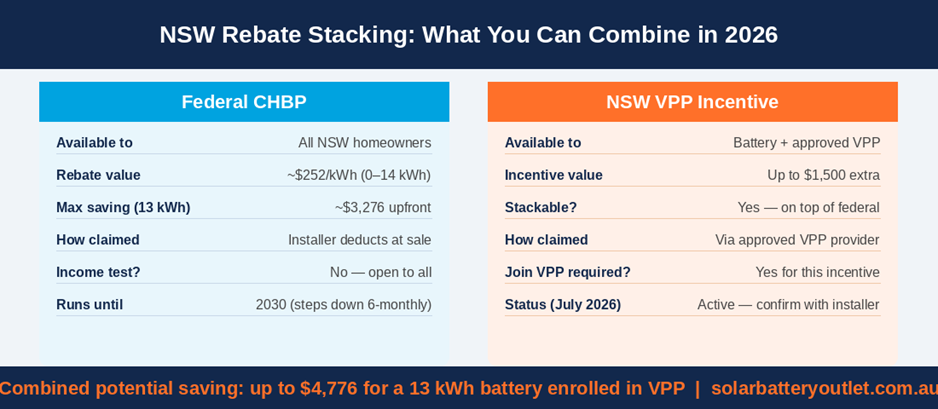
This is where NSW homeowners have a real advantage over other states. The federal Cheaper Home Batteries Program can stack with the NSW VPP incentive—meaning you can access two sources of financial support from a single battery installation.

NSW rebate stacking 2026 — combining the federal Cheaper Home Batteries Program with the NSW VPP incentive

From 1 July 2025, the NSW Government increased the VPP incentive to up to $1,500 for households that connect their battery to an approved Virtual Power Plant. The exact amount depends on your battery size. Notably, this stacks cleanly on top of the federal rebate.

For a 13 kWh battery, the combined saving could therefore reach approximately $4,776—before you account for any ongoing electricity bill reductions from self-consumption. Homeowners looking at solar panel Liverpool, Bankstown, and surrounding suburbs should ask their installer specifically about VPP-approved providers in their area, since not all brands qualify.

How Much Will a Battery Actually Save You in NSW?

The rebate reduces your upfront cost. However, your ongoing savings depend on how you use the battery. Consider a typical NSW family with a 6.6 kW solar system that currently exports most of their midday generation at 5 cents per kWh.

After adding a 13 kWh battery — with the federal rebate reducing the net cost to roughly $7,000–$8,500 installed — they start storing that midday solar for evening use instead. At a grid price of 35 cents per kWh, storing 10 kWh per day saves approximately $1,277 per year in grid purchases. Add VPP income of $300–$1,000 per year, and the payback period moves to around 5–7 years.

If you want help sizing a battery correctly for your usage, a good installer—whether you’re looking for the best solar battery installer in western Sydney or anywhere else across NSW—will review three months of electricity bills before recommending a size. Bigger is not always better under the new tiered structure.

What to Watch Out for When Getting Quotes

The surge in battery installations has unfortunately attracted some poor-quality operators. Moreover, the ACCC and NSW Fair Trading have issued warnings about high-pressure solar battery sales tactics. Here is what to look out for.

  • The rebate should appear as a separate line item on every written quote. If it doesn’t, ask for it explicitly.
  • Installers must be accredited by Solar Accreditation Australia. Ask for their SAA number before you proceed.
  • Door-to-door and cold-call pressure to sign on the same day is a red flag. Under Australian Consumer Law, you have the right to a 10-business-day cooling-off period for unsolicited contracts.
  • Get at least three written quotes before committing. Price differences of $2,000 or more for the same battery are common in the NSW market.
  • Confirm the battery model appears on the CEC-approved products list before signing. An ineligible product means no rebate.

Frequently Asked Questions

Does the Cheaper Home Batteries Program apply to existing solar systems?

Yes. The program supports both new installations and batteries added to existing solar systems. This is one of the most frequently misunderstood aspects of the scheme.

Is there an income limit to access the rebate?

No. The Cheaper Home Batteries Program has no income or means test. Every eligible NSW household can access the discount regardless of income level.

Will the rebate run out before 2030?

The government expanded funding to $7.2 billion in December 2025 specifically to avoid the program running out early. At current installation rates, the program is expected to remain funded through to 2030. However, the per-kWh value steps down every six months, so earlier installation delivers a higher discount.

Can I get the rebate without joining a VPP?

Yes. Your battery must be VPP-capable, but you are not required to actually join a virtual power plant to receive the federal rebate. Joining a VPP is optional — though it unlocks the additional NSW VPP incentive of up to $1,500.

Is there a solar battery rebate specific to Bankstown or western Sydney?

There is no suburb-specific rebate. However, the federal program applies equally across all of NSW. Homeowners looking for solar battery options in Bankstown or across the greater western Sydney region can access the same federal CHBP discount as the rest of the state. The NSW VPP incentive is also available statewide.

Disclaimer: The rebate values, savings estimates, battery sizes, STC factors, and electricity prices in this article are illustrative only and not a guarantee of future performance. Actual outcomes vary by location, usage, tariff, battery configuration, and eligibility. Program details are subject to change. Please seek personalised advice from a qualified installer before purchasing.

If you installed solar panels three, five, or even eight years ago, you have a new opportunity. Feed-in tariffs in NSW have fallen to 4–7 cents per kWh. However, grid electricity still costs 31–43 cents per kWh. A battery stores excess solar energy generated during the day. You can then use that stored power in the evening. This helps reduce electricity costs when grid prices are highest.

The good news is that yes, most existing solar systems in NSW can accept a battery addition—and the federal Cheaper Home Batteries Program now covers around 30% of the upfront cost. This guide walks you through exactly how it works, what it costs, how long payback takes, and what questions to ask your installer before you sign anything.

Yes, You Can Retrofit a Battery—Here Is How It Works

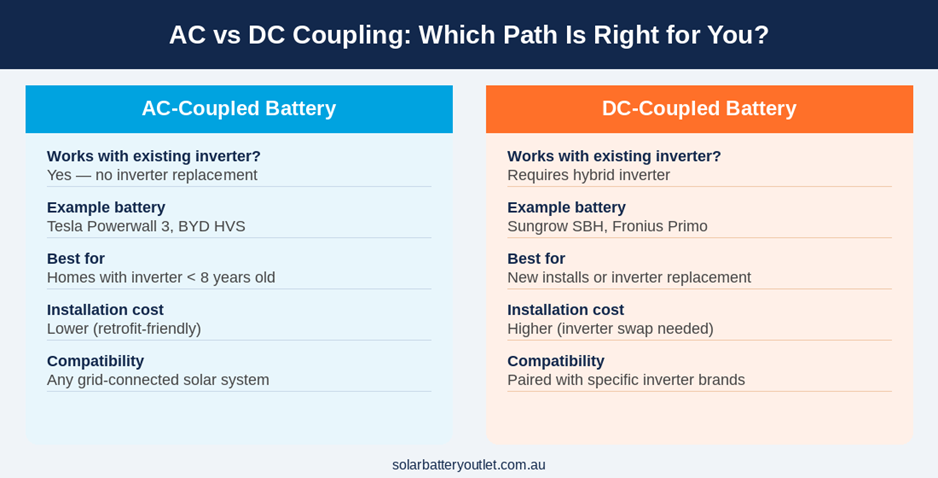
The most important thing to understand is the concept of coupling type. When you add a battery to an existing solar system, you choose between two technical paths: AC-coupled or DC-coupled. Each has different cost implications and compatibility requirements.

AC-coupled batteries connect on the AC side of your switchboard. They include their own built-in inverter and work with virtually any existing grid-connected solar setup—regardless of the brand or age of your current solar inverter. This is the most common retrofit path for NSW homeowners and keeps installation costs lower because you do not need to replace your solar inverter.

DC-coupled batteries connect through a hybrid inverter that manages both the solar panels and the battery as a unified system. They deliver slightly higher efficiency but require a compatible hybrid inverter. In most retrofit situations, this means replacing your existing solar inverter, which adds several thousand dollars to the project.

AC vs DC Coupling Comparison—Choosing the right retrofit path for NSW homeowners

For most homeowners doing a solar system upgrade in NSW, AC coupling is the simpler and more cost-effective choice. A qualified installer will assess your switchboard, existing inverter, and roof wiring before recommending which path makes sense for your home.

The Federal Battery Rebate Makes This More Affordable Than Ever

Since July 2025, the Australian Government’s Cheaper Home Batteries Program has delivered an upfront discount of around 30% on eligible home batteries. The rebate runs through to 2030, but it steps down every six months—so waiting has a real cost.

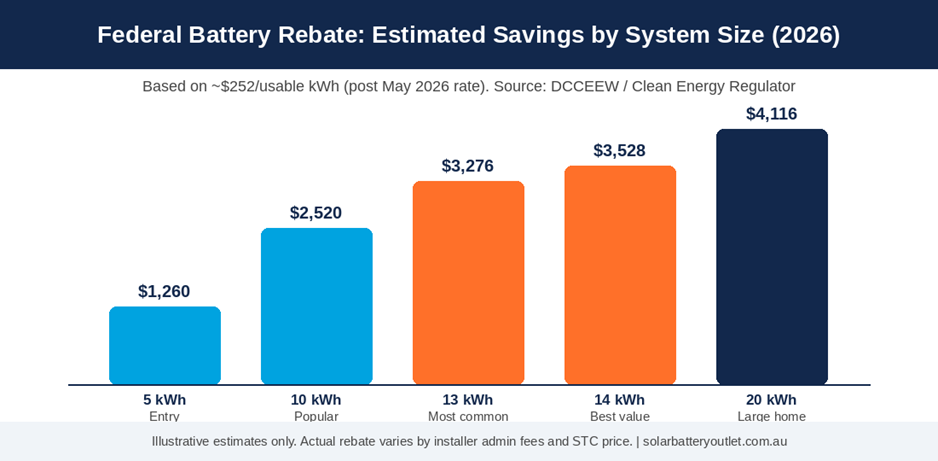
The rebate works through Small-scale Technology Certificates (STCs). Your installer applies the discount directly on your invoice, meaning you never have to claim anything back. As of mid-2026, the rebate is worth approximately $252 per usable kWh for the first 14 kWh of storage. For a 13 kWh battery—one of the most popular sizes for NSW households—the saving comes to around $3,276 upfront.

Federal Battery Rebate estimated savings by system size, 2026
NSW-Specific Note: VPP Incentive The NSW Government ended its direct battery rebate in June 2025, but it significantly expanded the Virtual Power Plant (VPP) incentive from 1 July 2025. NSW homeowners who install a battery and connect it to an approved VPP program can stack the federal rebate with additional NSW VPP payments. Ask your installer whether your chosen battery model qualifies.

What Battery Size Do You Actually Need in NSW?

Battery sizing depends on three things: how much power your household consumes in the evening, how much your existing solar system generates during the day, and whether you want backup power during blackouts.

A typical NSW family uses 25–30 kWh of electricity per day. A 10–14 kWh battery usually covers most evening energy demand. A larger battery may suit homes with an EV, higher electricity use, or a need for backup power during extended outages.

If you are looking for a solar battery installer in Western Sydney, ask for a bill analysis first. This applies whether you live in Liverpool, Bankstown, or nearby suburbs. A bill analysis helps determine the right battery size. A well-matched battery often delivers better savings than an oversized battery that stays partly unused.

The key practical tip: bigger is not always better. The federal rebate also tapers for batteries above 14 kWh of usable capacity, so right-sizing your battery around that threshold often delivers the best combination of coverage and rebate value under the current rules.

How Long Until a Battery Pays for Itself in NSW?

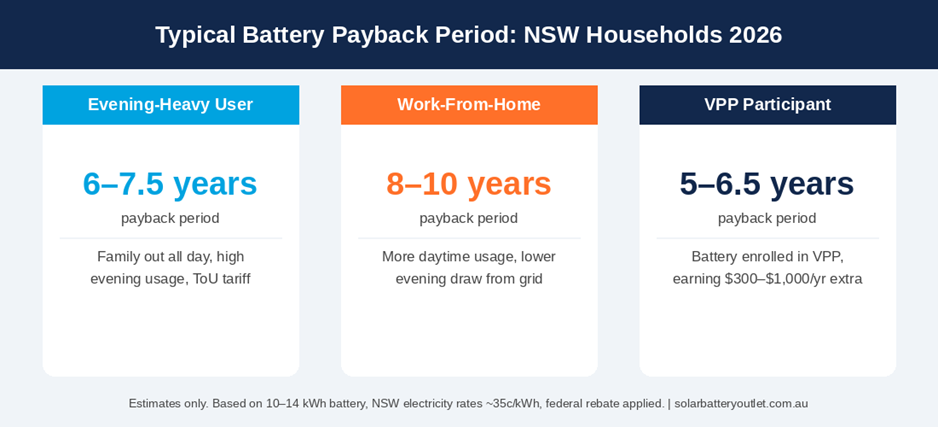
The honest answer depends on your usage pattern, your tariff structure, and whether you participate in a VPP. But based on current NSW electricity prices and the federal rebate in place, here are realistic estimates for three common household profiles.

Typical battery payback period for NSW households in 2026

According to the Australian Energy Regulator, NSW grid electricity now costs between 31 and 43 cents per kWh, depending on your retailer and plan. A 13 kWh battery cycling fully 300 days per year avoids roughly 3,900 kWh of grid purchases annually — worth around $1,365 in savings at 35 cents per kWh. Add VPP income of $300–$1,000 per year, and the numbers start to shift meaningfully in your favor.

4 Questions to Answer Before You Call an Installer

Before you book a consultation, work through these practical questions. The answers will help you have a better conversation and avoid the most common mistakes NSW homeowners make when adding storage.

  • 1. What is my evening electricity consumption? Check your most recent bill and look for usage after 5pm if your retailer provides that breakdown.
  • 2. How old is my solar inverter? AC-coupled batteries work with virtually any inverter. But if yours is over 10 years old, it may be worth discussing replacement at the same time.
  • 3. Do I want blackout protection? Not all batteries provide backup power during a grid outage by default. If blackout protection matters to you, confirm this at the quote stage — it can change both the equipment and the price.
  • 4. Am I willing to join a VPP? NSW homeowners can access the state VPP incentive by enrolling their battery in an approved program. You retain control of a reserve level for your home and earn bill credits on top.

What This Looks Like for a Real NSW Household

Consider a family in Bankstown with a 6.6 kW solar system installed in 2019. Their inverter is in good working order, and their evening usage averages around 14 kWh per day. Feed-in tariff payments bring in roughly $180 per year, while their nightly grid purchases cost them over $1,500 annually.

They added a 13.5 kWh battery through AC coupling, so no inverter replacement was needed. The battery now covers most evening electricity demand using stored solar energy. The federal rebate reduces the installed cost to about $7,000–$8,500. VPP income of around $500 per year further improves the return. The estimated payback period is 6 to 7 years. If you are comparing solar battery options in Bankstown or nearby suburbs, ask for this type of bill analysis with every installation quote.

The solar system upgrade they completed in 2019 did not need any changes. The battery connected via AC coupling and started cycling the same week it was commissioned.

Frequently Asked Questions

Can I add a battery to any solar system in NSW?

In most cases, yes. AC-coupled batteries are compatible with virtually all existing grid-connected solar systems regardless of inverter brand. DC-coupled batteries require a hybrid inverter. Your installer will assess compatibility during the quote stage.

Will my solar panels still work if I add a battery?

Absolutely. Adding a battery does not change how your solar panels generate power. The battery simply stores excess generation that would otherwise be exported to the grid at a low feed-in tariff rate, so you can use it in the evening instead.

Does adding a battery qualify for the federal rebate?

Yes — the Cheaper Home Batteries Program applies to batteries added to existing solar systems as long as the system meets eligibility requirements. The battery must be between 5 and 100 kWh nominal capacity, installed by an SAA-accredited installer, and be VPP-capable for grid-connected systems.

How do I find the best solar battery installer in NSW?

Look for installers accredited by Solar Accreditation Australia (SAA). Get at least three written quotes. A good installer will review your electricity bills, assess your existing system, and recommend a battery size based on your actual usage pattern — not just a standard package.

Does a solar battery work during a blackout?

It depends on the battery and how it is configured. Many batteries include a backup mode that isolates your home from the grid during an outage. You must specify this requirement before installation, as it can affect both the equipment choice and the wiring. Not all standard installations include blackout protection by default.

Disclaimer: The generation figures, savings estimates (including $208–$238/quarter and $900–$1,100/year), battery backup durations, payback periods, and rebate amounts mentioned in this article are illustrative examples based on a hypothetical NSW household and are not a guarantee of actual results. The Cheaper Home Batteries Program and NSW Peak Demand Reduction Scheme are subject to eligibility criteria and may change without notice. Actual outcomes vary based on your location, usage, tariff, system size, and weather conditions. Please seek personalised advice before making a purchasing decision.
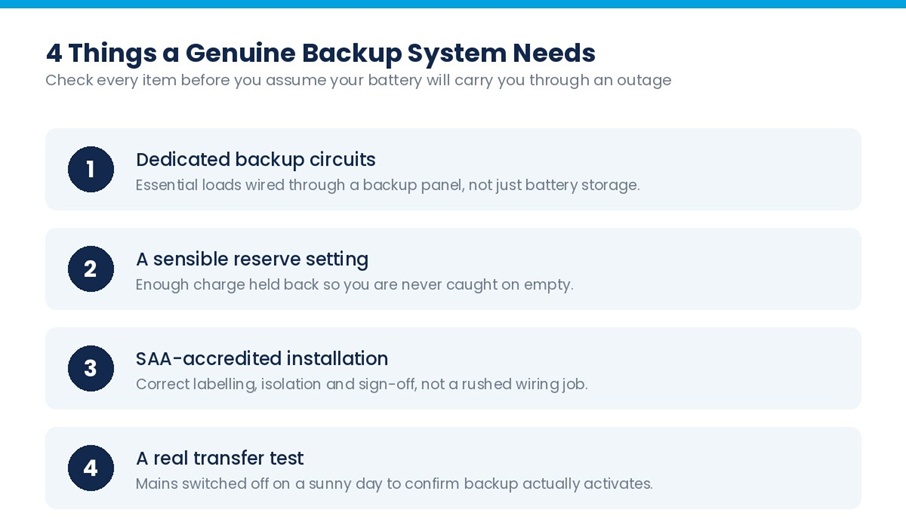
If you’ve ever heard someone say solar batteries are useless in winter, this article is for you. It’s one of the most common misconceptions in Australian solar circles—and it’s costing homeowners real money.

The short answer is: yes, a solar battery still helps in winter. But the ‘how much’ depends on your home, your usage, and how well you configure your system. This guide gives you the full picture—including real data, illustrative savings examples, a 5-step optimisation framework, and honest caveats.

What Actually Happens to Solar in the Australian Winter?

First, let’s separate myth from fact. Solar panels in Australia do not stop working in winter. They produce less energy — but not by as much as many people assume.

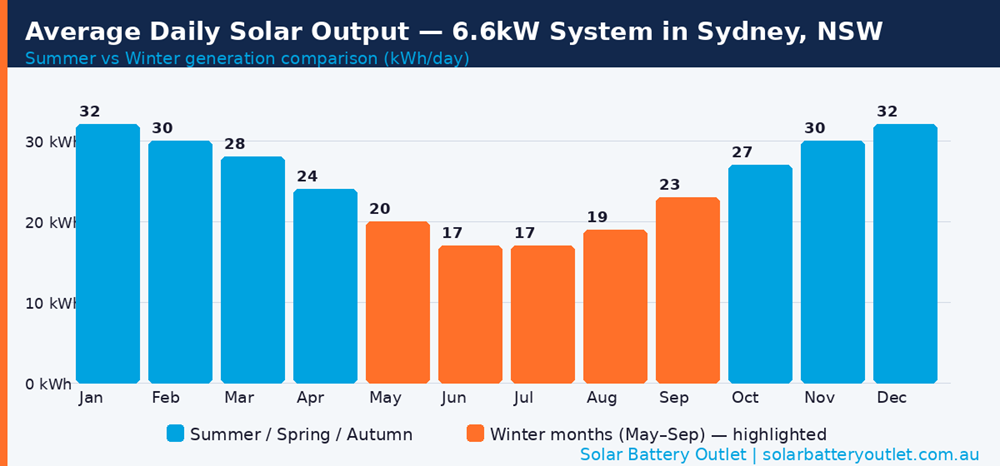
According to BrightFuture Energy’s seasonal performance data, a 6.6kW rooftop system in Sydney can generate around 26 kWh on a sunny summer day, while mid-winter days typically yield 16–20 kWh—roughly 60–70% of summer output. That’s still a meaningful amount of energy.

Average daily solar output 6.6kW system Sydney NSW winter vs summer monthly comparison chart

The dip happens for three main reasons. First, days are shorter — the solar production window in NSW narrows from roughly 10 am–4 pm in summer to 11 am–2 pm in June. Second, the sun sits lower in the sky, reducing the angle of incidence on your panels. Third, cloud cover increases, though overcast days in NSW still allow panels to generate at 10–40% capacity.

Here’s the key insight most people miss: cool temperatures actually improve panel efficiency. Solar panels lose roughly 0.3–0.5% efficiency per degree above 25°C. So while your system generates fewer kWh in winter due to fewer daylight hours, each kWh it does generate is produced at slightly better conversion efficiency than on a scorching 38°C summer afternoon.

The Real Question: What Does a Battery Actually Do in Winter?

A solar battery doesn’t generate electricity — it stores it. This distinction is critical when thinking about winter performance. Your panels still collect energy during the day (just a bit less of it). Your battery stores that energy and releases it in the evening, when the sun has gone down and your heating, lighting, and appliances kick in.

In winter, this storage function becomes more valuable, not less. Here’s why: Australian winters bring higher evening electricity demand (heating, longer nights, cooking earlier) paired with higher peak electricity prices. In NSW, peak grid rates run at 30–36 cents per kWh during evening shoulder and peak periods.

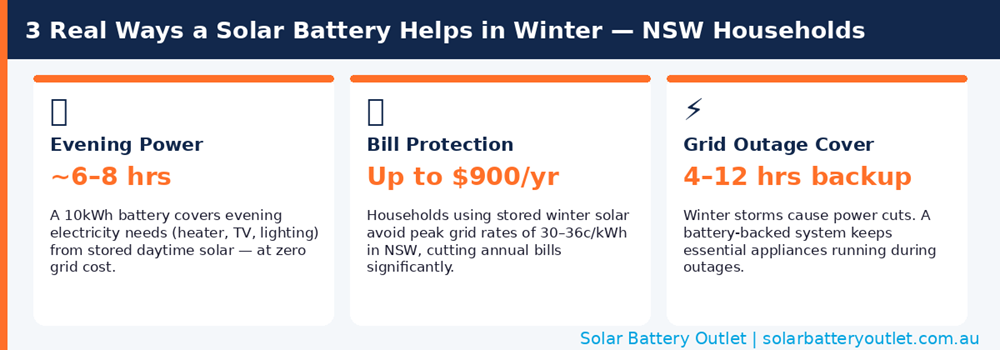
Three ways solar battery helps in Australian winter — evening power, bill savings, backup cover NSW

Real Example: A Sydney Family in Bankstown

Take a family of four in Solar Battery Bankstown. They use around 22 kWh per day in winter — more than the summer average of 18 kWh due to electric heating. Their 10kWh battery (a BYD HVS or Tesla Powerwall 3) charges to around 7–8 kWh on a typical winter day, covering their 5 pm–10 pm peak usage almost entirely. Instead of paying 33c/kWh from the grid, they use stored solar at effectively zero marginal cost.

Over a winter quarter (90 days), that’s roughly 630–720 kWh of avoided grid electricity — worth $208–$238 in bill savings from winter alone. Scale that across the full year with summer performance included, and the total saving potential reaches $900–$1,100 per year for a well-sized battery setup. These are illustrative estimates — actual outcomes depend on your tariff, usage pattern, and system configuration.

Where Batteries Shine in Winter — and Where They Fall Short

Battery Adds the Most Winter Value

  • Evening heating loads: If you run reverse-cycle air conditioning or an electric heat pump for heating, the battery covers this load without touching grid electricity.
  • Grid outage protection: Winter storms in NSW, particularly in areas like Liverpool, Bankstown, and Mudgee, cause power cuts. A battery-backed system keeps essentials running for 4–12 hours depending on capacity.
  • Time-of-Use tariff arbitrage: Households on TOU tariffs benefit enormously. The battery charges during cheap off-peak periods (or from solar) and discharges during 5–9 pm peak pricing — saving 20–30c/kWh on every kWh discharged.
  • Virtual Power Plant (VPP) earnings: NSW’s Peak Demand Reduction Scheme pays connected households up to $106 per quarter for sharing stored energy during grid stress events — which happen more frequently in winter cold snaps.

Winter Does Limit Battery Performance

  • Smaller charge window: With only 3–4 peak solar hours in June–July (vs 6–7 in summer), a large 20kWh+ battery may not reach full charge on overcast winter days.
  • Sequential cloudy days: Extended cloudy periods (3+ days) can exhaust battery reserves and force a switch to grid power — though this is uncommon in most of NSW.
  • Oversized batteries in small homes: A 13.5kWh battery in a home that only uses 14kWh per day will cycle less efficiently in winter when charge input drops.
Pro Tip from Solar Battery Outlet: In winter, we recommend setting your battery’s target charge window to 10 am–2 pm — the narrower NSW solar peak. This simple setting adjustment can recover 15–20% more usable charge on winter days compared to default system settings.

Solar Battery ROI in Winter: The Numbers NSW Homeowners Need

One of the most common questions from NSW homeowners is: does the ROI calculation change in winter? The answer is: not significantly — and here’s why.

Your battery’s ROI is calculated over its full 10–15 year lifespan. Winter months contribute proportionally less solar income but proportionally more grid bill savings (because evening usage and peak prices are higher). These effects partially cancel each other out. The overall annual saving figure remains robust even with winter’s reduced generation.

The best solar batteries Australia-wide — including the Tesla Powerwall 3, BYD HVS, and Sungrow SBH — all maintain winter charging efficiency above 95%, meaning virtually no energy is lost in the charge/discharge cycle even in cold temperatures. Lithium iron phosphate (LFP) chemistry, used by BYD and Sungrow, actually performs better in cooler temperatures than in summer heat.

The Cheaper Home Batteries Program (launched July 2025) provides approximately a 30% upfront rebate on eligible battery systems, reducing a typical 10kWh battery installation from ~$10,000–$11,000 to around $7,000–$8,000 after rebate. This significantly improves winter-adjusted payback periods across all NSW regions.

The 5-Step Winter Battery Optimisation Framework

If you already have a solar battery installed — or you’re about to have one installed by the best solar battery installer in your area — use this framework to maximise your winter output.

Step 1 — Set your charge window: Program your inverter (or battery management app) to prioritise charging between 10 am–2 pm. This is NSW’s winter solar peak and delivers the most kWh in the shortest window. Most modern batteries — Tesla, BYD, Sungrow — allow this via their smartphone apps.

Step 2 — Adjust your reserve percentage: In summer, a 10–15% battery reserve is standard. In winter, lift this to 20–30% to ensure you have buffer power for cold early mornings and potential overnight outages. This setting takes 60 seconds to change.

Step 3 — Switch to a Time-of-Use tariff: If you’re still on a flat-rate tariff, winter is the time to change. Retailers like Amber Electric, AGL’s EV plan, or Origin’s solar tariff offer structured peak/off-peak pricing. Your battery discharg during the 5–9 pm peak at 30–36c/kWh represents your biggest single saving lever.

Step 4 — Join a NSW Virtual Power Plant: The NSW Peak Demand Reduction Scheme pays you up to $106/quarter for connecting your battery to a VPP and sharing stored energy during demand events. Winter cold snaps are prime VPP activation windows. You stay in control — the VPP takes a small, brief amount of stored energy during events.

Step 5 — Book a pre-winter panel inspection: A dirty or partially shaded panel can reduce your winter output by 5–10% — amplifying the seasonal dip. Book a solar panel cleaning and health check before May each year. This is especially important in areas like Bankstown and Mudgee, where dust and bird activity are common.

Who Benefits Most From a Battery in Winter? A Quick Diagnostic

Not every NSW household gets the same winter value from a battery. Use these four profile questions to gauge your likely benefit:

  • Evening-heavy household: If 60%+ of your electricity use happens after 4 pm, you will see strong winter battery savings regardless of generation dip. Shift workers, families with kids, and work-from-home households that heat and cook in the evening all fall into this category.
  • Electric heating users: If you rely on reverse-cycle air conditioning or a heat pump for winter heating, your 5–9 pm load is substantial. A 10kWh+ battery can cover this load almost entirely from stored solar on most NSW winter days.
  • Homes with existing solar (5kW+): Larger solar systems generate more in winter, giving the battery more to work with. If you have a 6.6kW+ system, a battery is a natural complement even through June–August.
  • Homes on poor feed-in tariffs: NSW feed-in tariffs fell to around 5c/kWh in 2024–25 per ABS data. Exporting surplus winter solar earns almost nothing. Storing it in a battery instead is worth 6x more (30c vs 5c per kWh).

The National Picture: Why Australians Are Installing Batteries Year-Round

The scale of Australia’s battery adoption in 2025–26 makes clear that winter concerns aren’t stopping the market. The Clean Energy Council reported a record 183,245 batteries sold in Australia in H2 2025 alone — more than the previous four years combined. NSW alone logged 15,418 battery installations between July and August 2025, according to the Clean Energy Regulator. Australians installed batteries in their droves through winter — because they understand the year-round value proposition.

Average installed battery size in NSW has reached 19.6 kWh, reflecting consumers sizing systems to handle both winter shortfall and summer surplus. Joining a VPP earns an additional $106 per quarter on average according to the Clean Energy Council, helping offset any winter generation dip through direct payments.

Frequently Asked Questions
Does a solar battery charge at all on a cold, overcast winter day in NSW?

Yes — it charges, just at a reduced rate. Overcast days in NSW still allow solar panels to generate at 10–40% of peak capacity, depending on cloud density. On a typical cloudy winter day in Sydney, a 6.6kW system might generate 6–10 kWh rather than 17–20 kWh. A 10kWh battery would reach 60–100% charge on most winter days in NSW. Extended overcast periods of 3+ consecutive days are uncommon across most of the state.

Will a solar battery power my reverse-cycle heating at night in winter?

This depends on your battery capacity and your heater’s power draw. A reverse-cycle air conditioner in heating mode typically draws 1–3 kW. A 10kWh battery at 90% usable capacity can run a 2kW heater for approximately 4.5 hours — covering the 5 pm–9 pm evening peak. For larger homes using higher-output heating, a 13.5kWh+ battery provides more comfortable headroom.

Is a solar battery worth installing before or during winter in NSW?

Installing before winter is generally a sound strategy — you’ll capture the June–August storage savings from the moment installation is complete. The Cheaper Home Batteries Program federal rebate applies regardless of installation season. Speak to a qualified installer who will review your system’s performance data to confirm sizing. Homeowners in the Solar Battery Bankstown area and surrounding suburbs can contact Solar Battery Outlet for a no-obligation winter assessment.

Do the best solar batteries Australia offers perform differently in winter?

Modern lithium iron phosphate (LFP) batteries — including the BYD HVS, Sungrow SBH, and Tesla Powerwall 3 — maintain round-trip efficiency above 95% across a wide temperature range, including Australian winter conditions (typically 5–18°C in NSW). Unlike some older lithium-ion chemistries, LFP batteries do not significantly degrade in cold weather. The main winter variable is solar generation input, not battery chemistry performance.

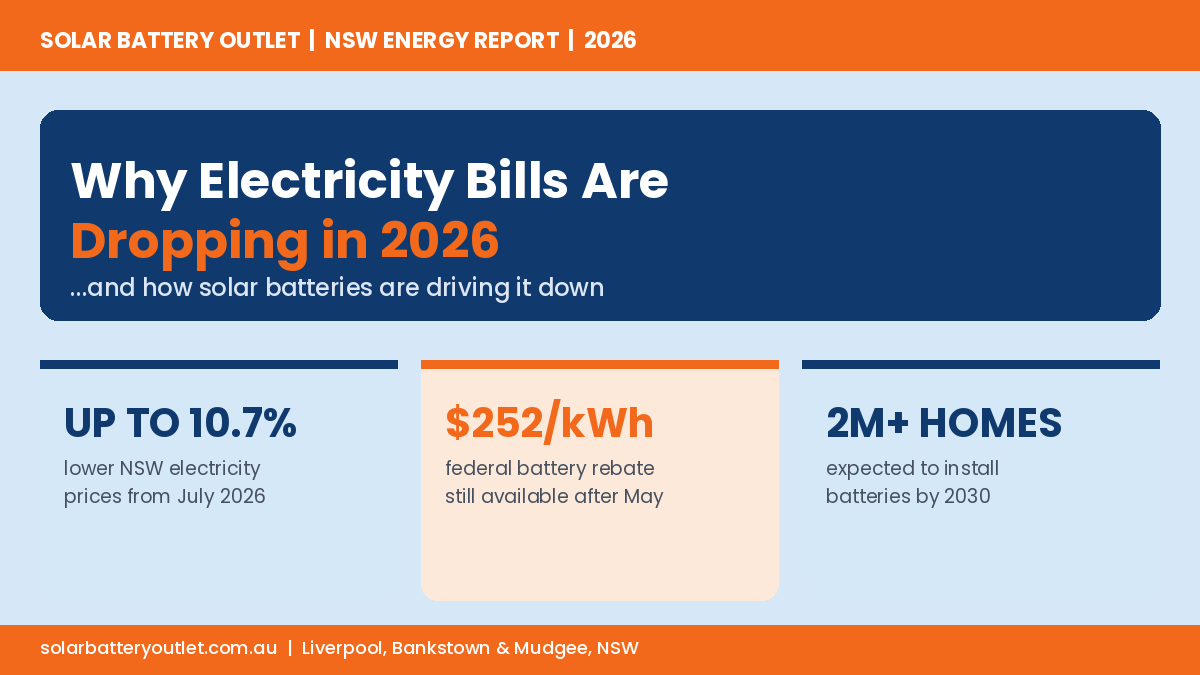
For the first time in years, NSW households are opening their electricity bills and seeing a number that has actually gone down. From 1 July 2026, the Australian Energy Regulator confirmed price cuts of up to 10.7 percent on standard offers across New South Wales, with similar falls in South East Queensland. After several years of steep increases, this is welcome news — and it is not happening by accident.

Behind this shift sits one technology more than any other: the home solar battery. As hundreds of thousands of batteries plug into the grid each year, they soak up cheap daytime solar power and release it during expensive evening peaks. This reduces strain on the network, lowers wholesale prices, and ultimately flows through to everyone’s bill—whether or not they own a battery themselves.

In this guide, we will break down exactly why electricity prices are falling in 2026, what role solar batteries play in that shift, the real numbers behind NSW pricing changes, and how homeowners considering solar batteries NSW can position themselves to benefit from both falling grid prices and remaining rebates.

The 2026 Turning Point: Electricity Prices Are Finally Falling

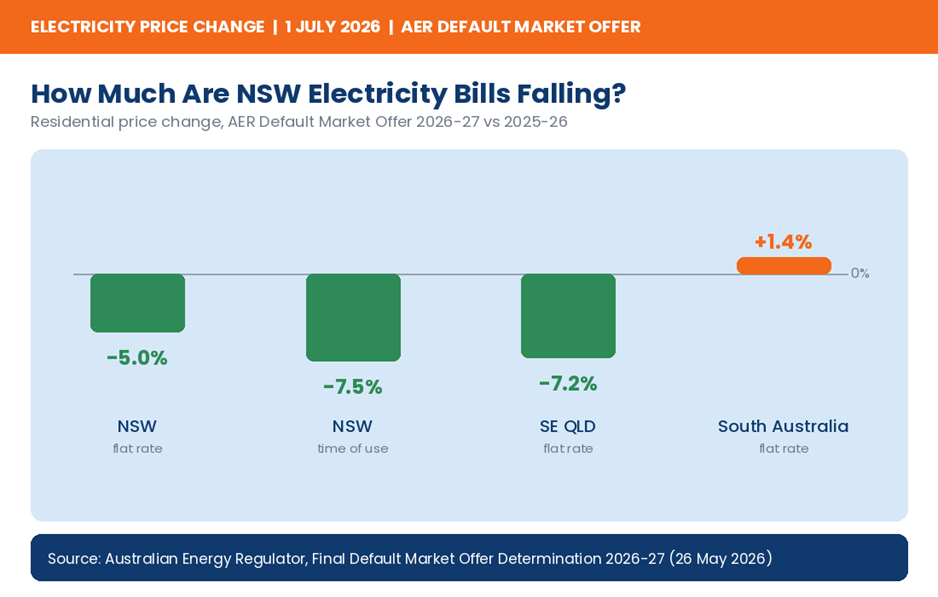
For most of the past five years, Australian households have braced for annual price increases. That trend reversed in 2026. The Australian Energy Regulator’s final Default Market Offer determination for 2026–27, released in late May 2026, confirmed that residential flat-rate prices in NSW will fall between 3.4 and 5.0 percent from 1 July, while time-of-use customers in NSW could save up to 7.5 percent. South East Queensland recorded the largest single drop at 7.2 percent, while South Australia was the only region to see a small increase of 1.4 percent.

The regulator pointed to three drivers behind the fall: lower wholesale electricity contract prices, reduced spot price volatility, and a meaningful increase in output from wind and battery generation during the evening peak. Put simply, when batteries—both household and grid-scale—release stored solar power exactly when demand spikes, expensive gas generators are needed less often, and wholesale prices come down for everyone.

NSW and SE QLD residential price changes, AER DMO 2026-27

How Solar Batteries Are Reshaping the Grid — And the Price You Pay

One in three Australian homes already has solar panels, but historically, only a small fraction had a battery to store that energy. That is changing fast. The federal Cheaper Home Batteries Program has already supported around 250,000 home battery installations since its launch, and the expanded budget — now $7.2 billion over four years — is expected to bring more than two million Australians into battery ownership by 2030, adding roughly 40 gigawatt hours of storage to the grid.

Why does this matter for prices? During the day, rooftop solar floods the grid with cheap power, sometimes pushing wholesale prices toward zero or even negative. In the evening, demand spikes just as solar generation drops off, traditionally forcing the grid to rely on costly gas peaking plants. Home batteries break this pattern. They store the midday surplus and discharge it during the evening peak, smoothing out the daily price curve. Industry analysts now describe this shift plainly: it is renewables, firmed by batteries, that increasingly set the price of power, not gas.

For households running a solar battery Liverpool installation or anywhere across Southwest Sydney, this means two things at once: your own bill drops because you are using stored solar instead of buying grid power at peak rates, and the broader grid becomes more stable because fewer homes are drawing power simultaneously during the 5 pm to 9 pm crunch.

What This Means for Your Household Savings

For a typical NSW household, three separate savings streams are now stacking together, and understanding each one helps you see the full financial picture rather than focusing on a single rebate figure.

1. Automatic bill reductions from 1 July 2026. Even households without a battery will see lower default electricity rates simply because the AER has reset the benchmark pricing downward.

2. The federal battery rebate. From 1 May 2026, the Cheaper Home Batteries Program discount sits at roughly $252 per usable kilowatt-hour for most standard batteries, applied as an upfront price reduction on your installation quote — no separate claim required.

3. The NSW VPP incentive. The NSW Peak Demand Reduction Scheme adds up to $1,500 on top for households that connect their battery to a virtual power Plant — a separate state-level incentive that runs independently of the federal rebate.

Three stacking savings sources for NSW solar battery households in 2026

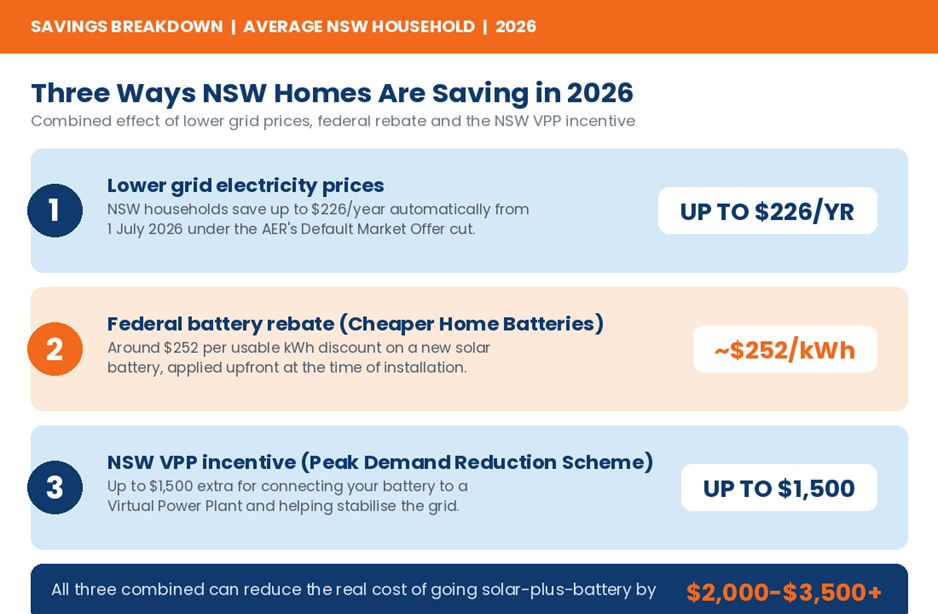
Combined, these three elements can cut the upfront cost of a solar battery system by around $2,000 to $3,500 for an average NSW household. This estimate does not include the ongoing savings from using stored solar energy instead of grid electricity at night. If you’re deciding whether to install now or wait for future rebate changes, compare these potential savings with your electricity bills before making a decision.

Real-World Example: A Liverpool Household Switching to Solar-Plus-Battery

Consider a household in Liverpool, NSW, with a 6.6kW solar system and a quarterly electricity bill of about $450. After installing a 10kWh battery, the home can reduce evening grid usage significantly. Instead of sourcing 60% to 70% of evening power from the grid, it may draw less than 15%, with the battery supplying energy for cooking, lighting, and household appliances.

Layer on the falling NSW default market. Offer rates from July 2026, and the household benefits twice over: the electricity they still buy from the grid costs less per kilowatt-hour than it did a year earlier, and they are buying far less of it overall. For households exploring options through a solar battery Liverpool installer, this combination—falling grid rates plus a battery that minimises grid reliance — is exactly the scenario the 2026 policy settings were designed to encourage.

Why This Trend Is Likely to Continue Beyond 2026

Three long-term trends suggest prices will continue to fall. First, the federal battery rebate remains available until 2030. This will support battery adoption, even as the rebate gradually decreases every six months. Second, regulators and network operators are introducing new tariffs to ease grid demand. One example is the Solar Sharer Offer, which provides three hours of free electricity during the middle of the day.

Third, battery costs continue to decline as global manufacturing expands. This improves the economics of home energy storage, even without government incentives. Together, these trends are creating a grid that relies more on distributed batteries and less on gas generation. As a result, households with battery storage are likely to see the greatest benefits.

A Simple Framework: Should You Add a Battery Now?

Rather than reacting to deadline pressure, walk through these four checks before deciding on timing.

  1. Check your evening usage. If most of your electricity use happens after 5 pm, a battery has the most to work with.
  2. Confirm your solar system’s health. A battery only stores what your panels generate, so an underperforming system should be assessed first.
  3. Compare written quotes. Get at least three quotes that show the federal rebate as a dollar deduction, not a verbal promise.
  4. Ask about VPP eligibility. Confirm your installer will register your system for the NSW VPP incentive at installation.
Why are NSW electricity prices falling in 2026 after years of increases?

The Australian Energy Regulator’s 2026–27 Default Market Offer reflects lower wholesale electricity costs, reduced price volatility, and higher output from wind and battery generation during peak periods. Together, these factors have lowered the benchmark used to calculate household electricity bills.

Do I need a solar battery to benefit from the lower electricity prices?

No. The Default Market Offer price reduction applies to all households, regardless of battery ownership. Battery owners can save even more by using stored energy during evening peak periods. This reduces the amount of electricity they need to buy from the grid.

Is the federal battery rebate still worth claiming after May 2026?

Yes. The rebate is available until 2030 and currently provides around $252 per usable kilowatt-hour. The value decreases every six months, so applying sooner can secure a higher discount. However, it will continue to offer significant upfront savings beyond 2026.

How much can a home battery realistically save on an NSW electricity bill?

Savings vary based on battery size and evening energy use. However, households that rely on stored solar power for most of their evening consumption can cut grid electricity usage by 50% to 80%. These savings come in addition to the lower electricity rates introduced in July 2026.

Sources & Data References

If you are a NSW homeowner with solar panels, you have almost certainly asked this question: Should you install a battery now, or wait another year for prices to fall? It sounds like a simple cost-benefit decision. In reality, the answer involves several moving parts—hardware trends, government rebates, import costs, and your household’s own usage pattern.

This article cuts through the noise. It draws on data from CSIRO’s GenCost report. It also uses BloombergNEF’s 2025 Energy Storage Outlook and the Australian Government’s updated Cheaper Home Batteries Program. Together, these sources show where battery prices are heading. They also explain what that means for your timing decision.
Home battery storage costs 2026 Australia – decision guide for NSW homeowners

What Has Happened to Battery Prices So Far?

The short version is that prices have fallen dramatically over the past five years. According to BloombergNEF, lithium battery costs declined by more than 40% between 2020 and 2025 globally. In Australia specifically, CSIRO’s GenCost 2025–26 draft report confirmed residential battery storage costs dropped 11 to 16% in 2024–25 alone. Furthermore, an even steeper 40% drop was recorded from 2023 to 2024.

To put that into dollar terms: the average installed cost of a 10 kWh residential battery in Australia currently sits at around $8,650 after the federal rebate, compared to well over $12,000 just three years ago. For homeowners researching the best home batteries Australia has to offer, this downward trend is genuinely significant.

Solar battery price per kWh Australia 2021 to 2026 trend chart

So Will Costs Drop Further in 2026?

Yes — but the picture is more nuanced than a simple ‘wait and save more’ conclusion.

On the hardware side, the outlook is positive. BloombergNEF expects lithium battery pack prices to fall by 8–12% through late 2026. Expanding manufacturing capacity is a key reason. Increased use of lithium iron phosphate (LFP) batteries is also helping. Supply chains have become more stable since 2024. CSIRO projects battery storage costs of $484 per kWh by 2030. That is down from $525 per kWh in 2025.

However, two factors are pushing back against those hardware savings for Australian buyers in 2026.

Factor 1: The Chinese Export VAT Change

In April 2026, China reduced its VAT rebate on battery exports from 9% to 6%. That 3-percentage-point cut increases the cost of imported battery components by roughly 3%, and industry analysts expect it to flow through to Australian installed prices within one to two months. The same rebate is scheduled for complete removal in January 2027, which could add a further 6% at the import stage.

For small- to mid-size batteries (5–10 kWh), the projected decline in hardware costs should offset this. For larger systems above 14 kWh, the combination of tiered rebates and higher import costs means the net price direction is less favorable than the headline hardware trend suggests.

Factor 2: The Rebate Steps Down — And Keeps Stepping

This is the factor most homeowners underestimate. The federal Cheaper Home Batteries Program is not ending — it runs to 2030, with the total program funding expanded to an estimated $7.2 billion. However, from 1 May 2026, the rebate structure changed in two important ways.

First, the STC factor dropped from 8.4 to 6.8. For a standard 10 kWh battery, that translates to approximately $530 less rebate. For batteries above 14 kWh, the new tiered structure means the reduction is considerably larger — between $1,000 and $1,800 or more, depending on size.

Second, and this is the part fewer people are talking about: from May 2026 onward, rebate values step down every six months rather than annually. That means the rebate is structurally programmed to shrink twice per year from this point forward.

The practical takeaway is clear: even if hardware costs fall 8% in the next 12 months, a homeowner who waits may find that the rebate reduction over the same period cancels out — or exceeds — those hardware savings.

Should I buy a home battery now or wait – decision guide 2026

The Numbers: What a NSW Homeowner Can Expect to Pay in 2026

Below is a realistic snapshot of what NSW homeowners are paying for installed battery systems in June 2026, post-rebate. These figures are drawn from current market data and exclude switchboard upgrades or additional backup wiring.

The Decision Framework: Should You Buy Now or Wait?

Rather than giving a one-size-fits-all answer, the most useful thing this article can do is give you a structured way to assess your own situation. Work through the following checkpoints honestly.

Decision guide for NSW homeowners considering home battery storage in 2026

Act Before the Next Rebate Step-Down If:

  • You have already obtained three or more written quotes and are ready to proceed.
  • Your planned battery is 10 kWh or larger, where the tiered rebate reduction has the most financial impact.
  • Your household uses the majority of its power in the evenings, after solar generation stops.
  • Your existing solar system is under ten years old and generating reliably.
  • You plan to enrol in a Virtual Power Plant (VPP) — NSW VPP incentives can add up to $1,500 on top of the standard rebate.

Take Your Time If:

  • You are still researching brands, sizes, or installers and have not yet compared quotes.
  • Your battery plan is under 5 kWh, where the hardware cost decline is likely to outpace the rebate reduction over the short term.
  • Your solar system is more than ten years old and may need servicing or replacement before adding storage makes sense.
  • Your daytime electricity usage is high — meaning you may already be consuming much of your solar output directly.

One important point worth emphasising: installers in NSW report that booking calendars filled rapidly ahead of the May 2026 rebate change. If you are considering a mid-2026 installation, getting onto a waiting list sooner rather than later is practical advice regardless of your timing decision.
What about solar battery NSW Markets?

For homeowners in south-western Sydney and areas like Liverpool, Bankstown, and Campbelltown, the same national pricing dynamics apply. However, there are a few local factors worth noting.

First, installation costs in Greater Sydney tend to be slightly higher than in regional NSW due to labour rates and parking/access considerations. This makes the upfront rebate value proportionally more significant for metro homeowners, since you are starting from a higher baseline cost.

Second, feed-in tariffs in the Ausgrid and Endeavour Energy network areas are now as low as 4–6 cents per kWh for excess solar exports. That gap between what you earn from exporting (4–6c) and what you pay to buy power back at night (30–35c) is exactly the economic case for solar battery Liverpool homeowners—and it is growing rather than shrinking.

If you are on a time-of-use tariff in NSW, a well-sized home battery storage system can shift almost all of your expensive peak consumption to free solar energy, making the payback calculation considerably more favorable than the headline figures suggest.

A Real-World Example: The Mathers Family, Penrith

To make the numbers concrete, consider a typical four-person household in western Sydney. They have a 6.6 kW solar system installed in 2021, pay approximately $2,400 per year in electricity bills despite having solar, and use most of their power between 5 pm and 10 pm.

Battery installed (10 kWh, mid-2026): The upfront cost is approximately $8,500 after rebate. Annual bill savings estimated at $1,100–$1,400 based on current Ausgrid tariff rates. Payback period: approximately 6–7 years. VPP enrolment could reduce payback to 5 years.

If they wait until 2027, Hardware cost savings of roughly $400–$600. Rebate reduction of approximately $400 (next step-down). Chinese VAT removal adds ~$300 to import costs. Net position: roughly similar or slightly worse out-of-pocket, plus 12 more months of high evening bills ($1,200+ missed savings).

The maths does not always favor waiting—especially once you factor in the electricity savings you forgo during the waiting period.

What the Experts Are Saying About Prices to 2030

CSIRO’s GenCost 2025–26 draft report is the most authoritative domestic source on battery cost trajectories. Its findings confirm that battery technologies continue to show significant double-digit cost reductions, while noting that large-scale solar has seen its first price rise in three years.

For residential storage specifically, CSIRO projects two-hour battery storage capital costs will reach $484 per kWh by 2030 under a current-policies scenario—down from $525 per kWh in 2025. In a faster-decarbonisation scenario, costs could fall to $358 per kWh by 2050.

BloombergNEF’s 2025 Energy Storage Outlook adds global context: average battery pack prices are expected to approach $80 per kWh at the pack level by 2026, roughly half of what they were in 2023. That said, pack-level costs do not translate directly to Australian installed residential prices, which include inverter hardware, installation labour, certifications, and grid connection charges.

What to Do Next

You have done the reading. Now it is time to do the numbers for your specific home.

Will home battery storage costs continue to fall through 2026?

Yes, but modestly. Hardware costs are projected to decline 8–12% year-on-year. However, the rebate step-downs and Chinese VAT changes partially offset those savings for Australian buyers. Small batteries (5–10 kWh) remain the sweet spot where hardware declines outpace rebate reductions.

How much does a 10 kWh battery cost in NSW right now?

As of June 2026, the average installed cost for a 10 kWh residential battery in NSW sits between $8,000 and $10,000 after the federal rebate. The exact figure depends on brand, installer, and whether any additional work (switchboard upgrade, backup wiring) is needed.

Is the federal battery rebate ending soon?

No. The Cheaper Home Batteries Program runs until 2030, backed by $7.2 billion in expanded funding. However, the rebate amount steps down every six months from May 2026. It does not end — but it does keep getting smaller, which means earlier installations attract a larger discount.

What are the best home batteries Australia currently recommends?

The most commonly recommended brands by NSW installers in 2026 are the Tesla Powerwall 3, Sungrow SBR, BYD Battery-Box, and Alpha ESS Smile-5. Each suits different budgets and system sizes. The best choice depends on your inverter compatibility, backup requirements, and long-term warranty support.

Does a battery make sense if I already use most of my solar during the day?

In that case, the financial return is lower than for households that shift a significant load to the evening. However, a battery can still provide value through VPP enrollment, blackout protection, and bill stability as grid electricity prices continue to rise. The honest answer: get a quote and review your usage profile with a qualified installer before deciding.

What is a virtual power plant, and how does it affect payback?

A Virtual Power Plant (VPP) connects your battery to a network of other home batteries, allowing the operator to dispatch small amounts of energy during grid demand peaks. In return, you receive bill credits or annual payments typically ranging from $200 to $600. In NSW, the government also offers a separate VPP incentive of up to $1,500 on eligible systems, which can reduce your payback period by 12–18 months.

If you are shopping for a solar battery in NSW, the most common question is also the most important one: what size do you actually need? Buying too small means your battery fills up early and you still pay peak rates for evening electricity. Buying too large means you spend thousands more upfront — and a portion of that battery capacity sits idle every day.

This guide breaks down the three most common residential battery sizes — 10 kWh, 13 kWh, and 20 kWh — and shows you exactly which one suits which household. We cover real costs, rebate entitlements, annual savings, and payback periods for NSW homeowners in 2026.

First, understand what battery capacity actually means.

Battery capacity is measured in kilowatt-hours (kWh). One kWh is roughly what a typical split-system air conditioner uses in 30 minutes, or what a fridge uses in about 7 hours. Therefore, a 10 kWh battery holds ten times that amount of stored energy.

However, the number on the box is not always the number you can use. Most batteries have a usable capacity of 90–100% of their rated storage — this is called the depth of discharge (DoD). For example, a BYD Battery-Box 10 kWh has 100% usable capacity, while some older models only allowed 80%.

When comparing quotes, always ask about usable capacity — not just the headline figure.

How Much Power Does a NSW Home Use Each Evening?

To size a battery correctly, you need to know how much electricity your household draws after sunset — typically from around 4 pm to 10 pm. This is the window when electricity costs the most in NSW, particularly if you are on a time-of-use tariff.

Here is how NSW households break down by daily evening usage:

  • 1–2 person household: 7–12 kWh per day total, with roughly 5–8 kWh used after 4 pm
  • 3–4 person household: 15–22 kWh per day total, with 8–14 kWh used after 4 pm
  • 4–6 person household with EV or pool: 25 kWh+ per day, with 14–20 kWh after 4 pm

The goal is to match your battery’s usable capacity to your evening demand. A battery that runs out by 8 pm is undersized. A battery that still has 60% charge remaining at midnight is oversized for your situation.

Battery Size Comparison: 10 kWh vs 13 kWh vs 20 kWh

Solar battery size comparison table NSW

The table above summarises the key numbers. However, the figures are estimates based on typical NSW installations — your actual quote will depend on your solar system, switchboard condition, and installer. Always get three written quotes before committing.

For detailed information on government rules affecting your installation, the new 2026 installation requirements for NSW homeowners cover what has changed and what your installer must comply with.

The 10 kWh Battery: Who Is It Best For?

A 10 kWh battery is the entry-level option for most NSW homeowners — and for the right household, it is also the most cost-effective. At a net cost of roughly $6,500–$7,500 after the 2026 federal rebate, it delivers a solid payback without the larger upfront investment.

This size suits you well if:

  • Your household has 1–2 people, or 3 people who are home and using power during the day
  • Your total daily electricity use is under 15 kWh
  • You already have a 5–6.6 kW solar system
  • Your main goal is to reduce your evening electricity bill, not full energy independence
  • You are on a standard tariff rather than a time-of-use plan with high peak rates

The 10 kWh category includes popular models such as the BYD Battery-Box 10 kWh and various Sungrow and Growatt options. These batteries are widely available, well-supported, and CEC-approved — which matters if you want to access the federal rebate and the NSW VPP incentive.

One important consideration: if you plan to add an electric vehicle within the next few years, a 10 kWh battery will likely feel undersized. Charging an EV overnight typically adds 8–15 kWh of demand on its own.

The 13 kWh Battery: The NSW Sweet Spot

For most NSW families, the 13–13.5 kWh range is the practical sweet spot. This is the size tier where the federal rebate provides the most benefit relative to capacity, where annual savings are substantial, and where the payback period remains manageable.

The Tesla Powerwall 3 (13.5 kWh) sits squarely in this category and remains the most popular single-unit residential battery in NSW. The BYD Battery-Box 13.8 kWh is a strong alternative, offering a slightly larger capacity at a competitive price point.

This size suits you well if:

  • Your household has 3–4 people with typical appliance use
  • Your daily electricity consumption is between 15–25 kWh
  • You have a 6.6–10 kW solar system
  • You run the dishwasher, washing machine, and AC during peak evening hours
  • You want a comfortable energy buffer without a premium price

At a net cost of approximately $7,500–$9,500 after rebates, the 13 kWh option offers annual savings of $1,100–$1,600 for a typical NSW family — giving a payback period of around 6–8 years. That is a strong result by any measure.

It is also worth noting that the 13 kWh size tier falls within the most favourable portion of the federal Cheaper Home Batteries Program rebate structure. For specifics on which batteries qualify for the 2026 federal rebate in NSW, including eligible brands and models, check the full eligibility list.

Matching Battery Size to Your Household: A Quick Reference

Decision guide — which solar battery size suits your NSW household, 10kWh, 13kWh or 20kWh

The decision guide above makes the size decision straightforward. Furthermore, keep in mind that the right battery size is not just about your current usage — it is about where your household is heading over the next 3–5 years.

If you are planning to switch to an electric vehicle, install an induction cooktop, or add more occupants to the house, factor that future demand into your decision now. Upgrading a battery system later involves additional labour and potential equipment costs.

The 20 kWh Battery: When Bigger Makes Sense

A 20 kWh battery is not for everyone — and that is by design. However, for a specific type of NSW homeowner, it is genuinely the right call rather than an oversized purchase.

This size suits you well if:

  • Your household has 4–6 people with high appliance usage
  • You own or plan to own an electric vehicle
  • You have a pool, home office, or other high-draw equipment
  • Blackout protection and energy independence are a priority
  • You have a 10–13 kW solar system that generates surplus power daily

The 20 kWh tier typically requires either two battery units stacked together (for example, two BYD 10 kWh batteries) or a single large-format unit designed for residential or light commercial use. Installation costs are proportionally higher, and the switchboard may need upgrading depending on your home’s existing electrical capacity.

Moreover, from 1 May 2026, the federal rebate structure introduced tiered support — which means larger batteries above 14 kWh attract a smaller proportional subsidy than before. Consequently, the relative financial case for a 20 kWh battery is slightly less favourable than it was pre-May. That said, if your household genuinely needs the capacity, the payback still stacks up.

Solar battery payback period by size NSW 2026 — 10kWh, 13kWh, 20kWh estimated years to payback

As the chart shows, all three sizes deliver a reasonable payback period in NSW — typically 6 to 9 years. The exact figure depends on your electricity tariff, your evening usage pattern, and whether you participate in the NSW Virtual Power Plant (VPP) incentive through the Peak Demand Reduction Scheme.

Importantly, VPP participation adds $300–$1,000+ in annual earnings on top of your bill savings. For solar batteries NSW-wide, that additional income can shave 1–2 years off the payback period. Ask your installer whether the battery they are recommending is VPP-compatible.

What Affects Your Battery’s Actual Performance in NSW?

Choosing the right size is only part of the equation. Even with the perfect capacity, your battery will underperform if the following factors are not in order.

Your solar system’s output

A battery only charges from excess solar production. If your panels are aged, shaded, or undersized, they will not generate enough surplus to fill the battery each day. Before adding storage, ask your installer to assess your current solar system’s performance. The

Before adding storage, ask your installer to assess your current solar system. The CER registration rules for NSW solar panel installers explain the credentials your installer must hold for the installation to qualify for rebates.

Your tariff type

On a flat tariff, a battery saves you the difference between what you would have paid for grid electricity and what it cost to generate solar. On a time-of-use tariff — which many NSW households are now on — the savings are larger, because you avoid paying 45–55 cents per kWh during peak evening hours. The higher your peak rate, the faster your battery pays back.

Installation quality

A properly installed battery on a compatible solar system outperforms a poorly installed one regardless of size. Wiring standards matter — the battery wiring standard in Australia sets out what a compliant installation must include. Make sure your installer follows AS/NZS 3000 and the relevant clean energy installer requirements.

Rebates Available in NSW in 2026: What You Can Stack

NSW homeowners in 2026 can access two separate incentives — and they stack together, which makes a significant difference to the net cost.

  • Federal Cheaper Home Batteries Program (CHBP): Approximately $302–$372 per kWh of usable capacity, applied as an upfront discount at the point of installation. For a 10 kWh battery, this is roughly $3,100–$3,700. For a 13 kWh battery, roughly $4,200–$4,800.
  • NSW Peak Demand Reduction Scheme (PDRS) VPP Incentive: Up to $1,500 when you connect your battery to an approved Virtual Power Plant. The exact amount depends on your battery size. You must use an Accredited Certificate Provider.

Combined, these two incentives can reduce your net cost by $4,000–$5,500 on a typical 10–13 kWh system. That is a meaningful contribution to payback, and it is available right now regardless of when you install — as long as you use a CEC-accredited installer and an eligible battery.

Quick Checklist: Before You Choose a Battery Size

Before you sign anything, work through these five checks. They take 10 minutes and will save you from buying the wrong size.

  • Check your last 12 months of electricity bills. Look at your total daily usage and identify how much you draw after 4 pm. Your retailer’s app or your smart meter data will show this.
  • Find out what solar system you have. Note the total panel capacity (kW) and the inverter size. A 5 kW inverter may not support a 20 kWh battery without an upgrade.
  • Ask whether your switchboard needs upgrading. Some older NSW homes need a switchboard upgrade before a battery can be safely added. This adds $500–$1,500 to the project cost and should appear on your written quote.
  • Confirm the battery is CEC-approved and VPP-capable. Both are required to access the federal rebate and the NSW PDRS incentive, respectively.
  • Get three written quotes. Size recommendations vary between installers. If one quote recommends a 10 kWh system and another recommends 20 kWh for the same home, ask both to justify the recommendation with your actual usage data.

Frequently Asked Questions

Is a 10 kWh battery enough to run a typical NSW home overnight?

It depends on your evening usage. A 10 kWh battery is sufficient for a 1–2 person household or a family that uses most of its power during the day. For a 3–4 person family running AC, the dishwasher, and the TV from 4 pm onwards, 10 kWh will often run out before midnight. In that case, 13 kWh is a safer choice.

Does the federal rebate cover the full cost difference between a 10 kWh and 13 kWh battery?

Not entirely. The rebate is calculated per kWh of usable capacity — so a 13 kWh battery attracts a larger absolute rebate than a 10 kWh battery. However, the total installed cost of the 13 kWh system is also higher. The net cost difference between the two is typically $1,000–$2,500 after rebates.

Can I install two 10 kWh batteries instead of one 20 kWh unit?

Yes. Many NSW homeowners choose to install one 10 kWh or 13 kWh battery initially, then add a second unit later as demand grows. However, adding a second battery in a future installation involves additional labour costs compared to installing both at once. If you know your usage is high, installing the full capacity upfront is usually the better financial decision.

How does my solar panel size affect which battery I should choose?

Your solar panels charge your battery. A 5 kW solar system in NSW typically generates 18–22 kWh on a good day. After powering daytime loads, it might produce 8–12 kWh of surplus available to charge a battery. Therefore, installing a 20 kWh battery on a 5 kW solar system means the battery will rarely be fully charged, which reduces your annual savings and stretches the payback period.

Do all battery sizes qualify for the NSW VPP incentive?

The PDRS VPP incentive applies to batteries connected to an approved Virtual Power Plant provider. The incentive value scales with battery size, with larger systems receiving up to $1,500. However, the battery must be VPP-capable (able to discharge to the grid on demand) — not all models support this. Ask your installer specifically about VPP compatibility before purchasing.

If you run a small business, manage a commercial property, or operate from a home office, you have probably wondered whether a solar battery can reduce your tax bill. The short answer—backed by ATO guidance and confirmed by the 2026-27 Federal Budget — is yes. A solar battery can be tax-deductible for Australian small businesses, and the rules in 2026 are more favourable than they have ever been.

This guide cuts through the noise. No jargon, no sales pitch. Just a clear walkthrough of how the deduction works, who qualifies, what you can claim, and what mistakes to avoid.

What Does Tax Deductible Actually Mean Here?

When we say a solar battery is “tax deductible” for a business, we mean you can reduce the taxable income your business reports to the ATO by the cost of the battery — either in full (if the asset qualifies for the Instant Asset Write-Off) or gradually over time (through depreciation).

This is not the same as a rebate. The federal battery rebate (under the Cheaper Home Batteries Program) reduces your upfront purchase price. A tax deduction reduces the income you pay tax on. They are separate benefits, and eligible businesses can access both.

Example: How the two incentives stack up for a small business

How the two incentives stack up for a small business

The Instant Asset Write-Off: Your Main Vehicle in 2025-26

The Instant Asset Write-Off (IAWO) is the primary mechanism most small businesses will use to claim a solar battery deduction. It allows you to claim the full cost of the asset in the year it is installed and ready for use — rather than depreciating it over 20 years.

Who qualifies for solar battery tax deduction Australia 2026

Who is eligible?

To use the instant asset write-off for a solar battery in 2025-26, your business must:

  • Have an aggregated annual turnover of less than $10 million
  • Have the battery installed and ready for use between 1 July 2025 and 30 June 2026 (for FY2025-26 claims)
  • Use the battery wholly or primarily for business purposes
  • Claim the GST-exclusive cost (if your business is GST registered)

What is the threshold?

For FY2025-26, the threshold is $20,000 per asset (excluding GST). If your solar battery costs less than $20,000 after the federal rebate, you can write it off immediately. The threshold applies per asset — you can write off multiple assets in the same financial year, each under $20,000.

What If the Battery Costs More Than $20,000?

Larger commercial battery systems — particularly those paired with rooftop solar installation for warehouses, offices, or multi-unit residential properties — may exceed the $20,000 threshold. In that case, the asset goes into the small business general depreciation pool.

YearDepreciation RateOn a $28,000 BatteryCumulative Claimed
Year 115%$4,200$4,200
Year 230%$7,140$11,340
Year 330%$5,004$16,344
Year 430%$3,503$19,847
Year 530%$2,452$22,299

Note: The 15% first-year rate and 30% subsequent-year rate apply under the simplified small business depreciation pool. The ATO has assigned solar systems an effective life of 20 years, but the simplified pool rules allow faster write-down. Always verify with your registered tax agent.

Three Business Types That Can Claim—and How

1. Sole Traders and Small Business Owners

If you run a registered business — a cafe, trade business, retail shop, professional practice, or any other commercial enterprise — and you install a solar battery at your business premises, the ATO treats the battery as a depreciating business asset. You can claim the full cost under the Instant Asset Write-Off (if under $20,000 after rebate) in the year of installation.

If your business uses solar battery installation at premises that are also partly residential (e.g. a live-in shopfront), you need to apportion your claim to reflect only the business-use percentage.

2. Landlords and Commercial Property Owners

Landlords who install a solar battery on their own commercial or residential rental property can claim the cost as a depreciating asset — but only if the landlord purchases and installs the system, not the tenant. The ATO makes this distinction clearly.

For residential rental properties, the deduction is available only for the portion of the property used for income-producing purposes. A purely personal residence does not qualify. A property rented at arm’s length to tenants does qualify.

3. Home-Business Owners and Sole Traders Working Remotely

If you run your business from a dedicated area of your home—a home office, a workshop, a studio—you may be able to claim the business-use portion of your solar battery system. The ATO confirmed in guidance to industry media that a solar system can be claimed under the $20,000 Instant Asset Write-Off when it is bought and used by an eligible small business to generate electricity for business use.

The key requirement: you must make a genuine and defensible apportionment. If 40% of your home’s electricity is used for business, you may be able to claim 40% of the battery cost. Document this carefully — the ATO expects a reasonable basis for the split.

Solar battery tax savings chart Australian small business

Can You Claim Both the Rebate and the Tax Deduction?

Yes. The federal battery rebate (delivered through the STC scheme under the Cheaper Home Batteries Program) and the Instant Asset Write-Off tax deduction are entirely separate incentives. You can access both, and doing so is the correct and legal approach.

Here is how they interact: the rebate reduces the upfront cost at the point of sale. Your tax deduction is then based on the net cost you actually paid (i.e. after the rebate is applied). You do not claim a deduction on the full retail price — only on what your business actually spent out of pocket.

For businesses looking at the best solar batteries Australia has to offer—BYD, Tesla Powerwall 3, Sungrow, or Enphase—the combination of a rebate and a write-off makes the effective cost significantly lower than the sticker price suggests.

Key ATO Rules You Need to Know

The ATO is specific about what is required to make a valid claim. Getting this wrong means lost deductions or, worse, a disallowance and penalties. Here are the rules that matter most:

Rules that protect your claim ✔  Asset installed & ready for use in same FY
✔  Separate invoice for battery (not bundled)
✔  GST-exclusive amount claimed if GST registered
✔  Written record of business-use percentage
✔  Installer confirms battery operates independently
✔  Keep records for at least 5 years
 Mistakes that void your deduction
✔  Claiming in year deposit paid, not year installed
✔  Bundled solar + battery on one invoice
✔  Claiming 100% when property has personal use
✔  No documentation for business-use apportionment
✔  Claiming on full retail price including rebate
✔  Claiming on a purely personal residential property
ATO documentation checklist solar battery tax claim

What About the NSW VPP Incentive?

If your commercial property or home business is in NSW, you may also be eligible for the Peak Demand Reduction Scheme (PDRS)—commonly called the VPP incentive — worth up to $1,500 for connecting your battery to a Virtual Power Plant program. This is a state-level incentive administered separately from the federal rebate and is not affected by tax treatment.

The NSW VPP incentive is available to eligible premises regardless of whether the battery owner is a homeowner, landlord, or business operator. It continues to 2030. It does not affect your tax claim — it simply adds another layer of upfront saving.

The Verdict: Is It Worth It for Your Business in 2026?

Let’s be direct. If you are a small business owner, landlord, or home-business operator with taxable income, a solar battery in 2026 offers a combination of financial benefits that is unusually strong:

  • The federal battery rebate reduces your upfront cost by $1,000 to $1,800+ depending on battery size
  • The Instant Asset Write-Off — now permanent — lets you claim up to $20,000 immediately against your taxable income
  • The ongoing electricity savings from the battery reduce your operating costs for 10 to 15 years
  • If in NSW, the VPP incentive adds up to another $1,500 on top

The businesses that benefit most are those with:

  • A clear, documentable business use for the electricity stored in the battery
  • A registered ABN and annual turnover under $10 million
  • An accountant or registered tax agent who can structure the claim correctly
  • A net battery cost (after rebate) under $20,000 — putting them squarely in Instant Asset Write-Off territory

The businesses that should take more care are those with mixed-use properties where personal and business electricity are difficult to separate, or those with purely residential properties. In those cases, the claim is still possible, but it requires careful apportionment and solid documentation.

Important: This article is general information only and does not constitute tax advice. Tax rules can change, and your circumstances are unique. Always consult a registered tax agent or accountant before making a deduction claim. The ATO website (ato.gov.au) has the latest Instant Asset Write-Off guidance.
Frequently Asked Questions
Can I claim a solar battery and solar panels separately under the write-off?

Yes — if they are invoiced separately and each costs less than $20,000 (excluding GST), you can claim both individually. The $20,000 threshold is per asset, not per project. Ask your installer to issue separate invoices for the solar system and the battery if you want to maximise this.

Does the solar battery have to be used exclusively for business?

No. You claim only the business-use portion. If your battery powers a mix of personal and business consumption, apportion the claim accordingly. Document the basis of your apportionment — the ATO expects a reasonable, defensible methodology.

What if I finance the battery through a chattel mortgage or commercial loan?

You can still claim the Instant Asset Write-Off even if you finance the purchase — you do not need to pay cash upfront. Under a chattel mortgage, the asset is legally treated as yours from day one, so you can claim the full deduction in the year of installation, then repay the finance over time. Discuss this structure with your accountant and your lender.

Can I claim the deduction if the battery is installed during June but I haven’t received the invoice yet?

The deduction applies in the financial year the asset is installed and ready for use — not the year the invoice is issued or paid. If the battery is commissioned in June 2026, it counts as FY2025-26 regardless of invoice timing. Keep the installation certificate as documentation.

Does the permanent instant asset write-off mean I can wait until next year?

For tax purposes, the permanent extension means there is no urgency created by a sunset clause. However, the federal battery rebate does continue to reduce in value every six months (the STC rate adjusts). If reducing upfront cost is your priority, acting sooner rather than later on the rebate side still makes sense.

Data Sources and References

The information in this article is drawn from the following sources:

  • Australian Tax Office (ATO) — Instant Asset Write-Off guidance: ato.gov.au/businesses/depreciating-assets
  • Australian Government business.gov.au — 2026-27 Federal Budget small business summary: business.gov.au/news/budget-2026-27
  • SmartCompany — ‘$20,000 instant asset write-off to become permanent’, published May 2026
  • SolarQuotes Australia — ‘Federal Budget 2026: What It Means For Home Electrification’, published May 2026
  • Choice Energy Australia — ‘Solar Panels Tax Deduction for Businesses’ (AU-specific ATO interpretation): choiceenergy.com.au
  • AusPac Solar — ‘How to Maximise Tax Deductions on Your Business Solar System’: auspacsolar.com.au
  • Why Solar Australia — ‘Instant Asset Write-Off for Solar: Can Your Business Claim It in 2026?’: whysolar.com.au
  • Energy Matters Australia — ‘Can I Claim a Home Solar System on Tax?’: energymatters.com.au
  • Journey Finance Australia — ‘The $20,000 Write-Off Deadline Is 30 June 2026’: journeyfinance.com.au
  • NSW Government — Peak Demand Reduction Scheme (VPP incentive): energysaver.nsw.gov.au

Note: All figures in this article are estimates for general illustration only. Tax outcomes depend on individual business circumstances, applicable tax rates, business-use percentages, and asset costs. Always consult a registered Australian tax agent before making a deduction claim.

php